 I’m continually amazed how the efforts of random bloggers make my life as a writing instructor all the more easier.
For our second writing project we focus on the epistemological dimensions of different academic disciplines and how implicit expectations shape the scholarly writing in those fields. While students are quite familiar with different departments in the university, trying to explain why they are separated as they are can be challenging.
I use class time to discuss the basic framework of how scholars of different disciplines ask different types of questions about the world. Consequently, they must marshal different types of evidence to support their claims.
This is, as always, an exercise in raising awareness. I use a podcast (as homework) to explain the history of disciplinary divisions, stemming from the secularization of the German university system in the 19th century and “discovery” of the social sciences (political science, economics, sociology, anthropology, etc.).
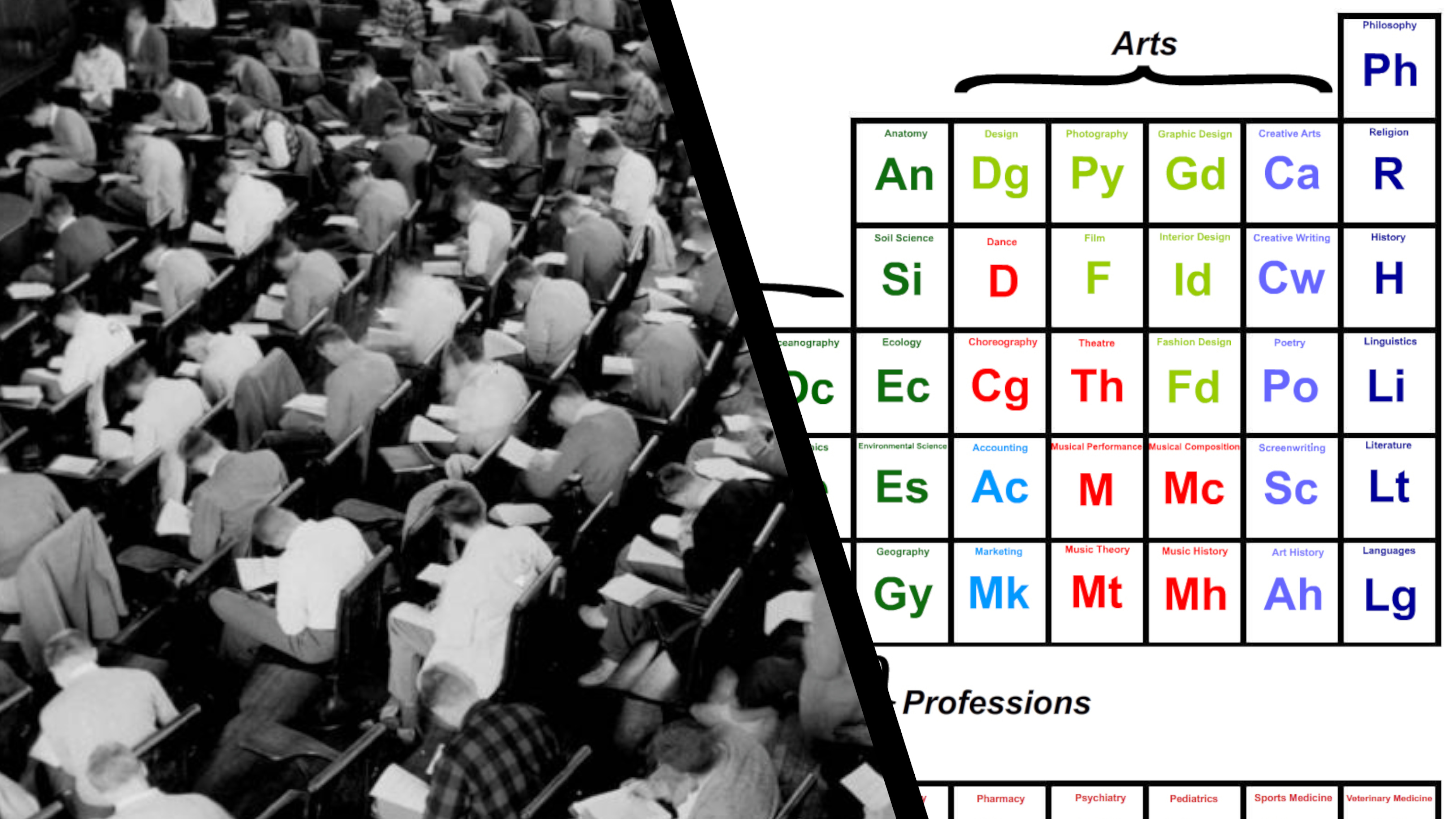
I charge the students with researching a topic and finding appropriate scholarly materials on that topic from different disciplines – both books and articles. They have to decide which discipline the work falls under, which can be harder than it seems, especially if you are not used to trying to differentiate those characteristics already. At some level, having a list of options makes the job easier, where Claudia’s blog helps exceptionally. She has made a chart, mirroring that of the Periodic Tables of Elements, with academic disciplines – even grouping them according to field.
My only criticism is that it does not represent some area studies, such as Women’s Studies, Black Studies, Chican@ Studies. etc. Also, Religious Studies is placed in the Humanities field (which is not inherently problematic), but does not make it clear that Religious Studies is a “raider” discipline – as is typical for other “areas studies”- pulling methodologies from various disciplines. This means a scholar of Religious Studies will approach their topics from the lens of history, sociology, psychology, cognitive science, etc. (There is no Humanities “methodology” per se). While one may have greater training in historical approaches, it is possible to take an inter-disciplinary approach as well, where several disciplinary approaches are intertwined.
Writing Skills Posts


 Personal Site of Peter Romaskiewicz
One thought on “Periodic Table of Academic Disciplines”