Introduction
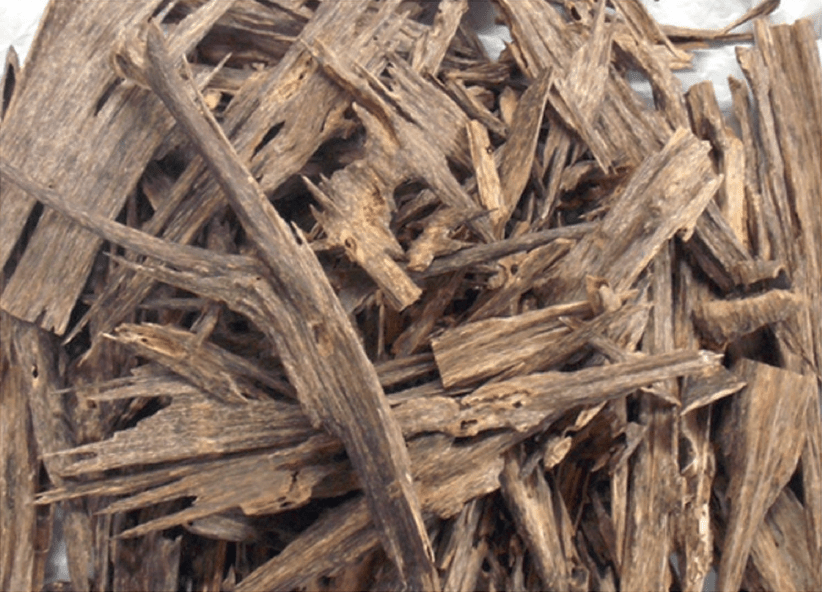
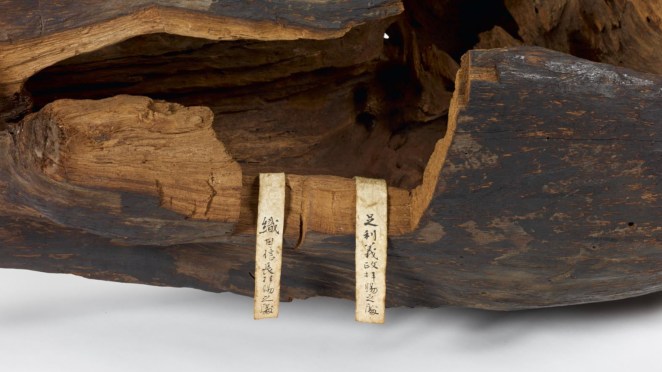
Aloeswood has long been considered among the premier perfuming and incense ingredients in East Asia, arguably similar to the historical importance of frankincense in West Asia and Europe. Aloeswood remains the costliest wood in the world and is known for it rich and complex scent profile. Notably, the creation of fragrant resin-infused aloeswood occurs only under specific conditions of stress upon the tree. Moreover, aloeswood forms unevenly within the tree’s wood fibers, thus harvested aloeswood pieces can be relatively small and irregular in shape. As a consequence, aloeswood pieces have been graded in terms of resin content, color, and scent quality since the early medieval period. The most densely resinous pieces of aloeswood will sink in water, a peculiar characteristic that gave rise to the medieval Chinese name, Sinking in Water Aromatic.
Facts and Features
- Medieval Chinese Name: Sinking in Water Aromatic (chenshui xiang 沈水香), Sinking Aromatic (chen xiang 沈香; J. jinkō) (among others, including names for different commercial grades)
- Common English Name: aloeswood, agarwood, gharuwood
- Botanical Origin: Resin-infused heartwood produced by several species in the Aquilaria genus (esp. A. malaccensis, A. crassna, A. sinensis)
- Phytogeographic Distribution: Northeast India into the Malay Peninsula, Indonesian Archipelago, Indochinese Peninsula, southern China, eastern Borneo, Philippines [approximate distribution* is shown in blue below]

- Harvesting Process: Darker colored fragrant aloeswood is cut away from the lighter colored, non-scented sapwood; this incurs considerable damage to the tree as its limbs are hewn off or the tree is felled and cut apart

- Earliest Chinese Citation: late 2nd century (translated Buddhist sutras: e.g. Daodi jing 道地經 [Yogācārabhūmi]); mid-to-late 3rd century (regional gazetteers: e.g. Treatise on Strange Things of the Southern Regions [Nanzhou yiwu zhi 南州異物志])
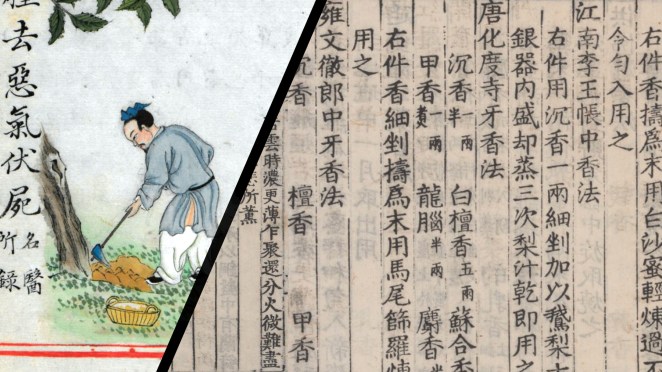
- Earliest Chinese Medicinal Use: 3rd/4th– late 5th century (Supplementary Record by Famous Physicians [Mingyi bielu 名醫別錄] and Collected Annotations on the Classic of Materia Medica of the Divine Husbandman [Shennong bencao jing jizhu 神農本草集注])
Comments: In early medieval China, aloeswood was known as an export of the Indochinese Peninsula, especially from what is now central and southern Vietnam. Aquilaria trees also grow in the southern Chinese tropics and I suggest it was as early as the mid-fifth century when domestic harvesting of aloeswood begins. China continued to received imports and tributes of aloeswood through the Tang and Song dynasties and supplemented with goods obtained from native trees in the far south.
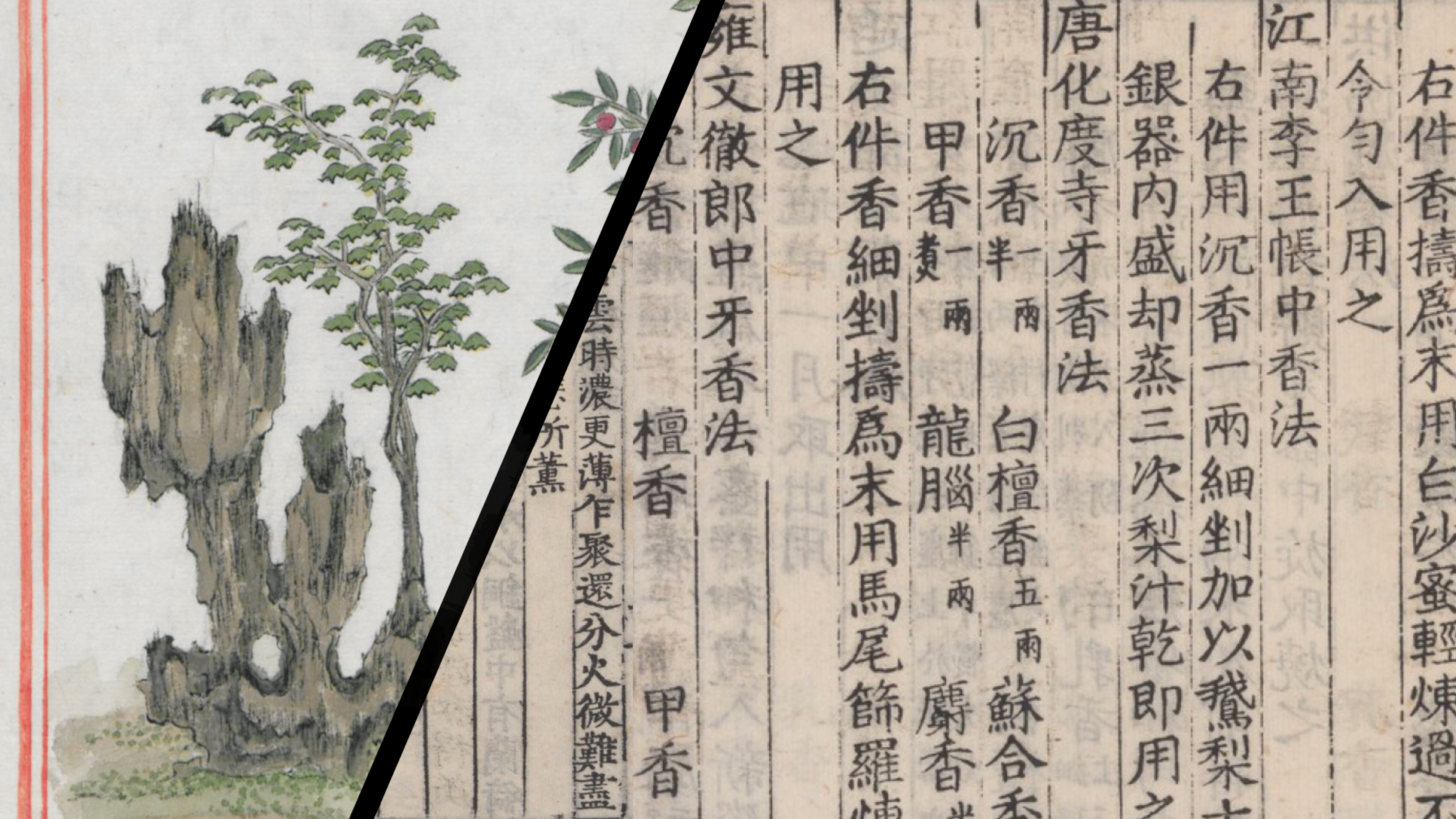
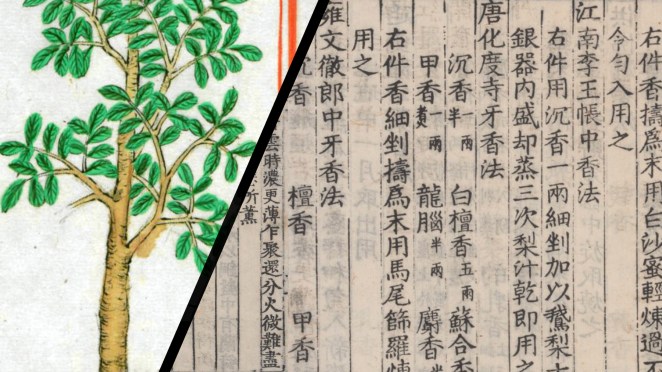
If we look at the Classified Essentials of Materia Medica (Bencao pinhui jingyao 本草品彙精要) from 1503, we see two illustrations of aloeswood, one labelled (on the right) as being from Yazhou 崖州, present day Sanya on southern Hainan Island, and the other labelled (on the left) Guangya 廣州, the present day region around Guangzhou. By the late medieval period aloeswood from Hainan was considered superior to the continental variety. It is worth noting at the outset that this pair of illustrations depict two very different types of tree. The illustration on the right shows a fruiting tree with simple (unlobed) ovate leaves, while the illustration on the left show a smaller tree or sapling with distinctive tri-lobed leaves.
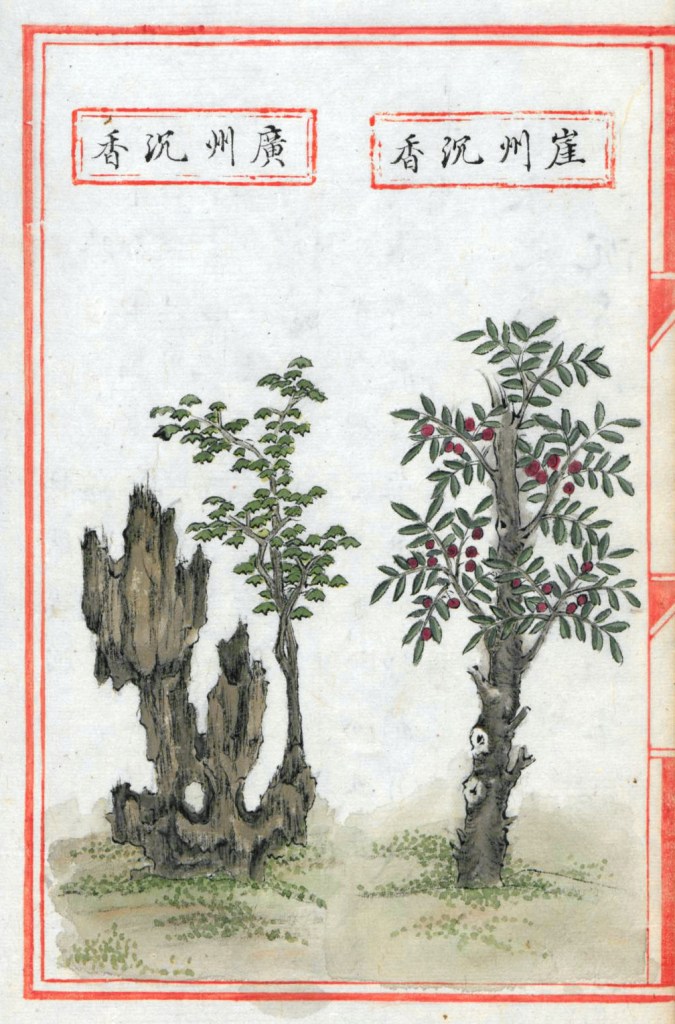
It is also worth noting that both illustrations may suggest aloeswood harvesting. For example, the tree on the right has lost its lower branches, reflecting a method of harvesting associated with Hainan in the late medieval period. The illustration on the left might depict, rather crudely, the more ruinous harvesting practices associated with continental China. At the very least, the larger irregular tree section resembles a carved out aloeswood piece.
Older scholarship has claimed aloeswood was used by the Egyptians for embalming and was further referenced in the Old Testament, but these views have been largely abandoned. A more firm identification can be found in the first century when the Greek physician Dioscorides describes aloeswood as a product of India and Arabia (likely via transshipment). Aloeswood is mentioned in several classic Indic texts, such as the Mahābhārata, Arthaśāstra, Suśruta Saṃhitā, and Caraka Saṃhitā. The earliest citations are conservatively placed in the first few centuries of the common era. Moreover, Indic sources associate the aromatic wood with northeastern India, the only regional area where Aquilaria trees classically occurred.
* The map is intended as a general heuristic for distribution and range, it reflects selected data from modern scientific research and descriptions from medieval Chinese materia medica and gazetteers
For further information and additional references, see: Peter M. Romaskiewicz, “Sacred Smells and Strange Scents: Olfactory Imagination in Medieval Chinese Religions.” Ph.D. dissertation, University of California, Santa Barbara, 2022.

 Personal Site of Peter Romaskiewicz