Chinese Buddhist Shrine in The Mysterious Dr. Fu Manchu (1929)

For all the new Buddhas in the West posts
follow us on Bluesky & Instagram


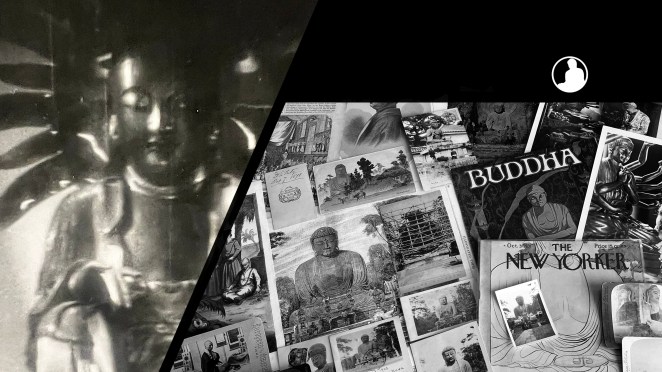
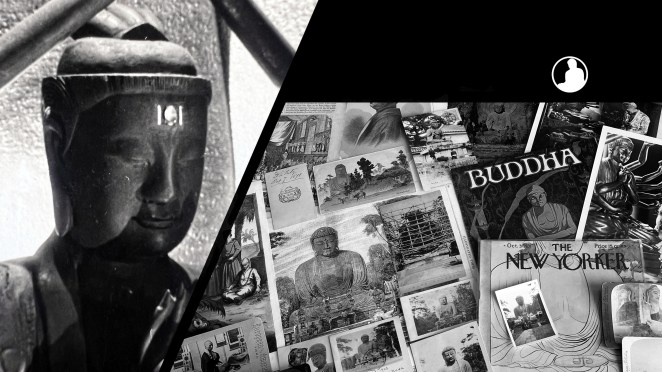
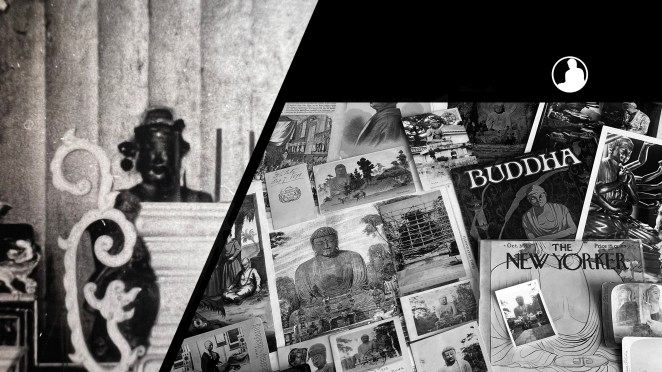
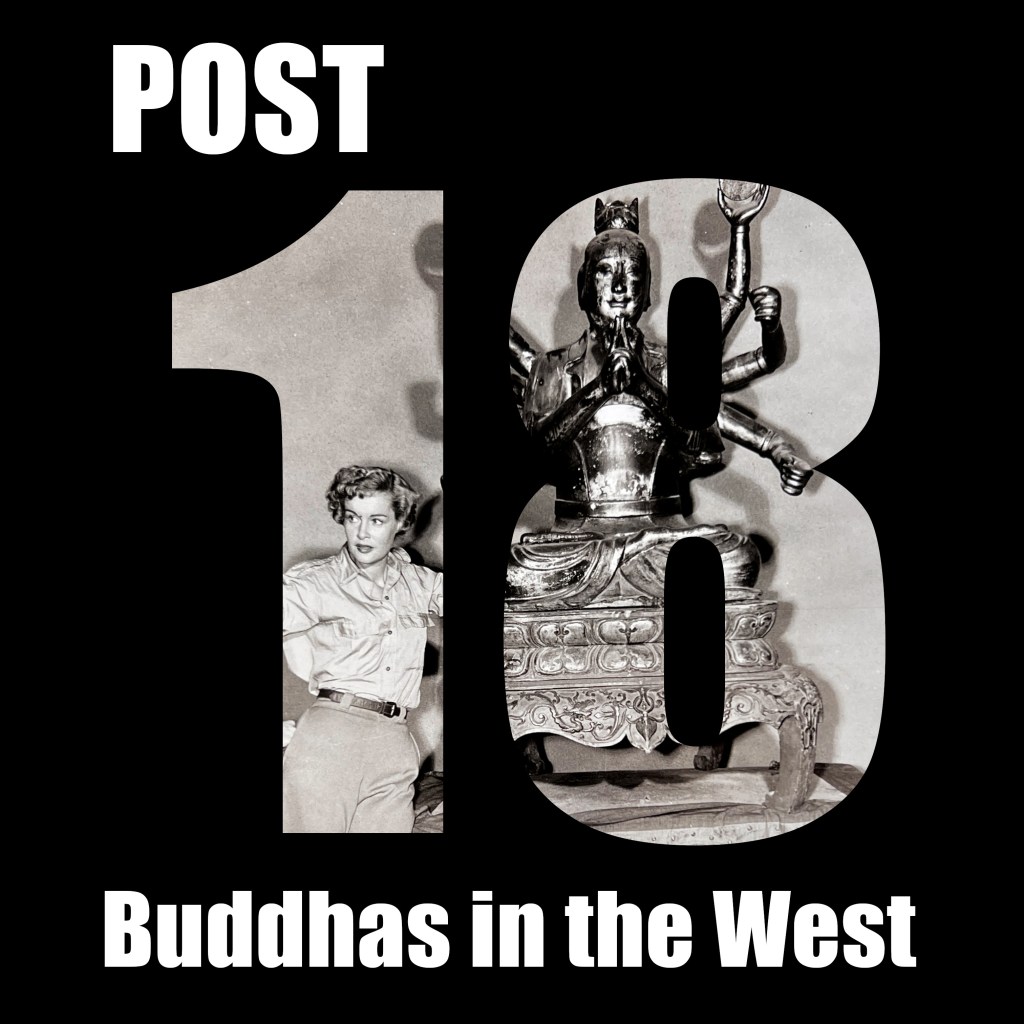
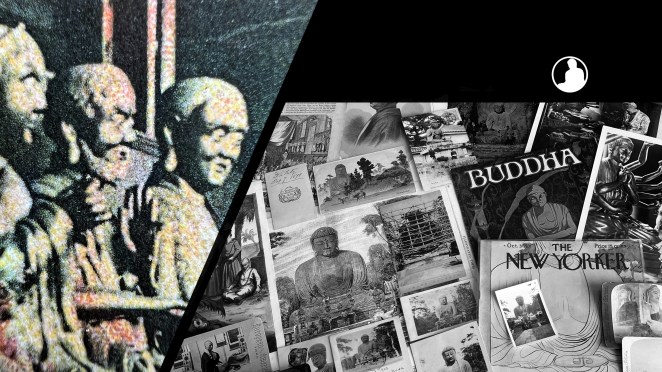
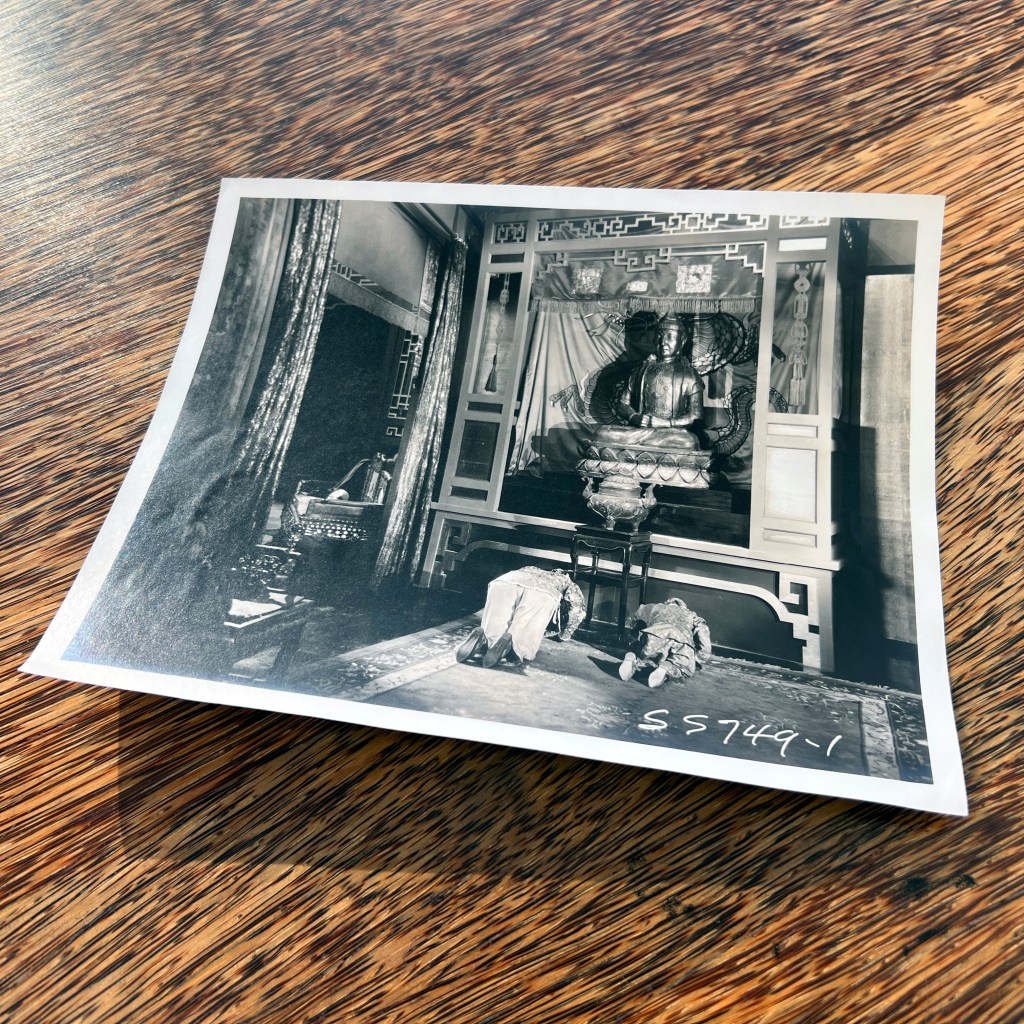
This photo casts a rather uncanny site with unnaturally bright side lighting, awkwardly wooden human figures, and a very odd Buddhist icon. This is not a real Chinese Buddhist temple, but a movie set designed for a famous 1929 Paramount film.
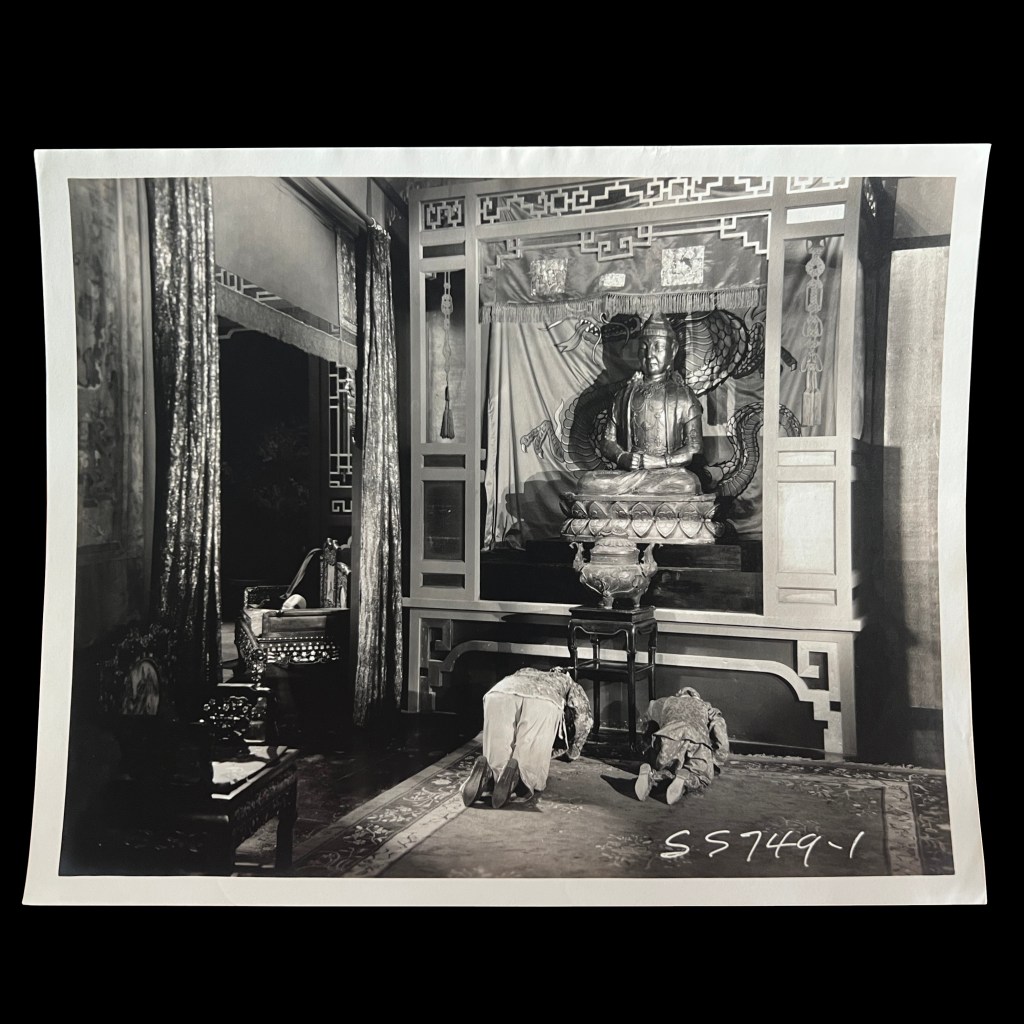
The photo is from a series of stills taken to preserve the set design and layout for The Mysterious Dr. Fu Manchu, starring Warner Oland in the titular role. This scene portrays the moment before that death of the doctor’s wife and son by errant British cannon fire during the Boxer rebellion.
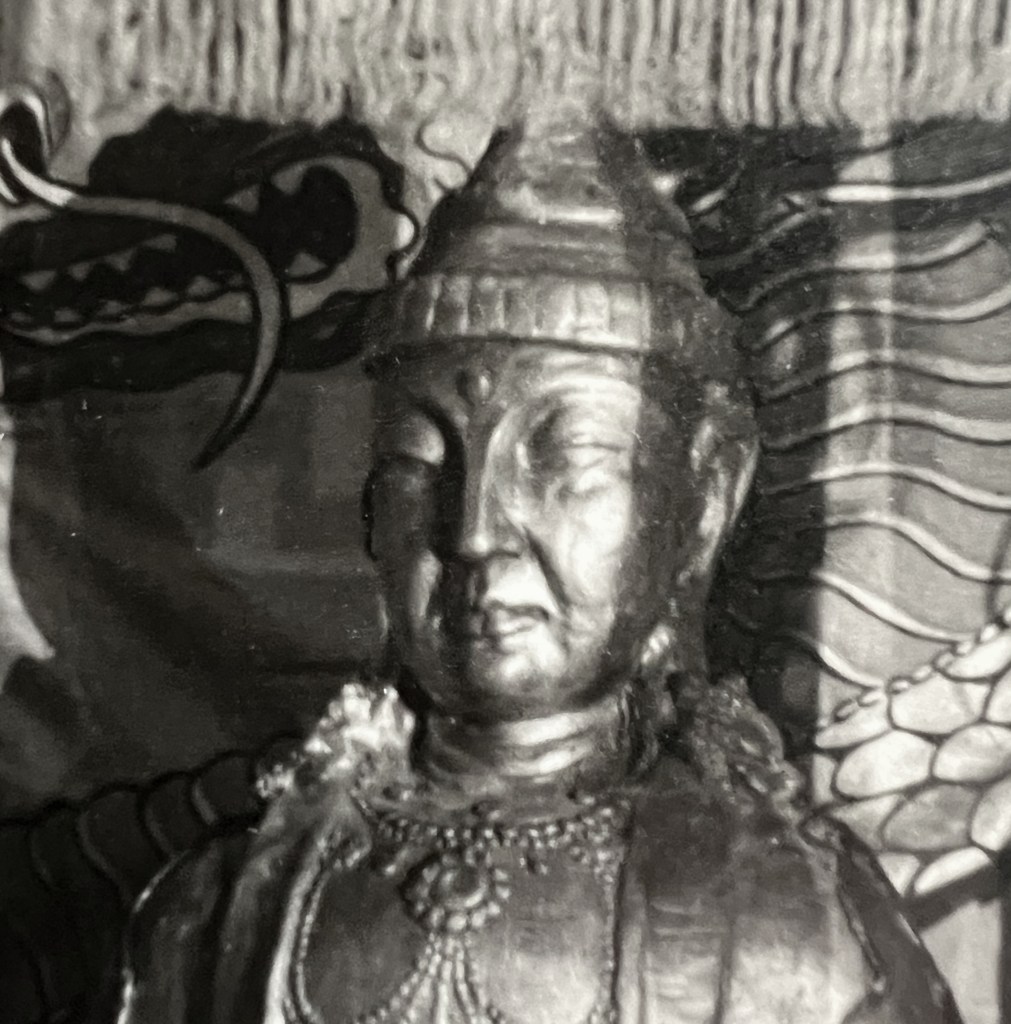
It’s worth marveling at this franken-buddha. While silent films of the 1910s and 20s sometimes used genuine Buddhist statuary, larger props were made of plaster. The craftsmen cobbled together the face of a buddha, the body of a jeweled bodhisattva, and adopted a two-fisted meditation mudra.

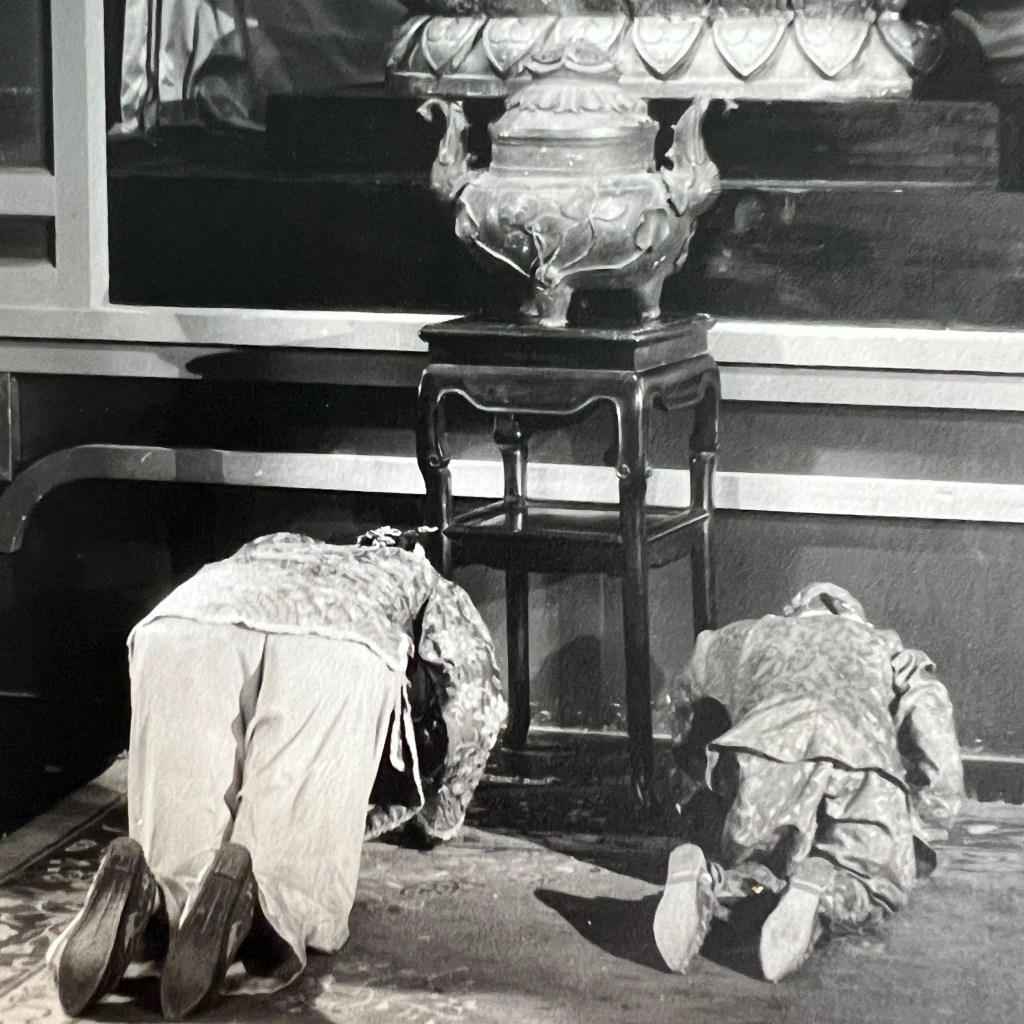
The prostrating mannequins represent the doctor’s family praying at the family shrine moments before the altar is destroyed by a shell, crashing rubble on top of them. Fu Manchu swears vengeance in front of his dead family and demolished Buddhist icon.
Buddhist statues appear elsewhere in the film, but mostly as room décor signaling a curio Buddhist statues appear elsewhere in the film, but as one reviewer in 1929 describes, they are among “the appurtenances of Oriental diablerie.” The “all talking” version of Mysterious Dr. Fu Manchu survives today and is viewable here: tinyurl.com/r5d9h7e5.
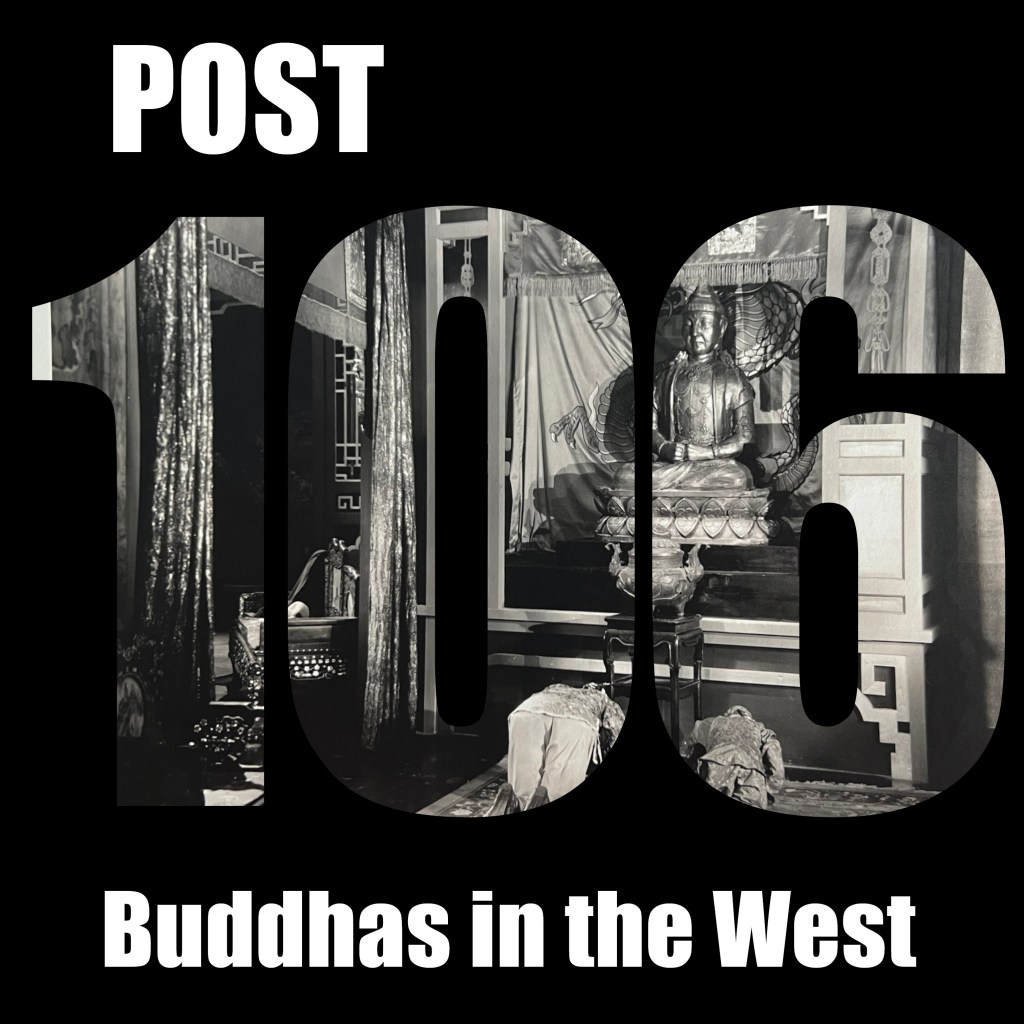
The Buddhas in the West Material Archive is a digital scholarship project that catalogues artifacts depicting Buddhist material culture for Western audiences. It’s comprised of prints, photos, and an assortment of ephemera and other objects. For a brief introduction to this archive, visit the main Buddhas in the West project page.


For Related Buddhas in the West Posts Featuring Historical Films:

For the Most Recent Buddhas in the West Posts:


Guanyin Icon in The Mask of Fu Manchu (1932)

For all the new Buddhas in the West posts
follow us on Bluesky & Instagram


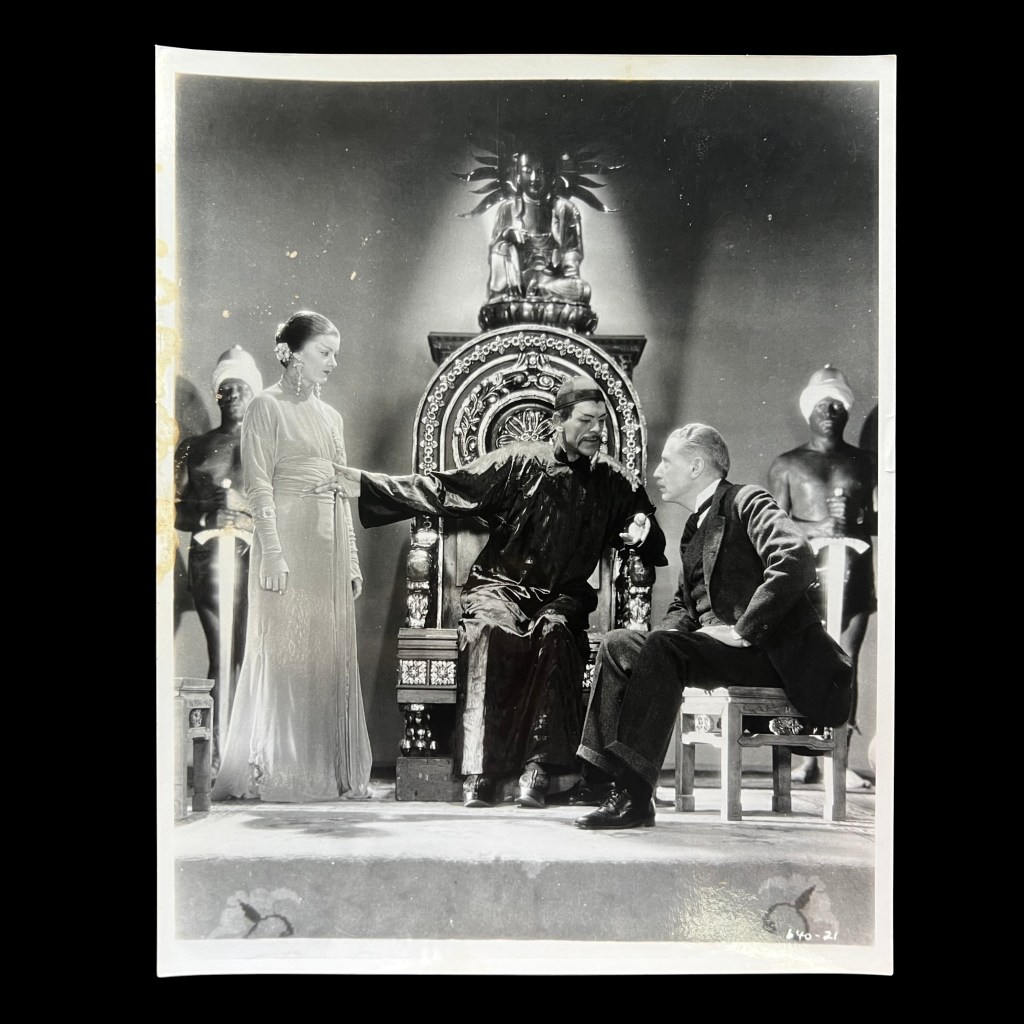
Fu Manchu’s opulent Gobi Desert lair seen in The Mask of Fu Manchu (1932) was assembled by MGM art director Cedric Gibbons. While the Art Deco inspired torture chambers remain horror classics, Gibbons’ strategic use of Buddhist statuary also hint to the audience impending danger.

Boris Karloff portrayed the villainous doctor Fu Manchu, here sitting on a throne introducing his daughter Fah Lo See (Myrna Loy). This scene unfolds under the eyes of a shadowy Buddhist figure perched atop the throne; close inspection reveals this to be in the style of a Guanyin statue.

Many props Gibbons used were made at the studio, including some of the Buddhist statues seen on screen. The idiosyncratic elements, including the multi-rayed halo, suggested this statue was pieced together by set designers; it was seen previously in Daughter of the Dragon (1931).

Curiously, the ornate backrest of the throne makes it appear as if Fu Manchu himself is a statue encircled by a halo. Like a menacing statue come to life, the audience can surmise the visitor will suffer at the hands of the villain.

Fu Manchu played on the racist fears of the Yellow Peril; in film, these fears could also be signified by Buddhist imagery. For further discussion of the dueling positive and negative views of China in American cinema, see Naomi Greene’s From Fu Manchu to Kung Fu Panda (2014).


The Buddhas in the West Material Archive is a digital scholarship project that catalogues artifacts depicting Buddhist material culture for Western audiences. It’s comprised of prints, photos, and an assortment of ephemera and other objects. For a brief introduction to this archive, visit the main Buddhas in the West project page.


For Related Buddhas in the West Posts Featuring Guanyin / Avalokiteśvara:


For the Most Recent Buddhas in the West Posts:

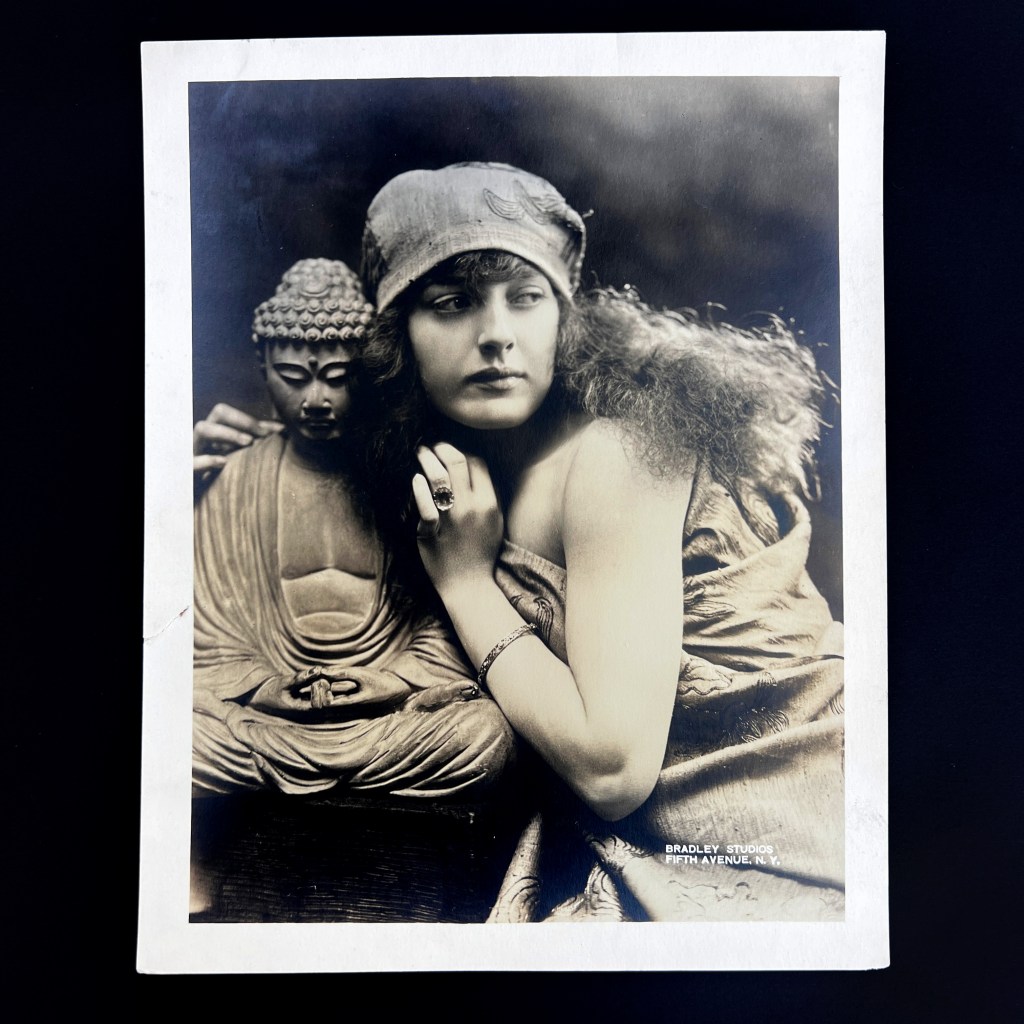
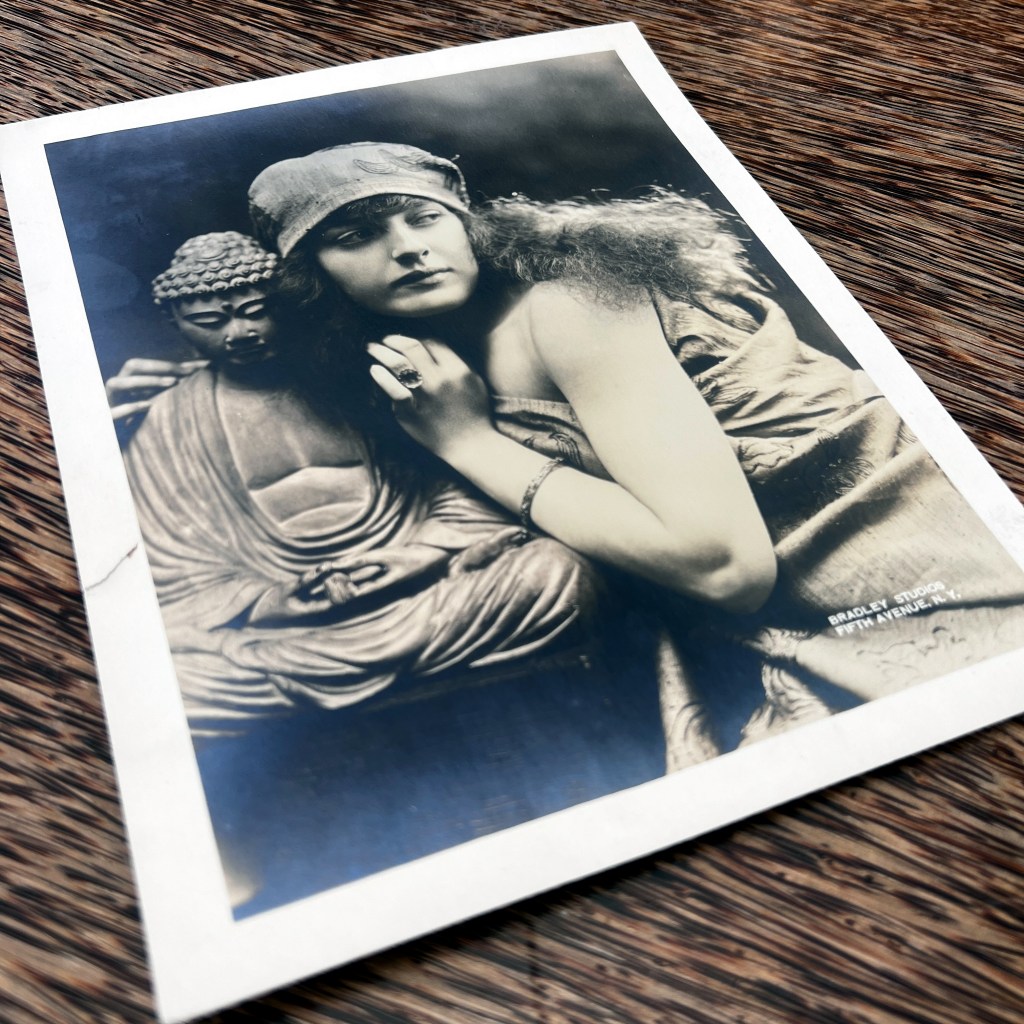
Marguerite Courtot c. 1920 Studio Portrait

For all the new Buddhas in the West posts
follow us on Bluesky & Instagram


Silent film star Marguerite Courtot joined Pathé after WWI and became a centerpiece in the studio’s action-adventure serials. She starred in Pirate Gold (1920), Velvet Fingers(1920) and The Yellow Arm (1921), with the latter being a stereotypical “Yellow Menace” adventure.

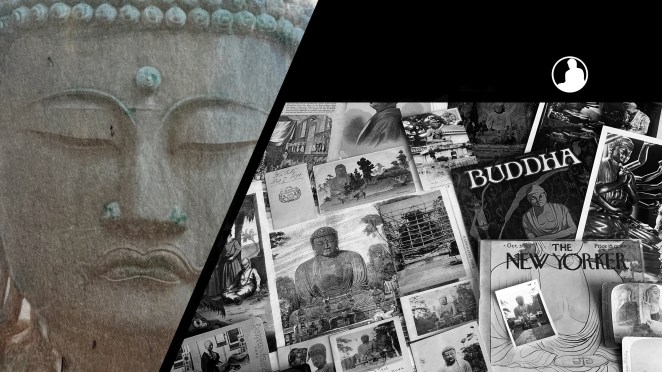
This photo does not appear to be a production still (a movie set photo), but a studio portrait taken in New York City. The portrait dates to around 1920 when the silent film industry was still centered in Fort Lee, New Jersey.

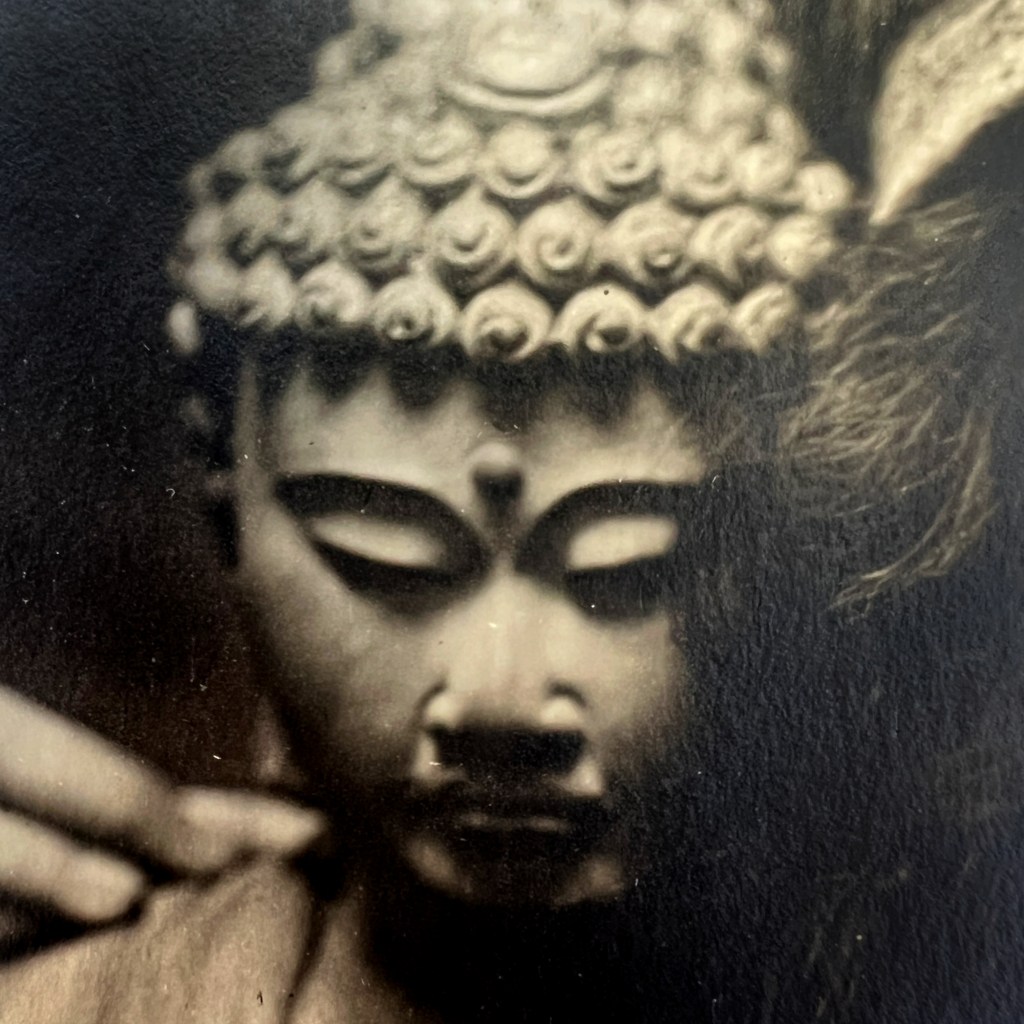
Courtout grasps on to the Buddha statue using a dramatic stage gesture, a relic of the theater age that was adopted in early film. While The Yellow Arm serial is considered lost, it is possible this was a cast portrait used in promoting the film.

Short written synopses survive for several of the Yellow Arm episodes as copyright claims. The synopsis for episode one is held by the Library of Congress, viewable here: https://www.loc.gov/item/s1229l16612/.


The Buddhas in the West Material Archive is a digital scholarship project that catalogues artifacts depicting Buddhist material culture for Western audiences. It’s comprised of prints, photos, and an assortment of ephemera and other objects. For a brief introduction to this archive, visit the main Buddhas in the West project page.


For Related Buddhas in the West Posts Featuring Silent Films:


For the Most Recent Buddhas in the West Posts:


The Cheat (1923) Production Photograph

For all the new Buddhas in the West posts
follow us on Bluesky & Instagram


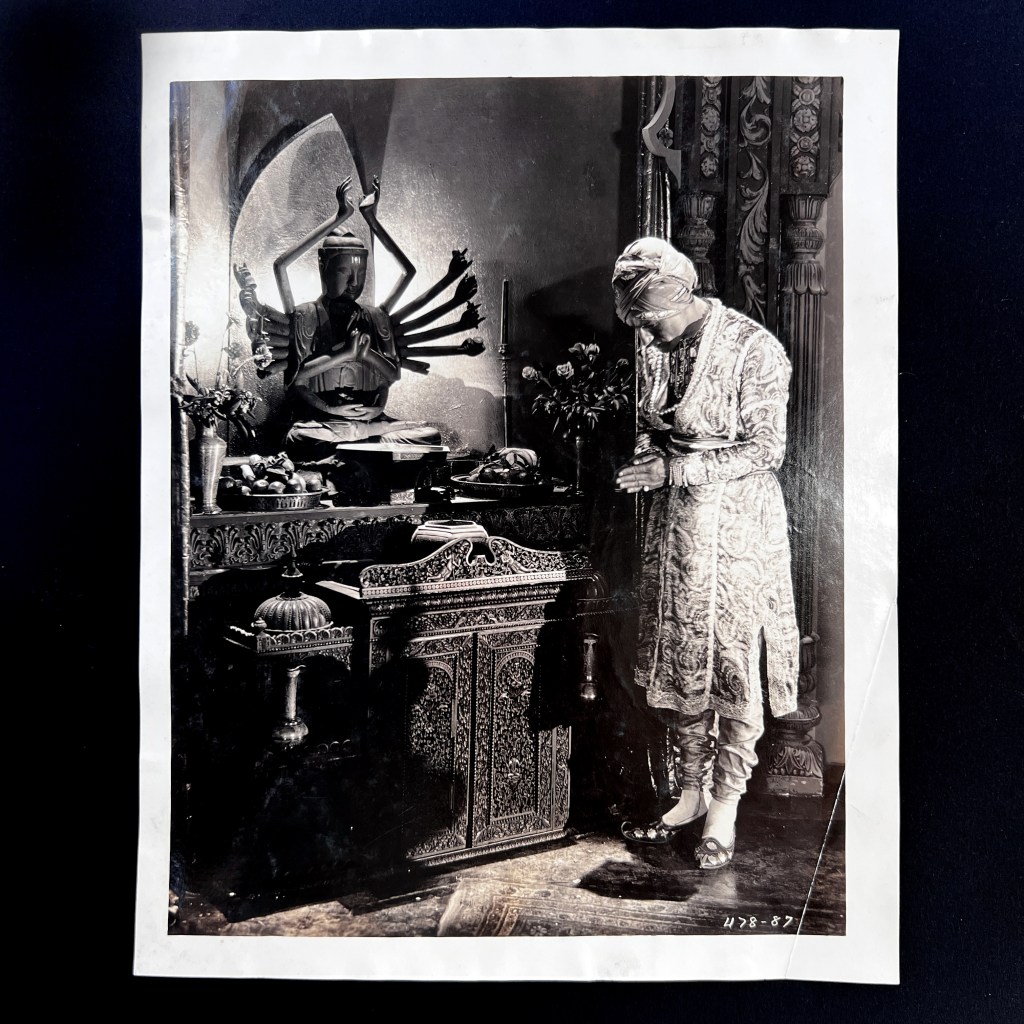
A Lost Film: The remake of The Cheat in 1923 starred Pola Negri in her second American film; she gave rise to the cinematic femme fatale. As with many silent films of the era, The Cheat is considered lost and theatrical stills are some of the only pictorial documents remaining.

Theatrical stills – shot since the advent of feature films in the 1910s – are simply production photographs. Over the last century they have become highly collected artifacts, here we can see where the photo was affixed to an album page.

The image here shows Charles de Rochefort playing a cunning art dealer masquerading as an East Indian Prince. The set design uses a multi-arm statue to underscore his foreign, and potentially nefarious, identity.

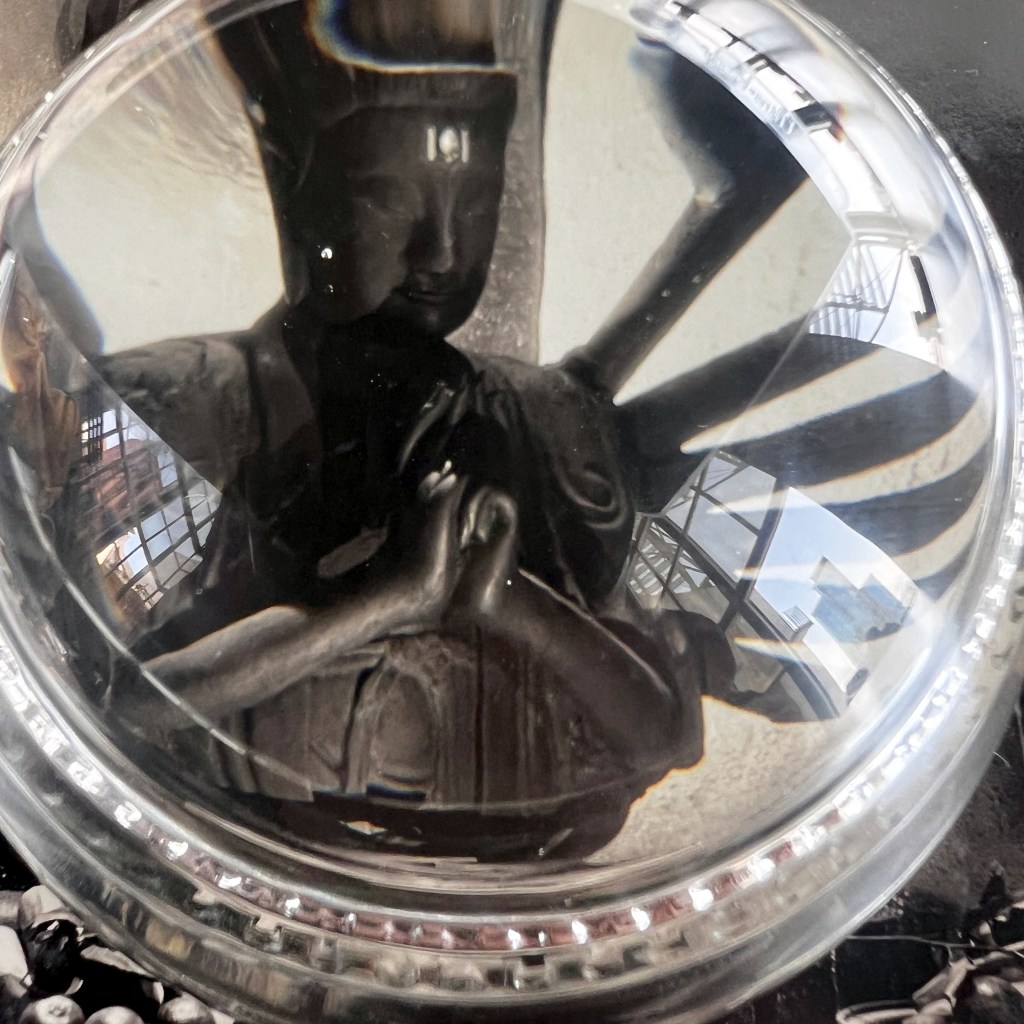
Looking closely at the statue, is does not appear to be a studio-made prop. The features and style suggest an authentic East Asian icon.

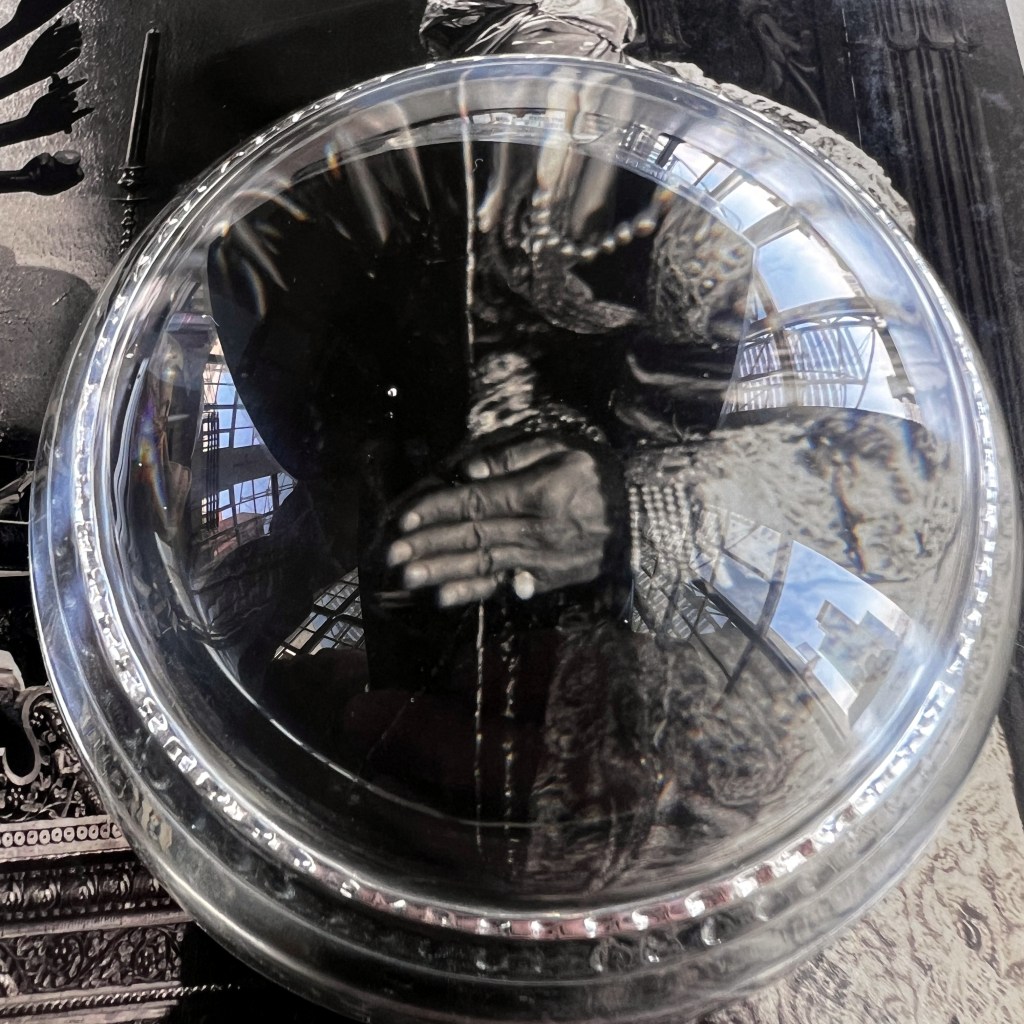
The richly brocaded costuming hints at the character’s royal pedigree, while his posture of reverence reveals his non-Christian religious allegiance.

A similar icon was photographed by German photographer Hedda Morrison in China between 1933–1946. It is viewable through Bristol’s Visualizing China project here: https://hpcbristol.net/visual/Hv08-085


The Buddhas in the West Material Archive is a digital scholarship project that catalogues artifacts depicting Buddhist material culture for Western audiences. It’s comprised of prints, photos, and an assortment of ephemera and other objects. For a brief introduction to this archive, visit the main Buddhas in the West project page.


For Related Buddhas in the West Posts Featuring Historical Photography:


For the Most Recent Buddhas in the West Posts:


Andrew Marton’s Storm Over Tibet (1952) Icon

For all the new Buddhas in the West posts
follow us on Bluesky & Instagram


Buddhist Demon of Shangri-la: Andrew Marton’s 1952 film, Storm over Tibet, utilizes Buddhist material culture to drive the Cold War horror-fantasy narrative. Filmed in part at Lamayuru in Ladakh, a cursed cham dance mask is a surrogate for the menacing antagonist.

Storm Over Tibet was a remake of Marton’s pre-war German-Swiss film Demon of the Himalayas from 1935. For both films Marton used documentary footage from the 1934 International Himalayan Expedition. Some of the same footage also was used for Columbia’s Lost Horizon in 1937.

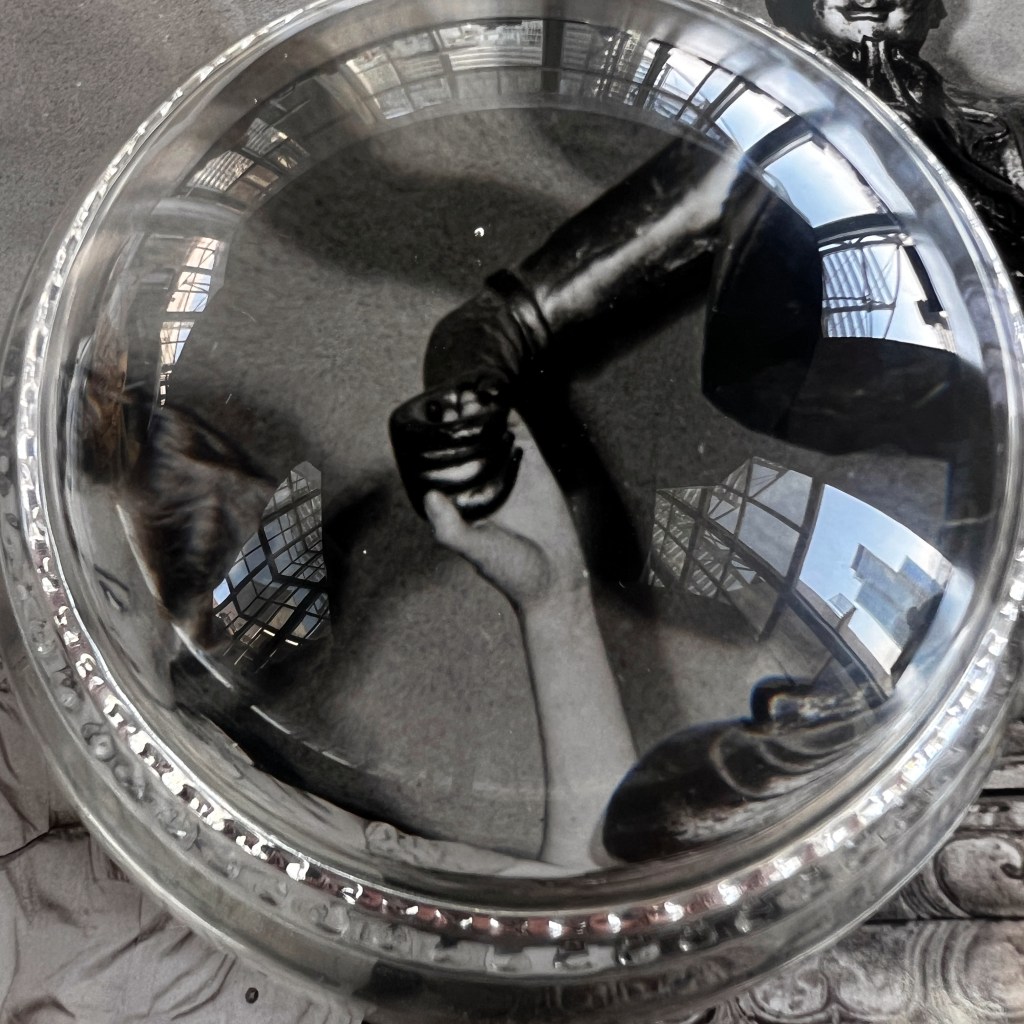
The co-lead, Diana Douglas, holds the hand of a Buddhist statue owed by the prop department of Columbia Pictures. It appears to be an image of Cundī. While large Asian statuary was oftentimes created by studio prop departments, this appears as if it was an authentic, yet incomplete, Buddhist artifact. [Update: This is the Daoist stellar deity Doumu, related to the Buddhist Cundī]

Marton’s 1935 German film, Demon of the Himalayas, incorporating on-location footage is available on the Internet Archive, viewable here: https://tinyurl.com/253rhr48.


The Buddhas in the West Material Archive is a digital scholarship project that catalogues artifacts depicting Buddhist material culture for Western audiences. It’s comprised of prints, photos, and an assortment of ephemera and other objects. For a brief introduction to this archive, visit the main Buddhas in the West project page.


For Related Buddhas in the West Posts Featuring Historical Film Photography:


For the Most Recent Buddhas in the West Posts:

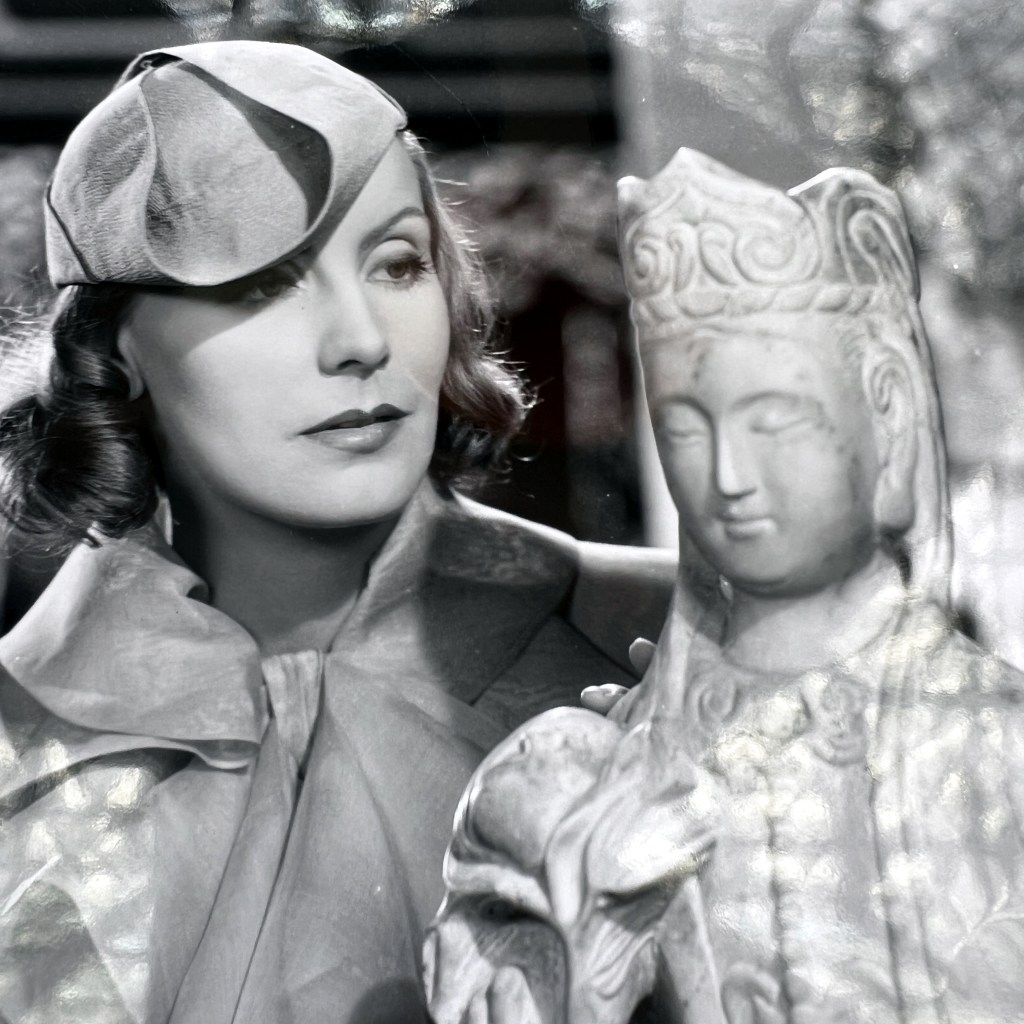
Greta Garbo’s Guanyin in The Painted Veil (1934)

For all the new Buddhas in the West posts
follow us on Bluesky & Instagram


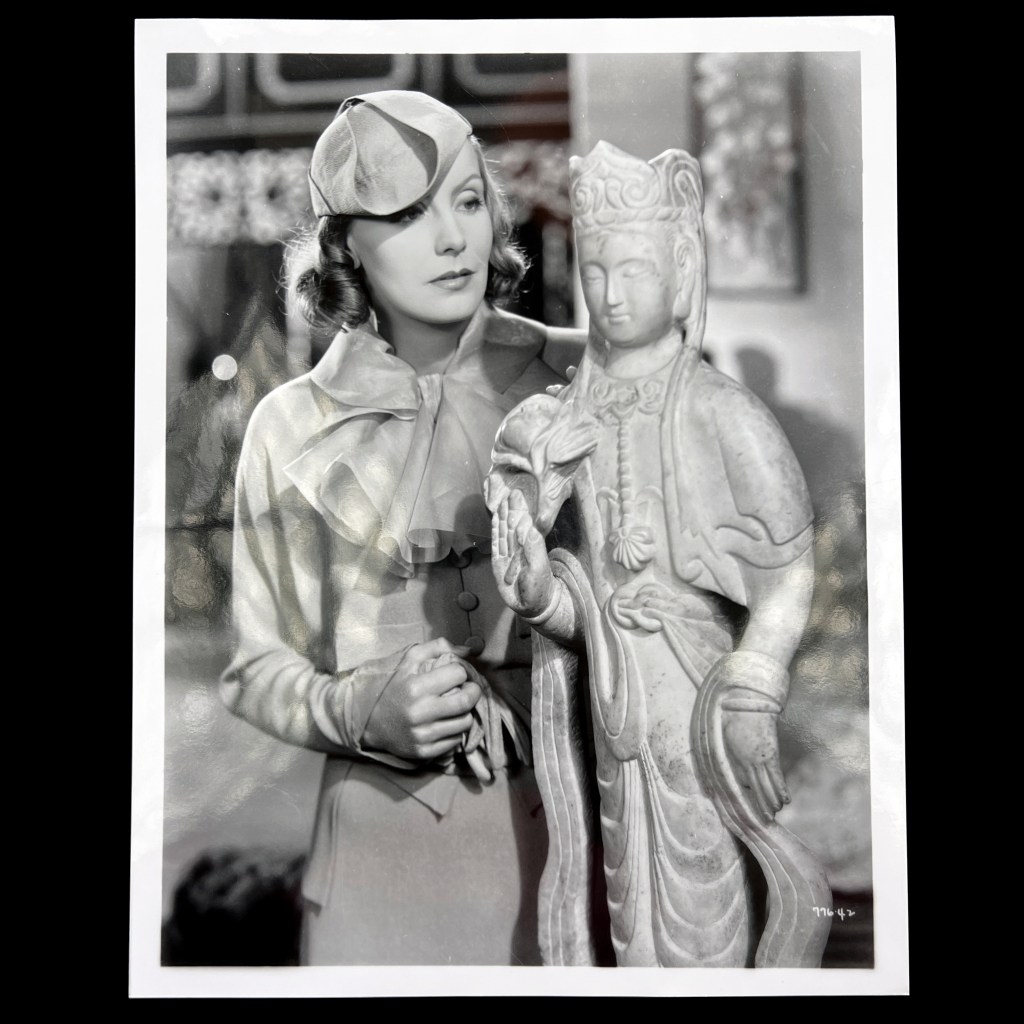
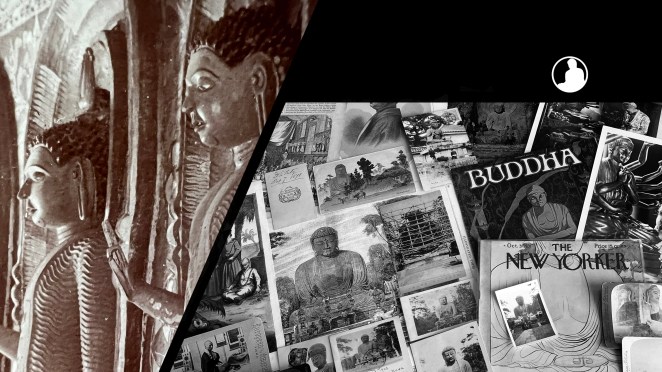
A theatrical still of Greta Garbo in the 1934 film The Painted Veil gazing upon a standing image of Guanyin. Looking closely, we see Garbo’s hand touching the shoulder of Guanyin, a moment of contact between the “icons.”

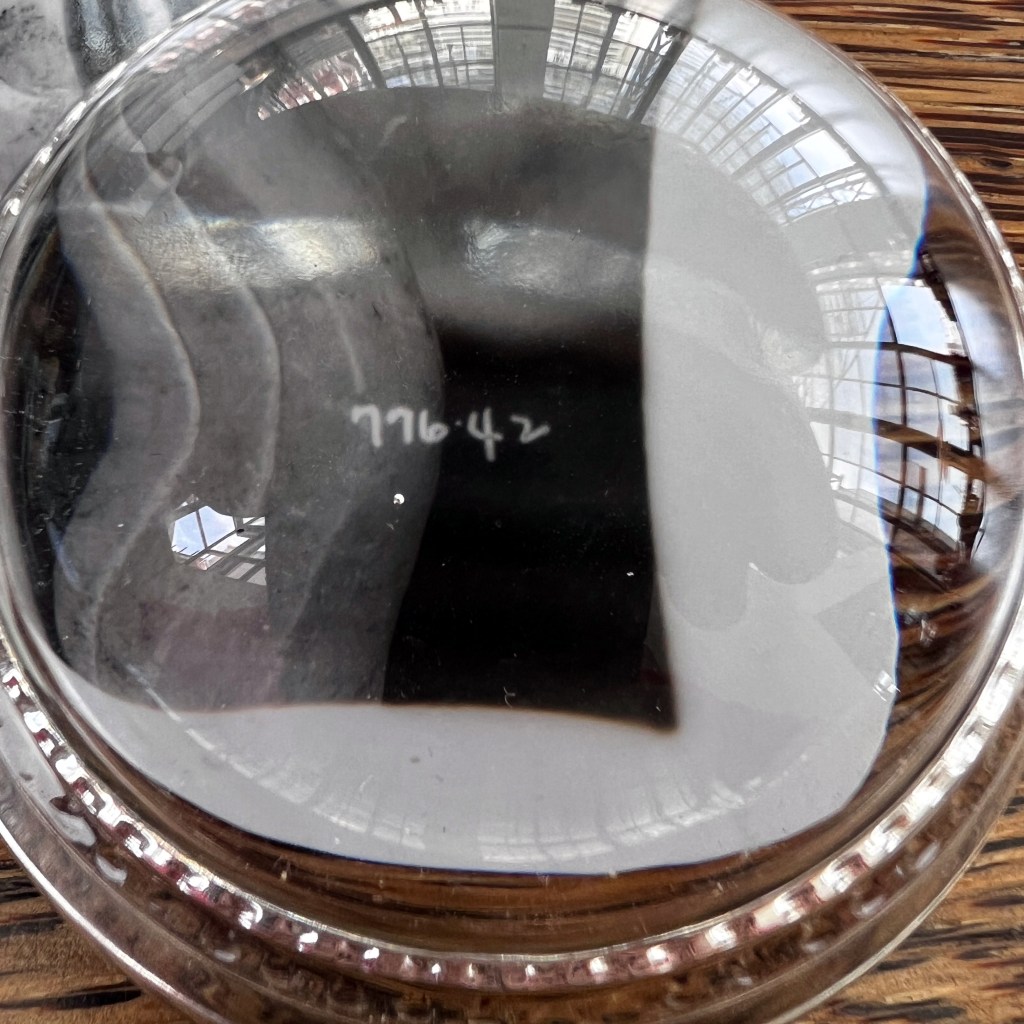
Theatrical stills – shot since the advent of feature films in the 1910s – are production photographs. Many were kept by the studio in albums called keybooks, while others were printed for promotional purposes, often marked with a code (here we see 776–42).

As advertising material, stills would often picture “tension, struggle, action,” but not reveal main elements of the plot, as noted by David Shields.

The scene here is not in the final edit of The Painted Veil, but would have occurred when Garbo’s character arrived in rural China during a cholera outbreak. The touch of the shoulder signaled an arrival into a far-away land, reflected in the materiality of the Buddhist icon.

For more on the history and interpretation of early film still photography, see David S. Shields’ Still: American Silent Motion Picture Photography (2013).


The Buddhas in the West Material Archive is a digital scholarship project that catalogues artifacts depicting Buddhist material culture for Western audiences. It’s comprised of prints, photos, and an assortment of ephemera and other objects. For a brief introduction to this archive, visit the main Buddhas in the West project page.


For Related Buddhas in the West Posts Featuring Historical Film Photography:

For the Most Recent Buddhas in the West Posts: