Frankincense (ru xiang 乳香) in Medieval China

Introduction

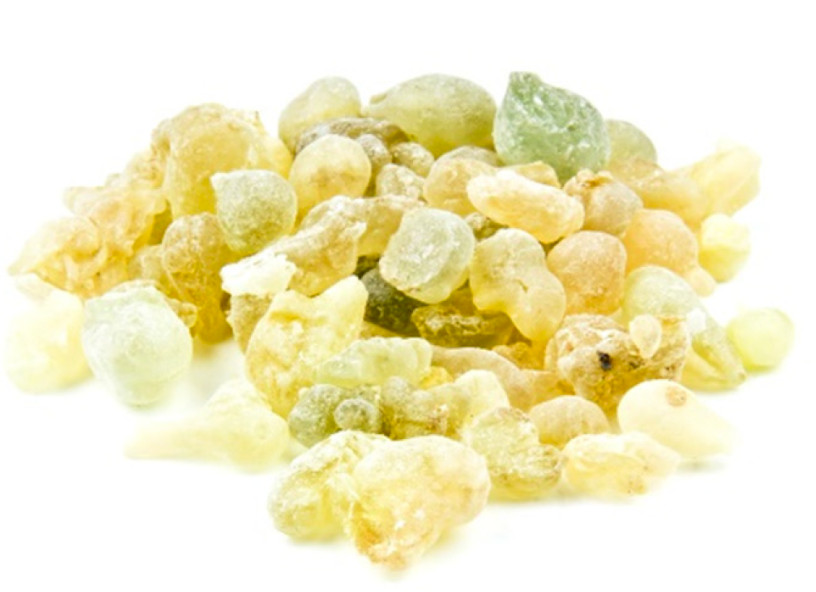
Frankincense and myrrh were two kinds of incense gifted to the baby Jesus according to the New Testament story of the Magi. Considering gold constituted the third gift, we can surmise how important such aromatics were to people in the ancient Mediterranean. Frankincense is an oleogum-resin with a distinctive balsamic-citrus scent that is produced by several species of the Boswellia tree. Biblical incense is thought to have traversed the two-to-three-month long trip along the so-called Incense Route connecting the eastern Mediterranean to the southern Arabian peninsula were Boswellia naturally occur. The subtropical-tropical climate of this region allows for the growth of many different kinds of fragrant resin-producing tress. There is also an Indian frankincense produced by the native Boswellia serrata, but this does not seem to have significantly impacted classical Greco-Roman commerce. It might be the case, however, that Indian frankincense, or a mixture of Arabian and Indian frankincense, was brought into China by at least the mid-third century. The origin for the early Chinese name for frankincense, xunlu xiang, is contested by scholars, with some claiming it is a transcription of the Sanskrit kundurūka and others claiming it is a hybrid or fully Chinese name. By the eighth century a new name for frankincense becomes dominant, Milky Aromatic (ru xiang 乳香), reflecting the Arabic name for frankincense, luban, “milky, white,” and the growing commercial importance of the Arabic sea trade.

Facts and Features

  • Medieval Chinese Name: Xunlu Aromatic (xunlu xiang 薫陸香), Milky Aromatic (ru xiang 乳香)(additional names for different commercial grades)
  • Common English Name: frankincense, olibanum
  • Botanical Origin: oleogum resin extracted from several species of the Boswellia tree (esp. B. sacra, B. frereana, B. papyrifera, B. serrata)
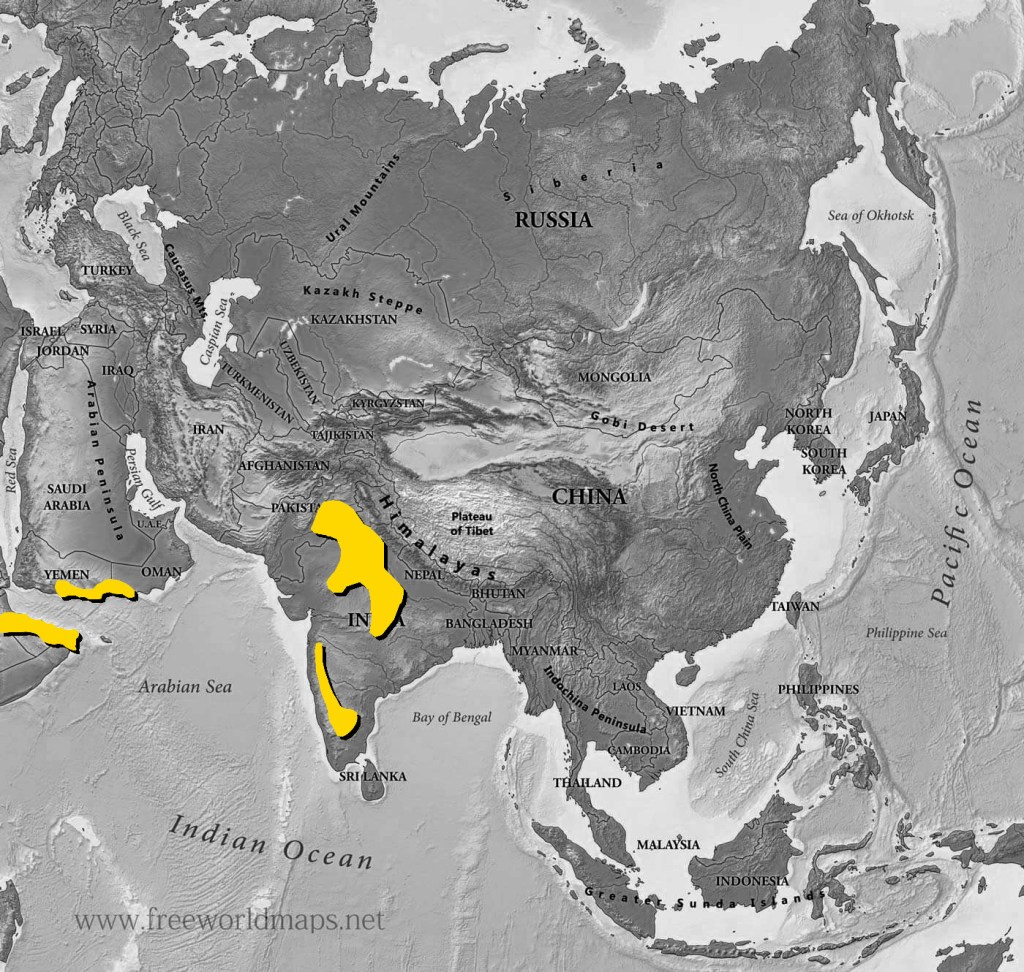
  • Phytogeographic Distribution: Ethiopia, Sudan, Somalia on the Horn of Africa, southern Arabian Peninsula, northwestern and southern India [approximate distribution* of frankincense is shown in golden yellow below]
  • Harvesting Process:  the bark of the tree is notched or slashed causing the release of milky oleogum resin that thickens upon contact with the air, then the globule pear-shaped tears can be collected

  • Earliest Chinese Citation: mid-3rd century CE (e.g. dynastic history: Abridged Account of Wei [Weilüe 魏略]) & late 3rd century (translated Buddhist sutras)
  • Earliest Chinese Medicinal Use: 3rd/4th– late 5th century (Supplementary Record by Famous Physicians [Mingyi bielu 名醫別錄] and Collected Annotations on the Classic of Materia Medica of the Divine Husbandman [Shennong bencao jing jizhu 神農本草集注])

Comments: Frankincense first appears in extant Chinese sources in mid-third century when it appears alongside several other aromatic imports from the Roman Empire, including storax, saffron, and possibly rosemary. For the early medieval Chinese, frankincense was considered an export of the Roman Empire, but in reality the Romans were only transshipping the resin into India where it would have been sent onward to Chinese merchants via Central Asian middlemen. By the mid-seventh century frankincense was considered a direct export of India, possibly indicating the circulation of the Indian variety. By the late medieval period, frankincense was strongly connected to Arab trade and in such cases was sourced from the southern Arabian peninsula.

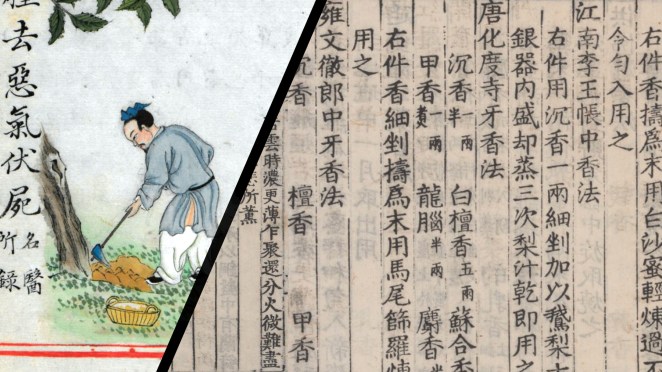
If we examine the Classified Essentials of Materia Medica (Bencao pinhui jingyao 本草品彙精要) from 1503 we find a pair of illustrations for the frankincense tree, one showing Xunlu Aromatic (on the left), the other showing Milky Aromatic (on the right). While the later shows clumps of resin forming on the bark (in uncharacteristic lime green), the former unexpectedly shows a collector digging into the ground around the base of the tree. Presumably, this was necessary when frankincense resin dripped from the bark wound on to the ground. The golden resin can be seen in the collection basket.

It is often claimed frankincense was used in pharaonic Egypt, but precise dating for its importation into Upper Egypt remains unclear. For example, there is a famous series of reliefs in the temple at Deir al-Bahri near Thebes which describe an expedition sent around 1500 BCE by Hatshepsut (r. 1481–1472 BCE) that crossed land and sea. The expedition to the unidentified land known as Punt returned with live trees preserved in pots as depicted in the reliefs. Moreover, it is noted the trees were used as fragrant ointment. Scholarly discussions over the depictions and associated terminology have not determined if these trees were Boswellia or a type of myrrh tree (or something else). Regardless of the famed Punt expedition, evidence suggests the Incense Route from southern Arabia commenced around the end of the eighth century BCE, supported by massive camel caravans. Herodotus speaks of Arabian frankincense in the mid-fifth century BCE as does Theophrastus in the third century BCE. The first century Periplus Maris Erythraei gives detailed accounts of both Arabian and Somali frankincense and notes that the fragrant resin is delivered into Indian ports. The history of frankincense in India, either imported or indigenous, is hampered by issues of terminology. Kunduru/kundurūka, śallakī/sallakī, and turuṣka are all treated as possible words for frankincense, among others. If we look towards the surviving Chinese translations of Indic Buddhist scriptures, we find the use of Xunlu Aromatic to translate (presumably) kundurūka at the end of the third century.


* The map is intended as a general heuristic for distribution and range, it ireflects selected data from modern scientific research and descriptions from medieval Chinese materia medica and gazetteers

For further information and additional references, see: Peter M. Romaskiewicz, “Sacred Smells and Strange Scents: Olfactory Imagination in Medieval Chinese Religions.” Ph.D. dissertation, University of California, Santa Barbara, 2022.
Ranjatai 蘭奢待: World’s Most Famous Aloeswood

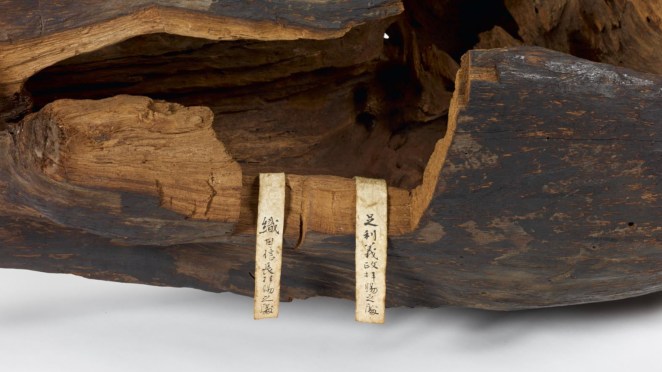
Arguably, the most famous singular piece of aloeswood in the world is held by the Shōsō-in 正倉院, the imperial Japanese treasury located at the famed Buddhist temple Tōdai-ji 東大寺 in Nara. This golden-colored piece of resinous wood with dark exterior is 1.56 meters long and weights 11.6 kilograms. Historically in Japan, unique fragrant materials categorized as meikō 名香, “famous aromatics,” were bestowed distinctive names. It is therefore commonly believed that upon entry into the Shōsō-in this piece of aloeswood was adorned with the name ranjatai 蘭奢待.

The ranjatai is sometimes praised in Japanese as the “World’s Most Famous Aromatic.” This is despite the fact this aromatic wood is rarely shown to the public and has an obscure history dressed in popular lore.

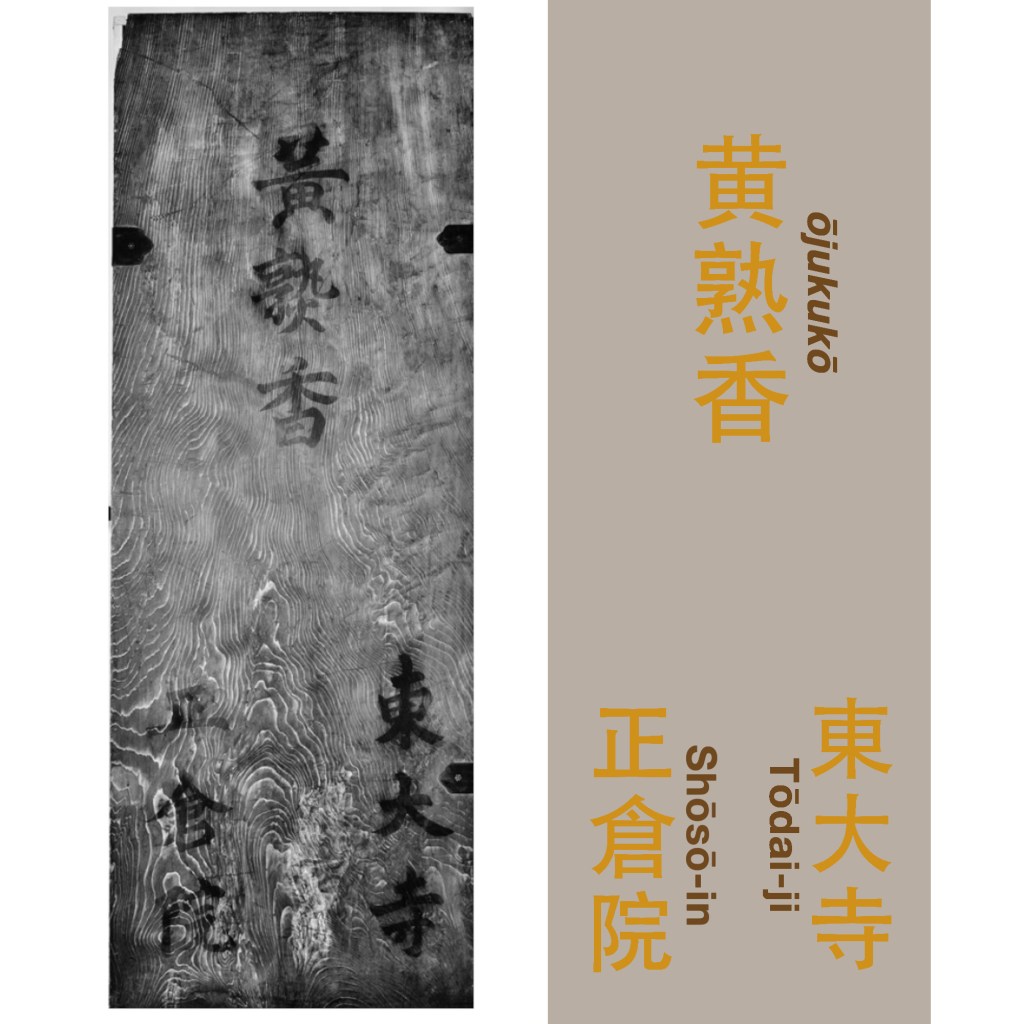
Part of the lasting interest in the ranjatai stems from its curious name. The word ranjatai inconspicuously hides the name of Tōdai-ji within its graphs (see above). One circulating story claims it would have been inauspicious to borrow the name of a prominent Buddhist monastery for naming a piece wood that would be burned as incense. Thus, using the characters for ranjatai was viewed as an elegant solution to honor the temple’s name while not indirectly threatening its safety.

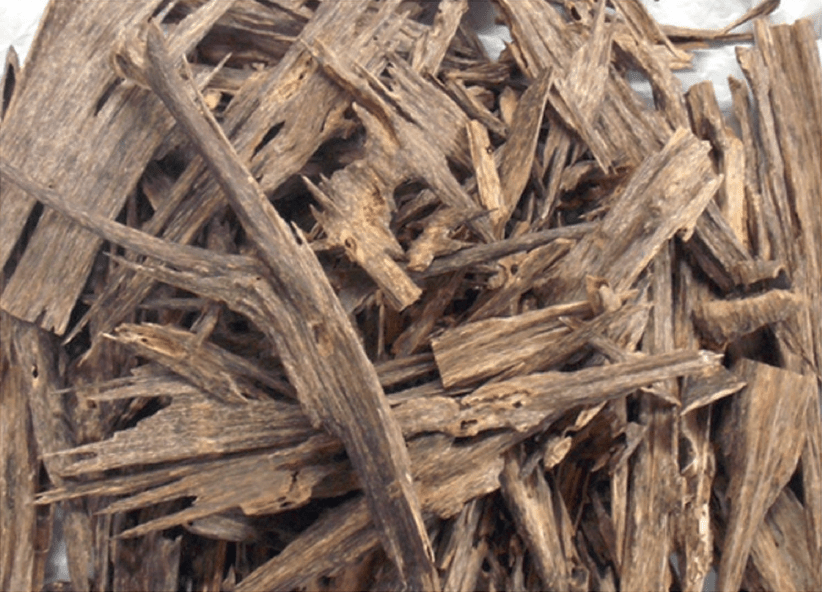
Materially, the ranjatai is a large piece of aloeswood. Aloeswood is one of the most expensive materials by weight with higher quality pieces worth more than gold. This cost is directly related to its rarity. Aloeswood is a fragrant resin-infused wood that forms in several species of the Aquilaria tree growing across the tropical regions of southeast Asia. This fragrant material is only formed under certain conditions, typically when the tree is stressed by environmental, biotic, or abiotic factors. Consequently, not all Aquilaria trees contain aloeswood, making it among the most rare commodities for incense and perfume blending. (For more on aloeswood in medieval China, read this post.)

According to one of the more prominent stories circulating, this large piece of aloeswood was originally in possession of Emperor Shōmu 聖武 (r. 724–748) who received it as tribute from China. Accordingly, some believe the ranjatai was donated by Empress Kōmyō (701–760) upon the death of the abdicated emperor in 756. The many donations given by the empress form the foundation of Shōsō-in’s collection today. A more nuanced take claims that during a state protection ritual at Tōdai-ji in 753 the ranjatai may have been gifted as an act of pious generosity. Proponents point out this practice was documented for another rare piece of aloeswood held by the treasury. A related circulating story claims the ranjatai was originally in the possession of Empress Suiko 推古 (554–628) after the wood drifted ashore in 595. This appears to be a further elaboration of a story contained the Chronicles of Japan (Nihon shoki 日本書紀) where a piece of aloeswood, found by locals along the beach of Awaji Island, was gifted to the Empress. This story is often treated as the origin of incense in Japan. It should be noted this story is sometimes associated with a different famous aromatic once known as the taishi 太子 in possession of Hōryū-ji 法隆寺.

Such incongruity in origin stories not only underscores the importance of the ranjatai, but further preserves it as a topic of debate and conversation among the public. The history of the ranjatai is perhaps most embellished by the fact that a few of the most politically important figures in Japanese history have reputedly cut off small portions for their personal use. This includes shōgun Ashikaga Yoshimasa 足利義政 (1436–1490), daimyō Oda Nobunaga 織田信長 (1534–1582), and Emperor Meiji 明治天皇 (1852–1912). For example, imperial records from 1877 note that when Emperor Meiji burned a small piece, “fragrant smoke filled the palace.” In these scenarios, having access to the imperial storehouse, especially for those who did not sit on the Chrysanthemum throne, was viewed as a sign of true political power.

There have been few attempts in the modern era to capture the likeness of the ranjatai. The first record comes to use from when the treasury was opened in 1693 for repairs. During the summer, the chief priest of Tōdai-ji moved all of the objects to the upper level during renovations and ordered illustrations prepared for some of the artifacts. The original illustrated manuscript no longer exists, but several copies were made and circulated under the name illustrations of Shōsō-in Imperial Treasures (Shōsōin gohōmotsu zu 正倉院御寶物之圖) through the Edo period (1603–1868). In most cases the first illustration in the book depicts the ranjatai, such as we find in a copy held by Kyoto University (below).

Five years before Emperor Meiji took a small piece of the famed aloeswood, survey teams were sent out around Japan to record objects and artifacts that had historical and cultural importance. Some of the items in the Shōsō-in were photographed over the course of twelve days in the summer of 1872, including the ranjatai. Looking closely at the photograph taken during that survey (below) we can see a small rectangular section had previously been cut away on the hollowed-out end. In comparison to the modern photo above, we can also see where Emperor Meiji would soon cut off a 8.9 gram piece from the narrower end. The Meiji-era label confirms this was the case.

It was not until after World War II that modern scientific studies were undertaken on various artifacts from the imperial treasury, in part for material identification, but also for the sake of preservation. Wada Gun’ichi 和田軍一 (b. 1896–?), director of the Shōsō-in, was among the first in charge for overseeing these matters and he took a special interest in the famous aloeswood piece. After scouring numerous Shōsō-in documents he found no evidence supporting the ranjatai’s presumed benefaction in the eighth century. The oldest document possibly bearing witness to the aloeswood comes only in 1193 (Kenkyū 4), where it might appear under the name ōjukukō 黄熟香.

This corresponds in part to what we know about the history and evolution of kōdō 香道, “the way of incense,” in Japan. It was only during the Muromachi period (1336-1573) that distinctive names were given to famous pieces of aromatics; this did not yet occur in the eighth century. We have evidence of this naming practice growing through the Edo period until a list of sixty-one different “famous aromatics” was developed under the auspices of perfume and incense aficionados (although different enumerations exist). As a sign of prestige, it is typical for kōdō practitioners to place Tōdai-ji’s ranjatai at the head of such listings.

Nevertheless, it remains unknown who donated the ranjatai or when it arrived at the Shōsō-in, although scholars have offered several different speculations. Moreover, precisely when the fragrant wood received its “honorific name” of ranjatai is also in dispute.

The Shōsō-in continues to officially catalogue the famous artifact under ōjukukō despite the widespread use of ranjatai in popular media. This former name can be seen, for example, in the copy of the 1693 illustrated shown above. Ranjatai, in smaller calligraphy, is listed as an “alternate name.” Ōkukukō is also written on the lid of the storage crate (below) were the famous piece of aloeswood is kept. It is believed this crate was also made in 1693 when the imperial treasures were inspected.


More recently, Yoneda Keisuke 米田該典 has performed a scientific analysis on the ranjatai to determine its botanical and graphic origins. Based on its chemical composition and comparison to chemical signatures of collected aloeswood samples, Yoneda concluded the Shōsō-in specimen originated from Aquilaria trees in Vietnam or Laos. This is a region closely associated with fine quality aloeswood since the third century in China.

Since 1946 various items from the Shōsō-in treasury are put on display each fall in the ancient capital of Nara. Many items are only available to be viewed by the public during these annual exhibitions. During the second exhibition in 1947 the ranjatai was selected for display. It was not displayed again until 1982, then again in 1997 and 2011. It was most recently displayed during the 72nd Annual Shōsō-in Exhibition in 2020. In addition, when Emperor Hirohito was enthroned in 2019, the ranjatai was put on special display in Tokyo for the occasion.

Like a scared relic only viewable to the few, these events further deepen the allure of the ranjatai, adding more layers to its already complex mythos.


External Links & Image Sources

  • Ōjukukō (Ranjantai) in the Illustrations of Shōsō-in Imperial Treasures (Shōsōin gohōmotsu zu 正倉院御寶物之圖) held by Kyoto University [here]
  • Ōjukukō (Ranjantai) at Shōsō-in’s Digital Repository [here]
  • Ranjatai photograph from 1872 Jinshi Survey of cultural assets [here]

Selected References

  • Hamasaki Kanako 濱崎加奈子. 2017. Kōdō no bigaku: Sono seiritsu to ōken renga 香道の美学: その成立と王権・連歌. Kyoto: Shibunkaku shippan 思文閣出版.
  • Īda Takehiko 飯田剛彦 and Sasada Yū 佐々田悠. 2021. “Shōsōin Hitsu-Rui Meibun Shūsei (Ni): Keichō Hitsu Genroku Hitsu 正倉院櫃類銘文集成(二): 慶長櫃・元禄櫃.” Shōsō‑in kiyō 正倉院紀要 43: 33–61.
  • Wada Gun’ichi 和田軍一. 1976. “Ranjatai らんじゃたい.” Nihon rekishi 日本歴史 335: 40–43.
  • Yoneda Keisuke 米田該典. 2000. “Zensenkō Ōjukukō no kagaku chōsa 全淺香、黄熟香の科学調査.” Shōsō‑in kiyō 正倉院紀要 22: 29–40.

For further information and additional references, see: Peter M. Romaskiewicz, “Sacred Smells and Strange Scents: Olfactory Imagination in Medieval Chinese Religions.” Ph.D. dissertation, University of California, Santa Barbara, 2022.


Buddhist Huadu Temple Incense Blend

Introduction

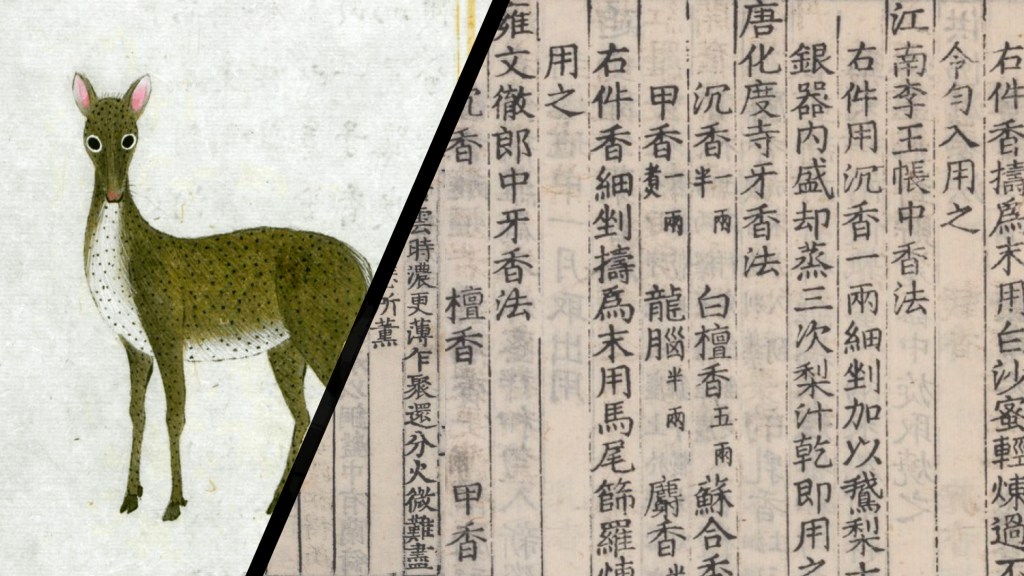
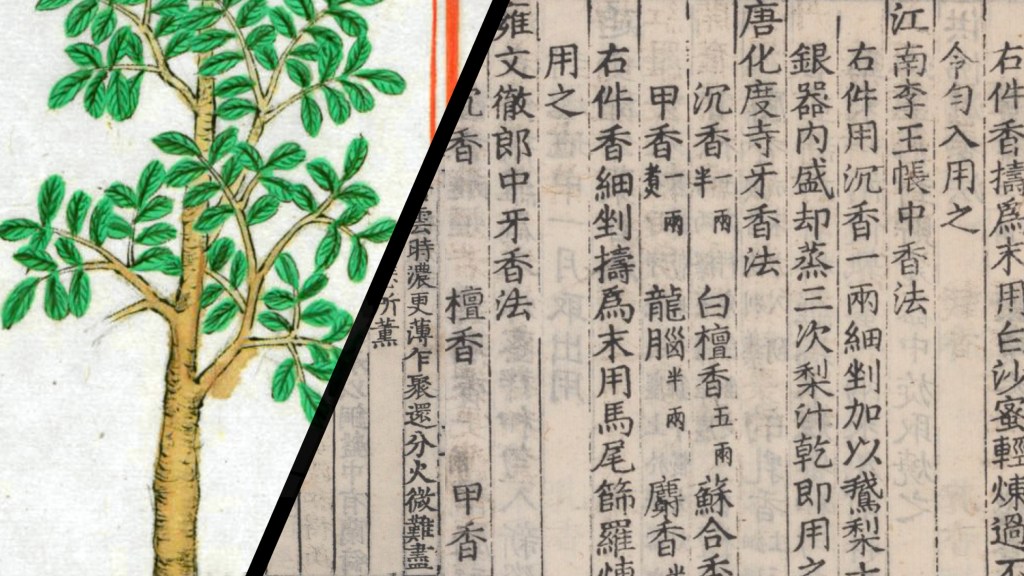
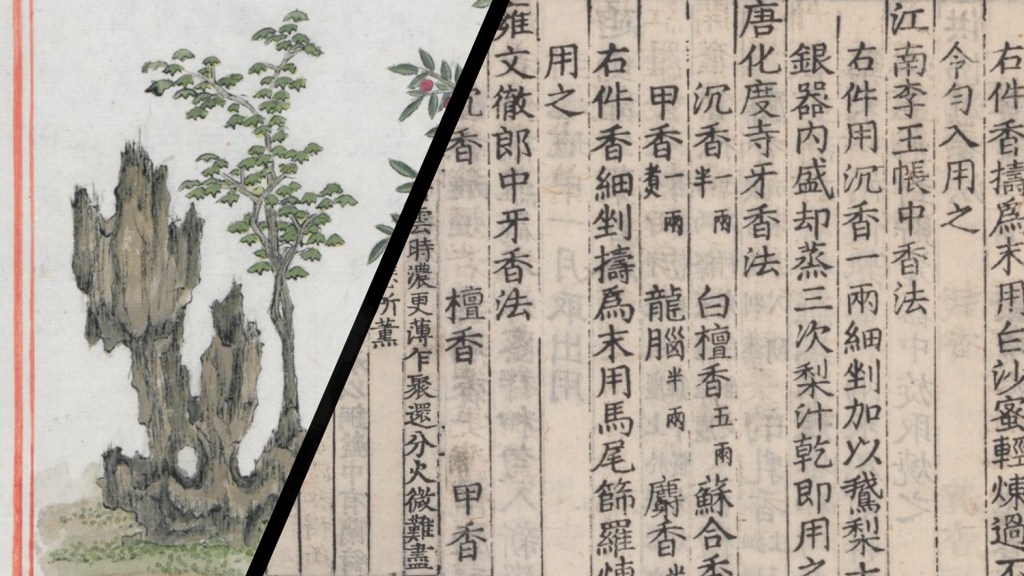
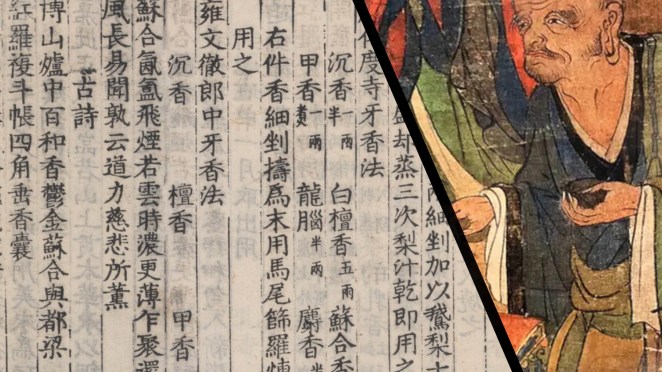
The “Recipe for Blended Incense from Tang Huadu Temple” (Tang Huadu si yaxiang fa 化度寺牙香法) is first recorded in Hong Chu’s (1066–c.1127) Materia Aromatica (Xiang pu 香譜). Hong Chu’s text is the earliest extant Chinese perfuming catalogue and was compiled in the early twelfth century. The six-ingredient recipe (plus honey) is shown here as it appears in the two fascicle Materia Aromatica preserved in the Baichuan xuehai 百川學海 collectanea originally published in 1273 (the image here is from a xylographic print issued after 1501).

Buddhist blending recipes are also scattered throughout the Chinese Buddhist canon, but nothing precisely matches the one recorded by Hong Chu during the Song. Furthermore, there are other Huadu Temple blends preserved in later medieval Japanese perfuming catalogues, yet these contain additional ingredients. Thus, we are left to presume the recipe discussed here is a genuine Tang-era artifact associated with the famed Buddhist Huadu Temple.

Facts and Features: Huadu Temple

The Huadu Temple (Huadu si 化度寺) was a monastic compound located in the medieval capital city of Chang’an, present day Xi’an. The temple grounds were located in the northwest part of the city, positioned east of the southern gate to Yining Ward [red circle on map]. This location was not far from the famed Western Market where foreign merchants sold and exchanged exotic imported goods [blue box on map].

The temple was first constructed as Zhenji Temple (Zhenji si 真寂寺) in 583. It was renamed Huadu Temple under the first Tang emperor in 619. Then in 846, after rebuilding in the wake of the Huichang Persecution of Buddhism, the monastery complex was renamed Zhongfu Temple (Zhongfu si 崇福寺). If we are to take the name of the blending recipe at face value, we can presume it became closely connected to this Buddhist site between 619 and 846 when the monastery was still named Huadu Temple.

During the Sui and early Tang the wealth of Huadu Temple was considerable and well-known among all in the capital. This was the location of the Inexhaustible Storehouse (wujin zangyuan 無盡藏願), a treasury used to pay for the repair of temples and monasteries all over the country and to provide loans to the subjects of the capital. The treasury was confiscated by the imperial house in 721. Following this seizure the temple never returned to its former wealth and glory. For the sake of discussion, I will speculatively hold the Huadu Temple blending recipe dates approximately to the year 700, before the temple lost is vast holdings. Moreover, it is during this time when Huadu Temple held its No-Barrier Festivals, great public celebrations of generosity held under the auspices of the imperial house. As we will see, the combination of exotic aromatics clearly signals wealth and conspicuous consumption.    

Translation


Recipe for Blended Incense from Tang Huadu Temple 唐化度寺牙香法

aloeswood liang*沈香 一兩半
sandalwood5 liang白檀香五兩
storax1** liang蘇合香一兩
onycha1 liang (reduced)甲香一兩煮
camphor½ liang龍腦 半兩
musk½ liang麝香半兩

File and grind the above aromatics into a powder. Use a horse tail mesh to sift. Incorporate and mix with refined honey, then it is ready to use.
右件香細剉擣為末,用馬尾篩羅,煉蜜溲和得所用之。


*During the Tang, one liang, the “Chinese ounce,” was equivalent to 1.31 ounces (37.3 grams)
**Listed as 2 liang in the Newly Compiled Materia Aromatica (Xinzuan xiang pu 新纂香譜)


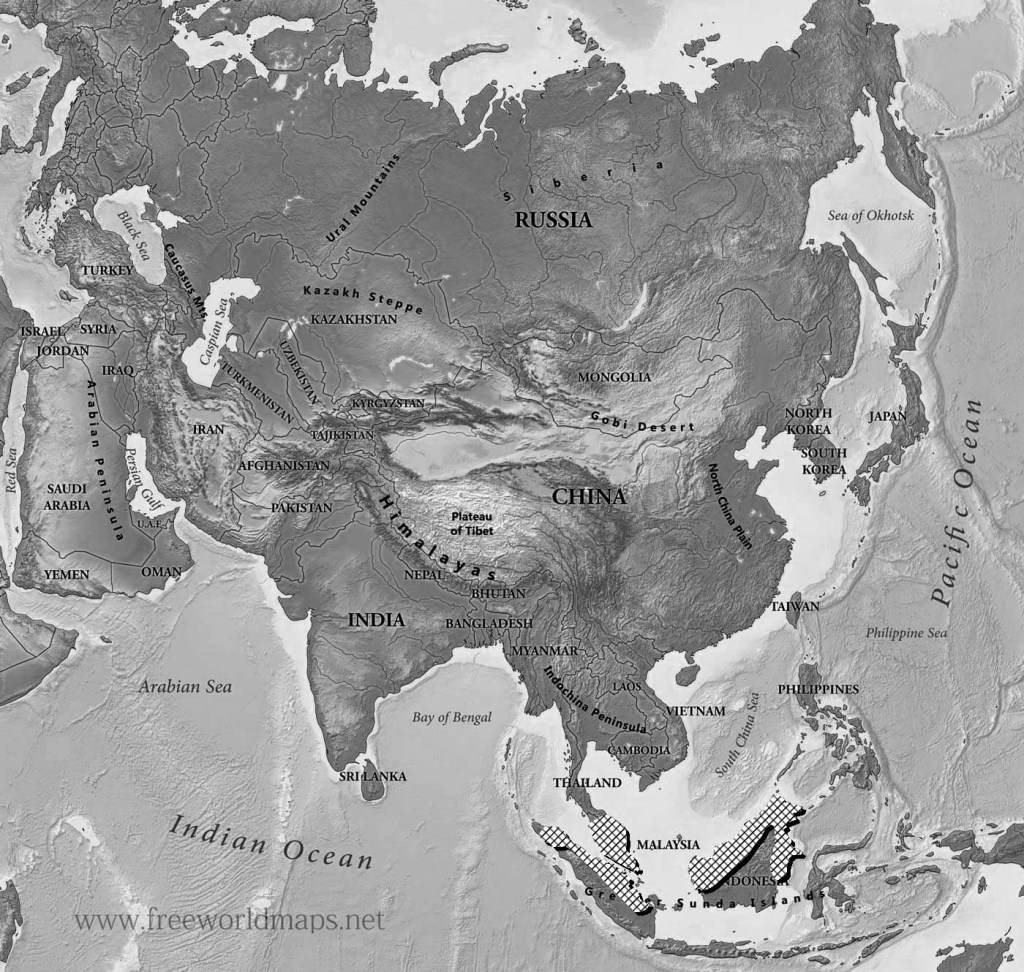
Comments: The Huadu Temple blend is a historical snapshot of exotic aromatics circulating in China during the height of the Tang Dynasty. Storax came from the Mediterranean (violet on map below), camphor likely came from the Malayan Peninsula (crosshatched white), sandalwood likely came from southern India (orange), and aloeswood likely came from the tropical south in the vicinity of present-day Vietnam (blue). Musk, from the musk deer, probably arrived from the mountains of the Tibetan and Yungui plateaus (lavender), while onycha was made from gastropod mollusks found along the coasts of southeastern and southern China and the Gulf of Tonkin (light blue). Chang’an (red dot) was connected to all of China’s major cities through a network of roads and canals which further channeled foreign goods from distant markets and ports. (Areas of distribution* overlap are barred.)

In the medieval world, aromatics were also part of larger webs of significance that might go overlooked from our modern vantage point. For example, all of the raw materials in the Huadu Temple blend are found in the Newly Revised Materia Medica (Xinxiu bencao 新修本草) published in 659. Consequently, in addition to scenting the air, each material was also believed to have therapeutic properties. Within this pharmacological context, however, these drugs would typically have to be ingested as there is no recorded medieval Chinese practice of aromatherapy in the modern sense. If we broaden our scope to a wider range of medieval textual genres, including translated Buddhist scriptures, regional gazetteers, and dynastic histories, all of the aromatic ingredients appear to have been known in China by the early fourth century. In such cases they appear as ritual items of religious power, tributary gifts from foreign states, and regional commodities of high economic value. The six-ingredient Huadu Temple blend thus helps provide a glimpse into a vast supra-regional trade flowing into medieval China as well as the multiple layers of significance reflected through possession of these aromatics.


* The map is intended as a general heuristic for distribution and range, it reflects selected data from modern scientific research and descriptions from medieval Chinese materia medica and gazetteers

For further information and additional references, see: Peter M. Romaskiewicz, “Sacred Smells and Strange Scents: Olfactory Imagination in Medieval Chinese Religions.” Ph.D. dissertation, University of California, Santa Barbara, 2022.


Musk (she xiang 麝香) in Medieval China

Introduction

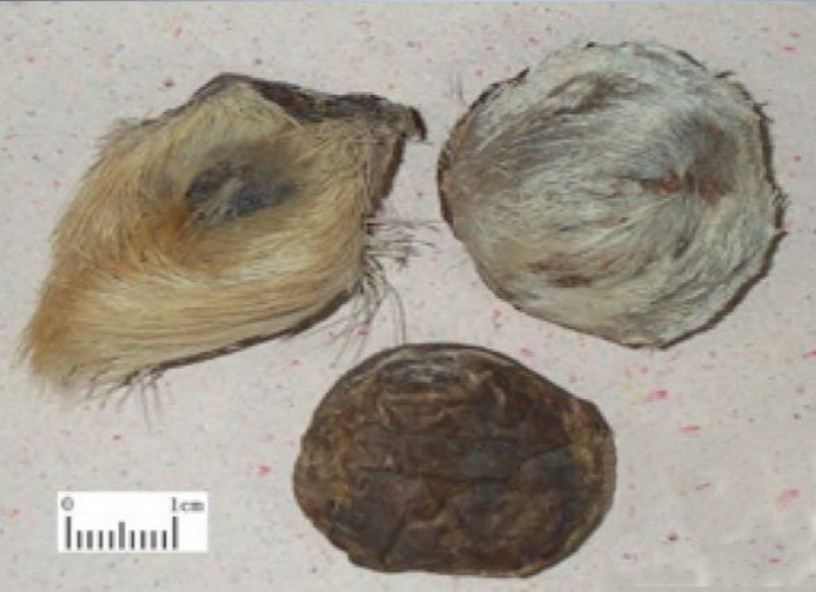
Musk is among the most expensive materials derived from an animal, worth more by weight than gold. The intensely scented dark granular paste comes from the male musk deer of the genus Moschus. Produced by a scent gland on the abdomen, the deer uses the scent to attract mating partners and mark territory. The smell of musk is pungent with a warn and powdery, yet bitter, scent profile. Its chemical characteristics translated into its use as a fixative in medieval perfumery which continues through today. Several species of musk deer are native to the forested Chinese highlands: the M. berezovskii has the greatest range in China, spreading from western central China down into northern Vietnam, the M. sifanicus covers some of this range and extend into the Tibetan plateau, the M. fuscus and M. chrysogaster roam the Himalayas and eastern Tibet, and the M. moschiferus lives in north China. In the early medieval period the Chinese knew the musk deer as primarily inhabiting the regions of Shaanxi, southern Gansu, Sichuan, and Yunnan, all regions far from the old capital cities in the Central Plain. Consequently, musk retained a sense of the semi-exotic in the medieval period.

Facts and Features

  • Medieval Chinese Name: musk (she xiang 麝香)
  • Common English Name: musk, deer musk
  • Animal Origin: paste derived from the dried contents of the preputial scent gland of several species in the Moschus genus
  • Range: Himalayan region (Northern India, Nepal, Bhutan, Tibet), northern Myanmar, northern Vietnam, southwestern China, western central China, north China [approximate range* of musk deer is shown in lavender below; range of M. moschiferus extends northward to Arctic Circle]

  • Collection Process: male musk deer is captured and killed, then the scent gland is removed and dried, turning the interior into a dark granular paste

  • Earliest Chinese Citation: 3rd–1st century BCE (lexicographic work: Approaching Elegance [Erya 爾雅])
  • Earliest Chinese Medicinal Use: 1st c. BCE – 1st century CE (Classic of Materia Medica of the Divine Husbandman [Shennong bencao jing 神農本草經])

Comments: The Chinese character for musk is found among the oracle bone corpus and a simple graphemic analysis shows a bowhunter shooting an arrow (she 射) and a deer (lu 鹿). The interpretation offered by Li Shizhen in the sixteenth century is that the musk deer projects, or shoots (she), its fragrance over a long distance. Chinese texts have the earliest citations to musk, but they appear with greater frequency around the turn of the common era. For example, musk does not appear in the traditional ritual canon of the Shang and Zhou, nor does it appear in the Mawangdui medical manuscripts from the second century BCE. Starting by at least the first century (if not earlier), musk is regularly encountered in prescriptions, formularies, and materia medica throughout the medieval period. For example, the early fourth century herbalist Ge Hong considered musk one of approximately two dozen drugs to have constantly on hand and prescribed the use of musk pellets to repel snakes in the mountains.

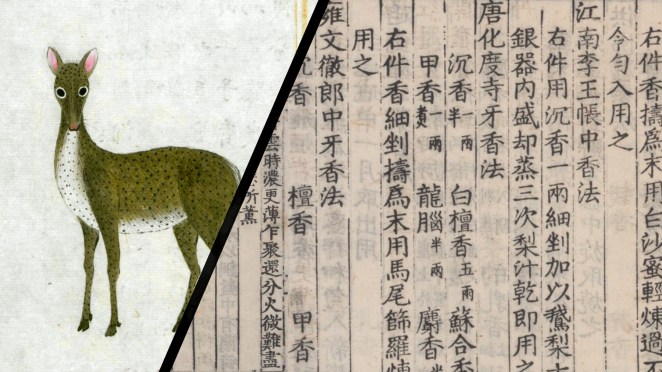
If we turn to the Classified Essentials of Materia Medica (Bencao pinhui jingyao 本草品彙精要) from 1503 we find an illustration of the musk deer. It is depicted accurately without antlers and upon close inspection we can find two small canine tusks jutting downward from the mouth.

Musk does not appear in Indic textual sources until a few centuries into the common era. This is somewhat surprising given the musk deer roamed the Indian side of the Himalayan range. Musk is also missing from classical Greek and Latin sources, including the first century Periplus Maris Erythraei, a handbook of Greco-Roman trade. Looking first at India, musk is found in the Caraka Saṃhitā, but it appears in a section that may reflect the last stratum of composition sometime around the fourth or fifth centuries. The seventh century Harṣacarita contains a clear reference to musk using what became the standard Sanskrit term kastūrī.

Curiously, however, kastūrī is a loanword from the Greek castoreum, which refers to a different animal-derived aromatic. How a Greek term came to name a natural material available in the Himalayas is difficult to understand, but it was perhaps Greek trade that spurred or supported an early Indian interest in musk. The earliest Western Asia reference to musk possibly does not come until the Byzantine Empire, such as we see in the writings of the mid-sixth century Alexandrian Greek merchant Cosmas Indicopleustes. Otherwise, another early citation to musk outside Chinese sources is found in the collection of Sogdian letters recovered in the Tarim Basin and dating to the early fourth century. Musk was included as one of the items of Sogdian trade, suggesting Sogdian merchants could have been one of the early bridges taking musk westward from China and Tibet.


* The map is intended as a general heuristic for distribution and range, it reflects selected data from modern scientific research and descriptions from medieval Chinese materia medica and gazetteers

For further information and additional references, see: Peter M. Romaskiewicz, “Sacred Smells and Strange Scents: Olfactory Imagination in Medieval Chinese Religions.” Ph.D. dissertation, University of California, Santa Barbara, 2022.

Sandalwood (tan xiang 檀香) in Medieval China

Introduction

Known for its characteristic earthy and warm scent, sandalwood is arguably the most common aromatic used in South Asian religious practice. The term sandalwood most typically refers to the fragrant heartwood of the Santalum album tree, although other Santalum species produce wood historically traded under the name sandalwood. Due to different levels of oil saturation, sandalwood’s color ranges from pale yellow to brownish red. Moreover, because the oil helps in preservation and due to the wood’s naturally close grain, sandalwood is also ideal for making finely carved objects. The heartwood closest to the tree root contains the most oil, consequently sandalwood harvesting typically requires the destruction of the tree. Curiously, the S. album tree may not have been native to southern India, but was indigenous to the eastern parts of the Indonesian archipelago. Archaeobotanical wood charcoal remains, identified as Santalum, were found in the southern Deccan and have been dated to ca. 1300 BC, suggesting the tree was cultivated by humans very early in southern India. When sandalwood was introduced to China sometime during the Han Dynasty, the Chinese apparently considered it a type of native rosewood and used that tree’s name, tan 檀, to translate the foreign aromatic wood.

Facts and Features

  • Medieval Chinese Name: “Rosewood” Aromatic (tan xiang 檀香), Chantan Aromatic (chantan xiang 旃檀香; approximating Sanskrit candana)(among others)
  • Common English Name: sandalwood
  • Botanical Origin: oil-saturated heartwood of several species in the Santalum genus, but most typically the Santalum album tree
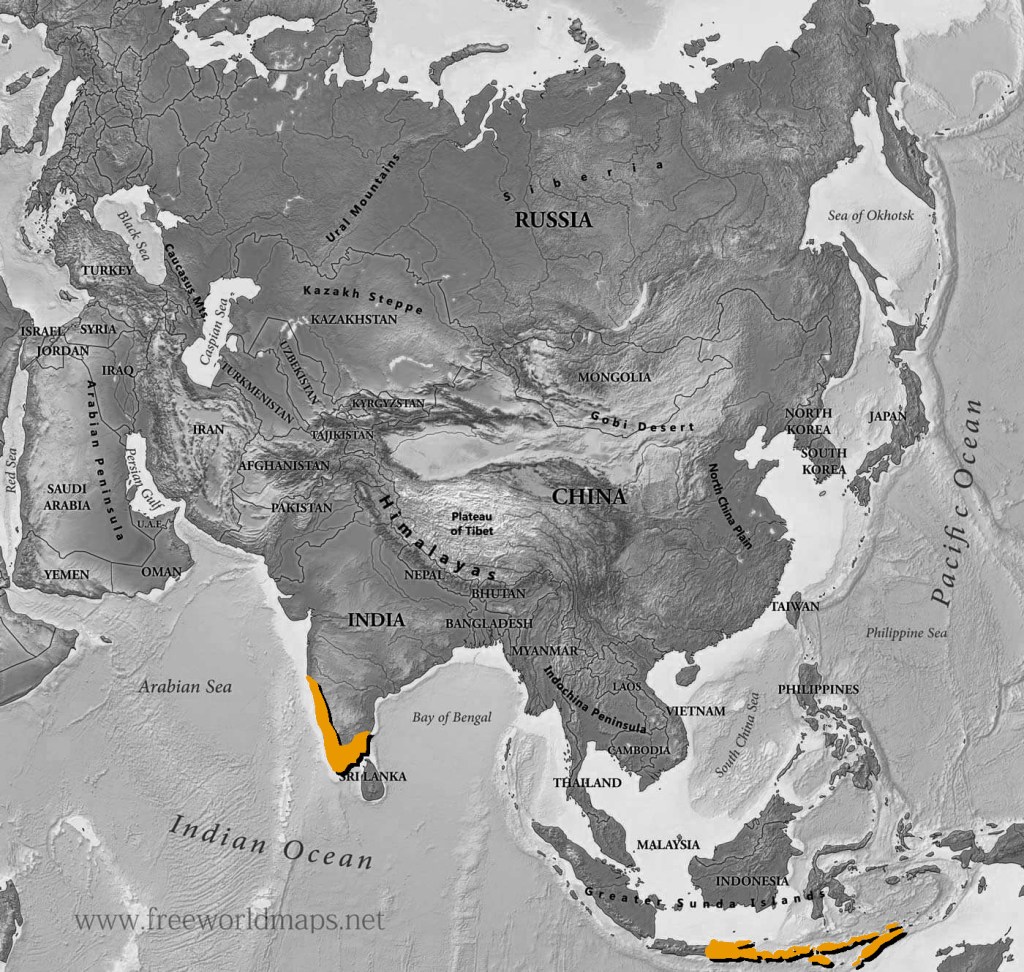
  • Phytogeographic Distribution: (S. album) Indonesian archipelago (eastern Java, Lesser Sunda Islands, and Timor), cultivated in southern India [approximate distribution* is shown in orange below]

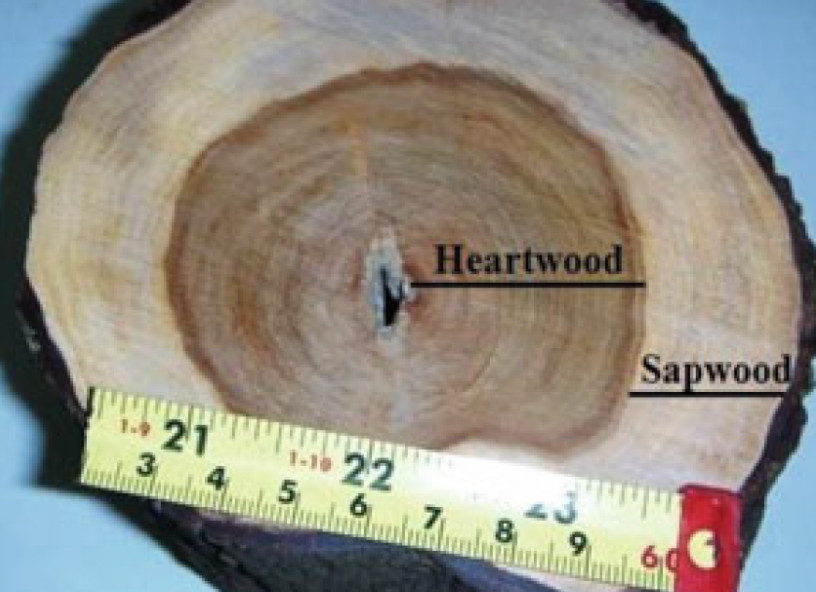
  • Harvesting Process: Yellowish fragrant heartwood is cut away from the lighter colored, non-scented sapwood; this processes often requires the destruction of the tree as the greatest concentration of oil is near its base and especially in its roots

  • Earliest Chinese Citation: late 2nd century (in translated Buddhist sutras: e.g. Daodi jing 道地經 (Yogācārabhūmi)[possibly earlier Western Han sources?]
  • Earliest Chinese Medicinal Use: late 5th century (Collected Annotations on the Classic of Materia Medica of the Divine Husbandman [Shennong bencao jing jizhu 神農本草集注])

Comments: Despite the cultural and religious prominence of sandalwood in medieval India, especially among Buddhists, Chinese citations to this important aromatic are relatively sparse well into the fifth century. This comes into a more stark relief when compared to early Chinese citations to Mediterranean storax, Moluccan cloves, Vietnamese aloeswood, Arabian frankincense, and Indian costus root during this same period. Even into the Tang, the source of imported sandalwood, either from southern India or the eastern end of the Indonesian archipelago, remain obscure in Chinese sources. Nevertheless, this should not be mistaken for total ignorance, as sandalwood emerges in China as an important religious and artistic medium, especially with the circulation of the legend of the Udayana Buddha sandalwood image starting at the end of the fourth century.

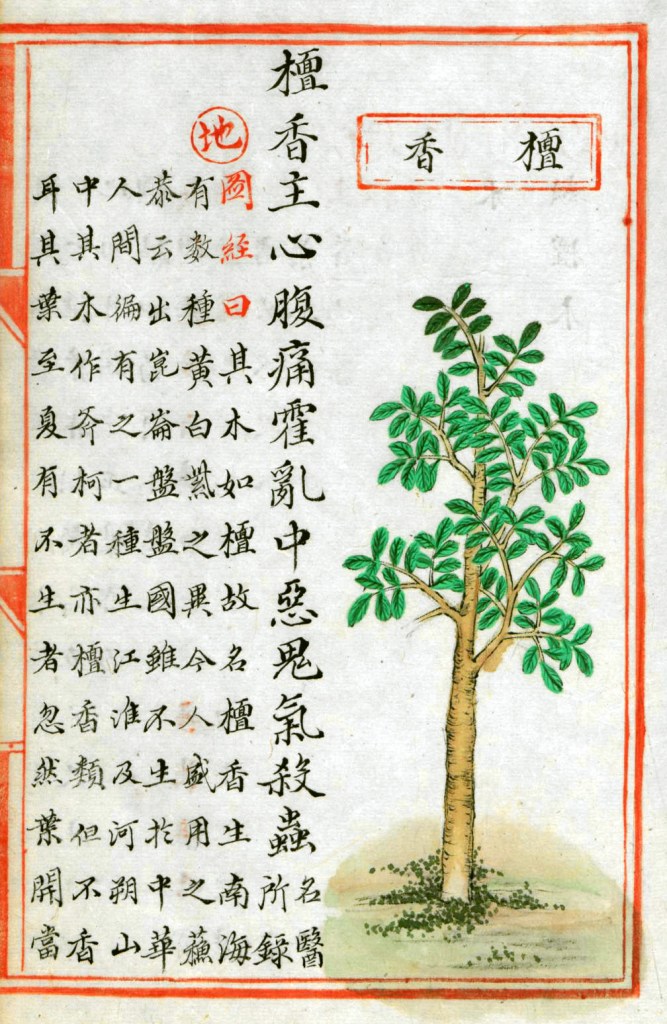
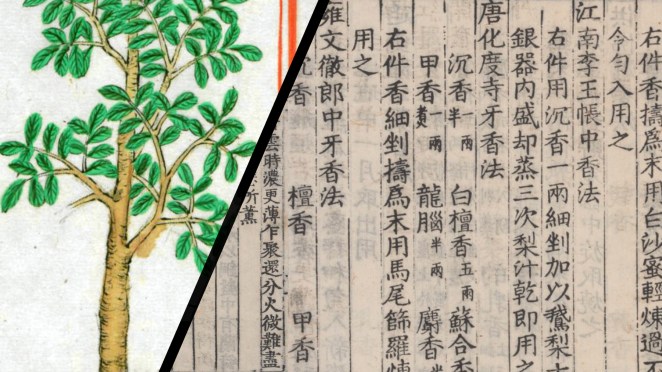
If we turn to the Classified Essentials of Materia Medica (Bencao pinhui jingyao 本草品彙精要) from 1503 we find an illustration of the sandalwood tree. It bears a resemblance to the relatively small S. album of Southern India with lanceolate-elliptic leaf anatomy.

Older scholarship had claimed sandalwood was cited in the Old Testament as a building material for Solomon’s temple, but this view has largely been abandoned. Equally, the claim that Egyptians employed sandalwood during the embalming process of mummies was poorly documented and has been rejected as unlikely. Turning to Greek and Roman sources, the purported citation to sandalwood in the first century Periplus Maris Erythraei has recently been emended, with good evidence, to teak. It also appears neither Pliny nor Dioscorides mention sandalwood in their first century works. Based on the strongest available evidence, it is only in the mid-sixth century when the Alexandrian Greek merchant Cosmas Indicopleustes indisputably refers to Indian sandalwood.  

The Sanskrit term for sandalwood, candana, has long textual history in India and can be found in Yāska’s Nirukta which was compiled before the third century BCE. In the final compilation of the Arthaśāstra, conservatively dated to the first century, sixteen different types candana are listed (all may not properly refer to sandalwood). In terms of use, both the Mahābhārata and the Ramāyaṇa, which may be of a later date, speak of candana made into a paste and smeared on the body.


* The map is intended as a general heuristic for distribution and range, it reflects selected data from modern scientific research and descriptions from medieval Chinese materia medica and gazetteers

For further information and additional references, see: Peter M. Romaskiewicz, “Sacred Smells and Strange Scents: Olfactory Imagination in Medieval Chinese Religions.” Ph.D. dissertation, University of California, Santa Barbara, 2022.


Camphor (longnao xiang 龍腦香) in Medieval China

Introduction

Medieval camphor was sourced from a relatively confined area in the South China Seas, but was nevertheless well-known across all of South and East Asia as well as the Eastern Mediterranean. Camphor was famous for its crystalline appearance and bright, cooling smell. Historically, medieval camphor needs to be distinguished from modern common camphor which has a similar appearance and smell, but which derives from an entirely different family of tree. Medieval camphor was primarily solidified oleoresin crystals that formed within the cavities of the Dryobalanops aromatica tree. Not all trees contained pockets of camphor crystals, making the aromatic rare and highly valued. For reasons that are not well understood, the medieval Chinese name for camphor, Dragon Brain Aromatic, was named after the draconic anatomy. Dragons had long been associated with water, so perhaps the origin of camphor in the seas to the far south of China helped shape this peculiar name.  

Facts and Features

  • Medieval Chinese Name: Dragon Brain Aromatic (longnao xiang 龍腦香) (among others, including names for different commercial grades)
  • Common English Name: camphor, Borneo camphor, borneol
  • Botanical Origin: solidified oleoresin that forms in cavities of the Dryobalanops aromatica tree
  • Phytogeographic Distribution: northern Sumatra, the southern Malay Peninsula, northern Borneo [approximate distribution* is shown in crosshatched white below]

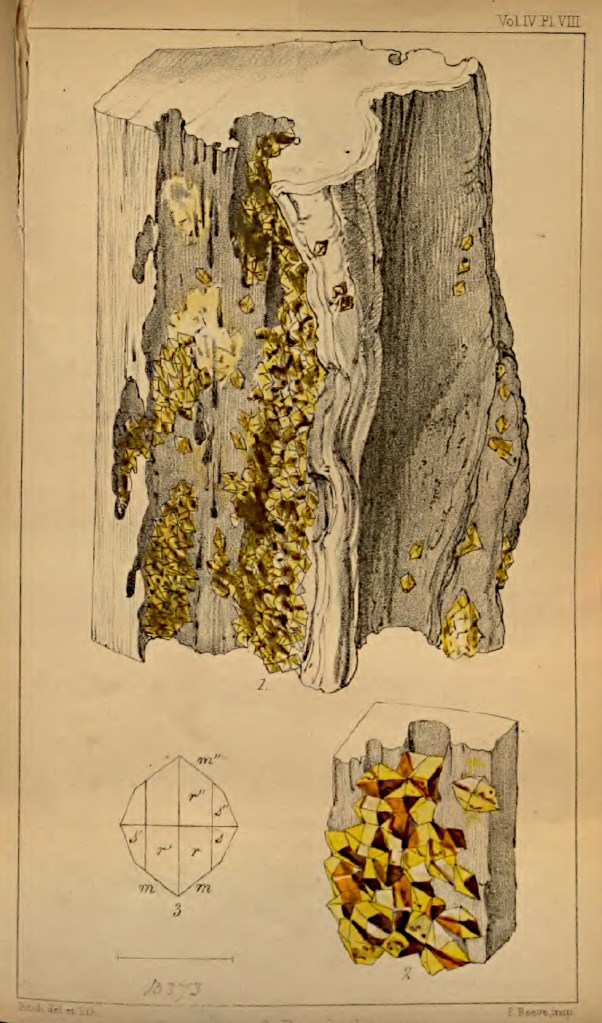
  • Harvesting Process: Tree is felled and split into logs allowing crystalline camphor deposits to be removed, sometimes a viscous oleoresin that smells of camphor is also collected [NB: the gold tinting of the illustration below is stylistic, camphor crystals are clear-white]

  • Earliest Chinese Citation: early 6th century (translated Buddhist sutras: e.g. Miscellaneous Collection of Dhāraṇī [Tuoluoni zaji 陀羅尼雜集]); mid-7th century (dynastic history: Book of Liang [Liangshu 梁書])
  • Earliest Chinese Medicinal Use: late 5th century? (Collected Annotations on the Classic of Materia Medica of the Divine Husbandman [Shennong bencao jing jizhu 神農本草集注]); mid-7th century (Newly Revised Materia Medica [Xinxiu bencao 新修本草])

Comments: In medieval China camphor was first known as an export from kingdoms along the Malay Peninsula. Another camphor product known the Ointment of Barus was a viscous oleoresin “oil” often associated with Sumatra. Not all of the towering Dryobalanops aromatica tress produce camphor crystals or camphor oil, however, thus adding to the difficulty in acquiring these highly-valued aromatics. It is likely this rarity spurred the creation of sublimated and distilled common camphor which comes from the Cinnamomum camphora (zhang 樟) found in southern and eastern China, as well as northern Vietnam, Taiwan, and Japan. When this shift started to happen is not well documented, but the mid-to-late eleventh century bears some indications of this change.

If we look at the Classified Essentials of Materia Medica (Bencao pinhui jingyao 本草品彙精要) from 1503, we find a depiction of camphor collecting. Against expectation, however, the tree is cited as growing in Guangzhou, an impossibility for the D. aromatica. It appears the illustrator conflated it with the native C.camphora. Nevertheless, the illustration shows how portions of the D. aromatica tree were cut off to expose the pockets of camphor. The collector could then scrape the crystals from the wood into a collection basket.

Reconstructing the history of the circulation of camphor in the medieval world has been hampered in part by the confusion between camphor from the D. aromatica and the C.camphora. For example, it was thought the residue of C.camphora camphor was found wrapped inside a second century BCE Egyptian mummy, but such a claim is without warrant. The chemical residue more likely came from some East African flora that has the same chemical profile, such as Ocotea usambarensis (East African camphorwood) or Ocimum kilimandscharicum (East African camphor basil).

The medieval camphor under main consideration here was not known to Western Asia until the Byzantine Empire when it was noted by Aetius of Amida (ca.500–ca. 575). The history of camphor in India is rather complex as it seems there was an abundance of trade throughout the medieval period whereby India was sometimes portrayed as producing camphor, perhaps using a native Indian substitute. Most of these speculations remain poorly supported. As it stands, the earliest Indic citation to camphor may be the Great Compendium (Bṛhatsaṃhitā) of Varāhamihira in the mid-sixth century. The earliest world-wide citation to camphor, however, is curious and just-so happens to place it in medieval China. By happenstance, a bundle of letters was discovered in western China in the early twentieth century composed in Sogdian. One letter talks about purchasing camphor at Loulan at the eastern end of the Tarim Basin. The bundle of letters have been dated to the early part of the fourth century.


* The map is intended as a general heuristic for distribution and range, it reflects selected data from modern scientific research and descriptions from medieval Chinese materia medica and gazetteers

For further information and additional references, see: Peter M. Romaskiewicz, “Sacred Smells and Strange Scents: Olfactory Imagination in Medieval Chinese Religions.” Ph.D. dissertation, University of California, Santa Barbara, 2022.


Aloeswood (chen xiang 沈香) in Medieval China

Introduction

Aloeswood has long been considered among the premier perfuming and incense ingredients in East Asia, arguably similar to the historical importance of frankincense in West Asia and Europe. Aloeswood remains the costliest wood in the world and is known for it rich and complex scent profile. Notably, the creation of fragrant resin-infused aloeswood occurs only under specific conditions of stress upon the tree. Moreover, aloeswood forms unevenly within the tree’s wood fibers, thus harvested aloeswood pieces can be relatively small and irregular in shape. As a consequence, aloeswood pieces have been graded in terms of resin content, color, and scent quality since the early medieval period. The most densely resinous pieces of aloeswood will sink in water, a peculiar characteristic that gave rise to the medieval Chinese name, Sinking in Water Aromatic.

Facts and Features

  • Medieval Chinese Name: Sinking in Water Aromatic (chenshui xiang 沈水香), Sinking Aromatic (chen xiang 沈香; J. jinkō) (among others, including names for different commercial grades)
  • Common English Name: aloeswood, agarwood, gharuwood
  • Botanical Origin: Resin-infused heartwood produced by several species in the Aquilaria genus (esp. A. malaccensis, A. crassna, A. sinensis)
  • Phytogeographic Distribution: Northeast India into the Malay Peninsula, Indonesian Archipelago, Indochinese Peninsula, southern China, eastern Borneo, Philippines [approximate distribution* is shown in blue below]

  • Harvesting Process: Darker colored fragrant aloeswood is cut away from the lighter colored, non-scented sapwood; this incurs considerable damage to the tree as its limbs are hewn off or the tree is felled and cut apart

  • Earliest Chinese Citation: late 2nd century (translated Buddhist sutras: e.g. Daodi jing 道地經 [Yogācārabhūmi]); mid-to-late 3rd century (regional gazetteers: e.g. Treatise on Strange Things of the Southern Regions [Nanzhou yiwu zhi 南州異物志])
  • Earliest Chinese Medicinal Use: 3rd/4th– late 5th century (Supplementary Record by Famous Physicians [Mingyi bielu 名醫別錄] and Collected Annotations on the Classic of Materia Medica of the Divine Husbandman [Shennong bencao jing jizhu 神農本草集注])

Comments: In early medieval China, aloeswood was known as an export of the Indochinese Peninsula, especially from what is now central and southern Vietnam. Aquilaria trees also grow in the southern Chinese tropics and I suggest it was as early as the mid-fifth century when domestic harvesting of aloeswood begins. China continued to received imports and tributes of aloeswood through the Tang and Song dynasties and supplemented with goods obtained from native trees in the far south.

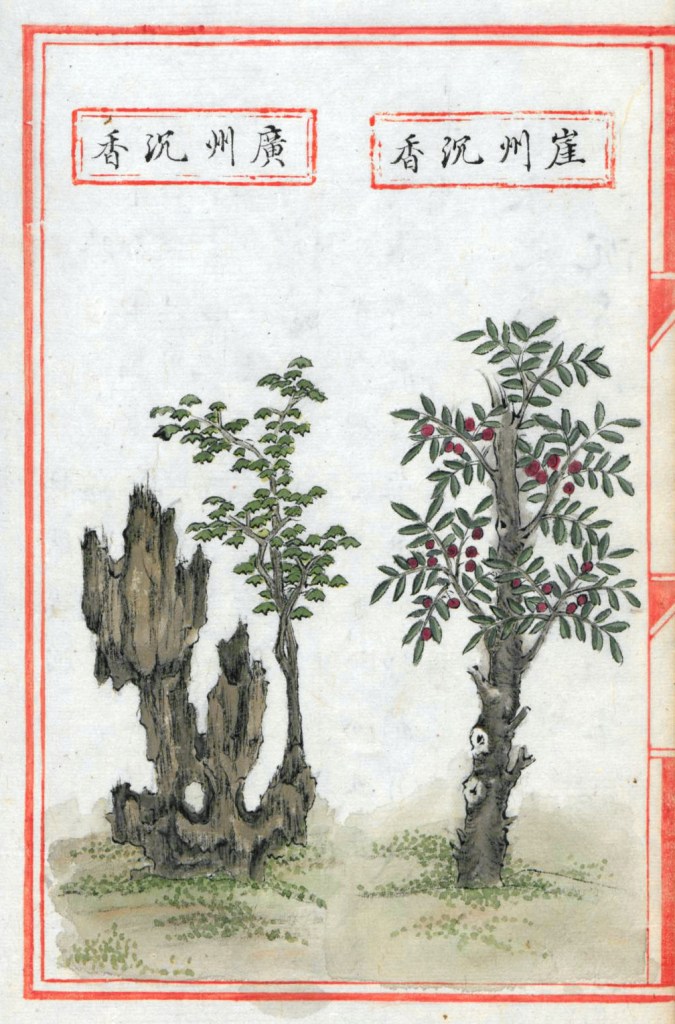
If we look at the Classified Essentials of Materia Medica (Bencao pinhui jingyao 本草品彙精要) from 1503, we see two illustrations of aloeswood, one labelled (on the right) as being from Yazhou 崖州, present day Sanya on southern Hainan Island, and the other labelled (on the left) Guangya 廣州, the present day region around Guangzhou. By the late medieval period aloeswood from Hainan was considered superior to the continental variety. It is worth noting at the outset that this pair of illustrations depict two very different types of tree. The illustration on the right shows a fruiting tree with simple (unlobed) ovate leaves, while the illustration on the left show a smaller tree or sapling with distinctive tri-lobed leaves.

It is also worth noting that both illustrations may suggest aloeswood harvesting. For example, the tree on the right has lost its lower branches, reflecting a method of harvesting associated with Hainan in the late medieval period. The illustration on the left might depict, rather crudely, the more ruinous harvesting practices associated with continental China. At the very least, the larger irregular tree section resembles a carved out aloeswood piece.

Older scholarship has claimed aloeswood was used by the Egyptians for embalming and was further referenced in the Old Testament, but these views have been largely abandoned. A more firm identification can be found in the first century when the Greek physician Dioscorides describes aloeswood as a product of India and Arabia (likely via transshipment). Aloeswood is mentioned in several classic Indic texts, such as the Mahābhārata, Arthaśāstra, Suśruta Saṃhitā, and Caraka Saṃhitā. The earliest citations are conservatively placed in the first few centuries of the common era. Moreover, Indic sources associate the aromatic wood with northeastern India, the only regional area where Aquilaria trees classically occurred.


* The map is intended as a general heuristic for distribution and range, it reflects selected data from modern scientific research and descriptions from medieval Chinese materia medica and gazetteers

For further information and additional references, see: Peter M. Romaskiewicz, “Sacred Smells and Strange Scents: Olfactory Imagination in Medieval Chinese Religions.” Ph.D. dissertation, University of California, Santa Barbara, 2022.