
Introduction
Questions drive thinking.
As I’ve discussed before, “punctuated lecturing” has its rightful place in the repertoire of a university instructor. When we lecture, however, we are often placed in the role of answering questions posed by students. An equally important skill is the ability to ask probing questions of students.
When we want to stimulate class discussion, having the ability to generate, hold, and gently direct conversation requires a bit of mental dexterity and social finesse. But these aspects are built upon a foundation of effective questioning strategies.
I’ll freely admit, discussion can be a slog at times. But having a range of questioning strategies can make us better prepared to face the wilds – and natural beauty – of the discussion-based classroom.
Below, I offer several of the slides I presented for a workshop organized by my university’s Instructional Development program. I will also provide some commentary and context to the slides themselves.
Crib Notes: Of the strategies I’ve found easiest to implement are Checking for Understanding questions and Redirection questions (third section below). Arguably of greater importance, however, is creating a classroom culture of student discussion. This is often developed through other strategies discussed below, such as Priming the Pump, and well as structured, time-constrained Group Activities.
1. Setting the Stage
Using Mentimeter, I first asked the workshop participants “Why should we ask students questions? (Why not just lecture at them all the time?)” This was a not-so-sly way to introduce two different techniques I would discuss: Entrance Tickets (“Priming the Pump,” see below) and the critical rephrasing of questions (“Stirring the Silence”). Nevertheless, I was not expecting such thoughtful, insightful replies created on the spot (I should have known better):

After recapping some of the comments (and asking about some of the jargon in the responses), it was clear the room was already actively engaged, which is the purpose of an exercise such as this. After noting the importance of using questions to drive and develop student thinking, we dove into several actionable strategies. Overall, I planned to address six different sets of techniques and protocols.

2. Priming & Phrasing
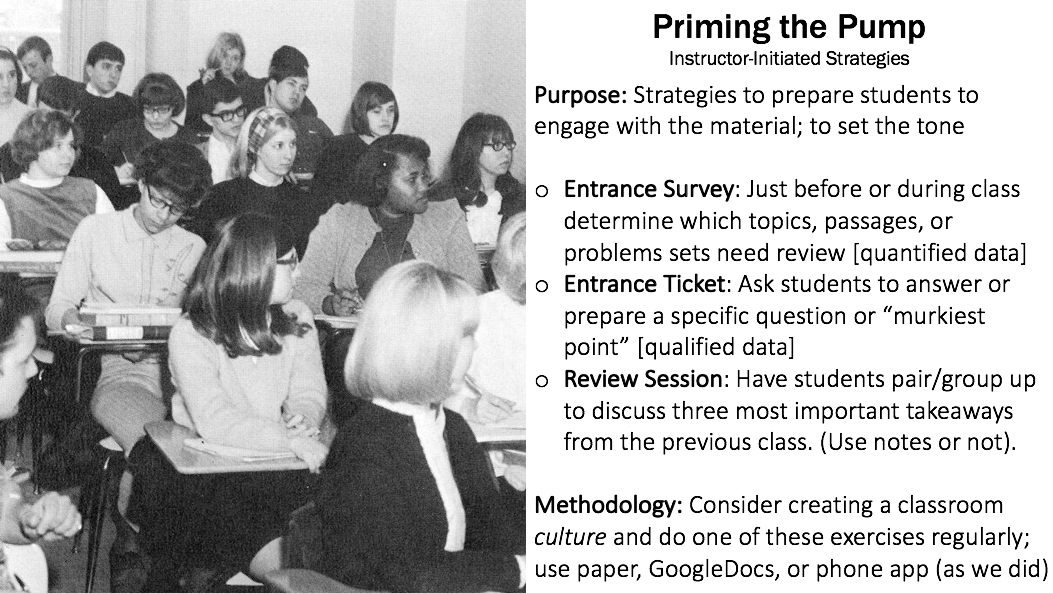
The first group of strategies was oriented around fielding potential discussion topics and priming the students to think about the day’s material. Moreover, asking questions as soon as students arrive in class creates an expectation that they need to engage and, hopefully, contribute to our discussion (if not individually, in small groups).
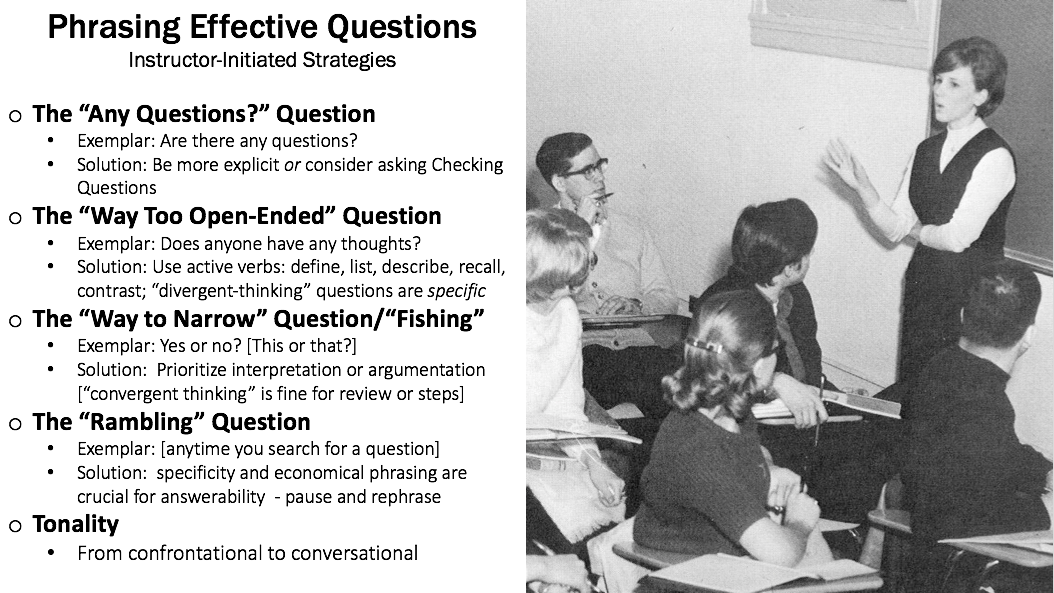
The second grouping of strategies concerned the general phrasing of questions. Several very common forms of questions, while valid in certain contexts, can also sometimes be squealing-brake showstoppers. These are potential problems that need solutions.
3. Understanding & Redirection
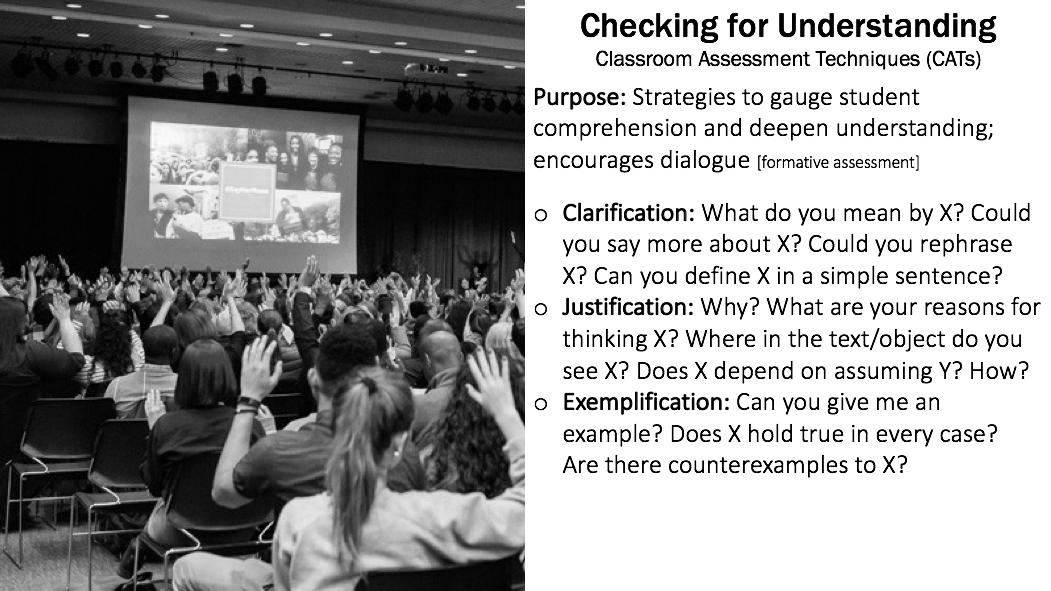
We next moved to a series of strategies developed to provoke more complex conceptual processes. These form a broad category of questions sometimes called Checking Questions or Checking for Understanding Questions. When wielded artfully, these can turn a rather blasé response into a moment of valuable class reflection. Truthfully, many of us already have these in our repertoire, with the most common simply being the follow-up question, “why?” (under “justification” in the slide below).

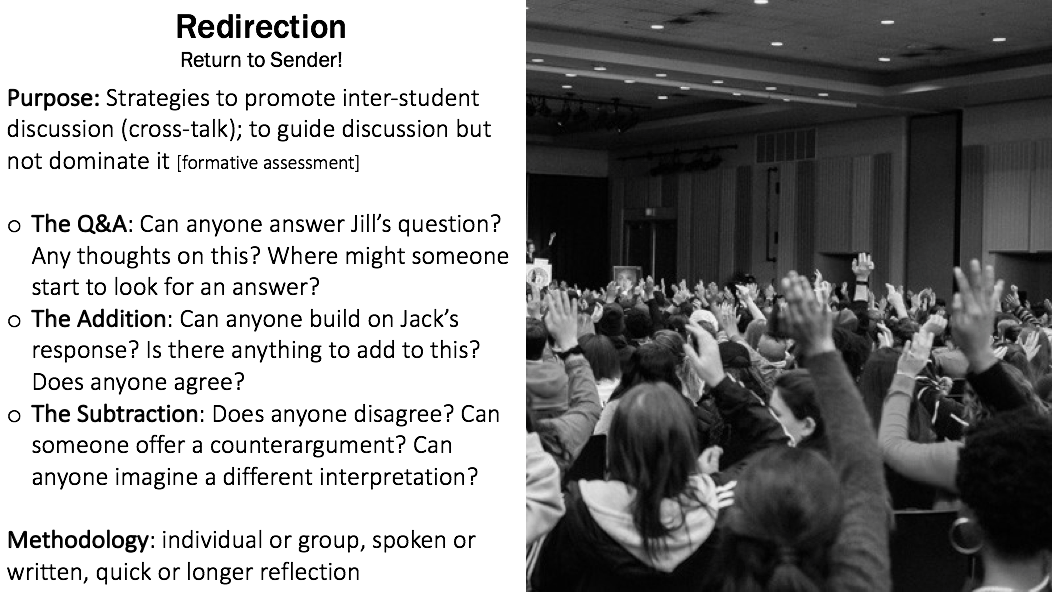
The next set of techniques are used to try and “decenter” the classroom from the instructor. The back-and-forth “yo-yo” pattern between student and instructor is modified to include more inter-student “cross-talk.” In many cases, the instructor still remains the moderator, but that largely depends on the purpose of the discussion exercise.
4. Stirring the Silence & Reviving the Dead
The last pair of strategies were protocols I’ve casually developed when consulting with other TA’s and instructors about how they handle general classroom unresponsiveness. Specifically, when a question to the class appears to be “dead-on-arrival.”


In the last few minutes of our workshop, we turned to the potentially awkward social scenario of a “wrong” or “non-optimal” student response to one of our questions (I prepared no slides for this, I preferred to hear what others thought). We discussed some ways that we’ve maneuvered through this scenario, always mindful of not chastising or “isolating” the student. Depending on the type of question, I’ve often found asking “why?” helps to determining the student’s reasoning. In some cases the rationale may be sound, but just not what I am “looking for,” and thus allows me to thank the student (“That’s a good take, I didn’t think of that”) and pivot to another response. Otherwise, if there’s a problem in the rationale, I may try to give clues to see if the student can find his or her own mistake (or problematic assumption) and offer a chance to respond again. Other times, I may ask for another student to provide a counterargument. In the end, I usually try to validate some aspect of the student’s original response, if possible. (Particularly sensitive or controversial views may need a different approach, but that’s a discussion for another workshop.)
I closed our workshop by handing out “Exit Tickets” – providing a moment of reflection for people to think about something that was meaningful or even unclear to them. I was curious which strategies were the most helpful to my workshop attendees; I received a range of replies. Around half explicitly noted the value of Redirection. Another large chunk approved of the Reviving the Dead, and the rest were evenly split between Checking for Understanding and Priming the Pump (Mentimeter is frequently a hit).
Last Thoughts: This was my last Instructional Development workshop for the academic year and the amount I’ve learned in the process has been quite gratifying. Of the workshops I’ve given, this was probably the most time intensive and interesting for me to think about, as well as the best attended (with Managing Teaching Anxiety being a close second). Is it just coincidence that the two workshops I’ve offered that most directly deal with student interactions were the most attended? Nevertheless, I will now be transitioning into my role as a facilitator for the Summer Teaching Institute for Associates, more workshop planning abounds!
Workshop Posts







 Personal Site of Peter Romaskiewicz