Two centuries before the common era, ideas about immortal beings residing in distant mountains started to gain popularity in the Chinese imperial court. The first emperor of a unified China, Qin Shihuang (r. 221 – 210 BCE) even sent a mission to locate the isles of immortals believed to exist off the eastern coast in his quest for an elixir that would extend his life. Ideas like these reflect the social, political, and religious significations of mountains in the ancient Chinese imagination.
As a generic type, the boshan lu 博山爐 or “mountain censer,” represents a long East Asian artistic tradition of crafting incense burners in the shape of a mountain. The form first originated in the second century BCE and continued for hundreds of years, albeit with lessening popularity through the later medieval period. The apex production of mountain censers was during the Han Dynasty (202 BCE–220 CE) when bronze foundries perfected the delicate craftsmanship necessary to create ornate mountainscapes crawling with people and fantastic creatures. Apertures hidden within the craggy rock face would emit the smell of fragrant incense and animate the visual scene with curls of rising smoke.
After the Han, the mountain censer was more frequently crafted in ceramic and regional variations started appear. This would sometimes create an object that bore only the faintest resemblance to the Han prototypes. Floral elements became increasingly common, sometimes completely replacing the mountain cliffs with petals. Abstraction became the norm as more regional kilns started to produce mountain censers in addition to a range of different censer designs.
Here I provide a simple visual narrative of the mountain censer with minimal commentary. If you’d like more information about these censers I’ll leave a few references at the end.
Too often, East Asian art history books, or even world art textbooks, show one among a handful of very early, and very ornate, mountain censer specimens. It’s typically one of the first three below. These designs were all made for members of the imperial family and the ornate design did not last very long. The presentation below is to demonstrate how the mountain censer form underwent significant changes throughout the centuries.
Each image below is made in a 16×9 slide format; feel free to download the images for classroom use. You can contact me at peter.romaskiewicz@gmail.com.
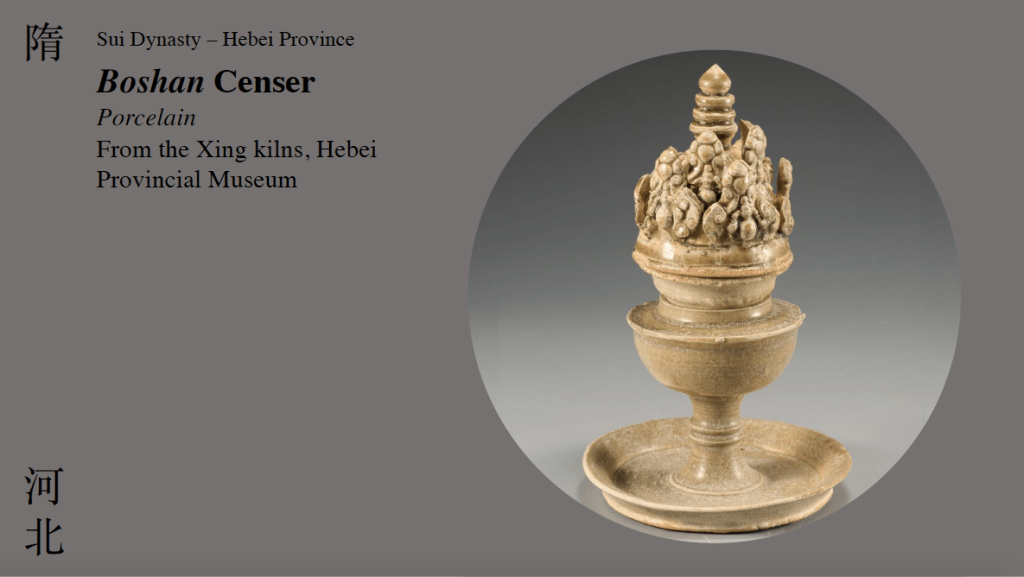
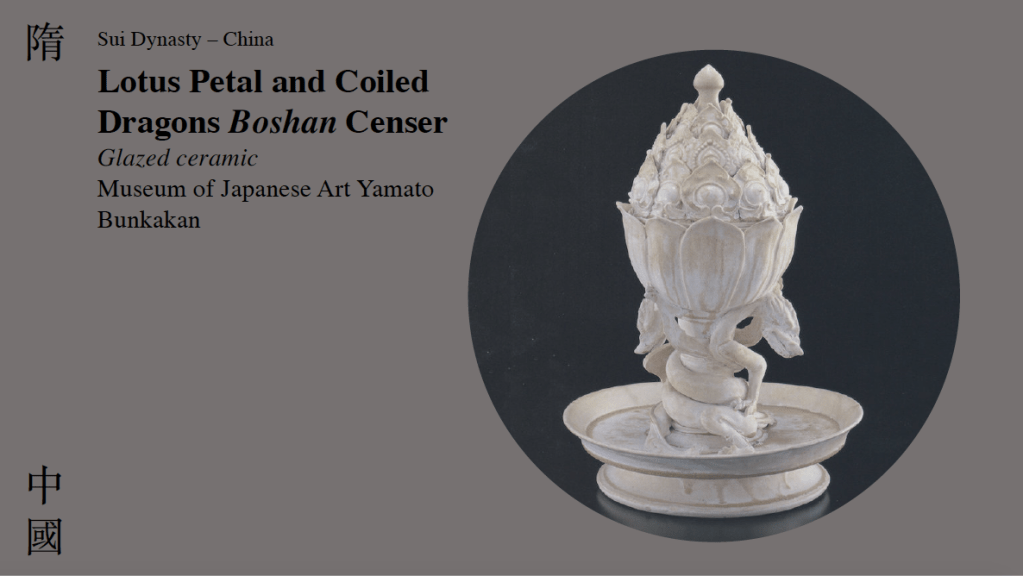
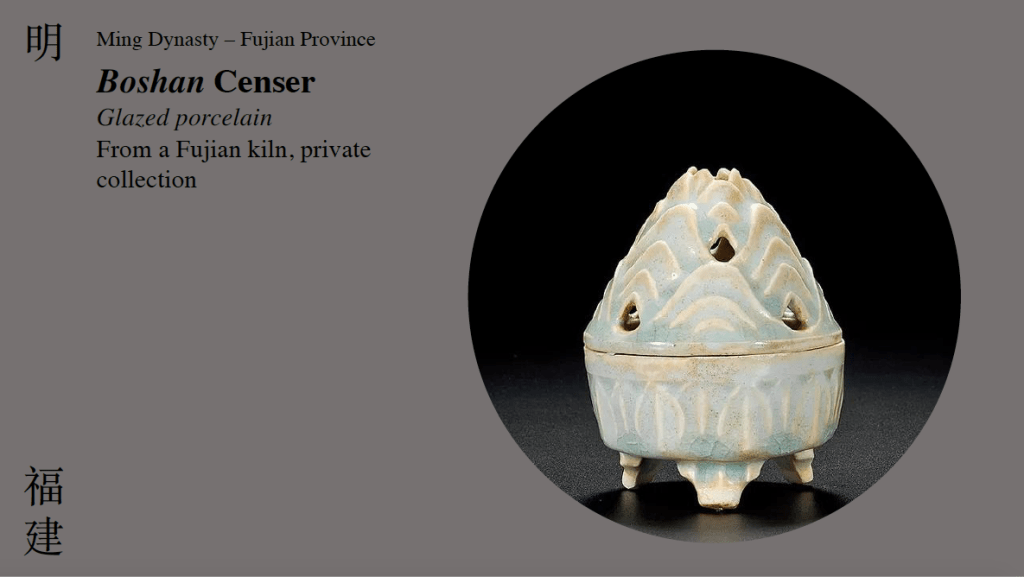
Standing at nearly 11 inches in height, this is an exquisitely crafted vessel. Small figures of humans and animal are included in the folds of the rocks. It has become customary for modern scholars to claim mountain censers depict the land of the immortals (xian 仙), mythic beings envisioned since the Han to occupy islands off China’s eastern coast . The mountain censer is most often believed to depict the immortal isle of Penglai 蓬萊 rising up from the sea. Animal motifs were frequently incorporated into the decor of the mountain censer. The lower register of openwork around the lid here depicts fantastic beasts such as the dragon and phoenix. Many mountain censer have trays; their use has been in dispute since the Song dynasty. Some claim the trays were used to hold water to cool the device when in use (and also vivifying their representation of the isles of the immortals), while others claim it was for catching ash. This censer has two inscriptions telling us that it was cast in 137 BCE and made to be housed in the imperial Weiyang Palace (Weiyang gong 未央宮). The censer body is held aloft by gilded bronze bamboo stem that terminates at the top with three dragons holding the basin.Because mountain censers appear in the archaeological record rather suddenly, one scholar, Jessica Rawson, has proposed a hypothesis that older Central Asian censers with conical lids may have inspired Chinese artisans. The “Rawson hypothesis” is partly founded on a well-known claim – that by the second century BCE, China had ongoing contact with regions further west.Metal workers would sometimes embellish the stem of the vessel with creatures, here depicting a bird or phoenix standing atop a turtle while holding the censer basin in its beak. Above, we saw a man atop a beast holding the censer. Below, we will see two twisting dragons acting as the stem.Chinese archaeologists unearth amazing finds every year. This mountain censer was recovered from a tomb discovered in 2011. The original excavation report claimed to find the residue of burned aromatics inside the vessel. Many recovered mountain censers are more simple in design, sometimes rendering the mountain with less embellishments and less sculptural depth. Concerns with functionality are also expressed; this censer is fashioned with a hinge (seen on the right side) so the lid can be flipped open. Through the Han and into the Jin, more mountain censers were made in ceramic. This one includes a bird at the top, a feature that also appears in earlier bronze mountain censer designs, as well as older Chinese incense burners that are shaped like chalices (i.e. ritual dou 豆 vessels). Many ceramicists started to play with the basic design of the mountain censer, creating far more abstract renditions. Here the mountain cliffs resemble the petals of a flower calyx or even the fingers of a flickering flame.Significant regional differences also start to manifest in ceramic mountain censer designs. The previous two examples were produces at kilns in modern Zhejiang, while this specimen was made in Jiangxi. Note, for example, the elongated rocky outcroppings and the overall taller profile. While there was a native Chinese artistic tradition of depicting lotus flowers, the influence of Buddhist motifs, especially the frequent use of new lotus flower imagery, cannot be overlooked in later mountain censer designs. Curiously, we find a head protruding from the lotus placed atop this censer lid. The abstract horn shapes surrounding the body of the censer was popular in the kilns of Fujian.Here we see the side of a lotus flower etched into the censer basin.This ceramic censer is influenced by the Buddhist sculptural and architectural tradition of reliquaries, known in Sanskrit as stūpa. As was commonly seen in those forms, and here, a spire with discs was placed atop the structure. One of the more common elements in later medieval censer design was to render the basin into a lotus by surrounding it with petals. Similar to the above design, in addition to the lotus petals, the top of the lid was decorated with a flaming pearl motif, representative of the iconography of the Buddhist wish-fulfilling gem (in Sanskrit, cintamani).The mountain censer design lasted into the Song, a full thousand years after it first appeared. By this time, the mountain censer was just one incense burner design among many and it no longer garnered the same social significance of centuries earlier.The Song was also a period of great trade in foreign incense, with frankincense and aloeswood being two of the more popular imports into China.This simple, but elegant design that gained popularity in the Song was continued through to the Ming. You can see the faint design of lotus petals around the basin. As late as one hundred years ago, before the widespread use of modern archaeological techniques, it was believed that mountain censers were the first type of incense burner in China. New finds have shown that incense burners go back to the third century BCE, if not much earlier (this depends on how we define the shape of a censer). Arguably one of the more elaborate and beautiful mountain censers was excavated in Korea in 1993. Standing at over two feet tall, it is considered a National Treasure of Korea.
Further Reading [English Resources]
Erickson, Susan N. 1992. “Boshanlu: Mountain Censers of the Western Han Period: A Typological and Iconological Analysis,” Archives of Asian Art, Vol. 45, pp. 6-28.
Kirkova, Zornika. 2018. “Sacred Mountains, Abandoned Women, and Upright Officials: Facets of the Incense Burner in Early Medieval Chinese Poetry,” Early Medieval China, Vol. 24, pp. 53-81.
Laufer, Berthold. 1909 [1962]. Chinese Pottery of the Han Dynasty. Leiden: E.J. Brill.
Rawson, Jessica. 2006. “The Chinese Hill Censer, Boshan lu: A Note on Origins, Influences and Meanings,” Arts Asiatiques, Vol. 61, pp. 75-86.
Romaskiewicz, Peter M. 2022. “Sacred Smells and Strange Scents: Olfactory Imagination in Medieval Chinese Religions.” Ph.D. dissertation, University of California, Santa Barbara.
Wenley, A.G. 1948/1949. “The Question of the Po-Shan-Hsiang-Lu,” Archives of the Chinese Art Society of America, Vol. 3, pp. 5-12.
*There are hundreds of mountain censer designs, I tried to select versions where I could find a good, high-resolution photograph and information about its provenance and current ownership. I claim no ownership of the original photos and only use them here for educational purposes. The censers noted as part of a private collection were found on Chinese auction sites with no indication of the identity of the final bidder.







 Personal Site of Peter Romaskiewicz