On Readings and Reading – and Double Entry Notebooks

Introduction

Is it preposterous to claim you’ll teach a university student “how to read”?

At one level, absolutely. Students have been reading for quite a while and are skilled at digesting and summarizing information. But, reading for information (and its close analogue, reading for comprehension) is only one way of reading, and one that serves foundational, but also a minimal, purpose for classes I teach.

Yet, not all readings are equal. Some texts are seemingly impenetrable even for scholars, and reading to simply comprehend a text might be challenging enough for students. Thus, selecting appropriate readings and instructing students how to read them are important steps in the pedagogical “decision tree.”


Reading Genres

For survey classes like the one I’m designing currently, introductory textbooks are a clear option. They are effective at delivering a broad range of ideas and terms in easily comprehensible language, and sometimes they are outfitted with convenient illustrations, maps, and charts. Yet, there are limitations to textbooks. Oftentimes, they do not include sufficient primary sources or documents (important if you are taking an historical approach) and due to their style, they tend to be pretty boring reads. Related, and often overlooked, the genre of textbooks are written as broad summaries, and as such do not function a good rhetorical models for student writing. They frequently present data as neutral facts, overlooking the (more interesting!) scholarly debates that breathe life into the field. Consequently textbook authors do not write in an argumentative style that builds to a thesis derived from evidence.

Admittedly, this may not be a concern for many, but I’d prefer to have students engage the genre of writing I’m hoping they will practice writing. I’ve come to think of textbooks as reference handbooks that function in a very similar fashion to good encyclopedia articles – informative, but uninspiring.

Other options include more formal scholarship, such as journal articles, chapters from anthologies, chapters from monographs, or even entire scholarly books. These will typically be analytically focused (and I’d argue, more interesting) and generally model good argumentative writing. Of course, these texts are not written for novice scholars like our students, and at times will assume knowledge our students simply do not have. But I think we should recognize some authors and topics are more welcoming than others, and I do not think this concern should eliminate readings such as these out of hand. In many cases, a good introduction to the text could greatly assist in comprehension and encourage students to do any other necessary background research (Wikipedia will often suffice). Providing guiding questions cna also help. I would suggenst that instead of asking questions that are merely fact based (“What does author X say about Y?”), one could make eplicit (the often implicit) research question the scholar is trying to answer.This will frame the work in the context of the discipline, and suggest where holes in knowledge exist(ed).


Reading and Active Note Taking

Regardless of selected readings, I would be remiss to not discuss on open secret – students do not read, and at best they skim for what they need to know, when they need to know it (like right before a test). Research has shown that 80% of students read the reading assignments in 1981, but that number was down to 20% in 1997.

Honestly, I am not sure what to do with this hard reality. One easy way to coerce students to read is to have regular (or surprise) tests on the readings or have them write or summarize the contents. I tend to do the latter, but it is relatively easy to “game” either of these scenarios in one way or another. Another solution is to assign more accessible and interesting assignments such as documentaries, podcasts, and journalistic articles, interspersed with more difficult academic texts.

We should remember, that whatever we assign should be in alignment with our course outcomes and – most importantly – our means of assessment. This matters because students will read in a manner that best prepares them for the type of assessment they receive. If we provide multiple choice exams and “list-the-facts” essays (which, ahem, does not engage higher-order thinking), then students will only read for content. They will, understandably, takes notes on facts, figures, dates, and so forth. While this is valuable, it does not develop any critical reading skills. I would argue that in addition to reading for content, a student should also read more critically.

In fact, scholars read in several ways simultaneously, gathering facts and data, forming opinions, challenging old idea, critiquing argument, and so forth.

This is something I want students to cultivate as well. One strategy to help student read more critically is to instruct them to take notes differently and keep a dialectical notebook or a double entry-journal. In terms of the latter, students take notes in one column and in the parallel column they write down their response to that information.

This is often “connections” or relational knowledge – how did that fact make you think about something you already knew, about something you see in your life or in the world, about something you are learning in another class, or about something you saw in another reading (text to text, text to self, text to world, etc.). It is foremost about making a network of meanings and ideas connected to one another.


Grist for the Mill: Choosing an good reading is only part of the puzzle, students also need to know how to read that text. It is important to be clear in what purpose the reading serves for your course. Why do you want students to read it? Ask them questions along those lines, instead of questions that simply cover content. Instructing them on double entry notebooks can facilitate a move away from simply skimming for facts. I have found that assigning a large writing project due at the end of the term can function as a lens for reflection throughout the term. If you assign students daily reflective writings on the readings, a portion of that reflection can be oriented towards thinking about how that text may help build part of an argument for that final paper.


*This is part of a series where I discuss my evolving thought process on designing a new university course in Religious Studies. In practice, this process will result in a syllabus on Japanese Religions. These posts will remain informal and mostly reflective.


More Pondering Pedagogy: Course Design Posts

Expectation, Assessment, and Alignment: Drafting Learning Outcomes

Introduction

This is where the rubber meets the road, when push comes to shove, and, er, where dreams come to die?! I apologize for my string of worn aphorisms, but so far, my series of posts have remained firmly in the realm of the conceptual. Now we must start turning practical. I’ve outlined some of the reasons why I prefer to focus on skills (or “critical thinking”) than on content (that will be refined soon), why it’s important to explicitly instill a sense of vitality in the humanities for undergraduates, and summarized several pedagogical approaches to teaching a religious studies course.

These general orientations will provide some of the direction for my learning objectives (see below) and will form the basis for my expectations for the course. A potential difficulty arises when we start considering what expectations students have when they walk in the first day. After reading about Gearon’s religious studies paradigms, I think it important to keep in mind that students may have different expectations; this forms one level of alignment. To refer back to Gearon’s paradigms, students may be operating from a theological, psychological, or even philosophical perspective while the instructor may assume a historical or sociological one –  it is the duty of the instructor to make it clear what is expected throughout the course.

In addition, as studies in instructional design have shown, the type of assessment will determine if the course objective are realized.[1] If the assessment tasks draw upon lower forms of cognitive activity than the course objectives (for example, assigning multiple choice tests when assessment or creation are the objectives), there will be a learning equilibrium achieved at a lower level. Proper instructional alignment needs to be conceived and deployed.[2]

I should add that alignment plays a role in several other contextual factors, including alignment with the university mission, alignment with broad departmental goals, and alignment with other courses. Ideally, a series of courses should build upon one another, deepening networks of meaning and skill cultivation.

I made a draft of my learning outcomes (LOs) below. They borrow the language and general structure of Bloom’s taxonomy, ranging from knowledge and comprehension to synthesis and evaluation. In addition, I consider classroom discussion and debate to be skills that need explicit cultivation (and thus proper teaching/learning activities or TLAs).

  • Identify and describe principle beliefs, practices, themes, or contested issues in Japanese religions, including Shinto and Buddhism (and their relationship), and other religious traditions
  • Identify and apply historical critical methods to explain the political, social, or cultural foundations for religious practices and beliefs in Japan
  • Analyze visual and material objects related to religions in Japan (based on the above skillsets)
  • Formulate a critical evaluation of the relative eminence and/or transcendence of Japanese religions
  • Communicate – and even debate – with your peers through in-class, out-of-class, and online discussion and through written assignments

I am pleased with this draft of LOs because I feel they clearly connect to potential assignments and projects (TLAs)[ideally, each outcome should only have one measurable verb, but my draft has more]. This was not accidental. I spent considerable time considering the projects I wanted my students to complete before crafting these outcomes; in other words I aligned them.

The skills of identifying and describing basic religious ideas will be developed through lecture materials, including audio-visual media where possible, and readings. I envision students identifying their own terms, figures, and concepts and constructing a bank of vocabulary for their use on low-stakes exams (a modicum of self-determination). Provisionally, I imagine students working in small “study groups” (a sublte homage to Ryuchi Abe’s analysis of Nara Buddhism) outside of class to identify central terms for that week’s readings (they can meet in person or coordiante through email or texting).[3] One group will be assigned to meet with me to discuss and analyze their choices and place them on a class-accessible website. I imagine both a temporal (Tiki Toki) and spatial (Google maps) component to this work.

Because I am primarily operating through a historical paradigm (although I hope to do class activities that are philosophically based), I will train my students in basic historical criticism so as to understand religion as a human phenomenon (and domain of the humanities). The first day of class will introduce this framework, and likely draw from the distinctions made by Bruce Lincoln.

One particular expression of this historical practice is to analyze and assess visual and material objects related to religion. One reason I incorporate this aspect is to take religion from the domain of belief and place it firmly within human cultural practices. This is also tied to the next outcome which will focus on the eminent, practical, and mundane aspects of religion. Provisionally, I am thinking of having students select items from e-Kokuho (e国宝) website which lists various National Treasures and Important Cultural Properties of National Museums and have them write a cultural biography or object narrative of an item, possibly as a foundational element for their final project.

I am also hoping to incorporate a term-long writing project where students explore the more mundane aspects of religion and have them assess the “worldly benefits” (genze riyaku) often associated with Japanese religions (and consider if all religions are primarily concerns with the eminent or transcendent).

Finally, I hope to design in-class activities (one, two, three?) where cross-talk occurs and philosophical stances are taken, elaborated, and debated.

I did not put it explicitly in the LOs, but I also plan to teach students how to effectively read in our class (reading for facts, reading to analyze method/argumentation, reading to connect ideas; as well as realizing the different genres of textbooks and scholarly works) and effectively take notes (double entry journal). I will return to this in a later post.


Notes:

*This is part of a series where I discuss my evolving thought process on designing a new university course in Religious Studies. In practice, this process will result in a syllabus on Japanese Religions. These posts will remain informal and mostly reflective.

[1] Many of the ideas discussed throughout were derived from Biggs 1996. A great discussion can also be found at the Scholarly Teacher blog, here.

[2] Biggs 1996: 350.

[3] Because I take a constructivist perspective, I hope to encourage multiple socially constructed ways of learning, including peer-controlled activities, in addition to teacher and individual controlled activities, See Biggs 1996: 354-5.

References:

  • Biggs, John. 1996. “Enhancing Teaching through Constructive Alignment.” Higher Education, Vol. 32, pp. 347-364.

More Pondering Pedagogy: Course Design Posts

The Carrot, the Stick, or Neither: Cultivating Student Motivation

Introduction

One of my favorites experiments on motivation (or “incentive,” as economists tend to call it) examined the best means to encourage parents to pick up their children on time from daycare. I first read about this study in Freakonomics many years ago and it regularly pops into my head. The researchers designed the experiment so that several daycare centers established a minimal fine to help incentivize parents who were consistently late. Resoundingly, the result was that more parents came late! It’s astoundingly simple: the inner moral motivation that made parents be on time was offloaded to an external financial motivation. Parents no longer needed to think that they were bad for being late, it would just cost them a few bucks. Not surprisingly, the type of motivation matters.[1]

Working for Instructional Development I am blessed to be surrounded by folks who are passionate about thinking, talking, and exploring all things “pedagogy.” I am also surrounded by folks who are wicked smart, and a few days ago my colleague, Katie, offered an hour-long seminar on the main theories of motivation. As she explained, there is no Grand Unifying Motivation Theory (my language), but several theories that clearly overlap (see: jangle fallacy) and fill in some mutual oversights or underdeveloped perspectives. After some good conversation and further reflection, here are some of my most practical takeaways:

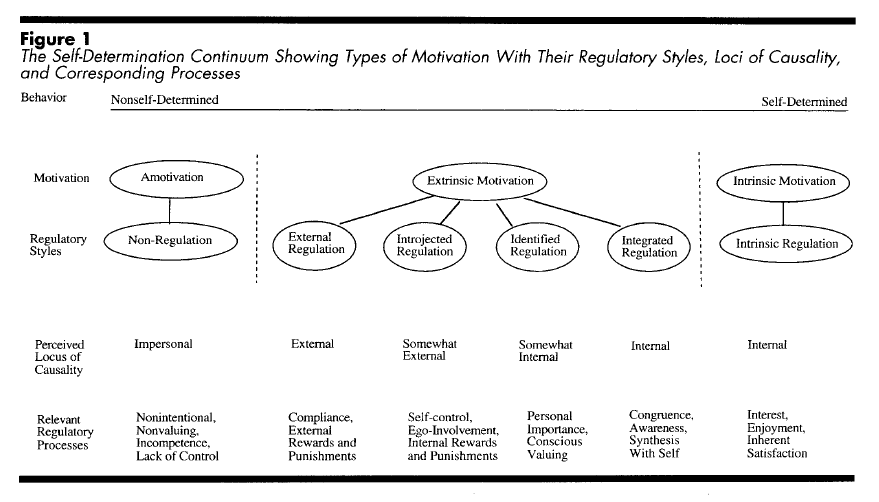
  • Students generally take my classes because they are required to do so. Religious Studies courses often cover a range of General Education requirements and thus draw in many non-majors. From the perspective of Self-Determination Theory, many of my students are complying to an external regulation, and as such may formulate what is called “extrinsic motivation” [see chart below]. Extrinsic motivation is not necessarily problematic per se, but “intrinsic motivation” has been shown to be more readily related to enhanced performance, persistence, and creativity. This explanation aligns with a practice I began several years ago. On the first day of class, when the class size is small enough, instead of asking students where they are from, or what their hobbies are, I orient discussion around why they are taking this class. They could take a gamut of classes to fulfill their requirements, so why this one? Students who initially said (in small group conversation) they only took the class because they “had to,” will start to open up about their interest in another culture or religious perspective, or about wanting to know more about their family or friends. Overall, I try to cultivate a sense of intrinsic motivation by having them realize they have some self-determination in the courses they choose. I ask them to identify some inner motivation and return to it throughout the course.
Screen Shot 2019-01-18 at 08.30.13.png
From Ryan & Deci 2000
  • While this is more applicable to my writing courses (where students tend to have a more entrenched view of being poorly skilling in writing), Self-Determination Theory also highlights the need for a person to feel competent, in addition to a sense of autonomy, in order to develop or sustain intrinsic motivation. Thus, not surprisingly, overly negative feedback from instructors (or peers) can influence student motivation. Unfortunately, I think this is often interpreted as the need to treat students as infantile and perfecting the “shit-sandwich” critique method. But – more importantly – I also think this means assigning regular smaller assignments, or low stakes assessment, so students can build up a repertoire of skills and, subsequently, confidence through a sense of competency. This approach overall aligns with scaffolding theory and the general advice to offer numerous small assignments/quizzes over the course of the term. This could also manifest in numerous other ways, such as asking students to come in with a potential research question or one book or article they would like to explore when they have larger research papers to write.


  • I think we all naturally attest to the fact that interest also drives motivation. So why not just pack lectures and readings with “interesting” factoids? Research into Interest Theory suggests there might be a negative relationship if there is too much extraneous – though possibly fun (so-called “seductive details“) – material for students to sort through. “Interesting” sidebar comments in readings (or I suppose, “fun” stories in lecture [edit: yes, in lecture too!], or hyperlinks in web documents?!) simply add unnecessary cognitive load and recruit ill-suited conceptual schemas. It’s better to focus on clarity than fell prey to endless “interest baiting.”


  • There seems to be much debate on the value of the “sage-on-the-stage” style of straight lecturing and the amount of time students can pay attention, with 10, 15, and 20-minute maximums being reported. Instead of critiquing our students for not being able to pay attention, I would gently remind my fellow scholars that in our professional lives, many of the conference papers we listen to are (sometimes mercifully!) capped at about 15-20 minutes. In addition, the reason we find some papers interesting is mostly because we easily relate the ideas to our base knowledge – we find ideas useful to our own work, we think about old ideas in new ways, or sometimes want to challenge a view that doesn’t align with our ideas, and so forth. Often student interest is diminished because they are less likely to be asked to relate to the ideas than just memorize them. How we assess our students can shift the imbalance.


  • My last observation is a little less formulated. According to Goal-Orientation Theory, there are different goal orientations that influence various self-regulatory processes. For those who have a “mastery orientation,” they tend to outperform on a series of measurements, including effort, persistence, non-procrastination, and both cognitive and meta-cognitive accomplishment. For those who have a “performance-approach orientation,” meaning they are primarily driven to demonstrate competency in order to receive favorable assessment (e.g. be the best student), they generally only outperform in one measurable category – course grade. Yes, read that again. A mastery orientation, which is beneficial in so many facets, does not necessarily lead to top performance [see chart below]. In the seminar, it was suggested that one way to push more students to a mastery orientation was to start assessing them in areas where it outperformed performance-approach orientation, of which I think persistence (regular, small or low stakes assignments?) and meta-cognition (reflection?) may be the most easily accessible.


Screen Shot 2019-01-18 at 12.51.54.png
From Radosevich et. al. 2007.


Grist for the Mill: I only discussed three motivational theories, Interest Theory, Self-Determination Theory, and Goal-Orientation Theory, and while I feel they provided a strong foundation for how I might structure a university course, there is a lot more to unpack. I may be biased in that I’ve read these theories to justify what I already do, but nevertheless, I feel compelled to continue to openly discuss student motivation in class, offer regular low-stakes assessment, provide frequent feedback and encouragement, and design larger assignments that can be divided into stages and are meant to be, at least partly, student-directed.

UPDATE: Very interesting article I just ran across.


Notes:

*This is part of a series where I discuss my evolving thought process on designing a new university course in Religious Studies. In practice, this process will result in a syllabus on Japanese Religions. These posts will remain informal and mostly reflective.

[1] Clearly there is more at stake in the experiment (and increasing the amount of the fine would clearly also change the outcome), this is just the gist that I often reflect upon.

References:

  • Ryan, R. M., & Deci, E. L. (2000). Self-determination theory and the facilitation of intrinsic motivation, social development, and well-being. American Psychologist, 55(1), 68-78.
  • Radosevich, D.J., Allyn M.R. & Yun S. (2007). Goal orientation and goal setting: Predicting performance by integrating four-factor Goal Orientation Theory with goal-setting processes. Seoul Journal of Business, 13(1), 21-47.

More Pondering Pedagogy: Course Design Posts

Should We Abolish Page-Lengths When Assigning Student Papers?

Introduction

For those of us who have written a dissertation, it’s likely we’ve run across a well-meaning friend or family member (or stranger in a bar) who has asked us, “How many pages does a dissertation need to be?!”

“Everyone knows,” I say, “it’s exactly 373 pages…no more, no less.”

Of course, this is a silly answer to a genuine question. Yet, I think we have to admit the assumptions behind this question are, well, misdirected and almost certainly misinformed.

I’ve seen dissertations in my field that are 200 pages and 1200 pages. I would say age-old conventions more commonly determine page length of dissertations, not whip-cracking advisors.[1] More importantly, the guiding principle behind writing a dissertation is identifying and crafting a compelling argument. The scope and depth of the argument is a better gauge for determining length than any pre-established page minimum. I would also say that most scholars do not have the problem of developing the length of their writing, but containing the scope of ideas! Word limit is our enemy, not word count!

Similarly, good student writing is (typically) good argumentative writing. With a focus on building argumentation skill, concerns around page-length should fade into the background.


Developing Writing as a Skill

In teaching academic writing, my colleagues and I foreground the importance of developing ideas through short writing assignments and drafts. Yes, we do have page-lengths, typically three 5-page papers are due throughout the term. But each of these 5-page papers were preceded by two 2-page papers, used to develop elements of the longer argument. This structure allows students to develop ideas over time (they receive critical feedback along the way) and draft verbiage that can be used for their longer paper. Even these initial 5-page papers are drafts that are revised and edited for their final portfolio. In total, the two final papers they submit are based on more than twenty-five pages of revised writing!

The first time I taught my course I was caught off guard by how many portfolio papers were too long, either repetitive or unnecessarily broad or meandering. They blew by the 5-page limit because they had too many good ideas![2]  I soon established page-maximums for the portfolio papers (7 pages), and decided to start talking throughout the course about how students should think about the scope of their thesis and the depth of their evidence and analysis. Surely, some initial 5-page papers are short, but I have an equal number of students who are struggling with too many possible trajectories for their argument. If guided by mere page length, a student might think this “problem” is no problem at all.

I instead teach my students to not be occupied with page length, but with identifying and crafting a compelling argument based on clear concept focus, reasonable argumentative scope, and solid evidentiary depth.

To be clear, this only happens because students are allowed (err…coerced) to developed ideas through writing over a period of time with critical feedback. I commiserate with students who are vexed by having to edit out good (or just fun) ideas – I tell them that is what real scholarship often entails – save them for your next paper!

Now, I can hear (and have heard) the objection, “But, I am a scholar of Religious Studies, I teach Religious Studies, I do not teach writing!”

I would rephrase the above statement like this: “I am a scholar of Religious Studies, I teach facts, not skills!” I rephrase it as such because I would argue that writing (or argumentative writing) is a core skill of doing Religious Studies, and if one wants to develop critical thinking, the practice of writing is a main vehicle for its development.

If one is truly interested in teaching only religious literacy (i.e. facts), then writing assignments do not need to be assigned – multiple choice exams will adequately test retention of ideas. (And don’t fool yourself if you think assigning an “essay question” necessarily elicits higher-order thinking – some essay prompts ask the student to list facts in one way or another. For example, a good essay question should ask the student to apply a skill in a novel context.)


Grist for the Mill

Page-lengths really don’t matter much if you are working with a motivated student to continuously help develop his or her ideas. Depending on the depth of available research materials (both primary and secondary sources), the complexity of the research topic, and the base knowledge of the student, paper lengths may vary significantly, but still reflect an equivalent effort. The point, I concede, may be simply placing the primary focus on – and underlying motivation directed towards – the quality of the argument and not the length of the paper. One way to do this is to emphasize the need for the slow development and building of ideas with regular peer feedback or instructor feedback.


Recommendations

Dare I say, page-recommendations should perhaps be determined by the time a teacher has to critically read and comment on them all – as opposed to some arbitrary 5, 10, 12, or 15 page paper?[3] I average about 20 minutes of reading and critical feedback per 5-page paper. This feedback (and sometimes this is just suggestions, not “corrections”) is then used to write a final, more polished piece of writing. This process requires more planning than simply penciling-in a “research paper” into your syllabus due at the end of the term. Is also requires a prompt that allows for the development of a student’s ideas over an extended period of time. Granted, this may not be ideal for every class, but I think it is preferable in many Religious Studies courses, especially where “critical thinking” is envisioned as a learning outcome.


Notes:

*This is part of a series where I discuss my evolving thought process on designing a new university course in Religious Studies. In practice, this process will result in a syllabus on Japanese Religions. These posts will remain informal and mostly reflective.

[1] If I engage in a longer conversation, I will usually say that scholars often think about the number of chapters needed to develop an argument, and that by the general concern of publishing a chapter or two as a 10-20+ page article we often arrive at a determined dissertation length. In other words, we (typically) do not start by having a total dissertation page length.

[2] Long papers could be plagued by what I call “stream of consciousness writing,” writing that meanders with no point. I usually tell students that this is the sign of a good rough draft, but now needs to be critically analyzed for kernels of ideas or good argumentation. Unless a student willfully wants to fail, this informal style of writing is almost always fixed after revision.

[3] Many universities have stipulations for certain classes that involve the required assignment of a certain number of pages of writing (it is 15 pages at my university). Typically this represents total pages of writing, thus, following a similar program I outline above, a final 10-page paper should easily be preceded by more than 5 pages of drafting, consequently complying with the 15-page minimum.


More Pondering Pedagogy: Course Design Posts

How Does One Do “Religious Studies”? Religious Studies Paradigms [Part III]

Some university students, and many among the general public, do not know the difference between Religious Studies and Theology. In casual conversation, I will often say that I am a historian of Chinese religions; it’s just a lot simpler and doesn’t necessarily entail, from their perspective, religious commitment (…no, I’m not planning on being a monk…in this lifetime ;).

Supreme Court Justice William J. Brennan has provided the wording that some scholars of religion use to help describe the difference between the two disciplines, noting that “teaching about religion” is to be “distinguished from the teaching of religion” [italics in original].[1]

The former is considered the typical realm of inquiry for teachers in university institutions, while the latter is considered – at least in its legal ramifications in public schools – an unconstitutional establishment of religion. Outside of many seminaries and Theology departments, confessional religious instruction (i.e. the full, unambiguous assent to the truth of a religion) is not expected.[2]

So, in addition to non-confessional instruction, what may be expected in terms of the theory or method of Religious Studies instruction? This, not surprisingly, is understudied and complex. For example, I’ve already talked about how the interdisciplinary nature of Religious Studies can lead to different disciplinary methodologies and levels of analysis being explored and practiced in the classroom setting. Being aware of these choices can help instructors decide what intellectual and disciplinary tools to model and teach.

Recently, I have also been inspired by the work of Liam Gearon who argues that instructors need a more rigorous conceptualization of the paradigms that undergird religious education.[3] Because modern religious education is no longer based upon theological truths or a religious life, Gearon claims, there have emerged several attempts to locate new epistemological grounds. Gearon identifies six different paradigms of contemporary religious education. I discuss each briefly below with some initial ruminations:

  • Scriptural-Theological Paradigm: This follows the premise that religious education should be concerned with Christian scripture and its revelations, and as such falls in line with the “teaching of religion.” This is not so much a mode of teaching, but an expected mode of being, which would in turn circumscribe the types of questions asked and the types of evidence marshaled in support of arguments.
  • Phenomenological Paradigm: Based on the tireless work of Ninian Smart, this approach champions the use of epoché, or the suspension of (dis)belief together with the use of empathy for the subject (or subjects) of study. This was partly a product of a growing awareness of religious pluralism throughout the 1960’s, and I would argue is the basis of the call for religious studies to increase cultural and religious literacy. A more critical reading might also suggest this is the theoretical foundation for “comparative religions,” which can treat religion as a sui generis phenomenon that resists historical or cultural deconstruction. Yet, I will admit that Smart’s Six (or Seven) Dimensions of Religion proves to be a useful heuristic that speaks well to non-scholars. As such, this paradigm may work well for survey courses.
  • Psychological-Experiential Paradigm: Founded on the ideas of developmental psychologist Jean Piaget, this takes the view that religious education is beneficial to a person’s moral development. Gearon suggests this paradigm arose in reaction to the Phenomenological Paradigm, which did not sufficiently address a young person’s developmental needs because it did not appropriately evaluate diverse religious doctrines. While ethical and character development is a noble cause (for people of all ages!), I struggle to see how one could implement this in a university setting with the expectation of behavioral change. Yet, could an instructor, for example, ask his or her students to become vegetarian for a week and reflect on the experience? (As part of a section on Chinese Buddhist practice?). Now that I write this, this might be something interesting to explore, but at the same time it is also ripe with problems since many religious practices would not be so amenable. Also, would asking students to engage in meditation fall into this paradigm?
  • Philosophical-Conceptual Paradigm: Gearon describes this paradigm as the throwing off of phenomenological neutrality and the search for “truth.” While intractability inter-related, I might characterize this as the conceptual counterpart to the experiential/behavioral paradigm above. It seems that Gearon present this as the search for an objective truth, rightly problematizing this paradigm’s epistemic grounds. If I may play with Gearon’s ideas a bit, I think this paradigm could be very appealing if was not established on the search for “truth,” but on a search for well-reasoned perspectives (not “what to think,” but indeed, “how to think“). Certain religious perspectives could offer a good counter-balance to student presumptions, causing them to refine – or articulate for the first time – the reasons for those perspectives. To explore the issue from above, a student may develop arguments both for and against vegetarianism, and then decide rationally on a preference (whether or not they adopt it as practice is inconsequential – they simply now are equipped with a well-argued stance).
  • Socio-Cultural Paradigm: This utilizes ethnographic methods, and thus underpins the discipline of Anthropology (and some alignment with Sociology?).
  • Historical-Political Paradigm: Gearon highlights the political ramifications of this paradigm, and as such claims that it is also the most prevalent in education. My reading here would understand the deconstruction of power (ideological, institutional, racial, gendered, etc. – power in all of its forms) to be the primary modality of analysis. The attempt is to explain, within the myriad of culturally and historically constructed frameworks, the religion or religious phenomenon under scrutiny. (I’ll admit my wording is a bit broad, and would encapsulate the above paradigm as well). I would agree, at least in university settings, this is the most common approach. This approach was popularized through the University of Chicago and has been nicely summarized and described by Bruce Lincoln. It should be noted, however, that Lincoln pits the historical method against traditional theology and does not address other potential methodological approaches.

To be honest, I have used Gearn’s paradigms more as things “good to think with” (bonnes à penser) than attempt to fully explicate, or even understand them (so, my apologies for any misinterpretation). Nevertheless, I would argue that the final two paradigms, the Socio-Cultural Paradigm and the Historical-Political Paradigm, align most cosely with my experience as a student and instructor of Religious Studies (Clearly Anthropology and History, but also a range of Area Studies fields). If we consider the Philosophical-Conceptual Paradigm more broadly as critical inquiry (identify assumptions, assess evidence, analyze claims, etc.) in the search for well-reasoned stances, this could also align with the goals of university education more broadly and specifically the with the aims of Philosophy.

Gearon’s description of Psychological-Experiential Paradigm appears to move beyond the mere description and explanation of psychological phenomena (the domains of many scholars) and towards the practice of psychology. In other words, instead of analyzing the minds of religious practitioners, here instructors would mold the actions and thoughts of the student so as to be like those religious practitioners. Clearly, this may be objectionable to many since it sounds like missionizing in the context of Religious Studies. Yet, I wonder if this could be done in limited ways with much though and care? I’ll have to leave that for further reflection. In some ways, this is not so different from the Philosophical-Conceptual Paradigm – both ask the student to inhabit the perspectives and worldviews of the religion under analysis. It seems to me that while a philosophy course could change your life, a religious studies course doing the same thing might raise a few eyebrows?

The Phenomenological Paradigm, which to me entails the comparative endeavor, is a pretty common approach to university courses in Religious Studies, especially in introductory or survey courses that aim to expose a student to a range of beliefs and practices.

Grist for the Mill: Each of these paradigms function as ideal types, and I think any course in Religious Studies would jump between several of them (save for the first). For me, I think it is helpful to identify which paradigm I am presupposing when I design class activities and course work – in addition to deciding how I will assess student work. This schema also allows me to add variety to how I teach, providing a convenient means to conceive of a differnt type of activity or assignment in order to break any potential monotony.

I’ll end by noting that I think the presumption of some students – often derisively called “spiritual seekers” – will assume the framing of the Philosophical-Conceptual Paradigm or even the Psychological-Experiential Paradigm (there are far less at my university who assume the Scriptural-Theological Paradigm). While I am committed to the general scholarly apparatus of deconstruction, and think these student can find value in that form of critical thinking, I do not think that has to be the only agenda for every lesson plan, every activity, and every reading.


Notes:

*This is part of a series where I discuss my evolving thought process on designing a new university course in Religious Studies. In practice, this process will result in a syllabus on Japanese Religions. These posts will remain informal and mostly reflective.

[1] In a very insightful piece, Sarah Imhoff has noted that this particular linguistic distinction is older than Brennan’s remarks of 1963.

[2] And while it is unconstitutional to teach “of religion” in US public schools, there is no legal standing against it in private Christian schools or homeschooling. As far as I am aware, a mandate of non-confessional instruction in university Religious Studies departments is not explicitly upheld by the Supreme Court’s 1963 decision in Abington School District v. Schempp, of which Brennan penned the concurrence. Nevertheless, non-confessional instruction is the unquestioned norm (if not written into the mission of individual departments).

[3] Gearon’s analysis is primarily based on the current political and legal realities of England, but his observations work well for the situation in the United States. It would take us too far afield here, but addition to Gearon’s views we could include more overarching learning theories, such as behavioralist, cognitivist, or constructivist approaches.

References:

  • Gearon, Liam. 2014. “The Paradigms of Contemporary Religious Education,” Journal for the Study of Religion, Vol. 27, No. 1, pp. 52-81.
  • Gearon, Liam. 2014. On Holy Ground: The Theory and Practice of Religious Education. London: Routledge.

More Pondering Pedagogy: Course Design Posts

How Does One Do “Religious Studies”? Religious Studies and Humanities [Part II]

Knowing the demographic and interests of the student body you teach matters. I’ve taught for several years at a large state university and it’s become a pet project of mine to keep a loose tally the majors of my students. Less than 1% major in the humanities. Admittedly, my classes overall reflect a small sample size, but university graduates with degrees in the humanities have only been between 10-15% in the past 30 years [also note the neagtive trends in the Humanities, and Religious Studies in particular, in the cart below]. Most of my taught classes have been university-required academic writing classes, so I would guess it’s a pretty fair representation (i.e. random sampling) of the student body as a whole. Yet, most of the students are freshman or sophomores, and to be frank, I’ve found that most of them don’t know what the humanities are, let alone have the motivation to major in a humanities discipline.


DtfqPAoUwAAqDyO.jpg


These suspicious were only confirmed this past summer. I was a last minute teaching assistant for a course that introduced the “research university” to incoming freshman. It was an online course to service the students who could not attend, for financial reasons or otherwise, the highly successful “head start” program, where incoming freshman took summer courses before their formal fall start.

Our course introduced the structure and disciplinary divisions of a research university, which is significantly different from their educational experience in high school. The middle three weeks of the five week course were devoted to explorations of the humanities, social sciences, and math & natural sciences respectively. Students watched recorded interviews of faculty members from each department, interviews of undergraduate majors, and watched or read other media describing the exciting intellectual opportunities of different disciplines.

There was a clear, noticeable trend among the weekly reflections of our students. Many commented that they simply did not know what the humanities studied or why it was valuable to their careers. Others said they enjoyed or excelled at humanities classes in high school, but opted for the safer STEM major (or were heavily persuaded by their parents) when going to college. Clearly, many of these sentiments are motivated by – understandable in some regards – employment-minded concerns.

They also noted that these feelings were common among their friends, claiming that humanities majors were “looked down upon” and taken up by students who were “lazy” and “looking for an easy A.” More interestingly, several incoming students did not know that scholars in the humanities did research, thinking that research was only conducted by scientists (!!). From their perspective, taking classes in the humanities meant rote memorization of “dead” facts, and science was the domain were creativity (and fun experimentation) was encouraged.

Lastly, of the handful of sophomores or upperclassmen who took the course (it was open to everyone), many spoke of a particular humanities class or particular teacher they had taken that revealed the intellectual excitement of that discipline.

So what is my biggest takeaway? First, almost all of the preconceptions above were mitigated once students got a better understanding of what the humanities constitutes (object or scope of study and methods of investigation), of the “living” and sometimes contested nature of humanities scholarship, and of how genuinely excited scholars were of their research, and of the opportunity for students to deeply engage their own research interests (some self-determinism is a powerful motivating tool). Moreover, before the summer course, sophomores and upperclassman only changed their perceptions when they encountered a particularly charismatic teacher.


Grist for the Mill: Thus, it is apparent to me as a teacher of religion (at least where I am currently), that I have to explain what I do as a scholar of the humanities, why I do it, and offer the opportunity for students to experience something similar. It has also been my experience that my excitement for research and resolving my research questions is contagious, which is only amplified when the students have a degree of determining their own research agendas. Admittedly, these are not novel insights. They are approaches derived from a constructivist theory of learning which broadly include methods of student-centered learning and cognitive apprenticeship. Nevertheless, it goes beyond simply having one lecture on the importance of the humanities – it goes into the conceptual structure, classroom activities, and means of student assessment for the entire course.


Notes

*This is part of a series where I discuss my evolving thought process on designing a new university course in Religious Studies. In practice, this process will result in a syllabus on Japanese Religions. These posts will remain informal and mostly reflective.


More Pondering Pedagogy: Course Design Posts

How Does One Do “Religious Studies”? Religious Studies as a Discipline [Part I]

Introduction

How might one conceive of teaching a university class in Religious Studies?

Many Religious Studies departmental websites will advertise the importance of appreciating religious pluralism or cross-cultural religious literacy.

While this is an admirable mission within a formal liberal arts education, it has limited value for an instructor conceiving how to teach his or her course. In other words, a concern for religious literacy guides the content of the course, not necessarily how one teaches it.

Many of my recent ruminations on teaching Religious Studies were shaped by my experiences teaching Rhetoric and Composition over the past several years. In those classes, I was not tasked with teaching my students about writing as much as I was tasked with teaching them how to write.[1] The focus is placed on skill mastery, not the memorization of writing trivia.

This mindset forced me to re-conceptualize my task as a university teacher of Religious Studies; can I move away from teaching about Religious Studies to how one does Religious Studies?[2] This is not an easy question to answer, nor is there one answer. I offer my perspective focusing on critical thinking over mere “religious literacy.”


Disciplinary “Doing”

This change in thinking is at both times trivial and non-trivial. It is trivial because instructors will naturally, implicitly or explicitly, model their teaching based on how they do Religious Studies – historians will do it historically; sociologists will do it sociologically, etc.

A class only concerned with content – if that’s even possible – would be nothing more than a performative Wikipedia page, listing off facts as students fastidiously take notes. An instructor acting as an endless source of stimulating facts may work well in a world where access to information is limited. This is not our world today, not anymore.

This is why I dislike heavily advertising Religious Studies courses as sources of religious literacy – simply, learners have plenty of avenues to gain basic competency about religions already.[3] Scholars of religion may argue we can curate facts better than Wikipedia (or a comparable source), but I think that misses my main point – we should identify which critical thinking skills are being cultivated as students learn content. Part of this commitment is to determine the means to adequately assess those skills (ahem, probably not through multiple choice tests). [4]

This change in thinking is non-trivial because it forces instructors to honestly consider how to teach more (in my words) “generative” modes of thinking, such as analysis, application, evaluation, or creation – the so-called “higher orders” of thinking. This is distinct from what I would consider more “consumer” modes of thinking, such as memorization or recognition – surely foundational, but hardly a suitable end goal for a humanities course in my opinion.

One potential impasse here is to realize that Religious Studies is defined by its object of study – namely, religion (good luck defining that!) – not its critical theory, methodology, or level of analysis.

David Lake and Ann Taves have referred to Area Studies fields, like Religious Studies, to be “raider disciplines” in that borrow theory and methods from other fields, such as History, Psychology, Philosophy, and so forth [see chart below]. While Religious Studies departments are interdisciplinary, individual scholars tend to be taught (or as Foucault would say, “disciplined”) in a singular discipline. I would argue that being aware of our disciplinary training will not only affect the content we chose to teach, but also the critical skills associated with that content.

Figure 1.png
From Ann Taves’ “2010 Presidential Address:
‘Religion’ in the Humanities and
the Humanities in the University” (JAAR 2011)

Because of this implicit and broad commitment to interdisciplinarity, many scholars also highlight the interdisciplinarity of religion to their students. For example, as a historian, in addition to historical documents, I may also assign ethnographic readings to my students, even though I do not teach them the theories and methods associated with ethnography.

We may teach with interdisciplinarity, but that does not necessarily mean we teach multiple disciplinary skills. Nor do I think we should necessarily commit to teaching multiple disciplinary methods, just fully realize and commit to what we do teach.

For example, these concerns were beneficial when I conceived a new survey course on Asian Religious Traditions. Given that Religious Studies is not defined by an overarching methodology, I decided to focus on a theoretical concern that was salient to the study of religion (I would argue it represents a “threshold concept” to the study of religion) – the term “religion” itself. I focused on historical method (looking at texts, objects, and sites), and from that evidence I had students offer their new definition of religion (or defense of an old one), based solely on Asian materials. For me, this addressed the more generative modes of thinking and argumentation, and represented one aspect of what Religious Studies does.

I do not think “disciplinary thinking” is the only way of critical thinking (but it is an important one within the academy), nor do I think that skill acquisition can be so neatly divided between different (non-area studies) disciplines (historians can think philosophically, and vice versa). Part of the reason for these first few posts is to examine what can be attempted within a course on religion when content takes a secondary role to cultivating critical intellectual skills.


Grist for the Mill: While there is a strong pull (by convention!) to begin designing a course by thinking about possible themes or readings, I’m going to explore what happens when I start by asking: “what skills do I want my students to acquire?” Clearly, this will be modulated by the readings that are actually available (I’m not ready to drop readings altogether!) Also, the “skills” we ask students to cultivate can be quite diverse. As I’ve discussed here, I think the inderdisciplinarity of Religious Studies can allow scholars to easily forget that disciplinary skills – that is, disciplinary methods and theories – may need to be explicitly taught. Thus, I will have to model more of what I want my students to do (“doing religious studies” in the mode of history in my case). This can be easily forgotten when the focus is solely on content.


Notes:

*This is part of a series where I discuss my evolving thought process on designing a new university course. In practice, this process will result in a syllabus on Japanese Religions. These posts will remain informal and mostly reflective.

[1] I need not digress here, but there are many ways to write academically (e.g. there are different academic genres), and thus I envisioned my role as providing my students a structure to practice their writing and conceive of strategies as to how they could develop their argumentation and style (or voice).

[2] As I will discuss, this is a particularly pertinent question for all Area Studies fields. One astute student essay about his preconceptions of Religious Studies can be found here; note that he thought he would simply obtain a “general knowledge about the major religions of the world” (i.e. a mindless religious literacy). Our field may be determined by content, but that doesn’t mean that we only trade in trivia.

[3] I would suggest this is potential reason why Religious Studies majors, and indeed many majors in the Humanities, have decreased in public institutions in the past decade.

[4] Multiple Choice exams may be great for assessing retainment of facts, but they remain difficult to construct as a means to asses “higher-order” critical thinking. Assigning papers does not necessarily mitigate this limitation, either. Writing assignment prompts would need to clearly move beyond having students rehearse facts they have learned or could read about elsewhere.


More Pondering Pedagogy: Course Design Posts

Threshold Concepts Conference Paper

Screen Shot 2018-03-27 at 21.31.48.png

Preface

This past weekend I presented a paper at the Western Regional AAR covering some of the insights I’ve developed while teaching religious studies classes. The numerous blog posts on this site formed the raw material for several ideas, yet, not surprisingly, there were also a few ideas which did not hold up to further scrutiny when researching and writing this paper. The most significant was the realization that my identification of Threshold Concepts in religious studies may have been initially too broad, and I really only focus on one (albeit important) example here. Some of the big takeaways include the important distinctions regarding researching and teaching religions, the necessity of teaching content while critiquing it at the same time, and – as the title plainly indicates – the value of Threshold Concepts in the classroom. (The original proposal can be found here.)

I would like to thank the organizers and my fellow panelists, Maha Elgenaidi, Mahjabeen Dhala, Bat Sheva Miller, Jonathan Homrighausen, and Leigh Miller, for their insightful (and well-delivered!) papers and lively conversation.

Rebuilding Religion: Threshold Knowledge and Its Value to Asian Survey Courses

“Religion is not an empirical thing. In fact, one can say that ‘religion’ does not exist.” This is what I tell my students on our first day of class, which immediately presents a challenge since I stand in front of them, apparently, as a teacher of nothing. Of course, I immediately guide conversation as to how “religion” is a discourse, a historical and cultural construct, so thoroughly naturalized so as to appear a part of human nature.

Admittedly, this is a kind of cheap trick. In function, I hope to undercut a student’s enculturated, naturalized perspective of the world and provide a model of the critical inquiry I hope to engender. In form, however, I give away a possible answer to a question I really want them to ponder, “what is Religion?”

In designing a survey course on Asian religious traditions, I wanted to keep this question, “What is religion?” as the vibrant centerpiece. Historical critical methods and discourse analysis have an important place in university research and in undergraduate teaching, but so does providing a basic competency in the various religions. My challenge, as I saw it, was to provide a basic “religious literacy” in Asian religious traditions while at the same time destabilizing the very notion of “religion.” Finding a balance between these two approaches I believe is integral to survey classes, not just upper division courses or even graduate seminars.

In my attempts to find middle ground I decided to have my students, as a final project, devise a well-reasoned and well-argued definition of religion for themselves – and here is the spin – a definition solely based on the Asian content we cover, in an attempt to undercut the Christian-centric World Religions Paradigm, a topic we will return to shortly. This project was stimulated, in part, by an emerging pedagogical theory called “threshold concepts” which operate as transformative moments in a learner’s experience if they can be identified and harnessed in the correct way.

Since deconstructing and constructing definitions are vital to my course, let’s start with a few important ones.

World Religions Paradigm (WRP)

So what is wrong with “religion”? As many of us are already aware, “religion, religions, and religious” – to quote the title of the seminal article by the late Jonathan Z. Smith – are all value-laden terms.[1] Smith, Russell McCutcheon, Timothy Fitzgerald, Tomoko Masuzawa, Catherine Bell, among many others, have all pointed to the influence of Christian values in shaping the conception of the genus, the category, called “religion.”[2] Bell summarizes it well when she says, “As a prototype for religion, Christianity provided all the assumptions with which people began to address historically and geographically different religious cultures. In other words, as the prototype for the general category of “religion,” …Christianity was the major tool used to encompass, understand, and dominate the multiplicity.”[3] [Slide 1]

Slide 1

Slide 1

To signal this discursive power of “religion” and its far-reaching impact, scholars have begun to refer to a “World Religions Paradigm”– this is where all world religions are molded in the image of Christianity – a phrase first coined, as far as I can tell, by Bell herself.[4] In a recent provocative article by Suzanne Owen entitled, “The World Religions Paradigm: Time for a Change” we are confronted with the ramifications of such a paradigm in the classroom.[5] Owen, correctly in my view, wants to challenge the paradigm because it remodels non-Christian traditions according to liberal Western Protestant values.[6] There is also a tendency to privilege, for example, texts over ritual, doctrine over practice, and the transcendent over the worldly.[7] It also hypostatizes religions into discrete, typically homogenous, entities nominalized by calling them “isms” – such as Buddhism, Hinduism, Daoism, etc. This tends to overshadow a long complex history of interaction, synthesis, and internal division. [Slide 2]
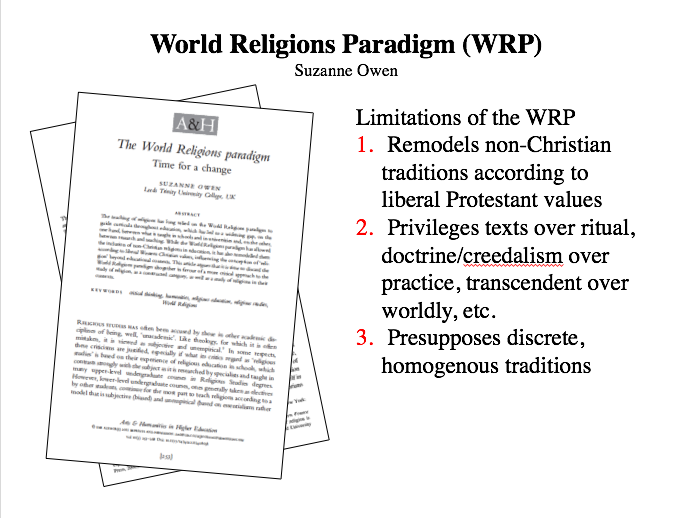
Screen Shot 2018-03-27 at 21.32.10.png

Slide 2

This privileging and mode of discrete categorization has long been reproduced in the Western study of Asian religions,[8] but as Owen reiterates, as modern scholarship becomes more attuned to these problematic presuppositions, there remains a gap between what we (as scholars) research and what we teach, where this paradigm often continues unabated in the classroom.[9]

While it is imperative that we destabilize categories such as “religion” (or address any of these issues) in our research and our teaching, I am actually not convinced that we need to completely discard the World Religions Paradigm in the classroom as Owen seemingly suggests.[10]

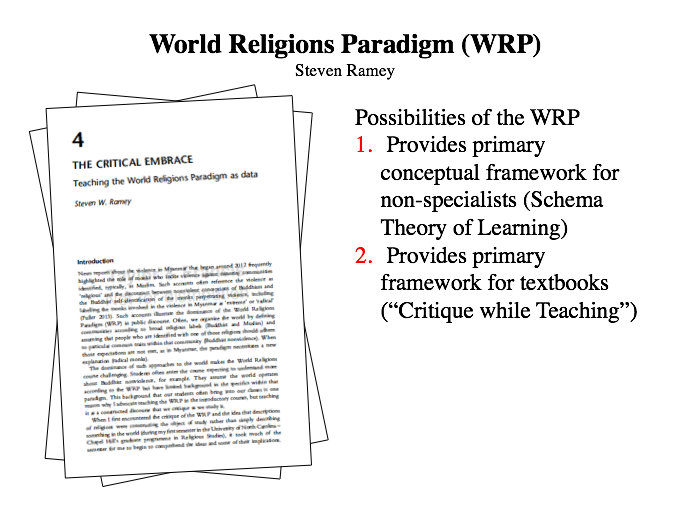
She admits that student expectations often drive the use of the paradigm in university courses; it is, after all, the primary conceptual framework for non-specialists.[11] Instead of viewing this as an obstacle, we can take it as an opportunity. In an edited volume entitled After World Religions, Steven Ramey argues that this familiarity with the paradigm provides an important starting point for student learning.[12] This follows an important principle in the Schema Theory of Learning which postulates that people primarily learn new concepts only after modulating pre-existing mental templates of the world, or in other words, “you gotta work with what you got.”[13]

Ramey summarizes his approach by saying, “This background that our students often bring into our classes is one reason why I advocate teaching the World Religions Paradigm in the introductory courses, but teaching it as a constructed discourse that we critique as we study it.”[14] Ramey calls this “critiquing while teaching,” whereby instructors can capitalize on the previous knowledge of students while also interrogating and transforming it.

This framework also allows for the use of traditional religious studies textbooks, an industry that widely accepts and perpetuates the World Religions Paradigm. For Ramey, these textbooks, with separate chapters on globally diverse “isms,” should become the target of student critique. Discussions can emerge on why certain subjects are included or excluded, or which organizational principles were employed, and how those choices reveal the assumptions and interests of the authors.[15] So, instead of taking textbooks as neutral descriptions of the world, they act as cultural documents that students can critically deconstruct. I quite recommend Ramey’s discussion of these matters, and I found this approach of critiquing textbooks to be quite useful in my course.[16] [Slide 3]
Screen Shot 2018-03-27 at 21.32.19.png

Slide 3

A third reason to critically utilize the World Religions framework is that it allows instructors to still focus on content that reflects phenomenal realities in our world. In 2016, the AAR was awarded a grant to produce guidelines related to the expected competency in religions for every university graduate; handily called a “religious literacy.”[17] A recent draft of these guidelines highlights the political necessity of understanding religions and religious actors. I would just like to briefly note that the “Learning Outcomes” reflect both a normative vision of religion as well as a more critical one, taking a blended approach as we have been describing here. [Slide 4]

Screen Shot 2018-03-27 at 21.32.26.png

Slide 4

To summarize, while the World Religions Paradigm remains highly problematic as a framework for contemporary scholarly research, with the correct approach, such as “critiquing while teaching,” its remains a useful tool in the classroom, or for those versed in Buddhism, an upaya, or “skillful method.”[18]

Destabilizing through Defining (or Rebuilding Religion)

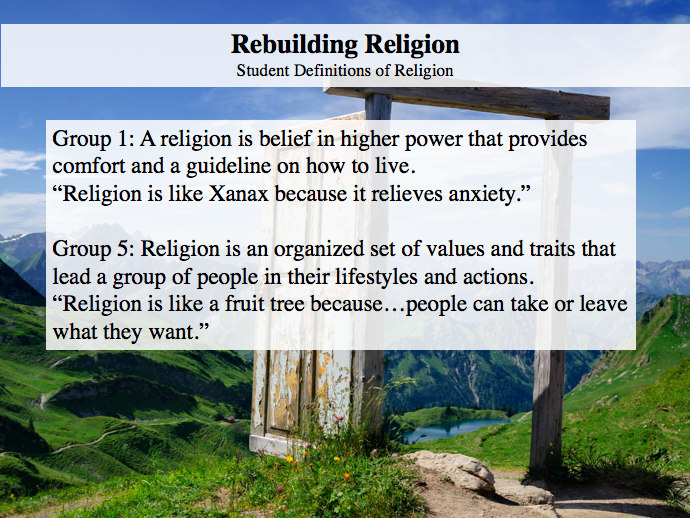
My approach utilized a close examination of definitions. On the first day of class I divided up the students into several groups and had each one craft a clear, one sentence definition of religion (with an illustrative metaphor to anchor it, which turned to out be pretty revealing of what students really thought of religion). [Slide 5]
Screen Shot 2018-03-27 at 21.32.33.png

Slide 5

Then we compare these to well-known scholarly definitions (EB Tyler, William James, Émile Durkheim, Clifford Geertz, Catherine Albanese, even Religion for Dummies) and see if we can identify any patterns, what constitutes the received “core dimensions” of religion. Things like belief, divine beings, and ethical codes are quickly targeted, which allows an easy transition into a discussion of the World Religions Paradigm and the guiding presence of Protestant values in these types of definitions.

Thus as a challenge, I ask my students to see if their definitions, and the definitions of scholars, hold up in light of the Asian content we explore. They are tasked individually with crafting their own definition of religion, to rebuild religion, based on examples drawn exclusively from Asian traditions, and presenting it along with their argumentation as a final paper.

I have found this approach appealing because it emphasizes higher-order thinking such as analysis, evaluation, and creation, the three highest cognitive domains according to Bloom’s taxonomy. The purpose is not to create a perfect definition of religion, as if that was possible, but to see that all definitions of religion are constructed. This encourages students to envision different ways in which to organize their worlds.[19]

To help facilitate this process I regularly introduced several comparative themes which could be adopted for the new definition. Many of them come from the more traditional understandings of religion (mysticism, polytheism, sacrifice), while some come from philosophy (ontology, epistemology), and others I incorporate to force my students to take unconventional perspectives towards religious ideology (metaphor, nature, humor). [Slide 6]

Screen Shot 2018-03-27 at 21.32.42.png

Slide 6


While I did not include kindness or metta/loving-kindness as a theme, I did happen to incorporate ahimsa, non-violence. As a comparative theme, not only were students asked to understand the concept in the framework of Jainism where it was introduced, but also to see if they could find analogues elsewhere, such as Confucianism or Shinto. By using these lenses to build bridges between traditions, students were encouraged to look beyond the traditional building blocks of religion – belief, divine beings, and ethical codes – to find potentially new ones they could argue as central. The creation of the taxon of religion is now no longer naturalized, it is rhetorical and discursive.

Threshold Concepts (TC)

My curriculum design was stimulated by a pedagogical theory called Threshold Concepts, first introduced by Jan Meyer and Ray Land in a 2003 landmark paper. In the intervening 15 years there have been hundreds, even thousands, of articles developing this idea, thus I can only give the most general outlines here.[20]

Threshold Concept theory maintains that there are concepts, most likely found in all academic disciplines, which act as conceptual gateways or portals through which allow one to arrive at important, new understandings. Initially, this particular knowledge remains obscure because it cannot be easily assimilated into one’s existing meaning frame (the pre-existing mental schema[21]). But through regular exposure and practice one can enter a liminal space where familiar ways of seeing slowly fade. A person thus can enter new conceptual terrain that permits previously inaccessibly ways of thinking and practicing.[22] Threshold Concepts also tend to represent specific disciplinary knowledge, allowing students to think, practice, and talk like scholars of particular fields.[23]

This transformative property has emerged as the “superordinate and non-negotiable” criterion of a Threshold Concept.[24] Taking the metaphor of travelling through a portal, this means that, once mastered, these concepts alter how the learner views the world, often engendering what is described as an epistemic, ontological, or subjective shift.[25]

A second criterion noted by Meyer and Land is integration, whereby the formerly disconnected elements of an idea gel into a coherent relationship.[26] I like to think of this as those moments when you have a lot of confusion about a concept, but once you understand it, you start to see it everywhere. All of a sudden, all of the facets are brought together and aligned, and you can’t quite remember how you didn’t see it beforehand.

A natural third factor is that these concepts are not self-evident, they are troublesome and take practice to master. Threshold Knowledge is a new mental template of the world, and that only comes with real intellectual work.

Generally this knowledge is seen as irreversible as well and limited, or bounded, meaning there are always new frontiers beyond the horizon of knowledge, new concepts and new schemas to assimilate. [Slide 7]

Screen Shot 2018-03-27 at 21.32.48

Slide 7

Conclusion

Personally, I feel that Meyer and Land have given a convenient handle to an important phenomenological event in the learning process, perhaps not too disconnected from the “aha” or “Eureka” moment.[27]

So, then, what might be an example of a Threshold Concept in the field of Religious Studies? I would argue that a prototypical example would be that “religion is a cultural construct.” This is a conceptual threshold that must be crossed in order to understand the modern study of religion. It is not self-evident to non-specialists, and once a person has that shift, they can find the entailments of that insight woven into the fabric of the field.[28] And it is precisely for that fact that I believe this concept should be taught in introductory courses on religion alongside the more stabilized (or normatized) “facts” which form the content of religious literacy.[29] The “critiquing while teaching” approach is successful in achieving a balance between servicing content and critique, and “destabilizing through defining” is but one example of this approach.

In conclusion, scholars of religion are not mere memorizers of facts and we should not treat students in religious studies courses in that manner either. Threshold Concepts mobilize critical thinking in ways that involve analysis, assessment, and creativity with the data. The development of these skills are not only integral to the humanities, but informed civic engagement as well.

Footnotes

[1] Smith 1998.

[2] See, inter alia, Fitzgerald 2000; 2007, Lincoln 1992, Masuzawa 2005, McCutcheon 1997; 2001, Nongbri 2013, and Smith 1978; 1998.

[3] Bell 2006: 30. The creation of “religion” is indebted to comparative Christian theology (e.g. see Masuzawa 2005: 72ff.), or as described by Fitzgerald, “liberal ecumenical theology” (2000: 4-5, 14).

[4] Smith was the first to bring attention to the importance of the taxon of “world religions” (see Smith 1998: 278, Smith 2004: 166-73), but Masuzawa (2005) was integral in outlining its particular European intellectual genealogy. Bell (2006, 2008) then loosely applied the concept of Kuhnian “paradigms,” in as much as they are “scaffolds” for organizing ideas (Bell 2006: 28), of which “World Religions paradigm” was one example (Bell 2006: 34-6). The phrasing was picked up by later scholars such as Suzanne Owen (2011).

Importantly, according to Masuzawa, her primary interest was not to examine the emergence of the Religious Studies field or disciplinary self-consciousness – as is highlighted by Bell and others – but the role world religions played in constructing the “West” (Masuzawa 2005: 10; Masuzawa 2008, esp. 149).

[5] Owen 2011. Bell (2006: 34) also notes the indispensability of the paradigm for teachers.

[6] Owen 2011: 258-9.

[7] To this can be added the presumption of “divine” or “higher” power, as well as the presence of a charismatic religious founder or leader.

[8] See, inter alia, Almond 1988, Schopen 1997, and King 1999. In addition, this conceptualization of religion tends to normatize a literary, and mostly male, elite perspective (Owen 2011: 256, 259).

[9] Owen 2011: 254, 258. This has political ramification outside the classroom as well since normatized conceptions of religions will continue to inform non-specialists in the journalistic and political spheres. (Owen 2011: 260, 261, 266). On a more general level, education in religion will remain an education in comparative morality, whereby abstracted ethical codes that are deemed similar to modern Western Christian morals will be examined (Owen 2011: 266).

[10] Owen’s language seems to vacillate between outright rejection and careful supplementation to the World Religions Paradigm. In her conclusion, Owen suggests that the historical and textual focus in religious studies can be corrected through the incorporation of the social sciences, ethnography specifically (Owen 2011: 256, 265), which can bring it more in line with critical analysis typical in the humanities more broadly (Owen 2011: 257). Thus, it appears her primary concern with the World Religions Paradigm, at the university level, is methodological. (See also her comments on teaching, p. 258, and secondary schools, p. 266). In a later article, Owen suggests a focus on “making sacred” as a corrective to the “world religions” approach (Owen 2016).

[11] Owen 2011: 257, 266. Generally, this framework suggests that there are several discrete religious traditions that all have some implicit resemblance to the Christian model, so much so, as Masuzawa explain, that presumptuously “any broadly value-orienting, ethically inflected viewpoint must derive from a religious heritage” (2005: 20).

[12] Ramey 2016.

[13] Schema Theory was first used to theorize about knowledge and cognition and was borrowed and adapted as a model to understand the processes of learning, notably by Richard Anderson (Anderson, et al.: 1977). There seems to be significant theoretical overlap with Hans-Georg Gadamer’s hermeneutical musings on the “fusion of horizons” (Horizontverschmelzung).

I take Ramey’s point as an important rejection of attempts which radically depart from using vernacular categories or organizational schemas in the classroom that unnecessarily frustrate students (Ramey 2016: 49). I would specifically include here the rather ineffective suggestions – at least in terms of pedagogy – of replacing the word “religion” with “cogmographic formations” (Dubuisson 2003) or “worldviews” (Droogers & van Harskamp 2014).

[14] Ramey 2016: 48. See also the comments of Philip Tite:  http://bulletin.equinoxpub.com/2015/08/teaching-beyond-the-world-religions-paradigm/.

[15] Ramey 2016: 51.

[16] I agree with my colleague, Caleb McCarthy, that if insufficient attention is given to describing the purpose of such an exercise, students may reject the values of such a book at all, or question why we even made them purchase it. This critique should be a creative act which seeks to understand the implicit choices all authors or textbooks must make, not a destructive act which renders the work worthless.

[17] See https://www.aarweb.org/about/religious-literacy-guidelines-for-college-students

[18] Indeed the creation and sustenance of a generic “religion” is a practical requirement for the existence of Religious Studies departments, a point made by Smith (1998: 281-2).

[19] See also Ramey 2016: 55.

[20] Flanagan 2016; Land, Rattray & Vivian 2014. In addition, there have been five international conferences on this topic (ibid: xi).

[21] For important connections between Schema Theory and Threshold Comments see Walker 2013.

[22] Meyer & Land 2003: 2.

[23] Walker 2013: 247. Also, “such a transformed view or landscape may represent how people ‘think’ in a particular discipline, or how they perceive, apprehend, or experience particular phenomena within that discipline (or more generally). It might, of course, be argued, in a critical sense, that such transformed understanding leads to a privileged or dominant view and therefore a contestable way of understanding something. This would give rise to discussion of how threshold concepts come to be identified and prioritised in the first instance” (Meyer & Land 2003: 1).

[24] Land, Meyer & Flanagan 2016: xii.

[25] Land, Meyer & Flanagan 2016: xxiii and elsewhere in this volume.

[26] Land, Meyer & Flanagan 2016: xii.

[27] To my knowledge there has been no serious attempt at correlating the two.

[28] Of course, from certain theological or even comparative phenomenological frameworks the idea that the category of religion is a cultural construct is anathema, or to use a playful analogue, heretical. From another perspective, Jason Davies (2016) points to the tribalism sometimes encountered in academic circles who try to keep the doors closed to their disciplines, terming this “threshold guardianship.”

[29] In breaching the Threshold Concept that “religion is a construct,” students become “insiders” of the discipline. This is in contrast to being or becoming an insider to a religion (in as much as one doesn’t define religion to include academic disciplines, but this is of course entirely possible!). Ever since Religious Studies was wrenched from Theology departments there seems to have emerged a lingering question as to how to preferably teach religious studies. A clear distinction is made between prescriptive (or confessional) statements, which belong to the field of Theology, and descriptive or analytical statements, which fall under the purview of Religious Studies. Yet, the level to which students inhabit those descriptions and analyses manifests on a sliding scale. An interesting discussion that moves in this direction is offered by Gerald Larson, who, borrowing from Melford Spiro, distinguishes between “acculturation” and “enculturation.” Acculturation in this context means to acquire propositions about a religion, while enculturation requires a level of internalization to the degree that they might become true or right (Larson 1988: 203). One reading of this would equate enculturation with Theologically prescriptive statements, but I think another reading is possible whereby enculturation could signal the “trying out” of perspectives without accepting them as totalizing truths. At some level, I think this is why meditation (typically Buddhist) is sometimes “practiced” in religious studies classrooms, in order to potentially capitalize on the affective components of deeper learning experiences, but not quite breaching the status of being prescriptive (this also explains why some are bothered by such exercises). This affective component I would argue plays a seminal role in the classes of Michael Puett, a popular professor of Chinese philosophy at Harvard University, who claims his courses will “change your life” (See https://theatln.tc/2o1IvPU). Of course, if he were a professor of Chinese religion, the claim may take a different, potentially problematic, coloring. This seems to be an interesting issue at the heart of a liberal arts educations which moves toward “character formation”; it is embraced unless there is the possibility of a “religious” tinge to it (see e.g. the comments by Owen 2011: 265-6). This struggle is also embodied in Ninian Smart’s dictum that the phenomenology of religion be guided by both époche (suspension or bracketing) and informed empathy. Nevertheless, the concern of making lecture material meaningful is mostly aligned with making it register on an affective level with the student. Since Threshold Concepts represent “troublesome knowledge,” the process of acquiring and integrating them is also noted for its affective quality, though these are truths bounded by disciplinary discourse (see, e.g. Walker 2013).

Bibliography

Almond, Philip. 1988. The British Discovery of Buddhism. Cambridge: Cambridge University Press.

Anderson, R.C. et al. 1977. “Frameworks for Comprehending Discourse,” American Educational Research Journal, Vol 14, No. 4, pp. 367-81.

Bell, Catherine. 2006. “Paradigms behind (And before) the Modern Concept of Religion,” History and Theory, Vol. 45, No. 4, pp. 27-46.

Bell, Catherine. 2008. “Extracting the Paradigm-Ouch!” Method and Theory in the Study of Religion, Vol. 20, pp. 114-24. [Review of Masuzawa’s thesis

Droogers, André and Anton van Harskamp, eds. 2014. Methods for the Study of Religious Change: From Religious Studies to Worldview Studies. Sheffield: Equinox.

Dubuisson, Daniel. 2003. The Western Construction of Religion: Myths, Knowledge, and Ideology. Baltimore: Johns Hopkins University Press.

Fitzgerald, Timothy. 2000. The Ideology of Religious Studies. New York: Oxford University Press.

Fitzgerald, Timothy. 2007. Religion and the Secular: Historical and Colonial Formations. New York: Routledge.

Flanagan, M. 2016. Threshold Concepts: Undergraduate Teaching, Postgraduate Training and Professional Development: A Short Introduction and Bibliography. London: UCL. Retrieved from http://www.ee.ucl.ac.uk/~mflanaga/thresholds.html

Gearon, Liam. 2014. “The Paradigms of Contemporary Religious Education,” Journal for the Study of Religion, Vol. 27, No. 1, pp. 52-81.

King, Richard. 1999. Orientalism and Religion: Postcolonial Theory, India, and “the Mystic East.” New York: Routledge.

Land, Ray, Jan Meyer, and Michael Flanagan, eds. 2014. Threshold Concepts in Practice. Rotterdam: Sense Publishing.

Larson, Gerald. 1988. “An Introduction to the Santa Barbara Colloquy: Some Unresolved Questions,” Sounding: An Interdisciplinary Journal, Vol. 71, No. 2-3, pp. 187-204.

Lincoln, Bruce. 1992. Discourse and the Construction of Society: Comparative Studies of Myth, Ritual, and Classification. New York: Oxford University Press.

Masuzawa, Tomoko. 2005. The Invention of World Religions: or, How European Universalism was preserved in the Language of Pluralism. Chicago: University of Chicago Press.

Masuzawa, Tomoko. 2008. “What Do the Critics Want?—A Brief Reflection on the Difference between a Disciplinary History and a Discourse Analysis,” Method & Theory in the Study of Religion, Vol. 20, No. 2, pp. 139-49.

McCutcheon, Russell T. 1997. Manufacturing Religion: The Discourse on Sui Generis Religion and the Politics of Nostalgia. New York: Oxford University Press.

McCutcheon, Russell T. 2001. Critics Not Caretakers: Redescribing the Public Study of Religion. Albany: SUNY Press.

Meyer, Jan and Ray Land. 2003. Threshold Concepts and Troublesome Knowledge: Linkages to Ways of Thinking and Practicing in the Disciplines. ETL Project Occasional Report.

Nongbri, Brent. 2013. Before Religion: A History of a Modern Concept. New Haven: Yale University Press.

Owen, Suzanne. 2011. “The World Religions Paradigm: Time for a Change,” Arts & Humanities in Higher Education, Vol. 10, No. 3, pp. 253-68.

Ramey, Steven. 2016. “The Critical Embrace: Teaching the World Religions Paradigm as Data,” in After World Religions: Reconstructing Religious Studies, Christopher R. Cotter and David G. Robertson, eds., New York: Routledge, pp. 48-60.

Schopen, Gregory. 1997. “Archaeology and Protestant Presuppositions in the Study of Indian Buddhism,” History of Religions, Vol. 31, No. 1, pp.1-23.

Smith, Jonathan Z. 1978. Map is Not Territory: Studies in the History of Religion. Leiden: Brill.

Smith, Jonathan Z. 1998. “Religion, Religions, Religious,” in M.C. Taylor, ed., Critical Terms of Religious Studies, Chicago: University of Chicago Press, pp. 269-84.

Smith, Jonathan Z. 2004. Relating Religion: Essays in the Study of Religion. Chicago: University of Chicago Press.

Walker, Guy. 2013. “A Cognitive Approach to Threshold Concepts,” Higher Education, Vol. 65, No. 2, pp. 247-63.




Setting Student Expectations and Intentions

While designing my course syllabus, I was focused on all of the traditional aspects: crafting learning outcomes, deciding on course content, selecting class readings, figuring out student assessment, and so forth. It never occurred to me to think about syllabus design, meaning graphic design. This is all the more strange because I was a graphic designer.

I was lucky enough to stumble across this blog by Tona Hangen (Update, also Zac Wendler) which had a profound impact on my syllabus design (I’ll discuss this more in-depth at another time). Her design reminded me of newsletters I created in the past and that insight led me to reconsider the purpose of a course syllabus. I wanted to make a document that was more than a course “contract” that was squirreled away and never thought about again.

One aspect, which I will discuss here, was the role a syllabus played in helping to frame the intentions of students. Hangen’s post does a great job of analyzing three different types of learners in her class, those who need to acquire basic knowledge, those that have that knowledge already, but want to expand their knowledge, and those who have extensive knowledge and who can analyze and assess at higher levels. Her syllabus  utilized the metaphor of scuba diving to describe the different “depths” her students would reach. I adapted these categories to the content of my course, dividing them between arhat, bodhisattva, and buddha.

Screen Shot 2017-10-22 at 22.16.25.pngDuring our first class meeting, these ideas are approached through conversation with my students about why they are taking my class (I’ve yet to have a religious studies major in any of my classes; I’m lucky if I have anyone whose major is in the humanities!). Typically, after listening to several comments on how this class fulfills several requirements, I begin to ask slightly more probing questions: Why this class? (Surely other classes fulfilled these requirements too!) Undoubtedly, a few start to open up about personal interests or express their genuine curiosity. I use those insights to propel discussion about the potential value of Religious Studies classes and how students can approach our class. For this summer class, I then introduced them to the three levels of aspiration (above) and asked them where they thought they might fall in the spectrum.

This is more of a reflection exercise to establish expectations and intentions than anything else. Overall I find this to be a much better introductory conversation than asking students about their majors or hometowns.

Pedagogy Proposal on Threshold Concepts

[UPDATE: Paper posted here]

I’ve become more drawn to the pedagogy sections of the academic conferences I’ve attended in the past few years, especially the American Academy of Religion. This year, for the first time, I’ve decide to dip my toe into this new field of inquiry by proposing a paper for the Western Regional Conference of the AAR, submitting to the Pedagogy of Religious Studies Unit.

I’ve thoroughly enjoyed ruminating on the role of threshold knowledge in teaching, a concept that was first introduced to me through my training for the Writing Program at UCSB and largely by the (then) head of the department Linda Adler-Kassner. Her views convinced me of the importance of threshold concepts and their application in classroom environments.

Buoyed by the success of my recent summer course I was hoping to reflect further on how it can be developed thought this conference proposal. The theme this year was “kindness,” something that I felt I could incorporate into my proposal since I used morality and non-violence as threshold concepts in my course.

My proposal is posted below:

Rebuilding Religion: Threshold Knowledge and Its Value to Asian Survey Courses

How can we teach religious studies and yet deconstruct its central focus, religion? Is this possible in a survey course where theory is often overshadowed by content? The paper will examine how students can be granted agency and creative freedom through designing a survey course with the directed goal of rebuilding a definition of religion based solely on concepts developed through the study of non-Western traditions. This critical process is supported by the introduction of “threshold concepts,” defined by Jan Meyer and Ray Land as ideas crucial for the epistemological participation in academic disciplines. Threshold knowledge, conceived on the metaphor of passing through a portal, that is derived from these concepts is considered transformative and oftentimes irreversible.

Using a course I taught in the past year as a case study, I will explore how analyzing and evaluating common scholarly definitions of religion acts as a springboard for engaged student inquiry. By highlighting Western biases in these definitions, students are asked to reconstruct, through sound argumentation, a definition of religion with the new “raw materials” gathered from non-Western traditions.

Moreover, threshold concepts anchor student’s analysis and comparative endeavors by acting as lenses through which they can critically interrogate the course materials. For example, by foregrounding ideas that frequently remain underdeveloped or implicit, such as material culture, soteriology, and myth, as well as less-commonly covered concepts such as metaphor and humor, and framing them as threshold concepts, students are asked to think about how these ideas may –or may not – constitute the “core dimensions” of religion. I will end with a rumination on “kindness” as a valuable threshold concept for religious studies, aspects of which were introduced to my students through the ideas of morality and non-violence.