Scholarly Writing: The Genre Scramble and the Genre Jigsaw

Under analysis, writing genres can be broken down into composite parts. Take a news article for example. Not only could we distinguish hard news, soft news, and fake news – which, for the sake of our class, I tell students to envision as separate genres – but we could also break down an article into its title, lede paragraph, photo caption, and so forth. Moreover, one could treat these as more than separate conventions that comprise the news article (macro-)genre, but (micro-)genres unto themselves, with their own specific purposes and intended audiences. This type of analysis helps students understand how genres are descriptive and analytical tools, not hard-and-fast prescriptive categories. In the end, genre theory helps give us an analytical leverage that can make our writing more effective.

I put this type of micro-analysis into practice when we first start to address scholarly writing in class. Students will often know the conventions of an academic paper, generally comprising an introduction, body, and conclusion. But do students realize these phases of a scholarly work each have their own functions and characteristics and, moreover, coordinate with one another to synergistically produce a more powerful rhetorical effect? In order to help suss out these distinctions, I’ve used the following activities to help students analyze and identify effective academic writing.

The Genre Scramble

Borrowing a practice from a colleague (Brian, Jackson, or someone else?!), I take an scholarly article or book chapter, print it out and cut it up into much smaller sections (maybe 20-30 sections depending on the selection). I then have students work in groups to piece the paper back together, using whatever clues they can find in the writing. In addition to subheadings, I try to find works that incorporate sequential language (first, second, third, on one hand, on the other hand, etc.), causal language (as a result, consequently, etc.) or self-referential language (as noted above, we will return to this point, etc.) to help in this process.

At one level, this helps students realize they already know a lot about the structure of scholarly writing. At another level, this helps train students to observe the usage – and practical utility – of transitional devices, or the numerous other linguistic cues that situate a phase of writing into an overall composition. This game, which I actively make competitive, is used as an opening activity for a class, getting students thinking and moving since most will clear out desks and arrange the slips of paper on the floor. (I typically allow 15 minutes for this activity, including a quick class discussion about what cues each group used to help them out. Depending on time, I will sometimes skip this activity and jump to the Genre Jigsaw.)

The Genre Jigsaw

This works in the broadest strokes by dividing up a selected scholarly work into smaller (micro-)genres and having students work in small groups to perform genre analysis on their segments. The divisions could include the abstract, introduction, two or three argument subsections (such as methods, results, discussion), and conclusion. For each sections students have to discuss the rhetorical purpose, the intended audience, and any identifying linguistic characteristics (the Genre Scramble help with this aspect).

To help model this kind of analysis, I first talk about the title as a (micro-)genre, an often overlooked rhetorical aspect of first year writing. As a class, we first brainstorm the potential purposes of an academic title (to summarize, to entice, to establish tone, to establish ethos?) and compare these titles to titles of other kinds of writing (how is it different from a news article or novel?).

Next, in a move that is sometimes confusing, we try to discuss audience and how it changes throughout an article. Since most folks intuitively think of audience demographically (age, gender, race, education level, etc.) it is hard to see how the audience may change in the process of reading. To start this discussion I have the class think about where they may just encounter a title of a work (bibliography, table of contents, in-text reference, etc.) and ask them to brainstorm about the mindset of a reader. For example, why would someone be looking through a bibliography? Maybe because they are looking for works relevant to their interests, thus the audience may be someone who is doing research and looking for key words or phrases. This gives us some information about the types of things we may want to include in our titles. Moreover, I guide conversation to how that audience may change when they shift to various phases of the essay (when are readers the most engaged, when are they most likely to read over sentences or passages, when are they the most critical or skeptical, when are they hoping for a summary of ideas?) This points to how the audience expectations change and how writing can accommodate that change.[1] They return to this point during their group discussions.

Lastly, we turn to a discussion about the language conventions of a title. Given what we analyzed about purpose and audience, what language could be included into a title? What can we notice about the language of the title of the work we are analyzing? I often end by noting how it’s pretty common in the humanities to structure a title with a colon in the center (the “colon construction”), looking something like this “Generality/Catchy Phrase: Specificity/Descriptive Statement.”
The Jigsaw Method

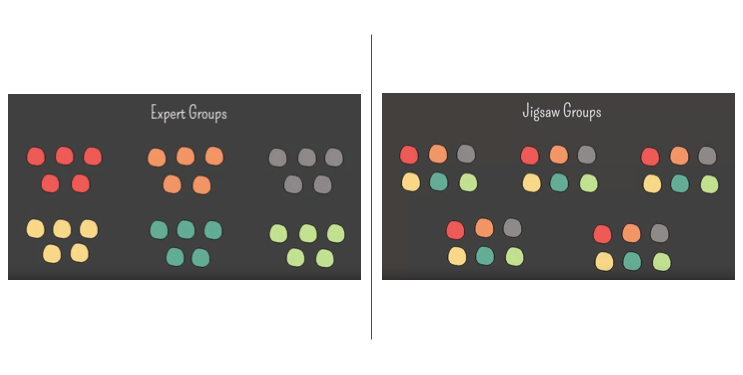
Using the analysis of the title as a model and applying the Jigsaw Method (I originally called this “Divide and Conquer” before learning of the Jigsaw) students then break up into Jigsaw groups, with one student taking responsibility for each phase of the scholarly work. I usually give an overview of the argument of the selected essay, since each student will only be reading a portion of the work (its possible to assign the essay as homework, too). Then students responsible for each phase meet with one another in Expert Groups to identify and discuss the audience, purpose, and specific linguistic cues. Armed with their insights for each phase, they then reconvene with their original groups and discuss the whole essay, trying to map out how the purpose and audience changes at the micro-level throughout the essay and attempt to create a bank of transitional words that appear in each phase. During class discussion, groups share their insights with one another.

While I’ve always enjoyed the analysis of my students, this can be a challenging exercise, especially if the scholar’s argument is complex or otherwise difficult. I’ve come to provide a decent summary of the article first so student can focus on genre analysis, not just comprehension. During class discussion I’ll have groups try to identify the thesis, or areas of strong or weak evidence. Overall, the purpose of this exercise is to have students work together to analyze different phases (or micro-genres) of scholarly writing and try to adopt certain strategies into their writing.

Notes:

[1] One example I like to give regards the use of personal anecdotes in writing. Scholarly readers are more likely to allow anecdotes in the introduction of the essay, since they know there may be an attempt to catch the reader’s attention. On the other hand, scholarly readers tend to not expect anecdotes in the body of an essay, especially when they hope to see formal argumentation regarding the main claims of the essay. In this case we can say reader are more critical and expect to see argumentation.

Concept Mapping My Academic Writing Course

While doing research on graphic organizers, I was quickly enraptured by the idea of concept mapping. Concept maps are a means of spatially representing the relationships between ideas and showing how they can form complex networks of knowledge. These types of maps can help both instructors and students more firmly grasp the connections between apparently disparate ideas and help to form a more integrated understanding of a topic or a whole course.

Our university courses are taught in a linear fashion. Ideally we try to scaffold or build towards more complex ideas and skills as the term advances. But the ideas of our courses are not necessarily related to one another in such a simple linear fashion, they often connect to and reflect one another at multiple junctures. In fact, being able to conceptually grasp these multiple juncture points, or how ideas are related on multiple fronts, can be an important step towards real mastery of a subject. Visual resources such as concept maps have been shown to be potent pedagogical tools that aid in building this type of holistic perspective.

In terms of construction, concept maps can show relationships between ideas through spatial placement or proximity (or hierarchy, though that is more usually reserved for tree-diagrams). These maps may be centered around a central idea, although this is not necessary. Importantly, connecting lines (or arrows to show direction) are added to clarify relationships between ideas, and in more detailed maps those lines can be labelled, thus adding even more clarity and precision.

Inspired by its conceptual utility and using these basic principles I’ve just outlined, I set out to create a concept map for my writing course. I wrestled with having my students do their own in groups as an in-class activity (this is often recommended in the literature I consulted), but I decided I needed to struggle with it first to see how reasonable the task would be and how long it would take. Brainstorming the individual components (the ideas/skills I considered most critical) was not difficult, nor was connecting some of the ideas. The biggest challenge was trying to limit the different ways I could connect ideas. In fact, if I was to recreate my concept map from scratch, it almost certainly would look a little different. I tinkered with it a bunch, mostly playing with the labels on the connecting lines. I decided to give it to my students near the end of the term, using it as a cover to a stack of (digital) documents I provide each student (this includes some of their own reflective pieces and copies of handouts we’ve used in class that I think will serve them after our course). Nevertheless, below is my concept map for my writing course.

Concept map - Romaskiewicz 2019.png
Concept Map Cover for my writing course.

I first showed the students the concept map as projected onto a screen in our classroom. I didn’t tell them what it was and allowed them a few minutes to discuss its meaning and purpose in small groups before having a short class discussion. Since I only learned about creating concept map towards the end of my course, I would likely do this at the beginning of the course next time.

Lastly, I was greatly inspired by Linda B. Nilson’s The Graphic Syllabus and the Outcomes Map: Communicating your Course when I designed my concept map. It provides numerous examples and an assortment of ways one could tackle such a project.


 Writing Skills Posts


How to Find a Scholarly Source…and What to Do When You Actually Find One

Introduction

So you’ve been tasked with some kind of assignment (likely a research paper, but there are other options, too) that requires you to find “scholarly” or “academic” sources. How do you find these magical items?

Well, if you find a work that is boring, dry, and references lots of people you’ve never heard of, congratulations, you’ve found a “scholarly” source. I’m joking…only a little.


What is It?

First, let’s simply review what is implied by the terms “scholarly” and “scholarship.” Superficially, this means that a work is written by scholars, but more importantly this means a work is written for scholars.

Here’s the important difference: a scholar could write a book for a popular audience, thus while the work may be credible (and a great introduction into a topic), it would not be considered formal academic scholarship. Generally this would not be the type of research scholars rely upon for their own intellectual work. In other words, works written for popular audiences would not bear the conventions of traditional scholarship (outlined below) and thus would not be “scholarship.”

At a basic level, trying to find scholarly sources can be tricky because it requires you to infer who the intended audience is for the work – in our case, other scholars. Unless you are fully trained and socialized into a scholarly discipline (history, psychology, chemistry, or whatnot), scholarly works are not written for you (if you are a student), hence they can often come off as dry and boring. It’s like trying to join a conversation late, you don’t really know what’s going on or fully catch all of the “inside jokes.” (Don’t let this dissuade you! Every scholar starts off feeling like this.)


How to Find It

The simplest way to determine if a particular work is scholarship is to identify if the work is “peer-reviewed,” meaning that before a work is published it went through a rigorous review process by scholars (“peers” in the same academic field) who agreed upon the value of the research and its conclusions.[1] If you find an academic journal article, make sure the journal in which it is published claims that it is peer-reviewed (look online or in the print volume itself). Books are a little more difficult to identify as peer-reviewed, but try to locate works that are published by university presses (Princeton University Press, University of California Press, etc.). (Though, be aware, there are other publishing houses that print scholarly works.) If you can further determine if the author holds (or has held) a university position, there’s a reasonable chance the work you have is indeed “scholarly.”

Moreover, if you used specialized search engine, such as Google Scholar or a university library database, there’s a good chance the work is true scholarship. But still check to see if it’s peer-reviewed.


What to Watch Out For

Sometimes we will find works that provide us with great, well-informed knowledge on a topic. This may be a spectacular article in National Geographic, Scientific American or a witty and interesting book on a fun topic by a popular publisher, such as Simon and Schuster. While these are great for giving you insight, they are not scholarship because they are not peer-reviewed publications.

Let me make an important distinction here. Peer-review is not just a barrier to keep certain people out of a special “scholar’s club”[2]; it’s meant to help filter out work that is not up to scholarly evidentiary standards and, perhaps most importantly, to make sure the work actually “pushes the field forward,” which is a snappy way of saying that it provides new information on a topic.

There are plenty of published works in the world which provide reliable information on a topic, but do not add anything new to the discussion. The most common scholarship-doppelgänger in this regard are works written by career journalists. They often do a fantastic job in summarizing the available scholarship on a topic and write in an invigorating, accessible way. A good example might be David McCullough who has written on American historical topics spanning the Brooklyn Bridge to the Wright Brothers. But summarizing old ideas do not “push the field forward,” even though the work may introduce ideas to a much broader audience. Thus, one of the basic genre conventions of scholarship is that it uses a solid ground of evidence to build to a conclusion (thesis) that is new or significant. McCullough’s works tend to summarize ideas already in circulation, albeit in very lucid prose.


What to Do When You Find It

My advice here is simple: read unevenly. Do not put all of your energy into reading each passage with the same intellectual intensity. Reading academic scholarship is not like reading a novel from start to finish in a linear fashion. Academic reading typically involves flipping back and forth between sections and footnotes.

First, get an understanding of what the article or book is about by reading, slowly and carefully, the introduction (or abstract) and then perhaps jumping to the conclusion. Remember, you want to find out what the work is ultimately arguing for. This should be the new thing that pushes the field forward.

The bulk of the writing will explain how that conclusion (thesis) was arrived at through marshalling lots of evidence. Once you know where the argument is going, try to piece together the most important pieces of evidence that lend to that conclusion.

Lastly, you will likely find scholarly writing refers to other scholars’ work often. At times you may get the sense that you are expected to already know who this other scholar is and what they have written about. This is normal, if you remember the intended audience is other scholars who already know that field of scholarship well. This may mean you will need to read up on another scholars’ work along the way.


Notes

[1] Of course, even if a work is peer-reviewed, that does not mean it hasn’t been problematized or even discredited after publication by other scholars. In any regard, it is often helpful to talk to your instructor about your research discoveries.

[2] There’s certainly a worthwhile discussion to be had here about how knowledge is socially constructed and how some (often marginalized) voices are left out of the scholarly debate. That will have to be a considerations for another time.


Other Posts on Writing and Researching Skills

What Does a Thesis Statement ‘Look’ Like – Thesis as Metaphor

Peter Romaskiewicz

Introduction

Early in the semester, I have my students tell me what a thesis statement looks like. They break into groups and write out a few bullet points listing the non-negotiable components of the ideal thesis.

Additionally, I ask them to think of a metaphor that best conveys what a thesis statement does (examples below). Finally, I ask them why that metaphor was chosen and to explain how it reflects their itemized bullet points.

It’s a relatively quick exercise (no more than 3-4 minutes of group collaboration, and another 10-15 of class discussion) and I encourage creativity in the metaphors. If the metaphor component is confusing the groups, I will give one example, often saying something like this: “A thesis is like a map, because it shows you where you are going [i.e. it foreshadows the conclusion] and highlights important landmarks [i.e. foreshadows some evidence] along the way.”

I wish I was far more fastidious over the years in copying down the metaphors created by my students. Nevertheless, scribbled in the margins of my lesson plans are the following examples:

  • A thesis is like a compass (because it gives direction)
  • blueprint (provides an overview)
  • billboards (works like advertising)
  • food label (lists contents)
  • skeleton (provides general shape)
  • receipt (tells you what you got)
  • shopping list (tells you what to look for)
  • bridge (brings you to a new place of understanding)
  • flashlight (tells you where you are going and is “flashy”)
  • treasure chest (holds all the “valuables”)
  • heart (vital organ, the core)
  • pyramid (strong foundation; made of blocks/components)
  • magnifying lens (it focuses)
  • spine (directs the body [paragraphs])
  • recipe (provides instruction)
  • Tinder profile (makes people interested).

In any individual class, the groups’ suggestions are usually diverse enough to point out that no single metaphor can characterize all of the functions of an ideal thesis statement. This is why I like this exercise. Choosing a metaphor is an argument; students have to come to some consensus on which aspect is the most important, which is then memorialized through the metaphor.

In sum, the metaphors above suggest that a thesis statement provides direction and cues the organization and methods of a paper. Furthermore, a thesis should also be focused (or relatively concise) and bring the reader to a new understanding of a topic. Ideally, a thesis should also be “attractive” (compelling or interesting).


Function Over Form
epigraph 1.1

I prefer focusing class discussions on the function of the thesis statement rather than on its forms (i.e. the listed bullet points they generate in groups). In the language of genre analysis, we are looking for the rhetorical purpose of the thesis, not its conventions.

I prefer this because many students have already been drilled in the conventions: a thesis is one sentence; a thesis needs to provide three points of support; a thesis is the last sentence of an introduction. These are all guidelines, not hard-and-fast rules.[1] Having a clear understanding of what the thesis is supposed to do can provide better direction of what it is supposed to look like. I would say the description above provides a good foundation for a generalized thesis.[2]

But a thesis can do more than summarized above, much more in fact, depending on the writing genre it is used in. Generally, I focus on argumentative/persuasive essays (but expository essays are common in my religious studies discipline), and thus a thesis in this context should also make a claim or take a stand, an aspect not clearly articulated in the above metaphors. In other words, you should imagine a reasonable person raising possible objections to your claim. This has two purposes. First, it draws in the skeptical reader who wants to see how you defend your claim. Second, it makes you a more thoughtful writer since it asks you to imagine, and possibly mitigate, potential counterarguments.[3]

Often, another aspect of a strong thesis is that it passes the “So What?” Test, meaning that a person’s first thought after reading the thesis should not be, meh, so what? To me, this is a very complex issue because it relates to significance. Often, scholarly theses do not pass the “So What?” Test for students because students often do not understand the broader disciplinary issues the scholar is tackling. In other words, the significance may not made explicit because the scholar is writing for his or her professional peers and who already know the gaps of knowledge in the field, not students who are novices in the topic. (Although I would contend that good, effective scholarship should make a paper’s significance explicit).

epigraph 1.2

For students, I’ve found success in enlivening their thesis claims by having them clearly articulate the question they are asking. Among all the other things we’ve talked about, a thesis is a response to a question (and a conclusion based on premises).  I’ve often found that a dead-on-arrival thesis is based on a rather uninspired research question. Instead of working on the thesis, I’ve had better responses talking to students about the questions they, often implicitly, are asking. While writing can be tortuous (and sometimes torturous), I suggest students return frequently to their question and try to refine it in terms of the new evidence they gather. In some situations, students find that the significance of their thesis can be rhetorically heightened by explicitly working their research question into the paper (according to the rhetorical principle of anthypophora).


Final Thoughts

Overall, I’ve found that defining the principle elements of a thesis statement can elicit deeply personal reactions. This may be due to personal preferences, misunderstanding regarding the genre of essay, or even disciplinary norms. These can be mitigated if we just tell our students, as clearly as we can, what we want a thesis to look like…but more importantly, what we want it to do.

So – What Can a Thesis Statement Do? (Anything else?)

  • It can preview (or provide) the conclusion of the argument
  • It can capture the interest of the reader
  • It can take a stance on an arguable claim
  • It can point to the significance of the argument or conclusion
  • It can preview the organization or structure of the essay (as reflected in the structure of the thesis statement)
  • It can encapsulate or highlight the most important points of the essay

So – What Does a Thesis Statement Look Like?

As you can start to see now, as long as a thesis statement accomplishes its necessary purpose(s), it can actually look different for different writing projects. If you still are looking for some more concrete starting points (that’s ok!) see the resources in the notes below.


Notes

[1] I have had colleagues use “starter formulas” for creating thesis statements, such as: Primary Sources + Observations = Conclusion or Evidence + Claim = Conclusion. In these cases, the Observation or Claim should change the understanding of the underlying evidence. Elsewhere, I have seen more specific directives to fill in the blanks: While critics argue_____, I argue_____, because_____./By looking at_____, I argue that_____, which is important because_____./The text, _____, defines _____as_____, in order to argue_____. I think these are all reasonable ways to jump start students who are struggling, but I would also be careful of pigeonholing student creativity or artificially limiting their argument styles.

[2] The advice available online for how to craft a thesis statement is absolutely daunting. It behooves us as instructors to help student navigate these resources if they have more questions. Arguably, one of the best online resources is the Perdue Online Writing Lab (Perdue OWL), but I would not say their thesis discussion is all that robust (a claim which pains me because it is such a valuable resource overall). I like the Harvard College Writing Center site because it provides some thesis caveats, and the University of Toronto Writing Support site because it talks about some myths. In addition to these, there are plenty of online materials which describe the process of developing a strong thesis, such as the University of Wisconsin Writing Center. I’ve used the handout from Vanderbilt University Writing Studio to develop my own worksheet for the thesis drafting process. Finally, for fun, if my student are having problems with crafting a draft thesis, I tell them to go here http://www.wonder-tonic.com/filmthesis/.

[3] I have a friend who likes to tell a story of his college writing instructor who made all students develop their theses (claims) until no one in the class agreed with the claim. Only once no one agreed with the thesis, was my friend set to writing to convince his peers to agree with him!

Resources:

Zhao, Jun. 2007. “Metaphors and Gestures for Abstract Concepts in Academic English Writing,” Dissertation, University of Arizona. [here]


Other Posts on Writing and Researching Skills

Rhetorical Contexts: Who is the Audience?

I did not learn genre theory in my college composition classes, so when it was introduced to me at UCSB I was unsure of its application outside of just being another provocative theory.

I’ve come to realize how the right approach to genre theory paints writing as a social practice, and when mastered, turns writing into a powerful and eminently practical skill. Part of genre analysis requires an assessment of the rhetorical situation, which is dissected in various ways by theorists and scholars, but always incorporates the element of intended audience.

When writers write they typically write for an imagined audience, and this largely dictates the choice they make while writing. Thus, while it is possible for anyone with an internet connection to read a blog post, depending on how it is written it may draw in certain audiences and drive away others. Those that come and stay would be the target audience (or intended audience) of a blog post.

When deciding to perform genre analysis on news genres, I was searching for another way to think about intended audience rather than the standard focus on demographics like age, ethnicity, gender, income, region, education, and so forth. After chatting with my writing advisor, Chris Dean, whose interests involve the critical analysis of urban legends and conspiracy theories, he highlighted the recurring issue of confirmation bias at the heart of all legend trippers and conspiracy theorists. This provided at least another way to view the audience of moderately (even grossly) biased Soft News articles, those looking to confirm their personal perspective on certain topics.

cognitive-biasThis lead me down a train of thought which wanted to play with audience and several other types of cognitive biases. In other words, how do certain cognitive biases direct what and how we read? I was reminded of the fabulous chart, originally posted by blogger Buster Benson.

I was surprised at how many other cognitive biases are similar to confirmation bias.

  • Anchoring Bias: People are over reliant on the first piece of information they obtain
  • Conservatism Bias: People favor prior evidence over new evidence
  • Choice-Support Bias: People favor a choice they have made even if it has flaws
  • Availability Heuristic: People overestimate the importance of information that is available to them

I gave the chart to my class and asked them to ponder some aspects of it to foster creativity in defining who the audience of news articles may be. I will say, however, for each person who is subconsciously looking to confirm his or her bias, there may very well be another person who is consciously looking to understand the “Other side” in order to challenge his or her own biases.

UPDATE: While the above chart is detailed and comprehensive, it may be too comprehensive for many to find a nice toe-hold. The more highly selective chart below may be a better alternative.

20-Cognitive-Biases

Other Posts on Writing and Researching Skills

Good Writing is Not a Gift – It’s a Skill

Romaskiewicz Syllabus cover.png

Setting the Tone

For yet another time I have the opportunity to teach a first-year composition and rhetoric class. I first taught this class in the Fall of 2012, and have taught it intermittently since them. This time, however, I will be doing a significant overhaul of the writing projects, as I have slowly developed ideas that better suit my course goals and personal interests.

Perhaps one of the biggest challenges I face is making the point clearly that writing is a learned skill and (for many) a slow process. Learning to write is not like learning a fact – learning to write is to acquire skills in the art of persuasion.

I will return to the mantra that this course is meant to help students develop a “heightened awareness” of their writing choices through the cultivation of particular sets of skills. Acquiring a skill requires repetition and incremental adaptation to higher order challenges.

I need to remind myself of this because inevitably students will just start asking me what I want to see in their writing – in the hopes of getting the best grades. Of course, at some level there are requirements, and these are always spelled out in the simplest terms in the course materials.

How to draft a thesis, how to support a thesis, how to organize an argument, or whatever other elements are necessary to “academic writing” need to be practiced through numerous iterations of drafting, critiquing, and revising. In other words, through the slow acquisition of a skill.

The criterion of “good” writing is simply effective writing, and effectiveness can take on many shapes. There is no universal template for good academic writing. Sorry, Artificial Intelligence enthusiasts, computers cannot grade essays well, let alone compose a novel argument.

As the prosaically named Professionals Against Machine Scoring Of Student Essays In High-Stakes Assessment (membership including Noam Chomsky) stated: “Computers cannot ‘read.’ They cannot measure the essentials of effective written communication: accuracy, reasoning, adequacy of evidence, good sense, ethical stance, convincing argument, meaningful organization, clarity, and veracity, among others.”

This is more about setting a tone for the class, where taking chances are rewarded and failures are framed as true learning opportunities, not shameful embarrassments. With this in mind, I am looking forward to class discussions and activities centered on their writing and hope they all can see growth in the next few months.


 Writing Skills Posts