Introduction
As I wrote about previously, this summer I realized I wanted to use a set of “threshold concepts” as tools to allow my students to compare religious traditions. This posed a specific problem. I needed to inform my students about these concepts in an effective and condensed fashion which still hit upon several important aspects. After eliminating encyclopedia entries and Wikipedia entries, I decided I would write short introductions – I called them “briefs” – to each of the concepts and then audio record them. Funny enough, it was only in conversation with my students that I realized they referred to the briefs as “podcasts.” Ha! (Academic literature tends to refer to projects like these as “complementary podcasts.”)
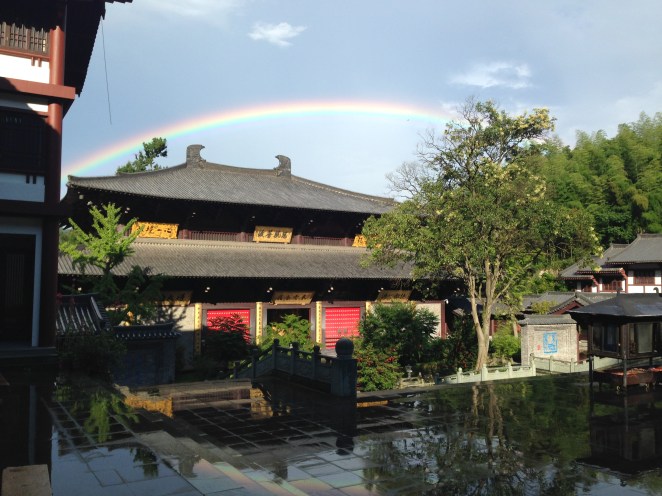
Originally, my idea was much grander. I wanted to make short videos for each concept. As is customary, I was spending the summer teaching for the Woodenfish program and I wanted to use the backdrop of the Buddhist monastery for my recorded conversations. This quickly was abandoned when teaching duties piled on and I was simply too exhausted to scout filming locations, write scripts, and film the twenty briefings I wanted to cover.
When I returned home and began preparing for my class in earnest I decided to simply do audio recordings and I think this worked out for the best. I certainly fumbled through the first through scripts. I was unsure of the conventions for the genre. I was lucky enough to naturally stumble upon a few guidelines that are recommended for doing education podcasts.
Overview
Time Length: This is perhaps the most crucial aspect. I did not want to impose too much information on my students, I wanted to give them just enough basic facts that they could immediately begin applying the concept to the readings and then develop a better understanding of it through their own investigation. The first threshold concept I scripted and recorded was “material culture,” and it ended up being four minutes and twenty seconds long. I had not set a time limit, this was just naturally how long it took me to write and then say the things I thought needed to be introduced. Overall, my shortest podcast was just less than 3 minutes and my longest was just over 5 minutes. One study (by Cheung On Tam) tabulated this chart for student preferred podcast lengths:

Clearly, going over the 5 minute mark was not problematic, though much of what I’ve read suggests keeping the length to about 10 minutes, if not even shorter at 6-8 minutes. Clearly, script writing ability will determine if listeners pay attention for longer.
Tone: I knew immediately from my extensive use of audio commentary on papers that I wanted the tone to be informal, but still driven by information. In the first few recordings I captured many of my “verbal ticks” (“so now…,” “right”), and even though these were weeded out in later recordings as I became comfortable with the format, I never just plainly read my script. I wanted those verbal cues which suggest conversation.
Conventions: The conventions for my podcast briefs took me a while to figure out, and they are still in flux. Ideally, I like to start off with a leading question, historical anecdote, or even a joke (well, only once – I started my brief on “humor” with a joke). When I’m less inspired, I’ll start off with a definition, especially for terms with clear Greek roots (soteriology, ontology, epistemology). For the basic content I would always try to segment the concept in some fashion, providing “different looks” so students could more effectively see the concept in culturally diverse religions. For example, I described bloodless and blood sacrifices for the concept of sacrifice, and elaborated on the here/now, here/then, there/now, and there/then models of utopia. Sometimes I would just give several broad examples. I would also try to end the podcast with some verbal clue (“in closing,” “I leave on this,” etc.) and restate the most important points or types of questions I would want the students to ask of the readings with the threshold concept in mind.
Transcriptions: Originally I just posted the audio recording to our course website, but then later started posting my script as well. I had already done the work, so there was no additional work.
Technology: I recorded everything on my iPhone, no special equipment. I was honestly surprised how crisp the recordings turned out (no hissing, background noise).
Outcome: After soliciting feedback from my students several said they enjoyed the podcasts. About halfway through the term I switched to uploading just my scripts because a non-native speaker in my class complained about needing to re-listen several times to the recordings. (I would quiz students on the content of the podcast, so note taking was necessary.) I was unsure if this was a widespread problem and students were simply afraid to notify me. After asking about this switch, however, a handful of students noted they would prefer to go back to the audio recordings, which was a peasant surprise. From that point onward I tried to provide both the audio and script.
It was only afterwards that I realized the trove of literature on the effectiveness of podcasts. I am already thinking about ways to incorporate podcasts into my writing course this fall term.



 Personal Site of Peter Romaskiewicz
One thought on ““Educational Podcasts” for Class”