Fritz Kapp’s Lamas and Disciples Postcard

For all the new Buddhas in the West posts
follow us on Bluesky & Instagram


In 1900, traveling to Darjeeling meant gazing upon the grandeur of the snow-capped Himalayas and imagining the inaccessible lands that lay beyond them in Tibet. Visiting Darjeeling at this time also meant having the rare opportunity to encounter and observe real Tibetan lamas.

Following the completion of the Darjeeling Himalayan Railway in 1881, the first commercial photography studios opened in the region. As the tourist demand for photographic souvenirs soared, studios increasingly staged scenes of various “ethnic” activities, including Tibetan Buddhist ritual.
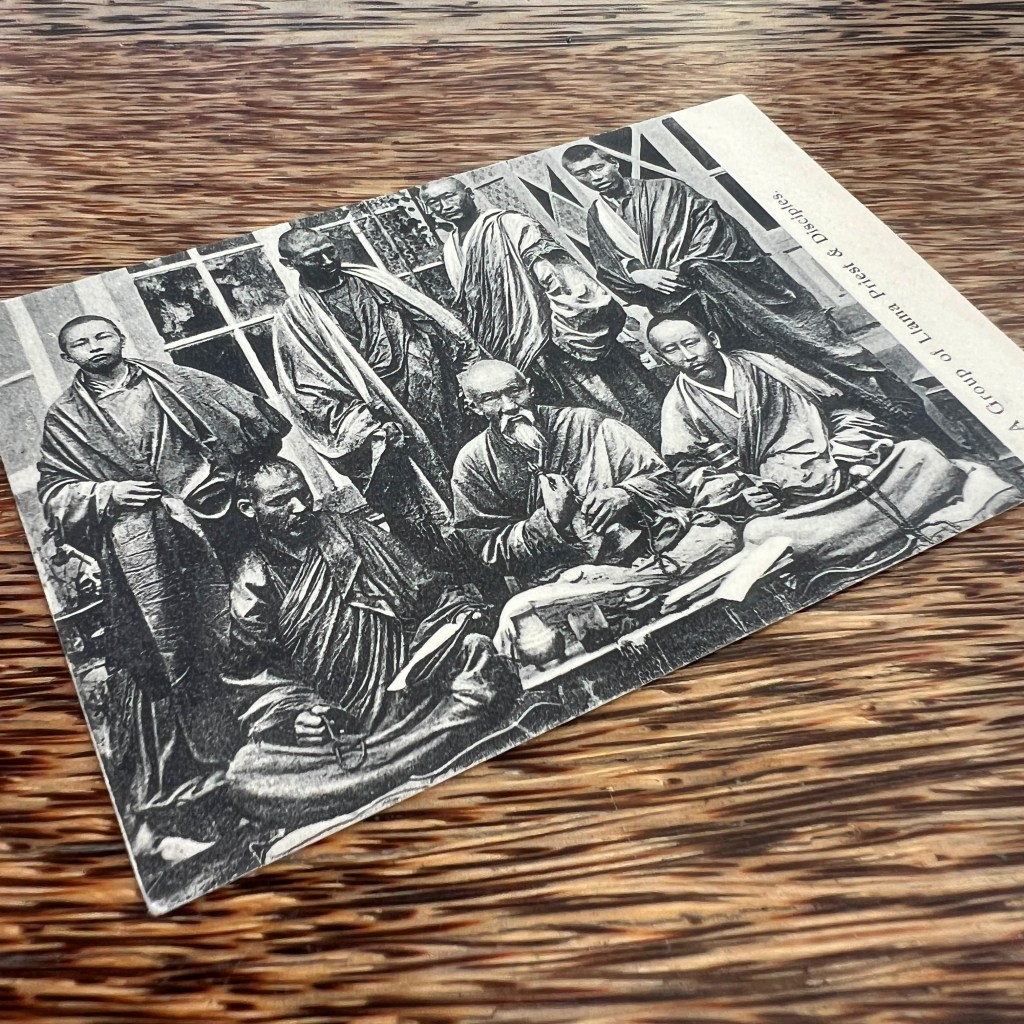
The original photographer for this shot was Fritz Kapp who ran a studio at Calcutta and Darjeeling from about 1888 to 1903. When the picture postcard format was first introduced to Darjeeling in the 1890s, they became a cheaper alternative to photographs and a highly collectable souvenir.

Driven in part by an anthropological mode of seeing and recording, staged studio photographs required appropriate clothing and props to clearly identify the “ethnic type.” Monk’s robes, mala beads, and prayer wheels all signaled the presence of “Llama [sic] priests” as cited in the caption.
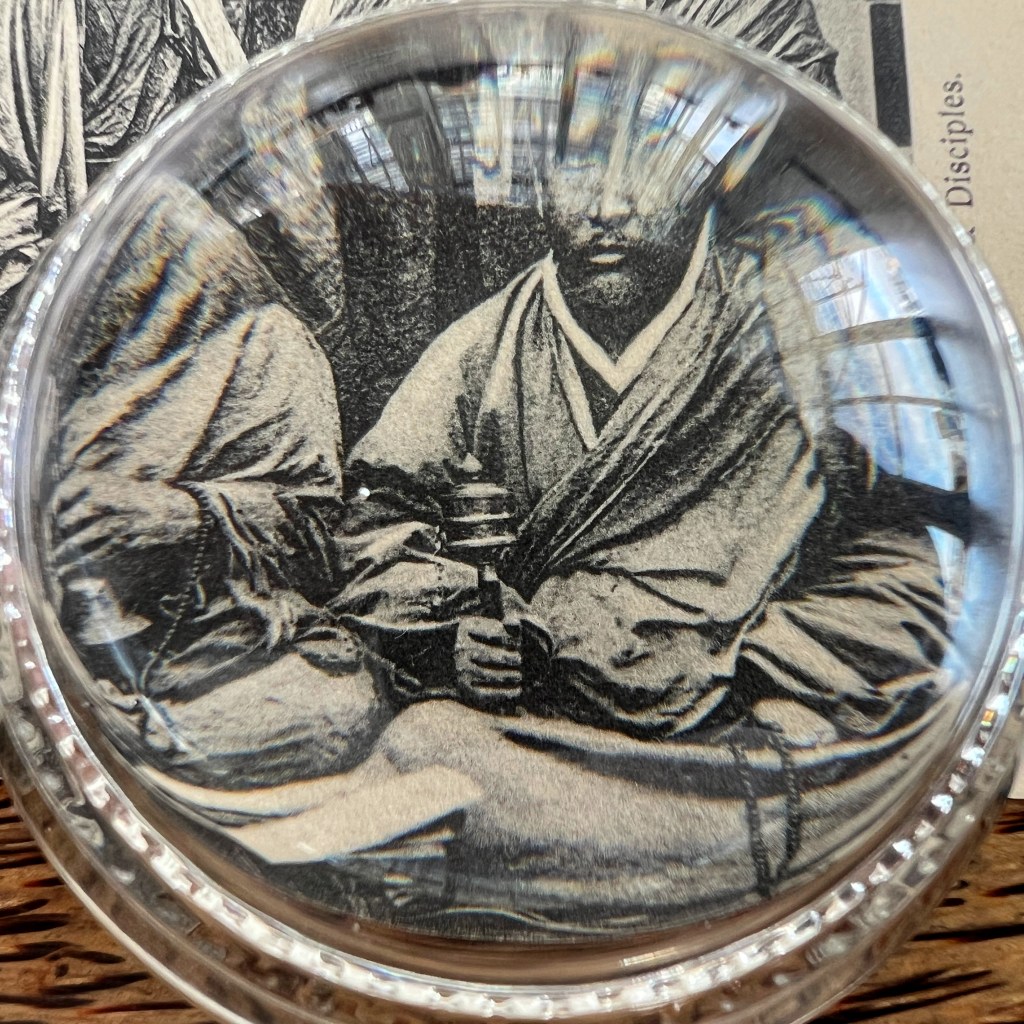
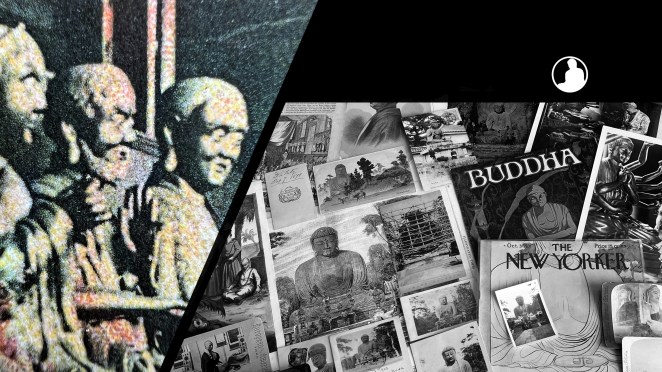
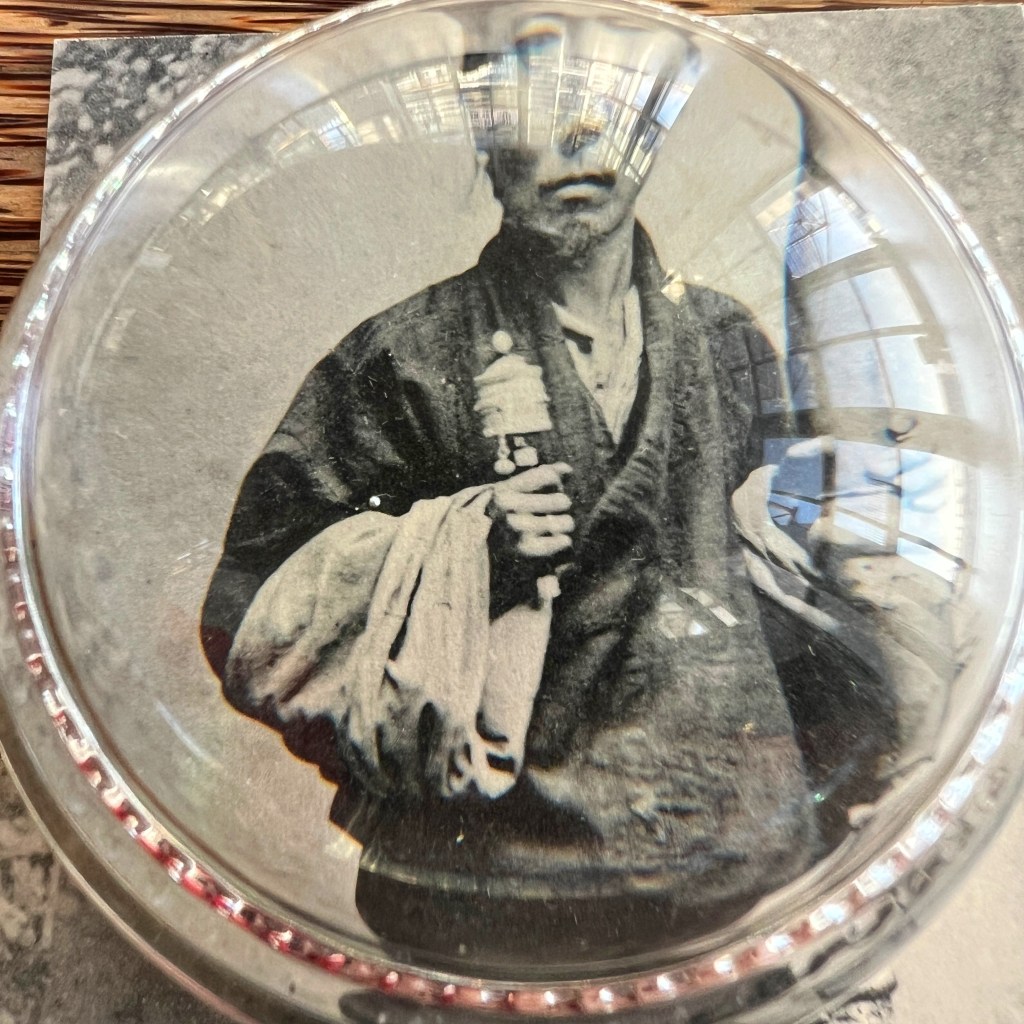
The central figure, looking directly at the camera, holds both a ritual vajra and bell; he is also a real Tibetan monk. Historian Clare Harris has identified this figure as Sherab Gyatso, the abbot of Ghoom Monastery located on the outskirts of Darjeeling.
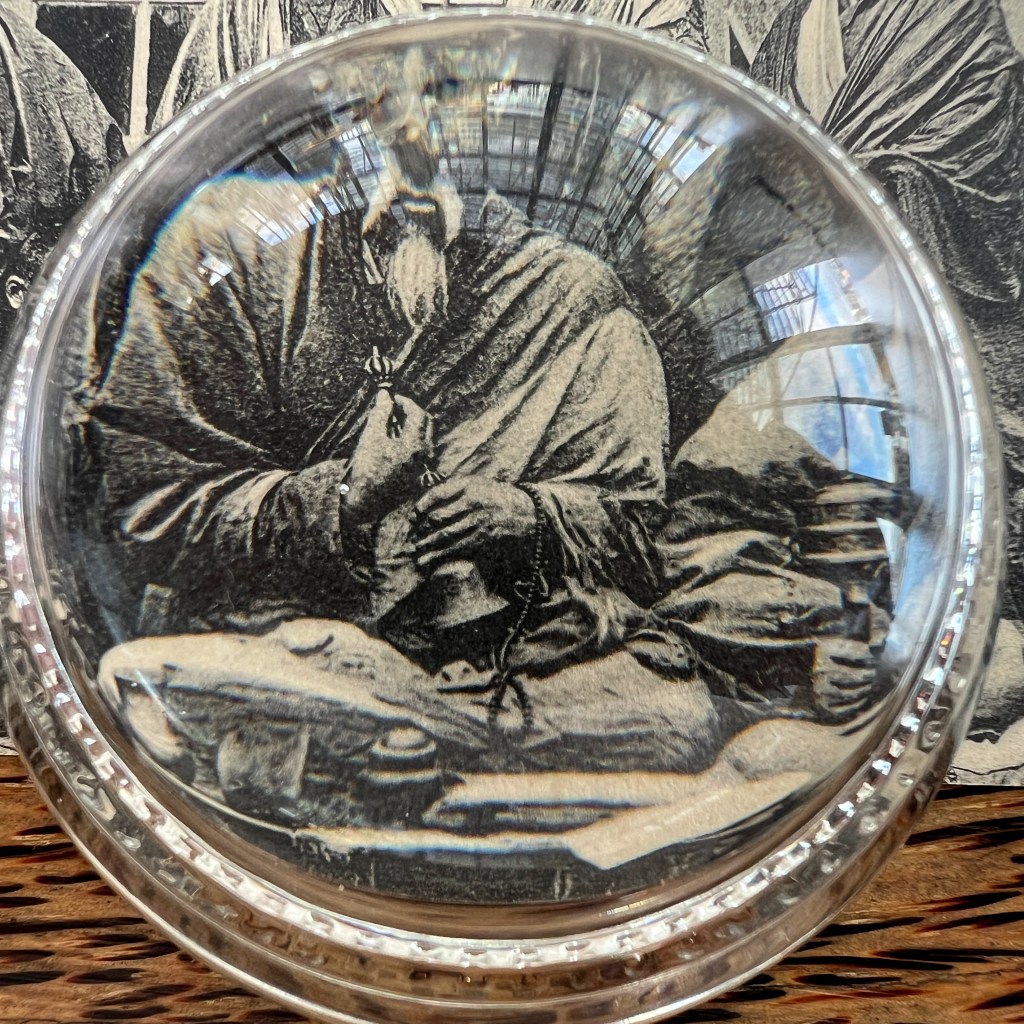
A November 2021 Sotheby’s sale of the original photo was inscribed: “Lama priests by F. Kapp./ Lama Sherb, Gyatso (front middle).” For more on the history of photography in Darjeeling, see Clare Harris’ Photography in Tiber (2016).
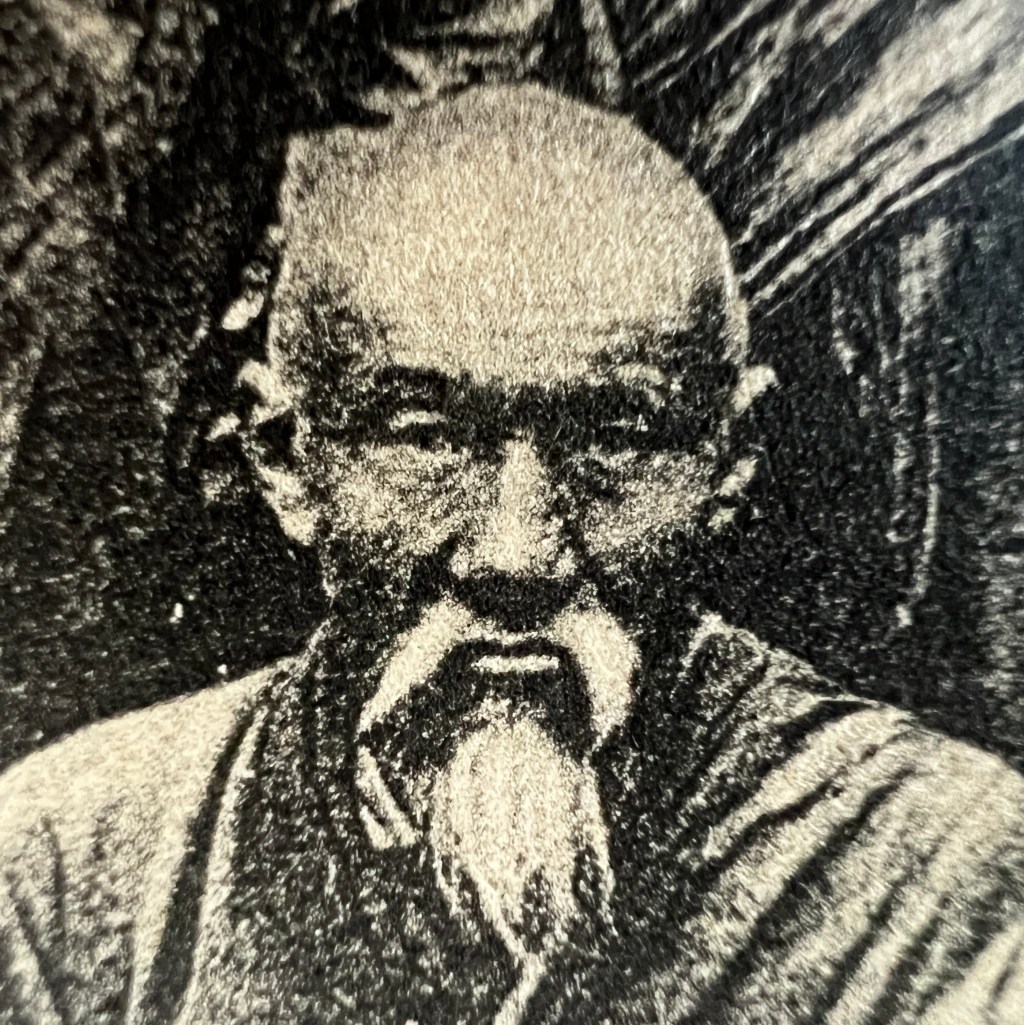

The Buddhas in the West Material Archive is a digital scholarship project that catalogues artifacts depicting Buddhist material culture for Western audiences. It’s comprised of prints, photos, and an assortment of ephemera and other objects. For a brief introduction to this archive, visit the main Buddhas in the West project page.


For Related Buddhas in the West Posts Featuring Prayer Wheels:


For the Most Recent Buddhas in the West Posts:


Eliphalet Brown’s Buddhist Priest at Shimoda Lithograph

For all the new Buddhas in the West posts
follow us on Bluesky & Instagram


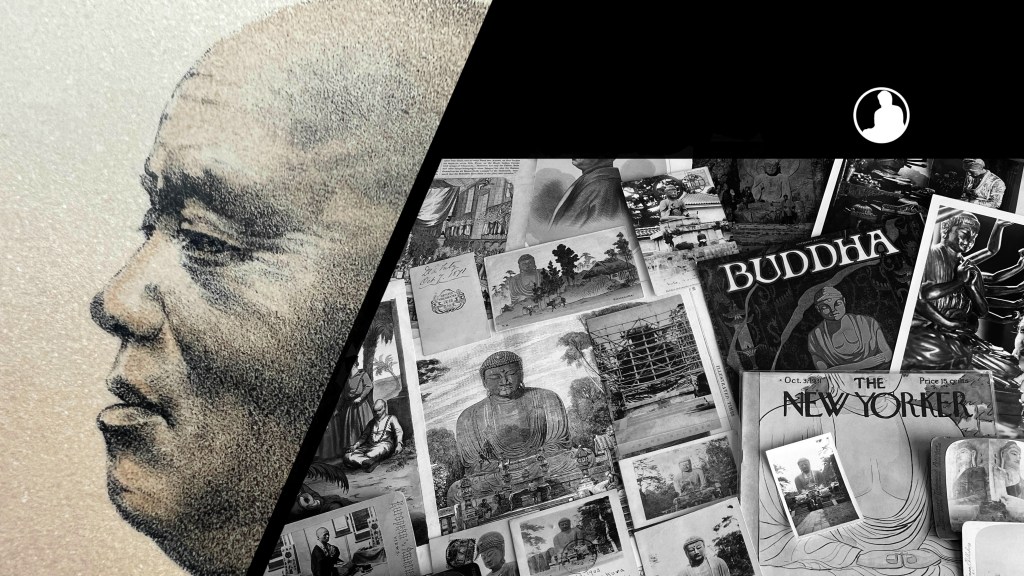
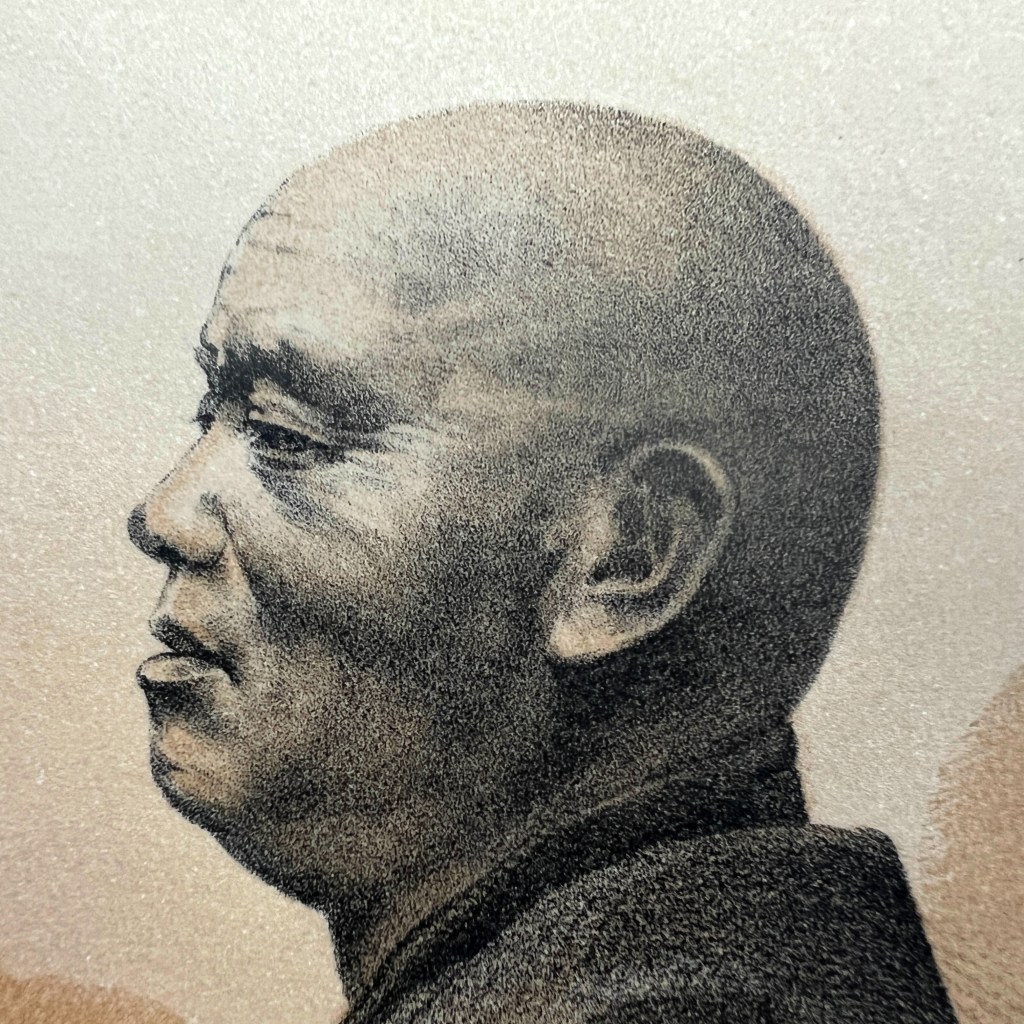
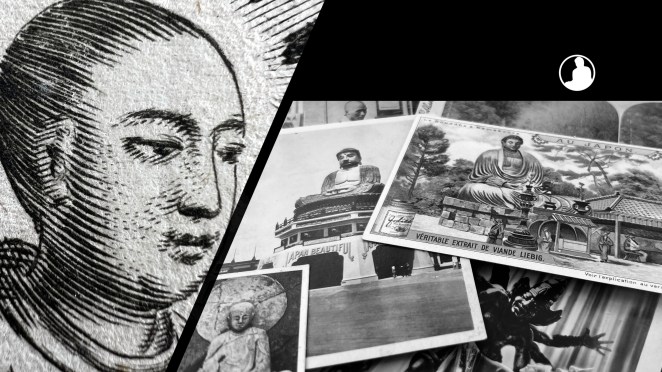
The earliest surviving photographs of Japan were shot by Eliphalet Brown as part of the Perry Expedition in 1853/54. Among many landscapes, Brown also took a few portraits, including this anonymous Buddhist priest at Shimoda – likely the earliest surviving photo of a Buddhist cleric.

Brown reportedly took more than 400 daguerreotypes during the expedition. Several dozen images, including fifteen from Shimoda, were used to illustrate the official US government report published as the Narrative of the Expedition of an American Squadron to the China Seas and Japan in 1856.

The selected daguerreotypes taken by Brown were first turned into paintings, most often by expedition artist Wilhelm Heine. These were then converted into sepia tone or color-tinted stone lithograph plates for printing; the caption below indicates this image was prepared by artist Peter Krämer.

Lithography is a printing process that uses drawings made with a waxy crayon on a stone plate. Due to a special “gumming” treatment applied to the stone, ink adheres only to the drawn lines, thus allowing prints to be made. The characteristic crayon marks can be easily seen here.

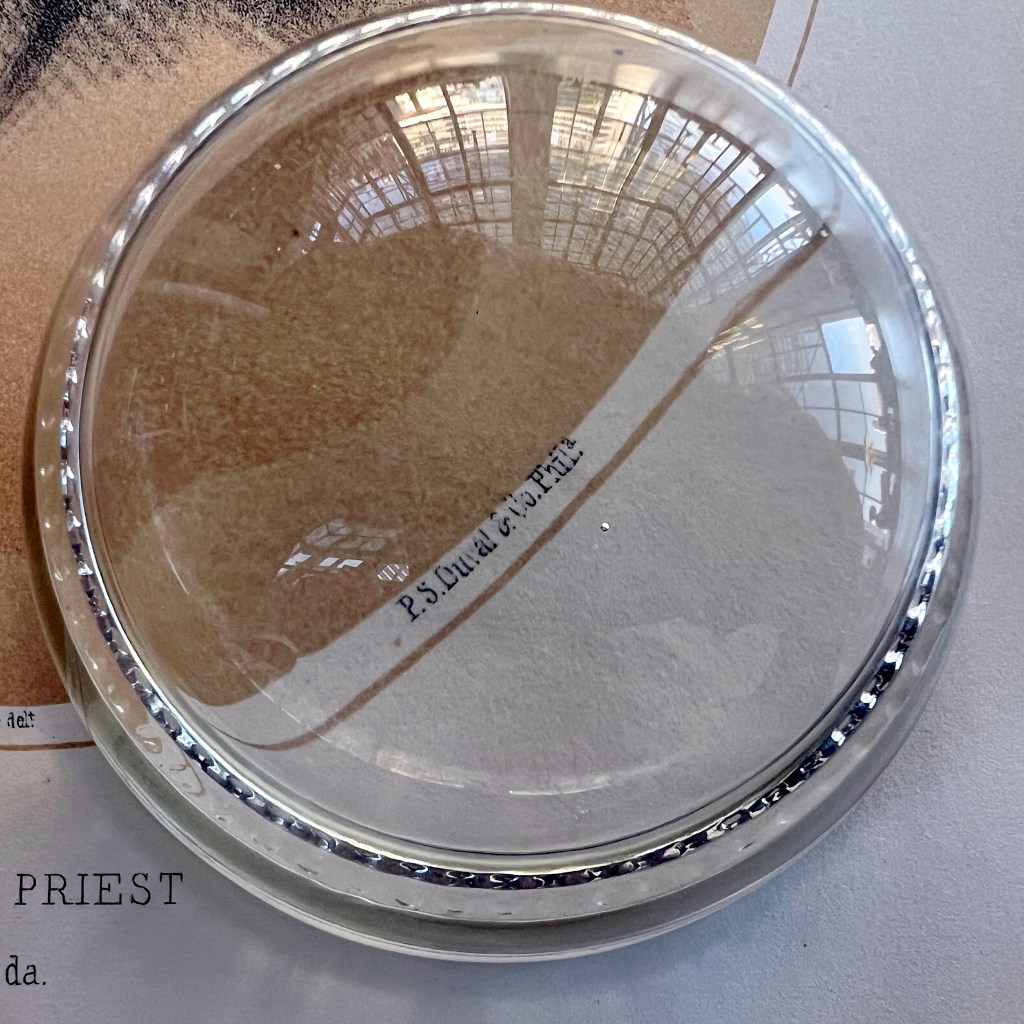
Only six of Brown’s daguerreotypes have been located; some were believed lost when the Philadelphia printer, P. S. Duval, suffered a fire in April 1856. In total, it is believed between 10,000 and 18,000 copies of Perry’s Expedition report were published.

When Perry landed in Shimoda on April 18, 1854, he reported a total of 7,000 inhabitants and nine Buddhist temples. The figure in Brown’s portrait remains unknown. The first volume of Perry’s report is viewable here: https://tinyurl.com/3rpscp9h.


The Buddhas in the West Material Archive is a digital scholarship project that catalogues artifacts depicting Buddhist material culture for Western audiences. It’s comprised of prints, photos, and an assortment of ephemera and other objects. For a brief introduction to this archive, visit the main Buddhas in the West project page.


For Related Buddhas in the West Posts Featuring Buddhist Clerics:


For the Most Recent Buddhas in the West Posts:

Sherab Gyatso of Ghoom Monastery Postcard

For all the new Buddhas in the West posts
follow us on Bluesky & Instagram


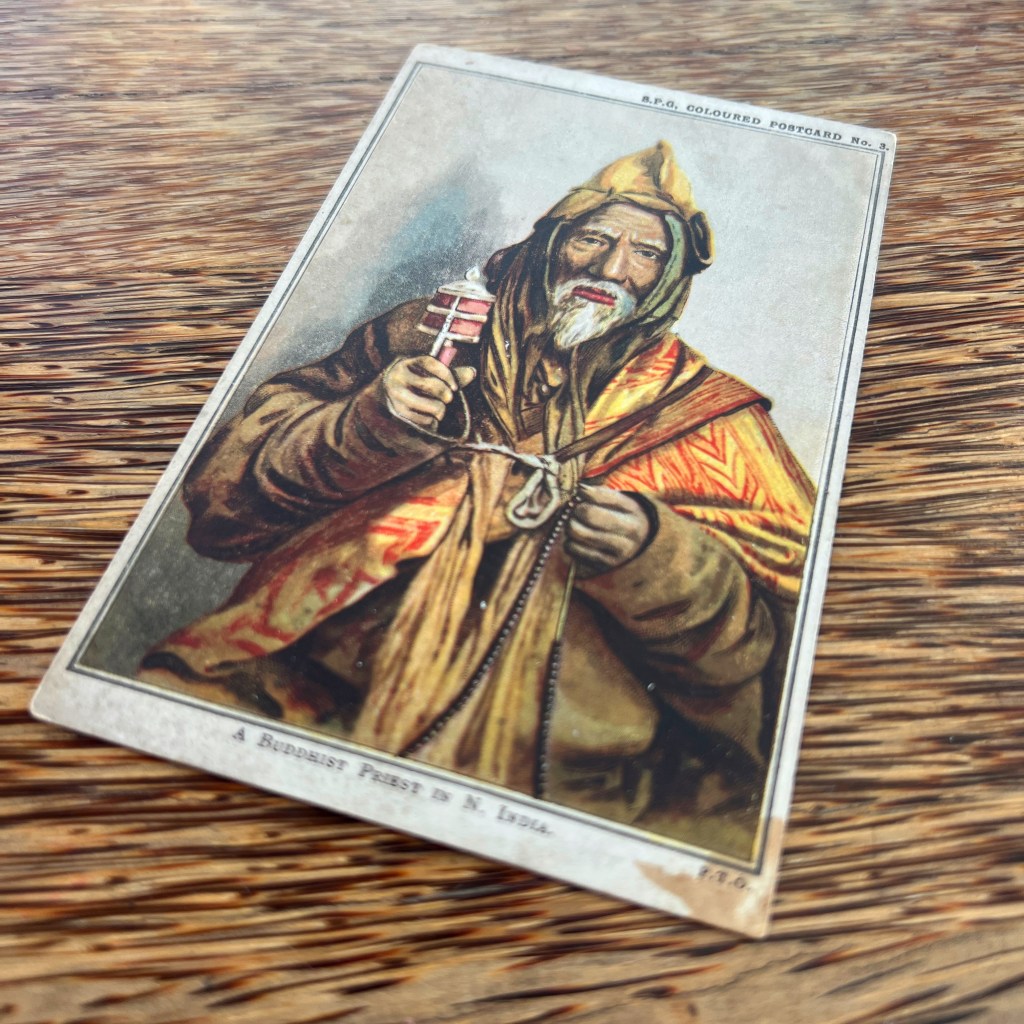
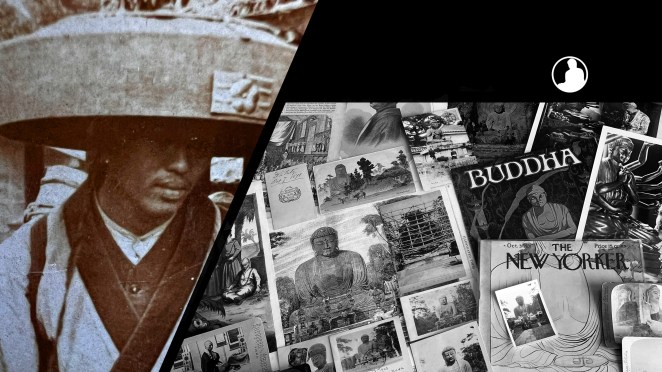
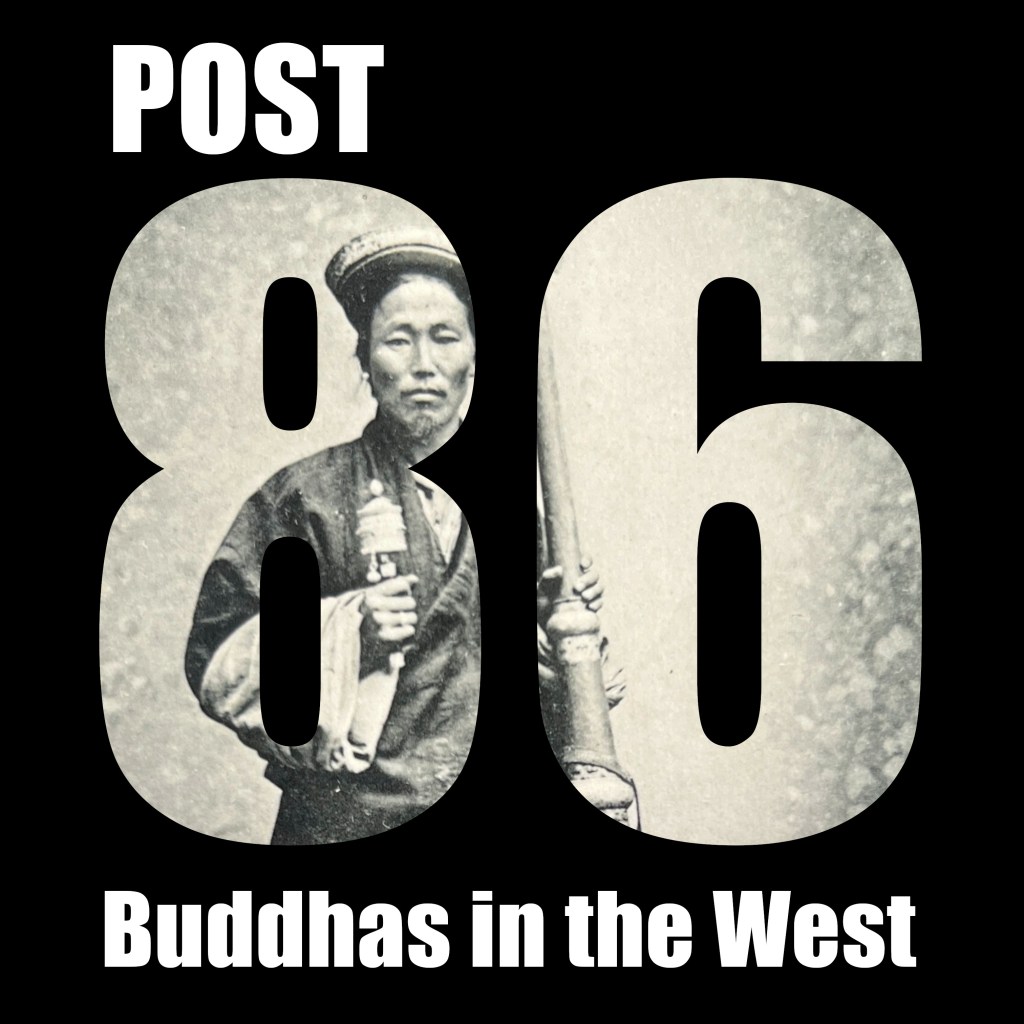
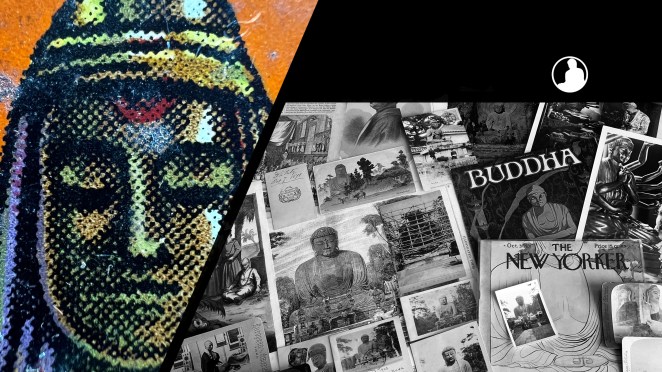
Identified as a “Buddhist priest” and holding a prayer wheel, a figure such as this would have passed for a generic Tibetan lama in the visual language of the early 20th century. In this case, however, we also know this monk’s name: Sherab Gyatso.

Scholar Clare Harris discovered an albumen print of the original photograph taken by Thomas Parr during the 1890s in Darjeeling; the negative was inscribed with the name “She-reb.” The monk was the head of the Geluk Monastery at Ghoom (Ghum) and was well known among the British as the “Mongol Lama.”

Gyatso’s image appears in a wide range of media, including travel guides, published travelogues, and postcards between 1890 and the 1910s. As noted by Harris, this monk emerged as a “poster-boy for Tibetan Buddhism” around the area of Darjeeling in northern India.

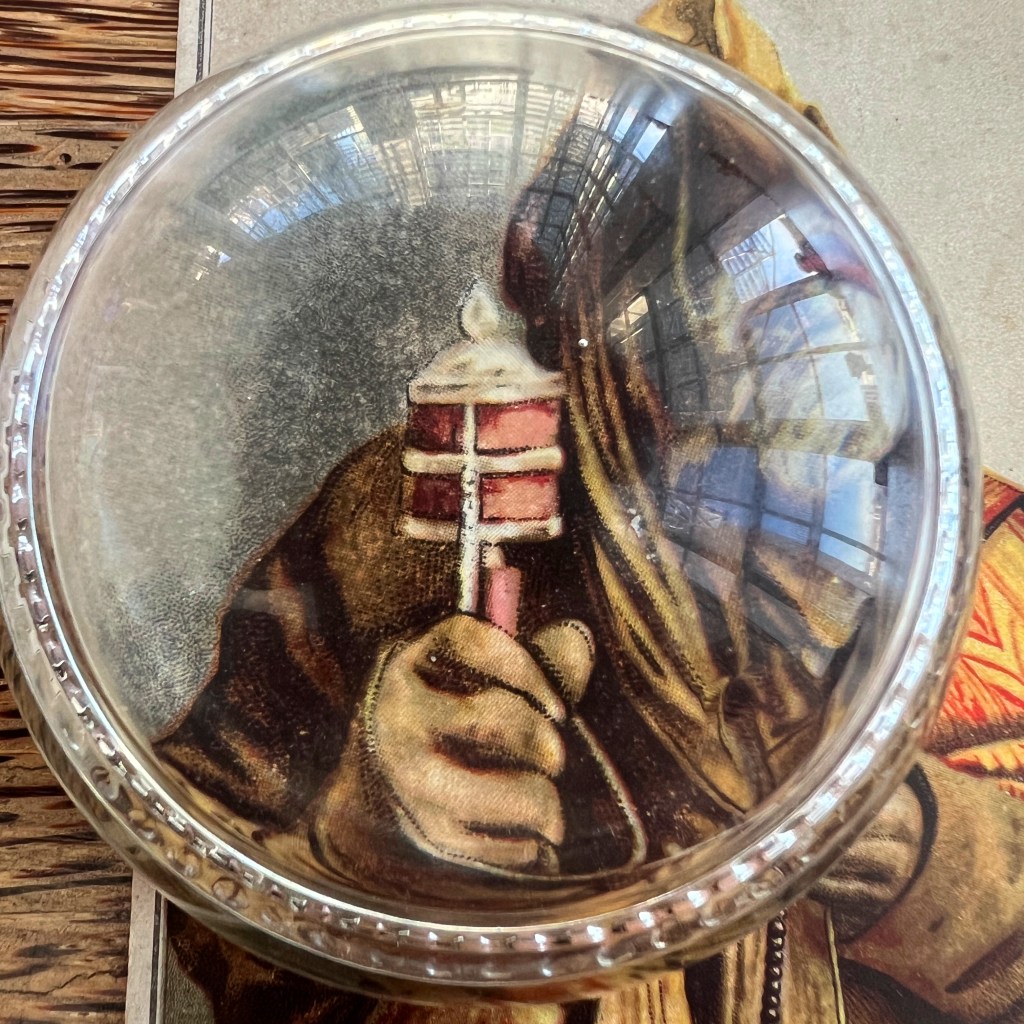
When posed for this portrait in Parr’s studio, the symbols of Tibetan ritual culture are clearly foregrounded, with one hand thumbing mala beads and the other holding a prayer wheel upright and ready for use.

Notably, a Tibetan-style painting and clay statue of Sherab Gyatso grace Ghoom’s monastery today, both derived from Paar’s photograph.

For further information of Sherab Gyatso and the history of early photography in Northern India and Tibet, see Clare Harris’ Photography in Tibet (2017).


The Buddhas in the West Material Archive is a digital scholarship project that catalogues artifacts depicting Buddhist material culture for Western audiences. It’s comprised of prints, photos, and an assortment of ephemera and other objects. For a brief introduction to this archive, visit the main Buddhas in the West project page.


For Related Buddhas in the West Posts Featuring Historical Postcards:


For the Most Recent Buddhas in the West Posts:


James Ricalton’s Priest at the Temple of the Tooth

For all the new Buddhas in the West posts
follow us on Bluesky & Instagram


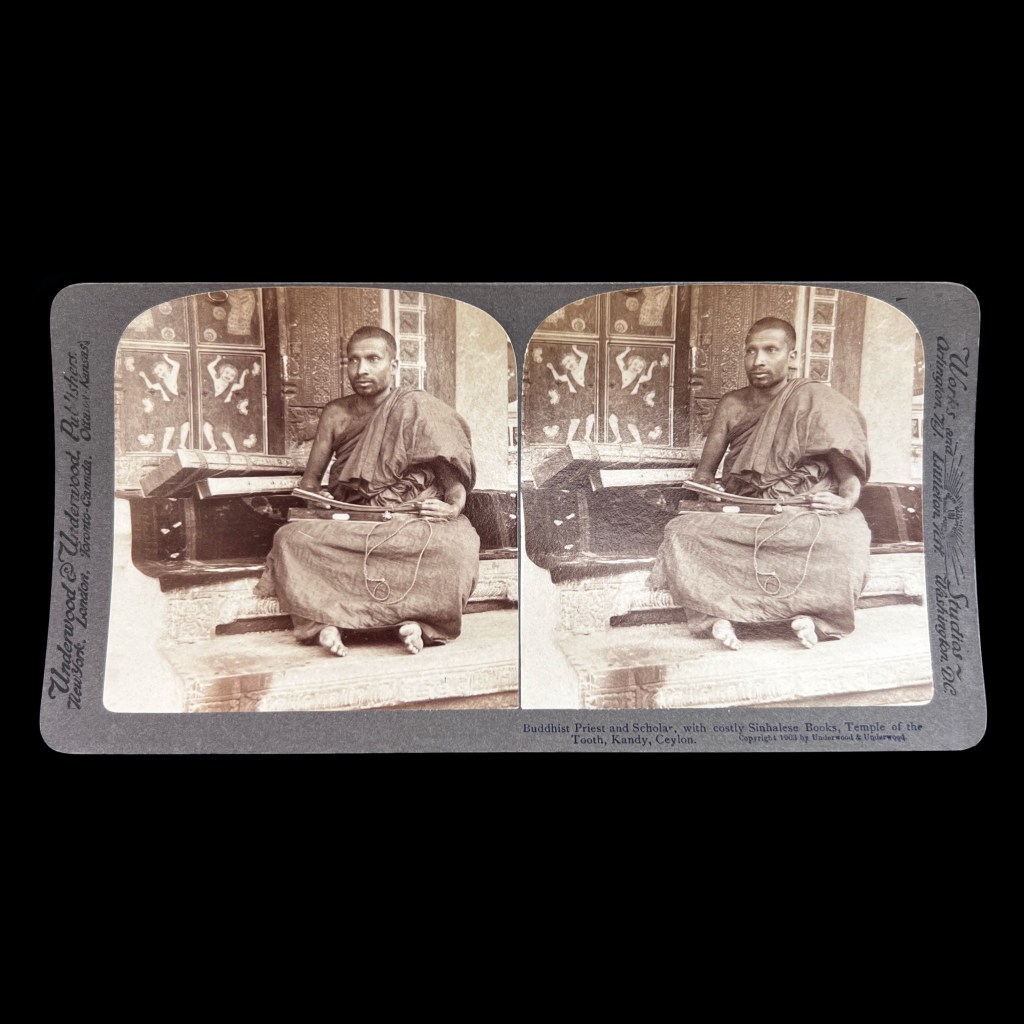
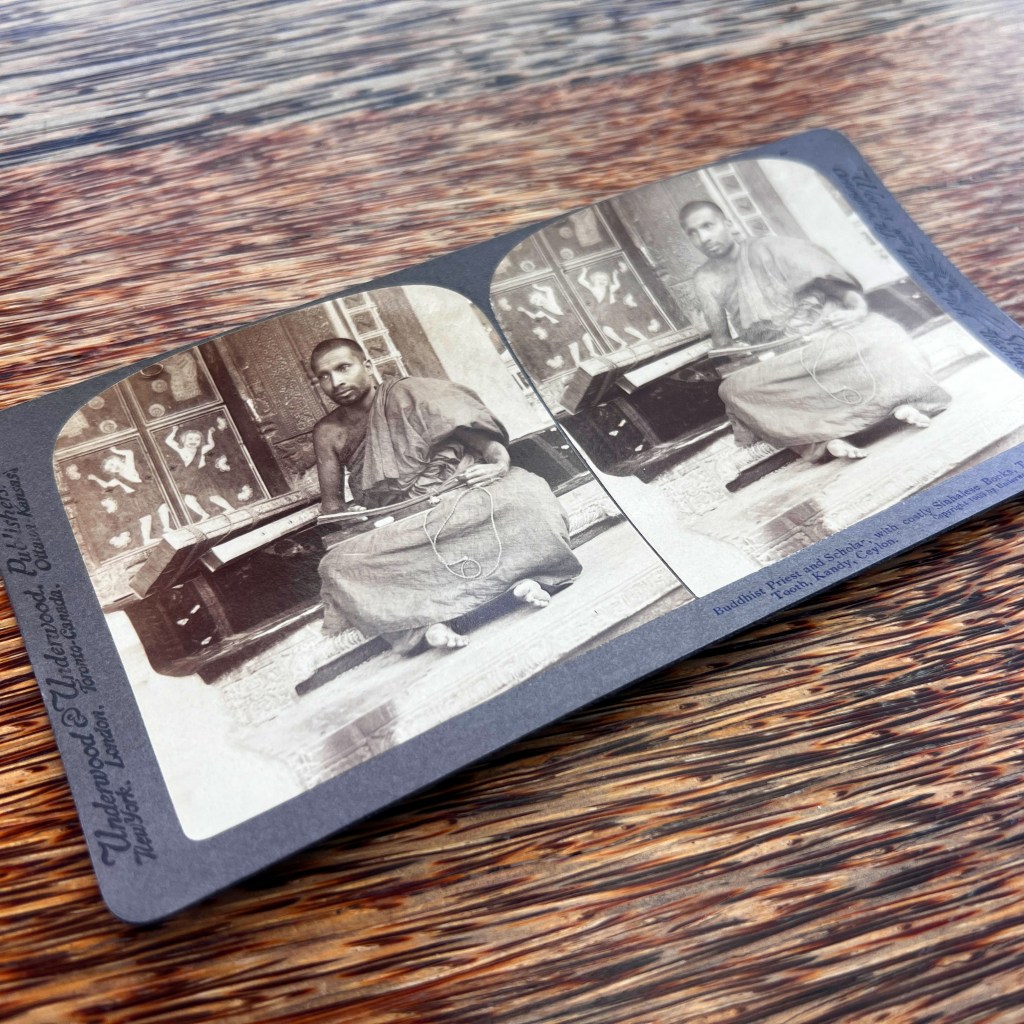
Just after the discovery of the Buddha’s relics at Piprahwa in 1898, James Ricalton was planning a photographic tour of the world. One of his planned stops was to visit the most famous Buddhist relic of his era, the Buddha’s tooth enshrined in the capital city of Kandy.

Ricalton’s employer, the largest stereoscope firm in the world, Underwood & Underwood, was launching several sets devoted to specific countries; Ceylon was slated to have 30 stereoview cards. Underwood’s slogan, ‘‘to see is to know,’’ drove its message that education was a main objective.

Shooting the Temple of the Tooth, Sri Dalada Maligawa, and a few stupas, this image was the only one for Ceylon showing a Buddhist monk. While it was common to depict monks on alms rounds, Ricalton shows this unnamed monk reading scripture, calling him a priest and scholar in the caption.

The monk sits holding the long, rectangular leaves of a Buddhist scripture in his lap. Views such as this were intended to give a glimpse into the “real lives” of the photographed subjects, thus allowing viewers to travel without the hassle of actually leaving home.

Selling “the world in a box,” stereoviews helped shape a vision of Buddhism for American consumers. For more on the powerful visual language of stereoviews, see Judith Babbitts’ “Stereographs and the Construction of a Visual Culture in the United States,” in History Bytes (2004).


The Buddhas in the West Material Archive is a digital scholarship project that catalogues artifacts depicting Buddhist material culture for Western audiences. It’s comprised of prints, photos, and an assortment of ephemera and other objects. For a brief introduction to this archive, visit the main Buddhas in the West project page.


For Related Buddhas in the West Posts Featuring Buddhist Clerics:


For the Most Recent Buddhas in the West Posts:

Bourne and Shepherd’s “Native of Thibet” Postcard

For all the new Buddhas in the West posts
follow us on Bluesky & Instagram


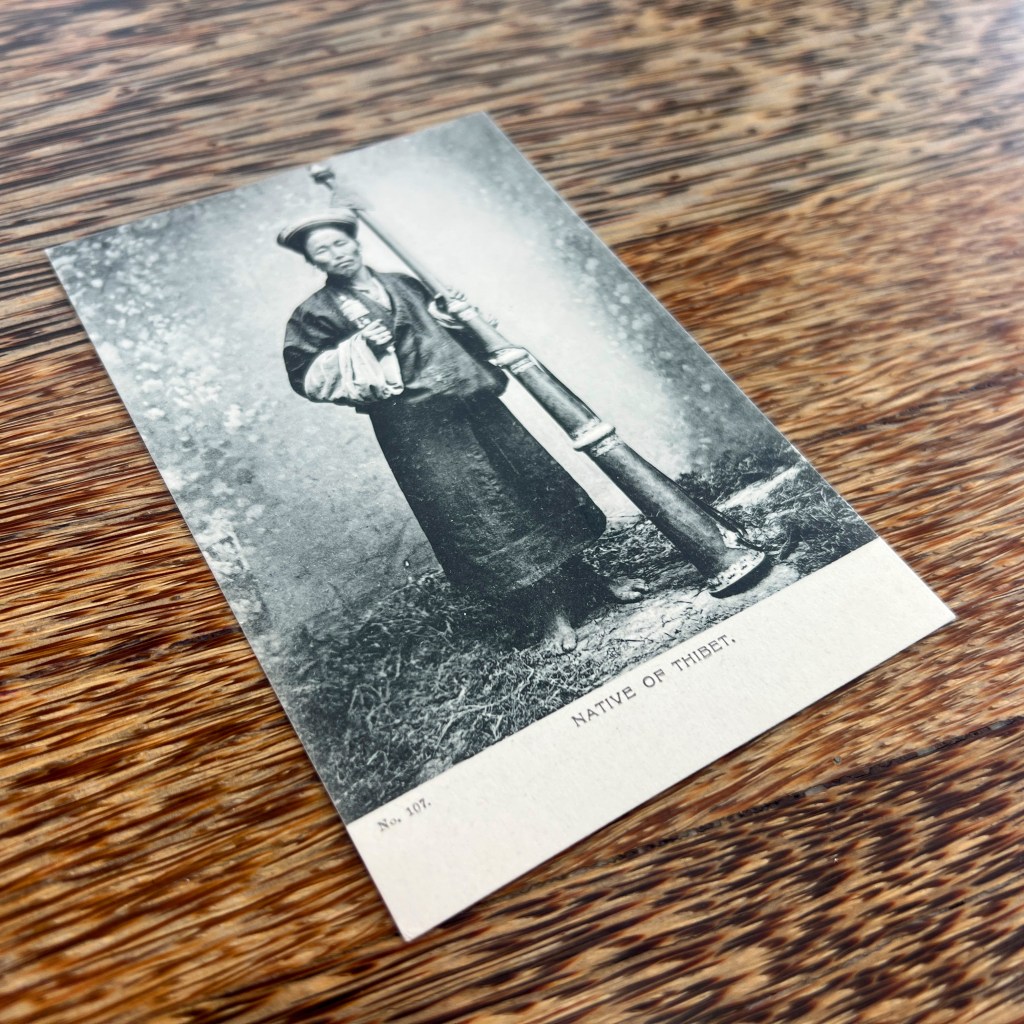
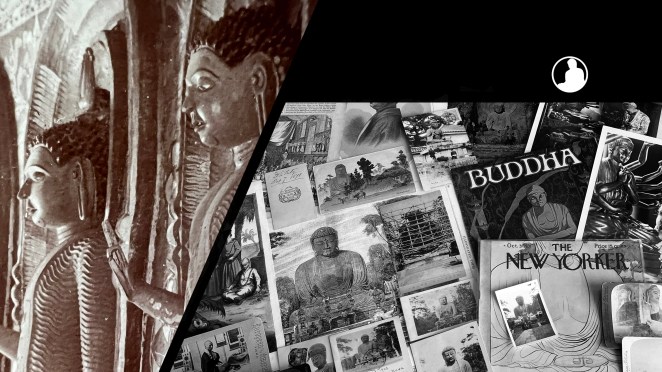
The first photographs of Tibet were not actually taken in Tibet, but were staged in British colonial India. To meet consumer demand, enterprising commercial photographers outfitted their subjects with stereotypical objects to create an easily identifiable “Tibetan” type.

In the Victorian era, material markers of religion were often used by colonial photographers to establish “ethnic types.” The material culture of Tibetan Buddhism emerged as a clear visual sign for Tibet; here we find a “Thibetan native” holding a Buddhist prayer wheel and monastic long horn.

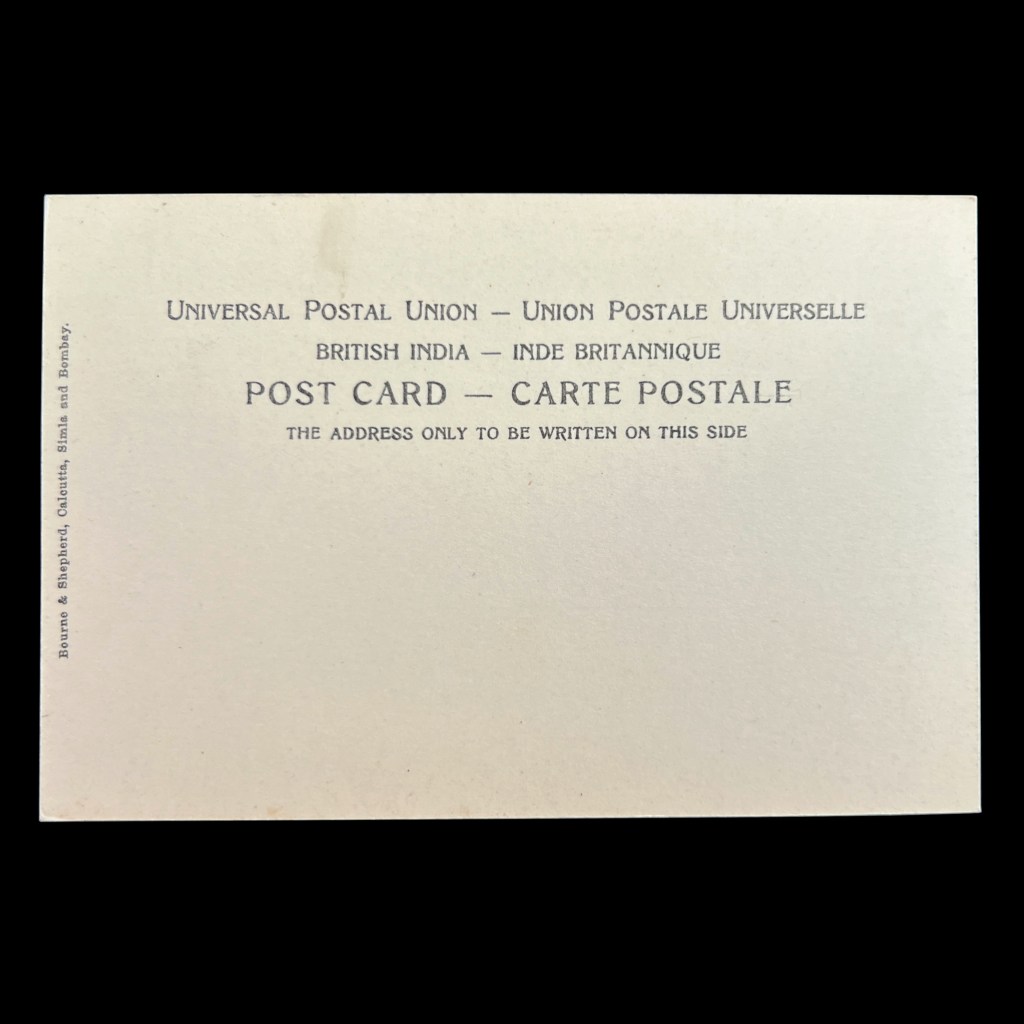
Charles Shepherd and Samuel Bourne formed a photography business in 1866 in Kolkata, producing prize-winning photographs of the Himalayan landscape. By the 1890s, commercial tourist photography was transferred to a new popular pictorial format: postcards.

One of the most commonly seen objects in Victoria era photographs of Tibetans is the hand-held Buddhist prayer wheel. The common portrayal of Tibetans holding ritual implements helped further embellish the fantasy of an enduring Tibetan mysticism.

Once one of the oldest operating studios, a 1991 fire destroyed much of the Bourne & Shepherd archives. For more on early photography in the Himalayas, see Clare Harris’ “Photography in the ‘Contact Zone’: Identifying Copresence and Agency in the Studios of Darjeeling” (2017).


The Buddhas in the West Material Archive is a digital scholarship project that catalogues artifacts depicting Buddhist material culture for Western audiences. It’s comprised of prints, photos, and an assortment of ephemera and other objects. For a brief introduction to this archive, visit the main Buddhas in the West project page.


For Related Buddhas in the West Posts Featuring Tibet:


For the Most Recent Buddhas in the West Posts:

Joseph Rock’s Photographs of Zhouni (Choni) Monastery

For all the new Buddhas in the West posts
follow us on Bluesky & Instagram


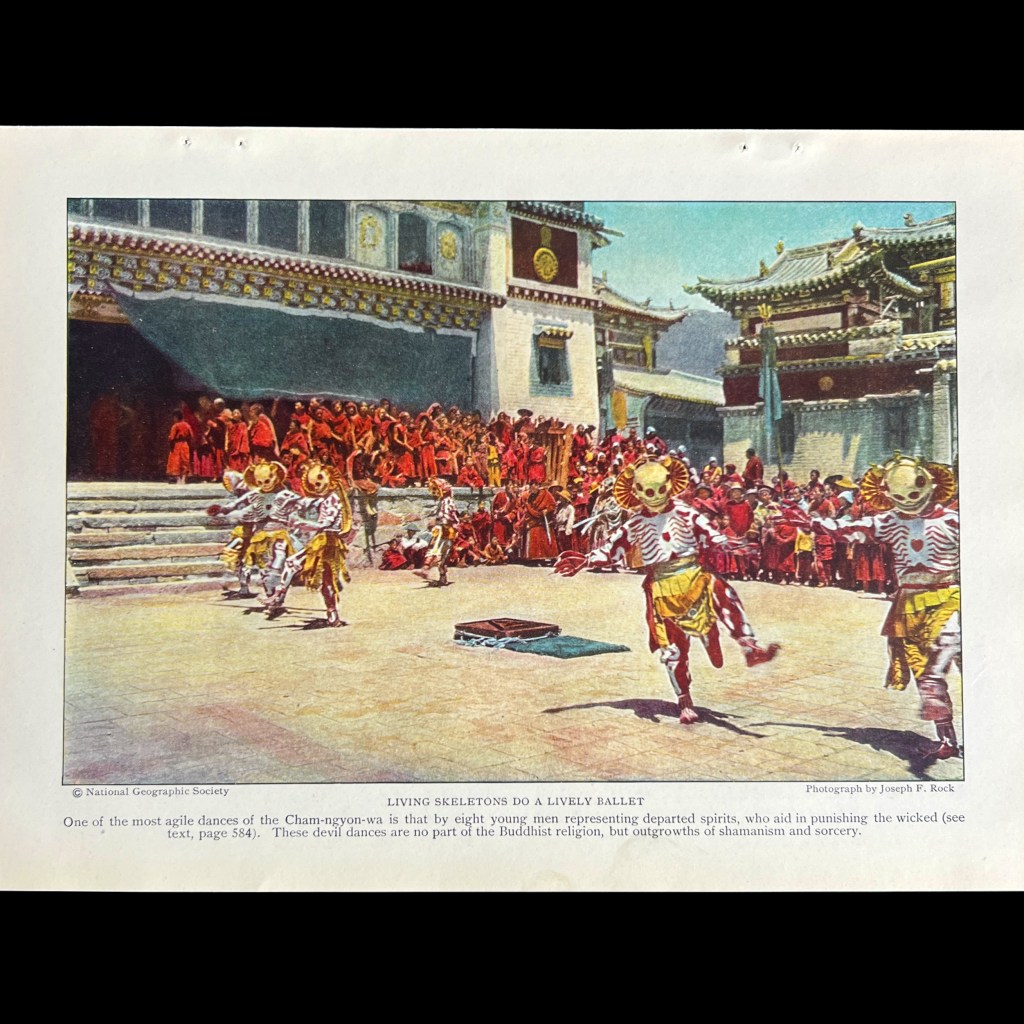
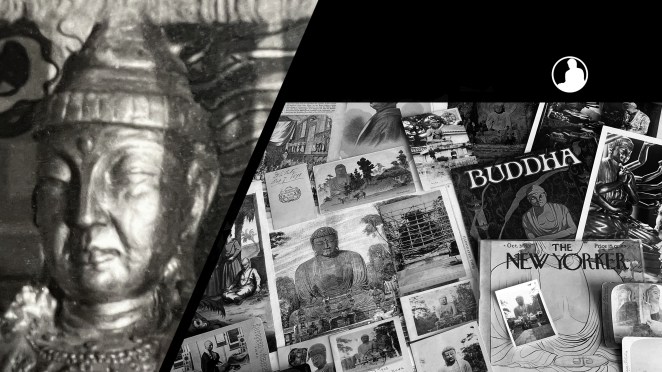
Joseph Rock took stunning photographs of the Tibet-China borderlands between 1922 and 1935, funded in part by the National Geographic Society. During this span, Rock wrote nine article for National Geographic; some were illustrated with gorgeous hand-colored prints.

Rock arrived in Zhuoni, China in April 1925 and stayed for two years, during which he wrote “Life among the Lamas of Choni” published in November 1928. Zhouni, then a Tibetan ruled chiefdom in Gansu province, was home to a bustling Buddhist monastery with hundreds of monks in residence.

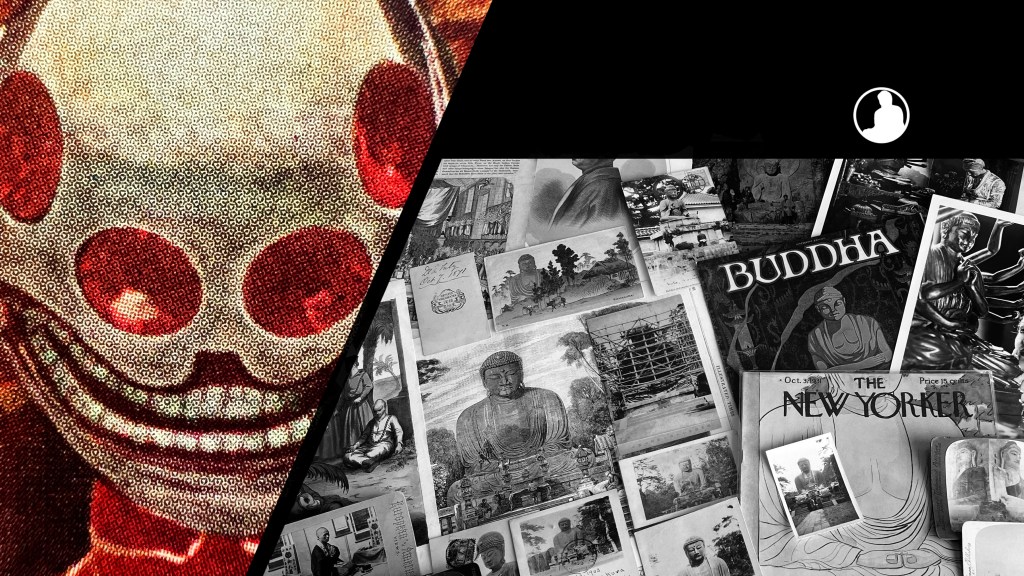
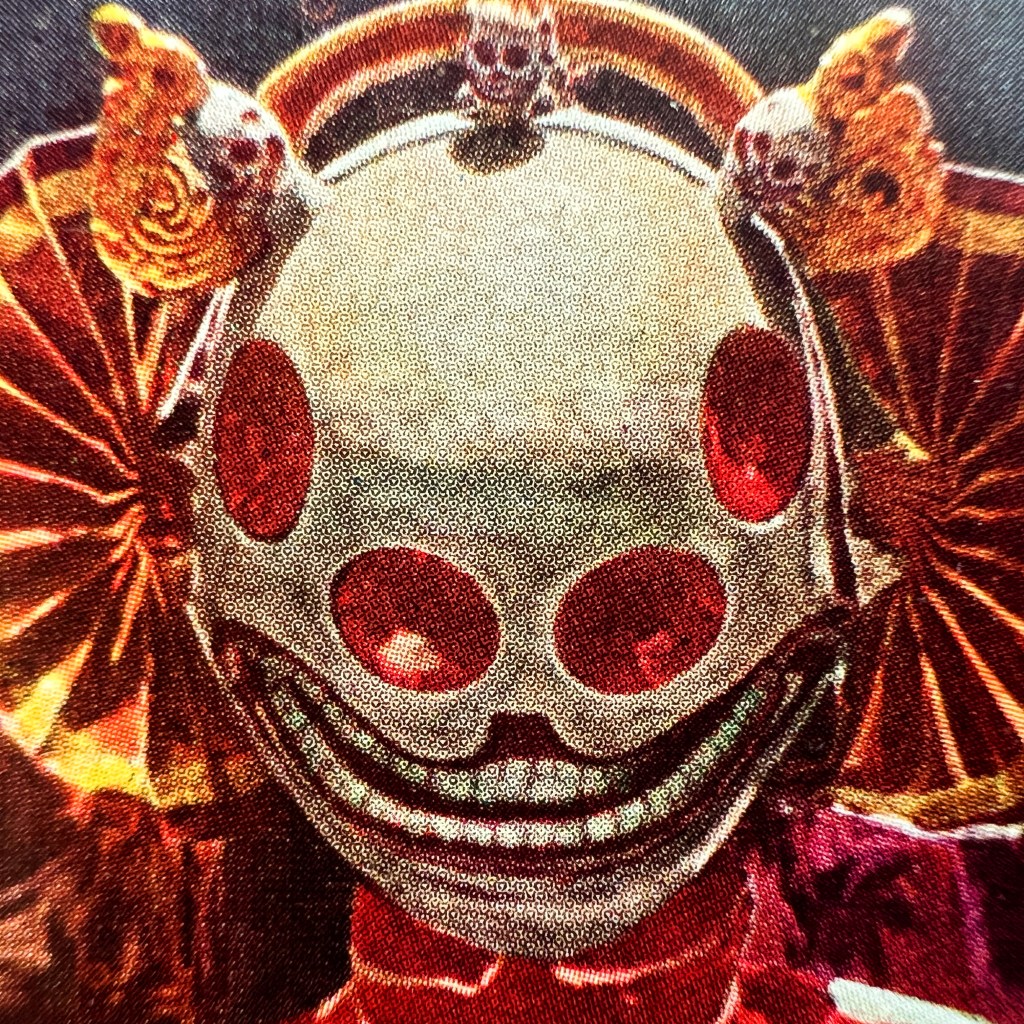
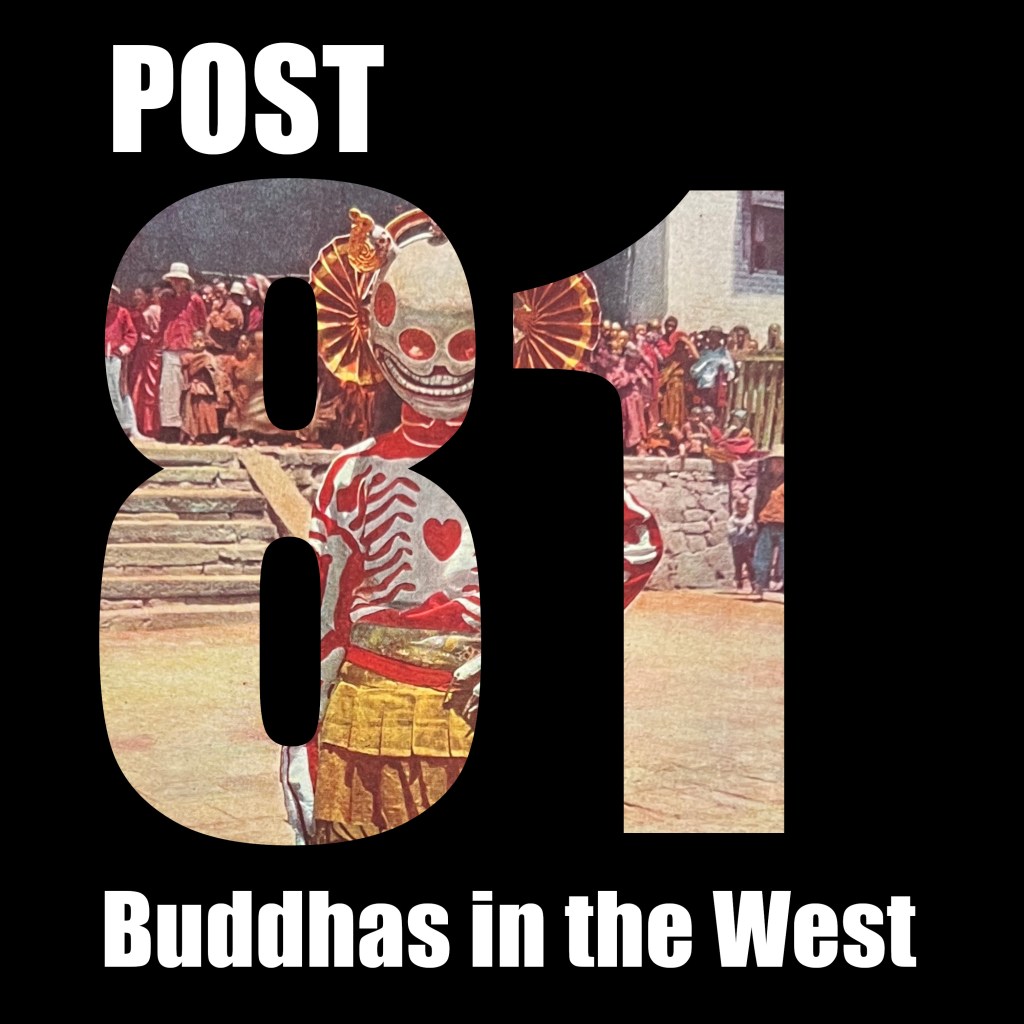
The visual centerpiece of Rock’s article were photos of the Tibetan “Old Dance,” held on the sixth day of the sixth month. Eight agile skeleton dancers were part of the festivities, representing “departed spirits” as described by Rock.

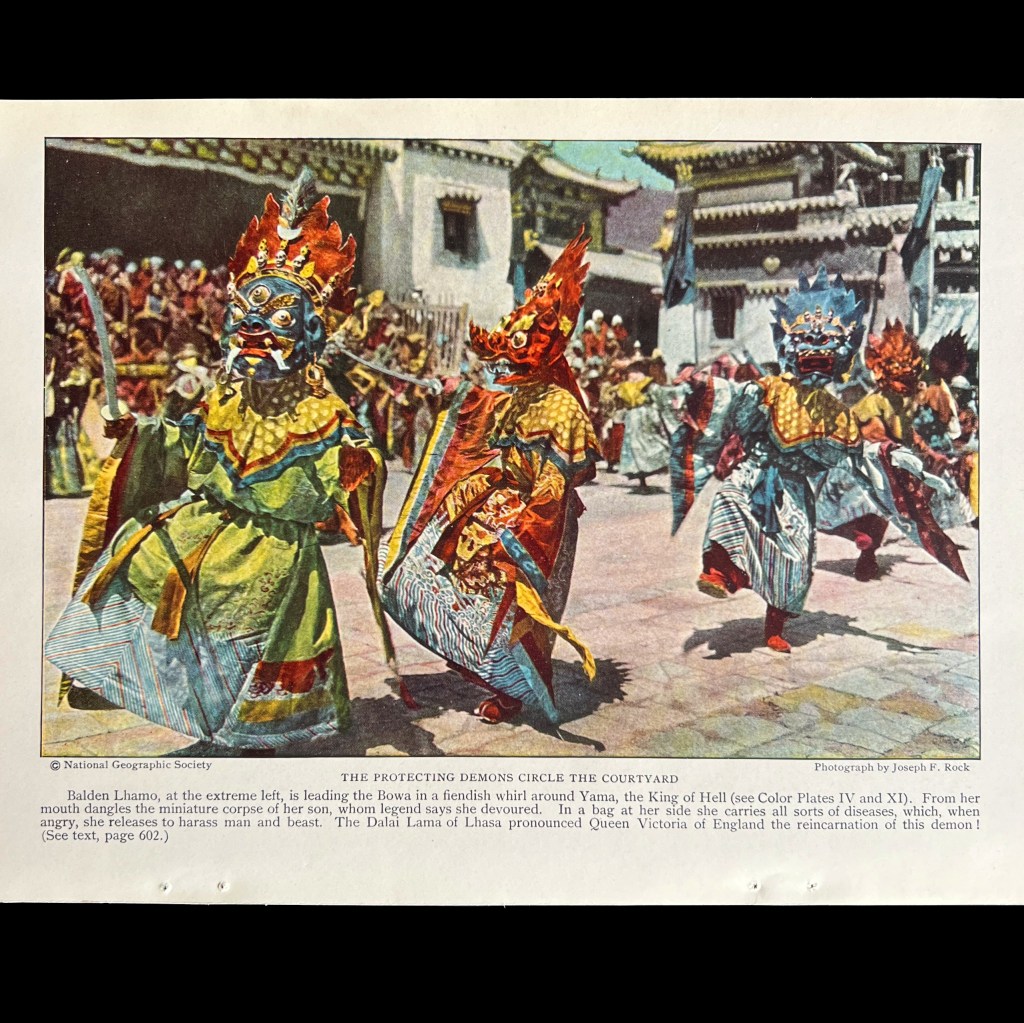
The climax of the Old Dance feature the appearance of Yama, the “grim ruler of the nether world.”

As recounted by Rock, the left-most figure here is Palden Lhamo, the wife of Yama who killed their son, seen dangling from her mouth. According to Rock, due to the British invasion of Tibet decades earlier, it was believed Queen Victoria was a reincarnation of this demon goddess.

Rock developed his own black and white glass negatives and sent them back to the United States. Artists then hand-colored the images according to detailed descriptions furnished by Rock (later, Rock would use potato starch based Autochrome color plates).

Rock was able to purchase a complete set of the Tibetan Buddhist canon printed at Choni Monastery before the printing blocks were destroyed in 1929. To read a digital version of Rock’s account of Choni Monastery in National Geographic, see tinyurl.com/4dwe2tmb.


The Buddhas in the West Material Archive is a digital scholarship project that catalogues artifacts depicting Buddhist material culture for Western audiences. It’s comprised of prints, photos, and an assortment of ephemera and other objects. For a brief introduction to this archive, visit the main Buddhas in the West project page.


For Related Buddhas in the West Posts Featuring Historical Magazines:


For the Most Recent Buddhas in the West Posts:

Pierre Dieulefils’ Angkor Wat Pilgrimage Postcard

For all the new Buddhas in the West posts
follow us on Bluesky & Instagram


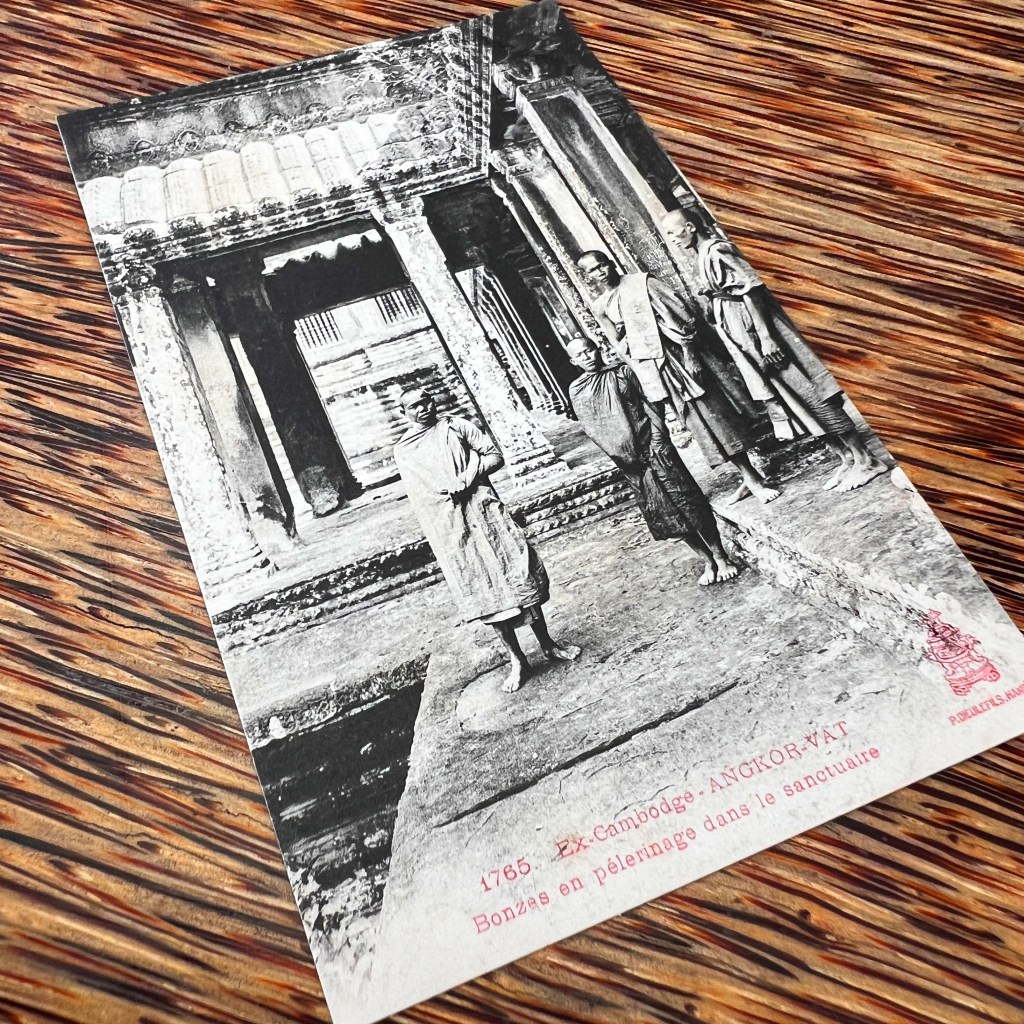
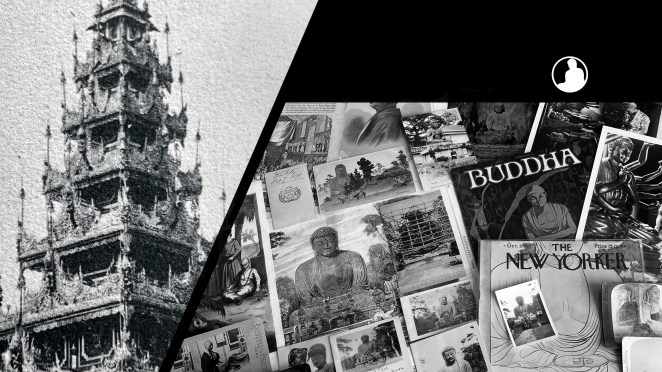
Given countless images showing the architectural grandeur of Angkor Wat, it’s easy to forget it was once an important religious site – not just a tourist destination. Here we see a photo by Pierre Dieulefils from 1905 showing “Buddhist monks on pilgrimage” to the sacred site.

In anticipation of the Exposition coloniale de Marseille in 1906, Dieulefils toured Cambodia to take photographs. His photos reveal many active shrines throughout the Angkor Wat complex, most of which have been cleared out and placed in museums today.

Dieulefils arrived in Vietnam as part of French military forces in 1885. Many of his photographs of Angkor Wat were printed as postcards that were popular among French officers who mailed them home to France.

This Theravadin monk wears his outer cloak (saṃghāti) covering both shoulders, while the monk behind drapes his folded cloak over his left shoulder, bearing his right. Based on contrasting shades, we may infer this monk is wearing maroon robes, while the others wear brighter saffron.

Despite Dieulefils’ photographic record, French colonial guide books portrayed Angkor Wat as an abandoned archaeological marvel, see further discussion in Michael Falser’s “From Colonial Map to Visitor’s Parcours” in ‘Archaeologizing’ Heritage? (2013).


The Buddhas in the West Material Archive is a digital scholarship project that catalogues artifacts depicting Buddhist material culture for Western audiences. It’s comprised of prints, photos, and an assortment of ephemera and other objects. For a brief introduction to this archive, visit the main Buddhas in the West project page.


For Related Buddhas in the West Posts Featuring Cambodia:


For the Most Recent Buddhas in the West Posts:


Liebig Dalai Lama Advertising Card

For all the new Buddhas in the West posts
follow us on Bluesky & Instagram


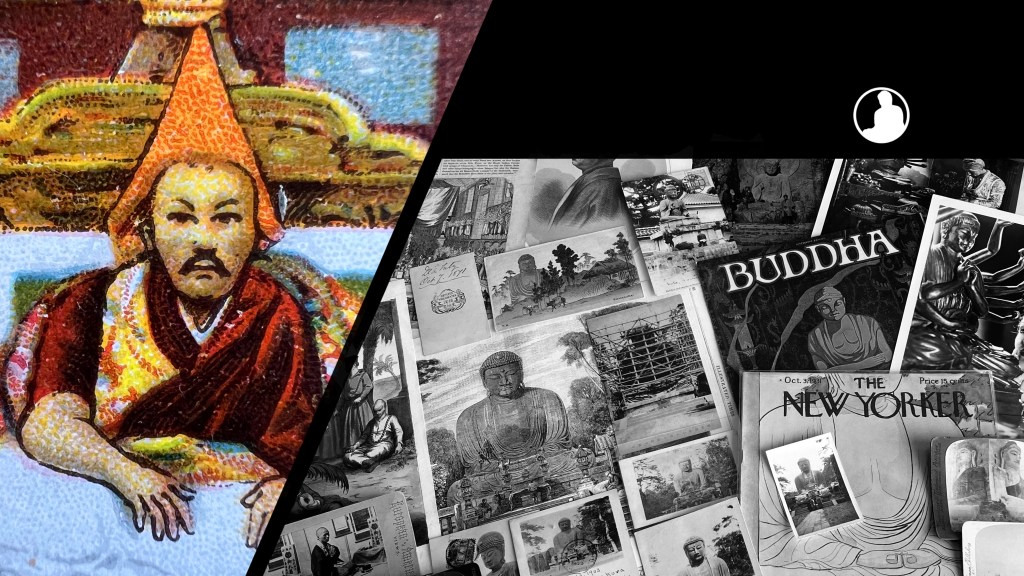
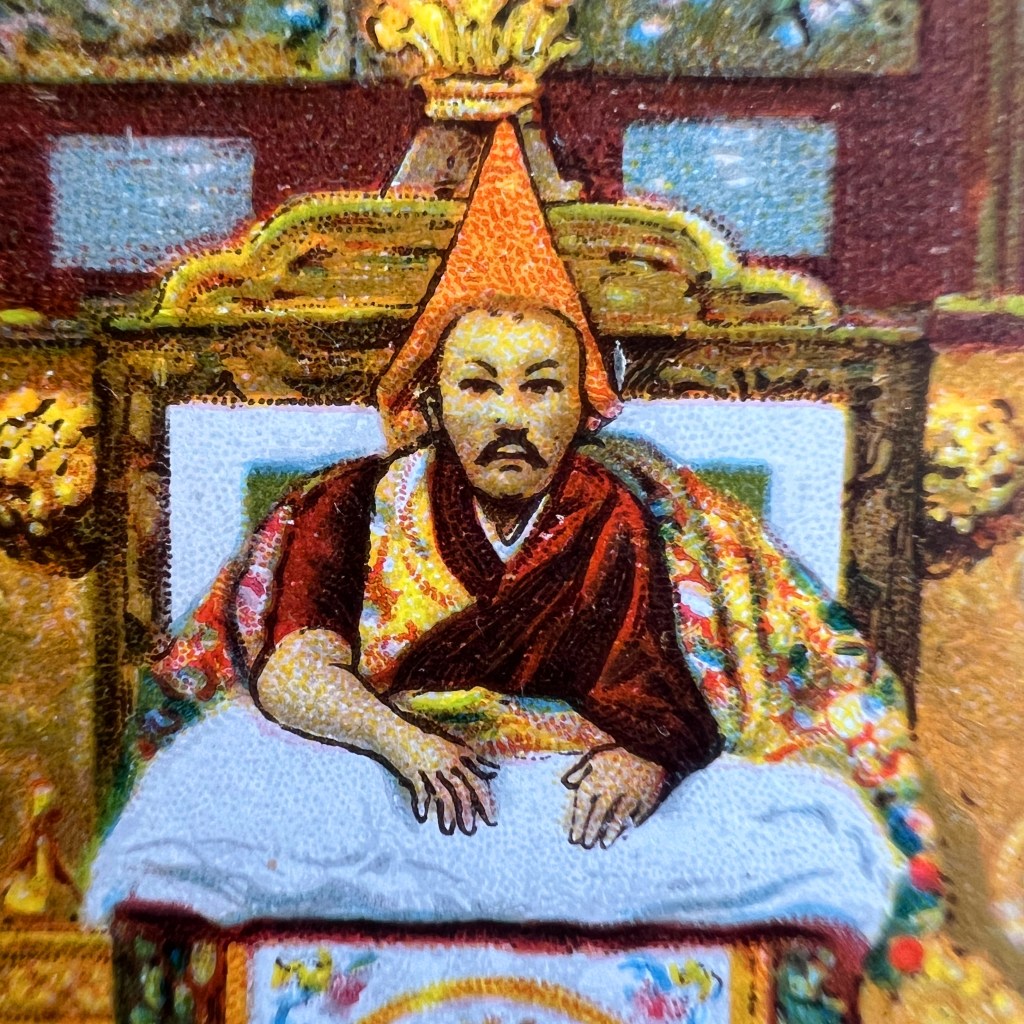
The first photograph of the Dalai Lama in Tibet was taken in 1921; it depicts “the Great Thirteenth,” Tubten Gyatso (1876–1933). The image was published in various Western media, even making its way on to a multicolor lithograph trade card for the German company Liebig in 1935.
*The first photograph of the Dalai Lama was taken in India in 1910 following the incursion of the Qing army into Tibet.

The photograph was taken by Charles Bell and Rabden Lepcha at Norbulingka, the summer palace of the Dalai Lama. Previously, images of the Dalai Lama were only spread through devotional tapestries (thangka) and gilt statues; now photographs could be shared among faithful Tibetans.

The Liebig company started printing colorful advertising cards in 1872, helping to support a popular collector’s hobby. This set from 1935 focused on Lhasa and included six cards, including an image of Potala Palace and large Tibetan prayer wheel, both iconic images in popular consciousness.

The original black and white photograph shows the Dalai Lama sitting on a throne behind an ornate dais. On the back wall hangs nine silk thangka depicting the Buddha, but the lithographic artist only loosely renders them as Buddhist images.

For a brief account of the Dalai Lama photograph and discussion on the impact of photography in Tibet, see Riga Shakya’s Lenses of Modernity: Photography in Tibet and the Himalayas, viewable here: tinyurl.com/bdzzcw4m.


The Buddhas in the West Material Archive is a digital scholarship project that catalogues artifacts depicting Buddhist material culture for Western audiences. It’s comprised of prints, photos, and an assortment of ephemera and other objects. For a brief introduction to this archive, visit the main Buddhas in the West project page.


For Related Buddhas in the West Posts Featuring Tibet:


For the Most Recent Buddhas in the West Posts:

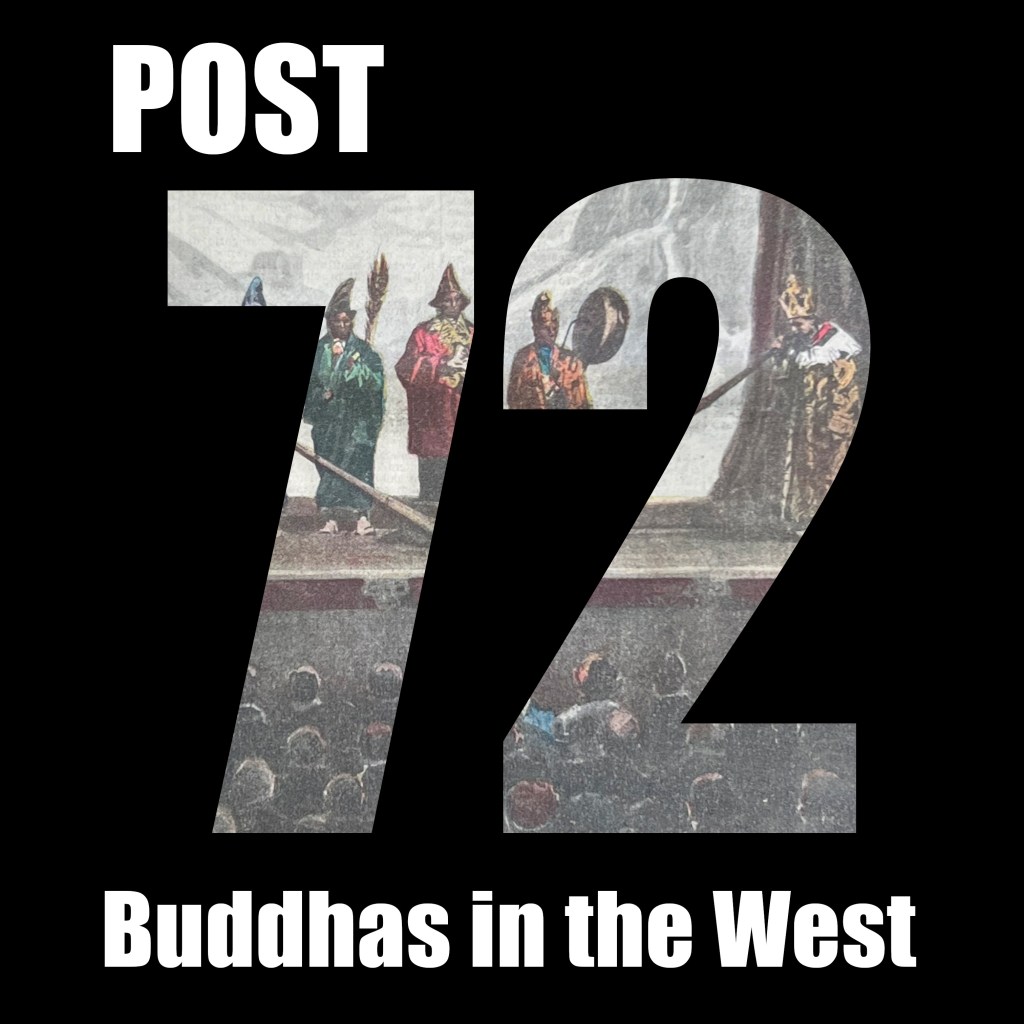
The “Dancing Lamas” and Epic of Everest (1924) Prologue Newspaper Illustration

For all the new Buddhas in the West posts
follow us on Bluesky & Instagram


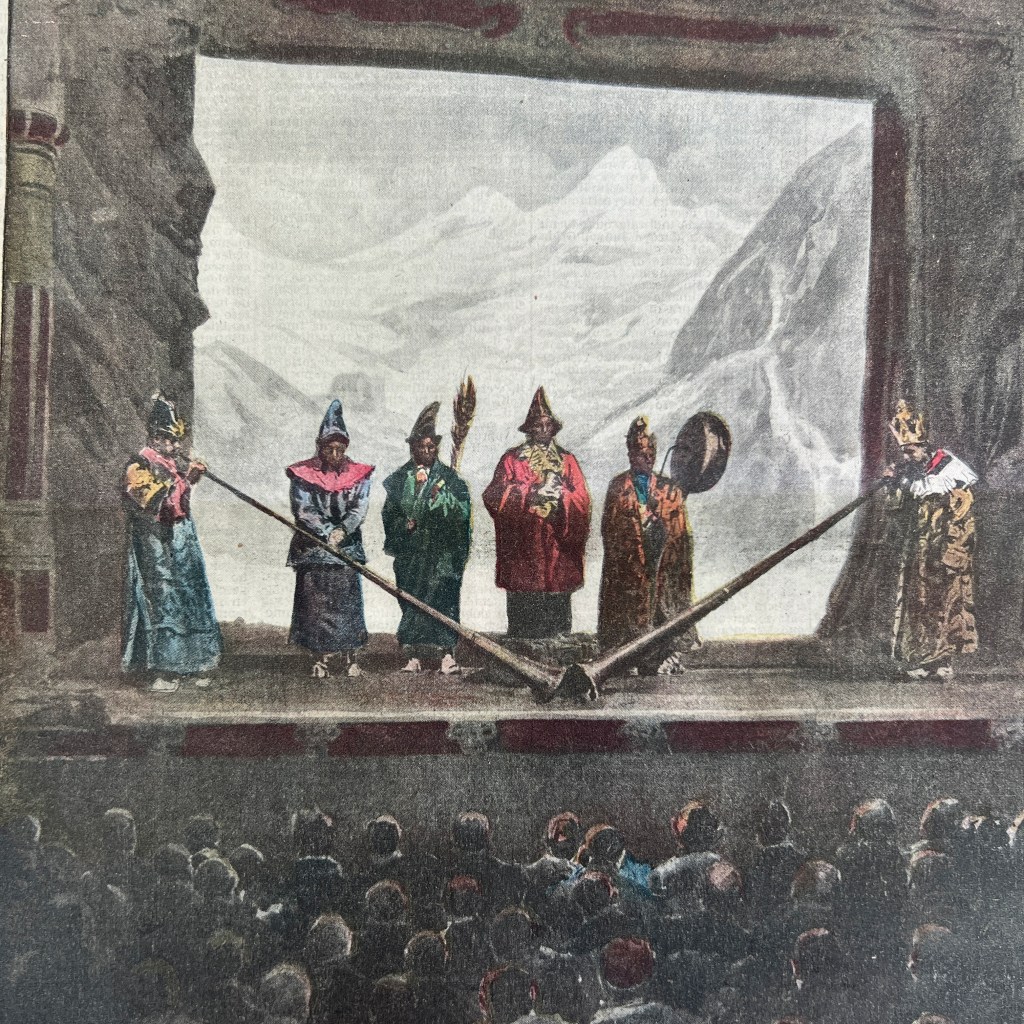
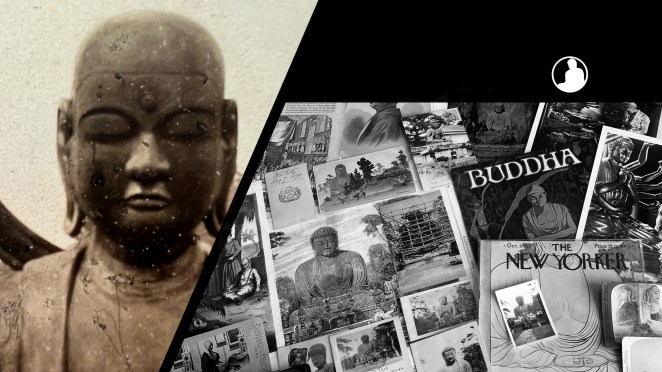
The arrival of the first Tibetan monks in Europe was surrounded with controversy, deeply straining Anglo-Tibetan relations. One group of monks, arriving in 1924, performed Buddhist rituals before showings of the silent film Epic of Everest, sparking the “Dancing Lamas” affair.

The director, John Noel, filmed the British Everest expedition where George Mallory and Andrew Irvine lost their lives. The first half of the film looks at Tibetan life in and around Rongbuk Monastery at the foot of Everest, including several brief scenes showing monastic ritual.

To help advertise the film in London, Noel brought several monks from Tibet and had them perform informal rituals as part of a “live prologue” (seen here). Newspapers report the monks chanted while playing long trumpets and beating drums and cymbals; some claimed they performed “devil dances.”

These reports were received in Tibet with furor; the Dalai Lama viewed the spectacle as disrespectful to Tibetan Buddhism and exploitative of Tibetan people. Consequently, a British Everest expedition the next year was refused by the Dalai Lama; the next British attempt at Everest came in 1932.

Noel toured Europe with his film accompanied by the Tibetan monks, but the controversy caused him to send the monks home before touring the United States. Noel’s silent film, Epic of Everest, is viewable here: tinyurl.com/3df4axfn.


The Buddhas in the West Material Archive is a digital scholarship project that catalogues artifacts depicting Buddhist material culture for Western audiences. It’s comprised of prints, photos, and an assortment of ephemera and other objects. For a brief introduction to this archive, visit the main Buddhas in the West project page.


For Related Buddhas in the West Posts Featuring Historical Periodicals:


For the Most Recent Buddhas in the West Posts:

Alain Mallet’s Dalai Lama Engraving

For all the new Buddhas in the West posts
follow us on Bluesky & Instagram


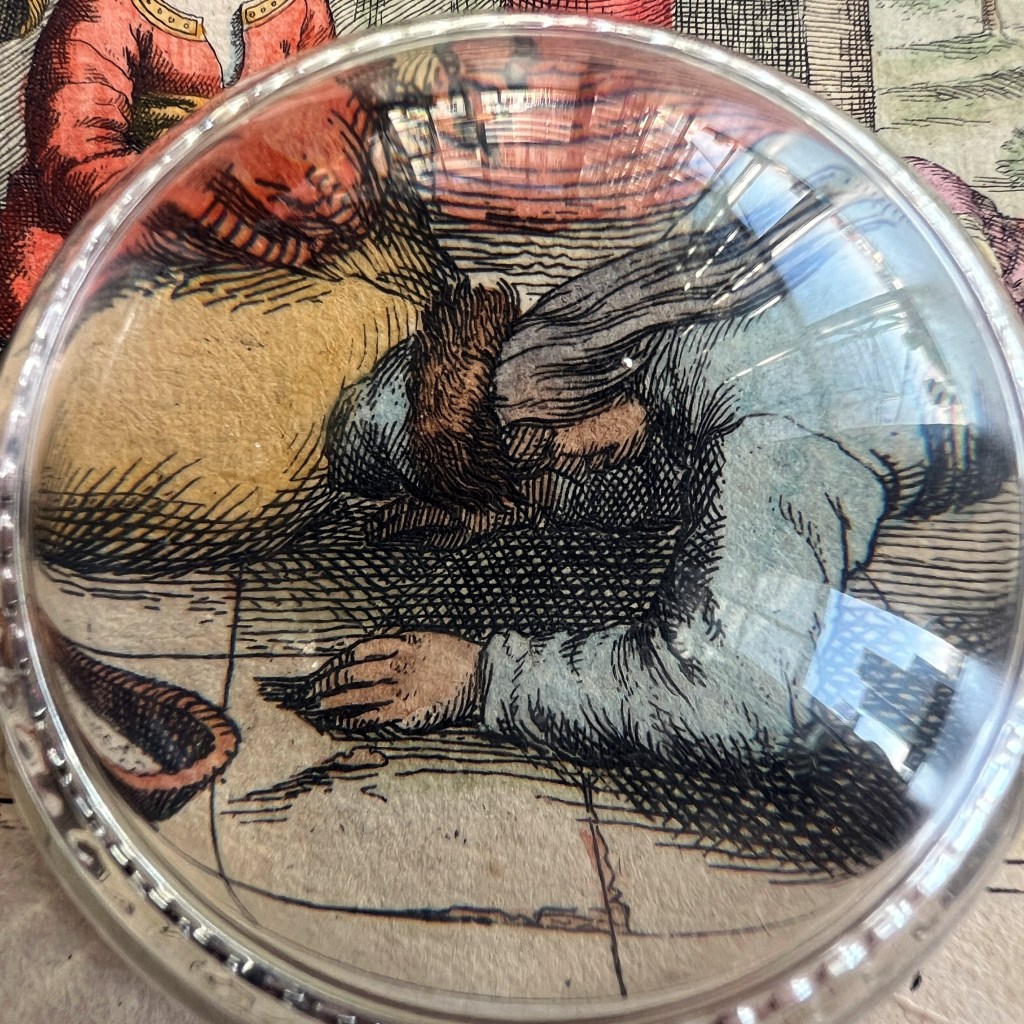
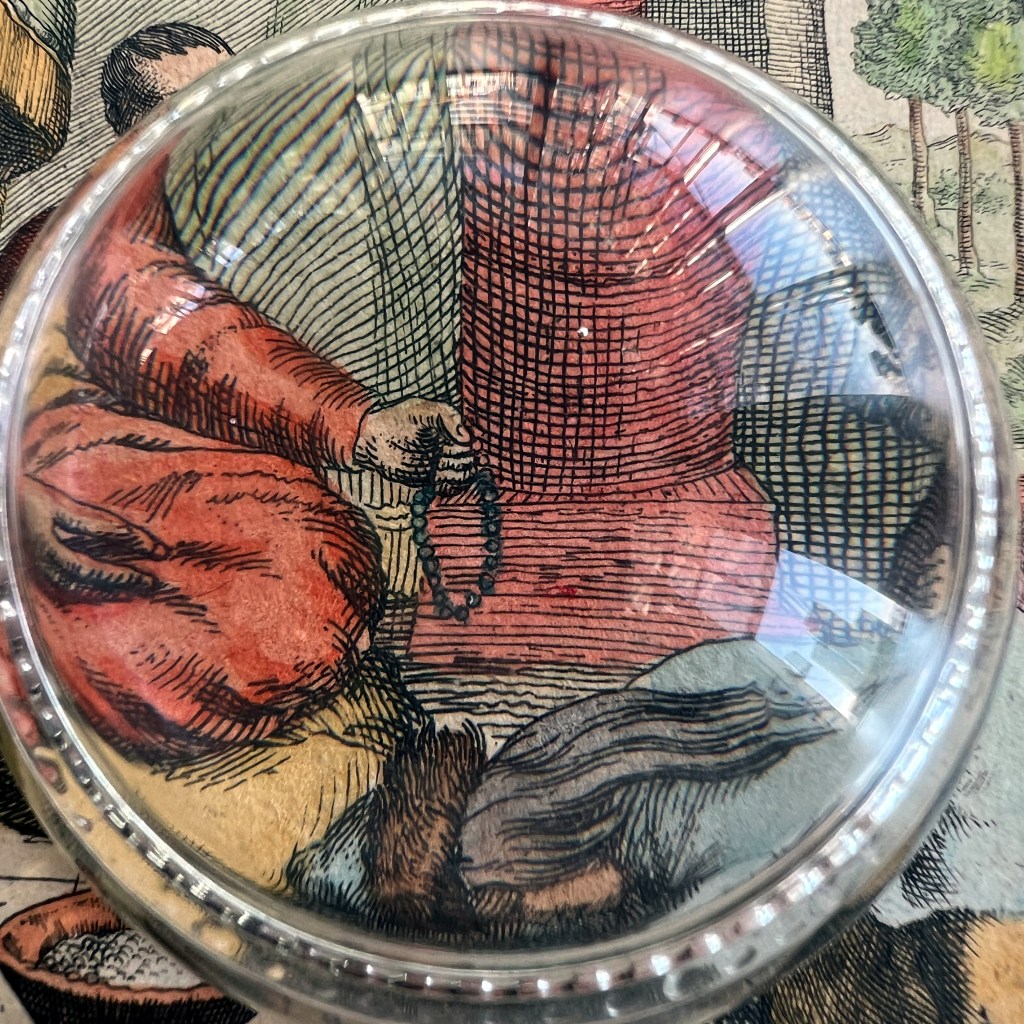
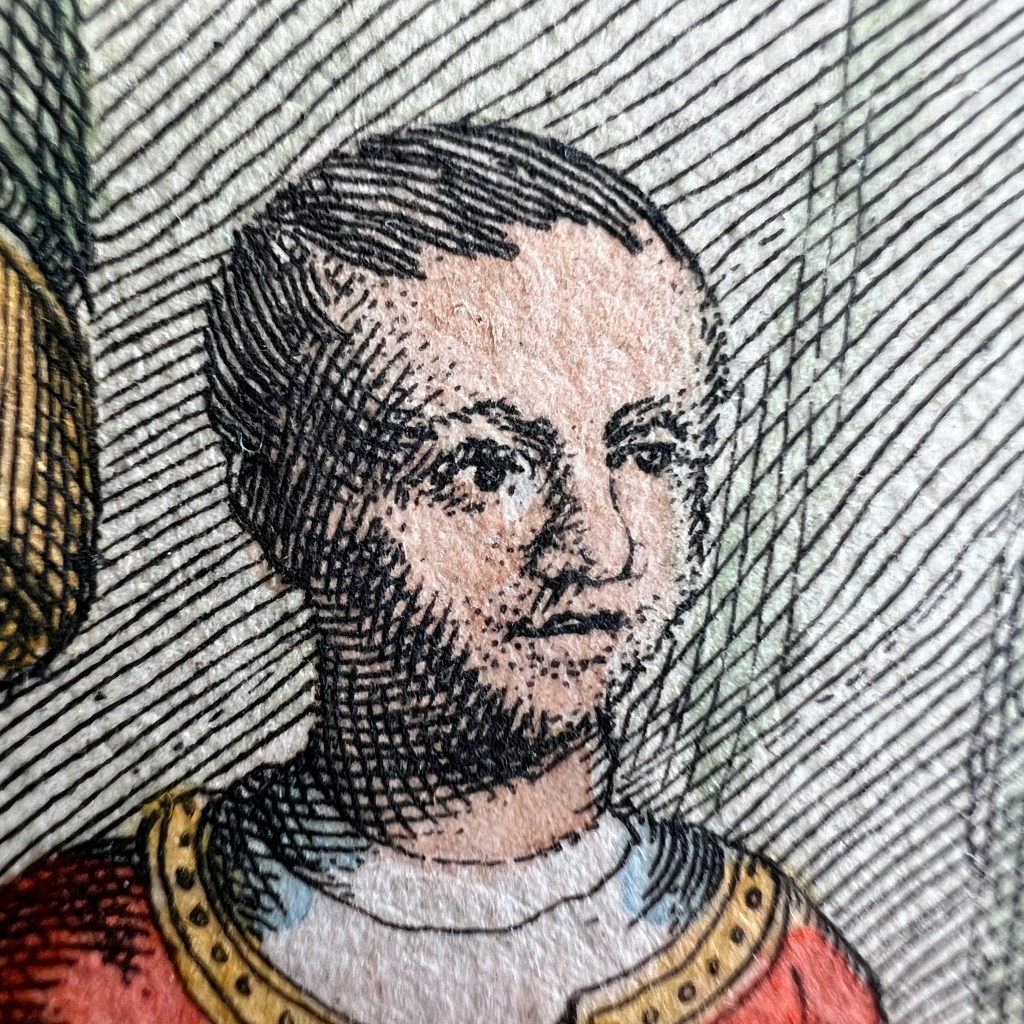
Earliest European depiction of the Dalai Lama? In 1683 Alain Mallet published his illustrated five-volume set entitled Description de l’univers. The second volume, devoted to Asia, contained an illustration of the Grand Lama, a “living and true God.”

Mallet copied an earlier illustration of Althanius Kircher from 1667 with minimal changes. The engraving shown here was hand colored (possibly after publication), giving the Dalai Lama a dark red robe.

While not named in the text, the original illustration was published during the lifetime of the famed Fifth Dalai Lama, Ngawang Lobsang Gyatso. Information about the Dalai Lama was gleaned from the reports of Jesuit missionary Johann Grueber who visited Lhasa in 1661.

The Fifth Dalai Lama died in 1682, a year before Mallet’s publication, but his passing was concealed for more than a decade. Mallet reports on the process of reincarnation, describing it as a “deception.”

To read Mallet’s text associated with this image, see the digitized scan provided by the University of Ottawa here: https://tinyurl.com/37895xc9


The Buddhas in the West Material Archive is a digital scholarship project that catalogues artifacts depicting Buddhist material culture for Western audiences. It’s comprised of prints, photos, and an assortment of ephemera and other objects. For a brief introduction to this archive, visit the main Buddhas in the West project page.


For Related Buddhas in the West Posts Featuring Engravings:


For the Most Recent Buddhas in the West Posts: