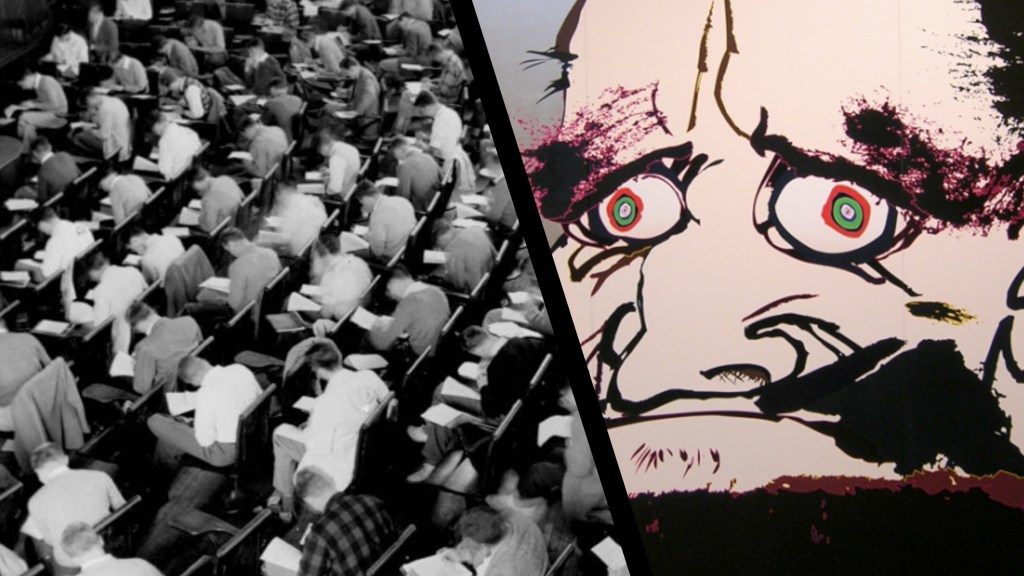
Drawing to Think & Thinking through Drawing

Introduction

Is there a value in having university students draw in a humanities course? Admittedly, this is charged question. I do not think practicing still-life drawing would benefit students greatly given the normal range of learning outcomes for a humanities course. But, beyond the perceptual skills being practiced while drawing, is there a cognitive benefit the can be leveraged? From this angle, I absolutely think there is pedagogical value in having students draw.[1]

For those weary of blindly joining me in advancing a “drawing across the curriculum” agenda (a bad joke for my writing colleagues), let me restate what I think drawing can be. For me, drawing is not about mimesis, the creation of a real-world replica on a paper, but about schematization. Drawing is not merely related to sensation, but also cognition and meaning-making. Mental schema function to align a range of perceptual data and convert them into intelligible concepts that can be used. Drawing is simply a physical practice, often overlooked in a non-art classroom, that enables this dynamic intellectual process. (I should note, I am not advocating to incorporate drawing activities to speak to “visual learners” – the myth of different “learning styles” has long since been debunked. Schematizing helps everyone.)


Graphic Organizers (Data Visualization)

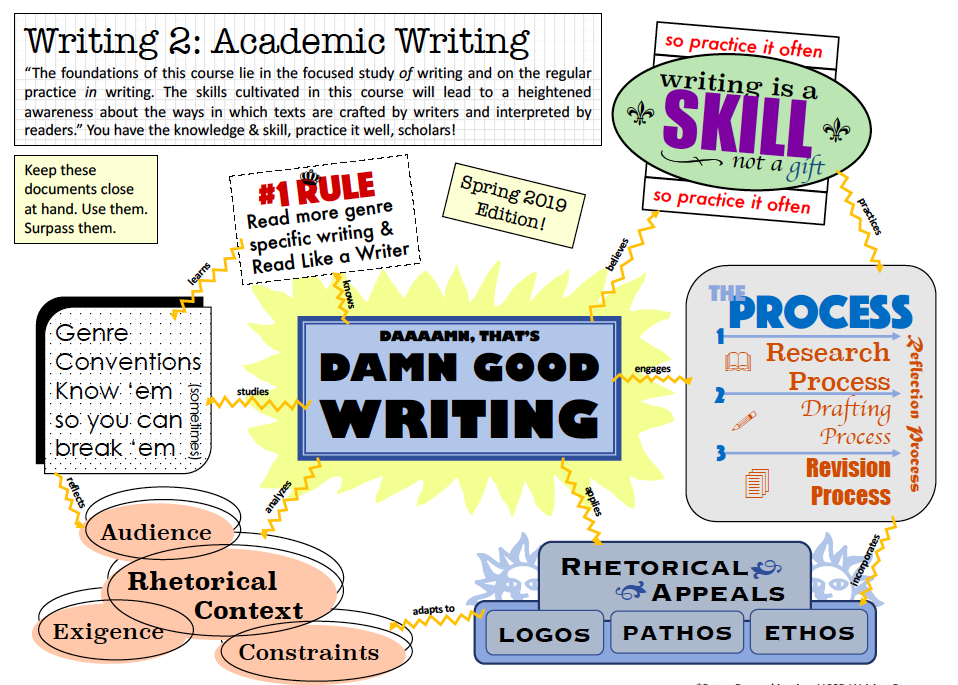
One of the most immediate applications of drawing is the creation of graphic organizers, which allow for the construction of knowledge in a hierarchical or relational manner. Organization that is non-linear (unlike linear note-taking or outlining) often leads to better retention and recall. Semantic maps, conceptual maps, Venn diagrams, and tree diagrams (even T-charts) can all be implemented effectively in a classroom environment. If students have difficulty developing them on their own, instructors can assist by making handouts with portions of the charts left blank. I will admit, there is a learning curve to creating more complex graphic organizers, but the goal should be, ultimately, to have your students attempt to create them – doing the conceptual work is where the greatest benefits lay.
Writing 2 Concept Map.png
My first concept map for my Freshman Composition course. For future iterations I would have students help with much of the work.

Maps and Other Diagrams

More commonly I have my student draw maps. Instead of showing a map of a region, I will first schematize it on the blackboard – and have my students draw with me.[2] I will then show a proper map after the exercise, mostly to relate what we’ve drawn to what’s on the map. My maps, by choice, are minimalist; I only choose to depict what I think is most pertinent to the content or narrative I am presenting. For example, I often focus on rivers and lakes (the source of life and centers of human activity), or mountains and deserts (obstacles to human movement), or cosmopolitan centers (where documents are often produced, also the civil antipodes to foreign “barbarism”). I can then draw lines to represent human migration or the movement of ideas. This clearly takes more time than simply showing a map on a slide, but I’ve found it to be more effective in crystalizing ideas to students.[3] I’ve also included drawing these minimalist maps (with clear labels) on students exams.

Along these lines, I’ve also spent time drawing mythic cosmologies with my students (e.g. the Buddhist cakravāla and its dhātus – I call it the Buddhist wedding cake), as well as other diagrams produced in the primary materials we are working with (e.g. the bhavacakra). A lot of meaning of often encoded in these endeavors by the original artists and I would argue there is value in (selectively) reproducing them, not only looking at or analyzing them.
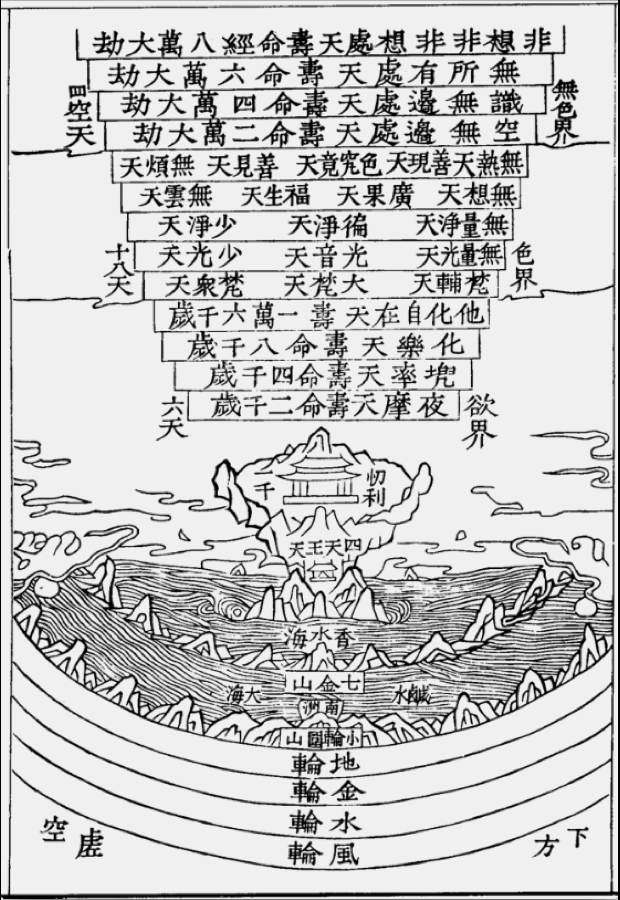
Figure 2.png
The mythic Buddhist world. There’s plenty of religious art to draw from!

Drawing Things

I might hear objections at this point – I am not really having students “draw” things. I believe there is room for this as well, although I would make sure we have a good pedagogical purpose for having students engaging in this (often) time-consuming endeavor. Luckily, for scholars of religious studies (like myself), various forms of artistic production is often at the core of religious practice. Having students participate in traditional religious practices of “art” making (we should always be mindful that some practices will not be considered “art” in the same way as we might approach it) can lead to meaningful interactions with the material under analysis. I can also be, quite frankly, simply fun too.

To provide one clear example, I’ve been having my students draw the important Buddhist figure Bodhidharma, the founder of Zen Buddhism, for several years now. I was inspired when I ran across the contemporary artist, Takashi Murakami, producing modern art versions of this famous Zen monk in 2007. I started scribbling some of my own portraits for fun and eventually decided to try and incorporate this practice into my teaching. At the time I was still looking for excuses to do fun in-class exercises that ask students to take a step out of their normal comfort zones. I was acutely aware that many people feel drawing is an in-born gift, not a skill, and would be hesitant to participate. Ultimately, I like to think that I fool students into drawing, rather than asking them to draw outright.

Figure 16.png
The inspiration: Murakami Takashi, I open wide my eyes but I see no scenery. I fix my gaze upon my heart.

On the schedule day, I will often bring blank copy paper class and provide two drawing options to my class. I say I will draw Bodhidharma on the blackboard step-by-step and students can choose to follow along, copying my process. Alternatively, students can choose to copy one of several traditional images of Bodhidharma I project on the screen. For those who choose to follow me (typically about half of the class), I imitate my best Bob Ross impression and try to make drawing non-threatening and, hopefully, fun (let’s draw a happy eyebrow right here…).

drawing Bodhidharma [PC-Peter Romaskiewicz].JPG
The set up with my finished Bodhidharma portrait on the whiteboard. [Southern Shaolin Temple, Putian, China. 2019]

The final pay-off for this activity comes at the end. I’ll have students reflect on the types of facial features we’ve drawn on the portrait and guess why they are important to East Asian artists (essentially, Bodhidharma is a caricature of a non-Chinese monk). This is the pedagogical purpose of this activity and I make sure to tie the points we make in discussion to those I’ve made throughout the lecture (if students do not do so already). To further draw out the significance of this activity, and position my students firmly within a actual “Buddhist” artistic tradition, I’ve also created an accompanying reading.


student Bodhidharma 05 [PC-Peter Romaskiewicz]
Rather superb renditions by my students for Woodenfish 2019.


The whole process of handing out paper, introducing the activity, drawing, and discussion takes – minimally – 15 minutes. Of course, you could conceive of projects that take much longer (such as over the whole term) or are completed as teams (based on the suggestion of a colleague, I used to do a textual version of Exquisite Corpse in my composition classes).


Final Thoughts

The real challenge is trying to determine the cost-benefit analysis of drawing – you will be spending far more time with the material than if you just showed the pictures, maps, or diagrams. Thus, as always, be judicious and reflect on the exercise afterwards – was it valuable in helping you to reach a particular learning objective? If at the end of the day, all I do is help my students doodle better, I am completely fine with that.


Notes:

*This is part of an ongoing series where I discuss my evolving thought process on designing university courses in Religious Studies. These posts will remain informal and mostly reflective.

[1] Disclaimer: As the son of an art teacher and professional artist, I’ve always challenged myself to have my students draw more. This notwithstanding, there is some interesting research on art and cognition that I’ve only just begun to dive into. A good primer is Thinking Through Drawing: Practice into Knowledge, edited by Andrea Kantrowitz, Angela Brew and Michelle Fava. Furthermore, there is already copious amounts of literature on incorporating drawing into science classrooms.

[2] This means I also have to tell student to bring paper and pen/pencils to class, quite a sizable portion (in my personal experience) takes notes solely on computers.

[3] There are clearly good reasons to show, and even focus on, highly detailed proper maps, it all depends on your pedagogical purpose. I’d suggest that if you want maps to be more meaningful, drawing elements of them with students can be helpful.

N-O-O Daily Reading Responses

Introduction

This is odd to admit, but I run a “coercive classroom.” And there is nothing more coercive in my mind than having my students write daily reflections on assigned readings. I have little reason to think they (or anyone, really) would keep up with the readings without a regular assessment of some sort. Of course, open class discussion on the day’s readings can “peer pressure” some into regular reading habits. I’ve found, however, only a select few are consistently willing to offers their insights, while others are more content to simply listen. (Cold-calling students is a craft I have not yet mastered, but will be attempting next semester. I plan to write about it here for another post.)

There are several ways to gauge if a student has read, but many require a lot of additional effort of the instructor. One may prepare a series of comprehension questions that are handed out just previous to the assignment. These have the benefit of focusing the student’s attention, but I would argue also have the same drawback (to tell the student what they should find interesting or important). It also takes time to craft thoughtful questions that genuinely move beyond basic fact-finding. I personally tend to save good questions like this for class discussion.

Daily (or surprise) reading quizzes are another means of coercion. I’m not convinced of the value of these either, mainly because the questions have to be “easy,” allowing for the student to signal to the instructor that the reading was done even though it may not have been fully comprehended. And grading these can be surprisingly difficult, especially if the question is too easy.

So I’ve veered in another direction, pulling an idea from my time in the Writing Program. I ask my students to respond to every reading by asking the three same questions.


What is New? What is old? What is odd?

New, Old, Odd, that’s it. I sometimes joking call this my N-O-O assignment. The first covers an idea they find interesting. Something they can be motivated to explore in more depth if need be. The second idea covers finding a topic they’ve seen elsewhere, or at least can create a parallel for. This allow students to build on top of old knowledge. The last concept requires them to critique an author’s point or to ask an clarifying question about a topic.

Currently I have my students post these responses on a Forum in GauchoSpace. After posting they can read other student’s posts, though I have not required them to post comments this time. My practice is to go through them shortly before class, and when I have time, to post a brief comment. Typically I will respond to their questions, but will also encourage their curiosities. Even if I do not have time to write responses, just browsing the posts will give me ample ideas of where to take my lecture and what to go over in more detail. I have hesitated to call out students by name about their (insightful) comments, but hope to make this a more common part of my practice.

I grade the reflections based on a simple “did it” or “didn’t do it” scale, though I’ve contemplated a three point scale of “outstanding,” satisfactory,” and “unsatisfactory” (plus “did’t do it”). I typically give my students a few “days off” as well.

Below are the directions I’ve used this summer (I tweak them for each class I teach).

Directions
When approaching the reading assignments for this course, I want you to pay attention to three critical aspects: what is New to you, what is Old to you, and what is Odd to you. Your written reflection for each one of these critical aspects should be at least a few sentences in length. Provide page numbers from the readings as necessary.

Below are some of the types of questions you can ask yourself for each aspect.

1. New – What was something new and interesting? What was particularly useful or insightful? What quote or passage was able to reveal something interesting and/or helpful for you? Why was it so? If anything, clearly locating these sections will make the time you spent reading seem worthwhile.

2. Old – What was familiar? What quote or passage claimed something that you already knew? Was there something that seemed familiar or had a potential parallel to another religious tradition you know? Locating these sections will give you a clear foundation should you encounter other sections that are not as clear to you.

3. Odd – What was confusing or unexpected? What quote or passage did not make sense or were you critical of? What problem did you have with it? Locating these sections will help you keep a healthy and critical attitude towards the readings and suggest areas that require further exploration.

Your response will have to be posted before class for you to receive credit.


   Relevant Pedagogy Posts

Setting Up Effective Student Peer Review

Introduction

This summer I’ve tasked my students with writing a final paper that argues for their own definition of “religion” based solely on the Asian traditions we cover in class. As part of this process, I’ve required them to craft a rough draft that was due during our mid-term exam. Technically, this was a slightly different shorter assignment that built towards their final product.

I assigned this shorter assignment with three specific goals in mind. One was to motivate them to think about their project early. The second was to force them, through peer review, to see how their fellow students tackled them same problem and hopefully to inspire their own approach. The last goal was to allow students the opportunity to practice the (slowly acquired) skill of good critique.

While this last objective really has little to do with the content of my course, I feel it is incumbent on me to teach writing in a Humanities course even when I am not formally teaching writing. (Yes, I have been indoctrinated.) Of equal importance, this provides my students insight into my criteria several weeks before they will hand in their final project. Consequently, this requires some type of peer-review rubric. If you haven’t tried it already, open-ended peer-review sessions – where students are just told to write whatever commentary they desire – are not worth anyone’s time.

One can find peer-review handout templates online, but it is important that your peer-review rubric contains elements that are related to your own grading rubric for the assignment. In fact, there is no reason your peer-review rubric and grading rubric cannot be the same thing!


Overview & Prep

Prep work: Each student had to bring in two printed copies of their short paper: one went to the peer-reviewer, the other was handed in for my commentary. I crafted a reader review rubric that each student had to fill out for the paper they read. In making the rubric, I was also drafting my own grading rubric for later in the term. Consequently, this peer-review exercise was also a means for me to gauge how students were interpreting the prompt and where I should re-examine my evaluation parameters.

Overall, I divided the rubric into three sections: 1) basic requirements, 2) organization & structure, 3) overall quality.

Peter Romaskiewicz Reader Review.png

Reader Review Rubric [Summer 2017]


In Practice

Set-up: The students took the midterm the same day we did reader review (summer sessions are rough!), so there was limited time. I wrote basic instructions on the top of the sheet and read them aloud. I regularly remind my students that there are real human beings reading these comments, so be nice; the tone can be colloquial. I also tell them to cite praise as well as criticism as long as it’s constructive (i.e. I want them to consistently tell the author why they made the specific comment).

In this case, I had the students pass their papers to a random person, and then again to a random person until they “lost” their paper. In hindsight I should of had them trade with a partner so they could talk about their papers with each other, but I knew time was going to be tight as it was and didn’t know if time would allow for it.

Practice: We had about 20 minutes total to do this exercise, which was a bit rushed. After a few minutes for instructions, less than 15 minutes were left to do a read through and write comments. I encouraged marginal comments, but also directed students to read the rubric and fill it out as much as they could. With about 2-3 minutes left in class I had the students hand back the papers to the authors so they could look over their comments and ask any final questions.

Outcome: As I mentioned, I wish I had made time to allow the students to talk to one another about their papers after the review session. Some shouted back a few comments to one another as we ended class. The class seemed engaged and invested. My curiosity overcame me and I asked each student to hand in their rubric with their “clean” paper. I wanted to see the type of comments given and gauge how constructive or helpful this exercise might have been. Overall, the rubric appeared to help focus comments on higher-order issues, like argumentation and organization, not just spelling. At least one conversation with a student revealed to me that exposure to another student’s take was key to her understanding the assignment.


  Relevant Pedagogy Posts


A Daily Review Exercise & Group Activity

Peter Romaskiewicz
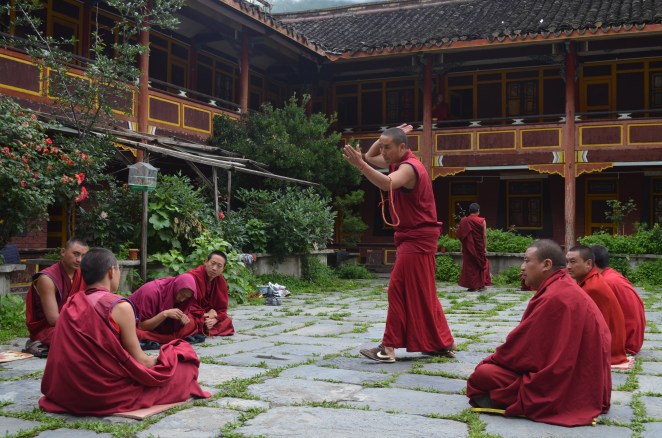
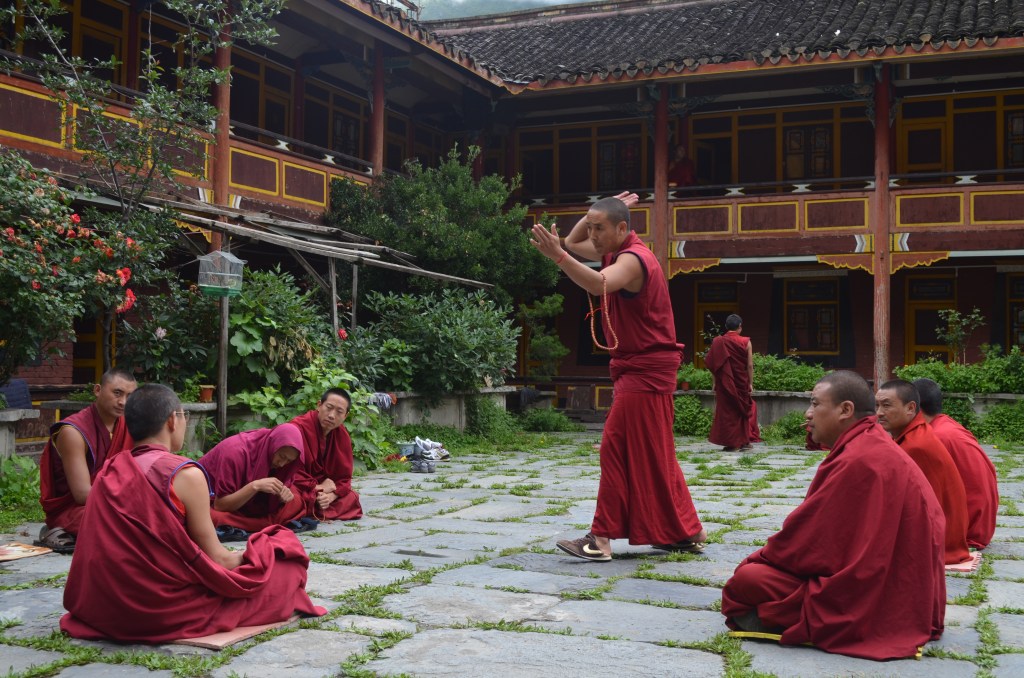
Tibetan Buddhist monks practicing debate at Nanwu Temple 南無寺, Kangding, China, c. 2011. Photo Peter Romaskiewicz.

While taking a graduate seminar a few years ago with José Cabezón, he had the all students engage in a practice which he claimed was standard operating procedure for Tibetan Buddhist monks in training. At the start of each class one student was responsible for reciting in summary the important points of the previous class. [An outline of a similar process can be found here.] We were not allowed to look at our notes nor we we allowed to make crib sheets. Individually, it was an exercise of memorization, but it was also an exercise of analysis and application. Collectively, it allowed the class to all be on the same page, preparing us all for the materials to be covered that day. It also sometime elicited clarifying questions. From what I remember, these daily summaries would last 5-10 minutes, followed potentially by conversation.

Every once and I while I like to do something similar with my class, and after I fell behind in lecture last week, today was a great day to break this exercise out. I wanted to to do a group activity at the start of class (I find it harder to break the class into groups halfway into lecture) and this seemed promising. I often just ask one student to summarize from memory for the whole class, but here I wanted the class to socialize a bit more and converse with each other. I asked the groups to come up with three important points I touched on in lecture the previous class (here, on the Bhagavad Gītā). This primed the students to the topic that I revisited today and also allowed them to hash out any confusions among themselves.

Overall, I found this to be quite valuable. It allowed the students to socialize, interact with (and teach) one another, and test their memory – or at least to familiarize themselves with their notes. I suppose this could be done for each class (maybe even making it a regular assignment), but I would have to take the time into consideration. The group work only lasted 5 minutes, but the class discussion lasted another 15 (there were a handful of questions).


  Relevant Pedagogy Posts

What is “Religion”? An Activity to Stir Thought

Why Are There No New Major Religions? - The Atlantic.jpgAn activity I’ve come to enjoy doing early on in my classes (first day if possible) is to have the students, in small groups, come up with their own succinct, one-sentence definition of religion. Today, when I did this with my Asian Religious Traditions class, I added the instruction that they also had to come up with an apt metaphor for “religion” as well, thus completing the sentence, “Religion is like _______ because it ________.”

This exercise allows the students to reflect upon their assumptions about what counts as religion and what does not. When the groups report back to the class, I’ll probe certain aspects of the definition. Today I asked various groups about their use of the term “spiritual” (How is a “spiritual” practice from an everyday practice?), or why a religion needs to be “organized” or “systematic” (Can a religion be un-organized, non-institutional?), or why religion make one feel “comforted” from the unknown (Can a religion be stressful or cause more questions?), or whether a religion can be “any” practice or belief that “guides one life” (Are sports and fandom religion then?), or why belief play such a central role in the definition (Does a religion only govern belief?).

Admittedly, I often put myself in the position to make these critiques, but this is mostly for purposes of time. I could expand this exercise to have groups critique other groups’ definitions, or look for overarching themes that are common to all or most. As it stands now, I have students consult for 6 minutes in groups, and then have a class discussion for another 20 minutes or so (5 minutes for each group to report and respond to questions). This is a large block of time, but I believe this is important critical work that sets a tone for the class.

I was unsure how well the metaphor component was going to work, but I thought this would also reveal assumptions about how people conceived of religion. The responses I received were interesting (I told them it was okay to be creative, as long as they could defend their choice). Here were the responses:

  1. Religion is like sports because it’s deeply ritualized, ingrained, part of culture, people get passionate about it, and it can be difficult to pinpoint why it is as important to someone as it is.
  2. Religion is like a fruit tree because there are different types of fruit trees with different yields you can get from them; they vary but also have similarities and people can take or leave what they want.
  3. Religion is like Xanax because it relieves anxiety.
  4. Religion is like a puzzle because smaller pieces come together to create a deeper understanding of the world.

I thought these were great. They sometimes revealed a different understanding of religion than the definition the same group offered. These formed good conversation points as well.

This activity concludes with me showing several “classical” definitions of religion by scholars, and I point out that there is no consensus scholarly definition of “religion,” that it is contentious. In the context of this course, I then shifted to say that if there is no consensus definition, then how can we be sure other cultures have “religion.” How can we be sure what we call religion is similar to the experience of people in other cultures? I raise this point because I want to construct a critical stance to these questions as we move forward through the course.

Overall I hope to continue to experiment with this activity, it has proven to be insightful each time I have done it, allowing students to talk with each other and to potentially reveal recurring assumptions about “religion.”

It is perhaps worth noting that I had student post these definitions and metaphors to a class website, and plan to have students grapple with these definitions throughout the course and make them chose one (or invent their own) to use in writing assignments.

* Image Paul Spella / The Atlantic