Group Activities Workshop

Introduction

Yesterday, I gave a short university-level workshop on organizing in-class group activities. This was partly a personal conversion story. As an undergrad, I absolutely despised group work. Sure, some of my apprehension was due to my angsty teenage disposition, but – as I’ve come to understand – some was also due to poorly executed planning by my old (but dearly valued) instructors.

My views on group work shifted when I was trained to teach freshman composition and rhetoric at UCSB. Peer-collaboration was highlighted as a student skill that needed to be taught, not just casually performed. Consequently, I returned to my old seminar yesterday to offer insights to this year’s new batch of writing instructors.

The Structuring Group Activities section below is the meat and potatoes of group activity.


Setting the Scene

The class was comprised of about twenty graduate students who all had previous teaching experience. To begin, I asked how many already included group work as an integral part of their classroom practices: Less than one-quarter raised their hands.

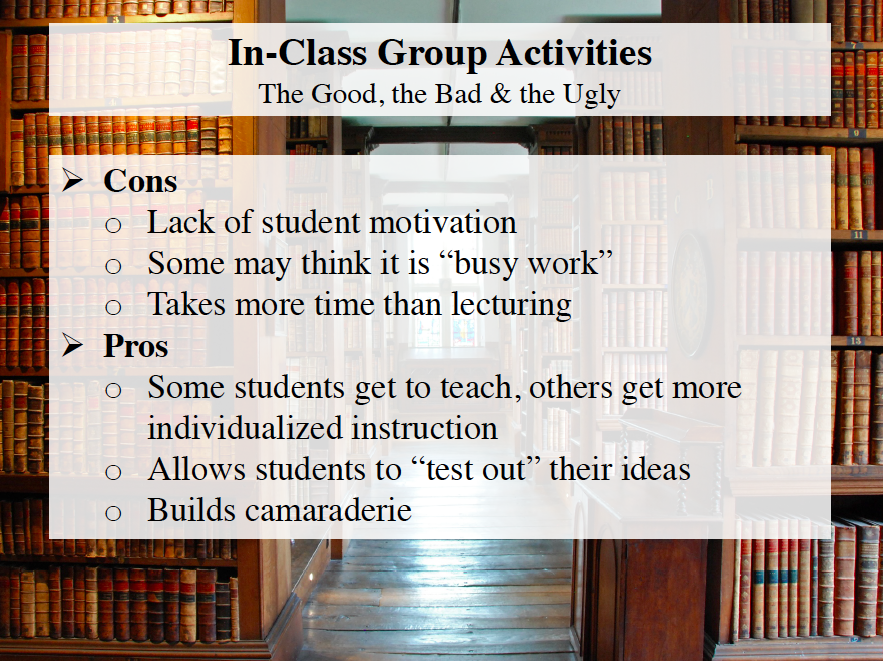
This was not surprising. I’ve found many other had similar negative experiences of group work as students like myself. I then turned to giving an outline of the potential benefits and drawbacks of group work [Slide 1].

Slide 1
Screen Shot 2018-09-14 at 13.26.26.png

Ultimately, I’ve come to feel that the negatives associated with group work can be significantly mitigated (except for the extra time it takes to do it) and the benefits can be amplified if the group activities are structured well.


Structuring Group Activities

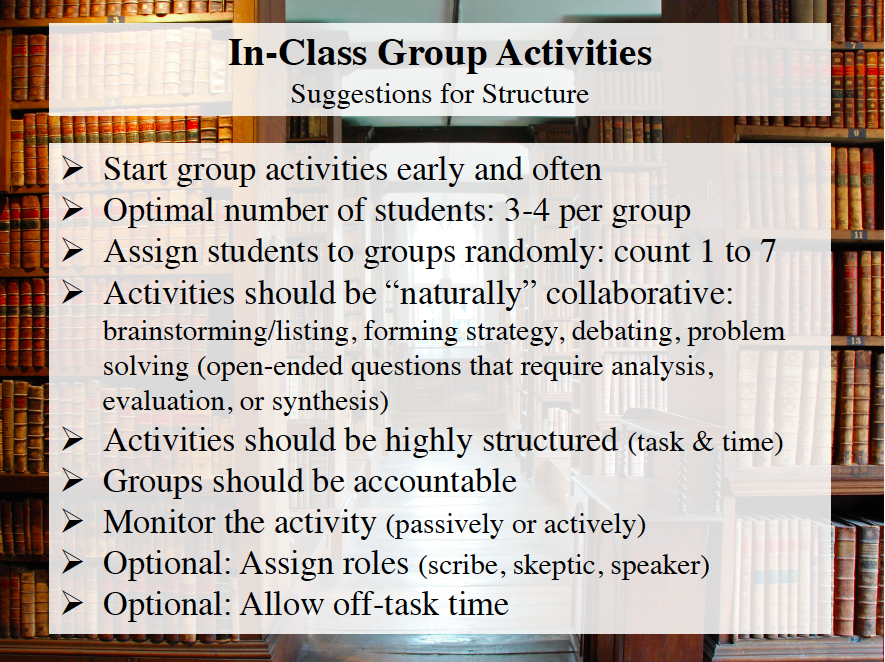
I spent a significant amount of time discussing the elements of an effective group activity [Slide 2]. Each element is described in further detail below.

Slide 2
Screen Shot 2018-09-14 at 13.30.30.png

1. Classroom Culture: Group activities need to be started early and often in the term to establish them as a regular part of class meetings. Group activities should not be treated as a special event nor added to a course halfway through the term when a classroom culture has already been established.

For example, the very first thing I do on the first day of class is break students up into small groups so they get to know each other. I take attendance during this time, so its not wasted time for me. When I’m finished, I ask one student about another student in the group (what’s this person’s name, where are they from?). Often this is followed by a bunch of nervous laughter from everyone in the class as they realize they didn’t pay much attention to one another. I, of course, laugh with them and use this time to comment on the collaborative nature of our course and how important it will be to communicate and listen to one another. (To finish, I let the groups talk to one another again to take notes on names and share emails. I still ask students to introduce other group members, but the conversation remains lighthearted.)

2. Group Size: Groups should always be kept relatively small so no one can “hide” or easily shy away from conversation. I’ve found that three or four members per group is optimal (groups with too many people invite the dreaded “social loafing“). Of course this may not be possible in all classroom settings, but I’ve found that groups of more than five simply do not work.

3. Group Membership: Groups should change from class to class and should not only be comprised of friends or people who sit next to them. I typically have students count off to form random groupings. Because students will need to physically move to a new seat, I always try to do group work early in the class, if not for the first activity.

4. Task & Time: Ideally, group activities should be oriented around open-ended questions that require creativity or discussion/argumentation among the members. If you’re looking for a singular “correct” answer, that’s perhaps not best addressed by a group activity (pair-and-share is suitable). The question(s) the students address should be clear (written on a slide or board) and the time limits should be strict. I always prefer to keep the timing tight, giving students only 3-5 minutes to complete most tasks (the tasks are often not very complex). I use the timer on my phone and allow the alarm to ring to signal the time is up.

For example, I’ll write on a slide: “Create a list of 3 variant hook sentences for this introductory paragraph. You have 3 minutes.”
After 3 minutes, I’ll change the slide: “Determine which of your candidate hooks is the best. Have at least two good reasons why it is the best. You have three minutes.”

Overall, having a clear task and tight time creates an energy and motivation to work quickly and effectively.

5. Accountability: Importantly, groups should always need to produce a “deliverable” – either sharing their ideas verbally with the class, handing in an assignment, or posting on our course website.

6. Monitoring: Sometimes I stay at the front of the room watching or getting other materials ready. Other times I will walk around the class and passively observe/listen to discussion. Sometimes, especially if the group is quiet, I will ask them what they are thinking about or which ideas they are weighing.

7. Roles: To facilitate group interaction and the assumption of personal responsibility, I ask different members of the group to take different roles. One person always operates as a scribe to take “official” notes for the group. (This is important if they are asked to hand in something or post online). Equally, I ask another person to be the speaker. I typically take a friendly, yet partly adversarial role when I talk to the speaker of each group during class collaboration. The speaker will be asked to think on their feet as I ask them to clarify or justify their group’s “deliverable,” or to provide further examples and argue for significance. Sometimes, when the activity allows for it, I also assign the role of the “skeptic.” Their duty is to offer disagreements (ideally, counterarguments) whenever possible, to halt any chance of “group think.” At other times, I will assign the role of “source master” to look up primary quotes or pertinent passages to assist the scribe. In the past, partly for fun, I have also assigned the role of supporter. Their role is to be the hype-person for the group, complimenting the ideas of other members.

To be clear, each group member is tasked with working collaboratively to produce a product for class discussion. Except for the unique role of the speaker, everyone should be taking notes, looking up sources, acting as a skeptic and supporter. The use of “roles” is designed to be an analytical approach to effective group work, identifying smaller inter-group tasks that each student should work on and improve. At least, this reflects my analysis of effective group dynamics, others may certainly have a different analysis.

Lastly, I often let students decide which roles to take, but it reasonable to have roles randomly assigned. For me, I tell students to take roles that reasonably challenge them. If a student is often silent, I’ll recommend taking the role of the skeptic or supporter where they are expected to talk, but with minimal stakes. If the student wants more of a challenge, then try being the speaker of the group.

8. Off-Task Time: Finally, I sometime allow a minute or two of off-task time before or after an activity to let the students get to know each other and build classroom camaraderie. Consequently, even when the task is clearly finished by all groups, if everyone is getting along and chatting, I’d prefer to nourish nascent friendships than have dead silence.


Practice

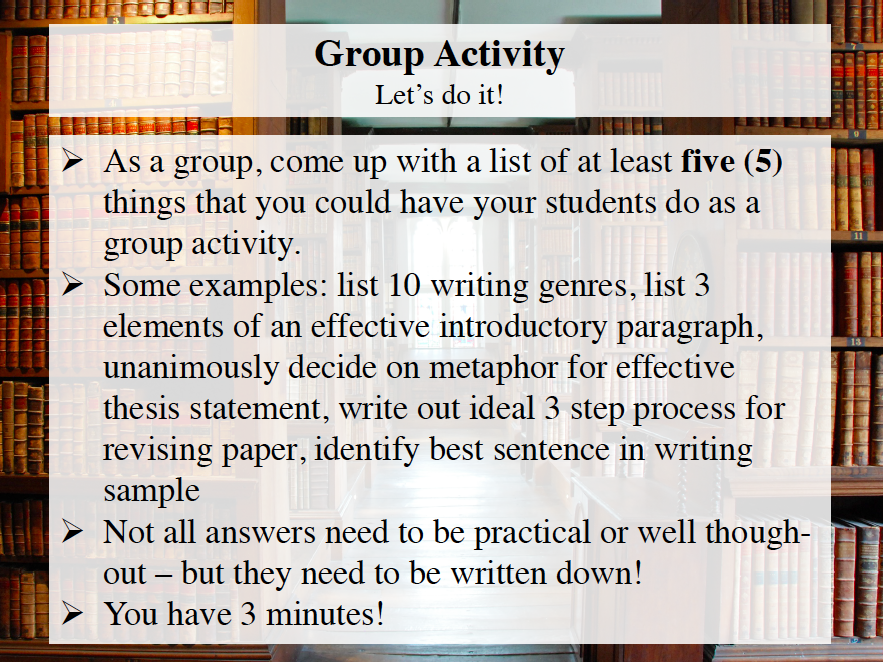
Since this short lecture-workshop was for a class of new writing instructors, I provided them with instructions of how a group activity built for them might look [Slide 3].

Slide 3
Screen Shot 2018-09-14 at 13.44.27.png

Note the question was simple and direct and I provided some examples to stimulate ideas. In addition, there was a clear expectation that the response needed to be written down and there was a clear (short) time limit.

I spent the rest of my class time talking about processes – namely, writing, researching, and reading – which I will return to in a later post.


Workshop Posts

Setting Up Effective Student Peer Review

Introduction

This summer I’ve tasked my students with writing a final paper that argues for their own definition of “religion” based solely on the Asian traditions we cover in class. As part of this process, I’ve required them to craft a rough draft that was due during our mid-term exam. Technically, this was a slightly different shorter assignment that built towards their final product.

I assigned this shorter assignment with three specific goals in mind. One was to motivate them to think about their project early. The second was to force them, through peer review, to see how their fellow students tackled them same problem and hopefully to inspire their own approach. The last goal was to allow students the opportunity to practice the (slowly acquired) skill of good critique.

While this last objective really has little to do with the content of my course, I feel it is incumbent on me to teach writing in a Humanities course even when I am not formally teaching writing. (Yes, I have been indoctrinated.) Of equal importance, this provides my students insight into my criteria several weeks before they will hand in their final project. Consequently, this requires some type of peer-review rubric. If you haven’t tried it already, open-ended peer-review sessions – where students are just told to write whatever commentary they desire – are not worth anyone’s time.

One can find peer-review handout templates online, but it is important that your peer-review rubric contains elements that are related to your own grading rubric for the assignment. In fact, there is no reason your peer-review rubric and grading rubric cannot be the same thing!


Overview & Prep

Prep work: Each student had to bring in two printed copies of their short paper: one went to the peer-reviewer, the other was handed in for my commentary. I crafted a reader review rubric that each student had to fill out for the paper they read. In making the rubric, I was also drafting my own grading rubric for later in the term. Consequently, this peer-review exercise was also a means for me to gauge how students were interpreting the prompt and where I should re-examine my evaluation parameters.

Overall, I divided the rubric into three sections: 1) basic requirements, 2) organization & structure, 3) overall quality.

Peter Romaskiewicz Reader Review.png

Reader Review Rubric [Summer 2017]


In Practice

Set-up: The students took the midterm the same day we did reader review (summer sessions are rough!), so there was limited time. I wrote basic instructions on the top of the sheet and read them aloud. I regularly remind my students that there are real human beings reading these comments, so be nice; the tone can be colloquial. I also tell them to cite praise as well as criticism as long as it’s constructive (i.e. I want them to consistently tell the author why they made the specific comment).

In this case, I had the students pass their papers to a random person, and then again to a random person until they “lost” their paper. In hindsight I should of had them trade with a partner so they could talk about their papers with each other, but I knew time was going to be tight as it was and didn’t know if time would allow for it.

Practice: We had about 20 minutes total to do this exercise, which was a bit rushed. After a few minutes for instructions, less than 15 minutes were left to do a read through and write comments. I encouraged marginal comments, but also directed students to read the rubric and fill it out as much as they could. With about 2-3 minutes left in class I had the students hand back the papers to the authors so they could look over their comments and ask any final questions.

Outcome: As I mentioned, I wish I had made time to allow the students to talk to one another about their papers after the review session. Some shouted back a few comments to one another as we ended class. The class seemed engaged and invested. My curiosity overcame me and I asked each student to hand in their rubric with their “clean” paper. I wanted to see the type of comments given and gauge how constructive or helpful this exercise might have been. Overall, the rubric appeared to help focus comments on higher-order issues, like argumentation and organization, not just spelling. At least one conversation with a student revealed to me that exposure to another student’s take was key to her understanding the assignment.


  Relevant Pedagogy Posts


A Daily Review Exercise & Group Activity

Peter Romaskiewicz
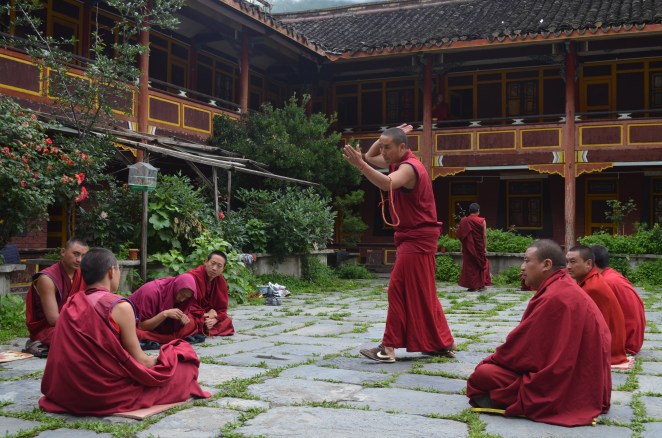
Tibetan Buddhist monks practicing debate at Nanwu Temple 南無寺, Kangding, China, c. 2011. Photo Peter Romaskiewicz.

While taking a graduate seminar a few years ago with José Cabezón, he had the all students engage in a practice which he claimed was standard operating procedure for Tibetan Buddhist monks in training. At the start of each class one student was responsible for reciting in summary the important points of the previous class. [An outline of a similar process can be found here.] We were not allowed to look at our notes nor we we allowed to make crib sheets. Individually, it was an exercise of memorization, but it was also an exercise of analysis and application. Collectively, it allowed the class to all be on the same page, preparing us all for the materials to be covered that day. It also sometime elicited clarifying questions. From what I remember, these daily summaries would last 5-10 minutes, followed potentially by conversation.

Every once and I while I like to do something similar with my class, and after I fell behind in lecture last week, today was a great day to break this exercise out. I wanted to to do a group activity at the start of class (I find it harder to break the class into groups halfway into lecture) and this seemed promising. I often just ask one student to summarize from memory for the whole class, but here I wanted the class to socialize a bit more and converse with each other. I asked the groups to come up with three important points I touched on in lecture the previous class (here, on the Bhagavad Gītā). This primed the students to the topic that I revisited today and also allowed them to hash out any confusions among themselves.

Overall, I found this to be quite valuable. It allowed the students to socialize, interact with (and teach) one another, and test their memory – or at least to familiarize themselves with their notes. I suppose this could be done for each class (maybe even making it a regular assignment), but I would have to take the time into consideration. The group work only lasted 5 minutes, but the class discussion lasted another 15 (there were a handful of questions).


  Relevant Pedagogy Posts

What is “Religion”? An Activity to Stir Thought

Why Are There No New Major Religions? - The Atlantic.jpgAn activity I’ve come to enjoy doing early on in my classes (first day if possible) is to have the students, in small groups, come up with their own succinct, one-sentence definition of religion. Today, when I did this with my Asian Religious Traditions class, I added the instruction that they also had to come up with an apt metaphor for “religion” as well, thus completing the sentence, “Religion is like _______ because it ________.”

This exercise allows the students to reflect upon their assumptions about what counts as religion and what does not. When the groups report back to the class, I’ll probe certain aspects of the definition. Today I asked various groups about their use of the term “spiritual” (How is a “spiritual” practice from an everyday practice?), or why a religion needs to be “organized” or “systematic” (Can a religion be un-organized, non-institutional?), or why religion make one feel “comforted” from the unknown (Can a religion be stressful or cause more questions?), or whether a religion can be “any” practice or belief that “guides one life” (Are sports and fandom religion then?), or why belief play such a central role in the definition (Does a religion only govern belief?).

Admittedly, I often put myself in the position to make these critiques, but this is mostly for purposes of time. I could expand this exercise to have groups critique other groups’ definitions, or look for overarching themes that are common to all or most. As it stands now, I have students consult for 6 minutes in groups, and then have a class discussion for another 20 minutes or so (5 minutes for each group to report and respond to questions). This is a large block of time, but I believe this is important critical work that sets a tone for the class.

I was unsure how well the metaphor component was going to work, but I thought this would also reveal assumptions about how people conceived of religion. The responses I received were interesting (I told them it was okay to be creative, as long as they could defend their choice). Here were the responses:

  1. Religion is like sports because it’s deeply ritualized, ingrained, part of culture, people get passionate about it, and it can be difficult to pinpoint why it is as important to someone as it is.
  2. Religion is like a fruit tree because there are different types of fruit trees with different yields you can get from them; they vary but also have similarities and people can take or leave what they want.
  3. Religion is like Xanax because it relieves anxiety.
  4. Religion is like a puzzle because smaller pieces come together to create a deeper understanding of the world.

I thought these were great. They sometimes revealed a different understanding of religion than the definition the same group offered. These formed good conversation points as well.

This activity concludes with me showing several “classical” definitions of religion by scholars, and I point out that there is no consensus scholarly definition of “religion,” that it is contentious. In the context of this course, I then shifted to say that if there is no consensus definition, then how can we be sure other cultures have “religion.” How can we be sure what we call religion is similar to the experience of people in other cultures? I raise this point because I want to construct a critical stance to these questions as we move forward through the course.

Overall I hope to continue to experiment with this activity, it has proven to be insightful each time I have done it, allowing students to talk with each other and to potentially reveal recurring assumptions about “religion.”

It is perhaps worth noting that I had student post these definitions and metaphors to a class website, and plan to have students grapple with these definitions throughout the course and make them chose one (or invent their own) to use in writing assignments.

* Image Paul Spella / The Atlantic