©Peter Romaskiewicz

Readings in Class and Group Activities

copyright Peter romaskiewicz.JPG
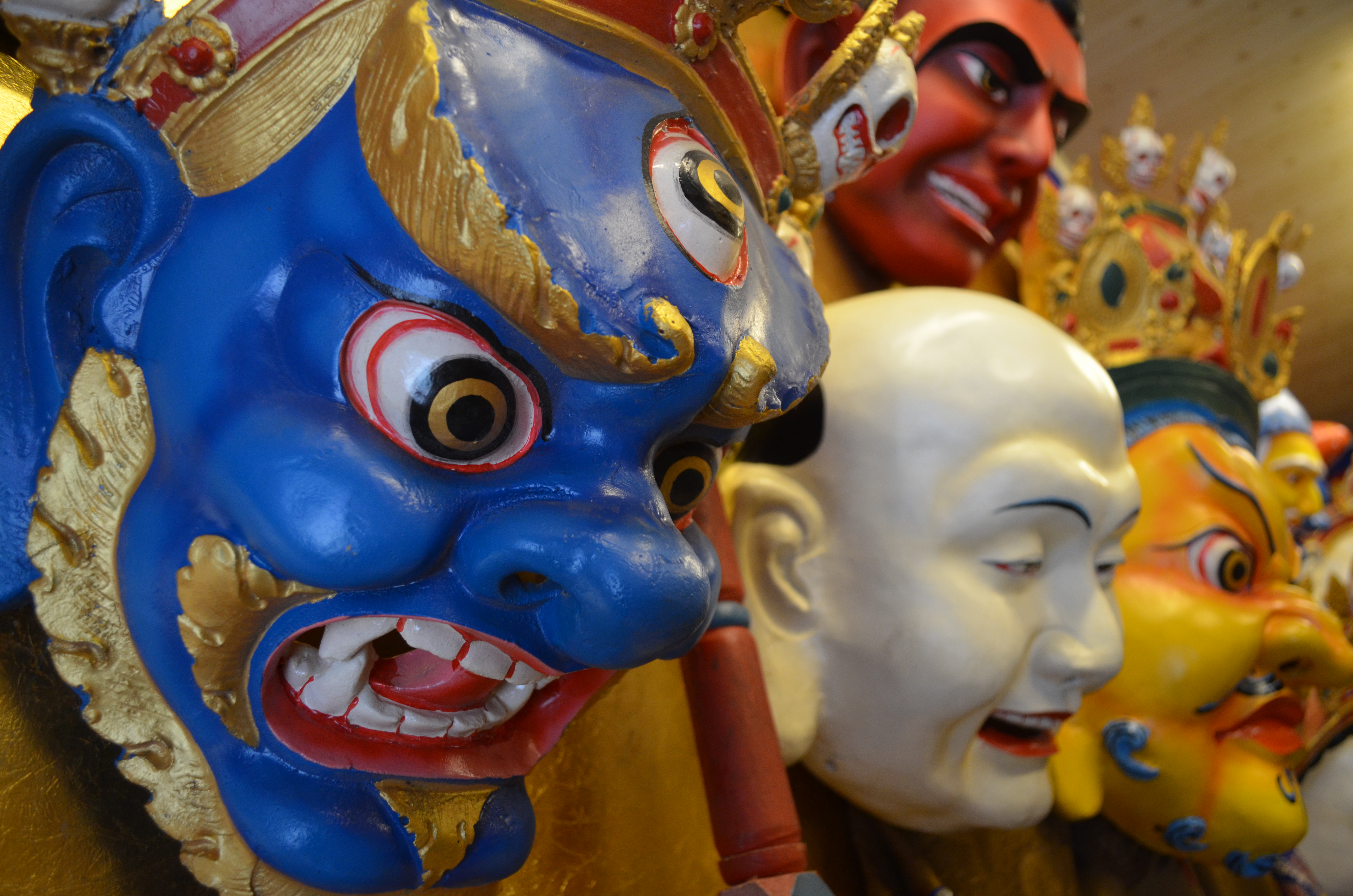
Tibetan Buddhist masks for sale in Chengdu, China, circa 2011. Photo Peter Romaskiewicz.
Introduction

When teaching introductory courses (like I am this summer) I tend to shy away from having students read texts/passages in class individually. I more typically type out passages on my slides and have students read collectively, or simply read the passage aloud and offer a question for discussion. Mostly this is due to time. I find reading in class often necessitates small group discussion, which then necessitates class discussion. Five minutes of reading (minimum), five minutes of group consultation (minimum), and ten minutes of class discussion can eat away precious class time. The topic needs to be worth the deep dive.

I have encountered more radical approaches to reading in class. During a teaching demonstration a few years back a grad student preparing for an upcoming interview did something quite…unique. The lecture was geared for an undergraduate class on the topic of the Portuguese Trans-Atlantic Empire. It was enthralling because the grad student giving the lecture was almost unhinged in his role playing, running back and forth and yelling as if he was really on a ship crossing the Atlantic during a storm. At some point he started throwing out balled up sheets paper and each person who caught one had to read it aloud to the class. (I really don’t remember the rationale, but I think it was something about sending out letters in bottles into the ocean.) Ultimately, this was not my style (and other than getting students involved and laughing, not too effective), but it was challenging to me to think about my pedagogy.


Nevertheless, I’ve been working on an in-class reading exercise to introduce the Confucian Analects. Its outlined here:
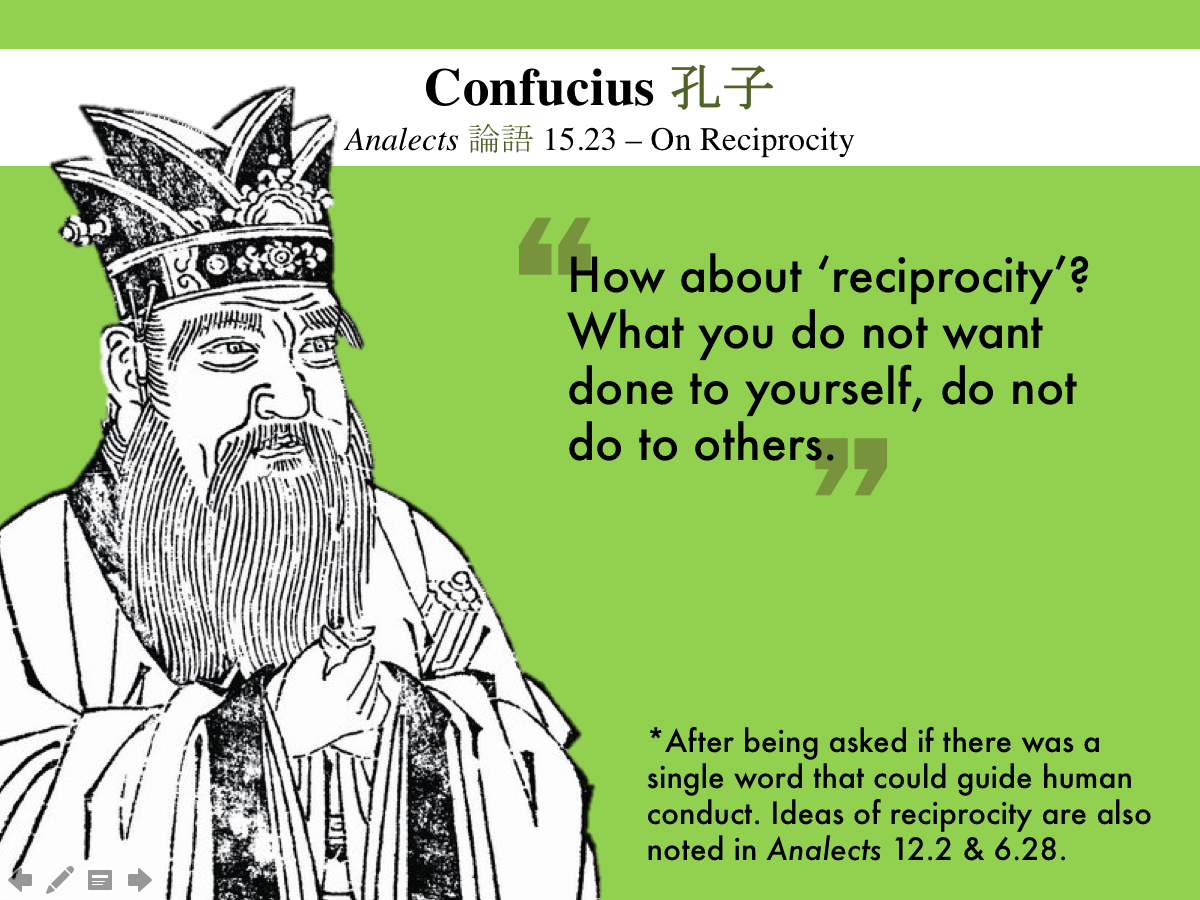
Peter Romaskiewicz Analects exercise slide
Slide for Analects exercise

Prep Work: For homework, students should have read several passages from the Analects. Before class I printed out five sets of five double-sided pages of different passages from the Analects. (I break the class up into five groups of five students, each student receives one double sided page of passages from the Analects – thus every student in each group reads a different group of passages). At least one of the passages in each set is 15.23 (on reciprocity/shu 恕).

Set-up: After describing the political and social turmoil of the Warring States, I told the class that Confucius just wanted people to “get along with one another.” I asked them to find a passage in the Analects they would consider central to accomplishing this aim. After reading individually they consulted with their group and decided on the best answer along with one/two alternate(s).

Motivation: To add a sense of challenge, I told them there is a correct answer, or at least an answer I am looking for. This was not necessary, but I felt it fit the nature of my students/class. I also had a “scribe” write down the final responses for their group (they were not allowed to switch responses if they heard something better from another group) and post the responses to our course website for posterity.

Practice: I gave them 6 minutes to read, which meant they had to read with focus. They had 5 minutes to discuss and plead their cases to their group. Class discussion was between 15-20 minutes long. As each group offered their response I asked them why/how they made their choices and/or to explain what each passage meant in their own words and/or to give a concrete example from their everyday life.

Outcome: I thought this exercise went well. Each group, interestingly, chose different passages, no doubling of responses! This exercise allowed students to get a sense of the breadth of the Analects and to discuss the meaning of several passages with each other. I think having a clear focus or problem solving aspect added to the exercise. I have done a similar exercise in the past having students reading passages to find one they “liked” the best with mixed results. The class conversation ended up being more broad and ultimately covering terrain that was not central to my lecture (of course, this may be a desirable goal!). This new version of the exercise allowed me to move forward with my lecture and hit the themes I wanted to cover.

One group did select the “correct” answer (15.23), which allowed me to transition into my lecture on reciprocity and the “Golden Rule.” Other groups also talked about the gentlemen (junzi 君子), virtue (de 德), and humaneness (ren 仁) which allowed me to reference their insights later in the lecture.

Out of all the primary resources I have my students read, the Analects are probably the easiest to pick up and read passages at random and to stumble across something personally insightful. Thus even with minimal introduction to the material, an exercise like this is still fairly effective.


 Relevant Pedagogy Posts


A Daily Review Exercise & Group Activity

Peter Romaskiewicz
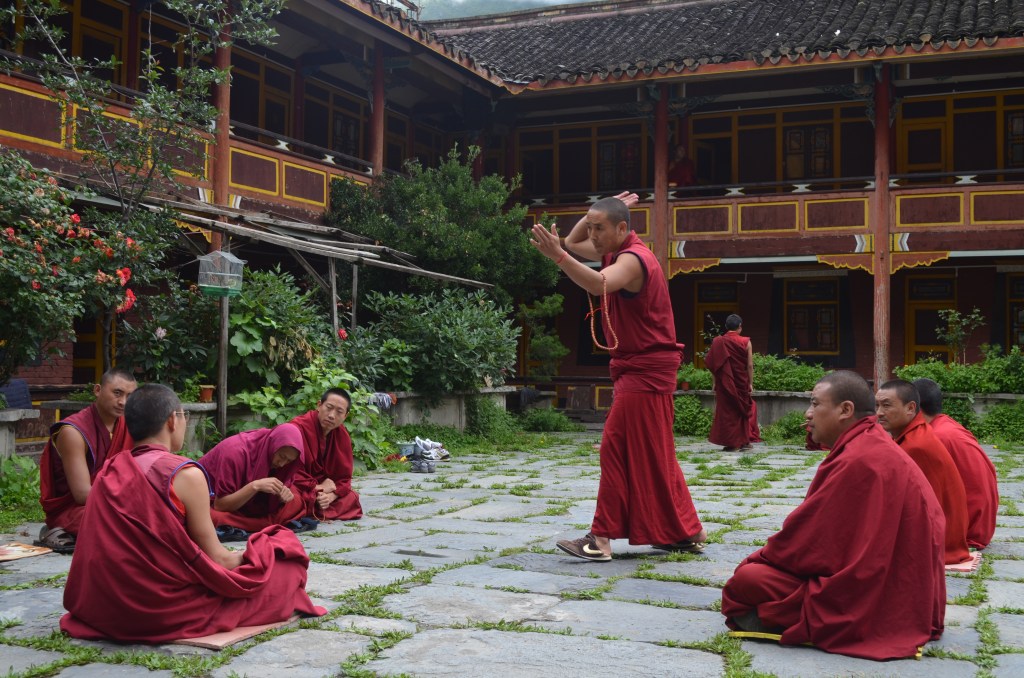
Tibetan Buddhist monks practicing debate at Nanwu Temple 南無寺, Kangding, China, c. 2011. Photo Peter Romaskiewicz.

While taking a graduate seminar a few years ago with José Cabezón, he had the all students engage in a practice which he claimed was standard operating procedure for Tibetan Buddhist monks in training. At the start of each class one student was responsible for reciting in summary the important points of the previous class. [An outline of a similar process can be found here.] We were not allowed to look at our notes nor we we allowed to make crib sheets. Individually, it was an exercise of memorization, but it was also an exercise of analysis and application. Collectively, it allowed the class to all be on the same page, preparing us all for the materials to be covered that day. It also sometime elicited clarifying questions. From what I remember, these daily summaries would last 5-10 minutes, followed potentially by conversation.

Every once and I while I like to do something similar with my class, and after I fell behind in lecture last week, today was a great day to break this exercise out. I wanted to to do a group activity at the start of class (I find it harder to break the class into groups halfway into lecture) and this seemed promising. I often just ask one student to summarize from memory for the whole class, but here I wanted the class to socialize a bit more and converse with each other. I asked the groups to come up with three important points I touched on in lecture the previous class (here, on the Bhagavad Gītā). This primed the students to the topic that I revisited today and also allowed them to hash out any confusions among themselves.

Overall, I found this to be quite valuable. It allowed the students to socialize, interact with (and teach) one another, and test their memory – or at least to familiarize themselves with their notes. I suppose this could be done for each class (maybe even making it a regular assignment), but I would have to take the time into consideration. The group work only lasted 5 minutes, but the class discussion lasted another 15 (there were a handful of questions).


  Relevant Pedagogy Posts

A Question of Quizzes & Low-Stake Assessment

Tayuan Temple Chanting.jpg
Buddhist monks chanting at Tayuan Temple 塔院寺, Mt. Wutai, China, summer 2016. Photograph Peter Romaskiewicz.

Introduction

Grading is one of the toughest parts of teaching. It also gives you immediate feedback on how well students are grasping the materials. Thus I’ve come to find that frequent, low stakes assessment is helpful in preparing students for larger and more complicated tasks.

In my summer course I’m having quizzes each week which review the material from the previous week. I’ve decided that quizzes will mostly be multiple-choice for a few reasons. First, these assessments are making sure students are familiar with basic terms and themes, mostly focused on recognition and recall. These ideas form the basis for more analytical and critical writing assignments in the coming weeks. Second, because of the pace of the course (we meet four times a week), I cannot spend too much time grading. Perfect for multiple choice.

The new angle I am trying this summer is online quizzes. Thus, I am also attempting to make this class hybrid, as I expect to teach a form of it fully online in the near future. The students have to take the quiz before they attend Monday’s class. I allow them a 36 hour window to take the test, opening it Sunday morning. To prepare them, and myself, for this new experience, I offered an online quiz (for minimal extra credit) on the syllabus after the first day of class.

I decided on the online quiz after much thought. The main concern I had was missing 10-15 minutes of class for these quizzes. I found them to be useful, even necessary, for low-level learning, but they also ate into lecture and discussion time. In addition, I was  hoping that automatic grading would save me time throughout the summer session.

I decided that I would make the quizzes open book and open note. Perhaps it is poor judgement on my part, but I just do not fully trust my students to not use notes for an assessment like this (!). This this is a concern I have for online quizzes, especially of the multiple choice variety.

To counterbalance this leverage, I decided to make the quizzes timed, instructing my students that they would need to study beforehand in order to answer all of the questions. My hope with this set-up is that the students would get used to the type of questions I would ask and potentially become familiar with the adequacy of the notes they are taking. (The midterm and final are in-class.) The first quiz was 10 multiple choice questions with two short answer questions. The total time I allowed for the quiz was 15 minutes, just about the time I would allow in class.

I will review the use of online quizzes at the end of the course.


  Relevant Pedagogy Posts

What is “Religion”? An Activity to Stir Thought

Why Are There No New Major Religions? - The Atlantic.jpgAn activity I’ve come to enjoy doing early on in my classes (first day if possible) is to have the students, in small groups, come up with their own succinct, one-sentence definition of religion. Today, when I did this with my Asian Religious Traditions class, I added the instruction that they also had to come up with an apt metaphor for “religion” as well, thus completing the sentence, “Religion is like _______ because it ________.”

This exercise allows the students to reflect upon their assumptions about what counts as religion and what does not. When the groups report back to the class, I’ll probe certain aspects of the definition. Today I asked various groups about their use of the term “spiritual” (How is a “spiritual” practice from an everyday practice?), or why a religion needs to be “organized” or “systematic” (Can a religion be un-organized, non-institutional?), or why religion make one feel “comforted” from the unknown (Can a religion be stressful or cause more questions?), or whether a religion can be “any” practice or belief that “guides one life” (Are sports and fandom religion then?), or why belief play such a central role in the definition (Does a religion only govern belief?).

Admittedly, I often put myself in the position to make these critiques, but this is mostly for purposes of time. I could expand this exercise to have groups critique other groups’ definitions, or look for overarching themes that are common to all or most. As it stands now, I have students consult for 6 minutes in groups, and then have a class discussion for another 20 minutes or so (5 minutes for each group to report and respond to questions). This is a large block of time, but I believe this is important critical work that sets a tone for the class.

I was unsure how well the metaphor component was going to work, but I thought this would also reveal assumptions about how people conceived of religion. The responses I received were interesting (I told them it was okay to be creative, as long as they could defend their choice). Here were the responses:

  1. Religion is like sports because it’s deeply ritualized, ingrained, part of culture, people get passionate about it, and it can be difficult to pinpoint why it is as important to someone as it is.
  2. Religion is like a fruit tree because there are different types of fruit trees with different yields you can get from them; they vary but also have similarities and people can take or leave what they want.
  3. Religion is like Xanax because it relieves anxiety.
  4. Religion is like a puzzle because smaller pieces come together to create a deeper understanding of the world.

I thought these were great. They sometimes revealed a different understanding of religion than the definition the same group offered. These formed good conversation points as well.

This activity concludes with me showing several “classical” definitions of religion by scholars, and I point out that there is no consensus scholarly definition of “religion,” that it is contentious. In the context of this course, I then shifted to say that if there is no consensus definition, then how can we be sure other cultures have “religion.” How can we be sure what we call religion is similar to the experience of people in other cultures? I raise this point because I want to construct a critical stance to these questions as we move forward through the course.

Overall I hope to continue to experiment with this activity, it has proven to be insightful each time I have done it, allowing students to talk with each other and to potentially reveal recurring assumptions about “religion.”

It is perhaps worth noting that I had student post these definitions and metaphors to a class website, and plan to have students grapple with these definitions throughout the course and make them chose one (or invent their own) to use in writing assignments.

* Image Paul Spella / The Atlantic