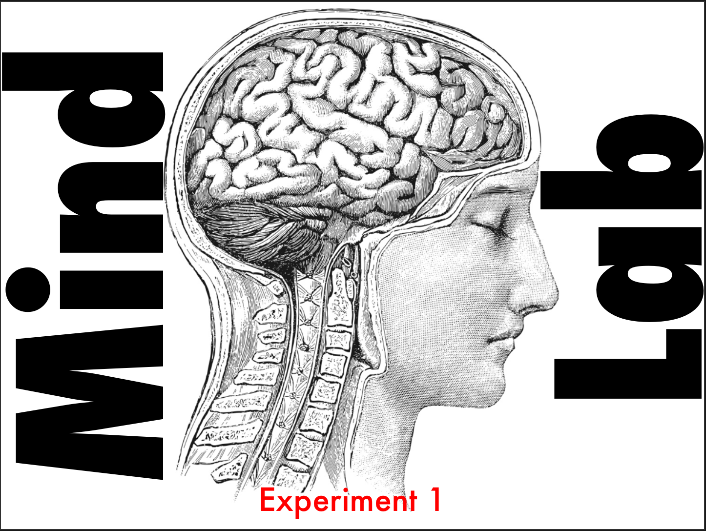
Meditation or Mind Lab?

Screen Shot 2017-10-18 at 16.25.13.png
Slide introducing a Mind Lab Exercise

I arrived on campus a few days before classes began to find my classroom. The room number suggested that I had to go to the gym to find my classroom, so I was curious. After being directed by a few students on the basketball team, I came to find that I was slated to teach my Zen class in a dance recital room, complete with mirror and ballet barre…and no desks what-so-ever.

I immediately went to the department to see if I could switch rooms, I had no idea how I could conduct a religious studies class there. I was told that room was selected because the previous instructor  – someone I knew was wildly popular – had requested to teach there. It immediately made sense – his Zen class was all about the practice of Zen (meditation) while mine was going to be about the history of Zen (myth, lineage & literature).

This immediately struck me. I love when I find someone who has a completely different approach to the same material. I talk a lot about the history of meditation in my classes on Buddhism, delving into its correlation with cosmology, the debates over non-cognitive states, the endlessly varied terminology the English term “meditation” masks, the arguments over the modern mindfulness movement, and so forth. I encourage students to seek out meditation clubs or to sit on their own time, but I dutifully omit much meditation practice in class. Perhaps when I discuss the Seven Point Vairocana Posture and ānāpānasmṛti (Mindfulness of Breathing) will I ask students to briefly engage in sitting – to get the flavor of it.

Part of this reasoning is simply practical. Much of my lecturing on the history of meditation was developed while students were actively engaged in sitting regularly during the Woodenfish program. My lectures tried to give context to their practice – they did not need me to teach them the practice as well.

Buoyed by the potential expectations of my students who planned to meet in the dance hall, I decided to introduce what I had been calling Mind Labs – quick and simple exercises to help get students to develop their own personal phenomenology of mind. (I suppose one could call these Thought Experiments too, but I prefer Mind Labs…)

For example, when the Abhidharmists claim that mental events can only occur in quick succession, and not simultaneously, I prefer to do an exercise which asks students to determine what they think first. Another question I like to ask is whether or not students always have an affective coloring to their thoughts (for Theravādin Abhidharmists, unless a highly achieved practitioner, the answer is typically “yes”).

Screen Shot 2017-10-18 at 16.31.13.png
Slide introducing a Mind Lab Exercise

For all Mind Lab questions I ask that students write down responses and hand them in to me for tallying. I try to quantify the results the best that I can and identify patterns of belief. During our next meeting I will have a small discussion about the results and try to relate the discussion back to the “standard” Buddhist position.

Thus while I do not typically engage in much meditation practice during class time, I feel that there are numerous other philosophical exercises of mind that may touch upon similar aspects.

Zen and the Art of Multiple Choice Exams

Multiple choice exams are universal on college campuses. But how do they stack up against other kinds of assessment, especially in courses where higher-level thinking (application, analysis, evaluation), and not mere memorization (recognition and recall), are emphasized?

Crafting good multiple choice (MC) stems (questions) and conceiving plausible distractors (wrong answers) are skills in themselves. Yet, when artfully done, MC exams can be effective in testing higher-level cognitive abilities – it just takes time and effort in the creation process.

A few years ago it dawned on me that students could shoulder some of these question-crafting responsibilities to good pedagogical effect.

Coming up with plausible – dare I say artful? – distractors is part of the practice I so thoroughly enjoy about writing MC exams. I try to imagine the reasons why a student may choose a incorrect answer: is X conceptually close to Y?, is it easy to confuse X for Y?, is X actually the opposite of Y?, does X actually negate Y?, is X spelled similarly as Y?, and so forth. These questions develop the pool of candidates from which I select distractors that are, for the most part, plausible and rationally derived.

Indeed, through this very exercise of crafting questions with good distractors I’ve built a better understanding of the relationships between concepts and a better appreciation of where conceptual pitfalls might appear. In other words, this activity helped me build a network of reinforced meanings which allowed me to better understand the materials at hand. This is precisely what I want students to do!

Thus, I decided to unveil a new extra-credit option for my Zen Buddhism class: students can craft five of their own MC questions following the criteria I set out for them. Some may be used on our midterm and final exams. From my perspective, this exercise has the following benefits:

  1. Students create their own webs of meaning between conceptually similar ideas or confusing terms. Creating plausible distractors causes students to study in a new manner.
  2. Students post their MC questions on an online forum and thus have the opportunity to take student-created mini practice tests.
  3. By selecting a handful of the best questions for class MC exams, students feel they had a sense of agency in the learning process.
  4. It can save time on my end in crafting MC questions.

Multiple choice exams will never replace the value of writing sustained, well-reasoned prose, but having students write well-reasoned multiple choice questions is a step in the same direction.


Review

Overall, about 50% of my class took me up on the extra-credit offer. I provided a hand-out outlining the requirements of a good question and an “artful” set of distractors. I offered 5 extra credit points for five well-crafted questions and sets of answers. I retained the option to withhold extra credit points should a question-answer set not be handled with sufficient attention to the directions. All submissions met my basic criteria and all students received full extra-credit.

Many of the MC questions did not match my highest standards – but, honestly, not all of my questions are perfect! Several were thoughtful and well-crafted and thus were incorporated into our exams.

Would I do anything different in the future? I would consider having students explain why they selected each distractor, laying bare the relationships I noted above or other critical logic. If I wanted to take this creative exercise more seriously, I could require students to produce MC questions, perhaps first as drafts, and practice with them during class review sessions before exams.

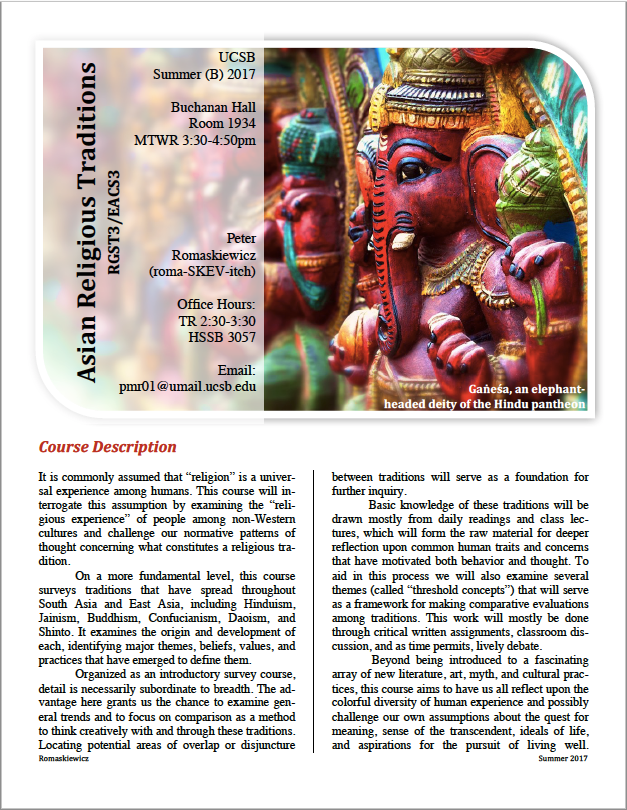
Asian Religious Traditions: Course Evaluation and Overview

Student grades are in and its time to evaluate on my survey course for Asian religious traditions. These blog posts began as a project for the Summer Training Institute for Associates, but ended up becoming a valuable tool for me to reflect on numerous aspects of my course (all of the hyperlinks here link to my original blog posts).

The Good: The biggest issue I wanted to address from the last time I taught this course was to provide students with a better framework for creative comparisons between traditions. I also wanted these comparative lenses to form the basis of a writing assignment which asked them to analyze, evaluate, and ultimately to creatively engage the material.

This issue was addressed through a careful progression of assignments. Daily readings were combined with podcasts on selected “threshold concepts” of which students had to write about daily. Daily lectures, classroom activities, and various lecture materials all reinforced the basic content and asked the students to challenge their assumptions about what constitutes a “religion.” Regular, low-stakes assessment was done through online quizzes (which saved time in class and some time on grading).

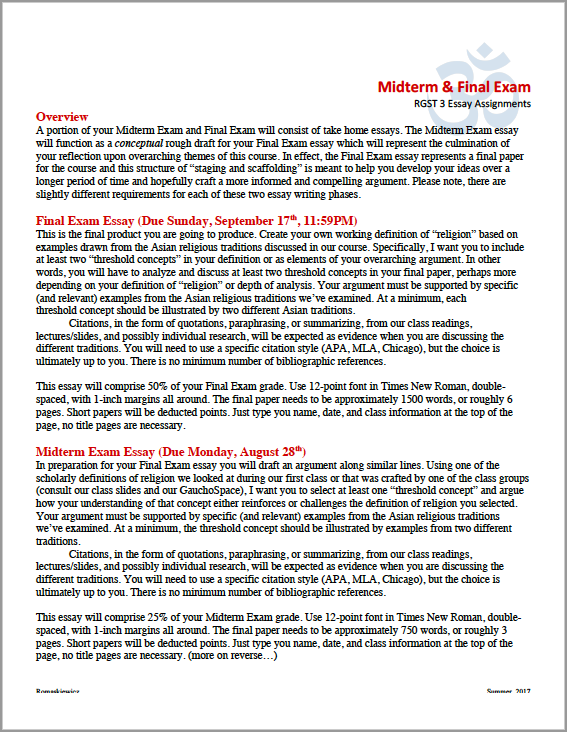
The final writing assignment was divided into stages as well. For the final product I wanted the students to craft and defend a definition of religion” solely based on the traditions we covered in class. They were required to draft a partial argument for the midterm exam, which was peer-reviewed and given audio commentary by myself.

Syllabus Cover.png

Asian Religious Traditions Syllabus [please contact me for a full copy]

Overall, I was pleased with the “chances” I took with podcasts, threshold concepts, and online quizzes. I also feel several students stepped up to the final writing project and crafted creative and sometimes challenging definitions of religion from the Asian tradition perspective.

The Bad: Student participation attrition was evident by the last few classes, making me reconsider the practice of cold-calling. I received positive feedback on the group activities, which certainly expanded participation by several students, thus I will continue to expand on these (as long as I can make them central to class content or progress the dialogue I wish to maintain). Overall I am still looking for techniques to maintain engagement throughout the term.

Perhaps the biggest remaining issue (which I have not discussed here previously) is that of selecting effective readings. There is no introductory textbook to Eastern/Asian religions that I find effective for the direction I want to take my class. I used the fourth edition of World Religion: Eastern Traditions edited by Oxtoby, Amore, and Hussain (2014), but find it does no go into the depth I would like and covers much terrain that I cannot fit into my course (UCSB terms are only ten weeks long). To supplement the textbook I use the primary sources compiled by the prestigious Columbia anthologies Sources of Indian Traditions, Sources of Chinese Traditions, and Sources of Japanese Traditions. I am selective in choosing what my students read since these anthologies are fairly expansive. I have come to find that being more selective is the key to active student engagement.

Overall, I will continue to look for readings that cover the range of topics I find important and to continue to seeks avenues of active student engagement.

I now transition into teaching composition and rhetoric, and will continue to update this blog on these ventures.


   Relevant Pedagogy Posts

Final Writing Project

My summer course fulfills the UCSB writing requirement for undergraduates, thus I knew my class would be writing intensive. I conceived of the final writing project as following a progression of “staging and scaffolding.”

My final project required students to develop their own definition of religion based solely on the Asian religious traditions we covered in class (it is presented as a challenge to the understanding of “religion” as based on monotheistic Western traditions which emphasize “belief” and “holy books”). This would require students to engage higher levels of thinking with the material (including analysis, evaluation, and creation), far beyond just memorizing foreign terms and names. It also required them to construct a written argument. Both of these goals require staged assignments, and my course was developed with these outcomes in mind.

There were three basic stages building up to the final writing project.

  1. Daily Reflections: In addition to my N-O-O assignments, students had to write and post daily informal reflections on concepts that they could use for the foundation of their definition. The concepts, which I called “threshold concepts,” were introduced through short podcasts, and each student had to locate where these concepts were found in that day’s reading assignment. They were also asked to reflect on where these concepts may have been illustrated in other materials as well, thus creating a network of comparisons. These were informal low-stakes writing tasks which focused more on critical thinking and idea development than formal writing structure. These daily ideas formed the beginnings of an argument for how a religion might be defined. Students also had to opportunity to read the posts of other students, thus increasing the cross-pollination of ideas.
  2. Idea-Generating Writing Project (Mid-term Exam Essay): For the midterm essay I had students take a definition of religion we looked at or created during our first class and either defend it or critique it according the the material we had covered thus far (we had covered “Hinduism,” Jainism, and Buddhism – or the Indian cultural sphere). They had to employ one or more threshold concepts as the basis for their argument. This was envisioned as a conceptional rough draft for their final project which required them to create their own definition. They had to bring in a copy of their paper for peer review and I provided audio commentary on what they turned in. I required this to be a formal academic essay, and gave insight into the construction of the thesis statements, the use of evidence, and organization of ideas. While some of the content would vary, these concerns would carry over into the final project.
  3. Final Writing Project (Final Exam Essay): This essay was the culmination of student efforts to understand and create useful comparisons among the rage of Asian religious traditions we covered. I made the essay due a few days after our in-class final exam so they could spend time referring to class and teacher commentary and to incorporate the East Asian material we had covered since the midterm. To make sure they remained on pace I required them to draft a definition of religion and post it to our course website a little more than a week before the paper was due.
Peter Romaskiewicz.png

Final Paper Prompt

   Relevant Pedagogy Posts

Online Quizzes: Recap

I want to quickly review my use of online quizzes this summer, returning to a post I started here. As I noted, I use “low-stakes retrieval practices,” i.e. quizzes, regularly in my courses so students can assess their efforts and make any micro-adjustments to their study habits they deem necessary. Instead of diverting time in class to taking quizzes I decided to have students take quizzes at home online as part of their homework. Here are some quick thoughts.

  1. Practice Syllabus Quiz: Not too many students are familiar with taking quizzes at home, nor was I familiar with the mechanics of making them. I decided to give my students a syllabus quiz after the first day of class, making sure they understood the requirements of the course as well as trying to troubleshoot any issues that may arise when the real quizzes start. As enticement, I offered minimal extra credit for completing the quiz with 100%.
  2. Multiple Choice (MC) Only: Clearly, this will depend on an individual instructor’s educational goals, but I shifted from the norms of my paper quizzes. I would often add a few short answer questions to the end of in-class quizzes, but found that grading these online took a bit too much time. Clicking, loading, scrolling, typing, and saving took far longer than flipping a page. After including short answer questions to my first online quiz I decided to make all subsequent online quizzes just multiple choice so everything could be graded automatically. If this was not a time-condensed summer class I may have kept the short answers, but I looking to save some time overall with online quizzes.
  3. Open-Book/Timed: Honestly, I just don’t trust anyone to not use their notes or book when taking a quiz at home, so I just decided to make them open-book. To offset this a little, I made all the quizzes timed meaning that students would not be able to casually get 100% on every test just by flipping through their notes or my slides. I told them they need to study before starting the quiz. I gave them just over 1 minute per multiple choice question.
  4. MC Strategy I: Crafting good multiple choice questions can be a skill in itself, especially ones that test higher-level thinking (application, analysis, evaluation) as opposed just memory (recognition and recall).  The first question below is an example of simple recognition and the correct response (“B”) would (or should) be found word-for-word in students’ notes.
    Screen Shot 2017-09-16 at 11.57.40.png
    The second question combines recognition with application, asking the students to apply their knowledge (in this case, to real world examples). In addition to testing higher-level thinking, the correct answer could not be found word-for-word in students’ notes.
    Screen Shot 2017-09-16 at 11.57.48.png
    Because the main focus of my quizzes is to test simple recognition and recall (midterms and finals are different), I mix in only a handful of MC questions to test higher-level thinking. Yet, it is possible in some cases to transform lower-level cognitive MC questions into higher-level ones.
  5. MC Strategy II: While generally not regarded as a good strategy for crafting MC questions, I’ve found that using some “exception” questions also requires to students to know (recognize) more about a concept.
    Screen Shot 2017-09-16 at 13.00.18.png
  6. Testing Recall: Another method I did not employ this summer is to use “fill in the blank” questions that are automatically graded.

Overall, I will continue to develop my use of online quizzes. For me, the benefits of saving valuable class time and automatic grading offset the issues of limiting (or avoiding) short answer questions. 


   Relevant Pedagogy Posts

“Educational Podcasts” for Class

Introduction

As I wrote about previously, this summer I realized I wanted to use a set of “threshold concepts” as tools to allow my students to compare religious traditions. This posed a specific problem. I needed to inform my students about these concepts in an effective and condensed fashion which still hit upon several important aspects. After eliminating encyclopedia entries and Wikipedia entries, I decided I would write short introductions – I called them “briefs” – to each of the concepts and then audio record them. Funny enough, it was only in conversation with my students that I realized they referred to the briefs as “podcasts.” Ha! (Academic literature tends to refer to projects like these as “complementary podcasts.”)

Originally, my idea was much grander. I wanted to make short videos for each concept. As is customary, I was spending the summer teaching for the Woodenfish program and I wanted to use the backdrop of the Buddhist monastery for my recorded conversations. This quickly was abandoned when teaching duties piled on and I was simply too exhausted to scout filming locations, write scripts, and film the twenty briefings I wanted to cover.

When I returned home and began preparing for my class in earnest I decided to simply do audio recordings and I think this worked out for the best. I certainly fumbled through the first through scripts. I was unsure of the conventions for the genre. I was lucky enough to naturally stumble upon a few guidelines that are recommended for doing education podcasts.


Overview

Time Length: This is perhaps the most crucial aspect. I did not want to impose too much information on my students, I wanted to give them just enough basic facts that they could immediately begin applying the concept to the readings and then develop a better understanding of it through their own investigation. The first threshold concept I scripted and recorded was “material culture,” and it ended up being four minutes and twenty seconds long. I had not set a time limit, this was just naturally how long it took me to write and then say the things I thought needed to be introduced. Overall, my shortest podcast was just less than 3 minutes and my longest was just over 5 minutes. One study (by Cheung On Tam) tabulated this chart for student preferred podcast lengths:

Screen Shot 2017-09-15 at 12.35.43.png

Clearly, going over the 5 minute mark was not problematic, though much of what I’ve read suggests keeping the length to about 10 minutes, if not even shorter at 6-8 minutes. Clearly, script writing ability will determine if listeners pay attention for longer.

Tone: I knew immediately from my extensive use of audio commentary on papers that I wanted the tone to be informal, but still driven by information. In the first few recordings I captured many of my “verbal ticks” (“so now…,” “right”), and even though these were weeded out in later recordings as I became comfortable with the format, I never just plainly read my script. I wanted those verbal cues which suggest conversation.

Conventions: The conventions for my podcast briefs took me a while to figure out, and they are still in flux. Ideally, I like to start off with a leading question, historical anecdote, or even a joke (well, only once – I started my brief on “humor” with a joke). When I’m less inspired, I’ll start off with a definition, especially for terms with clear Greek roots (soteriology, ontology, epistemology). For the basic content I would always try to segment the concept in some fashion, providing “different looks” so students could more effectively see the concept in culturally diverse religions. For example, I described bloodless and blood sacrifices for the concept of sacrifice, and elaborated on the here/now, here/then, there/now, and there/then models of utopia. Sometimes I would just give several broad examples. I would also try to end the podcast with some verbal clue (“in closing,” “I leave on this,” etc.) and restate the most important points or types of questions I would want the students to ask of the readings with the threshold concept in mind.

Transcriptions: Originally I just posted the audio recording to our course website, but then later started posting my script as well. I had already done the work, so there was no additional work.

Technology: I recorded everything on my iPhone, no special equipment. I was honestly surprised how crisp the recordings turned out (no hissing, background noise).

Outcome: After soliciting feedback from my students several said they enjoyed the podcasts. About halfway through the term I switched to uploading just my scripts because a non-native speaker in my class complained about needing to re-listen several times to the recordings. (I would quiz students on the content of the podcast, so note taking was necessary.) I was unsure if this was a widespread problem and students were simply afraid to notify me. After asking about this switch, however, a handful of students noted they would prefer to go back to the audio recordings, which was a peasant surprise. From that point onward I tried to provide both the audio and script.

It was only afterwards that I realized the trove of literature on the effectiveness of podcasts. I am already thinking about ways to incorporate podcasts into my writing course this fall term.


   Relevant Pedagogy Posts

Intro to Religions & Threshold Concepts

[OCTOBER 2017 UPDATE: Since the class ended I have been thinking about how I used the term “threshold concepts” and decided that it was too broad, i.e. several other terms likely did not meet the criteria for a true threshold concept. I may just use the terms “lenses” in the future.]


Introduction

This summer I decided to try something slightly different for my survey course on Asian religious traditions. I wanted a way to bridge the diverse religious traditions I planned on covering. In other words, I wanted a way for students to more easily and creatively engage in the act – and art – of comparison.

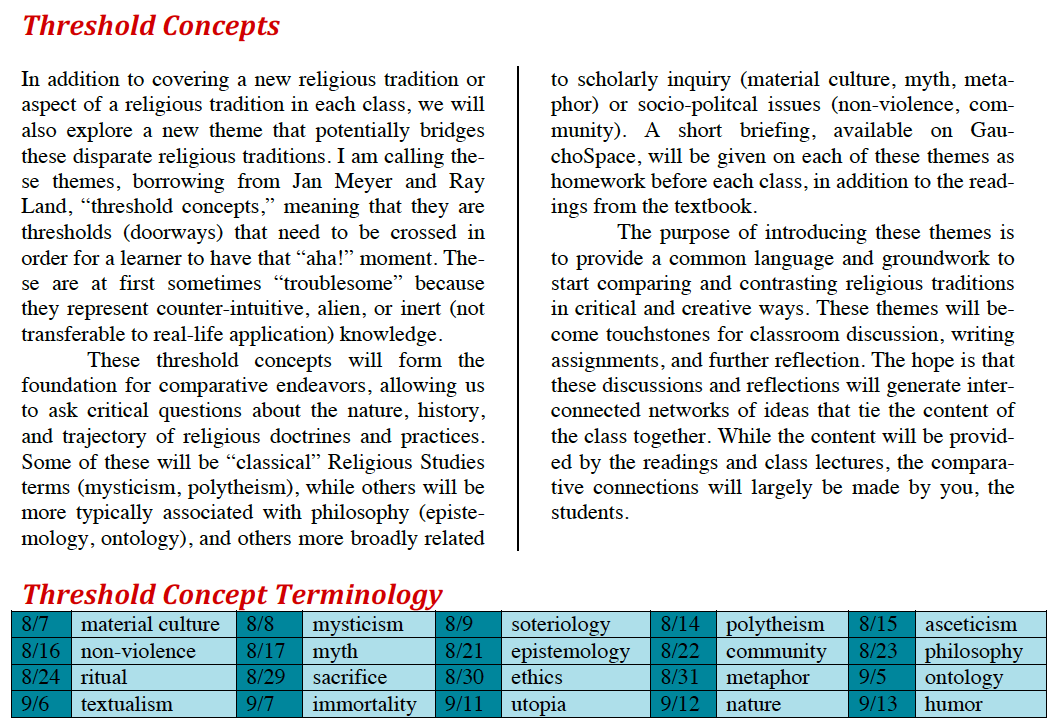
I decided to use a set of “threshold concepts” to function as lenses for comparison. I described “threshold concepts” in my syllabus, along with how I wanted them to be used and which terms I selected. Here is the relevant excerpt from my syllabus:

Screen Shot 2017-09-13 at 21.22.02.png

There were plenty of comparative terms that did not make the cut, including: deity, monism, human nature, millenarianism, sacred/spiritual, and cosmogony/cosmology.

My basic criteria for selection was, admittedly, biased. But generally, the terms needed to serve several functions. First, they needed to be potentially useful for a definition of religion. The main writing projects for my students were oriented around critiquing and creating such a definition. Second, I needed to be able to clearly exemplify the term in the content of that day’s assigned reading and lecture. For example, we discussed material culture on the day we examined the Indus Valley Civilization, which is re-constituted solely through archaeological and art historical remains. Asceticism was discussed in the context of the śramaṇa movements in ancient India, epistemology was introduced to talk about the early Buddhist approach to the Dharma, metaphor was used to understand the explanations of the Dao in the Daode jing, and so forth. Sometimes I selected a term because I thought it could highlight a different way of thinking about religions (see non-violence, immortality, humor).

The immediate problem I encountered was trying to figure out how to introduce these concepts effectively without spending too much time on them. I first thought about simply using Wikipedia entries, but then settled on selecting entries from the widely used Encyclopedia of Religion. The entries here were too long, however, and many times too complex for what I was looking for. Oftentimes the entries placed too much of an emphasis on Western religious traditions, which I didn’t want confusing (or even “tainting”) my students.

Ultimately, I decided I would make short audio recordings, hitting the points I thought were most effective and illustrative of the traditions we were covering. I based many of my ideas on the entries in the Encyclopedia of Religion and provided the pdf’s to my students who wanted further clarification. I didn’t want students to do more (and potentially needless) reading and was hoping to provide them with another mode of learning. These recordings, shunning all modesty, worked perfectly. Students listened to the recordings (which I called “briefs”) and located where the concept was illustrated in that day’s reading. They were then expected to write about their ideas in daily reading posts.

I will do another post on creating the “podcasts” later. Ultimately I found the threshold concepts worked well in helping to organize student thoughts and gave them a solid framework for crafting a definition of “religion.” I recently asked my student to select two potential threshold concepts they would highlight for their definitions, and the tally was as follows:

  • Soteriology x7
  • Community x6
  • Mysticism x5
  • Material culture x5
  • Morality x4 (=ethics)
  • Ritual x3
  • Epistemology x2
  • Myth
  • Ontology
  • Scripture (=textualism)
  • Metaphor

Clearly not every “threshold concept” was equally valuable in this assignment (though we had not yet discussed paradise, nature, or humor when the students posted their ideas), but I am quite happy with the variety. I am also happy some students decided to wrestle with tricky terms like epistemology and ontology, or even ideas that often get overlooked in religious studies, such as material culture or metaphor.

If I was to employ threshold concepts again in this manner I may cut some out in future iterations. But, nevertheless, I am quite pleased with how this turned out for this iteration of my survey course.

The Art of Cold Calling Students

Peter Romaskiewicz photo.JPG
Jin’e Temple 金峨寺, Ningbo, China, summer 2017. Photo Peter Romaskiewicz.
Introduction

I have never cold-called students in my classes, but I am becoming more intrigued by it. I am hesitant for the reason many others likely share: I would never want to embarrass or alienate a student who is uncomfortable speaking in a group setting. Yet, I run against a persistent problem in my classrooms where only a narrow segment of students consistently share their thoughts. Simply, I am looking for a tool in my pedagogical “tool kit” to combat this problem.

My current summer class has been no exception to this rule. I also noticed this segment of students thinned throughout the term, with only about 4-5 students (out of 25) regularly participating by the end. I was happy to observe that small group work was effective in producing “new” speakers when we convened for class discussion. But I cannot plan group activities for every facet of a lesson, lecturing and asking (open-ended) questions still remains the backbone of my teaching style.


Does Cold-Calling Work?

There has been some compelling research on the value of cold-calling recently. One study (by Dan Levy & Josh Bookin) shows that cold-calling actually helps to increase voluntary student responses. It appears that effective cold-calling “breaks the ice,” so to speak, giving the classroom environment a sense of inclusivity that makes students more willing to volunteer ideas. Another study (by Elise J. Dallimore, Julie H. Hertenstein & Marjorie B. Platt) shows that when cold-calling is used in conjunction with student online postings, students devote an additional hour to assigned readings. A slightly refined technique is suggest by a recent dissertation (by Brittany Carstens) which calls for teachers to gradually switch over from cold-calling to voluntary participation after student engagement increases.


Takeaways

Personally I am not motivated to use cold-calling as a coercive technique to ensure students do their assigned readings (I discussed my primary coercive technique elsewhere). I am interested in getting more engaged students, however. After talking with some colleagues and reading around on the internet, these are my most important takeaways about cold-calling.

  1. Prime the Students: List “public speaking” and/or related skills, as a course goal. Devote a few words to it as well at the beginning of the course.
  2. Start ’em Early: Cold-calling students has to occur on the first day of class and occur regularly thereafter. I really wanted to try cold-calling during this summer class, but decided to ease off on the idea because I was pleased with student participation early on. By the middle of the term I wanted to hear from different student voices, but also did not want to shift the learning environment so significantly halfway through the class and risk really embarrassing a student.
  3. Be Inquisitive: Be motivated by caring to hear what students have to think and say. Too easily cold-calling is conceived as simply testing students to see if they did the work. That’s setting up a rather antagonistic environment. I had one grad seminar when the teacher cold-called a student and caught him a little off guard (he did not regularly cold-call folks). The student asked, in a friendly manner, why he had be chosen. The teacher simply shrugged and said, “well, I usually enjoy your thoughts, so I thought I’d ask.” It was a natural and honest response, and I still remember it.
  4. Model Thinking-Out-Loud: Students may be intimidated to speak without well-formed thoughts. This is one reason why I think my group exercises generated several “new” participants, they were able to rehearse their ideas. Perhaps instructors can speak a little off-the-cuff to invite similar “live thinking” from students.
  5. Inviting Others: Closely related to the above point is inviting students to help others along or to fill in the blanks. Instead of moving on from a student who does not have a response, you could have him or her take a wild guess, or just invent something (as students commonly do on exams!). From a different angle, you could also invite students to critique or build upon a response.
  6. All’s Fair: To avoid bias (or always picking on the student who doesn’t pay attention) it may be reasonable to select students (truly) at random. Index cards with names are one clear option. There are several “random picker” and “random name picker” apps for phones.
  7. The Shift: Not all responses need to be cold-called. Cold-calling can be used to generate initial conversation. You can ask for volunteers after a few responses, or even switch completely over to volunteer participation once broad engagement is achieved.

To be honest, even after reading and thinking about this, I am still hesitant. Cold-calling is not a natural part of my personality nor my teaching persona, but I do want to challenge myself and try new things, even if I ultimately decide they are not well suited for me.


   Relevant Pedagogy Posts

N-O-O Daily Reading Responses

Introduction

This is odd to admit, but I run a “coercive classroom.” And there is nothing more coercive in my mind than having my students write daily reflections on assigned readings. I have little reason to think they (or anyone, really) would keep up with the readings without a regular assessment of some sort. Of course, open class discussion on the day’s readings can “peer pressure” some into regular reading habits. I’ve found, however, only a select few are consistently willing to offers their insights, while others are more content to simply listen. (Cold-calling students is a craft I have not yet mastered, but will be attempting next semester. I plan to write about it here for another post.)

There are several ways to gauge if a student has read, but many require a lot of additional effort of the instructor. One may prepare a series of comprehension questions that are handed out just previous to the assignment. These have the benefit of focusing the student’s attention, but I would argue also have the same drawback (to tell the student what they should find interesting or important). It also takes time to craft thoughtful questions that genuinely move beyond basic fact-finding. I personally tend to save good questions like this for class discussion.

Daily (or surprise) reading quizzes are another means of coercion. I’m not convinced of the value of these either, mainly because the questions have to be “easy,” allowing for the student to signal to the instructor that the reading was done even though it may not have been fully comprehended. And grading these can be surprisingly difficult, especially if the question is too easy.

So I’ve veered in another direction, pulling an idea from my time in the Writing Program. I ask my students to respond to every reading by asking the three same questions.


What is New? What is old? What is odd?

New, Old, Odd, that’s it. I sometimes joking call this my N-O-O assignment. The first covers an idea they find interesting. Something they can be motivated to explore in more depth if need be. The second idea covers finding a topic they’ve seen elsewhere, or at least can create a parallel for. This allow students to build on top of old knowledge. The last concept requires them to critique an author’s point or to ask an clarifying question about a topic.

Currently I have my students post these responses on a Forum in GauchoSpace. After posting they can read other student’s posts, though I have not required them to post comments this time. My practice is to go through them shortly before class, and when I have time, to post a brief comment. Typically I will respond to their questions, but will also encourage their curiosities. Even if I do not have time to write responses, just browsing the posts will give me ample ideas of where to take my lecture and what to go over in more detail. I have hesitated to call out students by name about their (insightful) comments, but hope to make this a more common part of my practice.

I grade the reflections based on a simple “did it” or “didn’t do it” scale, though I’ve contemplated a three point scale of “outstanding,” satisfactory,” and “unsatisfactory” (plus “did’t do it”). I typically give my students a few “days off” as well.

Below are the directions I’ve used this summer (I tweak them for each class I teach).

Directions
When approaching the reading assignments for this course, I want you to pay attention to three critical aspects: what is New to you, what is Old to you, and what is Odd to you. Your written reflection for each one of these critical aspects should be at least a few sentences in length. Provide page numbers from the readings as necessary.

Below are some of the types of questions you can ask yourself for each aspect.

1. New – What was something new and interesting? What was particularly useful or insightful? What quote or passage was able to reveal something interesting and/or helpful for you? Why was it so? If anything, clearly locating these sections will make the time you spent reading seem worthwhile.

2. Old – What was familiar? What quote or passage claimed something that you already knew? Was there something that seemed familiar or had a potential parallel to another religious tradition you know? Locating these sections will give you a clear foundation should you encounter other sections that are not as clear to you.

3. Odd – What was confusing or unexpected? What quote or passage did not make sense or were you critical of? What problem did you have with it? Locating these sections will help you keep a healthy and critical attitude towards the readings and suggest areas that require further exploration.

Your response will have to be posted before class for you to receive credit.


   Relevant Pedagogy Posts

Setting Up Effective Student Peer Review

Introduction

This summer I’ve tasked my students with writing a final paper that argues for their own definition of “religion” based solely on the Asian traditions we cover in class. As part of this process, I’ve required them to craft a rough draft that was due during our mid-term exam. Technically, this was a slightly different shorter assignment that built towards their final product.

I assigned this shorter assignment with three specific goals in mind. One was to motivate them to think about their project early. The second was to force them, through peer review, to see how their fellow students tackled them same problem and hopefully to inspire their own approach. The last goal was to allow students the opportunity to practice the (slowly acquired) skill of good critique.

While this last objective really has little to do with the content of my course, I feel it is incumbent on me to teach writing in a Humanities course even when I am not formally teaching writing. (Yes, I have been indoctrinated.) Of equal importance, this provides my students insight into my criteria several weeks before they will hand in their final project. Consequently, this requires some type of peer-review rubric. If you haven’t tried it already, open-ended peer-review sessions – where students are just told to write whatever commentary they desire – are not worth anyone’s time.

One can find peer-review handout templates online, but it is important that your peer-review rubric contains elements that are related to your own grading rubric for the assignment. In fact, there is no reason your peer-review rubric and grading rubric cannot be the same thing!


Overview & Prep

Prep work: Each student had to bring in two printed copies of their short paper: one went to the peer-reviewer, the other was handed in for my commentary. I crafted a reader review rubric that each student had to fill out for the paper they read. In making the rubric, I was also drafting my own grading rubric for later in the term. Consequently, this peer-review exercise was also a means for me to gauge how students were interpreting the prompt and where I should re-examine my evaluation parameters.

Overall, I divided the rubric into three sections: 1) basic requirements, 2) organization & structure, 3) overall quality.

Peter Romaskiewicz Reader Review.png

Reader Review Rubric [Summer 2017]


In Practice

Set-up: The students took the midterm the same day we did reader review (summer sessions are rough!), so there was limited time. I wrote basic instructions on the top of the sheet and read them aloud. I regularly remind my students that there are real human beings reading these comments, so be nice; the tone can be colloquial. I also tell them to cite praise as well as criticism as long as it’s constructive (i.e. I want them to consistently tell the author why they made the specific comment).

In this case, I had the students pass their papers to a random person, and then again to a random person until they “lost” their paper. In hindsight I should of had them trade with a partner so they could talk about their papers with each other, but I knew time was going to be tight as it was and didn’t know if time would allow for it.

Practice: We had about 20 minutes total to do this exercise, which was a bit rushed. After a few minutes for instructions, less than 15 minutes were left to do a read through and write comments. I encouraged marginal comments, but also directed students to read the rubric and fill it out as much as they could. With about 2-3 minutes left in class I had the students hand back the papers to the authors so they could look over their comments and ask any final questions.

Outcome: As I mentioned, I wish I had made time to allow the students to talk to one another about their papers after the review session. Some shouted back a few comments to one another as we ended class. The class seemed engaged and invested. My curiosity overcame me and I asked each student to hand in their rubric with their “clean” paper. I wanted to see the type of comments given and gauge how constructive or helpful this exercise might have been. Overall, the rubric appeared to help focus comments on higher-order issues, like argumentation and organization, not just spelling. At least one conversation with a student revealed to me that exposure to another student’s take was key to her understanding the assignment.


  Relevant Pedagogy Posts