Concept Mapping My Academic Writing Course

While doing research on graphic organizers, I was quickly enraptured by the idea of concept mapping. Concept maps are a means of spatially representing the relationships between ideas and showing how they can form complex networks of knowledge. These types of maps can help both instructors and students more firmly grasp the connections between apparently disparate ideas and help to form a more integrated understanding of a topic or a whole course.

Our university courses are taught in a linear fashion. Ideally we try to scaffold or build towards more complex ideas and skills as the term advances. But the ideas of our courses are not necessarily related to one another in such a simple linear fashion, they often connect to and reflect one another at multiple junctures. In fact, being able to conceptually grasp these multiple juncture points, or how ideas are related on multiple fronts, can be an important step towards real mastery of a subject. Visual resources such as concept maps have been shown to be potent pedagogical tools that aid in building this type of holistic perspective.

In terms of construction, concept maps can show relationships between ideas through spatial placement or proximity (or hierarchy, though that is more usually reserved for tree-diagrams). These maps may be centered around a central idea, although this is not necessary. Importantly, connecting lines (or arrows to show direction) are added to clarify relationships between ideas, and in more detailed maps those lines can be labelled, thus adding even more clarity and precision.

Inspired by its conceptual utility and using these basic principles I’ve just outlined, I set out to create a concept map for my writing course. I wrestled with having my students do their own in groups as an in-class activity (this is often recommended in the literature I consulted), but I decided I needed to struggle with it first to see how reasonable the task would be and how long it would take. Brainstorming the individual components (the ideas/skills I considered most critical) was not difficult, nor was connecting some of the ideas. The biggest challenge was trying to limit the different ways I could connect ideas. In fact, if I was to recreate my concept map from scratch, it almost certainly would look a little different. I tinkered with it a bunch, mostly playing with the labels on the connecting lines. I decided to give it to my students near the end of the term, using it as a cover to a stack of (digital) documents I provide each student (this includes some of their own reflective pieces and copies of handouts we’ve used in class that I think will serve them after our course). Nevertheless, below is my concept map for my writing course.

Concept map - Romaskiewicz 2019.png
Concept Map Cover for my writing course.

I first showed the students the concept map as projected onto a screen in our classroom. I didn’t tell them what it was and allowed them a few minutes to discuss its meaning and purpose in small groups before having a short class discussion. Since I only learned about creating concept map towards the end of my course, I would likely do this at the beginning of the course next time.

Lastly, I was greatly inspired by Linda B. Nilson’s The Graphic Syllabus and the Outcomes Map: Communicating your Course when I designed my concept map. It provides numerous examples and an assortment of ways one could tackle such a project.


 Writing Skills Posts


Instructional Design in Higher Education: What is It?

Introduction

As a trained historian who has (rather belatedly) developed an interest in Instructional Design, I grew curious about its historical origins and development. Quite frankly, The more I learned about various teaching techniques the more I became interested in tracing the trajectories and relationships between specific theories and concepts. This is a cursory attempt to make sense of this field of study and place it in relation to the Scholarship of Teaching and Learning, the concept of Active Learning, and the advancements of Educational Technology.


Early Years

The origins of “Instructional Design” (ID) are often traced to the creation of training materials for the military during World War II. Yet, it was not until the 1960’s that a more systematic approach to effective teaching began to appear. This included combining aspects of task analysis, learning objective specification, and criterion testing – all hallmarks of modern higher education – into an overarching model for effective instruction. The elementary principles were derived from the works of psychologists such as B.F. Skinner, Benjamin Bloom, Robert Gagné, and Robert Mager.[1] At this stage, there was interest in creating an overarching “systems approach” to teaching and learning, thus creating what may be now considered a specialized field of study.

As a result of these advances, in the early 1970’s many universities started funding instructional improvement centers (with names such as the “Instructional Systems Development Center”) to help faculty improve the quality of their instruction. In 1977, the first peer-reviewed journal devoted to ID, the Journal of Instructional Development, was published.[2] Moreover, in the same year, the Association for Education Communication and Technology (AECT; originating as the Department of Visual Instruction in 1923) proposed a formal definition of ID centered on five core elements: analysis, design, development, implementation, and evaluation (ADDIE).[3] Thus, ID was founded on a specific methodology focused on improving teaching efficacy.

The interest in teaching instruction faltered in higher education, however, in the 1980s and many of the improvement centers were defunded or disbanded. Furthermore, the Journal of Instructional Development ceased publication in 1988 due to “fiscal austerity.”[4] The 1990s proved to be an important juncture for the study and practice of teaching in higher education.


Constructivism and “Active Learning”

One of the important shifts in the 1990s was the growing interest in constructivism as a learning theory. Constructivism, viewed most broadly, has roots in epistemology, psychology, and sociology, and attempts to explain how people come to know the world around them.[5] Constructionist perspectives on learning are oriented around several principles:

  1. learning is an active, adaptive process
  2. knowledge is idiosyncratically constructed through personal filters of experience, beliefs, or goals
  3. knowledge is socially constructed
  4. effective learning requires meaningful, authentic (“real world”), open-ended, and challenging problems for the learner to work through[6]

Overall, the constructivist theory of learning is commonly positioned in opposition to the older behaviorist model, where learning is characterized as a passive stimulus-response to highly controlled surroundings. Following this new theoretical approach, learners are no longer treated as inert, empty vessels to be filled with knowledge, but active participants who try to develop effective ways to solve novel problems. While some have criticized this simplistic characterization of behaviorism and the “traditional” views of learning, it cannot be denied that this new interest in constructivism in the 1990s spurred a novel wave of research into optimizing the learning environment for this new conception of the “engaged” learner.[7] Since knowledge (or, anything beyond low-order memorization) cannot be simply be transferred from one mind to another according to this new framework, this leads to an inconvenient reality, namely, “we can teach, even well, without having students learn.”[8] Consequently, developing a full repertoire of teaching strategies based on sound research became ever more important. This coincided with a broader interest in teaching-related scholarship (discussed below).

It should be remembered that constructivism is not an ID theory. Instructional Design attempts to adopt relevant learning theories and develop a systematic approach to effective teaching. It should also be noted that instructional design aims to develop a range of pedagogical techniques – a proverbial pedagogical toolbox – thus, constructivism is only one learning theory that has been adopted. Nevertheless, the 1990s saw a growth in literature speaking to constructivist-based “active learning” environments, so much so that many of the most common teaching best practices today reflect, or have been reinforced by, the so-called constructivist movement.

One of the most well-known targets of active learning proponents is the classical lecture, now sometimes framed (unjustly) as an out-of-date modality of instruction. In 1991, Charles Bonwell and James Eison, authors of the seminal work Active Learning: Creating Excitement in the Classroom, proclaimed that “the exclusive use of the lecture in the classroom constrains student learning.” Instead, they promoted instructional activities “involving students in doing things and thinking about what they are doing.” Critics will often interpret this to mean that all lecturing activities need to be replaced by student-led learning initiatives. This is a misunderstanding of the application of active learning. The concern of Bronson and Eison was directed towards the exclusive use of lecturing, where students only take notes and follow directions. To enhance learning, they recommend routinely engaging in activities throughout the lecture where students can reflect upon, analyze, evaluate or synthesize the material that was presented.

These activities can vary greatly, but the general goal is to have students engage in higher-order thinking through reading, writing, and discussing. These can be very simple activities (such as employing think-pair-share) or more complex (such as providing a new reading where a recently learned theory needs to be applied). In practice, these activities are not significantly different from what Michael Scriven called “formative evaluation” (or formative assessment) in 1967. These are assessment procedures performed during the learning process, as opposed to “summative evaluation” (or summative assessment) which takes place at the completion of a learning activity (often measured by exams).[9] A wide range of these activities which provide crucial feedback to students are often placed under the category of Classroom Assessment Techniques (CATs), first coined by K. Patricia Cross and Thomas Angelo in 1988.[10]

The point is to puncture lectures with moments of student activity in order to break the line of one-way transmission in exchange for more interactive moments of cognitive processing. This can occur between instructor and student, between students, or function as an individual reflective exercise. While there is no pre-determined time frame to engage active learning activities, the common recommendation is to allow time for reflection and processing every 12-20 minutes of lecture. The timing depends on the complexity, density, and novelty of the information as well as the goals of the instructor. In practice, the instructor revolves between two roles in the active classroom setting, functioning first as the “sage on the stage” by providing important information or modeling procedural knowledge, then acting as a “guide on the side” by coaching and providing feedback to assist in the students’ development.


Teaching Informed by Scholarship

A second shift in the 1990s was the interest in developing scholarly literature that focused on teaching and learning in higher education. The theoretical underpinnings were outlined in Ernst Boyer’s Scholarship Reconsidered: Priorities of the Professorate in 1990. Boyer was the president of the Carnegie Foundation for the Advancement of Teaching and called for faculty to expand beyond their traditional roles as scholars and consider how to better serve college and university missions to educate an increasingly diverse student population. Boyer proposed re-conceiving scholarship (“the work of the professoriate”) as four distinctive types: scholarship of discovery (e.g. traditional research in one’s discipline), scholarship of integration (e.g. composing introductory textbooks), scholarship of application (e.g. applied research), and scholarship of teaching.[11] It was this last category, scholarship of teaching, where Boyer argued that teaching should not merely be “tacked on” to the duties of faculty, but should be treated as an active area of intellectual exploration where instructors plan, evaluate, and revise their pedagogical approaches based on a rigorous understanding of relevant literature. In other words, teaching and research should not be seen as representing opposing scholarly interests because the research of teaching in higher education is a valuable contribution to scholarship in itself.

Soon after Boyer’s influential publication, other scholars such Robert B. Barr and John Tagg started to highlight the limitations of perceiving higher education as mere access to instruction and suggested examining the value of improving student learning. The suggestions of Barr and Tagg presumed a constructivist theory of education where the focus was centered on the learner.[12] Consequently, the following president of the Carnegie Foundation, Lee Schulman, formally incorporated “learning” into Boyer’s “scholarship of teaching,” thus creating the field of the Scholarship of Teaching and Learning (SoTL, often pronounced “sō-tul”) as it is known today.[13]

While there is no formal criteria for research to fall under the rubric of SoTL, one working definition has been suggested by Michael Potter and Erica Kustra: “the systematic study of teaching and learning, using established or validated criteria of scholarship, to understand how teaching (beliefs, behaviours [sic], attitudes, and values) can maximize learning, and/or develop a more accurate understanding of learning, resulting in products that are publicly shared for critique and use by an appropriate community.”[14] Generally, however, SoTL is rather broad and encompasses any approach to teaching and learning in higher education that mirrors traditional research, namely having defined goals, appropriate methods, significant results, and appropriate presentation.

I have seen no attempts to try and define the relationship between ID and SoTL. Even though they have disparate origins, they tend to share common methods and goals. In practice, because of the specific initiatives of the Carnegie Foundation, SoTL appears to represent the scholarly output of disciplinary specialists interested in researching teaching practices in higher education, while ID represents the pragmatic work done in departments found on campuses (e.g. holding workshops, publishing SoTL-oriented journals [see below], managing informative websites on pedagogy, etc.). These departments often appear under a wide range of names such as the Center for Teaching, Center for Excellence in Teaching and Learning, and Teaching Commons.[15] Perhaps the largest distinction is that historically ID has been interested in all levels of education (including training for business and the military), of which higher education was just one dimension. Additionally, ID has historically shown a closer affiliation with instructional media and technology (see below).

Ultimately, SoTL has become a recognized field of research both within individual disciplines and as a stand-alone discipline. Since 1990, there has been rapid growth in the publication of discipline-neutral journals exploring effective teaching. Below is an incomplete list of running publications falling under the SoTL rubric (including publications that existed previous to Boyer’s publication):

Numerous disciplines also have a history of studying how students learn within their fields, such as history (Teaching History, 1969-), sociology (Teaching Sociology, 1973-), or philosophy (Teaching Philosophy, 1975-), among many others. While SoTL research tends to be less tied to specific disciplinary domains, some will include these publications under the SoTL rubric. A helpful list of journal publications devoted to teaching and sorted by discipline is published digitally by the University of Saskatchewan Library (here).


Educational Technology and Instructional Media

A third shift in the 1990’s, which I will only discuss briefly here, was the growing interest in using computers and eventually the internet, for instructional purposes. Historically, we could trace the origins of ID to pre-World War II interests in technological advancements perceived as having an application for teaching. This would include early twentieth-century school museums and new visual media such as magic lantern slides and stereoview cards. In the coming decades, this interest would shift to the use of video and television.[16] This focus on researching (and adopting) the newest technology for the classroom is revealed in the name of one of the oldest professional groups dedicated to ID, the Association for Education Communication and Technology (AECT), which was started in 1923 as the Department of Visual Instruction. Additionally, many of the earliest journals dedicated to ID, published under the editorial supervision of the AECT, had titles such as A[udio] V[isual] Communication Review, Tech Trends, Media Management, and School Learning Resources. After World War II, Educational Technology (also known as Instructional Media, among other names) was increasingly seen as separate from the research interests of the newly developing field of ID. While these fields clearly overlap, they also covered specific, complementary niches.[17]

Some of the more recent interests of this field are the development and management of university Learning Management Systems (LMS) and the designing of online or blended classrooms, especially for long-distance courses. This has spawned a new major in several American colleges and universities called Learning Design and Technology (LDT).


TL;DR

Many Instructional Development departments in colleges and universities operate useful, information-rich websites. If I had to choose just one on the merits of providing ample, practical information about university pedagogy while also providing some historical context, it would be the Vanderbilt University Center for Teaching (if you navigate to the Center for Teaching home page, look for the Teaching Guides menu).


Notes

[1] I am indebted to Reiser 2001a and Reiser 2001b for this synoptic history of Instructional Design.

[2] The use and study of various forms of instructional media, such as audio-visual materials, is often treated as a parallel area of study to instructional design, with the recent focus on the use of computers and long-distance education.

[3] For discussion on the various definitions of Instructional Design see Branch & Dousay 2015: 14-8, and Reiser 2001a: 53-4. Robert Reiser offers a more nuanced definition of Instructional Design: “The field of instructional design and technology encompasses the analysis of learning and performance problems, and the design, development, implementation, evaluation and management of instructional and noninstructional processes and resources intended to improve learning and performance in a variety of settings, particularly educational institutions and the workplace. Professionals in the field of instructional design and technology often use systematic instructional design procedures and employ a variety of instructional media to accomplish their goals. Moreover, in recent years, they have paid increasing attention to noninstructional solutions to some performance problems. Research and theory related to each of the aforementioned areas is also an important part of the field.” See Reiser 2001a and 2001b. Some have suggested that instructional development mirrors the scientific method, see Andrews & Goodson 1980.

[4] Higgins et. al. 1989: 8. Technically, the Journal of Instructional Development was combined with Educational Communication and Technology Journal (titled previous to 1978 as A[udio] V[isual] Communication Review) and consolidated as Educational Technology Research and Development. Additionally, the publications Tech Trends, Media Management, and School Learning Resources were also consolidated, see Higgins et. al. 1989, also see Dick & Dick 1989: 87.

[5] The figures most prominently associated with constructivism are Lev Vygotsky and Jean Piaget. See, e.g. Owen-Smith 2018: 17-8.

[6] There is no consensus definition of the constructivist theory of learning, but a survey of the literature suggests a polythetic dimension. For delineations of the elements of constructivism see, among others, Fox 2001: 24, Reiser 2001b: 63, and Karagiorgi & Symeou 2005: 18.

[7] For a summary overview of critiques against the novelty of constructivism, see Fox 2001. I agree with Fox that it is highly unlikely any “traditionalist” view of learning proposed the learning process to be entirely passive. For a list of scholarship exploring the relationship between constructivism and more “traditional approaches, see Reiser 2001b: 63. Furthermore, in the camp of constructivism, there are more radical and more conservative views regarding the relative importance the external environment and internal, individual frameworks; see the brief discussion in Karagiorgi & Symeou 2005: 19.

[8] Karagiorgi & Symeou 2005: 18.

[9] The precursors to Scriven’s helpful distinction between formative and summative is discussed in Cambre 1981.

[10] Their recommendations were published in Classroom Assessment Techniques: A Handbook for Faculty. A collection of videos explaining some of these techniques can be found at the K. Patricia Cross website.

[11] This is outlined in Chin 2018: 304.

[12] Barr and Tagg differentiate between the Instruction Paradigm and the Learning Paradigm, see Barr & Tagg 1995.

[13] This is also reflected in the Carnegie Academy for the Scholarship of Teaching and Learning (CASTL) launched in 1998. For Shulman’s analysis of the importance of learning, see Shulman 1999. A brief history of SoTL can be found here (by Mary Huber) and here (by Nancy Chick).

[14] Potter & Kustra 2011: 2.

[15] It seems plausible to say that SoTL has superseded ID as the preferred terminology to name this field of research.

[16] See Reiser 2001a.

[17] See, e.g. Dick & Dick 1989.

References:

  • Andrews, Dee H. & Goodson, Ludwika A. 1980. “A Comparative Analysis of Models of Instructional Design.” Journal of Instructional Development, pp. 161-82.
  • Barr, Robert B. & Tagg, John. 1995. “From Teaching to Learning: A New Paradigm for Undergraduate Education,” Change, Vol. 27, No. 6, pp. 13-25.
  • Bonwell, Charles & Eison, James. 1991. Active Learning: Creating Excitement in the Classroom. ASHE-ERIC Higher Education Reports.
  • Boyer, Ernst. 1990. Scholarship Reconsidered: Priorities of the Professoriate. The Carnegie Foundation for the Advancement of Teaching: Princeton University Press.
  • Branch, Robert Maribe & Dousay, Tonia A. 2015. Survey of Instructional Design Models. Bloomington: Association for Educational Communication and Technology.
  • Cambre, Marjorie A. 1981. “Historical Overview of Formative Evaluation of Instructional Media Products,” Educational Communication and Technology, Vol. 29, No. 1, pp. 3-25.
  • Chin, Jeffrey. 2018. “Defining and Implementing the Scholarship of Teaching and Learning,” in Learning from Each Other: Refining the Practice of Teaching in Higher Education, eds. Michele Lee Kozimor-King, Jeffrey Chin, Berkeley: University of California Press, pp. 304-11.
  • Cross, K. Patricia & Angelo, Thomas. 1988 [1993]. Classroom Assessment Techniques: A Handbook for Faculty, 2nd edition. San Francisco: Jossey-Bass.
  • Dick, Walter & Dick, W. David. 1989. “Analytical and Empirical Comparisons of the Journal of Instructional Development and Educational Communication and Technology Journal.” Educational Technology Research and Development, Vol. 37, No. 1, pp. 81-87.
  • Fox, Richard. 2001. “Constructivism Examined,” Oxford Review of Education, Vol. 27, No. 1, pp. 23-35.
  • Higgins, Norman; Sullivan, Howard; Harper-Marinick, Maria & López, Cecilia. 1989. “Perspectives on Educational Technology Research and Development,” Educational Technology Research and Development, Vol. 37, No. 1, pp. 7-18.
  • Karagiorgi, Yiasemina & Symeou, Loizos.2005. “Translating Constructivism into Instructional Design: Potential and Limitations,” Journal of Educational Technology & Society , Vol. 8, No. 1, pp. 17-27.
  • Owen-Smith, Patricia. 2018. The Contemplative Mind in the Scholarship of Teaching and Learning. Bloomington: Indiana University Press.
  • Potter, Michael K. & Kustra, Erika D.H. 2011. “The Relationship between Scholarly Teaching and SoTL: Models, Distinctions, and Clarifications,” International Journal for the Scholarship of Teaching and Learning, Vol. 5, No. 1, Art. 23.
  • Reiser, Robert A. 2001a. “A History of Instructional Design and Technology: Part I: A History of Instructional Media,” Educational Technology Research and Development, Vol. 49, No. 1, pp. 53-64.
  • Reiser, Robert A. 2001b. “A History of Instructional Design and Technology: Part II: A History of Instructional Media,” Educational Technology Research and Development, Vol. 49, No. 2, pp. 57-67.
  • Shulman, Lee. 1999. “Taking Learning Seriously,” Change, Vol. 31, No. 4, pp. 11-17.

What Does a Thesis Statement ‘Look’ Like – Thesis as Metaphor

Peter Romaskiewicz

Introduction

Early in the semester, I have my students tell me what a thesis statement looks like. They break into groups and write out a few bullet points listing the non-negotiable components of the ideal thesis.

Additionally, I ask them to think of a metaphor that best conveys what a thesis statement does (examples below). Finally, I ask them why that metaphor was chosen and to explain how it reflects their itemized bullet points.

It’s a relatively quick exercise (no more than 3-4 minutes of group collaboration, and another 10-15 of class discussion) and I encourage creativity in the metaphors. If the metaphor component is confusing the groups, I will give one example, often saying something like this: “A thesis is like a map, because it shows you where you are going [i.e. it foreshadows the conclusion] and highlights important landmarks [i.e. foreshadows some evidence] along the way.”

I wish I was far more fastidious over the years in copying down the metaphors created by my students. Nevertheless, scribbled in the margins of my lesson plans are the following examples:

  • A thesis is like a compass (because it gives direction)
  • blueprint (provides an overview)
  • billboards (works like advertising)
  • food label (lists contents)
  • skeleton (provides general shape)
  • receipt (tells you what you got)
  • shopping list (tells you what to look for)
  • bridge (brings you to a new place of understanding)
  • flashlight (tells you where you are going and is “flashy”)
  • treasure chest (holds all the “valuables”)
  • heart (vital organ, the core)
  • pyramid (strong foundation; made of blocks/components)
  • magnifying lens (it focuses)
  • spine (directs the body [paragraphs])
  • recipe (provides instruction)
  • Tinder profile (makes people interested).

In any individual class, the groups’ suggestions are usually diverse enough to point out that no single metaphor can characterize all of the functions of an ideal thesis statement. This is why I like this exercise. Choosing a metaphor is an argument; students have to come to some consensus on which aspect is the most important, which is then memorialized through the metaphor.

In sum, the metaphors above suggest that a thesis statement provides direction and cues the organization and methods of a paper. Furthermore, a thesis should also be focused (or relatively concise) and bring the reader to a new understanding of a topic. Ideally, a thesis should also be “attractive” (compelling or interesting).


Function Over Form
epigraph 1.1

I prefer focusing class discussions on the function of the thesis statement rather than on its forms (i.e. the listed bullet points they generate in groups). In the language of genre analysis, we are looking for the rhetorical purpose of the thesis, not its conventions.

I prefer this because many students have already been drilled in the conventions: a thesis is one sentence; a thesis needs to provide three points of support; a thesis is the last sentence of an introduction. These are all guidelines, not hard-and-fast rules.[1] Having a clear understanding of what the thesis is supposed to do can provide better direction of what it is supposed to look like. I would say the description above provides a good foundation for a generalized thesis.[2]

But a thesis can do more than summarized above, much more in fact, depending on the writing genre it is used in. Generally, I focus on argumentative/persuasive essays (but expository essays are common in my religious studies discipline), and thus a thesis in this context should also make a claim or take a stand, an aspect not clearly articulated in the above metaphors. In other words, you should imagine a reasonable person raising possible objections to your claim. This has two purposes. First, it draws in the skeptical reader who wants to see how you defend your claim. Second, it makes you a more thoughtful writer since it asks you to imagine, and possibly mitigate, potential counterarguments.[3]

Often, another aspect of a strong thesis is that it passes the “So What?” Test, meaning that a person’s first thought after reading the thesis should not be, meh, so what? To me, this is a very complex issue because it relates to significance. Often, scholarly theses do not pass the “So What?” Test for students because students often do not understand the broader disciplinary issues the scholar is tackling. In other words, the significance may not made explicit because the scholar is writing for his or her professional peers and who already know the gaps of knowledge in the field, not students who are novices in the topic. (Although I would contend that good, effective scholarship should make a paper’s significance explicit).

epigraph 1.2

For students, I’ve found success in enlivening their thesis claims by having them clearly articulate the question they are asking. Among all the other things we’ve talked about, a thesis is a response to a question (and a conclusion based on premises).  I’ve often found that a dead-on-arrival thesis is based on a rather uninspired research question. Instead of working on the thesis, I’ve had better responses talking to students about the questions they, often implicitly, are asking. While writing can be tortuous (and sometimes torturous), I suggest students return frequently to their question and try to refine it in terms of the new evidence they gather. In some situations, students find that the significance of their thesis can be rhetorically heightened by explicitly working their research question into the paper (according to the rhetorical principle of anthypophora).


Final Thoughts

Overall, I’ve found that defining the principle elements of a thesis statement can elicit deeply personal reactions. This may be due to personal preferences, misunderstanding regarding the genre of essay, or even disciplinary norms. These can be mitigated if we just tell our students, as clearly as we can, what we want a thesis to look like…but more importantly, what we want it to do.

So – What Can a Thesis Statement Do? (Anything else?)

  • It can preview (or provide) the conclusion of the argument
  • It can capture the interest of the reader
  • It can take a stance on an arguable claim
  • It can point to the significance of the argument or conclusion
  • It can preview the organization or structure of the essay (as reflected in the structure of the thesis statement)
  • It can encapsulate or highlight the most important points of the essay

So – What Does a Thesis Statement Look Like?

As you can start to see now, as long as a thesis statement accomplishes its necessary purpose(s), it can actually look different for different writing projects. If you still are looking for some more concrete starting points (that’s ok!) see the resources in the notes below.


Notes

[1] I have had colleagues use “starter formulas” for creating thesis statements, such as: Primary Sources + Observations = Conclusion or Evidence + Claim = Conclusion. In these cases, the Observation or Claim should change the understanding of the underlying evidence. Elsewhere, I have seen more specific directives to fill in the blanks: While critics argue_____, I argue_____, because_____./By looking at_____, I argue that_____, which is important because_____./The text, _____, defines _____as_____, in order to argue_____. I think these are all reasonable ways to jump start students who are struggling, but I would also be careful of pigeonholing student creativity or artificially limiting their argument styles.

[2] The advice available online for how to craft a thesis statement is absolutely daunting. It behooves us as instructors to help student navigate these resources if they have more questions. Arguably, one of the best online resources is the Perdue Online Writing Lab (Perdue OWL), but I would not say their thesis discussion is all that robust (a claim which pains me because it is such a valuable resource overall). I like the Harvard College Writing Center site because it provides some thesis caveats, and the University of Toronto Writing Support site because it talks about some myths. In addition to these, there are plenty of online materials which describe the process of developing a strong thesis, such as the University of Wisconsin Writing Center. I’ve used the handout from Vanderbilt University Writing Studio to develop my own worksheet for the thesis drafting process. Finally, for fun, if my student are having problems with crafting a draft thesis, I tell them to go here http://www.wonder-tonic.com/filmthesis/.

[3] I have a friend who likes to tell a story of his college writing instructor who made all students develop their theses (claims) until no one in the class agreed with the claim. Only once no one agreed with the thesis, was my friend set to writing to convince his peers to agree with him!

Resources:

Zhao, Jun. 2007. “Metaphors and Gestures for Abstract Concepts in Academic English Writing,” Dissertation, University of Arizona. [here]


Other Posts on Writing and Researching Skills

Teaching Writing When You Don’t (Want to) Teach Writing

epigraph.png

(Or…Teaching Writing in a ‘Content Course’)

I know. Student writing is horrible. The sky is falling. Doomsday has come. I’ve had several conversations with colleagues about the sordid state of student writing. I once hooped and hollered atop that bandwagon too. It was so easy to blame high school teachers and college writing instructors (or anyone else) for not preparing students adequately in the fine art of written argumentation.

Then, I got a job as a university writing instructor. I’ve come to see that the problem partly lies with me and my curmudgeon colleagues (its a blight that extends beyond religious studies). It’s our duty to teach writing too, we just don’t want to do it.[1] Student writing is also not that bad, if you give students a fighting chance.

I’m a traitor to the “but-I-don’t-teach-writing” cause. I know.

If I haven’t angered you to rage-close the browser tab, then let me explain. At one level, writing is a skill, not a “fact”; all students know how to write, but some may not be proficient at it. They need more practice – and guidance in The Writing Process.

When I say instructors need to teach writing, I really mean they need to apportion time and structure activities that allow students to critique and develop their own ideas. Once students thoughtfully struggle with their ideas and arguments, they are more likely to want to “own” those ideas. As a result, almost magically, their writing will get better. In our religious studies courses (or humanities more broadly), we do not need to formally “teach writing,” as much as we need to give students the opportunity to work out their ideas in a strategic and structured manner. Teaching “writing” is just code for teaching critical thinking skills.

One of the key aspects of my writing courses focuses on (re)shaping student writing habits. We talk at length about “The Writing Process” and students develop their own ideal Process. While many facets are individual – some do their best writing in the library, some in their rooms; some listen to background music, some prefer silence; and so forth – other facets are non-negotiable. My writing course is structured around these non-negotiable facets, namely drafting, peer-review, and revision (see below). Ideally, my goal is to have students incorporate these elements into their natural Process, but like many new habits, they can be hard to adopt.[2]

In the non-teaching-writing classroom, it can be easy to omit drafting, peer-review, and revision activities (hereafter DPR). But these are precisely what students – and us scholars – need to produce our best writing. If done skillfully, DPR can all be handled by students themselves; there is no extra work for our already-exhausted teaching souls. I will admit, however, it does take time to devise drafting prompts, structured peer-review sessions, and direction for revision. Undoubtedly, these activities will go wrong before experience teaches us how to make them right (online research will certainly help too, or, gasp, conversations with colleagues about our failures).

Of course, I do think students benefit greatly from our expert insights on their ideas. If we can provide verbal, recorded audio, or written commentary at early stages in the Process, this will greatly assist students in developing their ideas. Spending time to get students to talk about their research in class with other is also valuable.

Overall, here are some thoughts about incorporating writing good critical thinking habits into your non-teaching-writing-classroom based around DPR.

Drafting: A simple recipe for disaster is to assign a big writing project due at the end of the term which does not also formally schedule several “checking-in” assessments along the way. These formative assessments could be a simple conversation with individual students or classroom activities where students discuss the early stages of their work. Drafting is another option. This does not have to be a full draft of the final essay. I’ve seen colleagues assign small segments of the essay that are due regularly throughout the term, such as drafting the introduction with a thesis, or body paragraphs with solid evidence, or the conclusion with the potential significance of the findings. More commonly, I’ve seen colleagues assign research proposals or annotated bibliographies, which discuss proposed research questions and potential lines of argument. Personally, I prefer (when possible) to assign smaller writing assignments that allows students to work on certain facets of their larger argument for their final paper. This works best if students don’t have an open-ended final research project, but are expected to address a pre-determined topic or theme at the end of the term (but I’m sure savvy instructors could still craft prompts that function in an open-ended manner). Overall, there are plenty of drafting options to help stimulate student thinking along the way, including daily writing reflections, for example. [3]

Peer-Review: It is important to remember that drafts can also be read by other students (even as homework), if reading students’ work is too time consuming for an instructor. Peer-review can be tricky to run effectively, however. One thing to keep in mind is that students will need assistance on how to critique the work of others; offering truly constructive criticism and thoughtful insight on writing is a skill in itself (as I’ve painfully learned as a writing instructor). Consequently, review sessions need to be highly structured. Provide a commentary rubric or the grading rubric you would use for evaluating the assignment. Or, at the very least, provide a list of things for students to pay attention to. I’d suggest saving the best papers from each term and sharing them during subsequent peer-review sessions. The entire class can read and comment upon the paper(s), thus helping to align expectations about the review process. I’d also strongly suggest having student converse with each other after providing written commentary; talking can easily clarify confusions on both sides. There are numerous discussions of running peer-review online, I’d suggest finding a method that might work best with your class and tinker with it.

Revision: The purpose of doing the above activities is so students think through their ideas and potentially see how others attempt to tackle the same or similar issues. Depending on the drafting assignment (suggestions above), you would have to decide how to have students build off of their initial insights. In other words, what is the next step in the Process? Does their thesis statement need to be re-thought (and possibly re-drafted)? Does their research proposal need to be more focused and peer-reviewed again? Is their annotated bibliography missing an important work? Will students’ smaller writing assignments dovetail cleanly into their larger argument or are there potential flaws which need to be redressed? While some of these interventions can be performed by other students, instructor commentary (or even better, conversation) will prove invaluable. Importantly, only work that will be revised merits extensive feedback, there is little pedagogical value in heavy commentary on final products – the real critical thinking work has already been done.

A final note: There are numerous other suggestions to consider as well when focusing on the Writing Process. One that was not immediately apparent to me was “exposing” myself as a writer to my students. I now regularly tell my classes about all of the writing projects I need to engage professionally as a writer: conference proposal, book review, dissertation chapter, journal submission, and so forth. I share with them the struggles, setbacks, and new insights gained through developing my work. It’s important for students to see or hear about writing that isn’t published, that isn’t perfect, that needs further reflection. By seeing the care that goes into our professional work, students can come to emulate that process.

Notes:

*Some of my comments here developed out of my ruminations on abandoing page-lengths for student writing.

[1] Duty might seem like a strong word, but I’ve used it purposefully. If we consider our course goals to include cultivating critical thinking skills, this almost certainly includes (there are reasonable exceptions) some form of writing assessment. As you will see, I do not consider the teaching of writing in the non-teaching-of-writing-classroom to be a review of low-level mechanics or refinement of diction, but the critique and development of ideas that normally happens in the Writing Process. In this case, the teaching of writing is, simply, the teaching of critical thinking.

[2] I’ll say it again, but now as a footnote: So-called “good writing” is not the memorization of facts. Most students are fully aware of the elements of a good thesis or how to make a strong argument. In many circumstances, what limits them is not their misunderstanding of these facts, but the underdeveloped ideas they have. By spending time on their ideas (researching, conversing, debating, refining, reflecting, etc. ) students generally come to care for those ideas. When folks don’t care about their ideas, they hand in “poorly written” work or plagiarize it.

[3] Even regular, short responses to readings can include a few comments by students on their relevance to a proposed final project. In other words, responses to readings don’t always need to be simple summary.

Further References:

Wingate, Ursula; Andon, Nick & Cogo, Alessia. 2011. “Embedding Academic Writing Instruction into Subject Teaching: A Case Study.” Active Learning in Higher Education, Vol. 12, No. 1., pp. 69–81.

Efficient and Effective Grading of Student Writing Workshop

Introduction

Once, over the course of five weeks, I graded – and commented upon – just over four hundred student papers.

It was mind-blistering work. I was asked by a colleague if this experience passed a cost-benefit analysis. Many of these papers were drafts (or important student reflections) and thus demanded more care; students would be building their ideas off my comments.

In the end, their final papers – which received minimal comments from me – were mostly enjoyable to read. In my assessment, my work had paid off. Ultimately, efficient and effective grading requires the front-loading of instructor effort as well as strategic off-loading to students.

After several years, I like to think I’ve become better at offering constructive criticism of student writing and becoming more effective at helping students write critically. Below, I offer some of the slides I presented on this topic for our university’s Instructional Development program for TAs and add some additional commentary.

The workshop was divided into three discussion themes: Before Grading, While Grading, and After Grading. (The slides below carry most of the information.)


Setting the Scene

Our workshop was fairly small so I started by surveying our group’s attitudes towards elements of the writing process. Using Mentimeter, the first question asked the attendees to rate their opinions of the importance of drafting, peer-review, and creating rubrics:

Question 1: On scale of 1-5, how necessary would you evaluate each action/activity: student rough drafts, creating grading rubric, student peer-review.

The numbers above represent the averages of the individual responses (“5” being the most “necessary”). Of those, creating grading rubrics was deemed the most important among our group. Happily, this aligned with the work-shopping component of my presentation. Drafting and peer review require some “experience” (ahem, failures) on the teacher’s part to get it “right.” Nevertheless, I consider all three to be closely related, I’ll return to this below.

The second question asked the participants to do a cost-benefit analysis of creating rubrics, setting up peer-review, and giving ample commentary:

Question 2: What is your relative impact-effort evaluation of each action/activity: student rough drafts, creating grading rubric, student peer-review.

MMQ2

Not surprisingly, providing feedback was the most time-intensive, but it’s value was on par with crafting a good rubric. As I noted above, there’s an inverse value to feedback as the semester progresses. It’s most valuable early in the term, when students can adjust their habits and styles (and build their ideas); there is minimal value on maximal feedback at the end of the term.

The final question was more straightforward: how long does it take to read, comment significantly, and grade a five-page paper?

Question 3: How long does it take for you to comment on a 5-page student paper?

MMQ3

I asked this question to get a sense of how others operate – we instructors often don’t talk about these types of things with each other. At the very least, I think its important to have an internal estimate of our grading times so we do not go overboard with commenting.

Personally, I have not been able to break the 15 minute barrier for five-page papers. I average about 18 minutes.

As such, I set a timer for each paper I read at 20 minutes and always try to “beat” it. (Perhaps I can call this a variant of the Pomodoro Technique.)


Before Grading

Before diving into my presentation formally, my favorite suggestions for managing paper load comes from Shelley Reid’s insightful thoughts posted in her “Shelley’s Quick Guides for Writing Teachers.” Many of Reid’s principles are sprinkled into my presentation here.

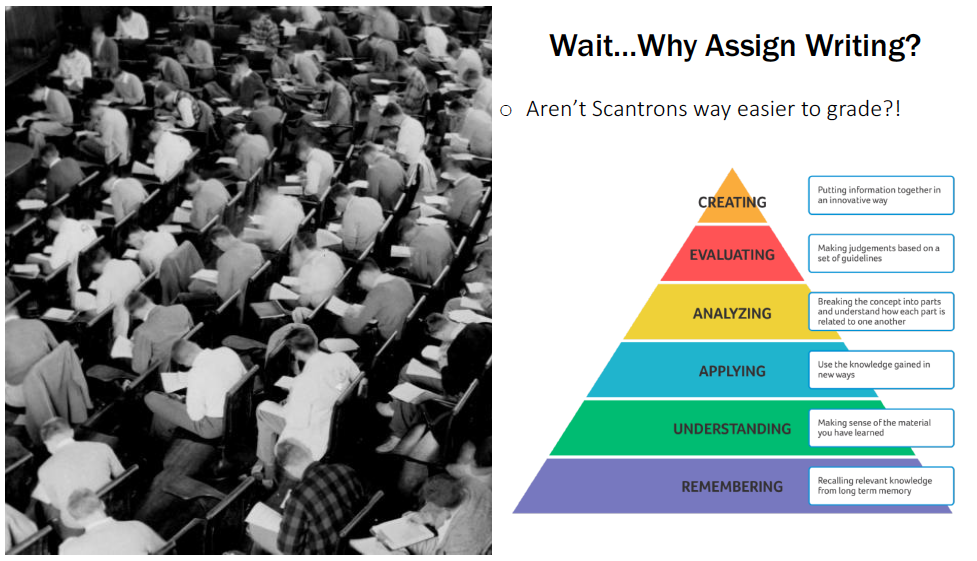
I start by asking why instructors should assign papers at all. Its important to keep in mind the value of writing for recruiting “higher orders” of thinking: applying, evaluating, creating, etc. This kind of thinking is impossible to access, for example, through multiple choice exams.

It’s also important to think about which orders of thinking your writing prompt(s) address; some writing prompts may only ask students to list elements of a concept or theory. This remains in the lower order of “remembering” (see Bloom’s Taxonomy below).

It is, of course, harder to evaluate, comment upon, and grade higher orders of thinking.

Slide 1

Slide 1.png

Instructors can do several things to off-load more of the conceptual “heavy lifting” to students – and thus have them build more of the conceptual “muscle.”

Having students draft is an important step in the writing process because it allows them to develop (and become more invested in) their ideas. If you pair this with a structured peer-review, there is actually minimal work for the instructor. Of course, peer-review requires structure and guidance. Students need to practice and learn the skill of critical reading and constructive criticism.

This is important to keep in mind if you are the only one providing commentary on student writing, you are doing some of the “muscle-building work” students could – should? – be doing themselves.

I offer the next few slides with minimal comment, but feel free to review the text in each one.

Slide 2

Slide 2.png

Slide 3

Slide 3.png

Slide 4

Slide 4.png
“Before you Grade” considerations

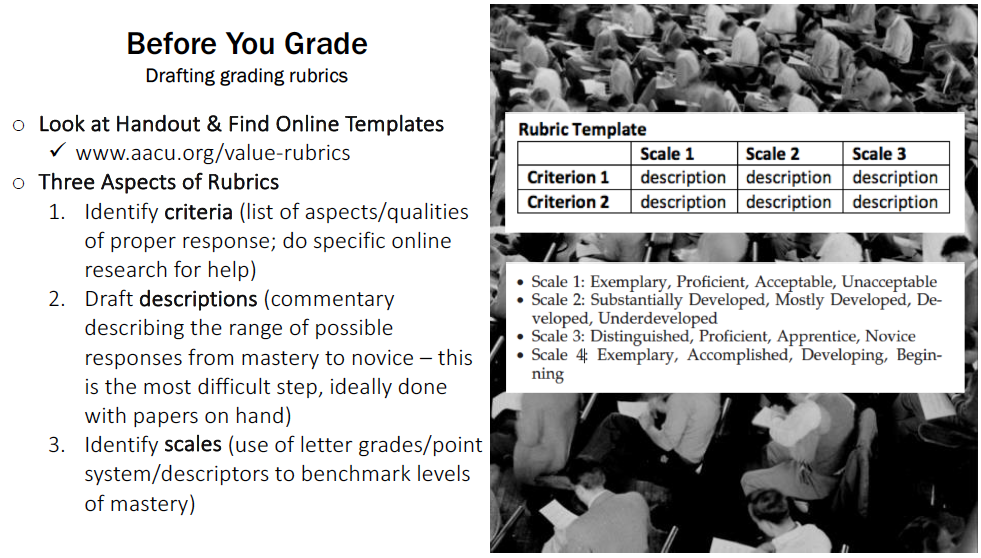
After reviewing the basic components of grading rubrics (criteria, description, scale), we spent time looking for relevant rubric templates online – there is no need to re-invent the wheel! There are many resources available that can inspire your rubric divisions. I provided the following handout for consultation: Creating Grading Rubrics Handout.

After discussing some strategies “before you grade,” I switch to pragmatic suggestions “while you grade.”


While Grading

Slide 5

Slide 5

Slide 6

Slide 6

Slide 7

Slide 7.png
“While you Grade” considerations

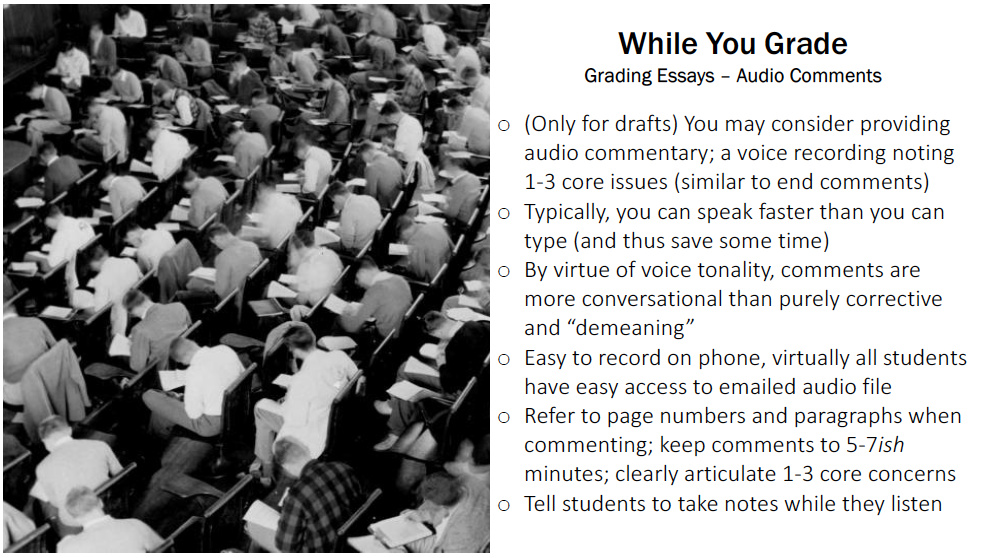
I have long been a covert to audio commentary and have suggested it to many of my colleagues. If you have the space (the one limiting factor is you need a generally quiet location), it’s worth a try. Finally, I ended with a few thoughts on “after you grade.”


 After Grading

Slide 8

Slide 8.png
“After you Grade” considerations

Slide 9

Slide 9.png

 Slide 10

Slide 10.png

Edit: This post below addresses several similar issues, but adds other interesting insights: https://movingwriters.org/2018/07/16/sy-2017-2018-top-ten-in-pursuit-of-meaningful-feedback/


 Workshop Posts

Should We Abolish Page-Lengths When Assigning Student Papers?

Introduction

For those of us who have written a dissertation, it’s likely we’ve run across a well-meaning friend or family member (or stranger in a bar) who has asked us, “How many pages does a dissertation need to be?!”

“Everyone knows,” I say, “it’s exactly 373 pages…no more, no less.”

Of course, this is a silly answer to a genuine question. Yet, I think we have to admit the assumptions behind this question are, well, misdirected and almost certainly misinformed.

I’ve seen dissertations in my field that are 200 pages and 1200 pages. I would say age-old conventions more commonly determine page length of dissertations, not whip-cracking advisors.[1] More importantly, the guiding principle behind writing a dissertation is identifying and crafting a compelling argument. The scope and depth of the argument is a better gauge for determining length than any pre-established page minimum. I would also say that most scholars do not have the problem of developing the length of their writing, but containing the scope of ideas! Word limit is our enemy, not word count!

Similarly, good student writing is (typically) good argumentative writing. With a focus on building argumentation skill, concerns around page-length should fade into the background.


Developing Writing as a Skill

In teaching academic writing, my colleagues and I foreground the importance of developing ideas through short writing assignments and drafts. Yes, we do have page-lengths, typically three 5-page papers are due throughout the term. But each of these 5-page papers were preceded by two 2-page papers, used to develop elements of the longer argument. This structure allows students to develop ideas over time (they receive critical feedback along the way) and draft verbiage that can be used for their longer paper. Even these initial 5-page papers are drafts that are revised and edited for their final portfolio. In total, the two final papers they submit are based on more than twenty-five pages of revised writing!

The first time I taught my course I was caught off guard by how many portfolio papers were too long, either repetitive or unnecessarily broad or meandering. They blew by the 5-page limit because they had too many good ideas![2]  I soon established page-maximums for the portfolio papers (7 pages), and decided to start talking throughout the course about how students should think about the scope of their thesis and the depth of their evidence and analysis. Surely, some initial 5-page papers are short, but I have an equal number of students who are struggling with too many possible trajectories for their argument. If guided by mere page length, a student might think this “problem” is no problem at all.

I instead teach my students to not be occupied with page length, but with identifying and crafting a compelling argument based on clear concept focus, reasonable argumentative scope, and solid evidentiary depth.

To be clear, this only happens because students are allowed (err…coerced) to developed ideas through writing over a period of time with critical feedback. I commiserate with students who are vexed by having to edit out good (or just fun) ideas – I tell them that is what real scholarship often entails – save them for your next paper!

Now, I can hear (and have heard) the objection, “But, I am a scholar of Religious Studies, I teach Religious Studies, I do not teach writing!”

I would rephrase the above statement like this: “I am a scholar of Religious Studies, I teach facts, not skills!” I rephrase it as such because I would argue that writing (or argumentative writing) is a core skill of doing Religious Studies, and if one wants to develop critical thinking, the practice of writing is a main vehicle for its development.

If one is truly interested in teaching only religious literacy (i.e. facts), then writing assignments do not need to be assigned – multiple choice exams will adequately test retention of ideas. (And don’t fool yourself if you think assigning an “essay question” necessarily elicits higher-order thinking – some essay prompts ask the student to list facts in one way or another. For example, a good essay question should ask the student to apply a skill in a novel context.)


Grist for the Mill

Page-lengths really don’t matter much if you are working with a motivated student to continuously help develop his or her ideas. Depending on the depth of available research materials (both primary and secondary sources), the complexity of the research topic, and the base knowledge of the student, paper lengths may vary significantly, but still reflect an equivalent effort. The point, I concede, may be simply placing the primary focus on – and underlying motivation directed towards – the quality of the argument and not the length of the paper. One way to do this is to emphasize the need for the slow development and building of ideas with regular peer feedback or instructor feedback.


Recommendations

Dare I say, page-recommendations should perhaps be determined by the time a teacher has to critically read and comment on them all – as opposed to some arbitrary 5, 10, 12, or 15 page paper?[3] I average about 20 minutes of reading and critical feedback per 5-page paper. This feedback (and sometimes this is just suggestions, not “corrections”) is then used to write a final, more polished piece of writing. This process requires more planning than simply penciling-in a “research paper” into your syllabus due at the end of the term. Is also requires a prompt that allows for the development of a student’s ideas over an extended period of time. Granted, this may not be ideal for every class, but I think it is preferable in many Religious Studies courses, especially where “critical thinking” is envisioned as a learning outcome.


Notes:

*This is part of a series where I discuss my evolving thought process on designing a new university course in Religious Studies. In practice, this process will result in a syllabus on Japanese Religions. These posts will remain informal and mostly reflective.

[1] If I engage in a longer conversation, I will usually say that scholars often think about the number of chapters needed to develop an argument, and that by the general concern of publishing a chapter or two as a 10-20+ page article we often arrive at a determined dissertation length. In other words, we (typically) do not start by having a total dissertation page length.

[2] Long papers could be plagued by what I call “stream of consciousness writing,” writing that meanders with no point. I usually tell students that this is the sign of a good rough draft, but now needs to be critically analyzed for kernels of ideas or good argumentation. Unless a student willfully wants to fail, this informal style of writing is almost always fixed after revision.

[3] Many universities have stipulations for certain classes that involve the required assignment of a certain number of pages of writing (it is 15 pages at my university). Typically this represents total pages of writing, thus, following a similar program I outline above, a final 10-page paper should easily be preceded by more than 5 pages of drafting, consequently complying with the 15-page minimum.


More Pondering Pedagogy: Course Design Posts

Periodic Table of Academic Disciplines

9-10-2010.jpgI’m continually amazed how the efforts of random bloggers make my life as a writing instructor all the more easier.

For our second writing project we focus on the epistemological dimensions of different academic disciplines and how implicit expectations shape the scholarly writing in those fields. While students are quite familiar with different departments in the university, trying to explain why they are separated as they are can be challenging.

I use class time to discuss the basic framework of how scholars of different disciplines ask different types of questions about the world. Consequently, they must marshal different types of evidence to support their claims.

This is, as always, an exercise in raising awareness. I use a podcast (as homework) to explain the history of disciplinary divisions, stemming from the secularization of the German university system in the 19th century and “discovery” of the social sciences (political science, economics, sociology, anthropology, etc.).

I charge the students with researching a topic and finding appropriate scholarly materials on that topic from different disciplines – both books and articles. They have to decide which discipline the work falls under, which can be harder than it seems, especially if you are not used to trying to differentiate those characteristics already. At some level, having a list of options makes the job easier, where Claudia’s blog helps exceptionally. She has made a chart, mirroring that of the Periodic Tables of Elements, with academic disciplines – even grouping them according to field.

My only criticism is that it does not represent some area studies, such as Women’s Studies, Black Studies, Chican@ Studies. etc. Also, Religious Studies is placed in the Humanities field (which is not inherently problematic), but does not make it clear that Religious Studies is a “raider” discipline – as is typical for other “areas studies”- pulling methodologies from various disciplines. This means a scholar of Religious Studies will approach their topics from the lens of history, sociology, psychology, cognitive science, etc. (There is no Humanities “methodology” per se). While one may have greater training in historical approaches, it is possible to take an inter-disciplinary approach as well, where several disciplinary approaches are intertwined.


 Writing Skills Posts

Rhetorical Contexts: Who is the Audience?

I did not learn genre theory in my college composition classes, so when it was introduced to me at UCSB I was unsure of its application outside of just being another provocative theory.

I’ve come to realize how the right approach to genre theory paints writing as a social practice, and when mastered, turns writing into a powerful and eminently practical skill. Part of genre analysis requires an assessment of the rhetorical situation, which is dissected in various ways by theorists and scholars, but always incorporates the element of intended audience.

When writers write they typically write for an imagined audience, and this largely dictates the choice they make while writing. Thus, while it is possible for anyone with an internet connection to read a blog post, depending on how it is written it may draw in certain audiences and drive away others. Those that come and stay would be the target audience (or intended audience) of a blog post.

When deciding to perform genre analysis on news genres, I was searching for another way to think about intended audience rather than the standard focus on demographics like age, ethnicity, gender, income, region, education, and so forth. After chatting with my writing advisor, Chris Dean, whose interests involve the critical analysis of urban legends and conspiracy theories, he highlighted the recurring issue of confirmation bias at the heart of all legend trippers and conspiracy theorists. This provided at least another way to view the audience of moderately (even grossly) biased Soft News articles, those looking to confirm their personal perspective on certain topics.

cognitive-biasThis lead me down a train of thought which wanted to play with audience and several other types of cognitive biases. In other words, how do certain cognitive biases direct what and how we read? I was reminded of the fabulous chart, originally posted by blogger Buster Benson.

I was surprised at how many other cognitive biases are similar to confirmation bias.

  • Anchoring Bias: People are over reliant on the first piece of information they obtain
  • Conservatism Bias: People favor prior evidence over new evidence
  • Choice-Support Bias: People favor a choice they have made even if it has flaws
  • Availability Heuristic: People overestimate the importance of information that is available to them

I gave the chart to my class and asked them to ponder some aspects of it to foster creativity in defining who the audience of news articles may be. I will say, however, for each person who is subconsciously looking to confirm his or her bias, there may very well be another person who is consciously looking to understand the “Other side” in order to challenge his or her own biases.

UPDATE: While the above chart is detailed and comprehensive, it may be too comprehensive for many to find a nice toe-hold. The more highly selective chart below may be a better alternative.

20-Cognitive-Biases

Other Posts on Writing and Researching Skills

Genre Analysis: Hard News, Soft News, Fake News

My first-year composition class requires students to engage in rhetorical and textual analysis through developing a “heightened awareness” of writing genres. Genre-based analysis works on a wide range of texts (really, all texts) and given the important role of media in the several last US elections and the prominent and recurring spotlight thrown on Fake News, I thought an examination into news genres would be timely and interesting.

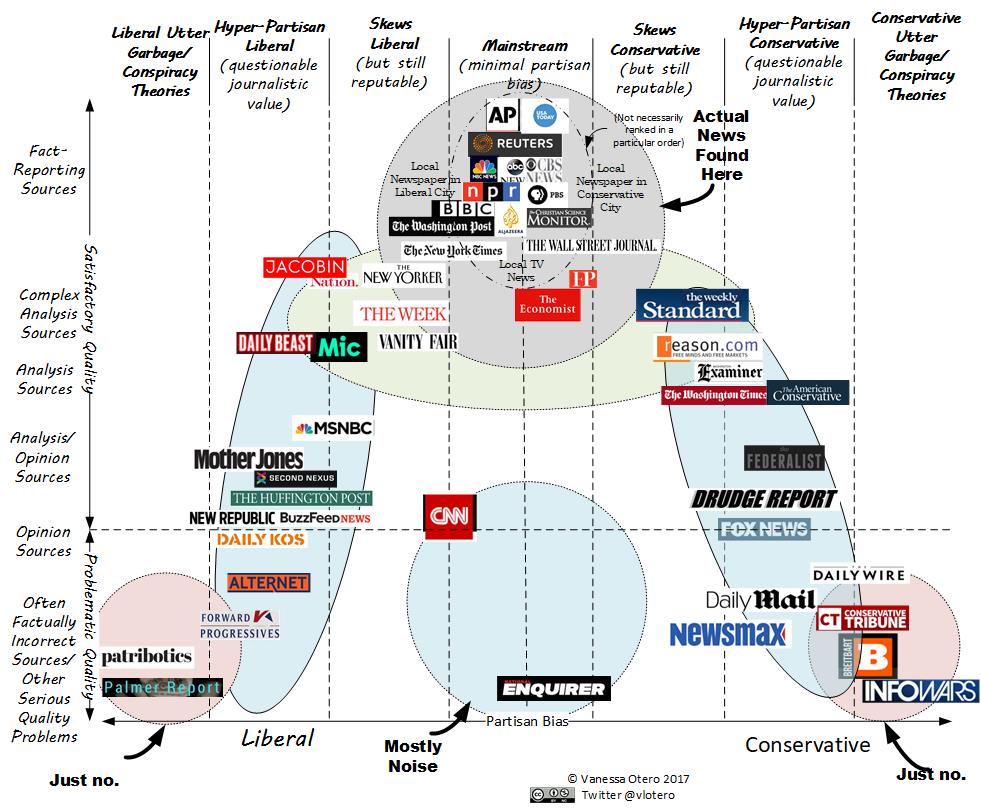
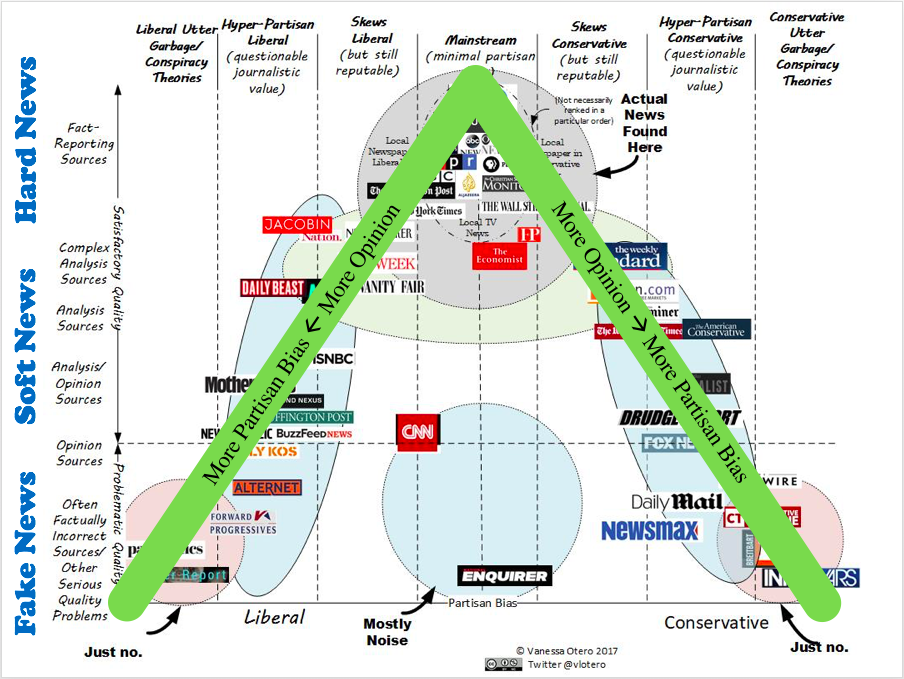
While researching and analyzing the distinctions between news genres, one online resource stood above the rest because it offered a convenient visual representation of news sources along two axes of partisan bias and journalistic integrity. The chart (below) was created by Vanessa Otero, a blogger whose keen eye helped me make several important distinctions between news writing styles. [Updated Interactive Media Bias Chart 5.0]

Second-Edition-News-Chart.V2.vsdx_.jpg
Vanessa Otero’s Chart [Version 2.0]

There are several online resources which chart the political polarization of news media, including a well-researched report by the Pew Research Center and the curiously amusing “Blue Feed, Red Feed” maintained by the Wall Street Journal [now archived](also helpful are the AllSides and Media Bias/Fact Check websites). These resources, however, only measure partisan bias (horizontal axis above). I was looking for other measurements that may align with elements of genre analysis. Otero’s chart was helpful because it added a vertical axis that charted journalistic quality, highlighting important stylistic differences that I could easily map on to the traditional divisions of news genres: Hard News/investigative journalism (just the facts!), Soft News/Feature News/Editorials (analysis and opinion), and Fake News (plain fiction).

This was the perfect entry point for starting discussion, a convenient and astutely crafted visual chart showing the complexity of news writing. It also allowed me to handily visualize the close relationship between bias and interpretation without confounding them. Analysis and description of news articles beyond partisan bias became a core assignment for my students.

Screen Shot 2017-10-18 at 05.36.30.png
Class Slide labeling Hard/Soft/Fake News and the relationship between bias and interpretation

Many sources cite the standard distinction between Hard News and Soft News as a difference in topic coverage, with the former focusing on events (political, economic, disruptive), while the latter focuses on people (lifestyles, celebrities, and human-interest). The gendered implications of this division have been noted in Women, Men, and News by Paula Poindexter, Sharon Meraz, and Amy Schmitz Weiss. Otero’s chart, on the other hand, begins to suggest how writing choices also frame the categorization of news genres, suggesting attention also is paid to tonality, organization, length, and evidence, along with several other smart observations made by my students.

In order to discuss CNN’s position as an outlier, being both highly analytical and opinionated and yet only mildly left-leaning, I turned to the Vox series Strikethrough which publishes excellent videos on modern American media. In a short 6-minute video (perfect for class), CNN’s approach to telling news is compared to the ESPN’s “hot take” model, which favors heavy-handed opinion and argumentative debate over cool-headed fact-reporting. This serves to underscore how Hard News can be “softened.” Furthermore, I ended up pairing Otero’s chart with the insights of Colleen Patrick into the value of Soft News as providing much-needed perspective on simple fact-reporting.

Overall, these resources proved invaluable in helping me to conceive of the distinctive writing conventions found among Hard, Soft, and Fake News, and provided a good springboard into discussion on other important contextualizing rhetorical features, such as intended audience and purpose.


 Writing Skills Posts

Good Writing is Not a Gift – It’s a Skill

Romaskiewicz Syllabus cover.png

Setting the Tone

For yet another time I have the opportunity to teach a first-year composition and rhetoric class. I first taught this class in the Fall of 2012, and have taught it intermittently since them. This time, however, I will be doing a significant overhaul of the writing projects, as I have slowly developed ideas that better suit my course goals and personal interests.

Perhaps one of the biggest challenges I face is making the point clearly that writing is a learned skill and (for many) a slow process. Learning to write is not like learning a fact – learning to write is to acquire skills in the art of persuasion.

I will return to the mantra that this course is meant to help students develop a “heightened awareness” of their writing choices through the cultivation of particular sets of skills. Acquiring a skill requires repetition and incremental adaptation to higher order challenges.

I need to remind myself of this because inevitably students will just start asking me what I want to see in their writing – in the hopes of getting the best grades. Of course, at some level there are requirements, and these are always spelled out in the simplest terms in the course materials.

How to draft a thesis, how to support a thesis, how to organize an argument, or whatever other elements are necessary to “academic writing” need to be practiced through numerous iterations of drafting, critiquing, and revising. In other words, through the slow acquisition of a skill.

The criterion of “good” writing is simply effective writing, and effectiveness can take on many shapes. There is no universal template for good academic writing. Sorry, Artificial Intelligence enthusiasts, computers cannot grade essays well, let alone compose a novel argument.

As the prosaically named Professionals Against Machine Scoring Of Student Essays In High-Stakes Assessment (membership including Noam Chomsky) stated: “Computers cannot ‘read.’ They cannot measure the essentials of effective written communication: accuracy, reasoning, adequacy of evidence, good sense, ethical stance, convincing argument, meaningful organization, clarity, and veracity, among others.”

This is more about setting a tone for the class, where taking chances are rewarded and failures are framed as true learning opportunities, not shameful embarrassments. With this in mind, I am looking forward to class discussions and activities centered on their writing and hope they all can see growth in the next few months.


 Writing Skills Posts