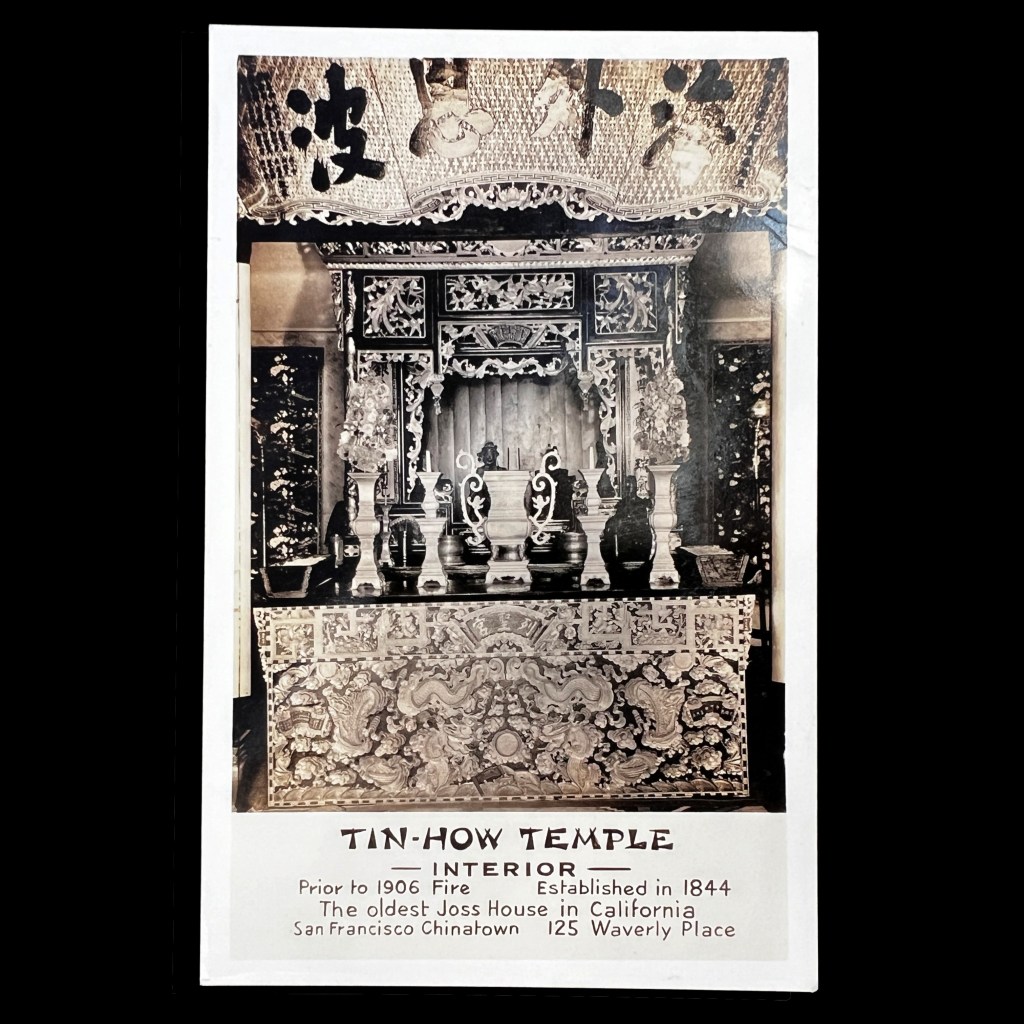
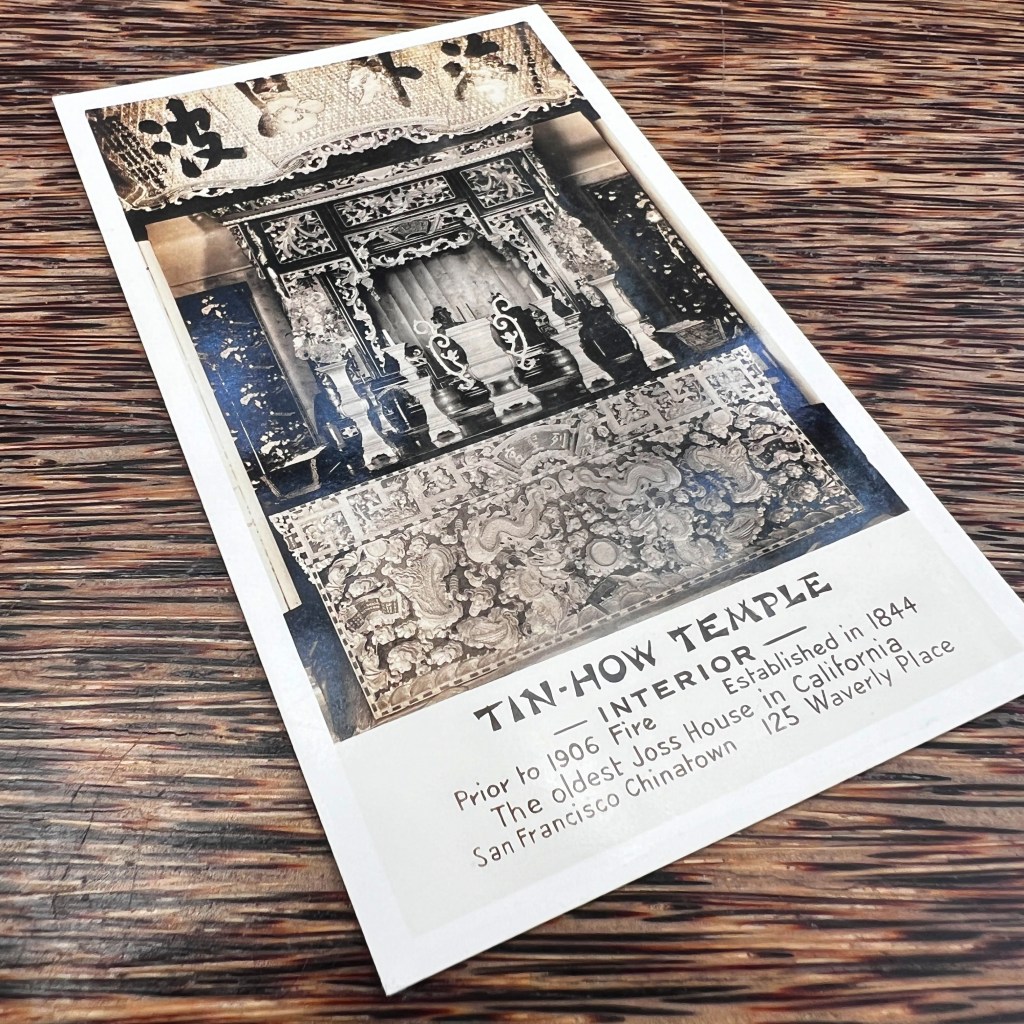
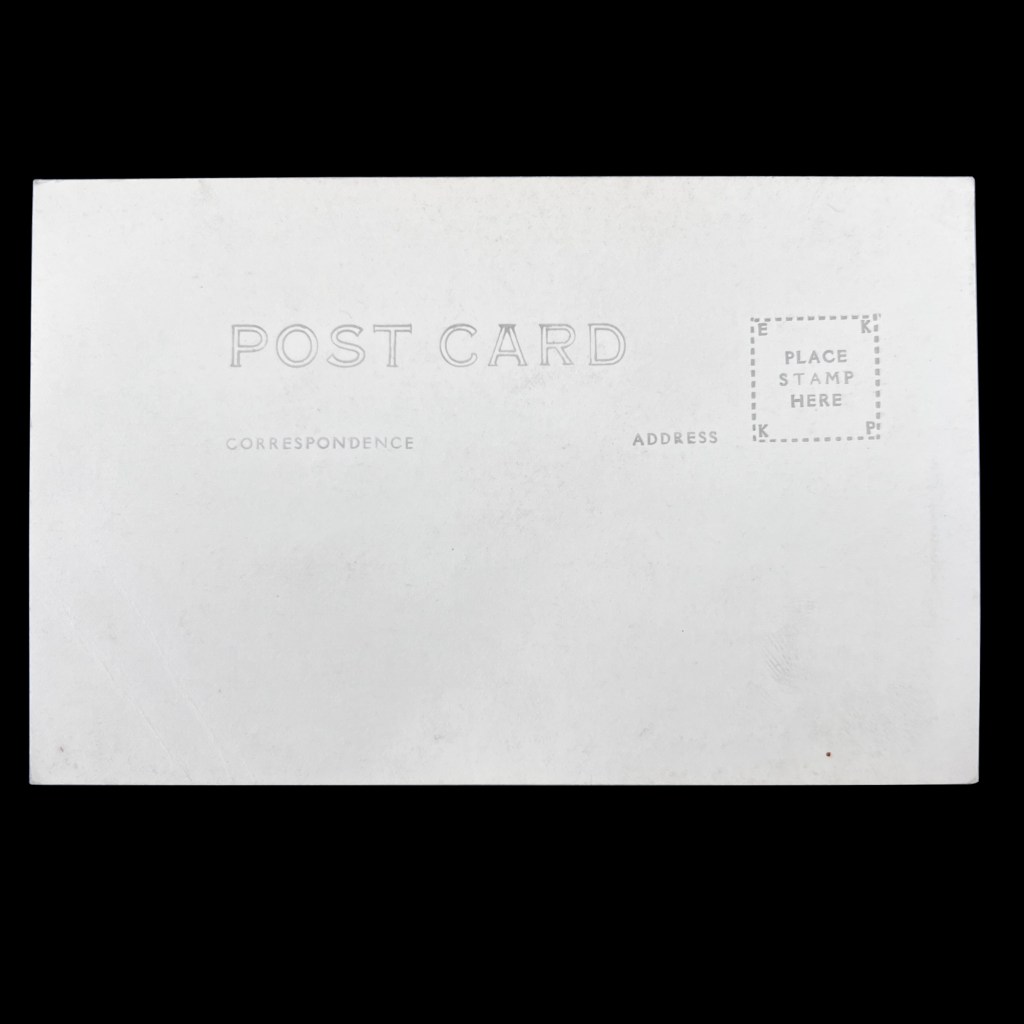
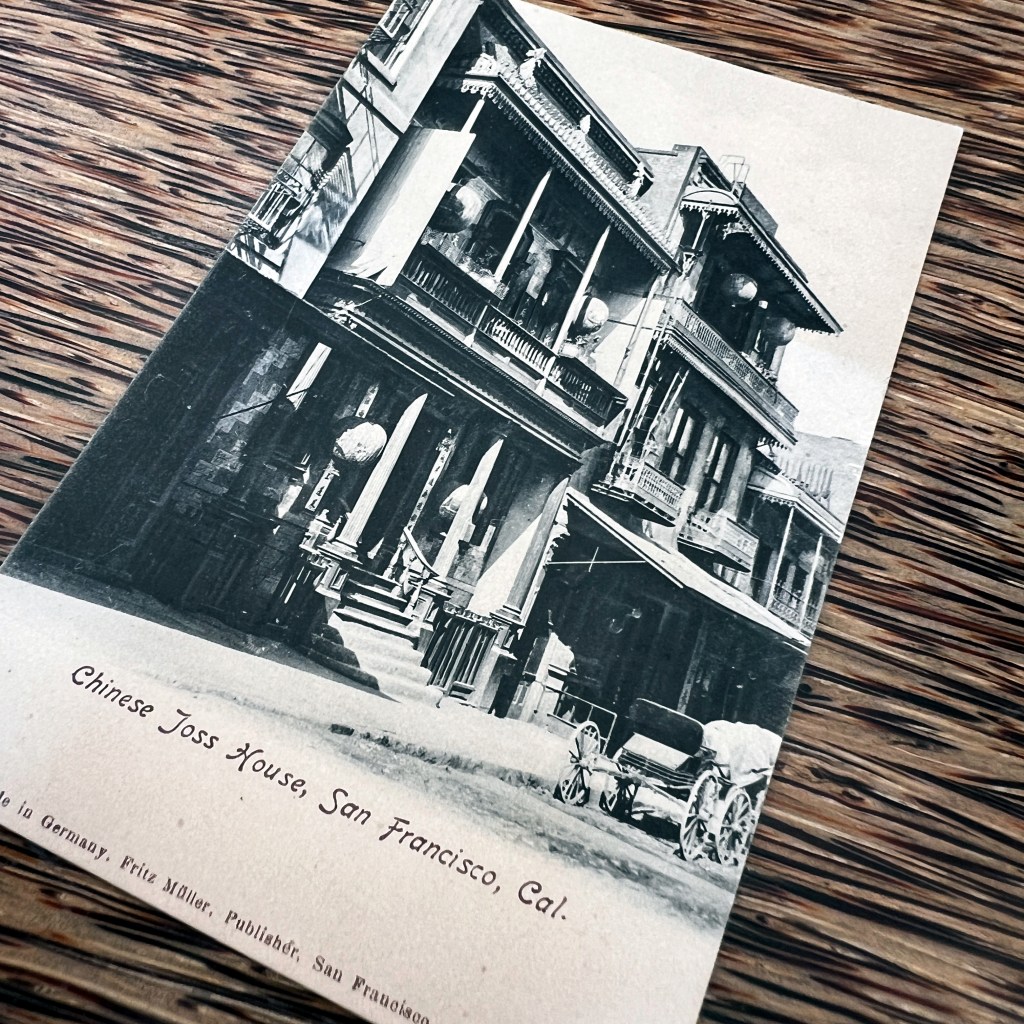
Chinatown’s Tin How Temple / Grass Valley Temple Real Photo Postcard

For all the new Buddhas in the West posts
follow us on Bluesky & Instagram


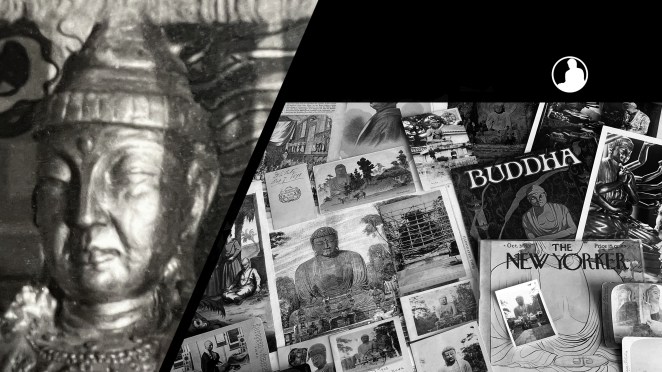
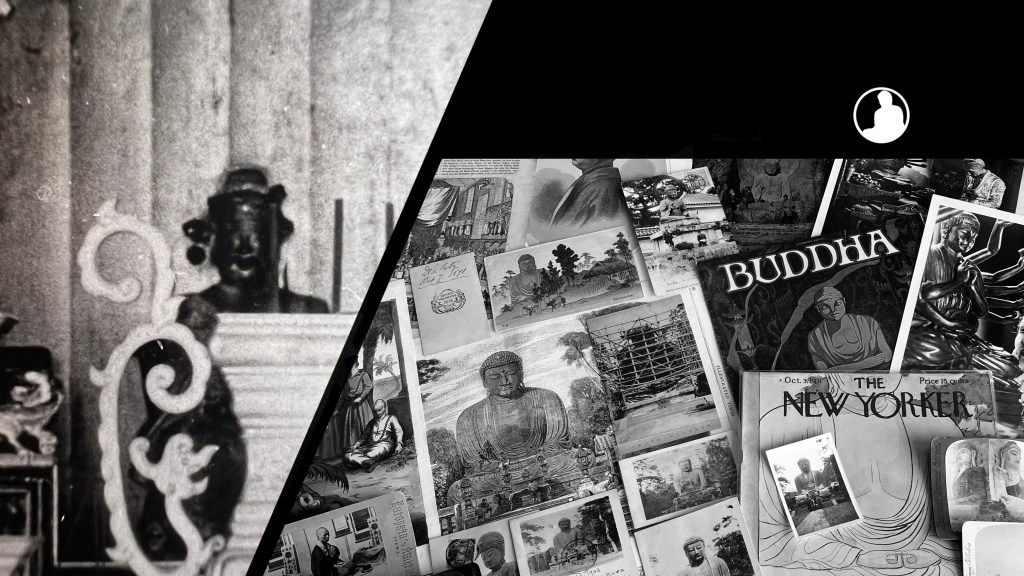
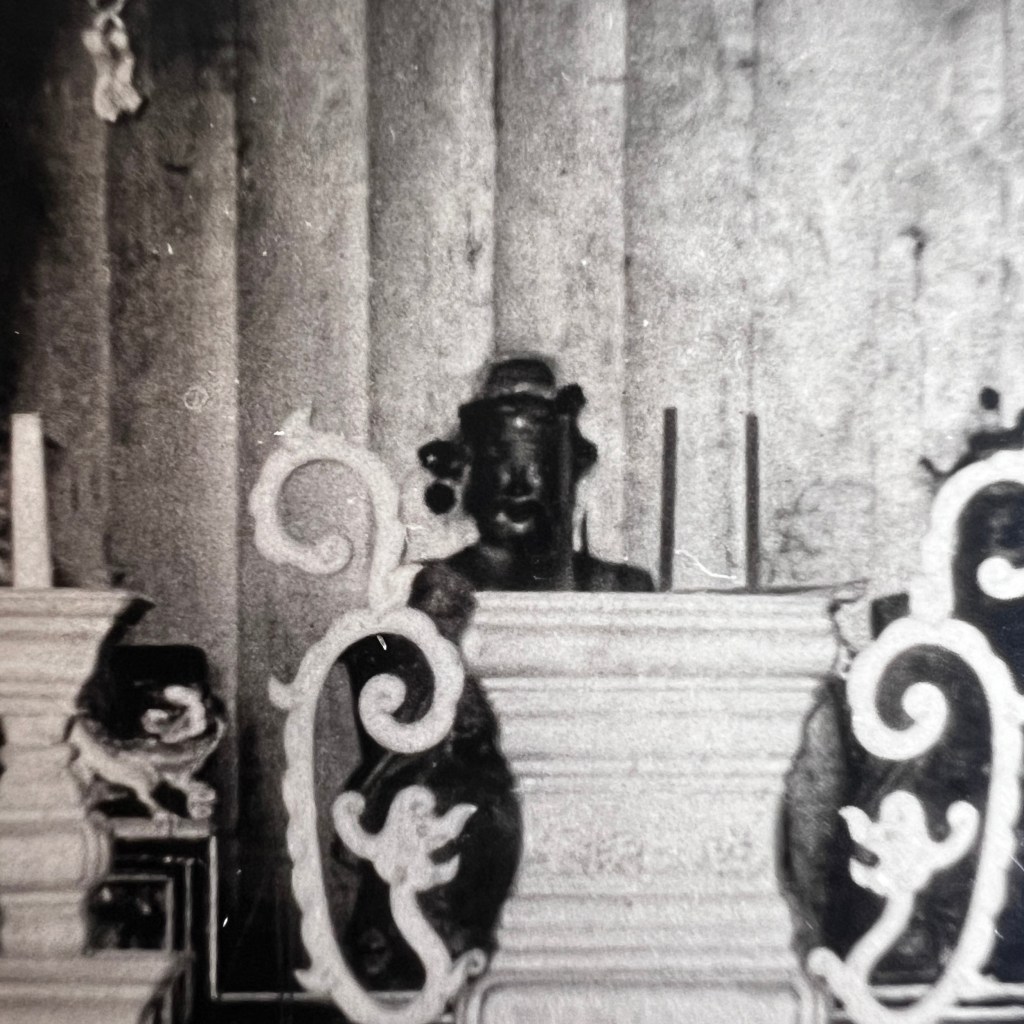
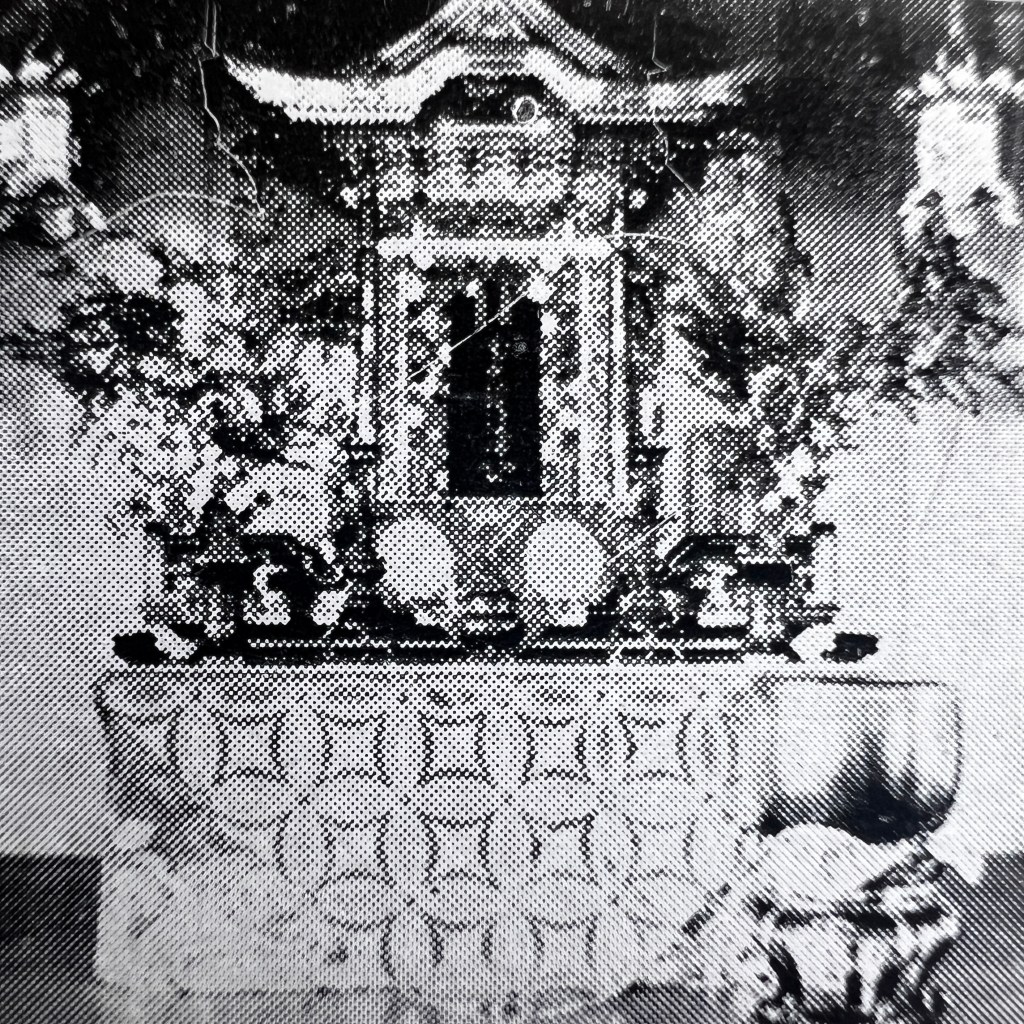
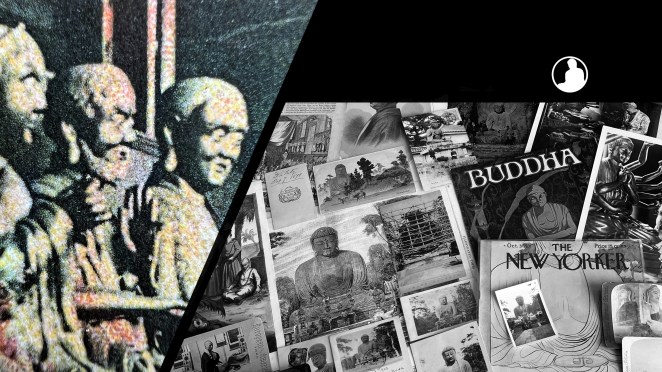
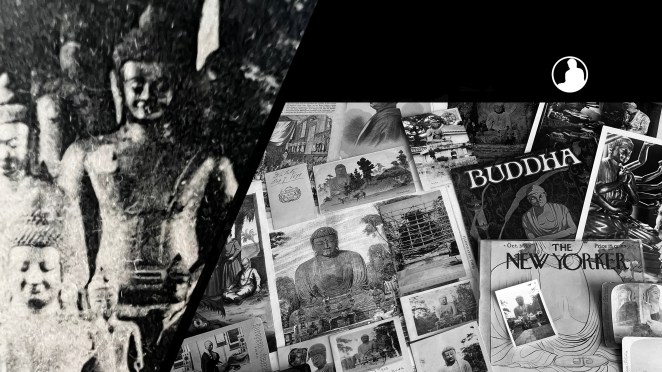
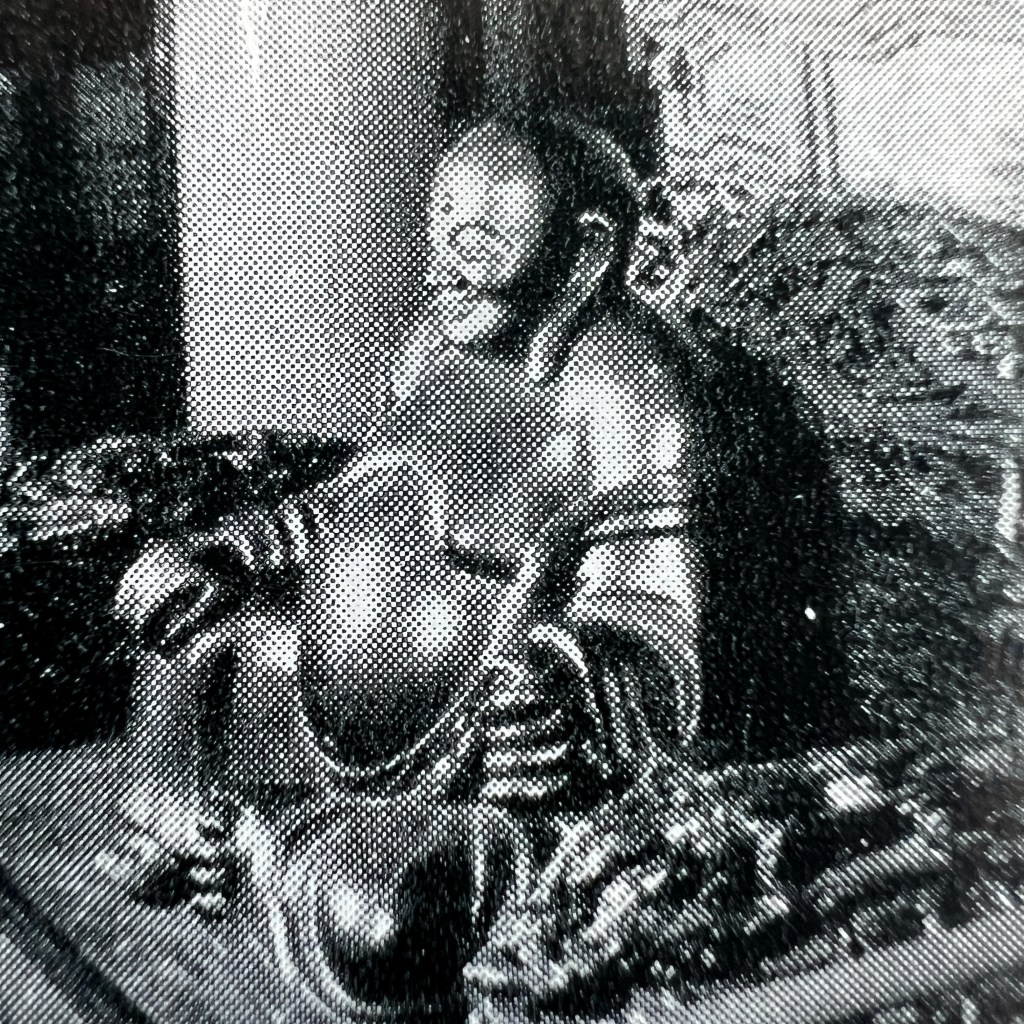
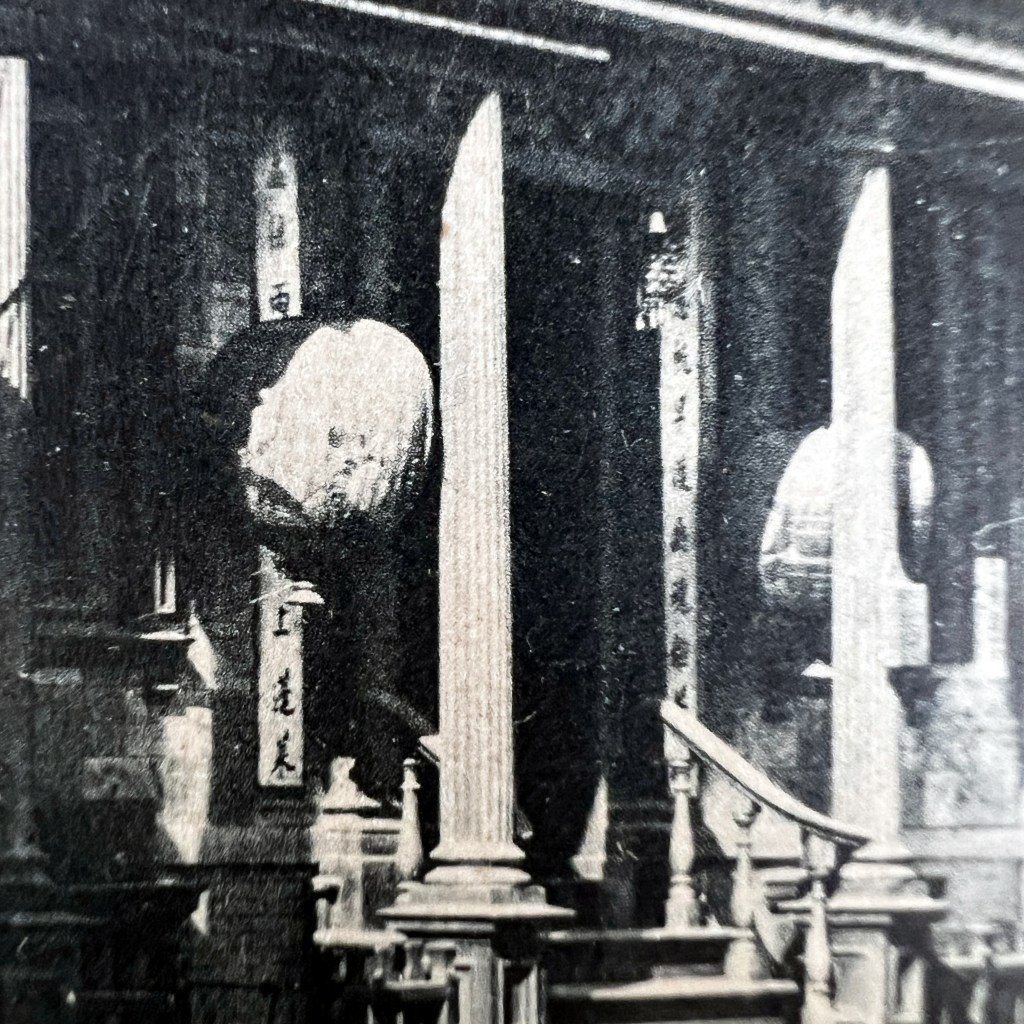
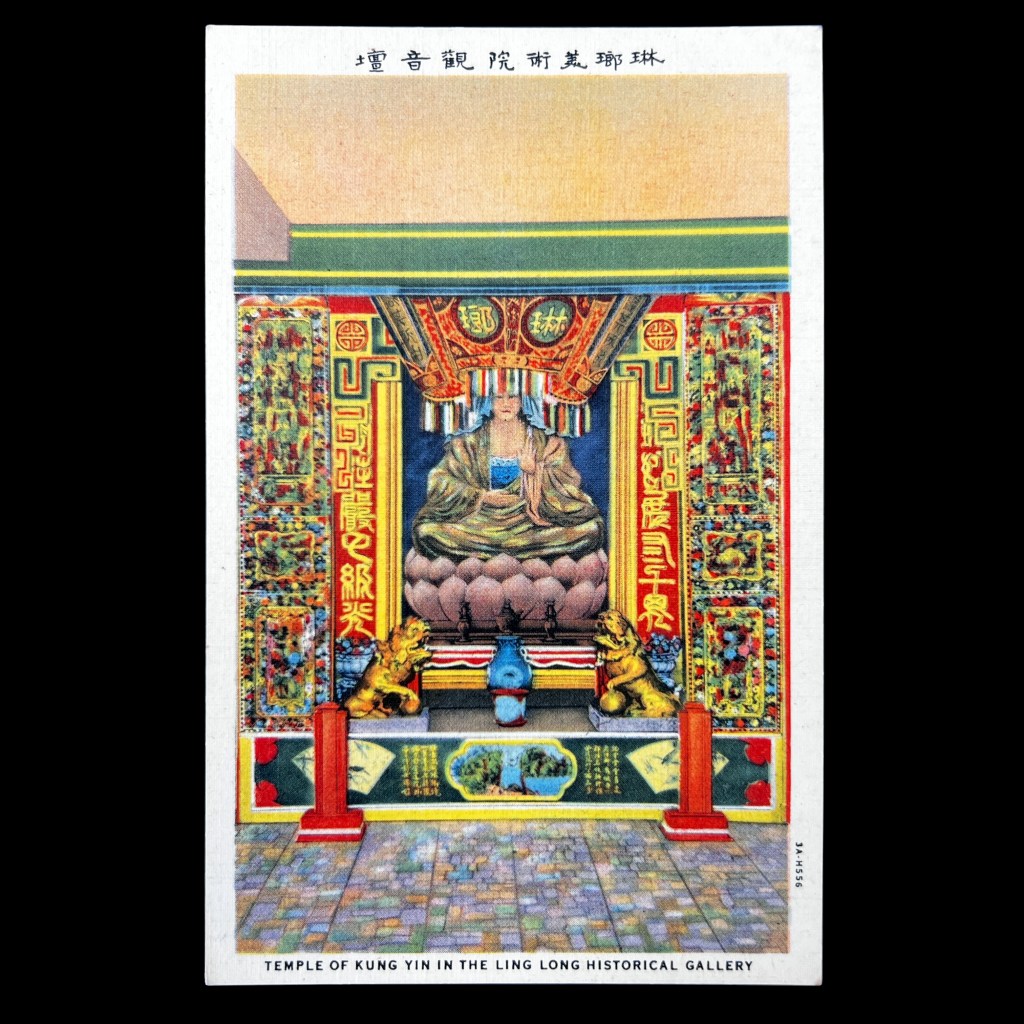
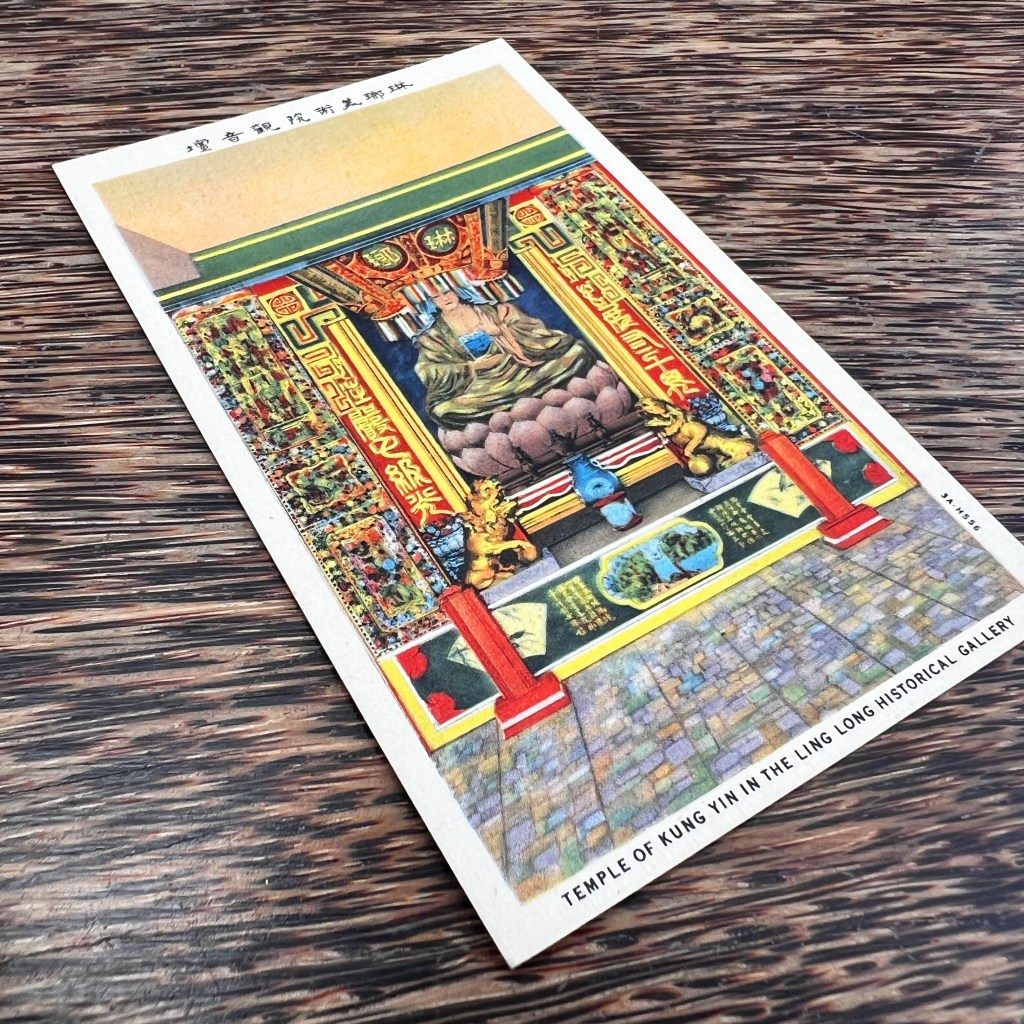
After the 1906 earthquake, San Francisco’s Tin How Temple was one of a fraction of Chinese religious institutions to rebuild, reopening in 1911 on the footprint of the original building. Despite the caption, this photo does not show the pre-1906 altar, nor is it a San Francisco temple.

Tin How, the Empress of Heaven, also known as Mazu, was popular along China’s southern coast and revered for her protective powers, especially at sea. Many early Chinese immigrants erected temples dedicated to her and other deities across North America.

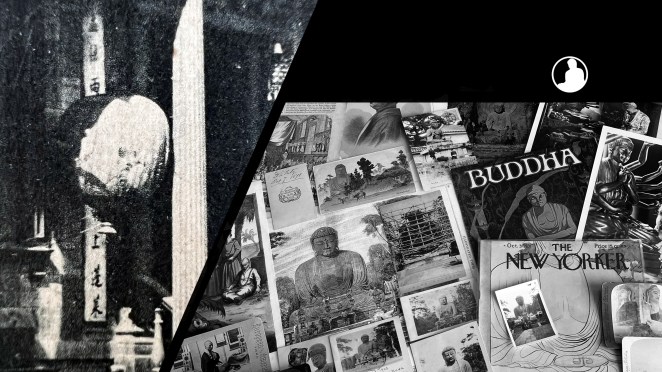
The photo shows the altar of the old Chinese temple in Grass Valley, identifiable by the large carved inscription board reading “Waves of favor cross over the seas.” It’s likely the postcard publisher saw a more lucrative opportunity in selling a visual “relic” of the lost Tin How Temple shrine.

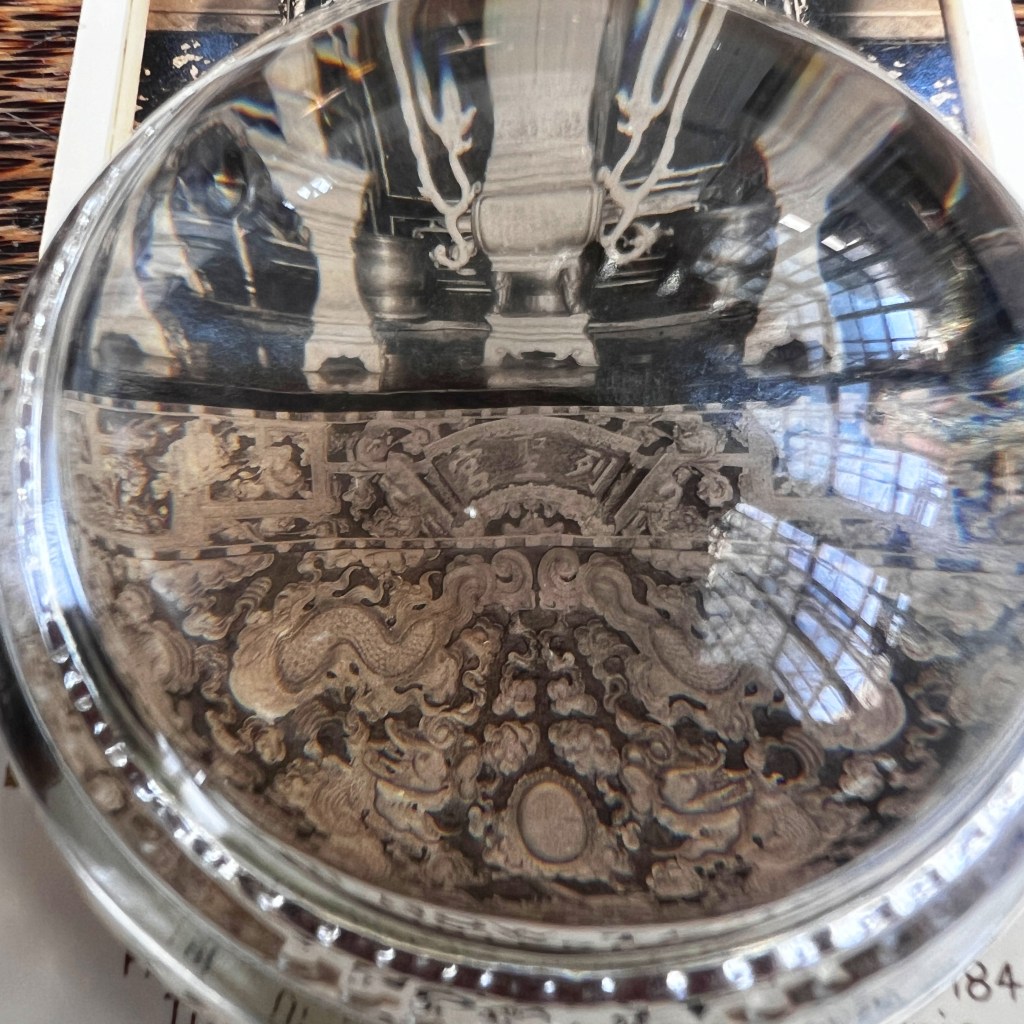
Moreover, the Grass Valley temple was dedicated to Houwang, not Mazu, yet both locations were alternatively called the Temple of Many Saints, seen carved on the altar façade from 1875. The Grass Valley temple fell into disrepair by 1933 and was closed soon thereafter.

The altar was preserved and is now displayed at the Nevada Firehouse No.1 Museum. For more history on the Grass Valley temple, see Chuimei Ho and Bennet Bronson’s Chinese Traditional Religion and Temple in NorthAmerica, 1849–1902 (2022).


The Buddhas in the West Material Archive is a digital scholarship project that catalogues artifacts depicting Buddhist material culture for Western audiences. It’s comprised of prints, photos, and an assortment of ephemera and other objects. For a brief introduction to this archive, visit the main Buddhas in the West project page.


For Related Buddhas in the West Posts Featuring Historical Real Photo Postcards:


For the Most Recent Buddhas in the West Posts:


Buddhist Temple of Los Angeles Postcard

For all the new Buddhas in the West posts
follow us on Bluesky & Instagram


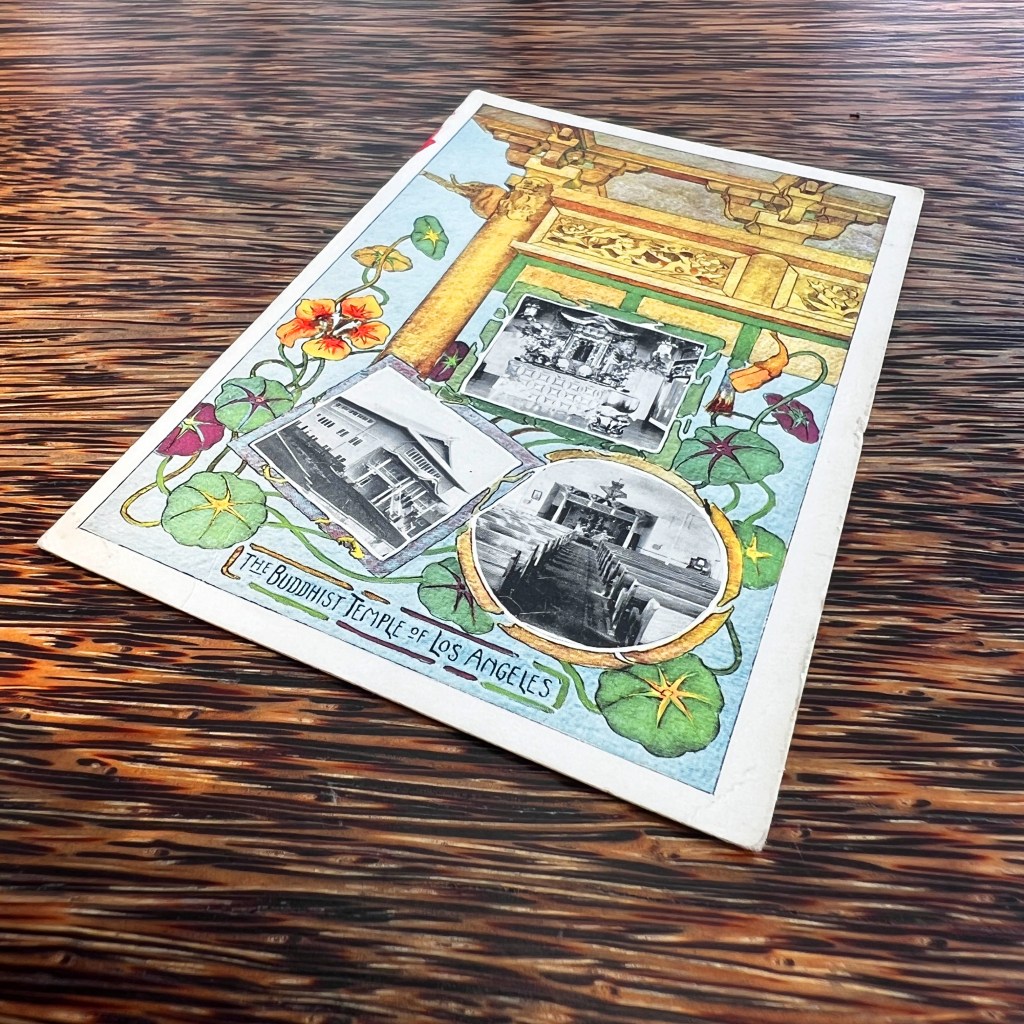
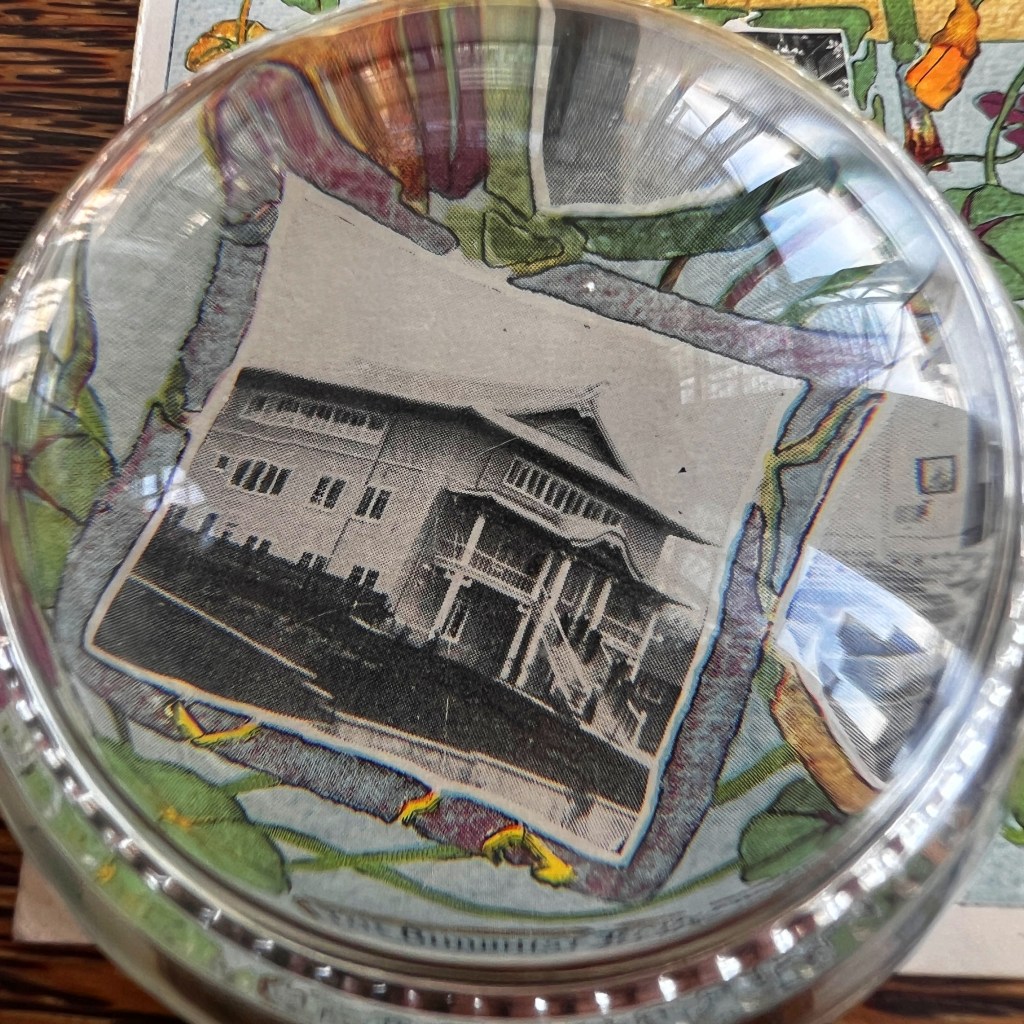
Inspired by the success in San Jose and Sacramento, Izumida Junjō 泉田準城 (1866–1951) arrived in Los Angeles in 1904 and opened the city’s first Buddhist temple for Japanese immigrants. After raising funds and purchasing land, a newer and larger temple was opened in 1911 on Savannah Street.

Associated with Nishi Hongan-ji, a Jōdo Shinshū Buddhist organization headquartered in Kyoto, Izumida organized the Rafu Bukkyō-kai 羅府仏教会, the Buddhist Mission of Los Angeles. It was meant to meet Japanese immigrants’ needs for funerals, memorial services, and spiritual guidance.

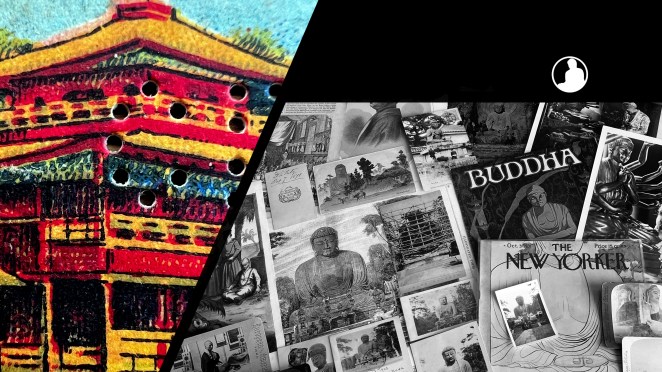
Possibly in celebration and promotion of the new temple, the Mission issued picture postcards highlighting both the interior and exterior of the building. The colorful illustrated elements on the front reveal an Arts and Crafts influence popular in the early 20th century.

The building was meant to reflect both American residential architecture and Japanese temple architecture. The latter can be seen in the curved eaves on the roof and the temple-style gate over the front porch.

The interior also shows a hybrid style, with church-like pews set in front of a traditional Japanese Buddhist altar.

As a Jōdo Shinshū temple, the shrine is dedicated to Amida Buddha, here with a scroll bearing his name. For more on the history of this LA temple, see Michihiro Ama, Immigrants to the Pure Land: The Modernization, Acculturation, and Globalization of Shin Buddhism (2011).


The Buddhas in the West Material Archive is a digital scholarship project that catalogues artifacts depicting Buddhist material culture for Western audiences. It’s comprised of prints, photos, and an assortment of ephemera and other objects. For a brief introduction to this archive, visit the main Buddhas in the West project page.


For Related Buddhas in the West Posts Featuring Historical Trade Cards:


For the Most Recent Buddhas in the West Posts:

Harper’s 1871 “Joss House” Print

For all the new Buddhas in the West posts
follow us on Bluesky & Instagram


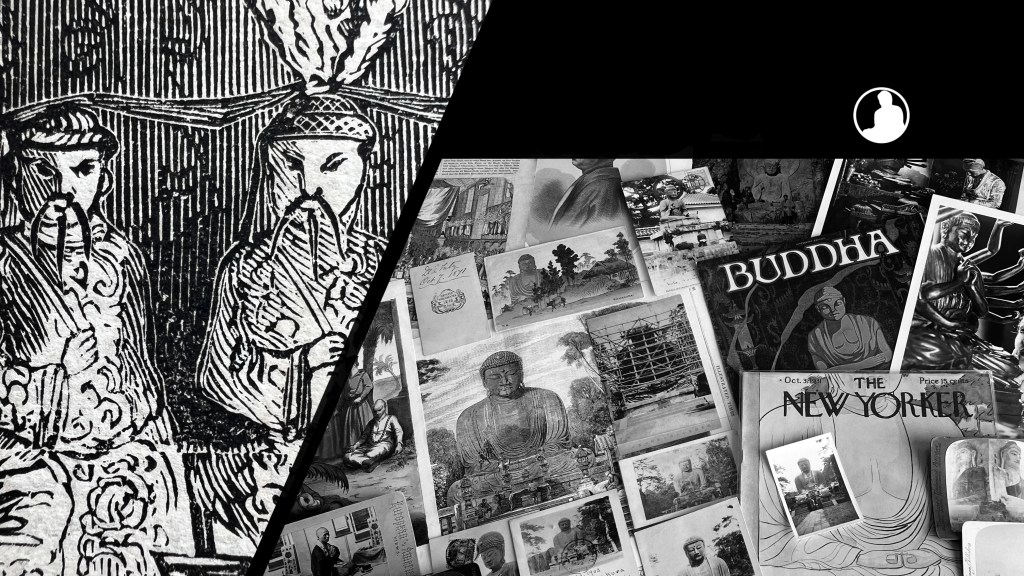
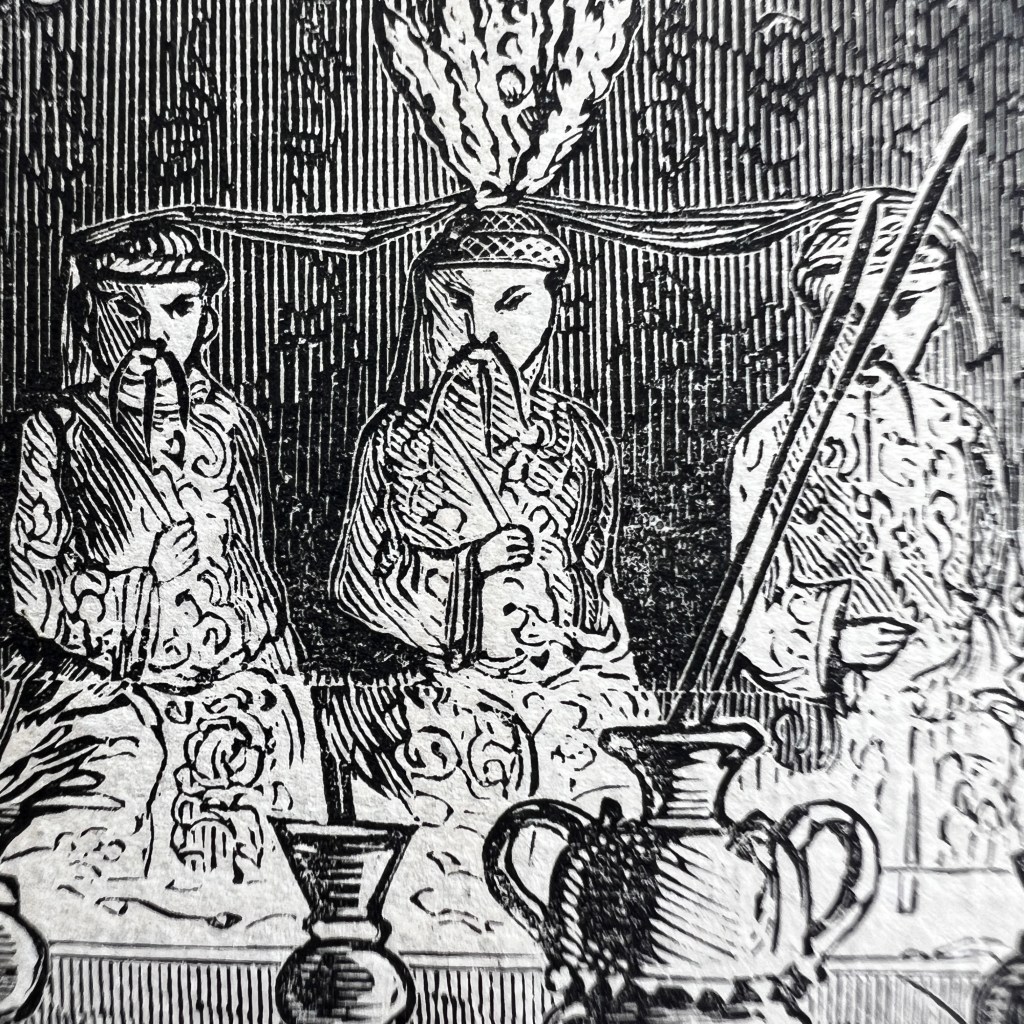
In 1871, Harper’s Weekly published a wood engraving depicting the interior of a San Francisco Chinese temple, a rare print subject before the 1906 earthquake. Clues suggest it shows the main hall of Eastern Glory Temple located off Jackson St. on St. Louis Alley.

Eastern Glory Temple was privately owned by physician Li Po Tai (1817–1893), an immigrant from Guangdong who opened a general store and apothecary across from Portsmouth Square. His temple was featured in California newspapers in February 1871, just before Harper’s illustration that March.

Despite being called a “Buddhist temple” in some popular accounts, there is no Buddhist icon displayed in the main shrine hall. The central icon is the Northern Emperor, a celestial deity popular among early Chinese immigrants from southern China.

Contemporary newspaper reports claim the icon to the far left was the “controller of fortunes” named “Choy Pah.”

The icon to the far right was a famous military general named “Tun Goa.” The next room over holds a shrine to Guanyin (not illustrated), the sole Buddhist figure, which newspapers describe as a “Cinderella” who is “treated cruelly by haughty women [and performs] act of charity.”

In addition to the Northern Emperor, the central altar displays the famous general Guandi and righteous official Hongsheng. To read more about Li Po Tai, see Tamara Venit Shelton’s Herbs and Roots: A History of Chinese Doctors in the American Medical Marketplace (2019).


The Buddhas in the West Material Archive is a digital scholarship project that catalogues artifacts depicting Buddhist material culture for Western audiences. It’s comprised of prints, photos, and an assortment of ephemera and other objects. For a brief introduction to this archive, visit the main Buddhas in the West project page.


For Related Buddhas in the West Posts Featuring Chinatown (US):


For the Most Recent Buddhas in the West Posts:


Guanyin Icon in The Mask of Fu Manchu (1932)

For all the new Buddhas in the West posts
follow us on Bluesky & Instagram


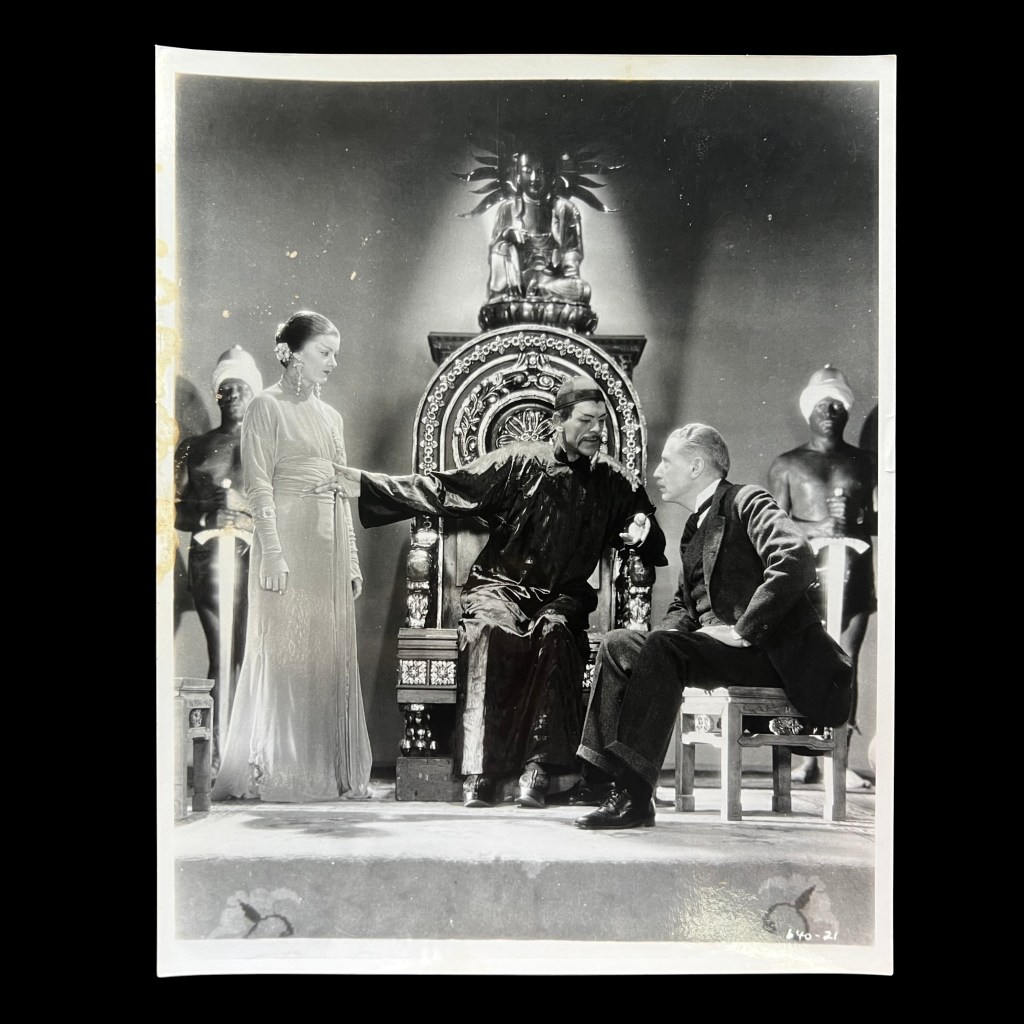
Fu Manchu’s opulent Gobi Desert lair seen in The Mask of Fu Manchu (1932) was assembled by MGM art director Cedric Gibbons. While the Art Deco inspired torture chambers remain horror classics, Gibbons’ strategic use of Buddhist statuary also hint to the audience impending danger.

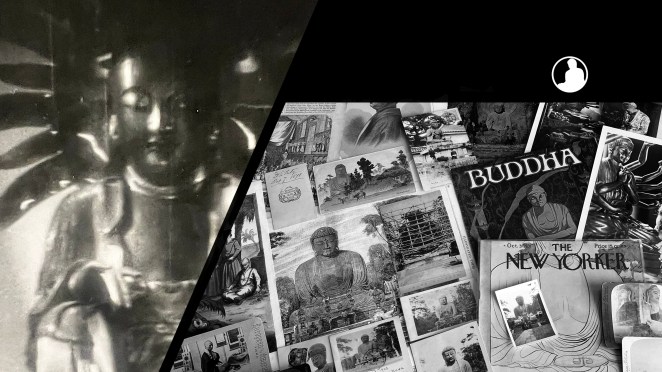
Boris Karloff portrayed the villainous doctor Fu Manchu, here sitting on a throne introducing his daughter Fah Lo See (Myrna Loy). This scene unfolds under the eyes of a shadowy Buddhist figure perched atop the throne; close inspection reveals this to be in the style of a Guanyin statue.

Many props Gibbons used were made at the studio, including some of the Buddhist statues seen on screen. The idiosyncratic elements, including the multi-rayed halo, suggested this statue was pieced together by set designers; it was seen previously in Daughter of the Dragon (1931).

Curiously, the ornate backrest of the throne makes it appear as if Fu Manchu himself is a statue encircled by a halo. Like a menacing statue come to life, the audience can surmise the visitor will suffer at the hands of the villain.

Fu Manchu played on the racist fears of the Yellow Peril; in film, these fears could also be signified by Buddhist imagery. For further discussion of the dueling positive and negative views of China in American cinema, see Naomi Greene’s From Fu Manchu to Kung Fu Panda (2014).


The Buddhas in the West Material Archive is a digital scholarship project that catalogues artifacts depicting Buddhist material culture for Western audiences. It’s comprised of prints, photos, and an assortment of ephemera and other objects. For a brief introduction to this archive, visit the main Buddhas in the West project page.


For Related Buddhas in the West Posts Featuring Guanyin / Avalokiteśvara:


For the Most Recent Buddhas in the West Posts:

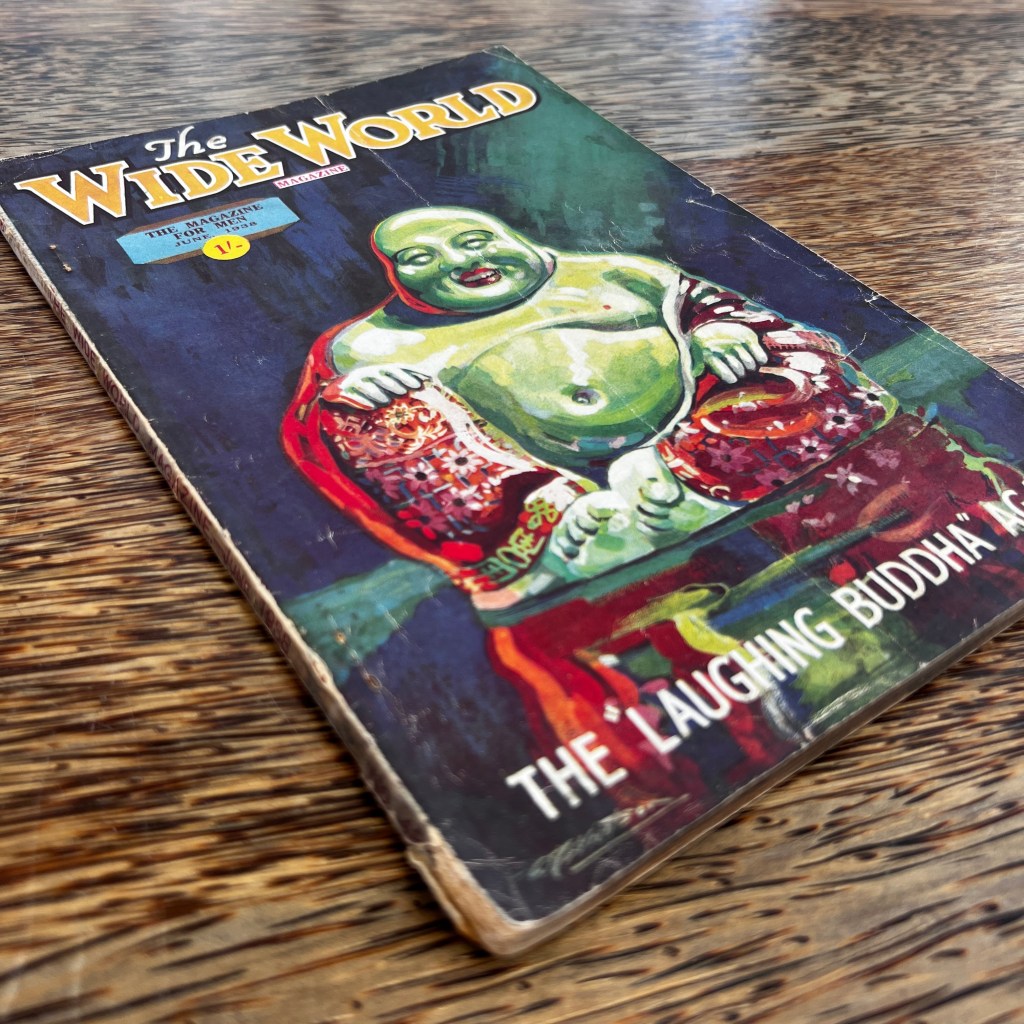
World Wide Magazine 1938 Laughing Buddha Cover

For all the new Buddhas in the West posts
follow us on Bluesky & Instagram


Founded in 1898, the Wide World Magazine was “devoted to romance of travel, adventure, and exploration.” Stories were promoted as “true in every detail” and submissions required a written statement by the author to this effect (they were, of course, not true).

Over 150 pulp magazine titles were sold in the 1930s, thus striking cover art was critical for newsstand sales. The cover here depicts a brightly colored green-skinned Laughing Buddha statue

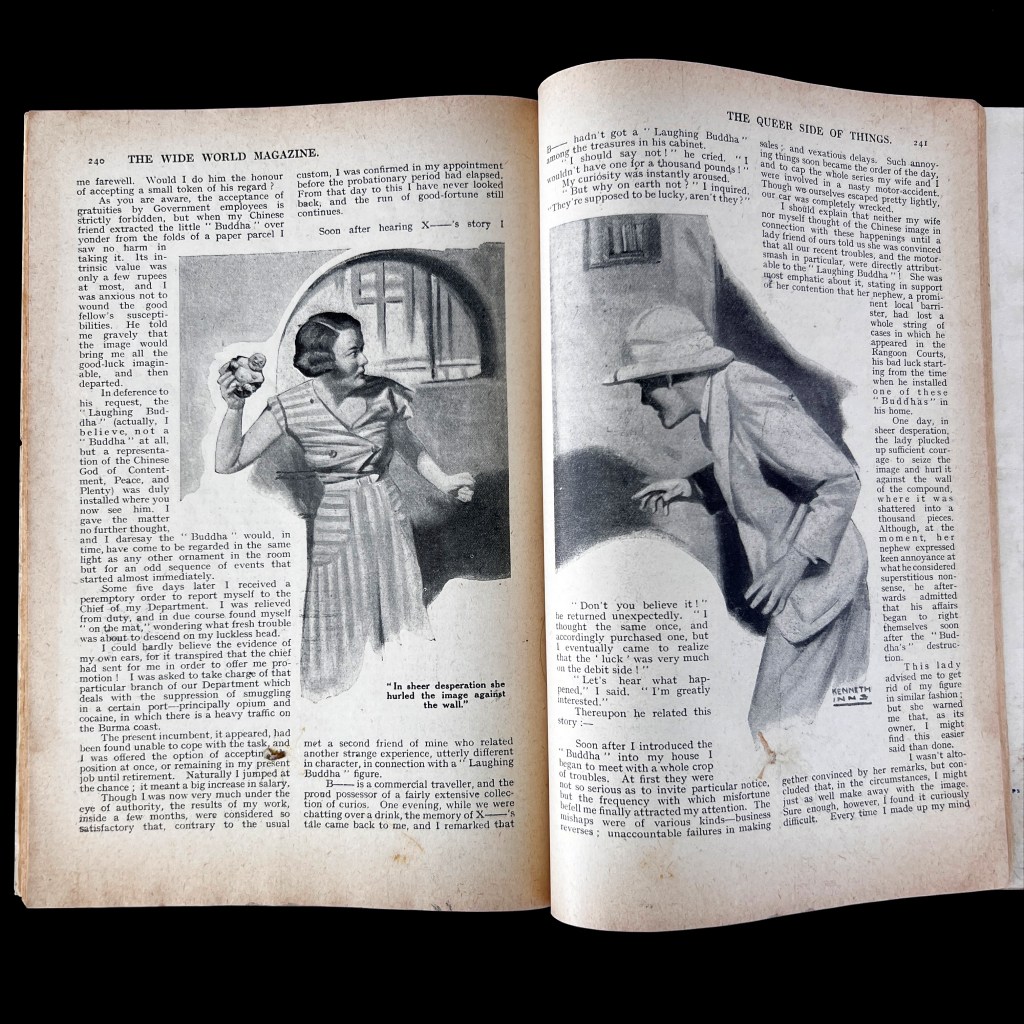
The cover story of June 1938 issue contained a report provided by one “Dennis Blake of Rangoon, Burma,” concerning the curious effects of Buddhist images.

In this report, two small Chinese Laughing Buddha statues were believed to either cause blessings or misfortune to its owners. The artwork by Kenneth Inns shows a statue about to be broken against the wall.

The stories are resolved when we are told that gifted Buddhist statues bring luck, while purchased Buddhist statues bring misfortune!


The Buddhas in the West Material Archive is a digital scholarship project that catalogues artifacts depicting Buddhist material culture for Western audiences. It’s comprised of prints, photos, and an assortment of ephemera and other objects. For a brief introduction to this archive, visit the main Buddhas in the West project page.


For Related Buddhas in the West Posts Featuring the Laughing Buddha:


For the Most Recent Buddhas in the West Posts:

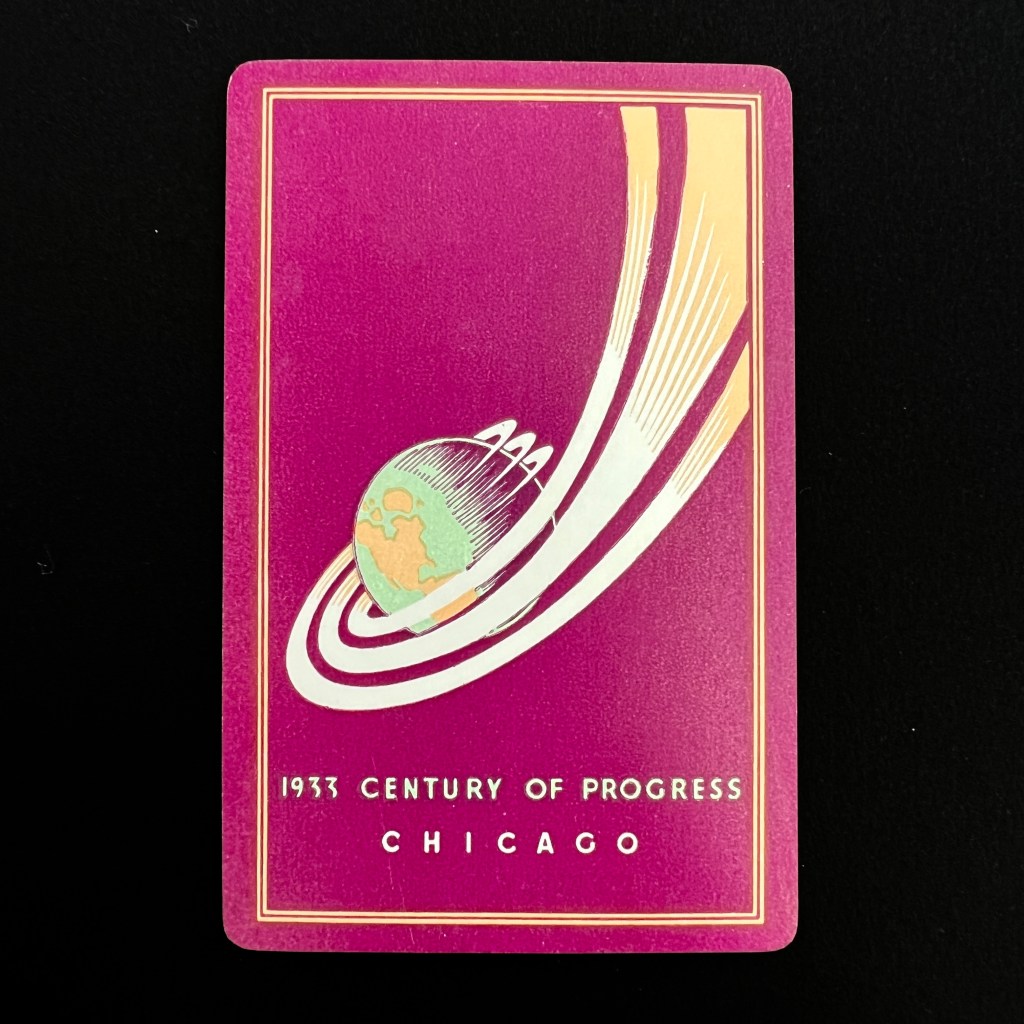
1933 Golden Pavilion Laughing Buddha Playing Card

For all the new Buddhas in the West posts
follow us on Bluesky & Instagram


The 1933 Chicago World’s Fair held a true wonder: A Chinese replica of an 18th century Tibetan Buddhist shrine hall, the Golden Temple of Jehol. While the hall included a main shrine to Guanyin, the Laughing Buddha at the front entrance was often used in advertising.

Due to growing conflict in East Asia, the Chinese government withdrew from the 1933 World’s Fair. Subsequently, organizers arranged for display of the recently acquired temple replica of Vincent Bendix, a well-known Chicago industrialist.

Bendix had funded the expedition of Sved Hedin a few years earlier to procure a replica of a Chinese Buddhist temple. The original interest was to display two replica temples with Tibetan religious objects, one in Chicago and one in Stockholm.

Only one replica was made, but Hedin acquired many ritual implements, including thankas and icons, to outfit the building. Named the Bendix Golden Temple (or Pavilion), it was a Chinese-made replica of the Wanfaguiyi Hall in present-day Chengde (Jehol).

The temple was rebuilt for the 1939 World’s Fair in New York. As of 2018 the remains of the temple hall are in Stockholm, but the ritual items and furnishing have all been lost.


The Buddhas in the West Material Archive is a digital scholarship project that catalogues artifacts depicting Buddhist material culture for Western audiences. It’s comprised of prints, photos, and an assortment of ephemera and other objects. For a brief introduction to this archive, visit the main Buddhas in the West project page.


For Related Buddhas in the West Posts Featuring Budai / Laughing Buddha:


For the Most Recent Buddhas in the West Posts:

Joseph Keppler’s Crafty Priests Puck Magazine Cover

For all the new Buddhas in the West posts
follow us on Bluesky & Instagram


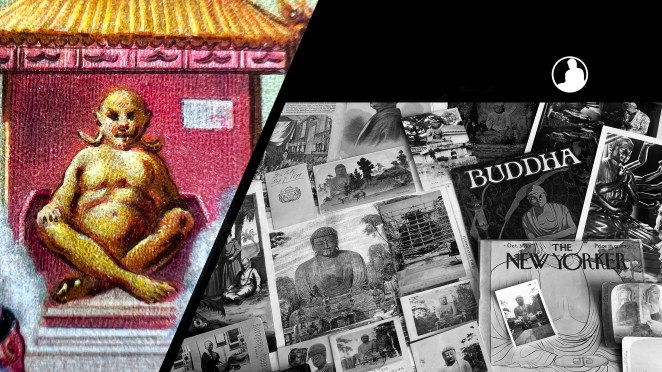
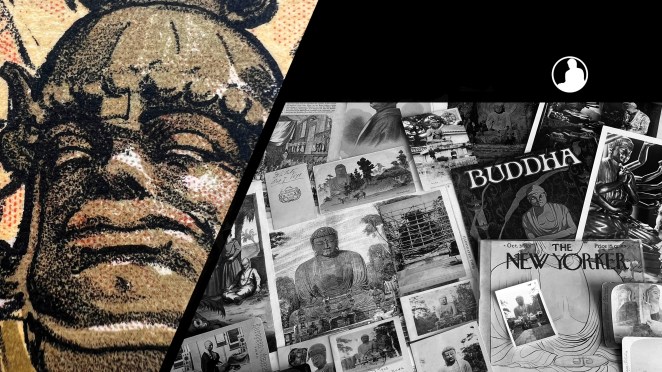
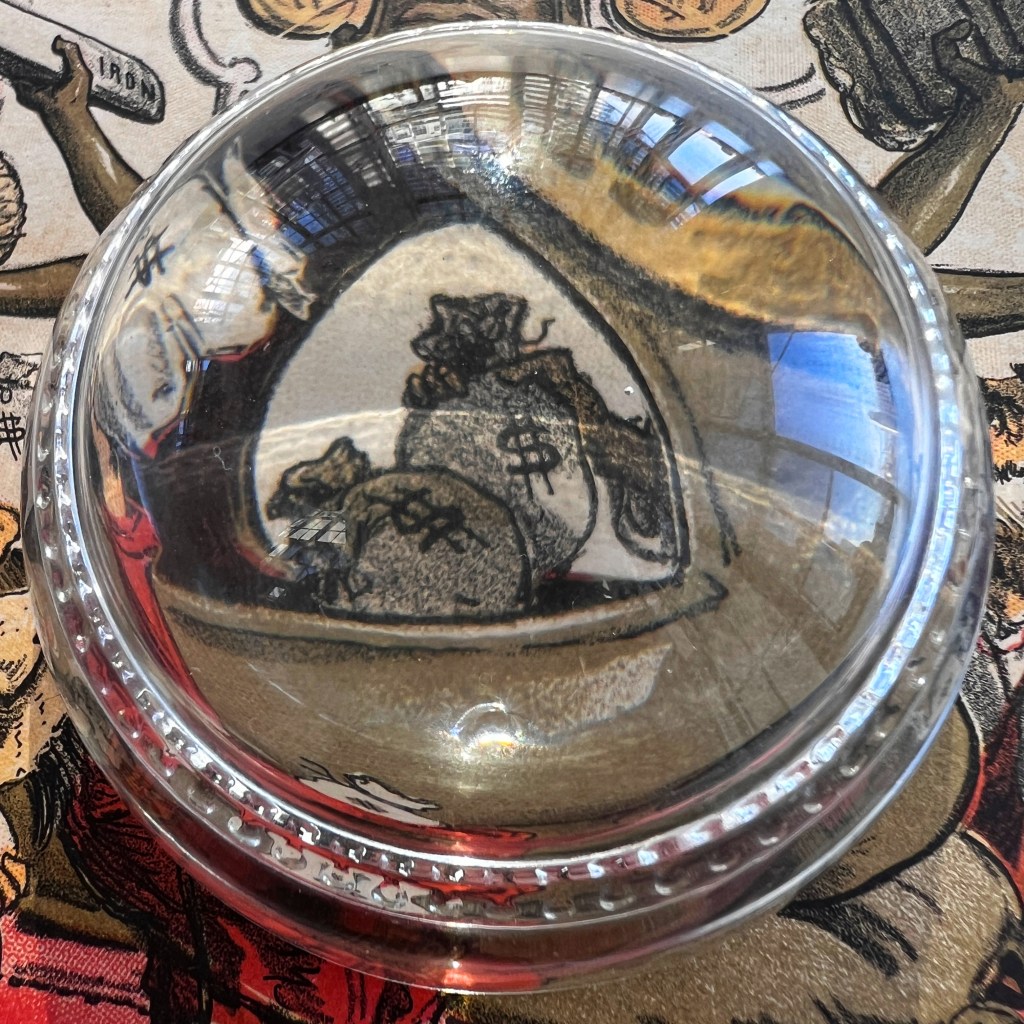
In the 1880s Puck was America’s premier satire magazine, but the publication stood out for another reason: it was among the first periodicals to use chromolithographic printing. Puck was founded by Joseph Keppler who was also a main artist – his work from 1888 is seen here.

The political commentary draws upon the old trope of “crafty priests” stealing from pious believers.

The visual trope, however, uses more recently circulating popular imagery of a cross-legged multi-arm idol. The traditional Biblical imagery of the golden calf has replaced by a stereotyped golden Asian icon. Moreover, the facial features are exaggerated to look more grotesque.

A large collection of Puck political cartoons has been digitized by the Library of Congress, viewable here: https://tinyurl.com/ycde4xtc.


The Buddhas in the West Material Archive is a digital scholarship project that catalogues artifacts depicting Buddhist material culture for Western audiences. It’s comprised of prints, photos, and an assortment of ephemera and other objects. For a brief introduction to this archive, visit the main Buddhas in the West project page.


For Related Buddhas in the West Posts Featuring Historical Magazines:


For the Most Recent Buddhas in the West Posts:
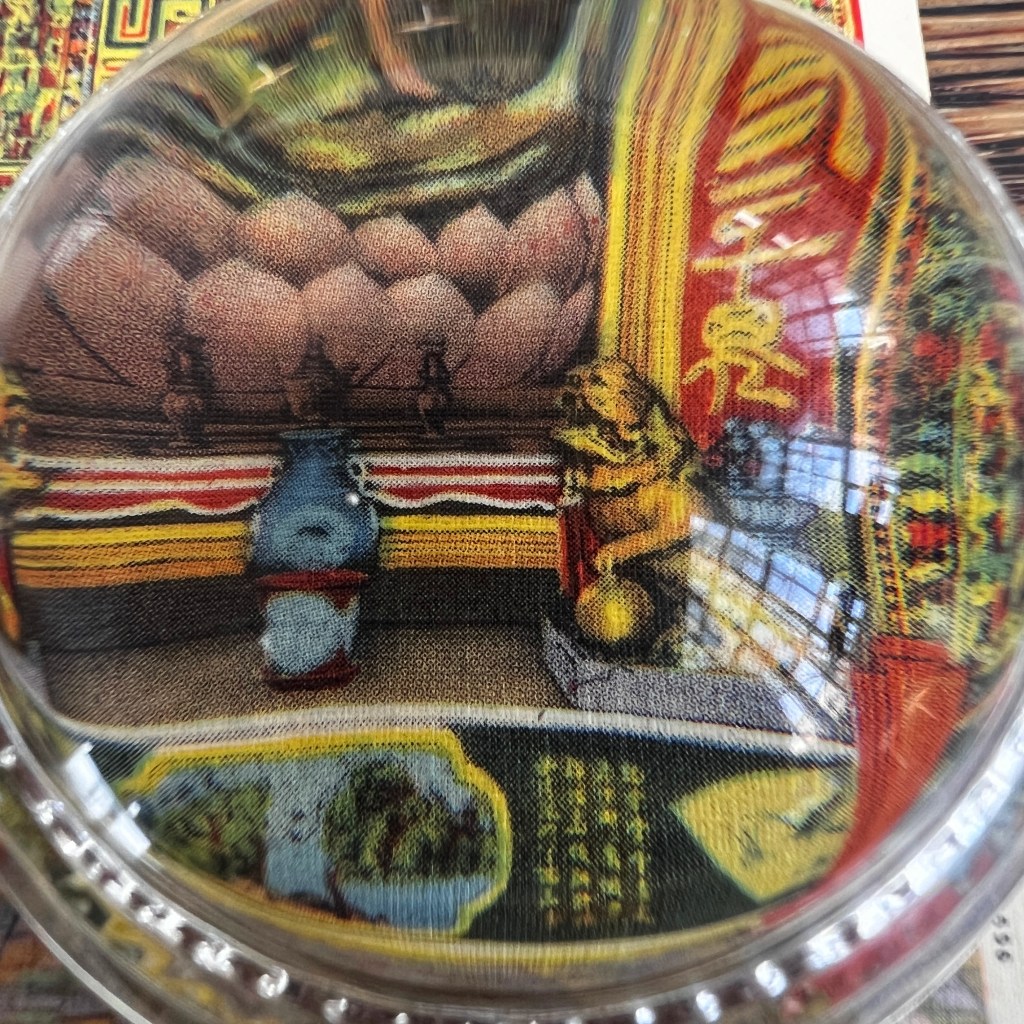

Fritz Müller’s Tin How Temple Postcard

For all the new Buddhas in the West posts
follow us on Bluesky & Instagram


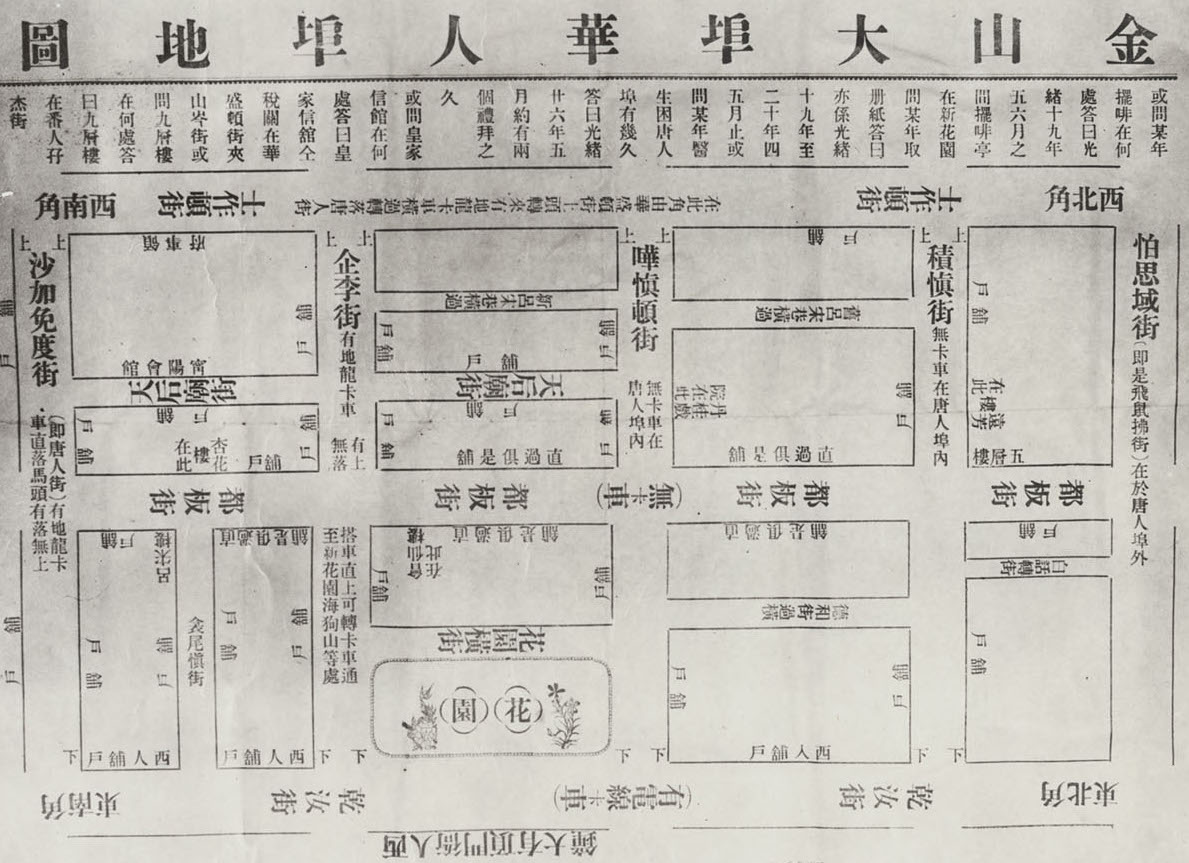
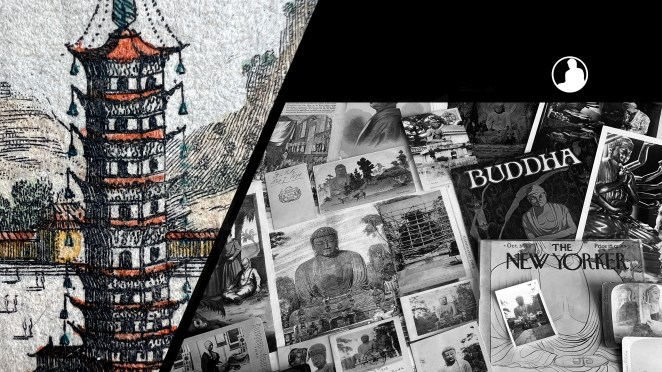
Chinatown’s Iconic Joss House: We lack a rich photographic history of the religious life of San Francisco’s Chinatown before the 1906 earthquake. Of the photos we have, this Chinese temple on Waverly Place is arguably the most iconic – the Tin How Temple.

The goddess Tin How, otherwise known as Mazu, is known for her devoted protection of sailors and close association with early southern Chinese immigrants who came to the US. A close inspection of the second floor reveals her name, Tin How 天后, on plaques beside the doorway.

For a time, different temple shrines occupied the second and third floors of the adjacent building. One shrine was dedicated to the Emperor of the North, Beidi 北帝, who was an old stellar deity popular in the Pearl Delta Region.

Due to the design on the back we know this post card was issued before 1907. The front informs the San Francisco publisher Fritz Müller had the cards printed in Germany, a common occurrence at the time.

For an insightful commentary on how to conceptualize traditional Chinese religion through Mazu worship, see Natasha’s Heller’s “Using Mazu to Teach Key Elements of Chinese Religions” available here: https://tinyurl.com/48smwjx2.


The Buddhas in the West Material Archive is a digital scholarship project that catalogues artifacts depicting Buddhist material culture for Western audiences. It’s comprised of prints, photos, and an assortment of ephemera and other objects. For a brief introduction to this archive, visit the main Buddhas in the West project page.


For Related Buddhas in the West Posts Featuring Chinatown:


For the Most Recent Buddhas in the West Posts:
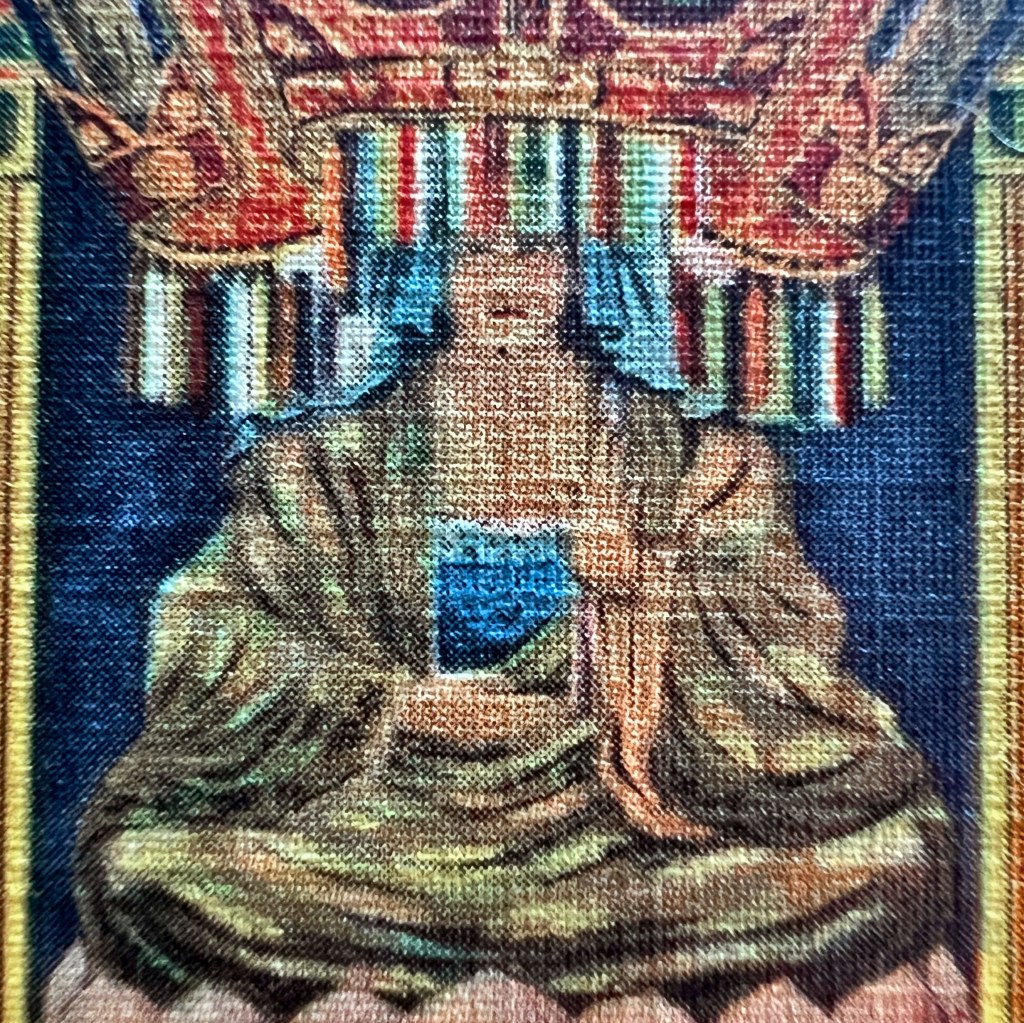


Anna Eva Faye’s Śiva Mascot Token

For all the new Buddhas in the West posts
follow us on Bluesky & Instagram


A rather unique mixture of religion, science, and stage magic was playing out on the Vaudeville circuit at the end of the 19th century. Anna Eva Faye, billed as the “Indescribable Phenomenon,” played to full houses with her other-worldly displays of mentalism.

As a souvenir of her show and a token of good luck (the generic sense of “mascot”), Faye sold coins bearing the image of the multi-armed Indian icon Śiva. The AEF below the figure refers to Anna Eva Faye.

The reverse bears a wreath (common to US coins of the era) enclosing the magic letters: AYX-7OD-77O. The coin reflects how the religious import of Śiva is funneled into larger American beliefs in occult power during this period.

This souvenir coin shows a decent amount of rub wear. This suggests the coin was a trusty good luck companion for someone in the past. The coin is about the size of a US quarter.

For a curated list of old newspaper articles about Anna Eva Faye, see the offering presented by the Library of Congress here: https://tinyurl.com/3jhkjsze.


The Buddhas in the West Material Archive is a digital scholarship project that catalogues artifacts depicting Buddhist material culture for Western audiences. It’s comprised of prints, photos, and an assortment of ephemera and other objects. For a brief introduction to this archive, visit the main Buddhas in the West project page.


For Related Buddhas in the West Posts Featuring Historical Advertising:


For the Most Recent Buddhas in the West Posts:

Vantine’s Buddha Sandalwood Incense Tin

For all the new Buddhas in the West posts
follow us on Bluesky & Instagram


An Art Deco Buddha: Ashley Vantine arrived in the newly opened port of Yokohama in 1861 looking to start an American import business. By the turn of the 20th century, A.A.Vantine & Co. had become one of the most influential importers of “Oriental” goods into the US.

First positioning itself as an authority of Japanese goods, by the 1890s Vantine’s shifted to a more eclectic mass-market approach. With a famous flagship store on Broadway in New York and a successful mail order business, Vantine’s goods circulated across the US.

By the 1910s it was becoming commonplace for more Americans to display Buddhist statuary in their homes to signify exotic taste. Vantine’s helped supply this growing market.

As the cosmetics market blossomed after WWI, Vantine’s shifted to perfumes and incense, often advertised with Buddhist imagery.

Valuable materials from the Vantine’s company are held by the Winterthur Museum Library. A mail order catalogue from 1914 is viewable here: https://tinyurl.com/4a7mhtst


The Buddhas in the West Material Archive is a digital scholarship project that catalogues artifacts depicting Buddhist material culture for Western audiences. It’s comprised of prints, photos, and an assortment of ephemera and other objects. For a brief introduction to this archive, visit the main Buddhas in the West project page.


For Related Buddhas in the West Posts Featuring Historical Trade Cards:


For the Most Recent Buddhas in the West Posts: