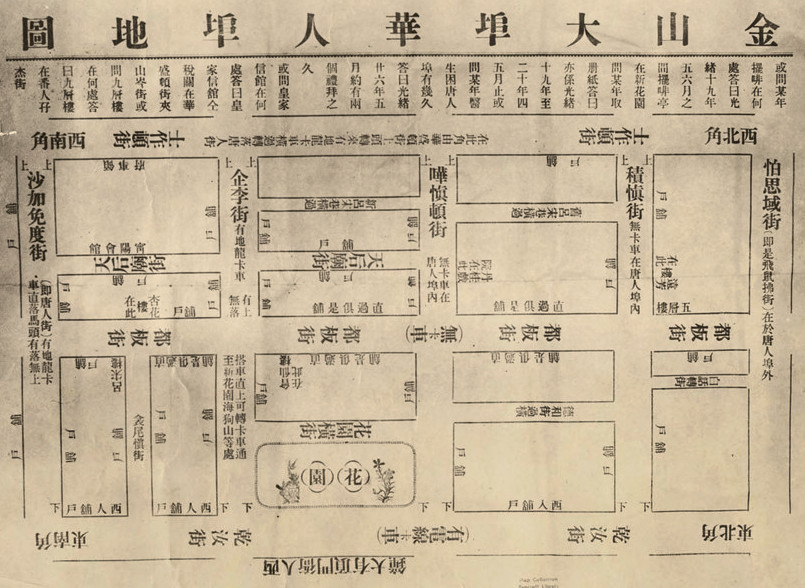
Map of Temples in San Francisco’s Chinatown 1850s-1906
Peter Romaskiewicz
Contents
1. About this Map and Lost Chinese American Temples
2. Map of Temples in San Francisco’s Chinatown: 1850s-1906
3. Historical Overview of Chinatown’s Temples
4. Selected Chinese American Temples with Commentary and Imagery
5. Early Chinese American Temples Beyond Chinatown
6. Additional Shrines in San Francisco’s Chinatown: Restaurants, Shops, Homes, and More
7. Appendix: 1887 Sanborn Map and 1885 Board of Supervisors’ Map
8. About this Project
1. About this Map and Lost Chinese American Temples [TOC]
Dedicated to Philip Choy (1926–2017)
This project reconstructs the religious landscape of San Francisco’s Chinatown before the 1906 earthquake and fire. Drawing on archival research, it identifies and maps 48 historical temples, shrines, and other religious sites dating from the 1850s to 1906, together with more than 100 photographs, engravings, paintings, and other period images connected to these locations.
Much of old Chinatown’s religious world has been lost. The 1906 earthquake and fire destroyed Chinatown’s religious sites, while surviving photographs, illustrations, and other visual records were often published without precise identifications or labeled indiscriminately as “joss houses.” Surviving textual records, including contemporary newspapers, travel accounts, city directories, property records, and other archival sources, likewise preserve scattered and sometimes contradictory evidence.
This project brings these visual and textual fragments together to reconstruct the history of Chinatown’s early religious institutions. In many cases, it identifies previously unknown or misidentified historical images strewn across popular publications and institutional archives, and connects them to specific buildings, religious communities, and moments in Chinatown’s early history.
The result is both a map and an evolving digital archive, a resource for exploring where Chinese American temples and other religious sites were located, how they changed over time, which communities maintained them, and how they were represented by contemporary observers.
A Note on Use
The map provides a visual overview of San Francisco’s early Chinese religious landscape. The sections below provide additional historical and visual detail, with reconstructed histories for individual temples and shrines drawn from contemporary accounts, historical maps, and surviving visual materials.
This remains an active research project. Identifications and interpretations are based on currently available evidence and will continue to be revised as additional sources and images come to light.
2. Map of Temples in San Francisco’s Chinatown: 1850s-1906 [TOC]
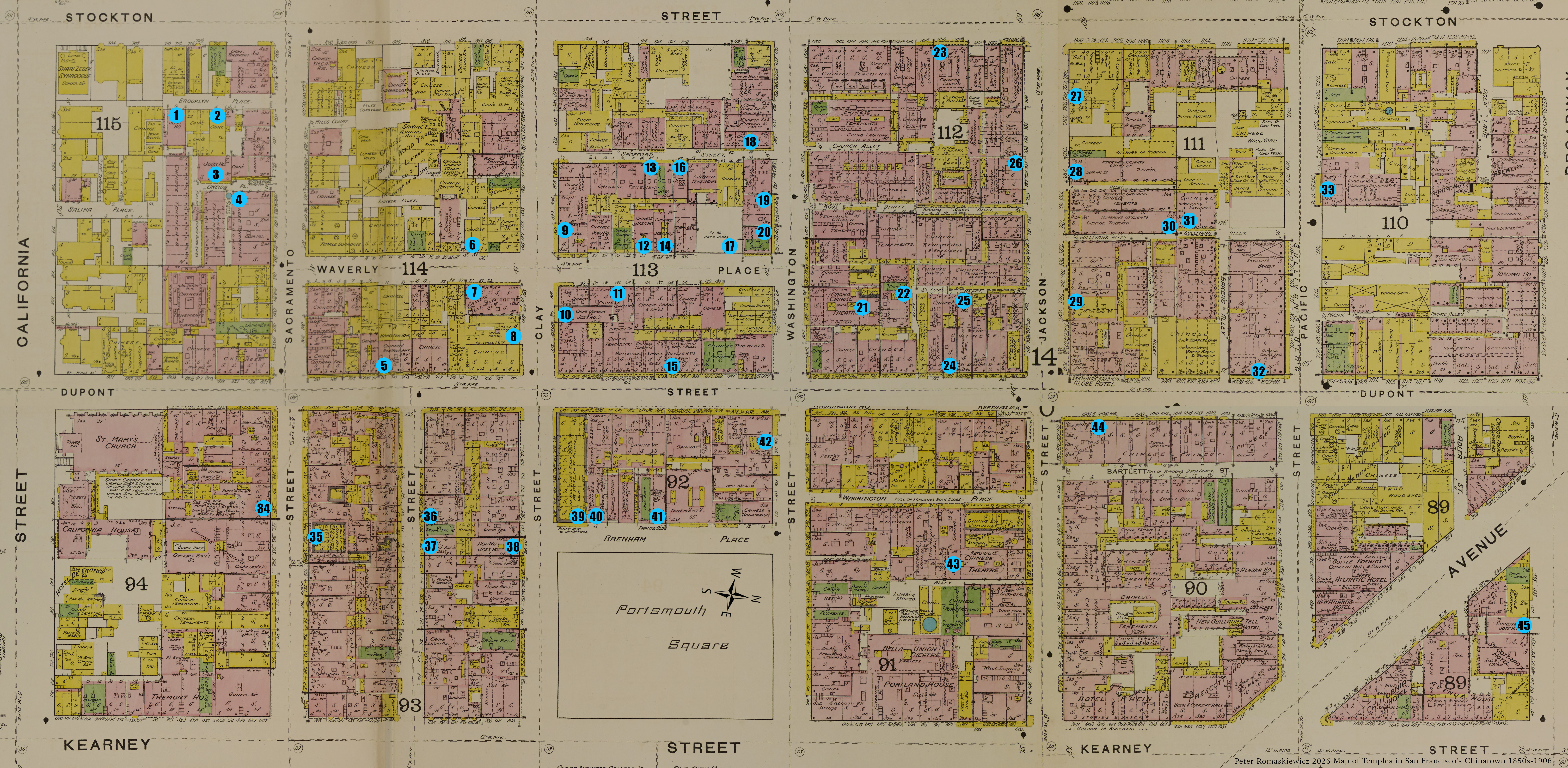
![District Associations
2. Yeong Wo Association II (Yanghe huiguan 陽和會館)
6. Ning Yung Assoc. II (Ningyang huiguan 寧陽會館)
12. Sam Yup Assoc. II [?] (Sanyi huiguan 三邑會館)
15. Sam Yup Association I (Sanyi huiguan 三邑會館)
24. Sam Yup Association III (Sanyi huiguan 三邑會館)
25. Yan Wo Association II (Renhe huiguan 人和會館)
35. Yeong Wo Assoc. III (Yanghe huiguan 陽和會館)
36. Six Companies I (Zhonghua huiguan 中華會館)
36. Hop Wo Association I (Hehe huiguan 合和會館)
37. Six Companies II (Zhonghua huiguan 中華會館)
38. Hop Wo Association II (Hehe huiguan 合和會館)
45. Ning Yung Assoc. I (Ningyang huiguan 寧陽會館)
X1. Yeong Wo Assoc. I (Yanghe huiguan 陽和會館)
X2. Sze Yup Association (Siba huiguan 四邑會館) Kong Chow Association (Gangzhou huiguan 岡州會館)
Clan Associations
1. Lung Kong Assoc. (Longgang gongsuo 龍岡公所)
3. Lord Tam Temple (Tamgong miao 譚公廟)
14. Yee Fung Toy Soc. (Yufengcai tang 余風采堂)
14. Gee Tuck Society (Zhide tang 至德堂)
17. Wong Kong Ha Shrine II (Huang jiangxia黃江夏)
40. Wong Kong Ha Shrine I (Huang jiangxia黃江夏)
Privately Owned Temples
2. Temple of Golden Flower (Jinhua miao 金花廟)
7. City God Temple I (Chenghua miao 城隍廟)
12. Tin How Temple (Tianhou miao 天后廟)
14. Eastern Glory Temple II (Donghua miao 東華廟)
18. Guanyin Temple (Guanyin miao 觀音廟)
22. Eastern Glory Temple I (Donghua miao 東華廟)
23. City God Temple II (Chenghua miao 城隍廟)
28. Jackson Street temple
30. Voorman’s building shrine
31. Sullivan’s building shrine
39. Chan Master Temple (Chanshi miao禪師廟)
39. City God Temple III (Chenghua miao 城隍廟)
X3. Ah Ching’s Tin How Temple (Tianhou miao 天后廟)
Secret Societies
8. Hong Sing Society
10. Dock Tin Society
11. Suey On Society (Ruiduan tang 瑞端堂)
12. Hip Yee Society (Xieyi tang協義堂)
13. Hip Sing Society (Xiesheng tang 協勝堂)
16. Chee Kong Society (Zhigong tang 致公堂)
19. Kai Sen Shea Society (Jishanshe tang 繼善社堂)
20. Bing Kong Society I (Binggong tang 秉公堂)
27. Bing Kong Society II (Binggong tang 秉公堂)
32. Hop Sing Tong (Hesheng tang 合勝堂)
33. On Yick Tong (Anyi tang安益堂)
39. Suey Ying Society (Ruiying tang 瑞英堂)
44. Suey Sing Tong (Cuisheng tang 萃勝堂)
Guild Shrines
4. Washermen’s shrine
34. Chinese Merchant’s Exchange shrine
40. Tailor’s shrine
Other
5. Hang Far Low Restaurant shrine
21. Grand Chinese Theatre shrine
26. St. George Temple
29. Yuen Fong Restaurant shrine
42. Chinese Telephone Exchange shrine
43. New Chinese Theatre shrine](https://peterromaskiewicz.com/wp-content/uploads/2020/06/san-francisco-chinatown-temple-map-legend-romaskiewicz-jan-2026.png)
Notes to the Map and Key
This map is syncretic, not all temples and shrines existed simultaneously. Roman numerals (I, II, etc.) indicate relocations, sometimes into earlier temple buildings. Multiple temples at a single address may reflect shared use or successive occupation; these relationships are discussed in the individual reconstructed histories below.
Temples and shrines are arranged by type following Chuimei Ho and Bennet Bronson (2022). The base map is a digitally stitched together 1887 Sanborn Fire Insurance Map. Please note that north is oriented to the right.
Locations marked X fall outside the map boundaries and are discussed in San Francisco temple locations beyond Chinatown. Smaller shrines in restaurants, theaters, and private residences are discussed in Additional Shrines in San Francisco’s Chinatown.
3. Historical Overview of Chinatown’s Temples [TOC]
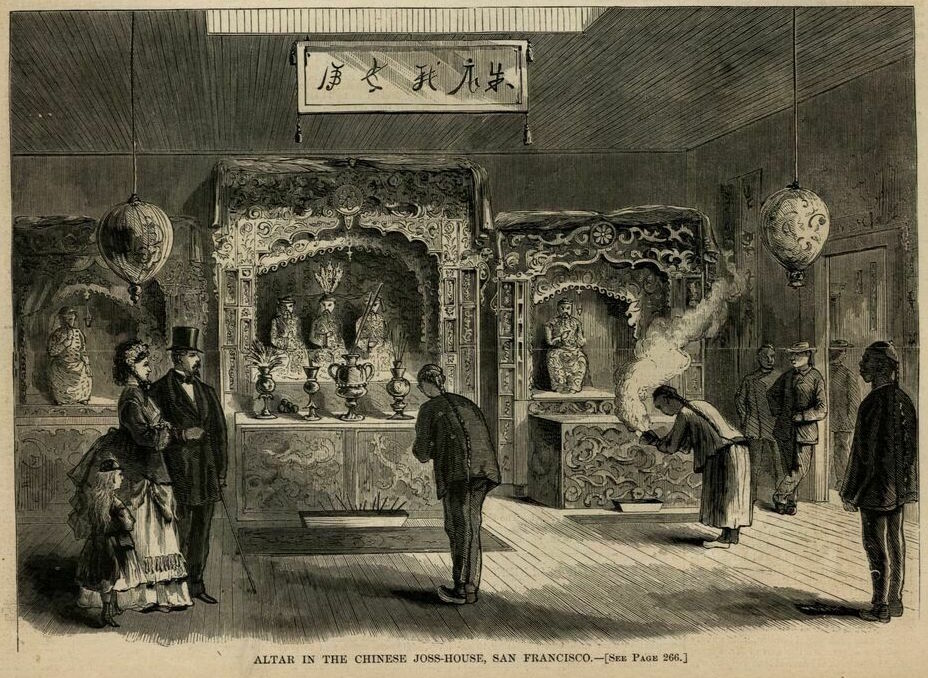
Surviving archival evidence helps us recreate a dynamic religious world. Chinatown’s temples were established, rebuilt, relocated, and sometimes lost from the historical record even before the 1906 earthquake. The sections below highlight several findings that illustrate how the project reconstructs this changing landscape.
Chinese Religious Sites and Institutions: What are Chinese American Temples?
Chinese temples are known generically as miao 廟 (or miu in Cantonese), meaning temple or shrine hall, but these religious structures were commonly referred to as “joss houses” by the non-Chinese American public. A principal function of these spaces was to enshrine Chinese religious icons, known indiscriminately as “joss,” and house other ritual equipment relevant to religious practice and worship.
Importantly, urban Chinese American temples in San Francisco rarely occupied a whole building. More typically, they took the form of shrine halls on the top floor of a multi-story structure, “to be as near the gods as possible,” one Chinatown resident explained in the 1960s. Moreover, these early shrine halls were not operated by formally recognized religious institutions, but were owned and operated by various community organizations formed in the United States. A handful of temples seem to have been privately owned and managed, like Eastern Glory Temple illustrated above.
The largest, most opulent temples were often maintained by district associations (huiguan 會館), while many others were operated by secret fraternal organizations (tang 堂) or by associations organized around clan lineages or particular trades.
Many temples, especially those that were independently managed around San Francisco, enshrined numerous icons that could be worshiped for an array of reasons. In other cases, the space was dedicated to a single figure who functioned as the patron deity of the association, clan, or guild. In the late nineteenth century, religious icons were typically statues or painted scrolls that were placed inside an enclosed altarpiece that resembled an open-faced cabinet. Statues, most often made of wood or clay, were colorfully painted or gilded in gold leaf and frequently dressed in red fabric clothing. Long altar tables were placed in front of the altarpiece displaying censers, vases, candlesticks, and other ritual implements used in worship. The contents and arrangements generally followed the patterns seen across southern China and among the Chinese diaspora settled in Southeast Asia and Oceania.
In larger district association buildings, the lower floors were typically devoted for non-religious functions, such as meeting rooms, hostels, or other work and business spaces essential for the organization’s operation. Consequently, when contemporary newspapers, magazines, and guidebooks referred to an entire building as a “joss house,” it erased the diversity of social and economic functions these buildings played within the Chinese community. Sometimes, and especially for smaller fraternal organizations that occupied a single floor, popular American media would refer to their headquarters as “society rooms” or “club rooms,” equally effacing the fact that these spaces would often house a small shrine.
The terminological shift from the racialized and antiquated “joss house” to the word “temple” therefore introduces a new set of limitations and blind spots. Early Chinese religious sites could take the form of district association shrines, fraternal society shrines, clan association shrines, guild shrines, and privately maintained shrines. This would be in addition to smaller private altars erected in restaurants, shops, and homes.
Reconsidering San Francisco’s Oldest Chinese American Temples
The oldest temples in San Francisco’s Chinatown are often thought to be the Tin How Temple on Waverly Place [#12] and the Kong Chow district association temple originally on Pine Street [#X2]. Both are claimed to have been built in the early 1850s, but this is not without some dispute and qualification.
As shown by Chuimei Ho and Bennet Bronson, the earliest report of a Chinese temple in San Francisco—variously characterized as a heathen, pagan, and idol temple in contemporary newspapers—appears in the fall of 1851. Unfortunately, the brief account repeated by newspaper editors across the US provides no details regarding location or affiliation [Figs. 1–3]. The earliest identifiable temple structure was connected with the Yeong Wo Association built on the southwestern slope of Telegraph Hill and dedicated in the fall of 1852 [see #35]. New evidence, however, suggests the unnamed Chinese “idol temple” described in 1851 should be identified as the Yeong Wo building located on Telegraph Hill [see #X1]. As a consequence, the oldest identifiable Chinese American temple in North America can be connected to a building constructed by the Yeong Wo district association.

Applying this new timeline, the Yeong Wo Association temple predates the Sze Yup Association temple, which has sometimes been mistakenly identified as the first Buddhist temple in the United States. The Sze Yup Association was formally organized at the end of 1851, but constructed its headquarters and temple off Pine Street two years later in 1853. In the mid-1860s, this building became the legal property of the Kong Chow Association, an organization composed of members from Xinhui in Guangdong Province, one of the four constituent groups that originally formed the Sze Yup Association. This relationship helps correct the common misconception that the Kong Chow temple was built in 1851, clarifying instead that it was built in 1853 by its parent organization, the Sze Yup Association (the founding date of 1851 remains unchanged).
Despite the widespread claim that the Tin How Temple on Waverly Place dates to the early 1850s, no contemporary historical documentation supports this assertion. The earliest evidence for a Tin How Temple on Waverly appears in June 1877, while the name “Tin How” first appears in a property sale record from 1876. Notably, however, by June 1877 Waverly Place, the two-block street connecting Sacramento and Washington Streets, was already known among the Chinese community as Tin How Temple Street (Tianhou miao jie 天后廟街). This area would later contain the highest concentration of Chinese temples prior to the 1906 earthquake.
According to current evidence, the Yeong Wo temple, Sze Yup/Kong Chow temple [#X2], and Ning Yung temple [#45] can be recognized as the three verifiably oldest Chinese American temples in San Francisco. In addition, the privately owned temple dedicated to Tianhou [#X3], founded by Ah Ching, and the temple dedicated to Guanyin [#18], located on Spofford Alley, may have both been founded in the 1850s, but this remains poorly documented.
Changing Religious and Institutional Landscapes
The Tin How and Kong Chow temples are today regarded as the most prominent in San Francisco’s Chinatown, both among the rare organizations to rebuild shrine halls after the earthquake and fire. An examination of historical media coverage, travel accounts, and visual representations of San Francisco’s Chinese religious landscape, however, reveals a far more complex historical picture. As Chinatown grew and developed through the nineteenth century, different temples garnered attention at different times, with some falling into obscurity after periods of relative prominence.
One of the first temples to receive media attention was the Sze Yup Association temple upon its opening in 1853 [#X2]. Substantial attention next fell on the Ning Yung Association temple in 1864 [#45], in part because its opening was described by the young Samuel Clemens, later known as Mark Twain. During the 1860s, this temple was widely regarded as the primary “joss house” for tourists, owing in part to its proximity to the newly built Globe Hotel at Dupont and Jackson Streets.
In the following decade, significant media and guidebook attention shifted first to the privately owned Eastern Glory Temple in 1871 [#22], located on St. Louis Alley, and then towards the new and lavishly decorated Hop Wo Association temple on Clay Street after 1874 [#38]. When the Yeong Wo moved from their old building on Brooklyn Place [#2] to their new site on Stockton Street in 1887 [#35], they also began attracting more outside visitors and curious onlookers, in part due to the festive parades held in honor of their main icon. Lastly, when the Ning Yung moved to their new temple on Waverly [#6] in 1891, in the religious heart of Chinatown, they were considered the most opulent and worthy of tourist visitation. After the turn of the twentieth century, self-guided walking tours through Chinatown also noted the beauty of the newly constructed Wong family temple, also on Waverly [#17]. After rebuilding and reopening in 1911, the Tin How Temple was seen as a reminder of old Chinatown, especially as many of the older temples and shrines halls were never rebuilt.
Restricting ourselves to the temples listed here where a main icon can be identified, the semi-historical figure Guandi 關帝 emerges as the most commonly enshrined deity [#6/#45, #38, #25, #X2, and nearly all secret societies). A small shrine to Guandi was also often found in restaurants, shops, privates homes, and some guild halls, establishing his presence at the center of Chinese immigrant life. In addition, two or three temples focused devotion to the Empress of Heaven (i.e. Tianhou 天后), also known as the goddess Mazu 媽祖 [#12, #28, #X3], and two temples were dedicated to the popular Buddhist bodhisattva Guanyin 觀音 [#18, #40]. Icons of Guanyin and Tianhou also appeared in several temples as secondary figures, placed in flanking positions on the main altar or housed in adjacent altars, rooms, or floors [#2, #22, #X3]. Another important figure was the Supreme Emperor of the Dark Heavens (Xuantian shangdi 玄天上帝), also known as the Northern Emperor (Beidi 北帝), whose icon traveled with the movement of the Eastern Glory Temple [#22, #14]. Among the numerous fraternal societies that operated temples, the Chee Kong Society [#16] was by considerable margin the most influential.
Rethinking Buddhist Icons in Chinatown
It is worth noting that I have not encountered a reliable written report, illustration, or photograph of Śākyamuni or Amitābha Buddha statues in any pre-1906 Chinese temple in San Francisco. Despite frequent tourist accounts describing encounters with “the Buddha” in Chinatown temples, such references can be attributed to misunderstanding or mis-identification. In most cases, the figure described was likely Guandi or the Northern Emperor. In other instances, the term “buddha” appears to have been used interchangeably with “joss” with no more precise meaning than “Chinese idol.” Visual depictions of buddhas sitting on San Francisco’s Chinatown altars appear only in racially charged political cartoons, crude newspaper sketches, and other poorly informed visual caricatures of Chinese immigrant life in the late nineteenth century (see, for example, #6).
In contrast to the limited ritual nature of community organization temples and shrine halls, many of which prominently displayed Guandi, privately owned temples seemed to hold more latitude for enshrining a wider variety of icons, including Buddhist ones. In this regard, the figure of Guanyin played a central role in the religious life of many early Chinese immigrants, being found in five locations on this map and likely remaining unreported at many others. At least one observer in 1883 claimed Guanyin occupied a “prominent corner of every private home as well as temple.” Images of the Buddha, by contrast, found no comparable level of popular support among early Chinese immigrants in San Francisco. This conclusion is further supported by the absence of any Chinatown-wide celebration for the Buddha’s birthday in either 1873 or 1880, when we have year-long records for important Chinatown festivals, or documentation for such an event in San Francisco newspapers prior to 1906. Consequently, images of buddhas in other temples across California, such at the Oroville temple complex built by the powerful Wong clan [see #40], should be considered meaningful exceptions to the typical landscape of early Buddhist material culture in the United States.
4. Selected Chinese American Temples with Commentary and Imagery [TOC]
1. Lung Kong Association (Longgang gongsuo 龍岡公所)
9 Brooklyn Place | 1887 Sanborn | Temple map
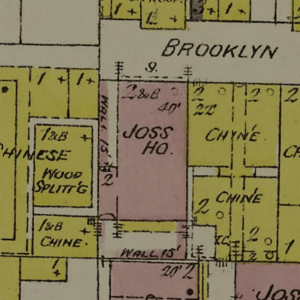
By the mid-1880s, a two-story building near the midpoint of Brooklyn Place, tucked between Sacramento and California streets, opened as the headquarters of the Lung Kong Association. Unlike traditional district associations which divided Chinese immigrants based on their specific home villages or counties in China, the Lung Kong Association was a kinship-based organization. It united members from four distinct family lineages: the Lew (Liu 劉), Quan (Guan 關), Jeong (Zhang 張), and Chew (Zhao 趙) families.
This four-family coalition was intentional. Each surname connects back to semi-legendary military and political figures from the Three Kingdoms period (220–280)—Liu Bei, Guan Yu, Zhang Fei, and Zhao Yun—whose fictionalized exploits in the novel Romance of the Three Kingdoms a millennium later cemented their status as paragons of brotherhood, loyalty, and righteousness. According to Lung Kong Association tradition, ancestors of these four families originally established a joint temple in the Kaiping district of Guangdong province during the seventeenth century before eventually organizing branches in the United States.
While association history points to an American founding in 1875, the Lung Kong organization first appears in the American press in the summer of 1886, marked by a public announcement celebrating the opening of its temple on Brooklyn Place.
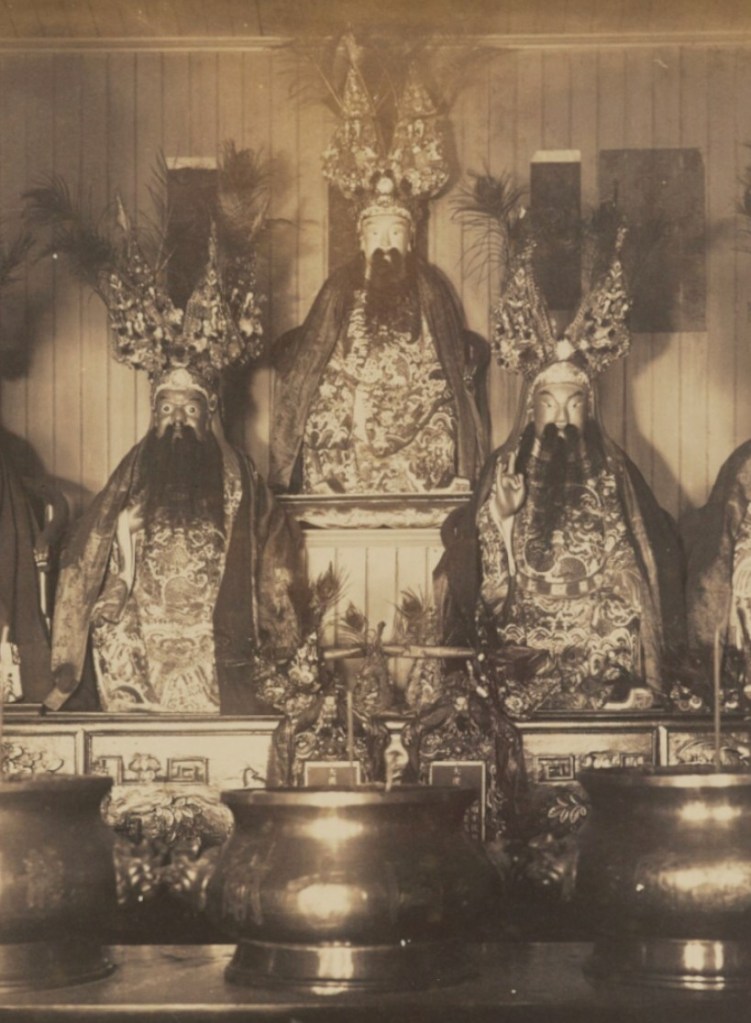
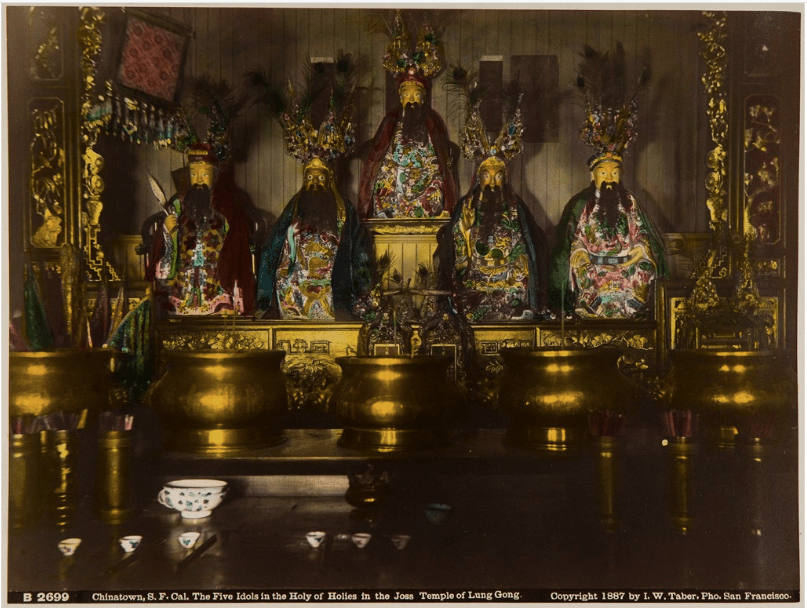
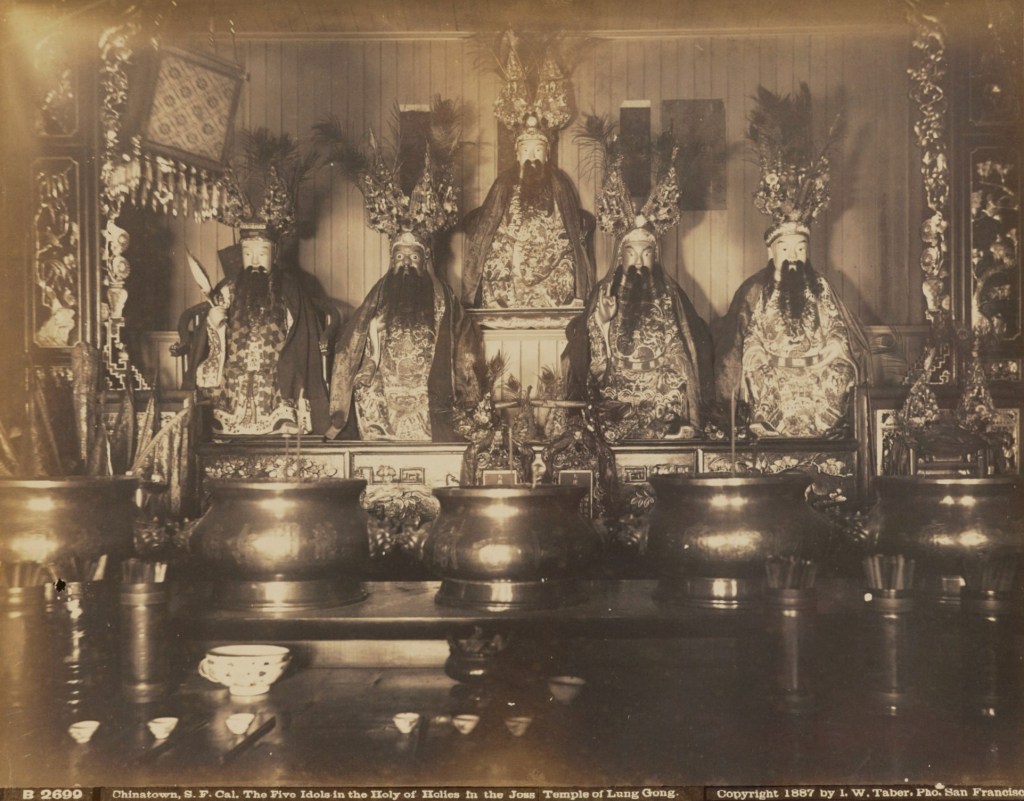
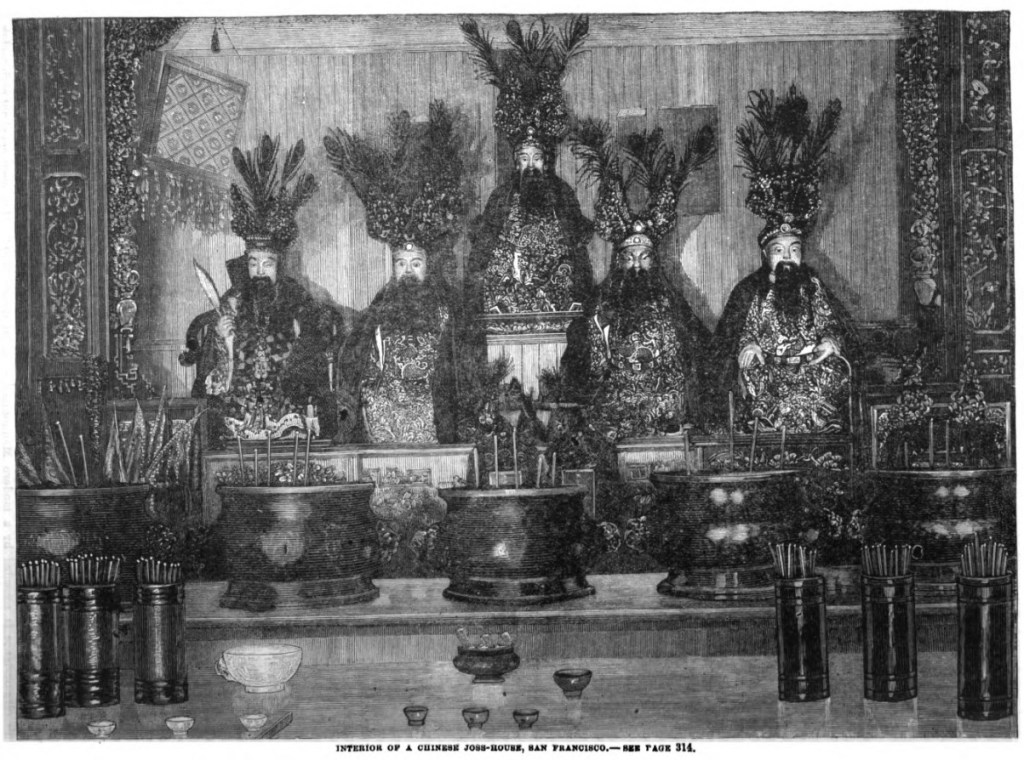
San Francisco-based photographer Isaiah West Taber (1830–1912) captured the Lung Kong Association’s shrine hall and altar in 1887, creating a rare interior image of an early Chinese American temple. The central icons honored the four glorified cultural heroes noted above—Liu Bei in the center, Guan Yu to his right, Zhang Fei to his left, and Zhao Yun on the far right—along with the Three Kingdoms statesman Zhuge Liang on the far left. (For more on Taber’s photograph and it’s continued biography as a postcard, see here).
One visitor in 1887 describes the shrine hall as a “beautiful room with a large window opening on to a balcony,” with five figures displayed at the furthest end of the room. These icons are described as “wood painted a bronze red, with fierce black mustaches and almond shaped eyes.”
Taber’s photograph of the tightly cropped altar was later repurposed for the cover of William Bode’s 1896 publication, Lights and Shadows of Chinatown. A second photograph by Taber captured the incense offering table placed directly before the main altar, a standard furniture arrangement in early Chinese American temples that partially obscured the icons (see both below).
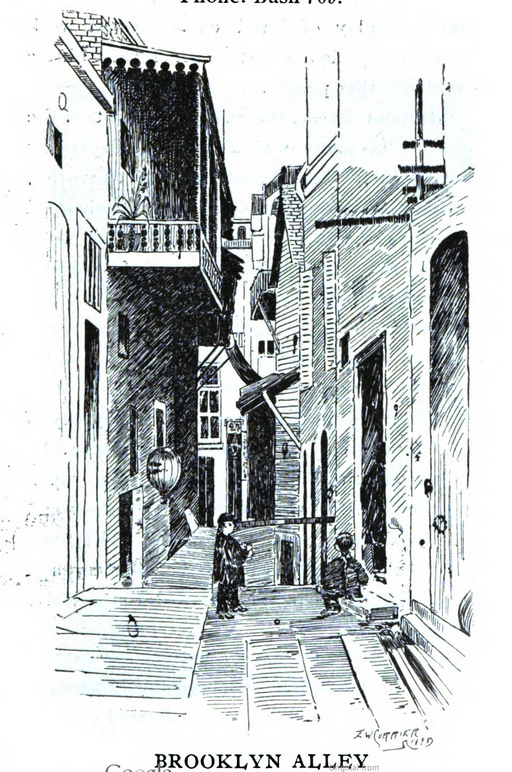
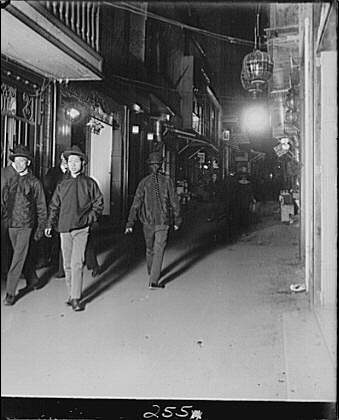
Visual records of the building’s exterior are scarce. A simplified sketch by artist Edward Wilson Currier (1857–1918), published in an 1898 San Francisco guidebook, likely depicts the two-story brick edifice. Photographer Arnold Genthe (1869–1942) may have also captured the location looking down Brooklyn Place, documenting the temple’s hanging lanterns, although the archival label providing an address of 4 Brooklyn Place instead points to the Temple of the Golden Flower. [#2].
Like many early Chinatown institutions, all Lung Kong temple records and artifacts were lost in the 1906 earthquake and fire. However, the association rebuilt at a new location after the disaster and remains in active operation today as the Lung Kong Tin Yee Association.


2. Yeong Wo Association II (Yanghe huiguan 陽和會館) / Temple of Golden Flower (Jinhua 金花)
4 Brooklyn Place | 1905 Sanborn | Temple map
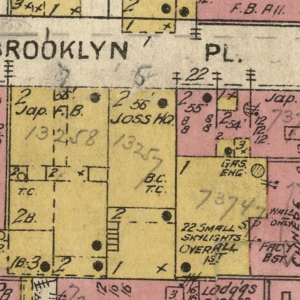
A building on Brooklyn Place was affiliated with the Yeong Wo Association by at least 1883, when it hosted the beginning of the inaugural parade and procession for the association’s principal deity, Houwang. According to contemporary newspaper reports, in previous years the festivities had been held inside a temple on Cum Cook Alley, a narrow thoroughfare connecting Dupont Street with Sullivan’s Alley three blocks to the north. The inaugural parade was sizable, involving 120 participants carrying banners and musical instruments and accompanying a procession chair bearing the small Houwang icon, reportedly no larger than a baby. This description corresponds closely with earlier reports of the 1852 dedication of the Yeong Wo building on Telegraph Hill, in which the icon was described as doll-sized [#X1]. The procession wound several blocks through Chinatown to a Chinese theater, where performances were held in Houwang’s honor.
As Ho and Bronson note, a Houwang Temple was known to have been located at Brooklyn Place since 1866, although its affiliation with the Yeong Wo Association remains uncertain until the early 1880s. For example, in September 1879, the San Francisco Chronicle reports on Yeong Wo’s birthday festivities on Brooklyn Place, but the Yeong Wo Association, one of the largest and wealthiest district associations in Chinatown, is not mentioned. By contrast, when reporting on the second annual Houwang procession in 1884, the San Francisco Call explicitly identifies the Houwang Temple on Brooklyn Place as being “maintained” by the Yeong Wo Association. The relationship between the Houwang Temple on Brooklyn and the Cum Cook Alley temple used by Yeong Wo members previous to 1883 remains unclear. It is worth noting that the Houwang Temple became so closely associated with Brooklyn Place that by the summer of 1877 Chinatown residents referred to the narrow alley as “How Wong Temple Street.” (Alternatively, Cum Cook Alley was named for Cum Cook Restaurant, which occupied a building on the small thoroughfare.) This affiliation between Houwang Temple and the Yeong Wo Association appears to have continued until 1887, when Yeong Wo relocated to its more permanent headquarters on Sacramento Street, enshrining the Houwang icon on the premises [#35].
At some point thereafter, the building was taken over by a privately owned temple that Frederic Masters described as being “crowded with images of goddesses, mothers, nurses, and children.” The central icon was Lady Golden Flower (Jinhua niangniang 金花娘娘), a deity revered for protecting the health and well-being of women and children. This figure was flanked by Guanyin and Tianhou on the altar. Additionally, eighteen attendant wet nurses (nainiang 奶娘) of Lady Golden Flower were arranged along the walls of the temple. The only known illustration of the temple interior was published with Masters’ description (see imagery tab below). The detailed illustration, likely based on a photograph, shows a long row of icons with incense smoke pouring out from censers in front of them. These figures appear to be half of the eighteen attendant wet nurses enshrined along one of the temple’s side walls. Two altar table stacked with ritual vessels and offerings are visible to the right. The main altar, hidden behind in the darkness and smoky haze, would have been just beyond these two tables.
A different visitor in 1892 adds a few important details to this scene. The figures flanking the walls are described as women and children, with a few bearded men. Many of the children are held on the women’s laps and a few animals are also depicted. The author notes they appear like children’s nurses, but speculates they could be goddesses who preside over various periods of a child’s development, with the men symbolizing tutors. The images are reportedly carved in wood, painted, and gilded, with the statues of the women standing two feet in height. Importantly, the temple is described as catering to married women. Moreover, there are cushions on the floor where women can kneel, which is noted as different from other joss houses that drew predominantly male crowds.
Our unknown visitor also highlights a critical religious and social function of this space that, to my knowledge, is otherwise unattested in the historical record: a small side shrine held memorial tablets for deceased women without children who had lived “outside the pale” of respectable society. The altar was well adorned with offerings of flowers, fans, jewelry, and cosmetic powders, suggesting that temple visitors remained attentive to the postmortem needs of poor and marginalized women who had worked in one of the city’s many brothels. This provides a poignant glimpse of an otherwise undocumented system of mutual care, suggesting that even women who lived “outside the pale” of respectability were not necessarily abandoned by their peers after death.
There is an important discrepancy with Masters’s account, however, that cannot be overlooked. The central icon around which the temple was organized was identified by our visitor as Guanyin, not Lady Golden Flower. The only distinctive characteristics provided are that the figure wears a crown and heavy earrings, attributes commonly shared by representations of Guanyin and Lady Golden Flower (e.g. see here). Given the presence of the attendant wet nurses, it seems likely that our visitor misidentified the relatively obscure Lady Golden Flower with the far more familiar Guanyin.
The temple’s identity as a shrine to Lady Golden Flower, moreover, should not obscure the deity’s much wider presence within Chinatown. A description of the Chinese quarter published in 1883, shortly before this temple appears to have been established, notes that images of the goddess—depicted holding a child in each arm—were placed beneath the beds of infants throughout Chinatown. Altars dedicated to Lady Golden Flower were likewise established within other independent temples, including Ah Ching’s Tin How Temple [#X3] and Eastern Glory Temple on St. Louis [#22]. Her birthday, celebrated on the seventeenth day of the fourth lunar month, also appears to have been observed throughout the Chinese quarter, as reported in 1873. Taken together, these scattered references suggest that Lady Golden Flower was not simply the presiding deity of a single temple, but part of a broader devotional landscape centered on childbirth, childhood, and the protection of women and children. The figure of Lady Golden Flower was clearly among one of the most important deities in Chinatown, but remains one of its most poorly understood.
The 1885 Board of Supervisors’ Map identifies a joss house on the east side of Brooklyn Place near this location, most likely referring to the Yeong Wo temple. By contrast, the 1887 Sanborn Map shows no temple at this address, suggesting that it was prepared after the Yeong Wo Association had moved, but possibly before the Golden Flower Temple was established.
Golden Flower Temple was not apparently rebuilt following the 1906 earthquake.

3. Lord Tam Temple (Tamgong miao 譚公廟)
Oneida Place | 1887 Sanborn | Temple map
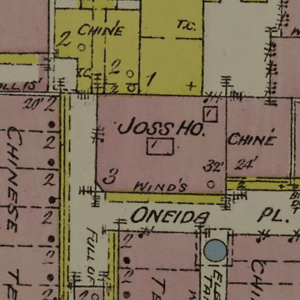
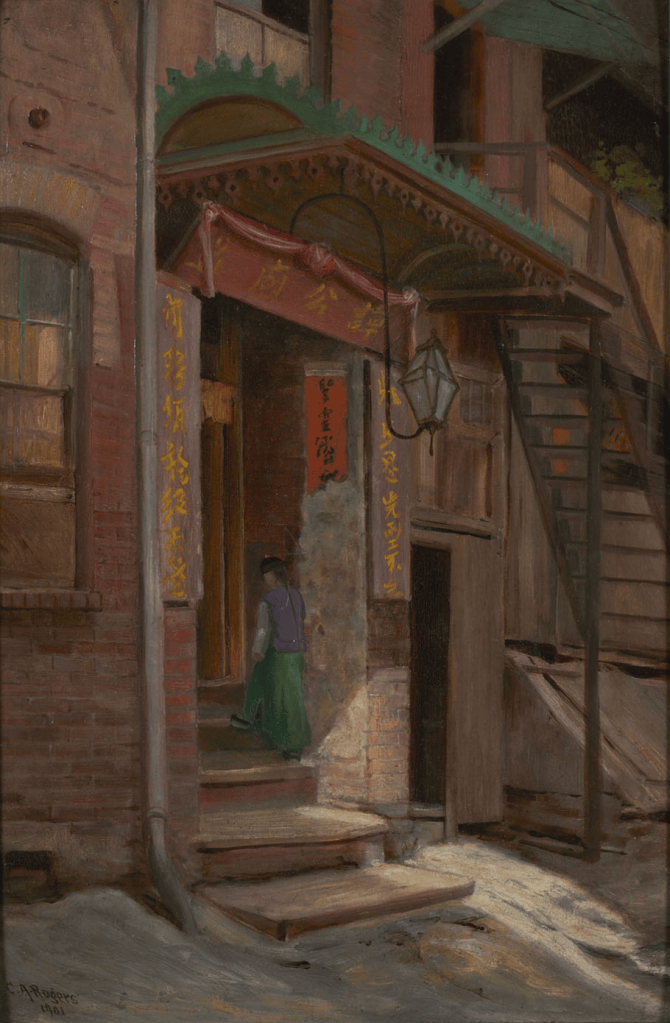
This three-story clan association temple served the Tam (Tom) families and was in existence by the late 1880s, though Frederic Masters claimed it to be among the oldest temples in Chinatown. Located on Oneida Place, the temple’s central icon was Lord Tam (Tamgong 譚公), a deity often regarded as a patron of seafarers and – at least in the context of Chinatown – also of theatrical troupes. Lord Tam is closely associated with the Hakka, a minority ethnic group within the broader Chinese diaspora.
The entrance to the temple was painted by Charles Albert Rodgers in 1901 (see imagery tab below). The name Lord Tam Temple (Tamgong miao 譚公廟) is clearly visible on the plaque above the door.
4. Washerman’s Guild Shrine
825 Sacramento | 1887 Sanborn | Temple map
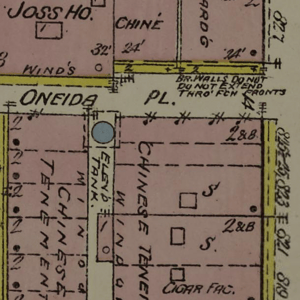
Several washermen’s guilds operated in Chinatown, but one early organization, simply known as the “Washermen’s Association,” was known to meet regularly on Oneida Place. A newspaper account from 1870 reports that the guild’s meeting room and joss house was located at the rear of a two-story building at 825 Sacramento Street, accessible via a narrow stairway off Oneida Place. This is one of the earliest institutionally-managed shrines reported in Chinatown, with the others being only large district association temples.
In May 1870, a dispute among members of the association quickly escalated into an armed melee, drawing in at least fifty Chinese combatants and spilling into the alleyway before police broke up the fighting. As a consequence, the meeting room was “torn to pieces,” while the guild’s icon, altar, and offering vessels, all “suffered considerably.” According to Richard Dillon, this was the “first bloody internal riot” in Chinatown’s history.
As Ho and Bronson note, since laundry services were not a common occupation among men in China, there would have been no traditional patron deity for a washerman’s guild. The missionary Augustus W. Loomis, who took leadership of the Presbyterian Church in Chinatown in 1859, offers insight into this quandary. He reveals that the washermen’s guild established altars to Guandi in order to secure prosperity for their businesses. Ethnographer Stewart Culin notes a similar appearance of Guandi in Chinese laundries on the East Coast.
Ho and Bronson suggest that by 1887 a guild shrine may have been located at 810 Clay Street [#10].
5. Hang Far Low Restaurant shrine (Xinghua lou 杏花樓)
713 Dupont Street | 1905 Sanborn | Temple map
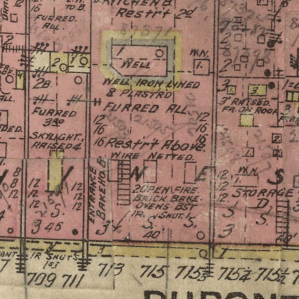
A large private shrine to Guandi was established at the famed Hang Far Low Restaurant. See relevant comments in Additional Shrines in San Francisco’s Chinatown below.
6. Ning Yung Association II (Ningyang huiguan 寧陽會館)
35 Waverly Place | 1905 Sanborn | Temple map
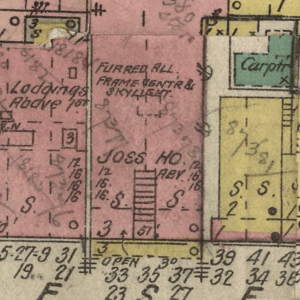
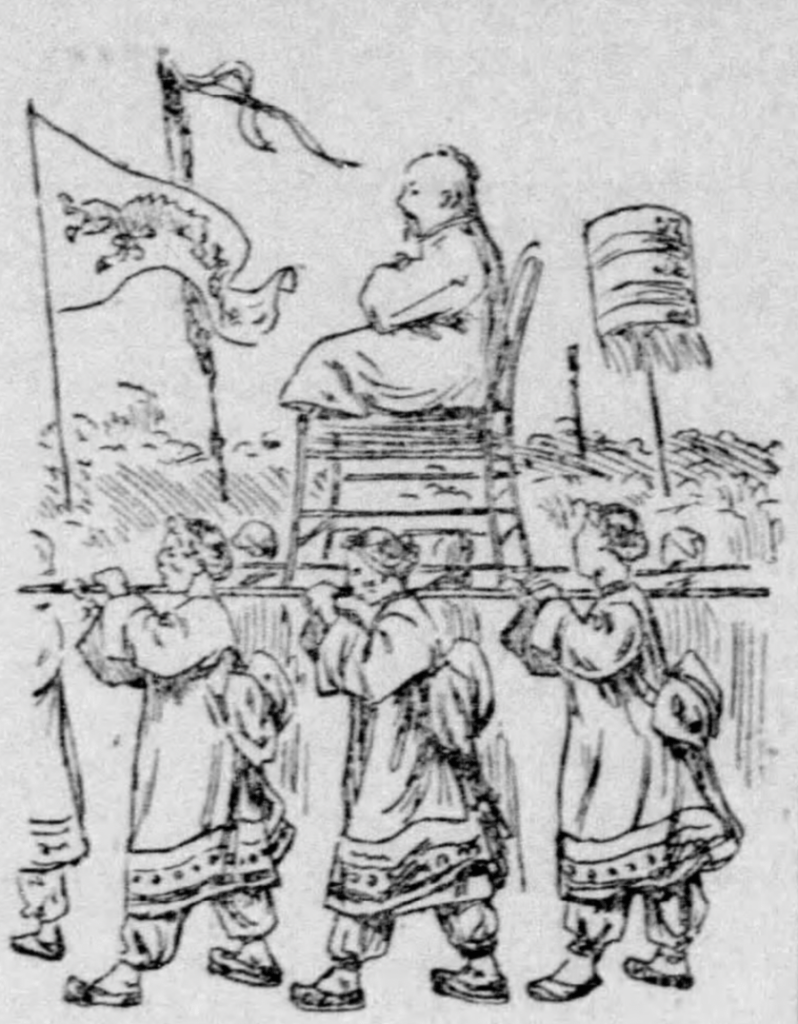
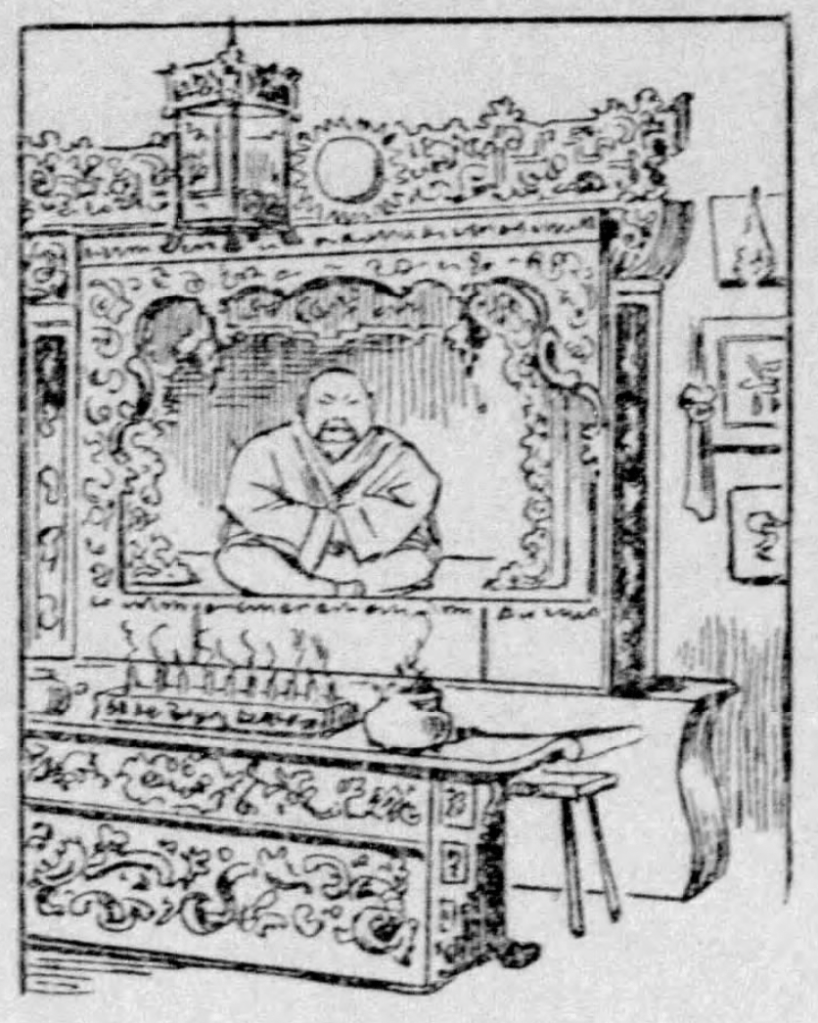
The Ning Yung Association moved from its original location [#45] to Waverly Place in 1891. According to one report, the main icon of Guandi could only be moved to its new sanctified altar on an auspicious day, otherwise “dire catastrophe would overtake the josshouse and all concerned.” After consultation with a fortune teller, September 26th was chosen as the day for enshrining the icon and dedicating the new building.
Two rather crude newspaper sketches offer a glimpse of the official procession and parade as well as the new altar for the Ning Yung Association icon, Guandi. The dangling hair queue added to the icon’s head was an attempt to highlight Guandi’s foreign origin rather than offer a faithful representation of its appearance. Moreover, rendering Guandi cross-legged, like a typical sitting buddha image, reflected more of the American popular perception of Chinese icons – what readers expected to see in Chinatown’s temples – than depict the icons that were actually enshrined.
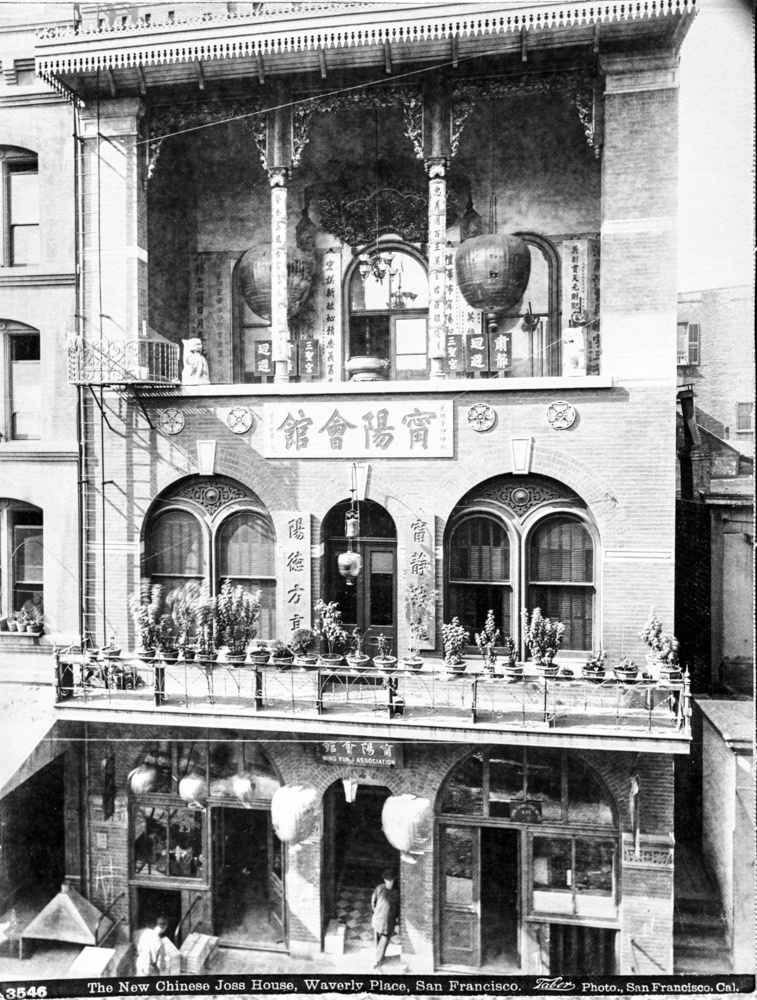
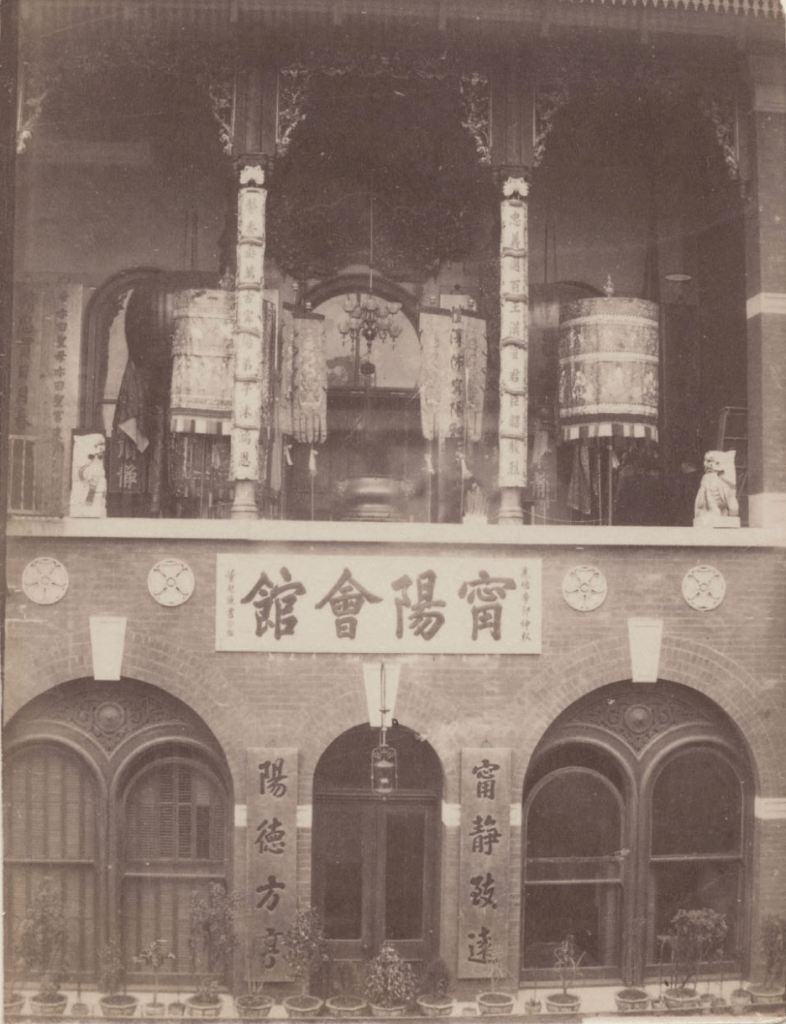
In 1892, Frederic Masters described Ning Yung’s building, located “on the west side of Waverly street between Clay and Sacramento streets,” as the finest temple in Chinatown and visitors reported marveling at its marble stairs and gas lighting. Construction costs reportedly reached $160,000 while the opening festivities, which lasted ten days, cost an additional $15,000 (newspaper reports, however, vary wildly on the final cost of construction and temple furnishings). Isaiah West Taber took a photo of the three-story building around 1891 (see imagery tab below).
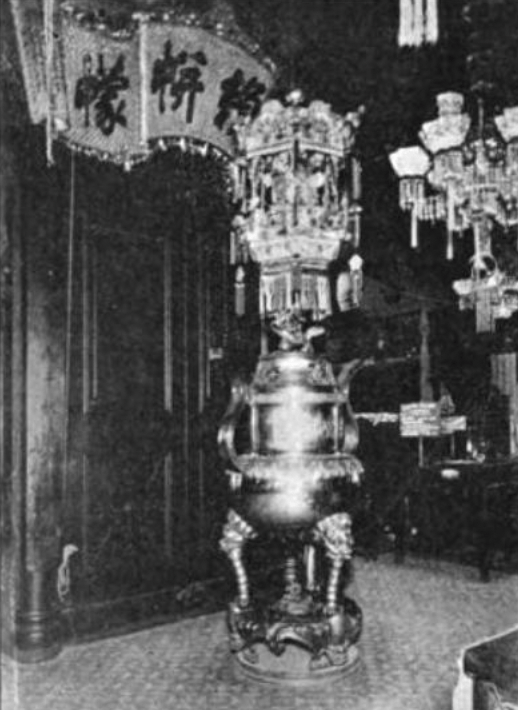
Masters also provides a fairly detailed description of the shrine hall’s interior, noting, for example, the presence of “inner folded doors,” which he reports are “never opened except when the idol is carried forth in procession.” Masters is referring to a separate interior doorway encountered immediately upon entering many temples in southern China, known as the “central door” (zongmen 中門), which visitors must walk around to enter the main altar space. As Masters further notes, a “monumental gateway piece of carved wood,” most likely an elaborate plaque known as a caimen 彩門, was hung above the central door, while an “enormous bronze urn worth a thousand dollars” was placed on the opposite side.
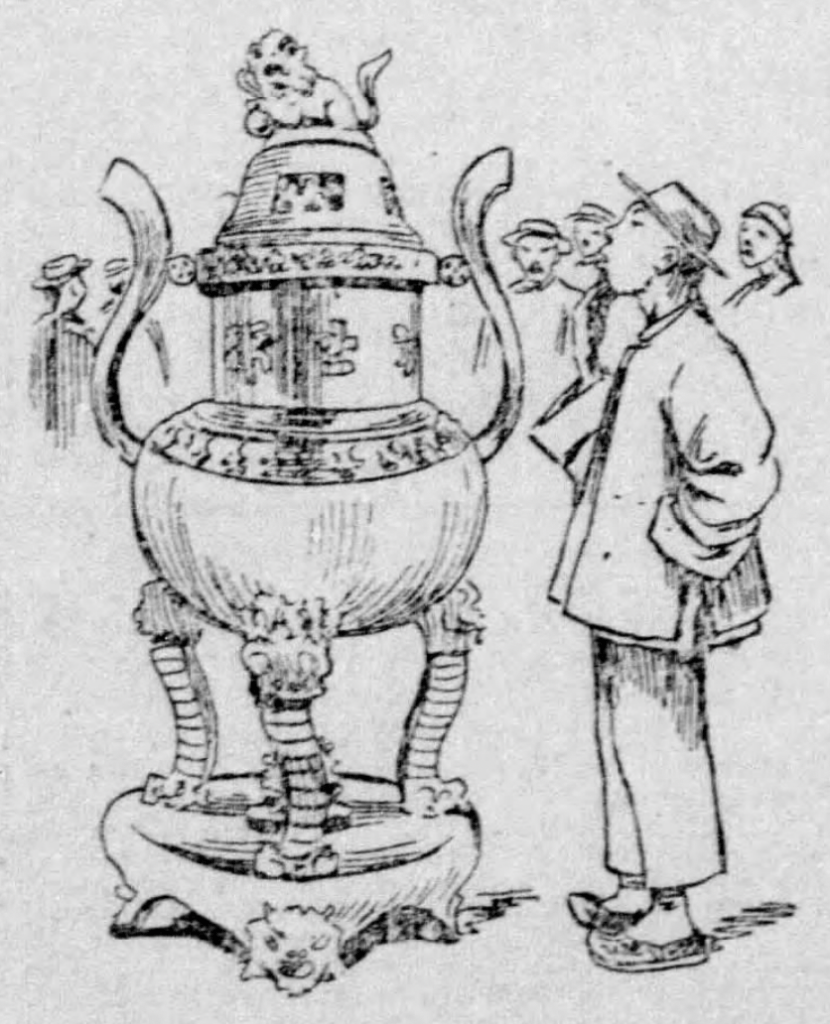
I believe an unidentified photograph showing a large censer set in front of a closed pair of central doors, provides a rare photograph of the interior of Ning Yung temple. The photograph, possibly issued by San Francisco photographer R. J. Waters, was published in a Chinatown remembrance by Presbyterian minister Ira Miller Condit in 1900 (see below). This identification is supported by a newspaper sketch showing the Ning Yung tripod censer during the temple’s opening festivities in 1891; the photograph and illustration show considerable similarities. The newspaper article claims the censer was seven feet in height and over a ton in weight. As noted by Ho and Bronson, this was only one of two colossal tripod censers they found in their research on North American Chinese temples.
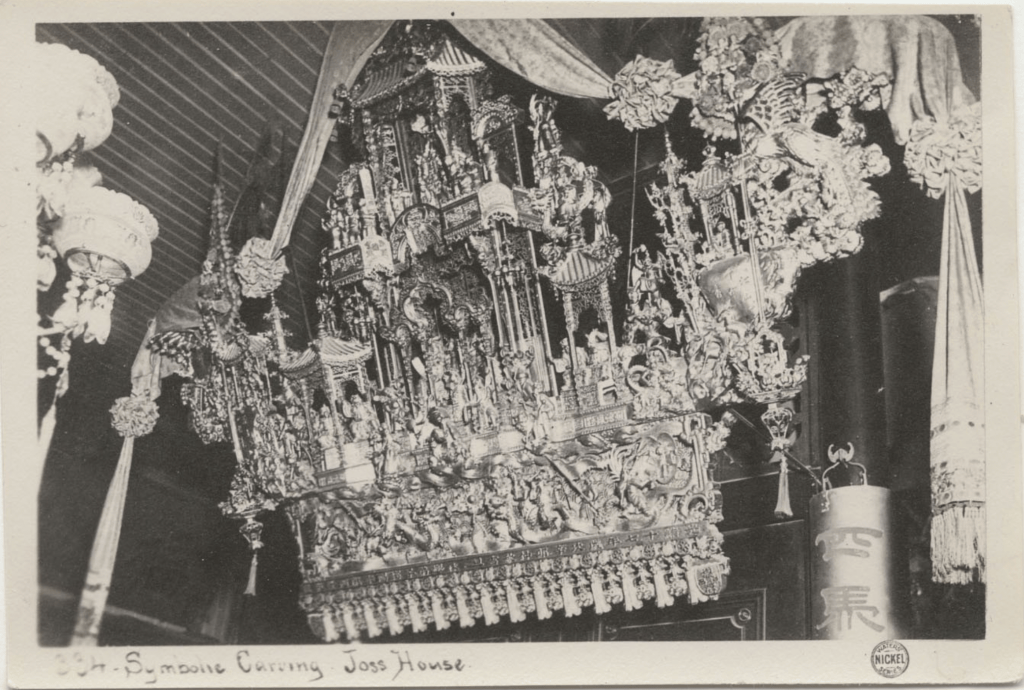
Two additional unidentified photographs issued by Waters as part of his “Nickel” series also appear Condit’s work and deserve closer scrutiny. One photograph shows an elaborately carved and gilded caimen hanging above a central door, just as Masters described; indeed, Masters provides considerable detail about the scenery depicted on the plaque. Importantly, Waters’s photograph clearly shows part of the plaque’s inscription which gives the date as the seventeenth year of the Guangxu Era, or 1891, corresponding to the opening of Ning Yung association building (see below).
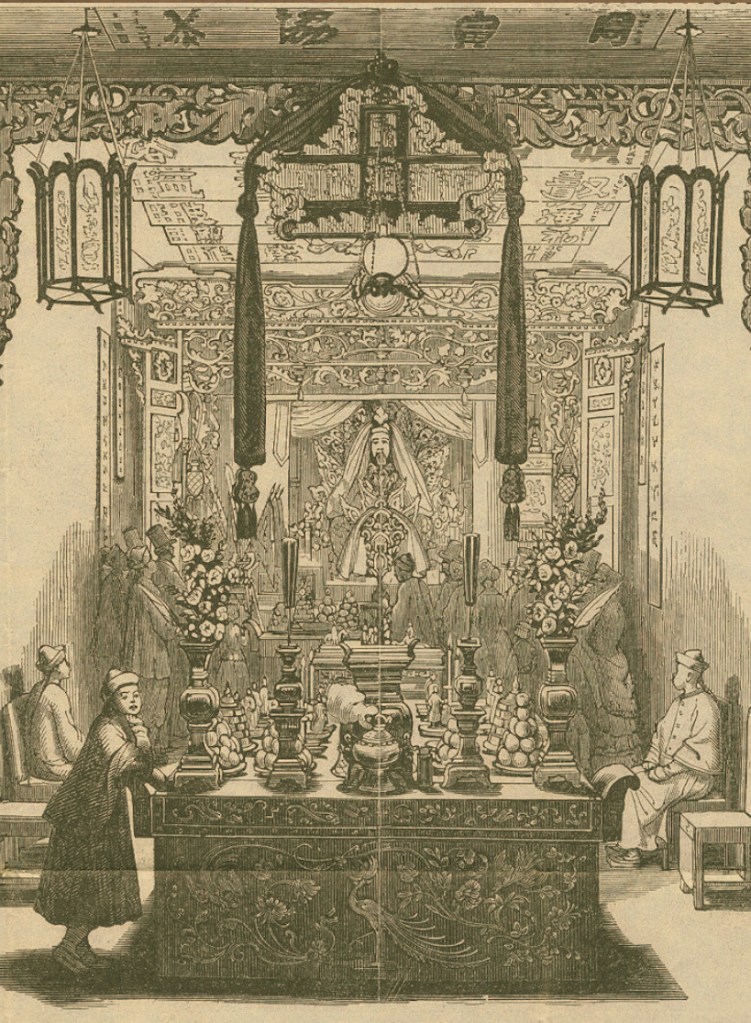
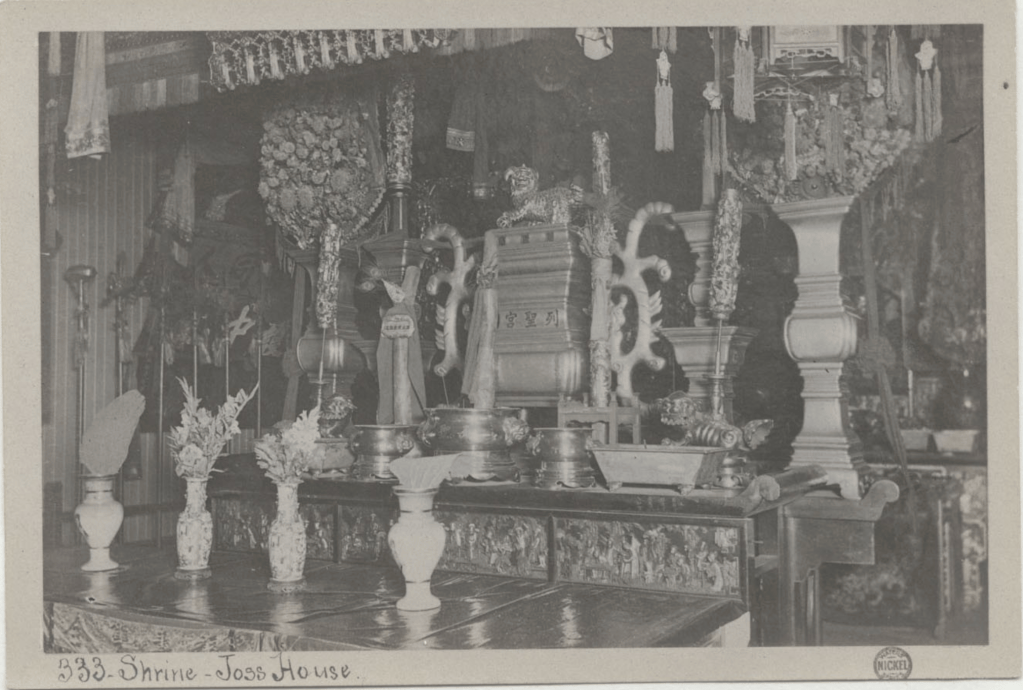
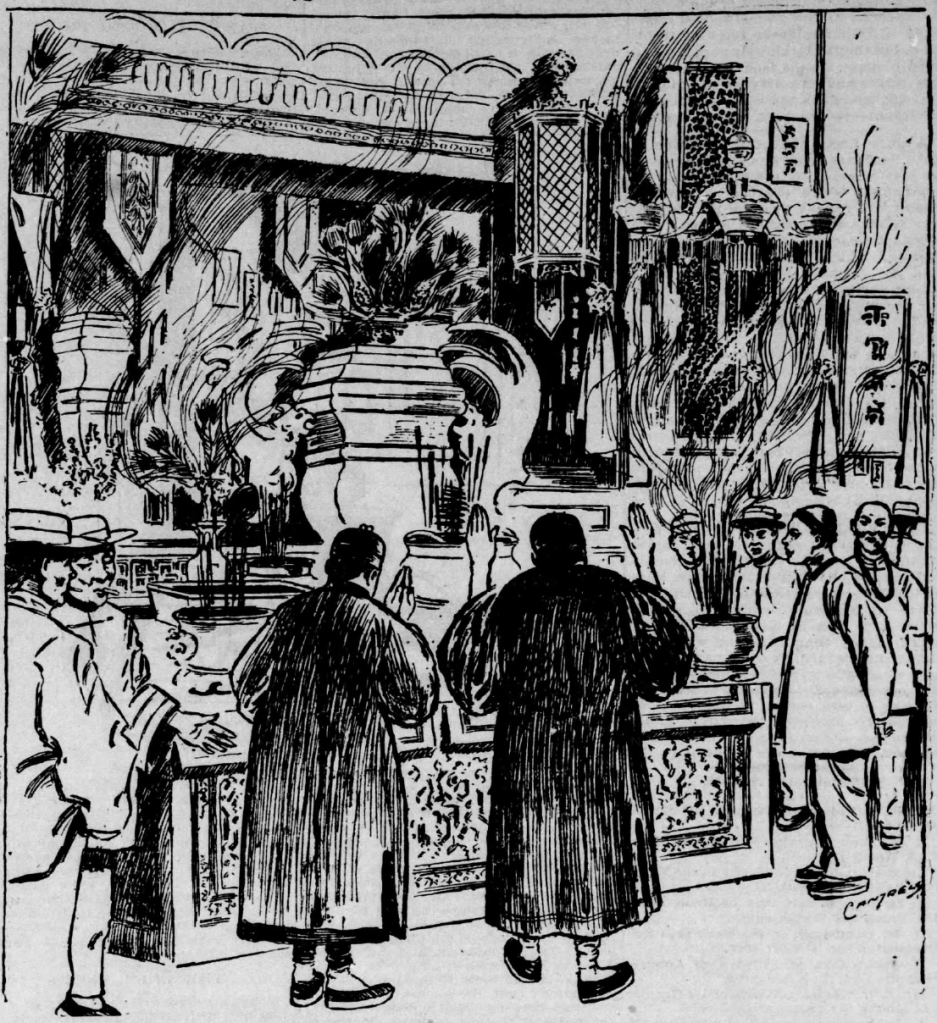
The second photograph shows a Chinese temple altar, complete with an altar set of censers, candlestick holders, and flower vases. The oversized central censer is inscribed “Temple of Many Saints” (liesheng gong 列聖宮), a name according to Masters that was inscribed on a plaque on the temple’s third-floor veranda and also used by numerous Chinatown temples (see below). The oversized central censer, together with the general arrangement of the altar and lanterns, appears to correspond to a newspaper sketch of the Ning Yung temple interior published in 1897 (see below). It appears Waters captured a rare photographic record of the interior of Ning Yung temple, one of Chinatown’s most opulent “joss houses” in the 1890s.
By the turn of the twentieth century, the Ning Yung shrine hall emerged as one of the more popular attractions on the Chinatown walking tour circuit. One 1902 San Francisco Chronicle article provides a map, directions, and commentary for the most important sites to visit while in San Francisco’s Chinese district. The map suggests a prospective visitor start at Portsmouth Plaza and walk westward up Washington Street, making stops in Washington Place and Dupont Street before heading to Waverly Place. While walking south on Waverly tourists are instructed to visit the new Wong family temple [see #40] and the “Temple of the Great Joss,” describing it as the “most magnificent house of worship in the quarter” (the map mistakenly places the Ning Yung building north of Clay). According to the reporter, temple managers catered more to tourists than Chinese worshipers, “for the sake of American gold.”
After the 1906 earthquake, the association building was rebuilt, but the shrine hall was not replaced.


7. City God Temple I (Chenghuang miao 城隍廟)
22 Waverly Place | 1905 Sanborn | Temple map
An 1892 Chinatown city directory placed a City God Temple (Chenghuang miao 城隍庙) at 22 Waverly Place. That same year, Frederic Masters published his survey of San Francisco Chinatown temples, concluding with a brief note on this specific site. Masters located the City God Temple opposite the Ning Yung Association building and noted that its interior featured vivid “representations of the Buddhist Hells.” Nineteenth-century American missionaries in China were frequently fascinated by gruesome depictions of Buddhist hell realms, sometimes citing a temple on Mount Putuo as having a particularly disturbing set of imagery.
The traditional role of the City God (Chenghuang shen 城隍神, literally “Wall and Moat Spirit,” with “wall and moat” functioning as a synecdoche for a “city”) was to protect the people and the affairs of a particular city, acting as a spiritual parallel to the protective functions of the state appointed magistrate. Both local officials and ordinary citizens appealed to the City God for supernatural aid during crises beyond human control.
Equally, the City God was envisioned as part of a much larger spirtual bureacracy, like his earthly counterpart. As part of popular belief in China, when an individual died, the soul was first brought before the local City God, who maintained ledgers of a person’s good and evil actions similar to local magistrates’ archives. The City God then transferred the soul into the subterranean judicial bureaucracy of Buddhist-derived underworld courts. By the late Qing dynasty, every imperially administered city in China housed a City God temple, often containing graphic imagery of these underworld tribunals. Living relatives visited these shrines to file spiritual petitions, perform merit-making rituals, or otherwise intercede on behalf of deceased loved ones navigating the post-mortem court system.
Although Masters specifically characterized the City God Temple in San Francisco as featuring “Buddhist Hells,” concepts of the subterranean judiciary had long merged into widespread Chinese popular religion. Outside of these depictions, we have little information regarding how the City God Temple was used by local Chinatown residents. One later report claimed the temple-keeper helped pray for the deceased, hinting the City God Temple was primarily used for mortuary practices as was common in China.
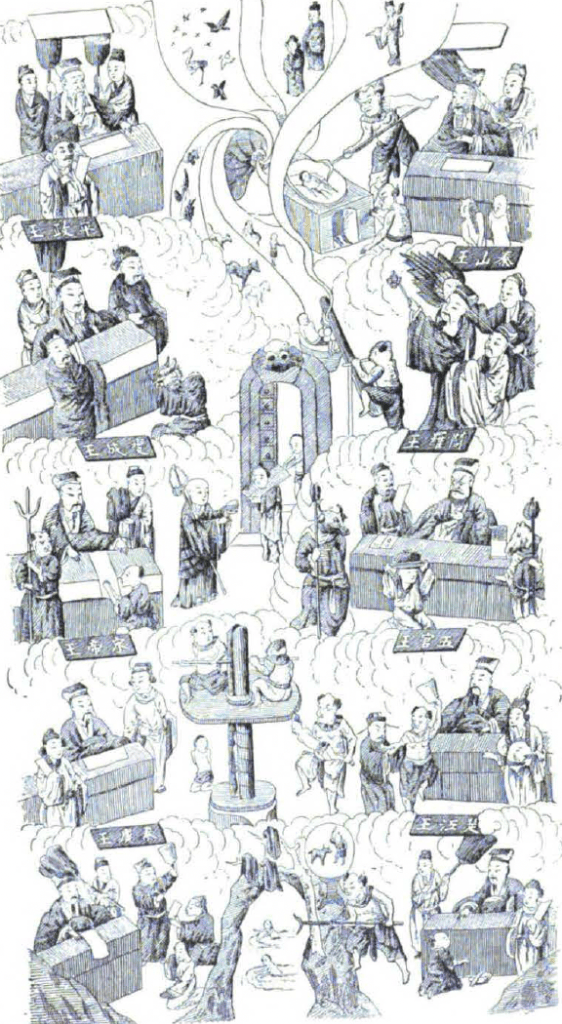
Interestingly, Masters would elsewhere return to the topic of Buddhist Hells and publish an illustration of the ten underworld courts “hung in private homes,” of the Chinese (see imagery tab below). While Masters did not specify if he was reporting on private homes in China or Chinatown, the image still provides a contemporary illustration of how such realms were envisioned.
An icon of the City God was first recorded in Chinatown as part of the diverse pantheon enshrined in Ah Ching’s private temple near Mason and Post streets [#X3]. When that temple burned down in 1874, it is unknown if the City God icon survived.
By 1897, the Temple of the King of the City, as the City God Temple was known in the American press, had moved to 1018 Stockton Street [#23].
8. Hong Sing Society
805 Clay Street [?] | 1905 Sanborn | Temple map
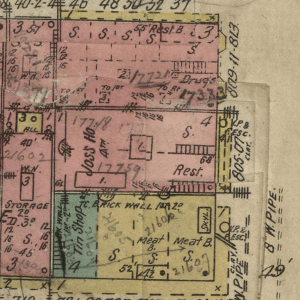
In 1892, a fire damaged the roof of the St. Francis Hotel, located on the southwest corner of Dupont and Clay streets (previously, I misidentified this as the northwest corner). A San Francisco Call article reported the fire also damaged a joss house belonging to the Hong Sing Society located “on Waverly.” Excluding the City God Temple which was located at 22 Waverly Place [#7], there is no immediately identifiable fraternal society located on the west side of Waverly between Sacramento and Clay streets. After examining the description of the path of the fire, discussed below, I believe the damaged joss house was actually located on Clay Street. While there is no joss house shown on the lower 800-block of Clay Street on either the 1885 Supervisors’ map or the 1887 Sanborn map, the 1905 Sanborn map does show a joss house occupying the top floor of 805–807 Clay Street.
The Call article covering the fire reports that it began at the rear of 715 Dupont Street, causing significant damage to the Hang Far Low Restaurant [#5] before spreading north toward Clay Street and destroying or damaging numerous structures. The owners of several affected buildings—including Paul Fleury, who leased his building to Hang Far Low; Daniel Eastbrook; and the Crooks estate—remained listed as the owners of these properties in the 1894 municipal “block book.” The old St. Francis Hotel, on the southwest corner of Dupont and Clay streets, was described as having been “badly damaged on the roof.” The Hong Sing Society’s shrine hall was said to be “in the building back of the hotel,” which appears to place it in the building at 805–807 Clay Street as shown on the 1905 Sanborn map.
The Call article identifies the joss house as being on the third floor, which aligns with the building on Clay Street depicted in the 1887 Sanborn map. By 1905, however, the Sanborn map shows a four-story brick building with the top floor occupied by a joss house. Might this represent the reestablishment of a society shrine hall in a new building following the 1892 fire? Dozens of Chinese secret societies emerged during the 1880s and 1890s and I have been unable to find any further information about the Hong Sing Society
If the Call newspaper sketch is accurate (see below), it suggests that even relatively obscure fraternal societies maintained surprisingly elaborate shrine halls.
9. Sze Yup Association II (Siba huiguan 四邑會館)
820 Clay Street | 1905 Sanborn | Temple map
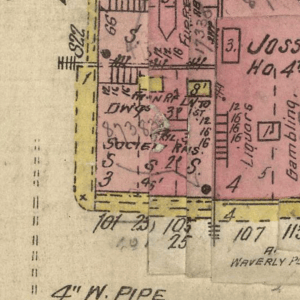
The first Sze Yap Association was organized at the end of 1851, but infighting and a series of struggles for control soon led its members to divide into competing groups. The original organization ultimately dissolved in the 1860s and reemerged as the Kong Chow Association. In 1895, a new Sze Yap organization was established. According to Ho and Bronson, this later organization had no historical institutional connection to the earlier district association and appears instead to have represented a coalition of smaller organizations and secret fraternal societies. The shared name, therefore, can be misleading: by the 1890s, “Sze Yap” (or See Yup as was often seen in contemporary newspapers) could refer to a different organizational constellation than it had a generation earlier.
Whatever the precise institutional affiliations (and future research will undoubtedly clarify these complicated relationships), newspaper accounts from the mid-1890s attest to numerous violent clashes between Sze Yap and Sam Yap members. The conflicts attracted the attention not only of the San Francisco police but also of the Qing government’s consuls-general, who had been appointed to represent Chinese interests in the United States and increasingly involved themselves in efforts to curb violence within Chinatown. In 1896, just a year after the new Sze Yap organization was incorporated, police raided its headquarters at 820 Clay Street with the approval and guidance of the recently appointed Consul-General Fung Yung Heng.
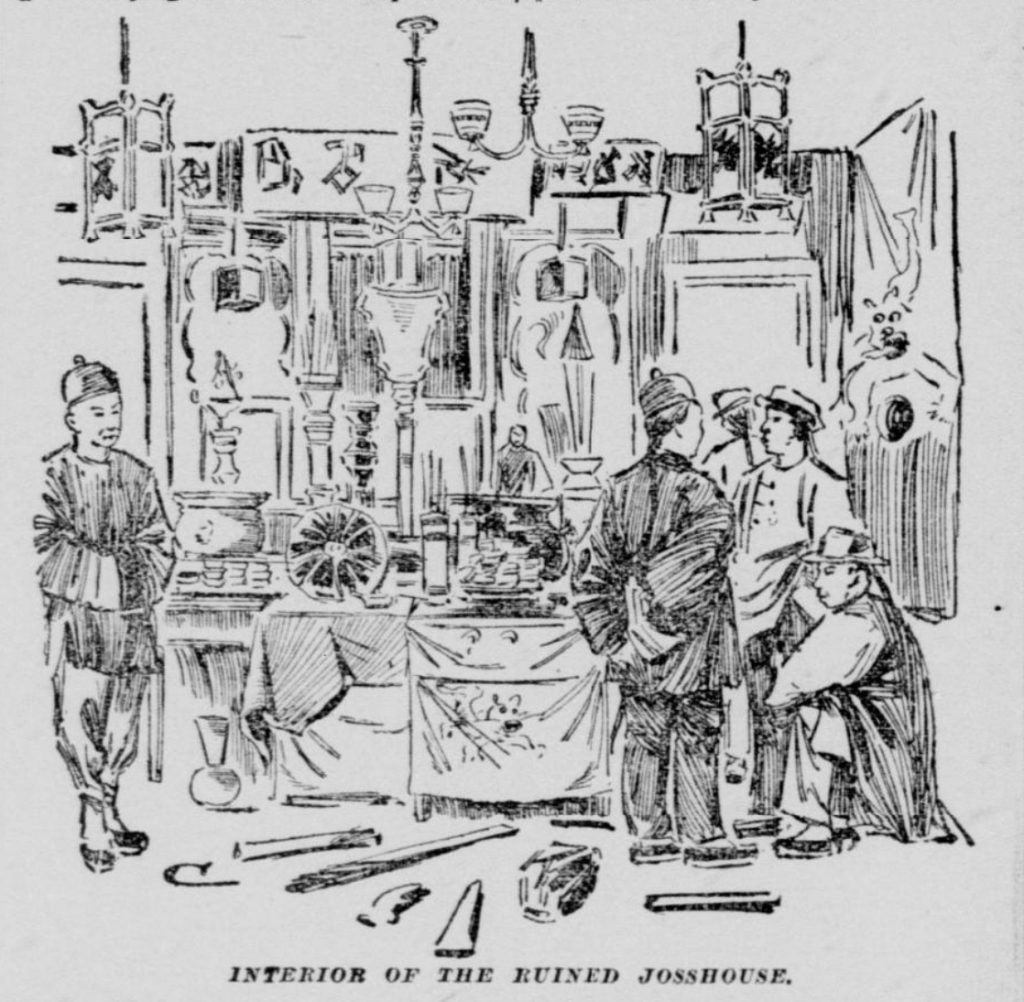
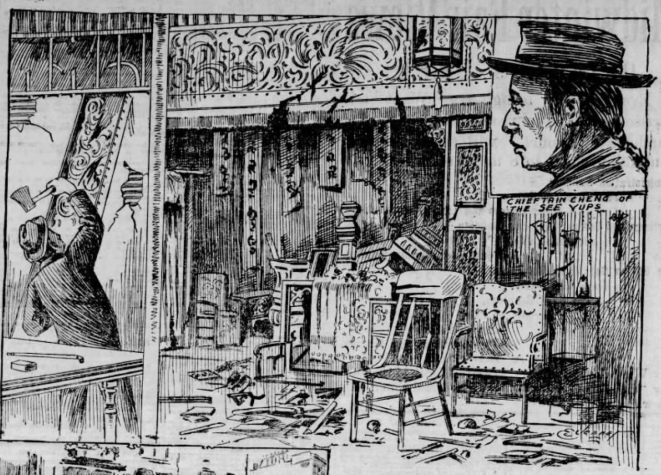
The raid was intended, in the words of one newspaper report, to force the violent “highbinders” to “keep the peace or leave town.” Officers smashed through the locked doors of the building with hand axes, and after discovering the clubroom, where the society’s altar was installed, proceeded to destroy its contents. The news reporter described the aftermath in particularly vivid terms: “vases, lamps, lanterns, silver incense-burners and all the gorgeous paraphernalia of a swell Chinese clubroom lie battered and broken.” A newspaper sketch artist rendered the scene in considerable detail, placing the shattered remnants of the altar at the center of the composition (see imagery tab below).
Published on page 9 of the October 16 issue, the illustration was among the largest and most detailed images appearing in the newspaper that day. This was hardly unusual. Scenes of violence and destruction in Chinatown made compelling news coverage, and the accompanying illustrations helped shape how readers perceived Chinese life in the city. The altar’s destruction thus became more than an incidental detail of a police raid, it also provided a visual symbol for the perceived disorder of Chinatown and of the supposed connection between Chinese religious spaces and criminality.
Chinese religious objects were rarely depicted simply as ordinary devotional furnishings. They were instead made to signify something about Chinatown itself. When ritual images and altars were shown in the context of unfamiliar ceremonies, they could be presented as grotesque manifestations of “pagan” superstition; when police raids provided the occasion, the same objects appeared as “battered and broken” evidence of vice and violence. In either case, the religious artifacts themselves became props in a larger story about Chinatown as strange, threatening, and fundamentally alien. The 1896 Sze Yap raid is therefore significant not only for what it tells us about the destruction of a Chinese altar, but also for how the destruction was transformed into a spectacle for an American readership.
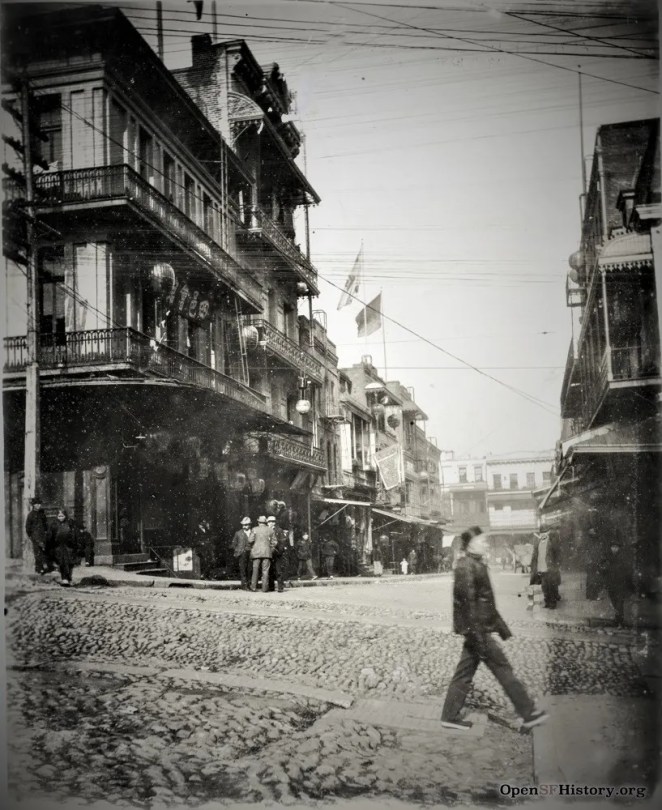
Despite the assoiciation with “tong warefare,” the new Sze Yup organization did not hide its whereabouts. One photograph attributed to Willard E. Worden circa 1900 looks nortward up Waverly Place, showing the building on the northwest corner adjoining Clay Street. Paper lanterns hinging on the second floor balcony clearly announce the “Sze Yap District Association” in bold Chinese characters (see below).
10. Dock Tin Society
810 Clay | 1887 Sanborn | Temple map
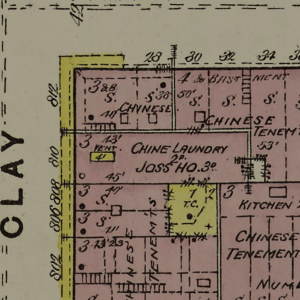
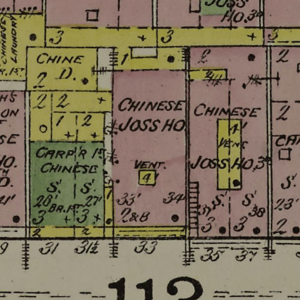
The 1887 Sanborn map notes this location at 810 Clay as “Chinese Laundry 2d Joss Ho 3d,” meaning it identified a joss house on the top floor. (The 1885 Supervisors’ Map identified the building as a restaurant.) Several contemporary photographs looking east down Clay towards Dupont suggest a shrine hall occupied the top floor (see below, also here, here, here & here). Hanging lanterns were a fixture on both restaurant and temple balconies, but one would expect to see inscribed boards above and on both sides of the main door of a temple. Existing photographs do not clearly show such details.
Newspaper reports, however, provide some clues. In January 1895, continuing police raids in Chinatown claim to have captured a “war joss” (i.e. Guandi) from Dock Tin Society at 810 Clay [source]. If we turn to the 1905 Sanborn map we find the third floor was still being used for society rooms [here].
Regardless of these activities, 810 Clay was perhaps most known for its successful restaurant that operated on the first and second floors into the early twentieth century. It appears the restaurant or building owner rented space to various Chinese societies from time to time. Overall, the eye-catching balconies of 810 Clay would become a favorite of Chinatown photographers and postcard manufacturers (see detailed write-up by Doug Chan here)[additional photos of Clay and Waverly here].

11. Suey On Society (Ruiduan tang 瑞端堂)
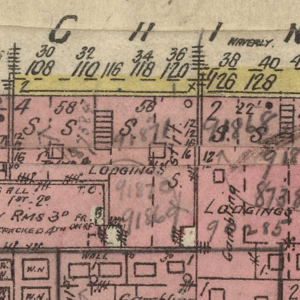
34 Waverly Place | 1905 Sanborn | Temple map
12. Tin How Temple (Tianhou miao 天后廟) & Hip Yee Society (Xieyi tang 協義堂) & Sam Yup Association II (Sanyi huiguan 三邑會館)[?]
33 / 121 / 125 Waverly Place | 1887 Sanborn | Temple map
In 1892, Frederic Masters published a survey of Chinatown temples where he made two claims about Tin How Temple on Waverly Place that significantly shaped modern perceptions of the temple’s history. Masters, the head of the Methodist Chinese Mission in San Francisco, appeared to have deep personal familiarity with many of the temples he described, giving his assertions a sense of credibility that have been difficult to dismiss. When discussing Tin How Temple, Masters described it as “the oldest Joss-house in San Francisco,” claiming it had been “erected over forty years ago,” and explicitly identified it as “the property of the Sam Yap Company.”
As Ho and Bronson have recently argued, however, neither the claims regarding Tin How Temple’s age nor its affiliation with the Sam Yup Association are supported by historical documentation. Instead, they argue that the temple functioned independently, like several other contemporaneous Chinese American temples in San Francisco, and was most likely only occasionally used by Sam Yup members. Moreover, Ho and Bronson find no evidence supporting a founding date earlier than the late 1870s.
Additional uncovered evidence supports Ho and Bronson’s conclusions. Let us first turn to the Sam Yup Association. In 1868, nearly twenty years after the reputed founding date of Tin How Temple implied by Masters, the Sam Yup Association is documented by Augustus W. Loomis as owning buildings on Clay and Sacramento Streets and leasing office space on Commercial Street, yet there is no mention of property ownership or tenancy on Waverly Place. Further, an 1880 city tax assessment locates a Sam Yup joss house at 825 Dupont Street [#15], suggesting no clear institutional connection to Tin How Temple, which is already documented as operating on Waverly Place by this time (we turn to this below). Taken together, this evidence undermines the recurring claim stemming from Masters that the Sam Yup Association maintained close ties to Tin How Temple since the early 1850s, potentially acting as the company’s original and primary “joss house.”
Similar problems of documentation arise when examining the history of Tin How Temple. Most notably, between July 1872 and March 1873, the building at 33 Waverly – the same address associated with Tin How Temple prior to the 1906 earthquake – appears repeatedly in city newspapers as a residential property available for lease [Fig 4]. Nothing suggests the building was being used as a temple at this time. In April 1874, public notice was given that the property had been leased for three years at $100 per month to an unnamed Chinese man [Fig. 5]. It remains unknown what role, if any, this individual played in transforming 33 Waverly into Tin How Temple, but the property was apparently sold before the lease agreement expired. As documented by Ho and Bronson, the building at 33 Waverly was sold in July 1876 by J. L. Eoff to a legal entity listed simply as “Tin How” for $15,000 [Fig. 6]. This transaction constitutes the earliest known documentary reference to what would become Tin How Temple. The property was sold again in 1879 to an otherwise unknown individual named Ly Haung, for the same price of $15,000.

Fig. 5: Waverly leased; San Francisco Chronicle, 1874 April 2.
Fig. 6: Waverly property sold; San Francisco Chronicle, “Real Estate Notes,” 1876 Juyl 19.
New evidence suggests a critical role of the Hip Yee Society in the transactions of 33 Waverly. As reported in the San Francisco Call, but not in the San Francisco Examiner referenced by Ho and Bronson, Ly Haung simultaneously purchased a second property in 1879 on Washington Place from the Hip Yee Society for $5,000. The timing of Ly Huang’s two transactions for buildings on Waverly and Washington is unlikely to be coincidental. To me, it suggests the Hip Yee Society was likely conducting business under the name “Tin How,” purchasing the Waverly property in 1876 and then selling it three years later bundled with the Washington Place property to Ly Huang. The motivations behind these sales, as well as Ly Haung’s relationship to the Hip Yee Society, remain unknown.
Notably, the Waverly and Washington Place properties remained in Ly Haung’s possession until December 1890, when he sold them both back to the Hip Yee Society, which had earlier that year formally registered under the name Hip Yee Pioneer Association of California. Regardless of the formal ownership of 33 Waverly between 1879 and 1890, the Hip Yee Society was still described in 1883 as “owning” a joss house. Because this claim appears in a discussion of Chinatown’s largest and most prominent Chinese temples, it certainly refers to Tin How Temple, which otherwise goes unmentioned. This suggests, as already proposed by Ho and Bronson, that Ly Huang could have been a member of a temple committee designated to hold the deed, rather than an wholly independent investor.
Additional evidence underscores the role of the Hip Yee Society in Tin How Temple’s early history. The strongest evidence appears in the 1878 city directory which places the Hip Yee Society temple at 33 Waverly, two years after the property’s purchase by “Tin How” in 1876. The city directory from 1877, however, locates the Hip Yee Society temple at 730 Jackson Street. What may account for this discrepancy? Critically, the 730 Jackson Street address is claimed to have housed a temple dedicated to the goddess Tianhou around this period [#28], the same deity enshrined by Tin How Temple. Then in June 1877, we encounter newspaper reports of a new temple on Waverly, “constructed from a house,” dedicated to the “Daughter of Heaven,” an inexact rendering of the name Tin How (Tianhou) [Fig. 7].
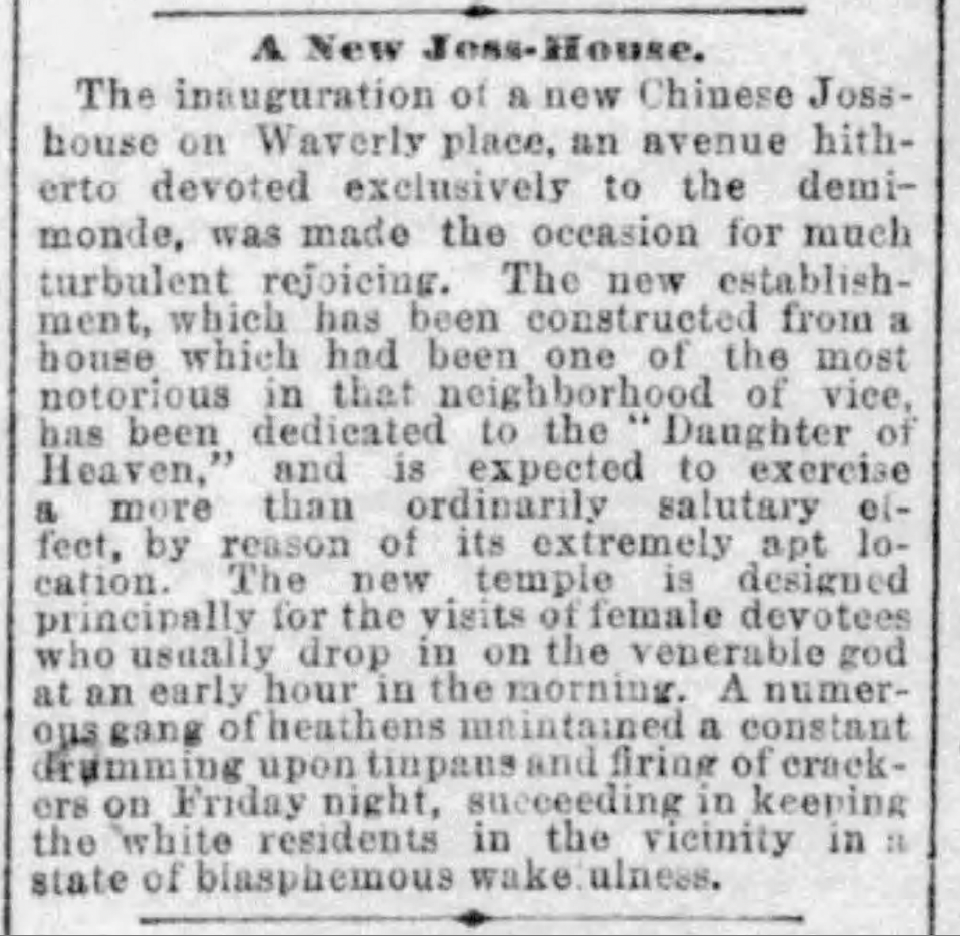
On the basis of the above documentation, it is possible to reconstruct a tentative timeline of events. In the summer of 1876, a “Tin How” organization, likely functioning as the legal arm of the Hip Yee Society, purchased 33 Waverly Place. During the renovations required to convert the former residential building into meeting rooms and a shrine hall, Hip Yee members appear to have used 730 Jackson Street, a property owned by the prominent Chinese physician Li Po Tai, either as a temporary site for the Tianhou shrine or, possibly, as the location of an already-operational temple established several years earlier (While home to the Chinese cigar manufacturer, Partagos & Co., the building at 730 Jackson was large and would come to house Chinese temples periodically over the next decade). Once renovations at Waverly Place were completed, the icon was transferred to its new location in June 1877, at which point the Tin How Temple was formally dedicated and opened to the public. The involvement of the Hip Yee Society is confirmed by its listing at 33 Waverly Place in the 1878 city directory. For reasons that remain unclear, the Hip Yee Society, operating under the name “Tin How,” sold the property to Ly Haung in 1879. Ly Haung retained ownership of 33 Waverly Place for the following decade before selling it back to the reorganized Hip Yee Pioneer Association.
While further research is warranted, these records suggest that the Hip Yee Society played a consequential role in founding Tin How Temple in the late 1870s on Waverly and had a substantially closer relationship with the temple than the Sam Yup Association through at least 1890. From our current vantage point, claims that the Tin How Temple originated in the early 1850s appear to be solely linked to the perceived connection to the Sam Yup Association which independently organized in 1853. Not only do we lack contemporary documentation from the 1850s through the 1880s to support this belief, evidence supports an alternative history for Tin How Temple beginning in 1876, with the purchasing of a residential building at 33 Waverly, and its transformation into an operating Chinese temple by June 1877.
The reasoning for Master’s claim in 1892 regarding the affiliation between the Tin How Temple and the Sam Yup Association is uncertain. Perhaps the two entities had an informal, yet very close, relationship at this time. But even this claim is diminished when looking at contemporary newspaper reports. In 1892, the same year as Master’s survey of Chinatown’s temples, the San Francisco Examiner covered the birthday celebration of Tianhou. The reporter carefully notes that, “here in San Francisco, Tin How was remembered by but one society, the California Chinese Pioneer Association,” indicating the Hip Yee Pioneer Association – and never mentioning the Sam Yup Association.
Master’s assertion that the Tin How Temple was “the oldest Joss-house in San Francisco,” being “erected over forty years ago” when the Sam Yup Association independently organized cannot be taken as credible without new evidence. The identity of Ly Haung may prove important in partly explaining Master’s claim, especially if he was not connected to the Hip Yee Society, but a member of the Sam Yup Association, an organization comprised mainly of merchants who would been well suited to finance an expensive property purchase. Further research may resolve these questions.
As indicated by the temple’s name, the central icon enshrined was the goddess Tianhou 天后, the Empress of Heaven, also popularly known as Mazu 媽祖. The establishment of this figure on Waverly in 1877 must have been an important event for the Chinese in the city, as a San Francisco Call article in June of that year notes the Chinese were already calling Waverly Place, “Tin How Temple Street.” The importance of this goddess to the local Chinese community was already evident through the festivities held at An Ching’s Tin How Temple on Mason Street [#X3]. Before its destruction by fire in December 1874, this Mason Street temple appears to have been Chinatown’s most significant site associated with the goddess and its loss must have left a vacuum in the religious landscape of Chinatown. In time, this void was filled by the new Tin How Temple.
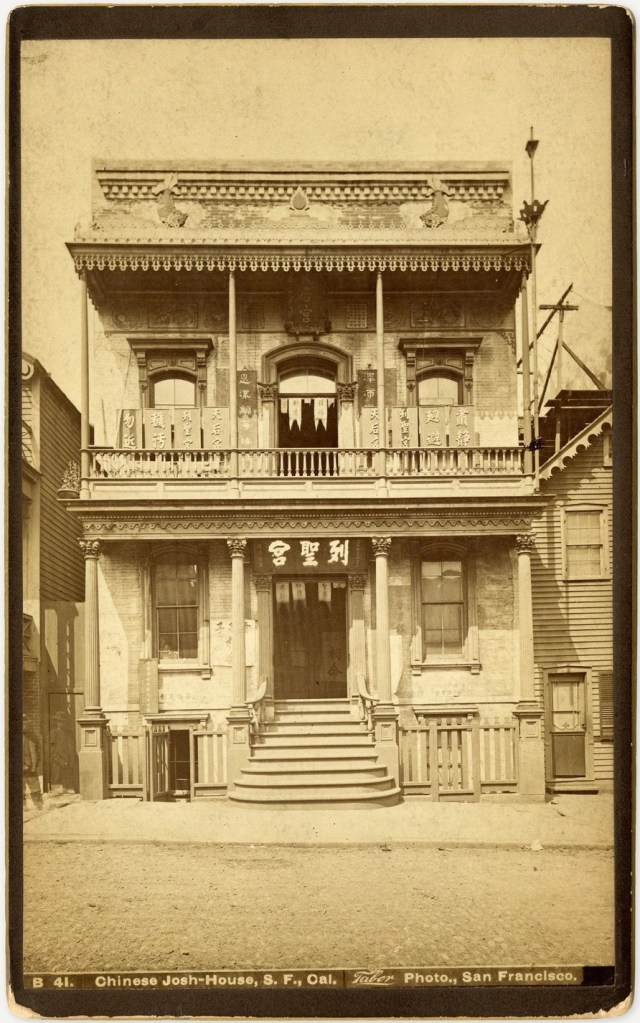
Isaiah West Taber took several photos of the original, pre-earthquake building housing Tin How Temple. This included two photographs taken approximately in the mid-1880s, with another taken by Treu Ergeben Hecht around the same time (see imagery tab below). Notably, these three photographs show the neighboring building at 35 Waverly as a two-story frame structure with gabled roof. Consequently these predate the appearance of a three-story brick building on that lot, which seems to have been built around 1885 [#14].
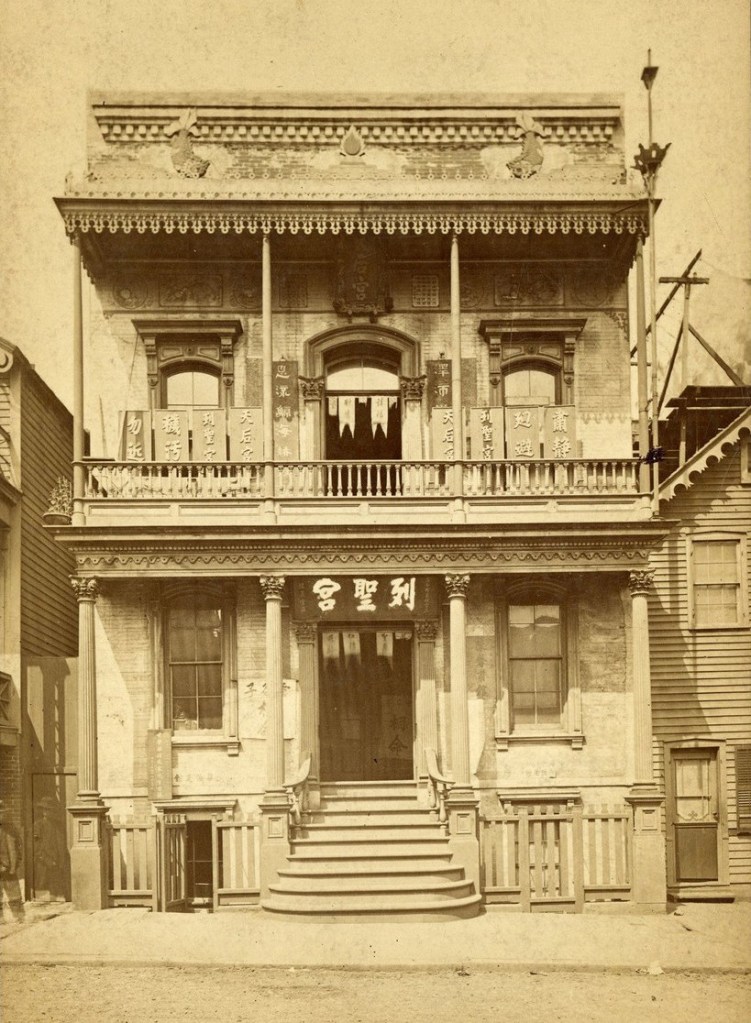
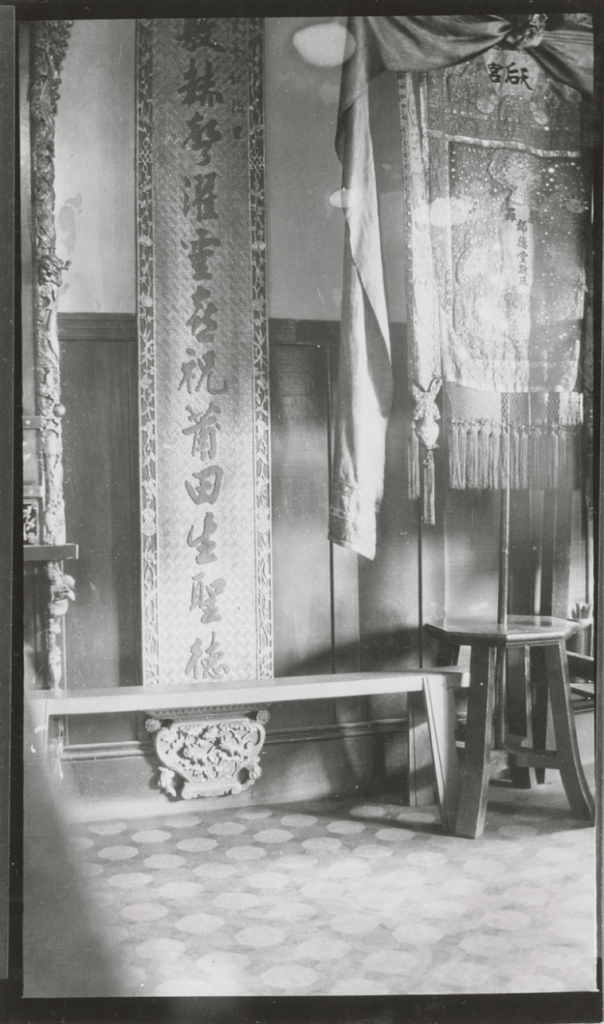
Tin How Temple’s facade was commonly used for early twentieth century Chinatown postcards (see here; also here), helping to establish it as a visual icon of pre-1906 Chinatown. No objects belonging to the original shrine hall appear to have survived the 1906 earthquake and fire; I also know of no surviving illustrations or photos of the original altar, although one candidate shows an incense burner inscribed with Temple of Many Saints (liesheng gong 列聖宮) as seen on the signboard above the Tin How Temple doorway (see here; see a falsified identification here). At least one undated photo which appears to have been taken prior to 1906 shows a part of the shrine hall interior; the name Tin How Temple is embroidered on the banner (see below).
Given the secondary name of the Tin How Temple as the Temple of Many Saints, we may surmise multiple icons were enshrined here, likely including Guanyin, but documentation is sparse as to the content of the shrine halls previous to 1906.
After the earthquake, the Hip Yee Pioneer Association sold the lot to the Sue Hing Benevolent Society who rebuilt Tin How Temple. It was reconstructed on roughly the same footprint of the old building, renumbered now as 125 Waverly. San Francisco guidebooks highlighting walking tours of Chinatown after reconstruction would often direct visitors to Tin How Temple, along with the newly rebuilt Kong Chow Association Temple [#X2]. For example, the 1914 Chamber of Commerce Handbook for San Francisco cites both as “the leading Joss Houses in San Francisco,” adding that “owing to changing faiths and ideas, no more are likely to be built” [source].
By the 1930s, Tin How Temple appears to have printed signage or souvenir histories claiming the temple was founded in 1844 by an immigrant named Day Ju, reputedly one of the first Chinese to arrive in California. One source even claims Tianhou’s altar was originally installed on Day Ju’s ship for daily worship before being removed to Waverly. In time, souvenir real-photo postcards were sold promoting Tin How Temple as “the oldest Chinese joss house in California,” quoting 1844 as the founding date (see below). This erroneous information is still printed in many San Francisco travel guidebooks today.


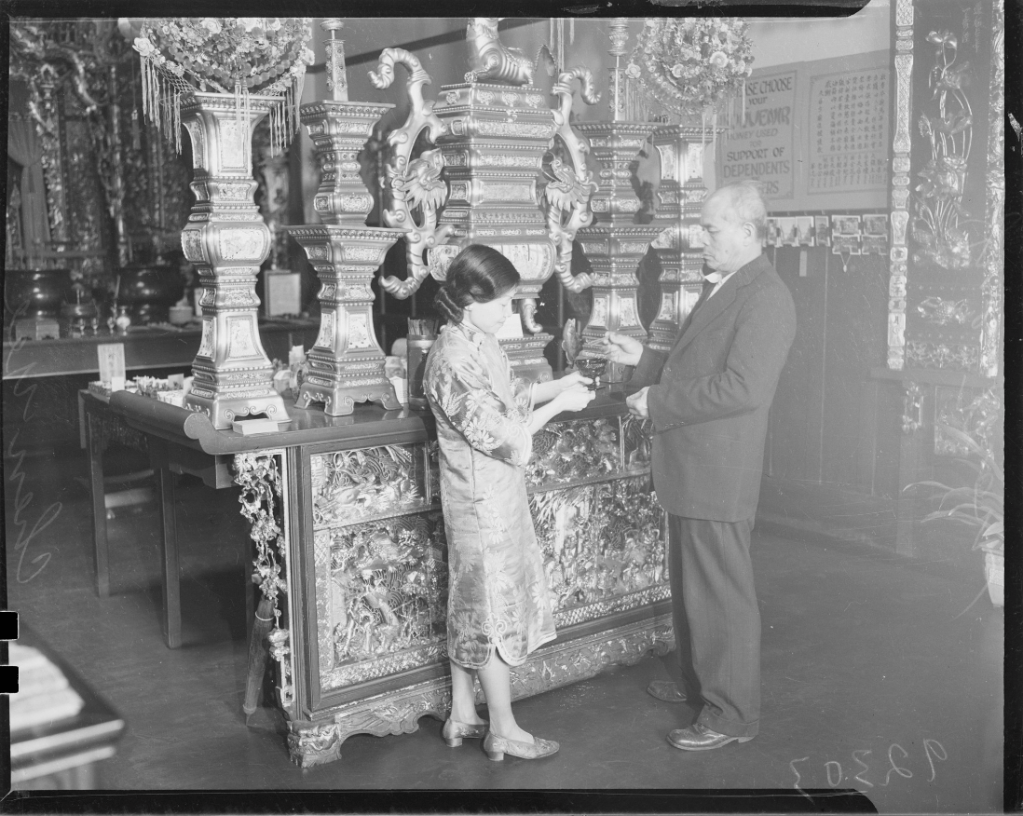
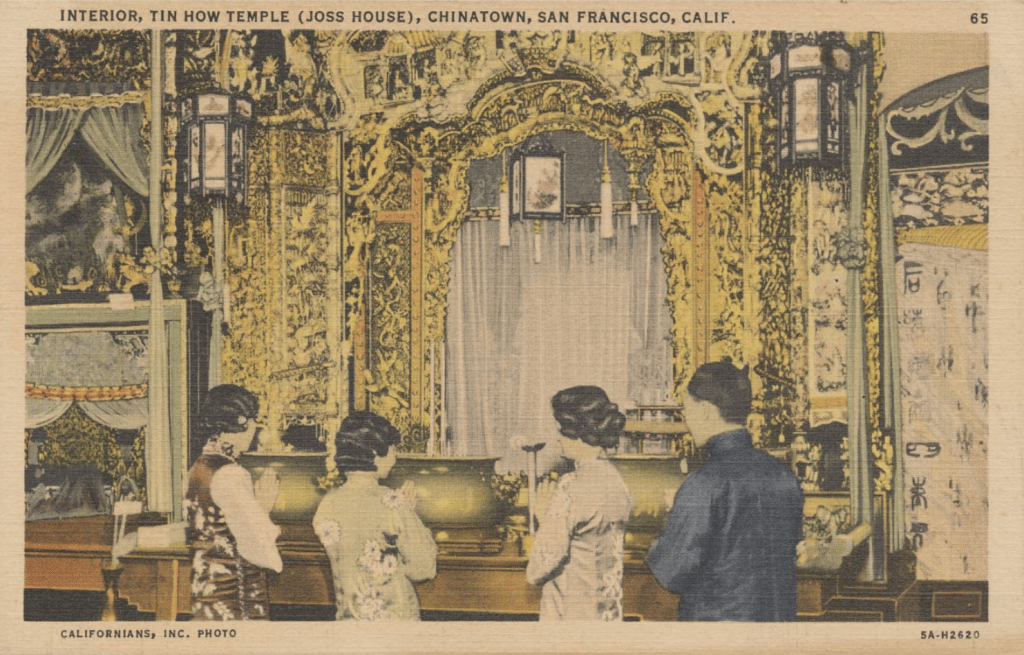
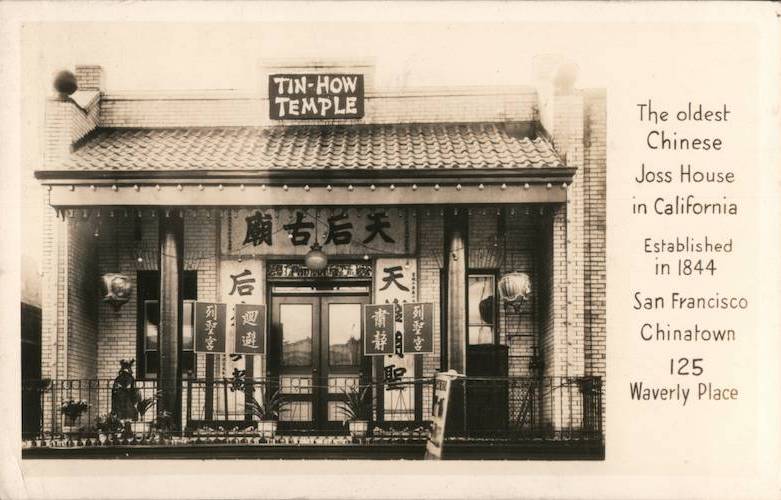
13. Hip Sing Society (Xiesheng tang 協勝堂)
10½ Spofford Alley | 1887 Sanborn | Temple map
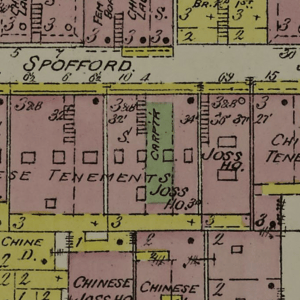
14. Eastern Glory Temple II (Donghua miao 東華廟) & Gee Tuck Society (Zhide tang 至德堂) & Yee Fung Toy Society (Yufengcai tang 余風采堂)
35 / 121 Waverly Place | 1887 Sanborn | Temple map
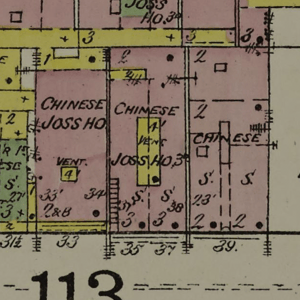
Adjacent to the Tin How Temple, 35 Waverly Place was rebuilt as a three-story brick structure around 1885. Approximately three years earlier, Li Po Tai appears to have relocated his Eastern Glory Temple from St. Louis Alley [#22] to this address. An 1882 guidebook describing a temple “on Waverly Place” identifies its central icon as the Supreme Emperor of the Dark Heavens (Xuantian shangdi) and names other figures known to have been enshrined at Li Po Tai’s St. Louis Alley location throughout the 1870s. (Ho and Bronson mistake the first edition of this guide as being published in 1885.) Another guidebook repeats this information in 1883. Furthermore, a July 1886 newspaper report covering a murder in front of 35 Waverly definitively places the Eastern Glory Temple at this address, confirming Li Po Tai’s move to Waverly by the mid-1880s.
There are at least two issues that deserve our attention regarding this potential timeline. First, the 1883 San Francisco city directory continues to list an unnamed joss house on St. Louis Alley. This entry likely refers to the Yan Wo Association’s shrine hall [#25], rather than Li Po Tai’s more prominent temple, a distinction seemingly corroborated by an 1883 guidebook that places a Yan Wo address on St. Louis. Consequently, it remains entirely feasible that Li Po Tai had already moved his temple to Waverly by 1882, a year prior to the directory’s publication.
Secondly, a single newspaper account from 1885 reports the Eastern Glory Temple as occupying 730 Jackson Street, a building owned by Li Po Tai. In this case, it is important to keep in mind the three-story brick building at 35 Waverly was constructed around this time, replacing a two-story frame building with gabled roof. Photographs of 33 Waverly taken by I. W. Tabor and T. E. Hecht clearly show this older gabled-roof structure (see imagery tab for entry #12). Notably, the 1885 Supervisors’ map identifies a structure at approximately 35–37 Waverly Place as a “new brick building, not finished,” precisely when the Eastern Glory Temple is briefly located on Jackson Street. I believe building renovations on Waverly likely forced a temporary relocation of the Eastern Glory Temple. Moving to a building already owned by Li Po Tai, and to a location where Chinese American temples had previously operated, represented a sound economic and logistical decision.
As detailed by Ho and Bronson the second floor of 35 Waverly was occupied by the Gee Tuck Society shrine, which was destroyed by an explosion caused by rival saboteurs in 1888. Firemen responding to the resulting fire reportedly chopped Gee Tuck’s main icon into “toothpicks.” While the Gee Tuck Society’s own oral history places their founding in 1879, their headquarters before 1888 remain unknown. In 1904, the Gee Tuck Society acquired the building across the street at 134–140 Waverly.
We hear little of Li Po Tai’s top floor shrine hall through the late 1880s, but sanitation inspection sweeps in 1889 and 1890 target Eastern Glory Temple for its filth and disorder. Frederic Masters still names the Eastern Glory Temple at 35 Waverly in 1892 as does a Chinese language business directory from the same year. This was one year away from Li Po Tai’s passing in 1893 and thus it appears the regular upkeep of his temple had fallen by the wayside. At some point after Li’s death, the third floor was used by the Yee Fung Toy Society, who purchased the entire building in 1896.
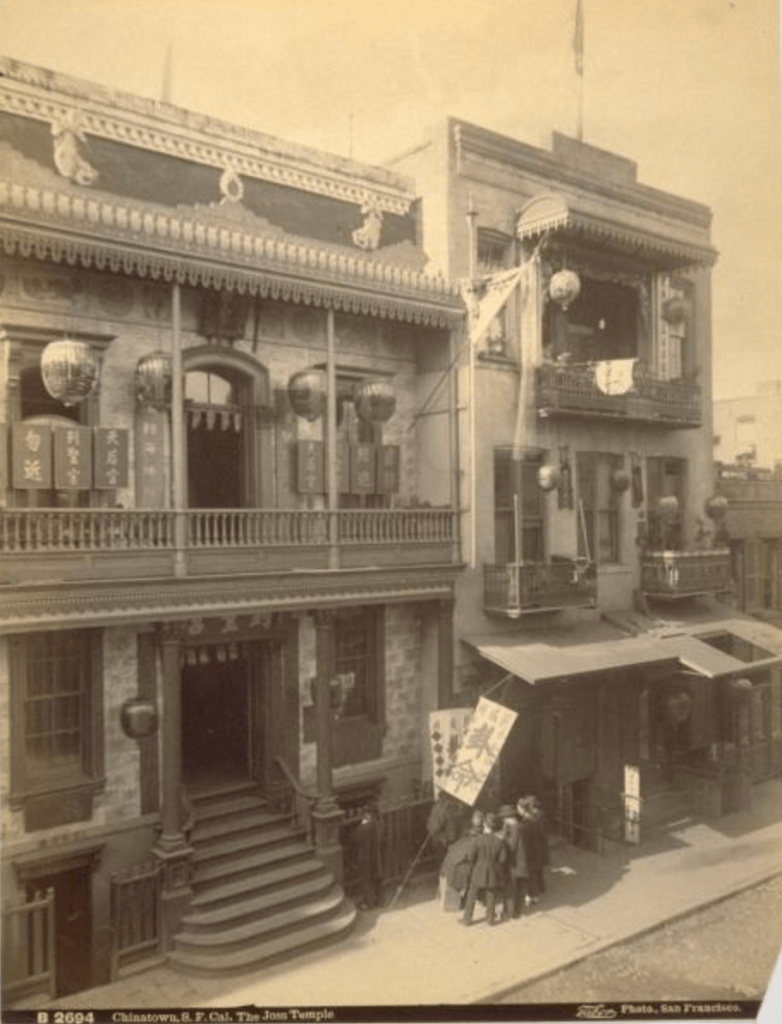
Isaiah West Taber photographed 33 and 35 Waverly in the late 1880s (see below), offering a unique cityscape portrait for sale by 1889. It is possible to see hanging lanterns and signboards on both the second and third floors of 35 Waverly. Taber entitled the photo “The Joss Temple,” likely unaware he captured three different temples at the same time. Ho and Bronson date Taber’s photograph to the 1890s and assert the top floor is occupied by the Yee Fung Toy Society. Perhaps a closer inspection of the physical photograph (or higher resolution scan) can reveal identifying information on the temple’s signboards, but if this is the same photograph for sale as in Taber’s 1889 catalogue, the top floor of 35 Waverly could only be Li Po Tai’s Eastern Glory Temple.
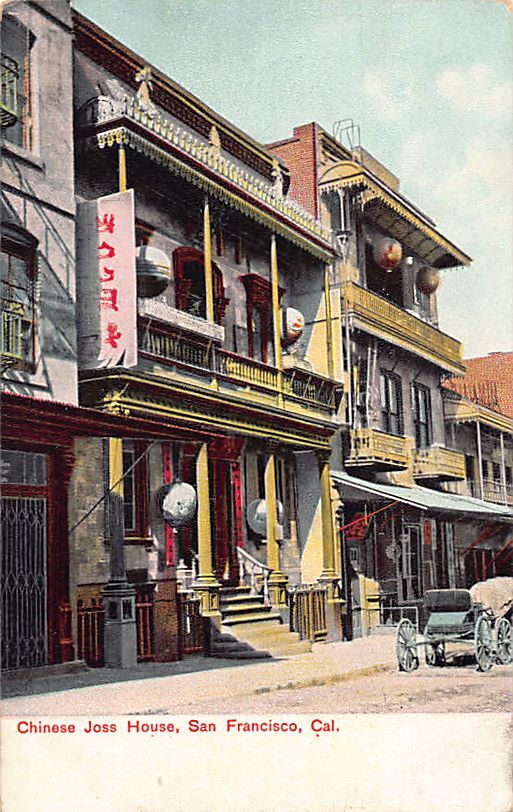
A postcard published by Fritz Müller shows roughly the same perspective (see below). Given there is no temple occupant on the second floor, we may infer this photograph was taken after the Gee Tuck Society relocated, but before the 1906 earthquake.
15. Sam Yup Association I (Sanyi huiguan 三邑會館)
825 Dupont | 1887 Sanborn | Temple map
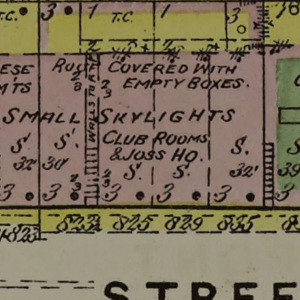
The Sam Yup Association is among the oldest district associations in San Francisco, founded in 1851 as the Canton Company, then operating as Sam Yup starting in 1853. Its close association with the Tin How Temple on Waverly at the turn of the twentieth century may explain why the latter is often cited as being founded in 1851, 1852, or 1853 (or sometimes, 1848). As noted above [#12], however, the affiliation between these two entities is obscure, but it is becoming clear the Sam Yup Association did not found the Tin How Temple in the 1850s. In fact, there is no clear evidence of them operating a company shrine hall in San Francisco until the 1880s.
In 1868, Augustus Loomis described the Sam Yup Association as maintaining a “company house” on Clay Street above Powell Street. This is likely the same frame house on Clay used by Sam Yup as reported in 1855. Loomis did not indicate whether this structure contained a dedicated shrine hall. While it is reasonable to presume a small private altar was established, a large public temple similar to other association temples does not appear to have been built. According to Ho and Bronson, the first Sam Yup temple in California was not in San Francisco, but in Sacramento in 1868.
In 1876, the Sam Yup Association was linked to an unknown address on Dupont Street and in 1878 is connected to 825 Dupont. The 1880 San Francisco city tax assessment listed a Sam Yup Company with a joss house at 825 Dupont (Ho and Bronson link this to 730 Jackson instead). The 825 Dupont address is corroborated by the city directory the following year in 1881, but unexpectedly also lists a “Sum Yup Co., Joss House” at 730 Jackson Street. This is the address of the poorly understood Jackson Street temple described as being devoted to Tianhou in the late 1870s [#28]. This is also the same address the Hip Yee Society occupied in 1877 before moving to 33 Waverly [#12], the location of Tin How Temple, in 1878. The relationship between the Sam Yup Association, Hip Yee Society, and Tin How Temple through the 1880s is poorly understood.
The city directory of 1882 again locates the Sam Yup Association at 825 Dupont, but assigns no ownership to the joss house it lists at 730 Jackson; it is not clear if this building was still leased by Sam Yup members as in the previous year, but the district association is not again connected to this building in future directories.
To add further complexity, the 1882 directory also lists an unnamed joss house on the west side of Waverly between Washington and Clay. This could refer to the Tin How Temple at 33 Waverly or, possibly, Li Po Tai’s Eastern Glory Temple at 35 Waverly when the building was still a two-story frame structure with gabled roof. More curiously, an 1883 guidebook places Tin How Temple on Waverly, in addition to a Sam Yup temple also on Waverly between Clay and Washington. To my knowledge, this is the first time the Sam Yup Association is linked to a temple on Waverly, but it is considered seperate from Tin How Temple. The unnamed joss house in the 1882 directory might instead indicate this Sam Yup building, but the information at hand does not allow us to resolve this question.
The city directory of 1883 again indicates the Sam Yup Association occupying 825 Dupont and an unnamed joss house again at 730 Jackson. Moreover, the directory lists, for the first time by name, a Tin How Temple on Waverly, in addition to an unnamed joss house on the west side of Waverly. There remains no evidence connecting the Sam Yup Association with the Tin How Temple up through 1883, as they appear as distinct organizational entities at this time. (The digitized 1884 city directory is missing the Chinese directory section.)
The 1887 Sanborn map lists “Club Rooms & Joss Ho.” at 825 Dupont, suggesting Sam Yup members kept at least a private company shrine at this address through the late 1880s. As suggested by Ho and Bronson, the Gee Tuck Society was identified in 1888 as an “offshoot” of the Sam Yup Association, thus they may have shared the shrine hall on the second floor of 35 Waverly. The Gee Tuck Society’s own oral history places their establishement in 1879, thus they could represent the unnnamed joss house on the west side of Waverly in the city directories of the early 1880s.
Fundraising efforts in 1899 finally allowed the Sam Yup Association to open their own dedicated public temple the following year at 929 Dupont Street [#24], as is reflected in the 1905 Sanborn map [here]. The main icon enshrined was Guandi.
16. Chee Kong Society (Zhigong tang 致公堂)
69 / 32 Spofford Alley | 1887 Sanborn | Temple map
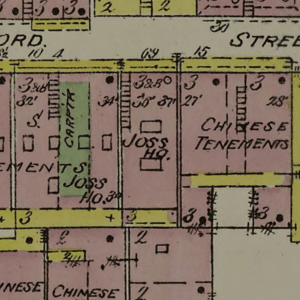
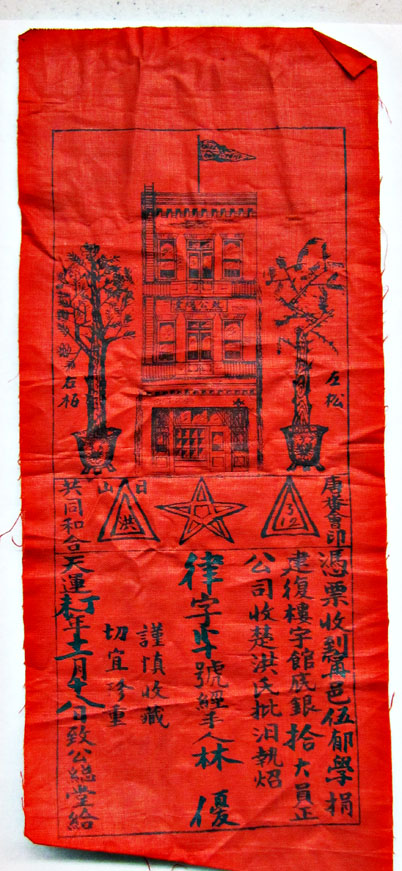
Often cited as the wealthiest and most influential of all Chinese “secret” fraternal societies, the Chee Kong Society occupied a three-story building on Spofford Alley from the early 1880s onward. Although many of their communal and social functions overlapped with district associations and clan organizations in the United States, fraternal societies emerged from a distinctly different historical and political lineage.
From a general historical perspective, the Chee Kong Society descended from the the Heaven and Earth Society (Taindi hui 天地會) in China, which emerged in the eighteenth century and advocated for the overthrow of the Manchu Qing emperors. Various anti-Manchu movements emerged, all seeking the restoration of Han Chinese rule under the Ming Dynasty. Consequently, members of these groups found inspiration and spiritual leadership in the first emperor of the Ming Dynasty, Hongwu, and thus referred to themselves more broadly as Hongmen 洪門 to signal their Ming loyalties. Because of their openly rebellious objectives, these groups were targeted and outlawed by the Qing government, forcing them to operate clandestinely as “secret” societies.
During the long course of the anti-Manchu Taiping Rebellion (1850–1864), many Hongmen fled overseas and settled among Chinese diaspora communities. According to Sue Fawn Chung, by 1854 there were 159 Hongmen in San Francisco, mostly comprising influential or wealthy merchants among the Chinese community. Because the political motivations of this Chinese secret brotherhood had no legal relevance in the United States, the group was compared to popular Masonic and Odd Fellow’s fraternities. Throughout the 1860s and 1870s, local branches actively encouraged this comparison, adopting the name “Chinese Masons” to enhance their prestige. As Ho and Bronson note, by 1879 certain branches also adopted the Chinese name Chee Kong Tong 致公堂, roughly translating to the “Hall of Universal Justice.”
The 1879 San Francisco city directory lists the Chee Kong Society, also recorded as the Independent Masonic Society, as occupying 827 Washington Street, just around the corner from Spofford Alley. In May of 1879, a public notice is placed the Daily Alta California announcing the formal incorporation of the Chinese Free Mason Society, which served as the primary public facing name of the Chee Kong organization (it was often used on the front of their individual lodge buildings). The stated object of their incorporation was for “benevolence, sociability and the diffusion of knowledge among its members.”
In 1880, the society purchased the property at 69 Spofford Alley and constructed its “Grand Lodge,” featuring a reported $15,000 worth of art and interior decorations. Unlike district or clan associations, fraternal groups like the Chee Kong Society imposed no birthplace, family lineage, or dialect requirements for membership. As Chung highlights, this fueled rapid growth, particularly in rural areas, ensuring that nearly every major Chinese community in the United States ultimately established a Chee Kong lodge.
According to Ho and Bronson, the Chee Kong Society continued observing similar initiation rites and rituals as their parent organization, the Heaven and Earth Society, which remained cloaked in secrecy. As tensions grew in San Francisco’s Chinatown due to legal, social, and economic deprivations in the 1880s and 1890s, the American public developed a lurid fascination for information about Chinatown’s “secret” societies who were ensnared in violent “tong wars” employing many “hatchet men.” Ultimately, the Chee Kong emerged in public consciousness as one of the groups who most profited from violence and vice and were sometimes presented as having an antagonistic relationship with the federation of district associations known as the Chinese Six Companies.
In 1886, Harper’s Weekly covered the the society’s elaborate initiation rituals which took place in front of a religious altar. The shrine hall is not described in the text and the accompanying artist’s sketch may be fictional, but the altar table and altar pieces are in accord with typical Chinese American shrine halls of the era (see imagery tab below). As a widely circulating national magazine, Harper’s exposure undoubtedly helped shape far-reaching American perceptions about the Chee Kong Society, and Chinese secret societies more broadly, by linking them to criminal activities.
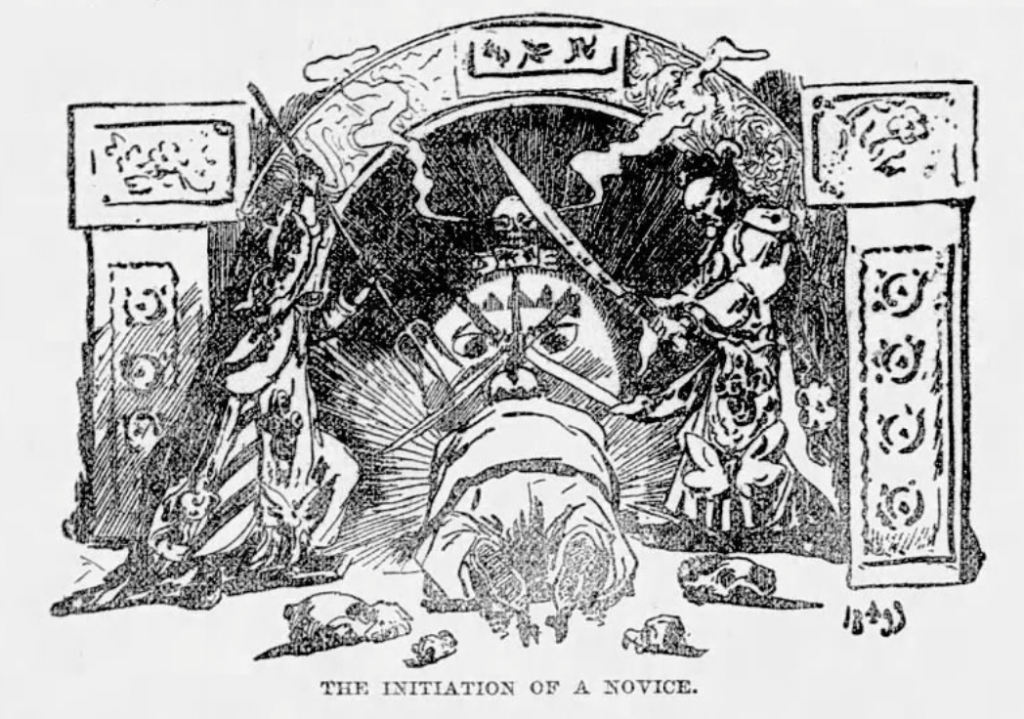
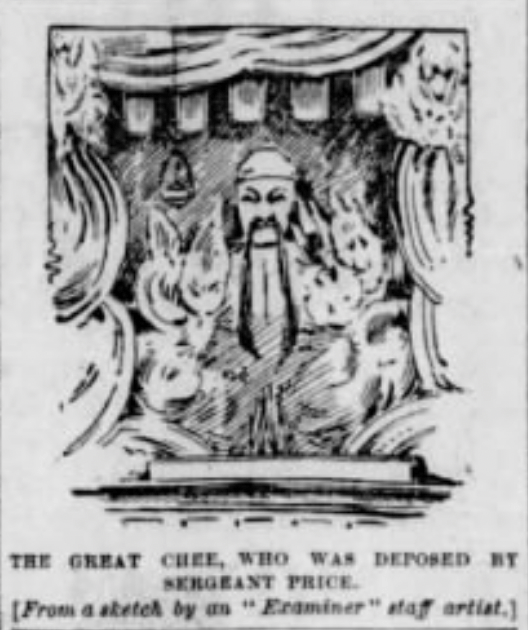
After the Geary Act of 1892 extended the federal laws regarding Chinese exclusion and started requiring Chinese registration, the flames of violence were fanned, triggering a series of police raids on prominent “highbinder” headquarters and joss houses through the 1890s. This coincided with the popularization of newspaper sketch artists who often exercised great latitude in depicting events covered in their newspapers. In 1893, one artist dramatically amplified the violence and terror associated with Chee Kong and other secret society initiation rituals, transforming them into caricatured spectacles (see below).
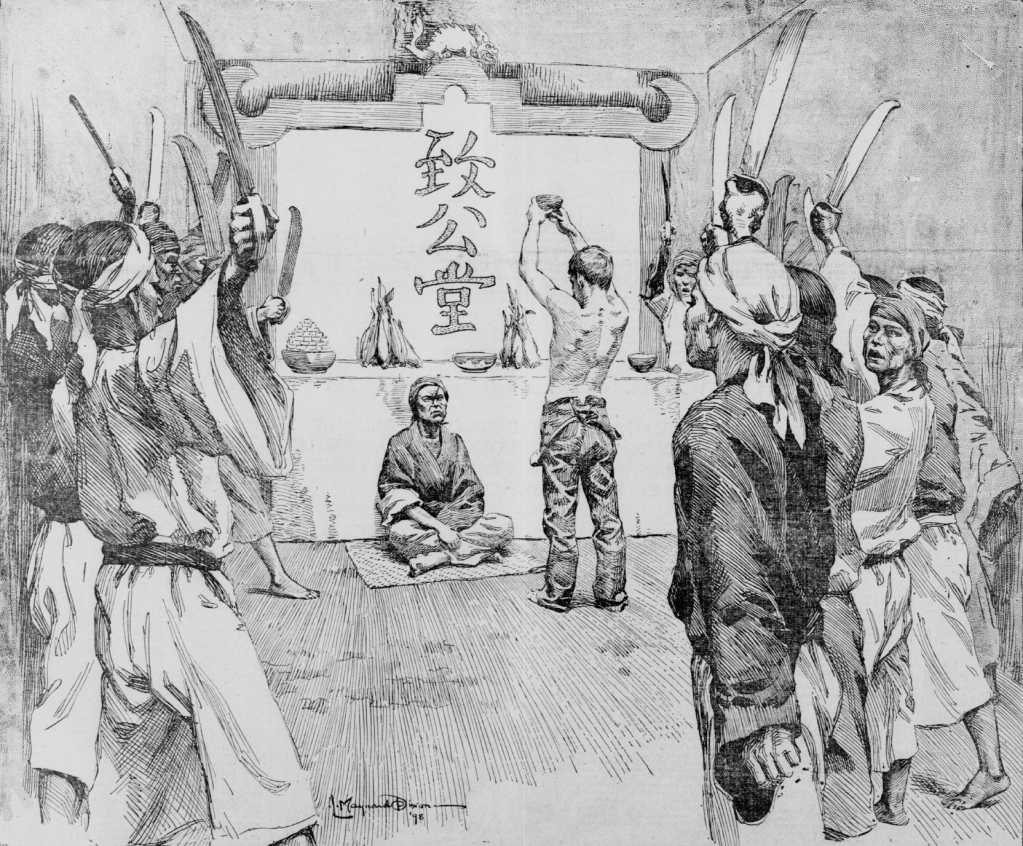
In 1898, a curious San Francisco Call reporter attempted to learn more about the Chee Kong Society by joining as a member. To his surprise, there was no resistance to his request. When he published an account of his initiation, the Call devoted a full-page illustration to the event (see below). The reporter noted that an “improvised altar” had been erected, but unfortunately provided no description of it. The artist chose to depict a sparsely decorated shrine with a few offering bowls.
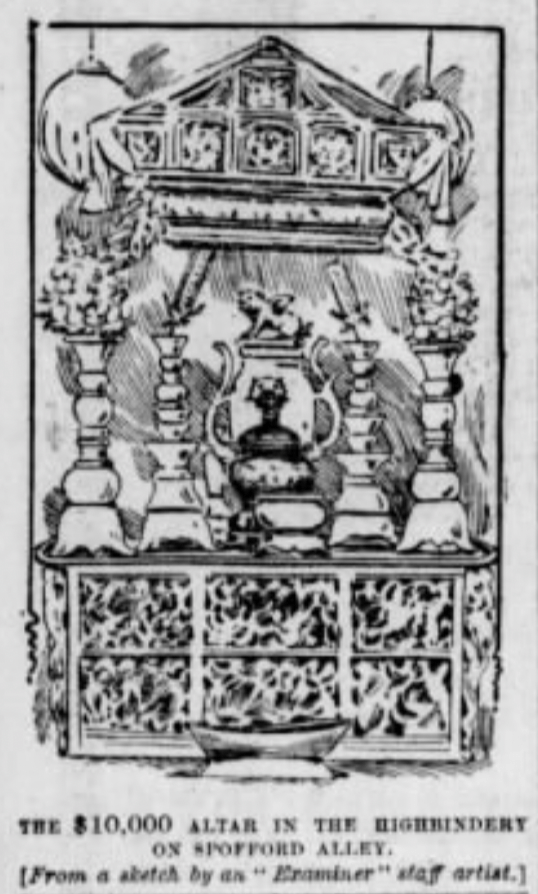
If we turn away from depictions of initiation rituals, very little visual documentation remains of the Chee Kong shrine hall on Spofford Alley before the earthquake. Two images we do possess are hasty newspaper sketches, but they capture an interesting issue of legal jurisprudence concerning Chinese religious material artifacts. After a series of police raids around Chinese New Year in 1891, newspaper reports claimed that Chee Kong’s main icon, Guandi, and smaller images of his two attendants, Guan Ping 關平 and Zhou Cang 周倉, along with other ritual artifacts, had been targeted and damaged by the police. The Chee Kong organization sought $1,227 in legal restitution from the city and police chief. A sketch artist for the Examiner submitted two drawings of the Chee Kong altar, which was estimated to have cost $10,000, presumably before the police took axes to the shrine hall (see below).
Another sketch appeared the following day, but this time it was based on a photograph taken immediately before the police destroyed the icons (see below). The image of Guandi appears almost life-size.
After 1906, the Chee Kong Society rebuilt on the footprint of their old building, complete with new shrine hall.


17. Wong Kong Ha Shrine II (Huang jiangxia tang 黃江夏堂)
137 Waverly Street | 1905 Sanborn | Temple map
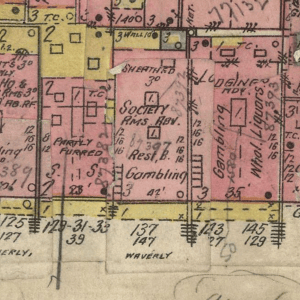
By the 1890s, the Wong (Huang 黃) clan was by far the largest and most influential Chinese lineage in the United States. An 1895 estimate placed their total number at 15,000, with 8,000 to 10,000 residing in San Francisco alone. Members of the Wong subclan known as Kong Ha (Jiangxia 江夏) established a building with a shrine hall on Brenham Place, opposite Portsmouth Square, by the early 1880s [#40]. Enshrining a statue of Guanyin on the top floor, the building served as the center of clan activities. It was particularly active during the summertime celebration of Guanyin’s birthday, when free feasts were hosted for Chinatown’s poor.
The Wong clan’s devotion to Guanyin traces its origins to late medieval China. According to Ho and Bronson, when Wong ancestors migrated from northern China in the tenth century to settle in Fujian and Guangdong, they believed their arduous journey was guided by the protection of the goddess. Upon safely arriving, they established Guanyin as their tutelary deity and initiated annual birthday celebrations. Meanwhile, the Kong Ha subclan traced its specific ancestral roots to the ancient Jiangxia commandery, located near present-day Wuhan in Hubei Province.
In November 1900, members of the Wong Kong Ha formally incorporated as the Wong Benevolent Association, purchasing property on Waverly Place the following year for a new family headquarters and temple. They purchased what appears to have been a vacant lot on Waverly from Wong Yow and Lim Shee for the relatively modest sum of $500 and began construction on new three-story brick building. The building is listed as 137 Waverly on the 1905 Sanborn Map and identified as containing “society rooms” (see inset map above).
The building and shrine hall were dedicated in January 1902 after the Guanyin icon was transferred from Brenham Place. A few months later, a San Francisco Chronicle article highlighted the temple as a premier stop on the Chinatown walking tour circuit, advising visitors to attend “incantation nights” when Wong family members gathered to pray for the “peace and prosperity of their tribe”—an experience the reporter noted could be seen “nowhere else.”
Because the Wong Benevolent Association building stood just doors down from the Tin How Temple, a prominent architectural landmark favored by Chinatown photographers, the Wong building sometimes appears near the margins of pre-1906 photographs. One anonymous photograph captures the west side of Waverly from Tin How Temple northward down the block, where a rounded awning jutting from an open third-floor veranda helps identify the Wong family building, complete with a barely visible paper lantern identifying the top-floor shrine hall (see imagery tab below).
A second photograph from William E. Worden shows a similar vantage point, but captures a bit of Washington Street as it connects with Waverly Place (see below). Notably, we can see signage identifying some of the buildings by name. A small printed sign on the far-left building marks the entrance to Tin How Temple, while a large vertical sign painted with Chinese characters on the neighboring structure ends with the character for “hall” (tang 堂), likely marking the Gee Tuck Society on the third floor. Farther north up the block, the three-story Wong building appears with a horizontal white sign hung between the second and third floors. Though overexposed in the photograph, the sign likely displayed “Wong Benevolent Association,” identifying the family headquarters to pedestrians and carriage drivers alike. Worden’s photograph, cropped to omit his name, would also live as a souvenir of old Chinatown sold as a postcard (see below).
Although the 1906 earthquake destroyed the original structure, the clan rebuilt on the exact footprint, renumbered as 145 Waverly Place. If the Wong clan rebuilt their shrine hall to Guanyin, it seems to have no longer been open for public view and Guanyin’s birthday festivities disappeared from local newspapers.
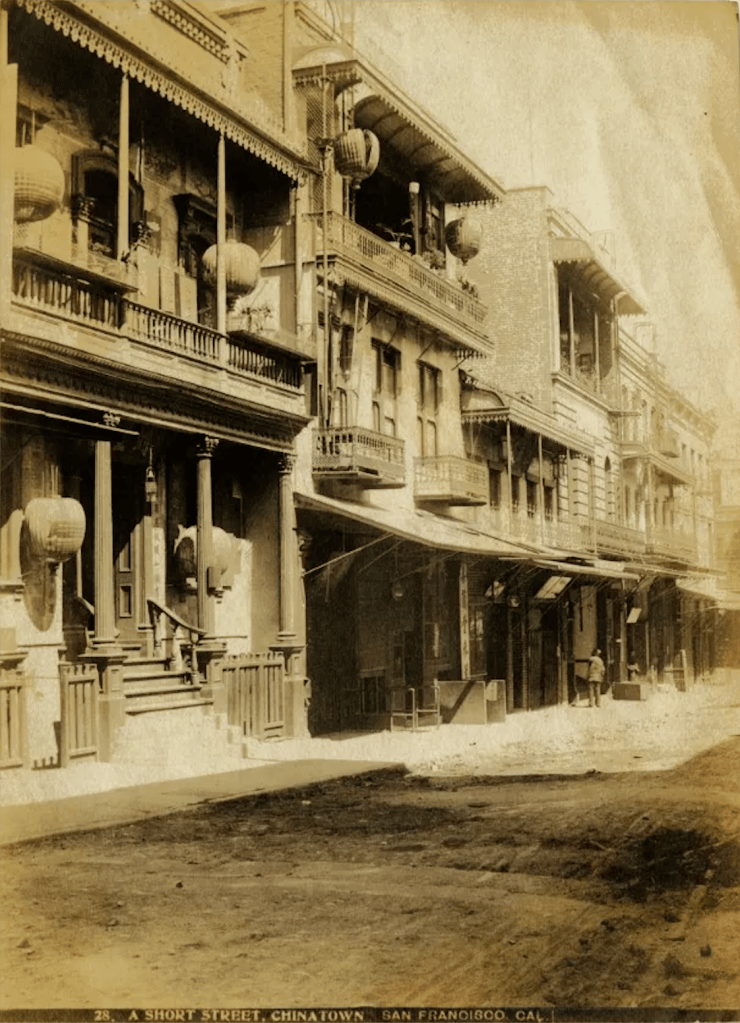
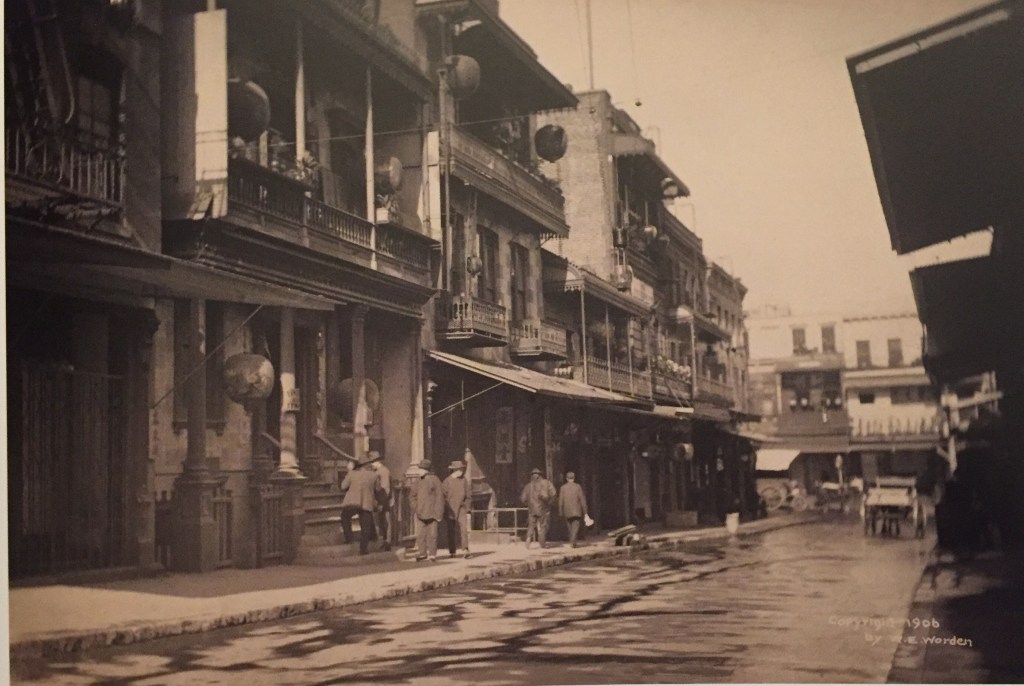
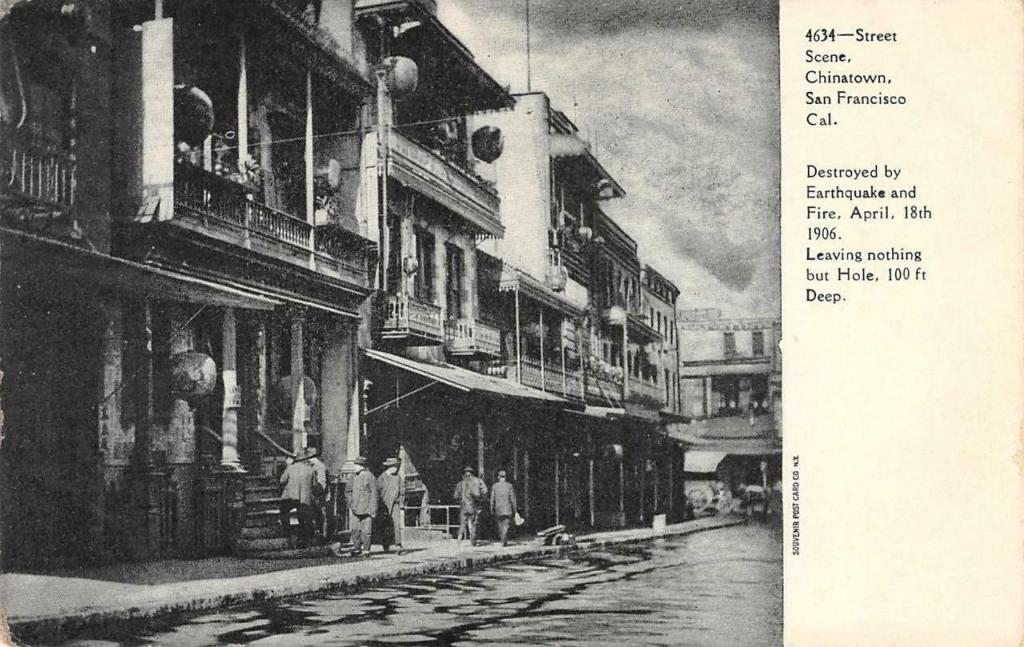
18. Guanyin Temple (Guanyin miao 觀音廟)
60 Spofford Alley | 1887 Sanborn | Temple map
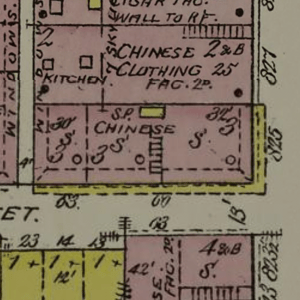
Opened by the early 1880s, the Guanyin Temple was located on the top floor of a three-story brick building on the southwest corner of Spofford Alley and Washington Street. The temple is curiously missing from both the 1885 Supervisors’ map and the 1887 Sanborn map. Nevertheless, in 1883, a Guanyin shrine is cited as located on the “contracted upper floor of a small building on Washington.” Frederic Masters, writing in 1892, notes the shrine hall was atop a “dingy staircase” that held a “rudely carved image and grimy vestments.” According to Masters, the space held an assortment of other figures, including the God of Medicine (Huatuo 華佗), the Grand Duke of Peace (Suijing Bo 绥靖伯), and Tsai Tin Tai Shing (Qitian dasheng 齊天大聖, otherwise known as the Monkey King, Sun Wukong 孙悟空).
Despite the popularity of Guanyin among Chinatown’s residents, we know very little about the rituals and ceremonies that took place at this small temple. Among what we do know is that sometime in the early 1880s, during the three-day birthday celebrations of Guanyin, a feast was held in her honor, inclusive of meat which seemed to surprise some onlooking Chinese, and her icon was paraded around Chinatown, leading to its installation in a Chinese theater where a performance was held in her honor. When the performance was finished in the early morning, her icon was returned to its altar on Spofford among a clamor of cymbals and cheers.
In a rare discovery, a brochure seeking funds to restore the temple has survived, dated to 1886 (see imagery tab below). As discussed by Ho and Bronson, the brochure claims the temple had existed for more than thirty years at that point. It also notes the space was managed by Li Xiyi 李希意. The success of this fundraising endeavor is unknown, but the building at 60 Spofford seems to have remained in poor condition, being recommended for condemnation by the city health inspector in 1890 (city property records in 1886 cite an otherwise unknown Liebermann as the building’s owner). Regardless, the temple seems to have remained untouched as Masters attests to its divinely crowded quarters two years later. The temple name also appears in a Chinese business directory from 1892 (see below).
The temple also seems to have issued a weekly eight-page newsletter or newspaper in 1893, called Bun Ding, which was printed on “bright red paper and partly colored ink.” Ho and Bronson attest to the poetic writing of the fundraising brochure, speculating it could have been penned by Li Xiyi himself. Is it possible he also wrote or edited a regular weekly publication? The 1905 telephone directory still records a “Quon Yum Temple” at 60 Spofford, next to a printer.
There is very little visual record of Chinatown’s Guanyin Temple. Isaiah West Taber took a photo looking north down Spofford and the temple’s round paper lanterns can barely be seen at the far end. Additionally, Arnold Genthe took at least one photo showing the exterior signage of this temple between 1896 and 1906 (see both below). The temple was apparently not rebuilt after 1906.

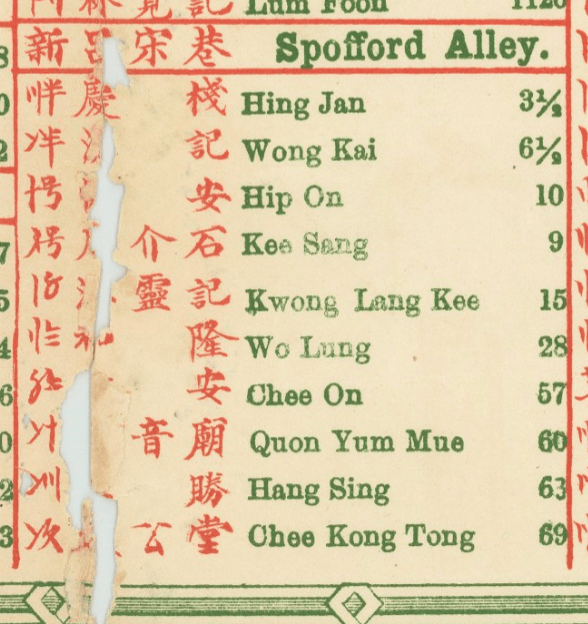

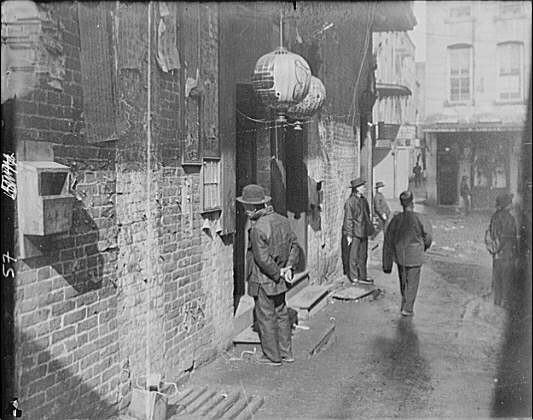
19. Kai Sen Shea Society (Jishanshe tang 繼善社堂)
819½ Washington Street | 1887 Sanborn | Temple map
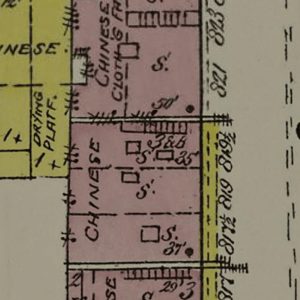
20. Bing Kong Society I (Binggong tang 秉公堂)
817 Washington Street | 1887 Sanborn | Temple map
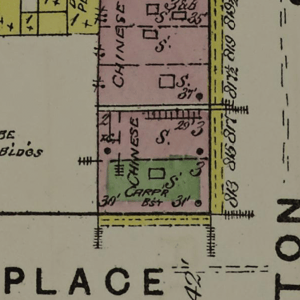
Chinese American fraternal societies, commonly called tong in the press, were considered “secret” in part because membership involved taking a series of oaths forbidding members from divulging society-related information to non-members, including their own family. These oaths resembled those taken by fraternal Hongmen societies in China, whose politically rebellious activities made secrecy necessary to protect members from targeted attacks by Qing authorities. In the United States, these oaths and associated secret rituals initially prompted comparisons with Euro-American Freemason and Odd Fellows societies. By the 1880s, however, the same secrecy was increasingly portrayed as evidence of the criminal activities supposedly undertaken by nearly all fraternal tong groups.
The specific oaths and regulations varied somewhat across the United States, with some changing considerably over time, as the rare surviving documents and banners recovered from societies in Tucson, Arizona; Virginia City, Montana; and Nevada attest. Nevertheless, members were commonly required to observe important cultic anniversaries, including the birthdays of the semi-historical Guandi and other important society patriarchs.
In September 1890, the Chee Kong Society and the Bing Kong Society, often considered an offshoot of the former, separately celebrated a common patriarch in a festive and highly public fashion. The societies decorated their lodge buildings with lanterns and ritual objects and erected music stands in the street. The proximity of the two rival groups—with Chee Kong’s lodge midway down Spofford Alley [#16] and Bing Kong’s lodge around the corner at Washington and Waverly Streets—appears to have contributed to considerable tension. At the end of the four-day celebration, when “paper idols, joss and devils” were to be burned outside in honor of the deceased, members of Chee Kong raided Bing Kong’s offering display, attempting to carry off some of the paper objects and disrupt the closing festivities. Knives were brandished and shots fired, prompting Bing Kong members to retaliate by rushing toward the Chee Kong lodge and its offering display down Spofford Alley. City police soon arrived to break up the growing melee.
The religious landscape of pre-1906 Chinatown involved public festivities, often bringing together Chinatown residents of different backgrounds in communal celebration, while an historical account such as this also reveals a moment of intense inter-tong rivalry and violence.
Less than a year later events like this helped instigate a series of police raids on society headquarters. The Bing Kong was targeted first and its shrine hall was ransacked as “joss and idols fell with a crash” [source]. The Bing Kong Socity soon relocated elsewhere in Chinatown [#27].
21. Grand Chinese Theater shrine
814 Washington Street | 1887 Sanborn | Temple map
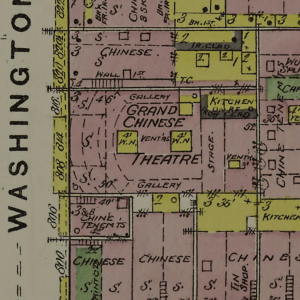
San Francisco’s Chinatown theaters enshrined religious icons high above the main stage. See relevant comments in Additional Shrines in San Francisco’s Chinatown below.
22. Eastern Glory Temple I (Donghua miao 東華廟) Update August 2025: Confirm St. Louis location
St. Louis Alley | 1887 Sanborn | Temple map
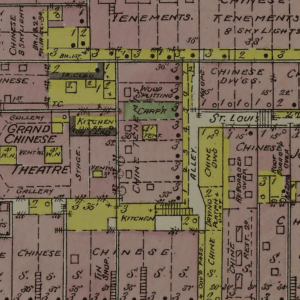
Famed Chinatown physician Li Po Tai (Li Putai 黎普泰) established this privately owned temple in 1871 after narrowly surviving a gas explosion the previous year that left him severely scarred and reportedly claimed the life of a friend. Known as Eastern Glory Temple (Donghua miao 東華廟), the multi-room temple occupied the third floor of a large building on St. Louis Alley, with entrances from both Dupont and Jackson Streets. A city directory from 1877 gives its address as 921½ Dupont, referring to a narrow alley running west from Dupont. Determining its precise location along St. Louis Alley, a cramped passageway that local Chinese residents called “Conflagration Alley” (huoshao xiang 火燒巷) as early as 1877, has proven considerably more difficult.
A map of Chinatown compiled by Henry Josiah West in 1873 places a joss house at the 90-degree bend in St. Louis Alley [here]. Until recently, however, I considered this placement to be an error. Ho and Bronson’s published reconstruction likewise rejects West’s location, instead placing Li Po Tai’s temple at the far rear of a building fronting Dupont Street, identified as a joss house on the 1887 Sanborn map.
Two visual sources now provide compelling evidence that West was right. The first is a recently discovered oil painting by Karl Wilhelm Hahn (1829–1887), held by the Bancroft Library; the second is an engraving included in West’s own publication that has received surprisingly little attention. Taken together, these images allow us to locate Eastern Glory Temple with considerably greater confidence than was previously possible.
Hahn’s painting depicts St. Louis Alley looking south and shows a temple doorway on the third story of a building (see imagery tab below). Rather unusually, the horizontal Chinese signboard is clearly legible and reads “Eastern Glory Temple.” Even the vertical pillar boards (yinglian 楹聯) appear to correspond closely with known textual descriptions and with a partly obscured photograph of the temple. According to the numbering on the 1887 Sanborn map, this doorway corresponds approximately to the street-level addresses of 4 or 5 St. Louis Alley.
The Bancroft Library currently dates Hahn’s painting to 1885, but another clue suggests that the image may be considerably earlier. We can now see that Hahn’s painting formed the basis for an engraving published in The Pacific Tourist, a guidebook first issued in 1876 and reprinted in 1881. Carleton Watkins also photographed Hahn’s painting and offered the resulting image as part of his views of Chinatown (see below). These reproductions provide an important chronological link between Hahn’s original painting and the visual record of Eastern Glory Temple beginning in the 1870s.
West’s rarely consulted 1873 report provides further confirmation. His description of Chinatown indicates that Eastern Glory Temple occupied the entire third floor of the building and contained six rooms; an earlier Daily Alta account from 1871 had reported eight rooms in total. The 1887 Sanborn map helps us reconstruct how this space was organized. The temple occupied a building abutting the rear of the Grand Chinese Theater and extending across multiple ground-floor addresses, from 1 through 7 St. Louis Alley. The first room, at the eastern end, had a small doorway leading into a reception area, while the second sold ritual supplies such as candles and paper money. The remaining rooms housed religious icons. A larger doorway toward the western end of the building—the entrance prominently visible in Hahn’s painting—led directly to the main altar and appears to have served as the principal entrance to the temple.
But the most satisfying piece of evidence comes from West himself. Among the series of engravings included in his 1873 report is one entitled “Chinese Quarters–San Francisco.” At first glance, the image offers a generic street scene, but closer examination reveals a crucial detail: “Jackson St.” is visible on one of the buildings. This tells us that the scene is looking directly south down St. Louis Alley. The three-story building at the bend in the alley forms the backdrop, while single- and two-story buildings stand in front of it. Most importantly, an awning hung with lanterns draws the eye toward the very entrance that leads to the main shrine hall.
What initially appeared to be an inaccurate placement on West’s map can therefore be read quite differently. His map, his written description, and his engraving all point toward the same building, while Hahn’s painting provides an independent visual record of its third-floor temple entrance.
A series of stereo-photographs taken by Eadweard Muybridge offer clear, rare depictions of the temple interior, including the main altar (see below). The Supreme Ruler of the Somber Heavens (Xuantian shangdi 玄天上帝; also Northern Emperor [Beidi 北帝]) sits in the center. Some contemporary reports given by visitors seem to conflate this central icon with Buddhist figures. It also appears Li may have moved icons around as one visitor claims in 1876, and another in 1880, that Guandi was the central icon, but this may just be a mis-identification (also see next entry for Yan Wo). In the Muybridge photo of the main altar, the Northern Emperor is flanked by Guandi to his left and righteous official Hong Sheng 洪聖 to his right.
The main hall originally enshrined a total of six icons, while other deities were found in adjoining rooms. Notably, Tianhou and Lady Golden Flower were reported enshrined in a room to the left of the main hall while Guanyin was enshrined in a room to the right. One visitor writing in 1890, but describing experiences more than a decade earlier, noted a Chinese liturgy to Guanyin imprinted with her image was available for sale. This was likely similar to the printed Guanyin liturgy dispensed at Ah Ching’s Tin How Temple [#X3], which was still in operation through late 1874. All of the original icons were reportedly made of local clay, a necessity after an intermediary who went to China with $3000 to purchase ritual supplies had disappeared, stealing the money. The temple’s icons were molded, painted, and decorated by Chinese immigrants in San Francisco. The craftsmen may have also made extra copies. One tourist recounting her visit to Eastern Glory Temple in 1877 noted the presence of miniature versions of the icons, claiming they were “possibly for sale.”
During a period when district association temples comprised a single room with a singular central icon, such as reflected at Kong Chow temple [#X2] and Ning Yung temple [#45], the multi-room temple complex of Li Po Tai displaying approximately a dozen icons must have stood out as an exceptional departure from prevailing norms. Only Ah Ching’s privately owned temple at the time held such a wide assortment of figures, but his temple was located further from the heart of Chinese life and tourist attention. Unsurprisingly, after its opening in the early 1870s, Eastern Glory Temple was known as the “boss temple” and “Grand Temple” of Chinatown. Some early reports, likely floated by those unhappy with the growing Chinese religious presence, inflated the grandeur of Li’s temple, claiming it possessed “over a hundred gods,” with “more expected on the next China steamer.”
By 1880, at least three major Chinatown celebrations centered upon Eastern Glory Temple, including the birthdays of the Northern Emperor (3rd day of 3rd lunar month) and the God of Wealth (16th day of 7th lunar month), as well as the summertime Ghost Festival, suggesting this privately-run temple was a major center of local religious life through the 1870s.
At least two detailed engravings were published in the 1870s showing the interior of the main shrine hall with three total altars (see below). The importance of this temple for the religious landscape of Chinatown was only further heightened by the prominence of Li Po Tai, a successful doctor who ran his business near Portsmouth Square and who was considered the wealthiest among all Chinese residents. Yet, the importance of Eastern Glory Temple was often diminished by tourists due to its location in a small, dark alleyway with “rickety stairs.” The claustrophobia of the alley, as well as the clamor of local gambling halls and brothels, caused many tourists to recount their visit to one of Chinatown’s main joss houses with a mixture of fascination and unease.
Sometime around 1882, Li Po Tai seems to have moved the contents of his Eastern Glory Temple to 35 Waverly [#14], next door to Tin How Temple [#12]. Frederick Masters still notes an Eastern Glory at 35 Waverly in 1892, but does not afford it a description, suggesting it had fallen from previous heights as a major Chinatown attraction.
Li passed on March 20, 1893 soon after turning 76. In July of that same year, one of his properties in Chinatown succumb to fire, but this was not his old temple site on St. Louis Alley as suggested by Ho and Bronson; Li never owned this building. Municipal property records from 1886 and 1894 show Li, or his estate, owning buildings at 730 Jackson and 1010/1012 Dupont. This is confirmed by contemporary newspapers covering his estate which variously estimated the value of his properties between $50,000 and $300,000 dollars. The building lost to fire in July 1893 was at 730 Jackson, which Li leased to at least two other groups that operated joss houses from that address in the mid-to-late 1870s and early 1880s.

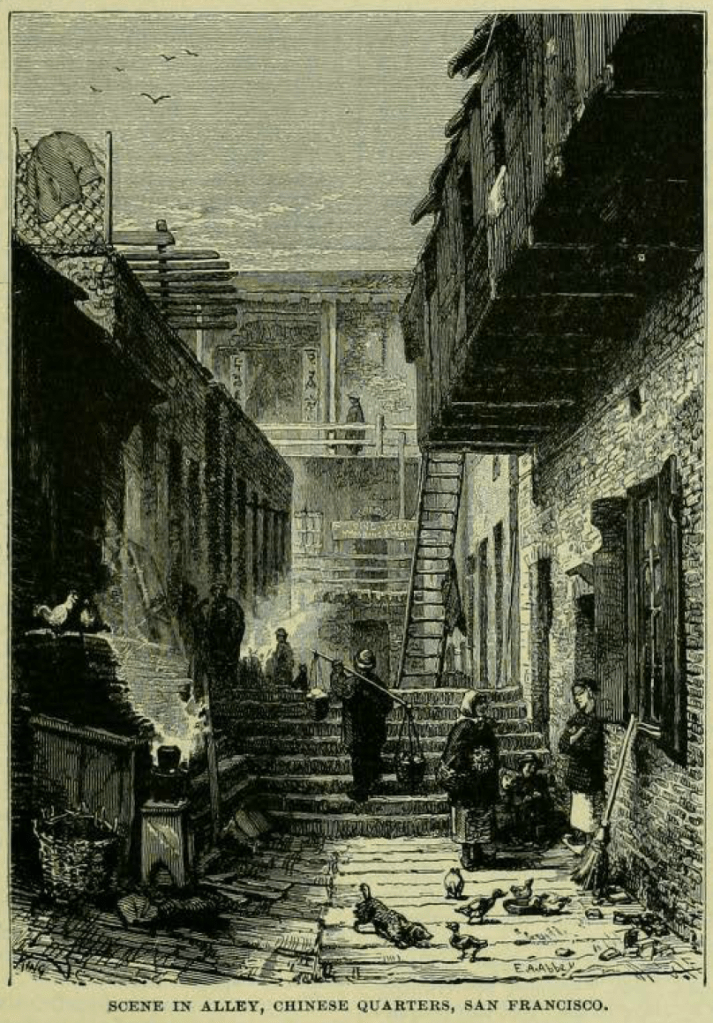
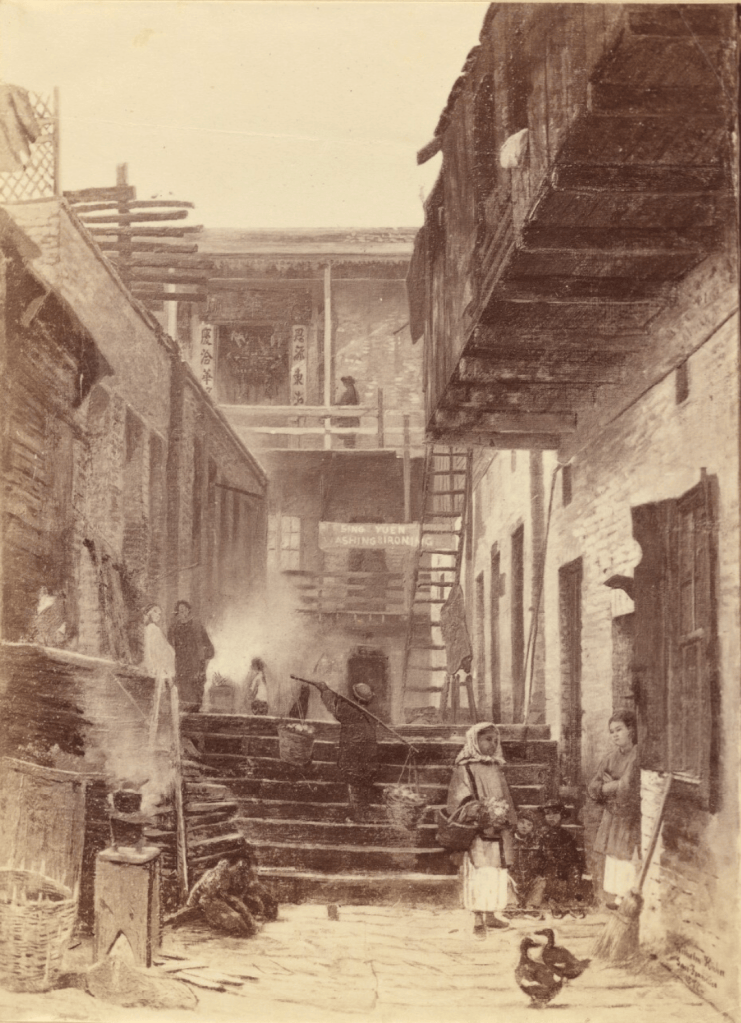
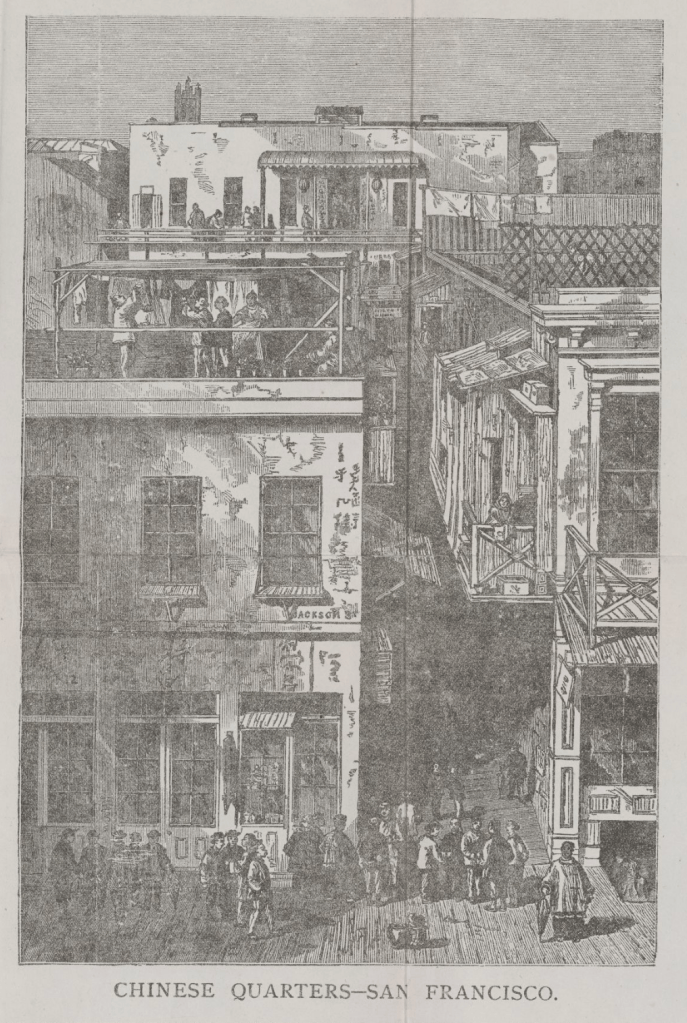

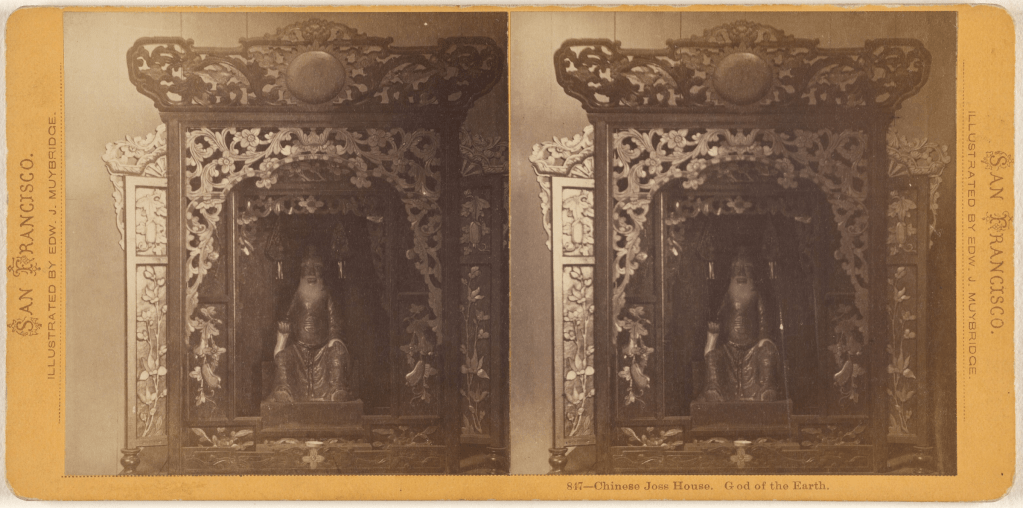
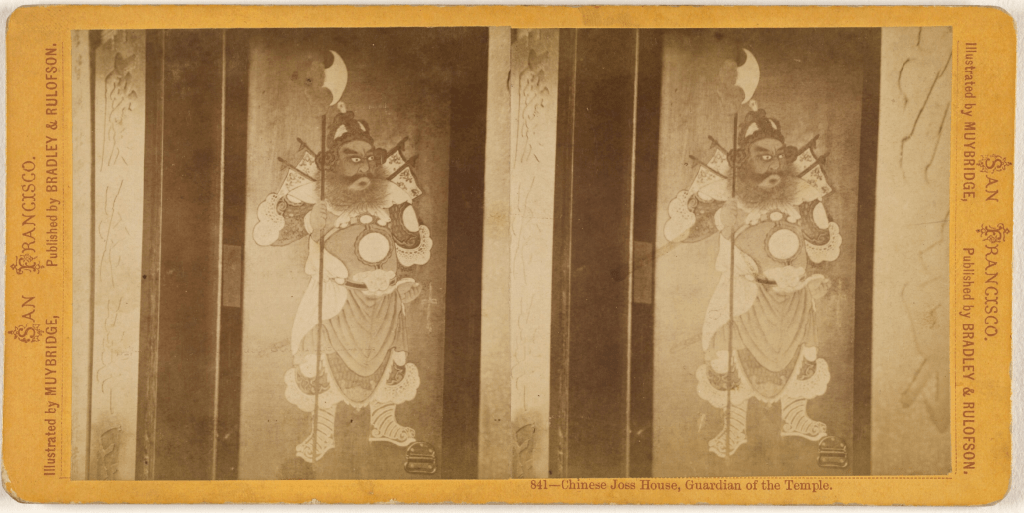
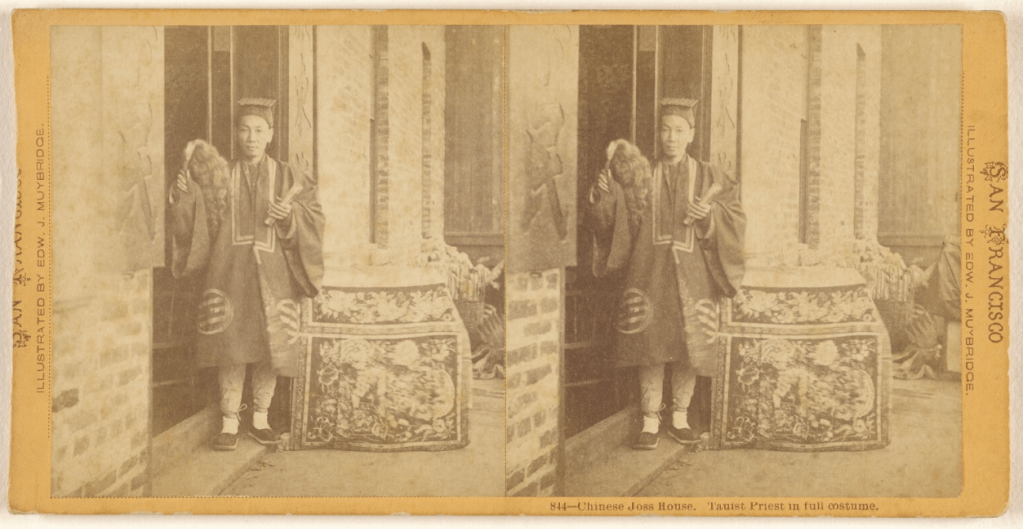

23. City God Temple II (Chenghuang miao 城隍廟) & Kim Fa Temple [?]
1018 Stockton Street | 1905 Sanborn | Temple map
In 1892, the City God Temple was located on Waverly Street, but by 1897 it had moved to 1018 Stockton Street, an old Chinese shirt factory that was reportedly also being used by the Ning Yung Association as a joss house. The exact relationship between the building on Stockton and Ning Yung’s main shrine hall on Waverly Place [#6] is uncertain. As reported in 1892, however, the City God Temple was located directly opposite the Ning Yung temple at 22 Waverly [#7], suggesting a possible relationship between these two institutions through the 1890s.
According to newspaper reports from November 1897, Chow Kung Sang, the keeper for the “Temlpe of the King of the City,” was murdered by an unknown assailant. Speculation arose that his death was the result of longstanding tensions between Sze Yup and Sam Yup members which had periodically erupted into violence. As reported in the press, the City God Temple was a “public josshouse” where the resident “priest” was primarily charged with selling incense sticks and praying for the deceased. One theory was that Chow had been killed in retaliation for allowing members of both the Sze Yup and Sam Yup organizations access to the shrine hall, that is, for refusing to take sides in the longstanding conflict between the two groups.
An accompanying sketch in the San Francisco Call depicted what may have been understood as a typical devotional visit to the temple, showing Chow and his assistant attending to a visitor who made offerings before the altar (see imagery tab below). The illustration includes a loose rendering of the City God. The artist appears, however, to have fallen prey to a common visual convention that did not accurately reflect the material form of such an icon: the figure is depicted sitting cross-legged, like a meditating buddha. City Gods were typically fashioned as well-dressed government officials, seated upright in elaborate chairs with their feet resting on the ground. The use of the crossed-leg posture may thus have been an attempt to employ a visual idiom more readily comprehensible to American newspaper readers.
Tensions among rival factions in Chinatown continued into 1903, when another newspaper report claimed that a Suey Ying member, Dong On, was ambushed and shot inside the joss house at 1018 Stockton Street. The temple keeper, identified as Dong Yick, was the victim’s brother and reportedly recognized the assailants as visitors to the temple several days before the attack. The temple is identified in the article as the “Kim Fa joss house,” a name that does not appear to correspond to the known Cantonese name for the temple, singwong mue, as seen in the 1892 Chinatown directory.
The journalistic style of the 1903 article exemplifies the sensationalist reporting common to the period, relying on narrative-driven prose and extensive speculation to captivate a mass audience. The accompanying newspaper illustration likewise appears to combine photographic images with hand-drawn elements to help visualize the narrative presented in the article. The resulting composite image reputedly depicts the exterior of the joss house at 1018 Stockton Street (see below).
Another city newspaper carrying the story of this 1903 murder frustratingly provides conflicting information. It cites the location as the Nong Family Joss House, which might refer to the shared use of 1018 Stockton Street as a secondary shrine hall for the Ning Yung Association, conflating “Nong” and “Ning.” No mention is made of the Kim Fa joss house. Moverover, the victim is first named as Ah Wong, and then later as Ah Nong, while the name Dong On does not appear.
Regardless of these inconsistencies, it appears the City God Temple was either also known as the Kim Fa joss house or was no longer open at 1018 Stockton Street. The next time the City God Temple appears in the American press is in 1905 at 1 Brenham Place [#39].
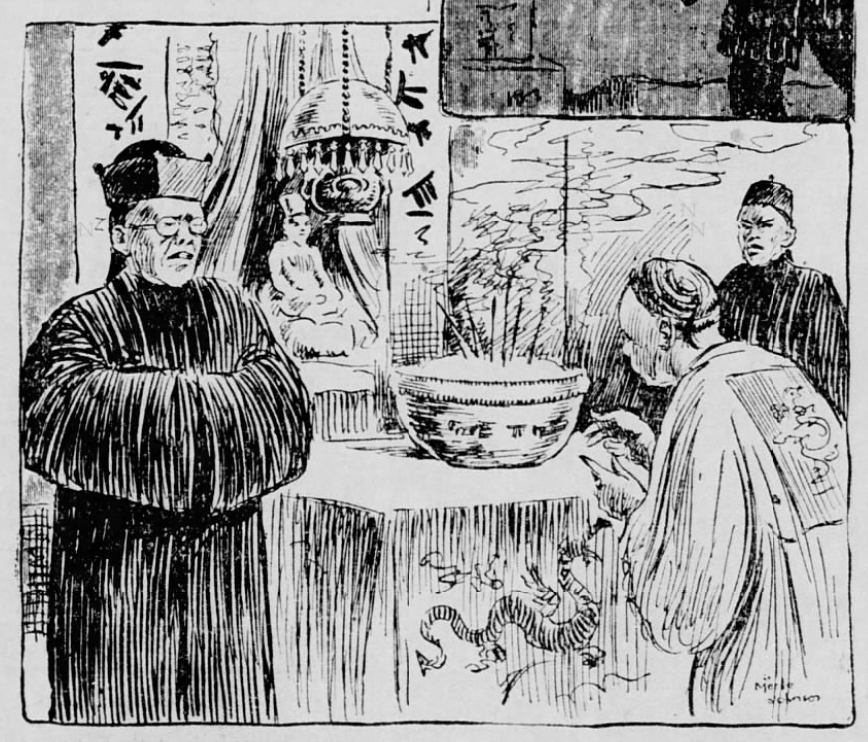
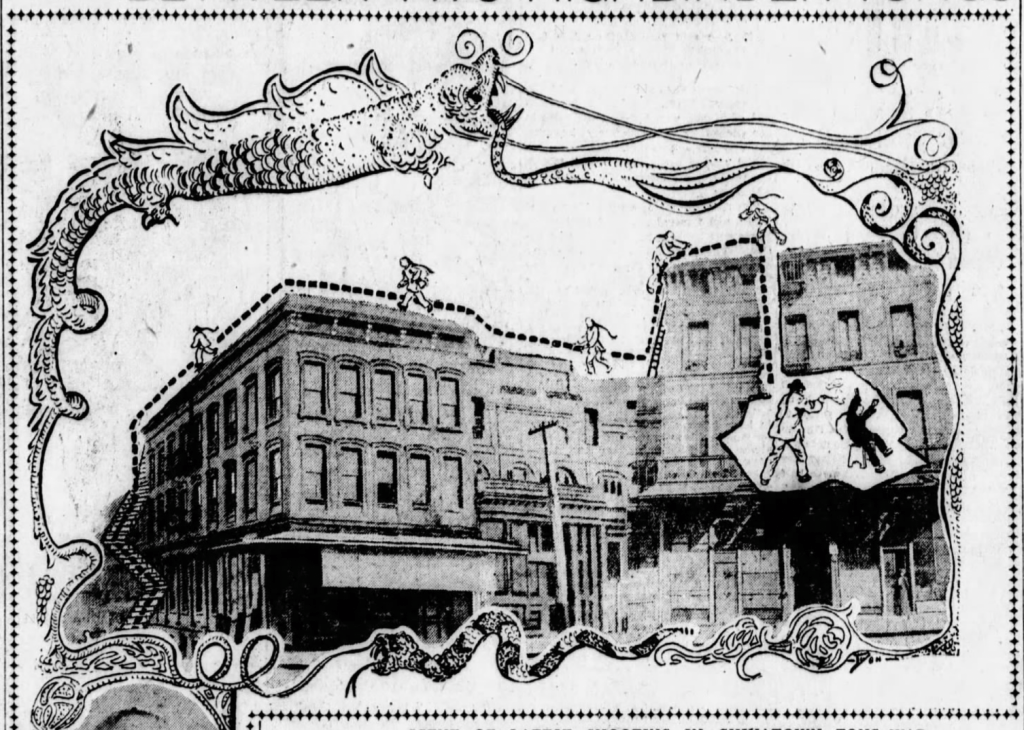
24. Sam Yup Association III (Sanyi huiguan 三邑會館)
929 Dupont Street | 1905 Sanborn (damaged) | Temple map
25. Yan Wo Association (Renhe huiguan 和會館) Update August 2026: Identify Watkins stereoview
St. Louis Alley & 933 Dupont Street | 1887 Sanborn | Temple map
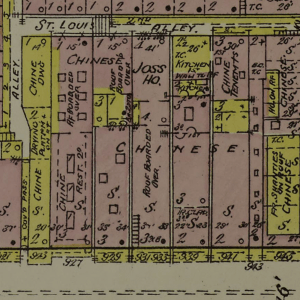
The Yan Wo Association served speakers of the Hakka language and, from its founding in the 1850s through the end of the century, consistently reported the smallest membership among the district associations. In 1877, Yan Wo was reported as the only one of the six major district associations that had not yet established a company temple, although its headquarters was already located in the 900 block of Dupont Street, near Jackson Street.
By 1880, a San Francisco city tax assessment records the Yan Wo Association as operating a joss house at 5 St. Louis Alley, placing the temple around the corner from its Dupont Street headquarters. This claim appears to be corroborated by an 1883 Chinatown guidebook, which likewise locates a Yan Wo temple on St. Louis Alley. Consequently, it is possible that an unnamed joss house listed on St. Louis Alley in the 1883 city directory also refers to this same district association temple. To date, however, I have found no descriptive accounts of Yan Wo’s shrine hall on or near this alleyway.
Several questions nevertheless remain outstanding. We now know that Eastern Glory Temple occupied the top floor of 5 St. Louis Alley until approximately 1882. If we take the 1880 city tax assessment at face value, the Yan Wo joss house may have shared this space or occupied a different floor of the same building. Moreover, if the 1876 and 1880 visitors’ reports identifying Guandi as the central icon of Eastern Glory Temple are correct (they may not be; see previous entry), thereby displacing the icon of the Northern Emperor, this could indicate a significant change in stewardship as early as 1876. At present, however, this remains uncorroborated and speculative. Accounts written by uninformed tourists have proven inaccurate and therefore cannot be treated as strong historical evidence on their own.
The recent identification of a Carlton Watkins stereoview photograph may shed light on several of these questions (see below). With the help of Doug Chan, I believe the Watkins stereoview shows the southwest corner of Dupont Street. The church steeple visible in the center of the frame in the distance matches that of the First Methodist Church on Powell Street, just south of Jackson Street. Additionally, the right-hand photograph of the stereoview pair shows the rectangular tower of the First Presbyterian Church on Stockton Street at the far left of the frame. Together, these landmarks help triangulate Watkins’s position toward the bottom of the steep incline, looking almost directly up Jackson Street toward Russian Hill. It appears that Watkins took the photograph from a balcony or rooftop on the southeast corner of Jackson and Dupont, looking westward. This places the viewer above the rooftops of the 900 block of Dupont Street, where the Yan Wo Association’s headquarters had been located since at least the 1870s.
Of particular interest, Watkins’s stereoview reveals a small brick structure at the rear of one of the buildings fronting Dupont Street. Watkins identifies this structure as a Chinese joss house “on the house tops,” a designation that can be verified by the decorative lanterns and inscribed vertical boards hanging outside. The location corresponds closely with the 1887 Sanborn map, which places a joss house at the rear of the building at 931/933 Dupont Street. Because the temple directly overlooked St. Louis Alley, it is conceivable that the temple itself was understood to be located on St. Louis. Notably, the 1887 Sanborn map identifies the temple as occupying a fourth floor of a building that was only three stories tall on its Dupont Street end. This suggests the temple had a separate entrance directly from the roof, much as we see in Watkins’s stereoview. It is also worth noting that the brick buildings on St. Louis Alley immediately to the south were only a single story tall (see Karl Wilhelm Hahn’s painting at #22). The rooftop temple would have therefore towered over the entire bend of the narrow alleyway. Unlike Eastern Glory Temple which also soared above St. Louis Alley, it appears visitors to the rooftop temple needed to gain entrance through Dupont Street. Ultimately, the Hakka-speaking Yan Wo association may have never opened their small temple to the public.
The position number of Watkins’ stereoview, 3757, is associated with his “New Series” of views taken during the latter half of his career between 1875 and 1890. Further research might determine where in this dating spectrum our stereoview falls, but many collections date Watkins’ views of Chinatown to the late 1870s.
By 1892, the address of the Yan Wo Association is specifically located at 933 Dupont Street, where its shrine was outfitted with an icon of Guandi and “fitted up in elegant style,” according to Frederic Masters.
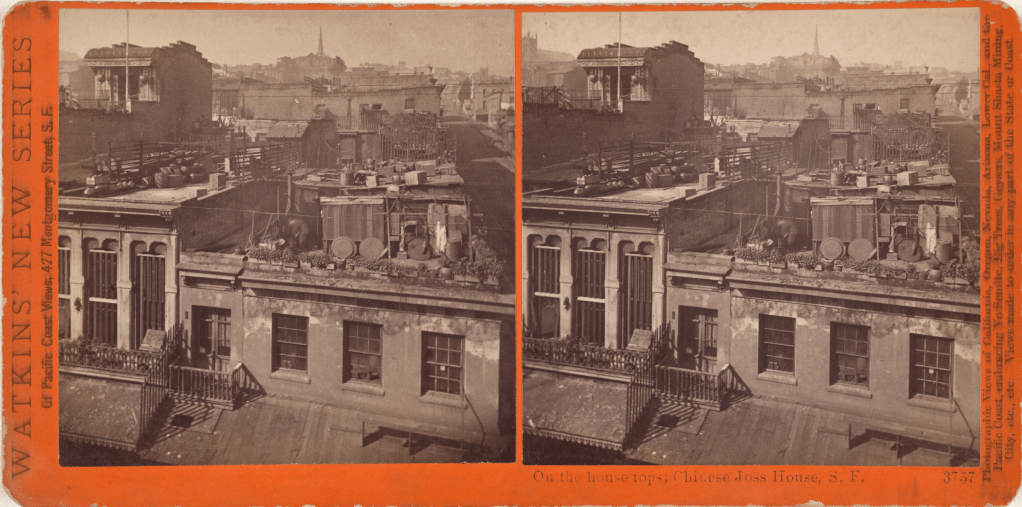
26. St. George Temple
731 Jackson Street | 1887 Sanborn | Temple map
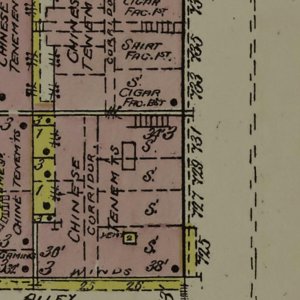
The 1875 Bishop San Francisco City Directory contains a curious entry: St. George Joss House, 731 Jackson [source]. It is listed again in the 1876 edition [source], but is missing the following year. Nothing is known about this temple.
It is not clear why the Christian martyr, St. George, famed for his defeat of a villainous dragon, is adopted as the name of a Chinese American temple, but Frederick Masters provides a clue. In his survey of Chinatown temples in 1892, Masters describes Guandi as the “Saint George of Far Cathy,” drawing attention to the militaristic aspects of both figures.
The St. George Joss House may have been one of many Chinese temples devoted to the semi-historical figure Guandi.
27. Bing Kong Society II (binggong tang 秉公堂)
740 Jackson | 1887 Sanborn | Temple map
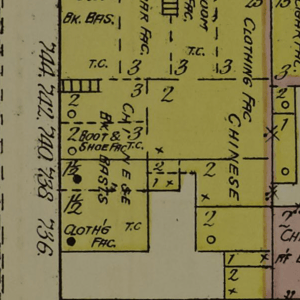
After a series of violent altercations with the Chee Kong Society, the organization from which the Bing Kong Society had originally split, and amid rising tensions in Chinatown more broadly, city police undertook a coordinated raid of Chinese secret society headquarters just prior to Chinese New Year in 1891. The Bing Kong Society was targeted first. When officers entered its headquarters at 817 Washington Street, at the corner of Waverly Place [#20], the interior was ransacked as “joss and idols fell with a crash” [source].
In the autumn of the following year, the society converted a former boot factory at 740 Jackson Street into a shrine hall for the veneration of its ancestors. Local newspapers covered the dedication ceremony and included a small sketch illustration of the event (see imagery tab below).
Major ritual celebrations from this period—categorized by Ho and Bronson as dajiao 打醮—featured large, wood-framed paper effigies of deities positioned at the temple entrance. These temporary figures, called Mountain-Sized Big Men (shandaren 山大人), among many other names, were ritually burned at the conclusion of the festivities.
For comparison, I have also included a painting by Theodore Wores depicting similar figures at an unidentified Chinatown temple. The original painting was likely destroyed in the 1906 earthquake and fire (for additional depictions, seen here, here, & here). Because large festivals attracted many non-Chinese visitors, contemporary observers sometimes mistakenly assumed that these monumental images were permanent fixtures of Chinese temples. By the 1896, the Bing Kong Society had established new headquarters and a shrine hall at 13 Waverly Place.


28. Jackson Street Temple
730 Jackson Street | 1887 Sanborn | Temple map
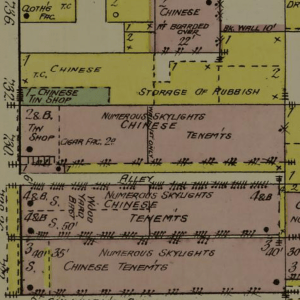
One temple on Jackson Street, often described as located between Dupont and Stockton Streets, remains obscure. It’s important to note that Jackson Street, especially the stretch between Stockton and Dupont streets, was viewed as the heart of “old Chinatown” to some San Francisco residents, thus a passing tourist reference to a “joss house on Jackson” might have intended to be more evocative of Chinatown’s perceived religious difference than descriptive of a real, operating Chinese temple. This notwithstanding, there have been an handful of specific claims about a Jackson Street temple that deserve our attention.
Most importantly, an 1876 guidebook identifies a site on Jackson as a temple dedicated to the goddess Tianhou (Mazu), a claim repeated in 1880 and again in 1882 (the latter account deriving from a visit to Chinatown in the summer of 1878). The 1876 description places the Tianhou temple “on the north side of Jackson, near Stockton.” This description is consistent with 730 Jackson Street, a building owned by the reknowned Chinese physician, Li Po Tai, and designated as the site of an unnamed “joss house” on the 1885 Supervisors’ map.
In 1883, however, another guidebook identifies a temple “on Jackson Street near Stockton” as the Eastern Glory Temple, an important site known to have been operated by Li Po Tai. There are at least two possible explanations. On one hand, this may reflect confusion with Li’s first temple location on St. Louis Alley [#22], which was sometimes also described as being off Jackson Street, albeit this location would be further east, closer to Dupont Street than Stockton. It is also possible Li temporarily relocated to 730 Jackson sometime around 1883 or 1885. Evidence suggests that Li moved his Eastern Glory Temple from St. Louis Alley to 35 Waverly as early as 1882 [#14], but construction at this Waverly address may have forced his temporary relocation in the mid-1880s to the building he owned on Jackson.
As property records in 1886 and 1894 attest, Li owned the large building at 730 Jackson (a record of a fire further confirms he owned the building in 1874 and published real estate records in 1873 affirm the same). The 1886 assessment records that Li owned – or, leased to tenants who operated – two joss houses, five opium dens, and two stores along Duncomb Alley (noted as a generic “alley” in the inset map above). This description aligns closely with the 1885 Supervisors’ map, which depicts the two-story structure at 730 Jackson as subdivided into ten apartments with two joss houses and five “opium resorts” among them. I have not confirmed who operated these joss houses, nor have I found evidence that two distinct joss houses operated simultaneously at this address. These sites may have functioned as separate shrine halls or chapels for the same joss house, similar to the arrangement documented at the Eastern Glory Temple on St. Louis Alley.
At least two different groups used the Jackson Street site as a shrine hall at separate times. The 1881 city directory lists a “Sum Yup” joss house at 730 Jackson Street, referring to the Sam Yup Association later loosely affiliated with the Tin How Temple on Waverly [#12]. If city records are accurate, it is reasonable to infer that the Sam Yup Association leased this space from Li Po Tai. In 1882 and 1883, the city directory simply lists the address as an unnamed joss house.
Several years earlier, in 1877, a different group known as the Hip Yee Society was also reported as maintaining a temple at 730 Jackson. Notably, in the following year, the Hip Yee Society is listed at 33 Waverly, the site of the famed Tin How Temple and a building the society ultimately (re)acquired in 1890. It could be the case that the 1876 city guidebook citing a Jackson Street Tianhou temple was referring to the same Hip Yee Society temple. The precise relationship between the Tianhou temples on Jackson and Waverly remains unclear, though the Hip Yee Society may have been a key link between the two.
There was at least one moment when the Jackson Street temple appears to have commanded citywide attention. In a work published in 1880, Chinatown’s birthday celebrations for Tianhou (the twenty-third day of the third lunar month) are described as taking place at the Jackson Street temple, suggesting that it was regarded at the time as a particularly important shrine to the goddess. Earlier celebrations in 1873 and 1874 had been held at Ah Ching’s Tianhou temple on Mason [#X3]. It is uncler if the Jackson temple in 1880 was managed by Hip Yee, Sam Yap, or another organization or individual. It does appear, however, the subsequent rise in prominence of the Waverly temple through the 1880s may be closely linked to the disappearance of the Tianhou temples on Mason and Jackson.
In 1885, Li Po Tai’s Eastern Glory Temple is (again) described as occupying 730 Jackson (a variant account claims it was the How Wong Temple of the Yeong Wo Association [see #35]). If accurate, this would corroborate the hypothesis of Li’s temporary relocation during the mid-1880s. It may also explain why the 1885 Supervisors’ map marks a joss house at this location, while the 1887 Sanborn map does not. John Hittel’s San Francisco guidebook map, published in 1888, also shows a joss house at approximately 730 Jackson, but this map seems to uncritically copy most of the joss house locations identified by the 1885 Supervisors’ map. Frederick Masters does not mention a Tianhou temple, or any other religious site, on Jackson Street in his comprehensive survey of Chinatown temples in 1892.
In summary, here is a chronology of known Chinese temples operating on Jackson Street, presumably at 730 Jackson: an 1876 guidebook records a temple to Tianhou, an 1877 city directory records a Hip Yee Society temple, a tourist in 1878 records a temple to Tianhou (published in 1882), an 1880 publication reports a Tianhou celebration, an 1881 city directoty records a “Sum Yup” temple, and both the 1882 and 1883 directories record an unnamed joss house. In 1883, a guidebook reports on Eastern Glory Temple, and two years later, in 1885, a newspaper again reports on Eastern Glory Temple. The 1885 Supervisors’ map records two joss house within the building at 730 Jackson and an 1886 city property record reports two joss houses on Duncomb Alley which runs along the length of Li Po Tai’s building. The 1887 Sanborn map omits any record of a temple on Jackson, but a map published in 1888 does locate a temple at 730 Jackson. In 1892, a rather comprehensive survey of Chinatown temples reports no temples on Jackson. This rather erratic history could reflect real historical instabilities and temple movement or it might suggest uneven reportage, with some sources being published with outdated, unverified, or unnuanced information. In all liklehood, there is a combination of both, making a cohesive chronology difficult to construct.
In July 1893, only months after Li Po Tai’s death, a fire broke out at 730 Jackson Street (misreported in newspapers as 830 Jackson), displacing a tinsmith, a cigar maker, and numerous tenants living in the rear of the long structure (see below). One newspaper account remarked that “the building was one time a joss-house of a powerful society,” a vague characterization that obscures the site’s complex – and rather significant – religious history.
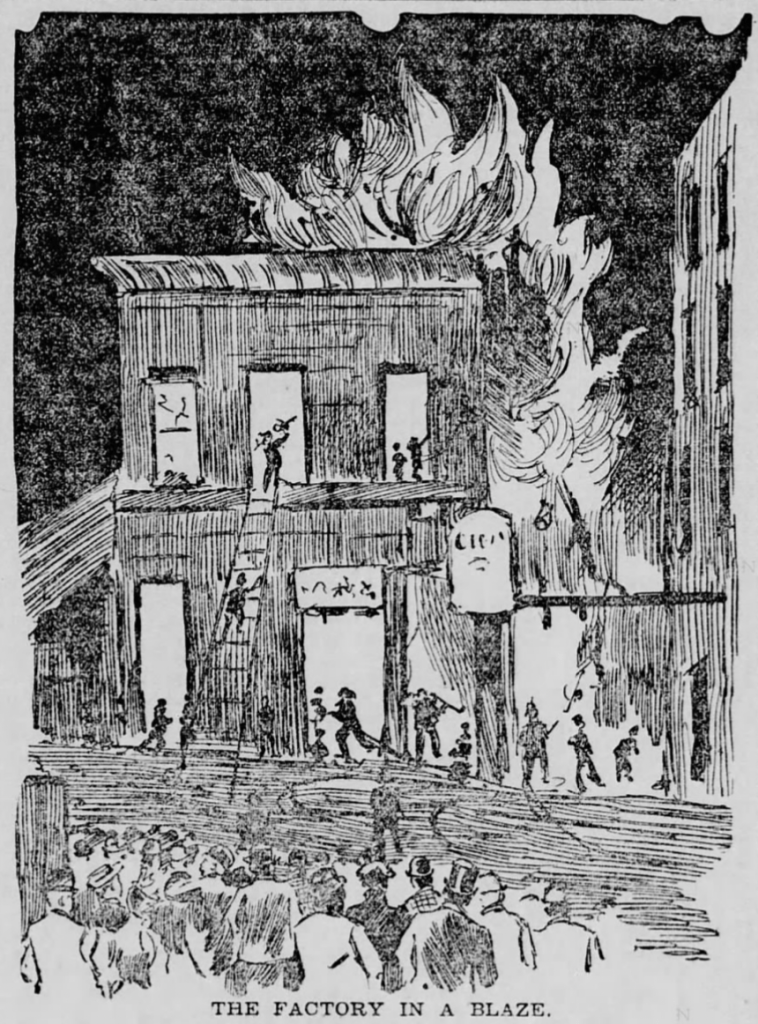
29. Yuen Fong Restaurant shrine
710 Jackson Street | 1887 Sanborn | Temple map
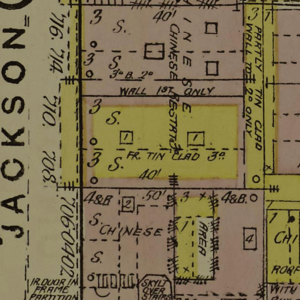
A small altar with a ceramic Laughing Buddha was photographed at this restaurant on Jackson Street. See relevant comments in Additional Shrines in San Francisco’s Chinatown below.
30. Voorman’s building shrine
Sullivan’s Alley | 1887 Sanborn | Temple map
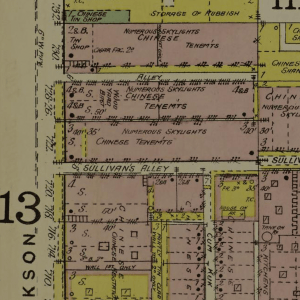
An unidentified joss house was reported in a building owned by Henry Voorman on Sullivan’s Alley. See relevant comments in Additional Shrines in San Francisco’s Chinatown below.
31. Sullivan’s building shrine
Sullivan’s Alley | 1887 Sanborn | Temple map
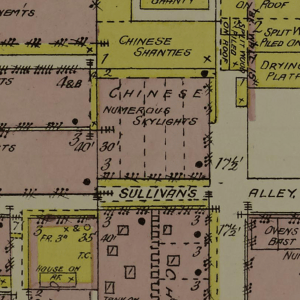
Two unidentified joss houses was reported in buildings owned by John Sullivan on Sullivan’s Alley. See relevant comments in Additional Shrines in San Francisco’s Chinatown below.
32. Hop Sing Society (Hesheng tang 合勝堂)
1025 Dupont Street | 1887 Sanborn | Temple map
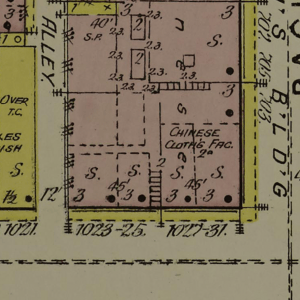
33. On Yick Society (Anyi tang 安益堂)
726½ Pacific Street | 1887 Sanborn | Temple map
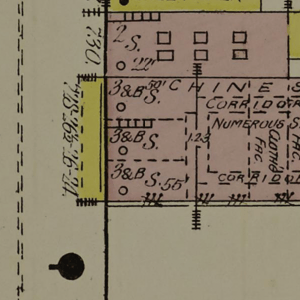
34. Chinese Merchant’s Exchange Shrine
739 Sacramento Street | 1887 Sanborn | Temple map
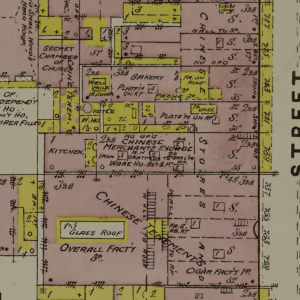
By as early as 1854, the Chinese had started building a merchants’ exchange [source]. By 1882, the Chinese Merchants’ Exchange had moved to 739 Sacremento Street and operated independently of the district associations, yet wielded considerable influence within Chinatown. Contemporary accounts note that the Exchange building contained a joss shrine, before which business transactions were formally concluded. This small shrine, centered on a spirit tablet, was reproduced as an inset illustration in Harper’s Weekly in 1882 (see below).
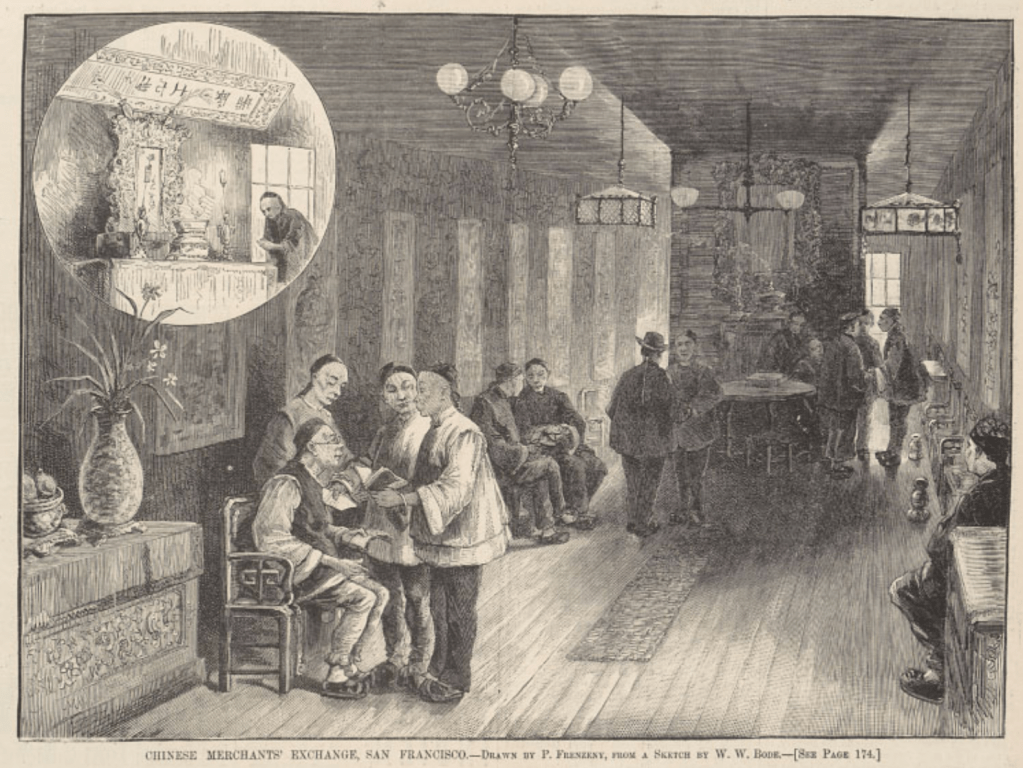
35. Yeong Wo Association III (Yanghe huiguan 陽和會館)
730 Sacramento Street | 1887 Sanborn | Temple map
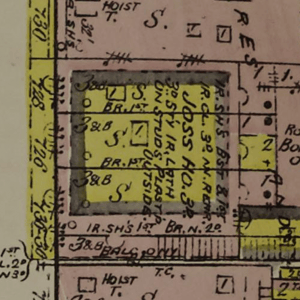
The Yeong Wo Association was formed in 1852 by a group of early Chinese immigrants, among whom Norman Assing (b. 1808?, born Yuan Sheng 袁生) was the most prominent. An English-speaking and self-described naturalized American citizen, Assing claims to have first arrived in the United States in 1820 and, after returning to China, came to California in July 1849 aboard the British barque Swallow. Upon arrival, Assing established a successful restaurant and trading firm, garnering him both wealth and local prestige. The 1850 city directory identifies his restaurant as the Macao and Woosung Restaurant, located at the corner of Kearny and Commercial streets.
In 1851, Assing also played a central role in organizing San Francisco’s first Chinese New Year celebration, hosting a large feast at his home and inviting members of the city’s police force. In subsequent years, the celebration developed into one of the city’s most visible expressions of Chinese identity and communal life. Assing was also an outspoken defender of his fellow Chinese immigrants. In 1852, he published a scathing critique of California’s governor in an open letter in the Alta California, protesting proposed legislation targeting Chinese immigration.
The Yeong Wo Association served immigrants from Xiangshan 香山 (modern Zhongshan) and the immediately surrounding areas of Zhuhai and Doumen, which together form a peninsula on the eastern side of the Pearl River Delta. Macao is located within this region, and many migrants from these areas consequently had longstanding familiarity with foreigners and foreign trade, as well as established traditions of overseas migration, particularly to Southeast Asia. By the mid-1850s, the Yeong Wo Association had the largest reported membership among San Francisco’s Chinese district associations, numbering as many as 14,000 members, and it remained among the largest over the following two decades.
Yeong Wo is known to have maintained a company building on the southwestern slope of Telegraph Hill by at least September or October 1852 when the building was dedicated with a large celebration. We can now connect this site to an earlier unnamed “idol temple” noted in newspapers across the US in 1851 as being erected at an undocumented location in San Francisco [#X1]. The temple was constructed in the summer of 1851, reportedly according to a “modified Chinese plan” and using imported Chinese spruce timber. Because of the scarcity and high cost of lumber during the Gold Rush, wood and many prefabricated buildings were shipped from Guangdong to California, making such a claim feasible.
The formal dedication of the shrine hall in the fall of 1852 was described in unusual detail by a local newspaper reporter for the San Francisco Whig. As Ho and Bronson have noted, the dedication included Chinese opera performances as part of the festivities, although the reporter mistakenly interpreted these theatrical performances as ritual actions conducted by Chinese priests. This connection is particularly intriguing because one of Yeong Wo’s founders, Assing, was responsible for bringing the first Cantonese opera troupe to the United States. The troupe, Hong Took Tong (hongfu tang 鴻福堂), gave its first performance in October 1852 at the American Theater. This aligns perfectly with the propsed September-October timeline for the Yeong Wo temple dedication (which is also the presumed founding date of the Yeong Wo Association). As described by Lois Rodecape, the Chinese troupe had brought a prefabricated portable theatre, setting it up on Dupont Street in December and performing in San Francisco through the winter. In recounting the temple dedication earlier in the fall, the Whig reporter also claimed a “new Chinese theatre” was being erected opposite the temple building, further suggesting the celebration involved the Hong Took Tong troupe who used Telegraph Hill as an early staging area.
The Whig reporter described the temple’s principal icon only as resembling “a little doll,” providing no further information about its identity or iconography, but the diminuative stature of the Yeong Wo icon would be highlighted again by future observors. The icon was an embodiment of Houwang 侯王, a semi-historical figure who had become the association’s “patron deity.”
The Yeong Wo Association’s devotion to Houwang stems from the fact that most of its members hailed from the Xiangshan district (modern Zhongshan), a region that was home to an important Houwang temple. The physical icon of Houwang in San Francisco was reputed to have an especially distinctive provenance. According to one tradition retold by the San Francisco Examiner, it was discovered in Xiangshan “centuries ago” after a devastating flood receded, revealing the small figure atop a mountain; the deity thereafter ensured peace and stability in the region. When the icon was brought to California, it was said to have first resided in apartments on Mason Street near Post Street. Notably, this intersection is precisely where Ah Ching would establish his Tin How Temple [#X3], possibly as early as 1856 if not before, suggesting this area may have served as an important hub of Chinese religious activity shortly after large-scale immigration began.
By 1868, the Yeong Wo organization headquarters was still in the “old house” on Telegraph Hill, but was also reported as developing property on Sacramento Street – addresses at 727 and 730 Sacramento Street appear in city directories of the 1870s and early 1880s. At an unknown time, religious activities seem to have shifted to Cum Cock Alley and then to a location known as Houwang Temple on Brooklyn Place around 1883 [#2].
The placement and potential movement of Yeong Wo / Houwang temples through the late 1880s remains difficult to reconstruct. An 1880 city tax assessment claims that Yeong Wo maintained a company house and joss house at 730 Sacramento Street, but this might refers to a small private altar, not a full public shrine hall. In 1883, for example, the festive parade for Houwang’s birthday still originated at Brooklyn Place. Parade members traversed down Sacramento, up Commercial, and along Dupont until arriving at the Chinese theater on Jackson Street where performances were held for the occasion. There is also no mention of returning to Sacramento street at the end of the celebration. Of equal note, however, one newspaper account asserts the 1885 parade used an icon of Houwang taken from “the josshouse on Sacramento,” which might be convenient shorthand for the Houwang Temple on Brooklyn Place, a small and relatively unknown alley just off Sacramento Street. These conflicting accounts cannot be fully reconciled at present.
Moreover, it has been suggested, by myself and others, that in 1885 the Yeong Wo Association or Houwang Temple might have occupied 730 Jackson [#28] during Houwang’s birthday festivities that year. The singular evidence for this, however, appears to derive from an error in the San Francisco Chronicle. By contrast, the San Francisco Examiner reports the Yeong Wo parade of that year passed by 730 Jackson which was occupied by Eastern Glory Temple, an occupant that makes more sense given the time frame of the mid-1880s [see #14].
The Yeong Wo Association finally relocated to Sacramento Street in September 1887, nearly twenty years after such a move was first reported. This transition was marked by an especially elaborate birthday parade for Houwang, who was ceremonially transported to his newly sanctified abode. A rudimentary newspaper sketch depicts the diminutive icon, echoing the early observer who likened it to a child’s doll (see below). The procession featured a massive serpentine dragon constructed from brown packing paper covered in silk, measuring 170 feet in length – more than three times longer than the fifty-foot dragon used the previous year (see sketch of mask below). The dragon alone reportedly cost $2,000, while the entire celebration was said to have cost $50,000. Houwang’s annual birthday festivities, characterized by raucous parades and spectacle, continued to attract public attention and press coverage through 1906.
Amédée Joulin (1862–1917), a French-American painter born in San Francisco, is reputed to have painted the interior of the Yeong Wo temple in 1890. Two newspaper illustrations also depict the temple elaborately decorated for festival occasions (see all below). After the 1906 earthquake the Yeong Wo shrine hall was not replaced.
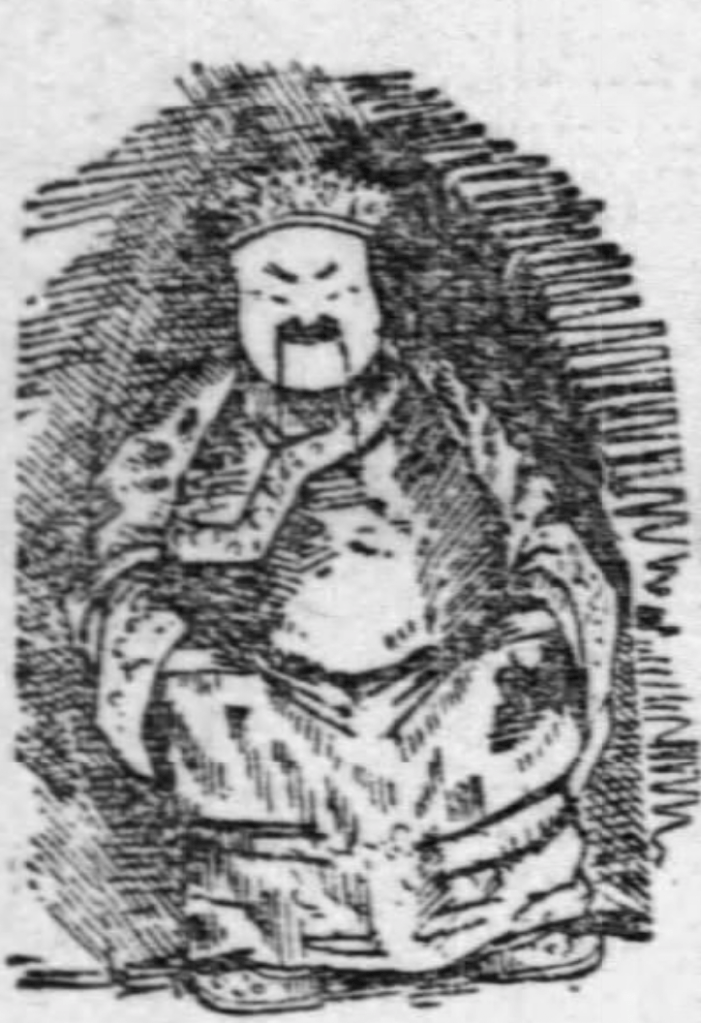
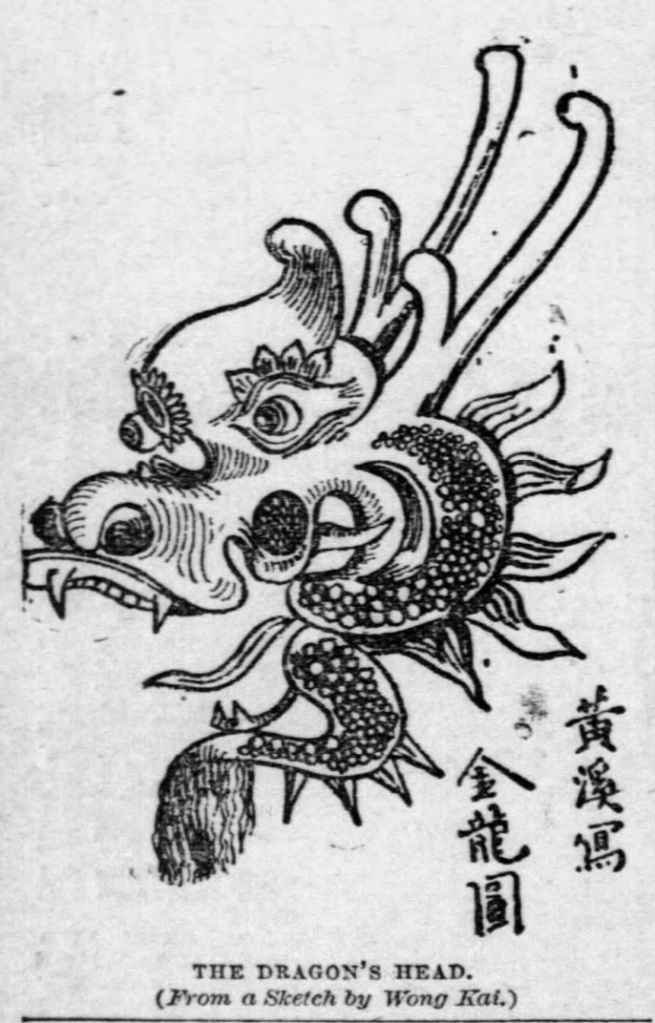

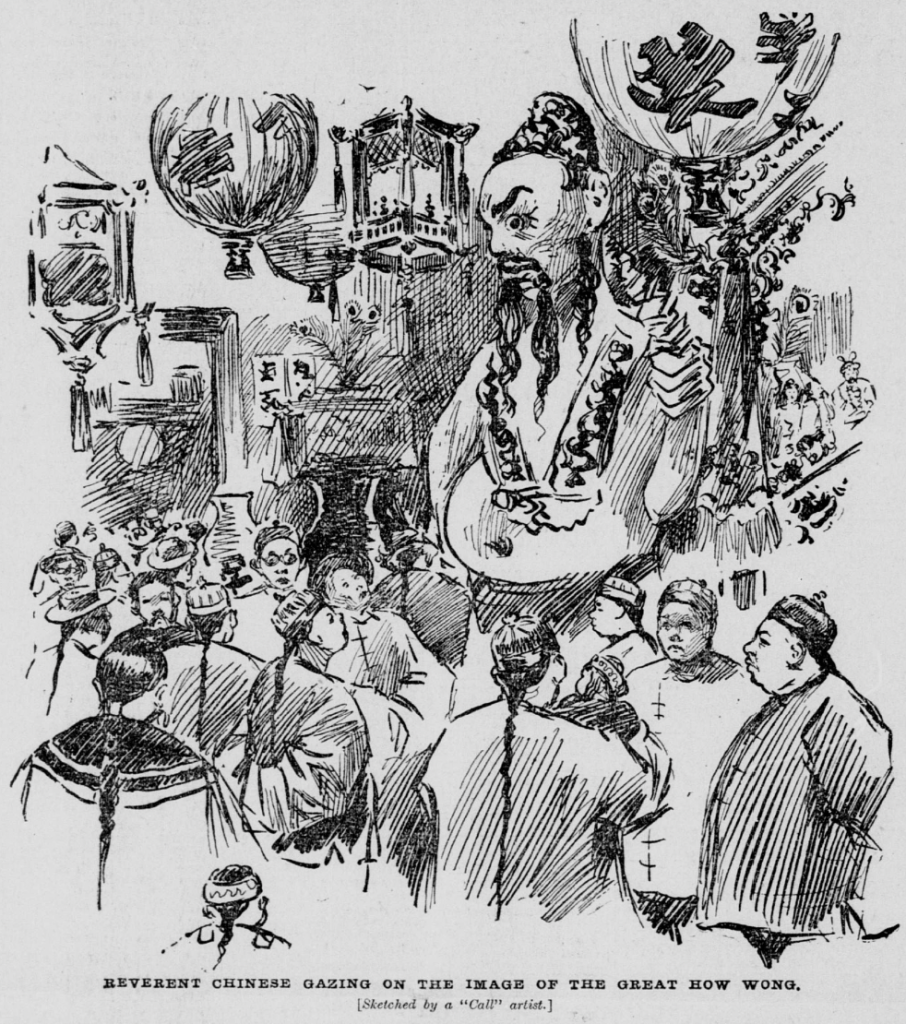

36. Hop Wo Association I (Hehe huiguan 合和會館) & Six Companies I (Zhonghua huiguan 中華會館)
736 Commercial Street | 1887 Sanborn | Temple map
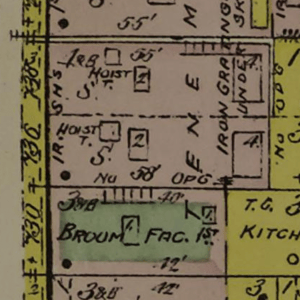
The Hop Wo Association splintered from the Sze Yup Association in 1862 and rented space at 736 Commercial Street through the late 1860s. City directories from this time also list the headquarters of the Chinese Benevolent Association at the same address, noting they were “sustained by the Hop Wo Company.” The Chinese Benevolent Association would come to be known as the Chinese Six Companies. Both organizations moved in the mid-1870s when the Hop Wo Association purchased a building a few doors down on Clay Street [see #37 & #38].
37. Six Companies II (Zhonghua huiguan 中華會館)
728 Commercial Street | 1887 Sanborn | Temple map
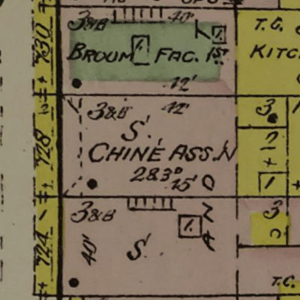
As early as 1853 district associations in Chinatown banded together to help collectively aid in the concerns of the Chinese community, especially in caring for the Chinese sick and poor and repatriating bones of the deceased back to China. In time, according to Him Mark Lai, “a gongsuo (“public hall”) consisting of huiguan [district associaiton] officers and committeemen was established around 1862. This, however, appeared to be a loosely organized federation of the huiguan, which by consensus made decisions on matters affecting the general interest of the Chinese on the Pacific Coast.” The services in which this loose fraternity provided were wide ranging, including, “settling disputes between the people of different companies, consulting on the best means to contest or seek relief from anti-Chinese laws, devising means to bar the import of Chinese prostitutes, and entertaining public figures.”
Because there were six major district associations in operation at the time – Ning Yung, Hop Wo, Kong Chow, Yeoung Wo, Sam Yup, and Yan Wo – this organization became known as the Chinese Six Companies, a name that held in later years despite the addition of more district assoications. By 1882, the loose organization was formalized and its powers more clearly defined, in part, to combat actions engendered by growing anti-Chinese sentiment. The new organization was formally known in English as the Chinese Consolidated Benevolent Association (CCBA) and had divisions in other cities across North America.
The San Francisco offices were initially at 732 Commercial Street through the late 1860s [#36], but the organization settled at 728 Commercial in the mid-1870s. According to Ho and Bronson, the San Francisco CCBA never managed a public temple, but only kept a “small non-public shrine hall in its meeting room.” The 1887 Sanborn map shows a unnamed Chinese Association occupying a three-story brick building at 728 Commercial that directly abuts the Hop Wo Joss House [#38].
38. Hop Wo Association II (Hehe huiguan 合和會館)
751 Clay Street | 1887 Sanborn | Temple map
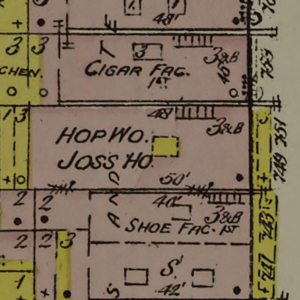
After seperating from the Sze Yup Association in 1862, the Hop Wo Association headquarters occupied 736 Commercial Street through the late 1860s [#36]. Hop Wo members opened their first headquarters with dedicated shrine hall in 1874 after purchasing a three-story brick building directly across from the southwest corner of Portsmouth Square the previous year for $24,000. The building spanned a lot that reached back to Commercial Street and soon after the building was purchsed the Chinese Benevolent Association moved to the other entrance fronting 728 Commercial [#37].
The shrine hall, dedicated to Guandi, was on the top floor and outfitted with a reported $30,000 worth of icons, furnishings, and ritual equipment shipped from China. Soon after opening, a touring New York clergyman marveled at the temple’s opulence, claiming he was “entranced in a blaze of glory!” A hospital for company members was located in the basement which also apparently offered hospice care.
Through the early 1880s tourist guide books continued to recommend seeing the Hop Wo shrine hall, but by 1892 the building had lost its former luster, with Frederic Masters proclaiming it a “dingy-looking place.”
Isaiah West Taber took two rare photographs of the shrine hall in the mid-1880s (see one below). These were sold by Taber’s studio by 1889. In addition, one anonymous photo from around 1900 shows the building exterior (below; see also Arnold Genthe photo here). The shrine hall, as with many district association buildings, was not replaced after the 1906 earthquake.

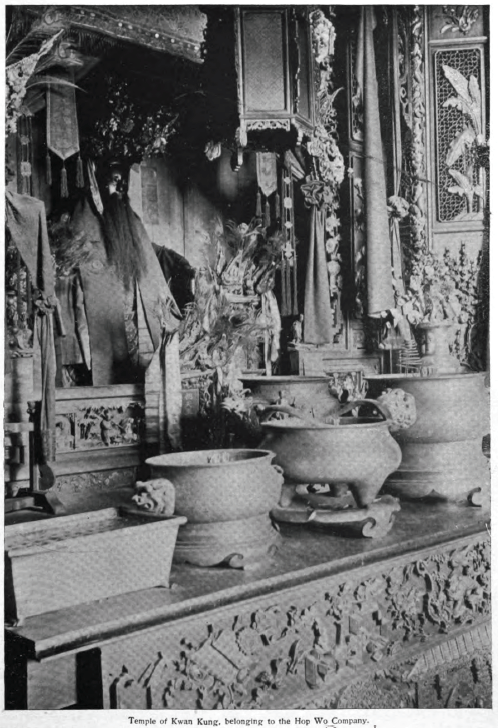
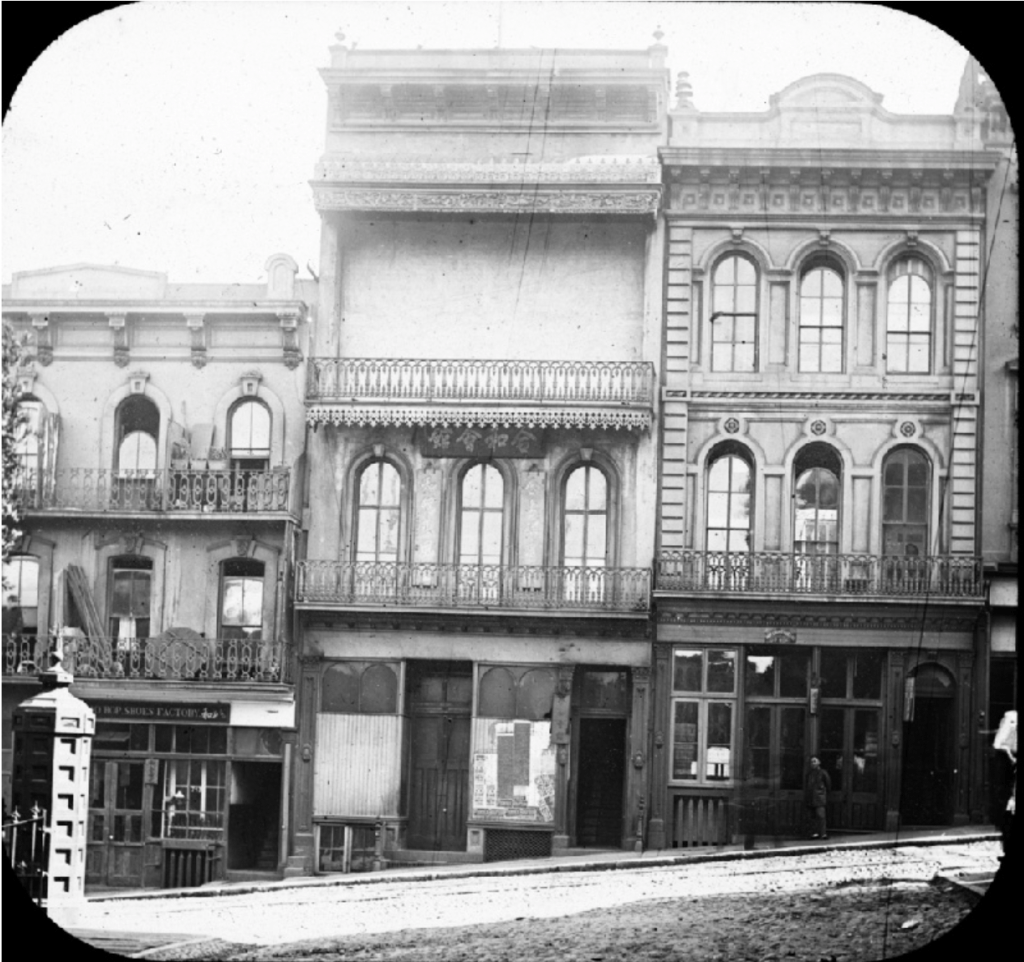
39. Chan Master Temple (Chanshi miao 禪師廟) & Suey Ying Society (Ruiying tang 萃英堂) & City God Temple III (Chenghua miao 城隍廟)
1 / 2 / 5 Brenham Place | 1905 Sanborn | Temple map
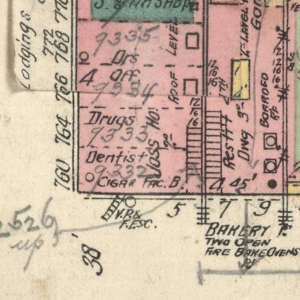
The Shim Shee Temple, or Chan Master Temple (Chanshi miao 禪師廟), and other Chinese religious sites related to the building on the corner of Clay Street and Brenham Place are discussed with the commentary for the Wong family temple below [#40].
40. Wong Kong Ha Shrine I (Huang jiangxia tang 黃江夏堂)
2 / 3 /7 Brenham Place | 1887 Sanborn | Temple map
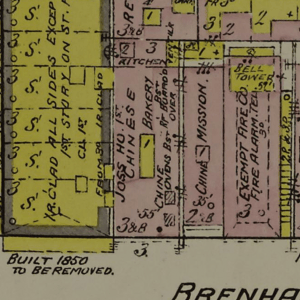
Both the 1885 Surveyors’ Map and the 1887 Sanborn Map mark 3 Brenham Place as a joss house, next door to the Chinese Mission under the supervision of Rev. William Pond. A joss house at 3 Brenham is first listed in the 1883 city directory. As Ho and Bronson have shown, the multi-story wood building was occupied by the wealthy Wong Kong Ha 黃江夏 clan. City property records from 1886 and 1894 cite the owners as L. & J. Joseph brothers, meaning the Wong family leased the building for their shrine hall. The Wong clan building faced Portsmouth Square, then simply known as the Plaza, the heart of old San Francisco.
One photograph, dated circa 1880, shows 3 Brenham Place with a shrine hall occupying the upper floor (see imagery tab below). An earlier stereoview of Portsmouth Square by Isaiah West Taber shows 3 Brenham Place before the upper floor was converted into a shrine hall (see here; also here). The later photograph provides several clear indications that the building had been converted for use as a Chinese American temple, including the construction of a small open-air veranda and the installation of large paper lanterns, a lintel signboard, and vertical inscription boards framing the doorway. The vertical inscription boards flanking the first-floor entrance further suggest that this was the temple’s principal entrance, with stairs leading visitors to the shrine hall above.
The approximate dating of the photograph to 1880 is corroborated by the small hand-painted sign identifying Hop Yick & Co. at 1 Brenham Place. This Chinese business appears in city directories from the early 1880s. Hop Yick & Co. occupied the southern end of a building known as the Portsmouth House, which formed the corner of the block and extended westward along Clay Street toward Dupont Street. Notably, while the photograph shows a two-story building at 3 Brenham, the 1887 Sanborn Map depicts a three-story brick building with a basement, suggesting that a new structure was erected in the intervening years. As we will see below, the older building at 3 Brenham appears to have been razed by February 1882, meaning construction of the new three-story brick building with basement likely began around that time.
The identification of a joss house on Brenham Place is complicated by the record of a second Chinese American temple, identified as the “Shin Shee Nue” [sic] joss house at 2 Brenham Place, first listed in the 1881 city directory. (Hop Yick & Co. is also listed at 1 Brenham in that directory.) The existence of a “Sin See Mu Society” on the “corner” of Clay and Brenham is reported again in the summer of 1882, when a festival and parade was held for its “wooden” icon, described as a “violent-looking old gentleman” with his “right hand stretched far above his head.” This was not the icon enshrined in the temple but a temporary image created specifically for the festival and burned at its conclusion, as was common practice. In the summer of 1884, a newspaper reported on celebrations of the “Shim Shee Mue” on Brenham, and the following summer, in 1885, another article described the birthday celebrations of a “Wong Tung Shim Shee Mue.” Neither of these later reports provides a street address. Although the 1884 article places the Shim Shee Mue in the West End Building—presumably the former West End Hotel, several buildings north on Brenham—I suspect this was an error.
The appearance of the name “Wong” in the 1885 report suggests that the Wong clan had a formal relationship with the Shim Shee Temple (Shim Shee Mue 禪師廟), which is transcribed in several different ways in contemporary sources as seen above. The precise location of the temple during the early 1880s, however, remains unclear. The 1881 city directory identifies it at 2 Brenham Place, presumably within the Portsmouth House. Its entrance may be visible in the circa-1880 photograph cited above, where a flag hangs beside an open doorway and an illegible vertical signboard bearing Chinese characters appears next to the door. The doorway presumably led to the upper floors, but the photograph provides no obvious indication of a temple occupying the second floor facing Portsmouth Square. The building itself appears to have had three stories.
A fire in February 1882 gutted the Portsmouth House, reportedly displacing 500 Chinese residents who lived on its upper two floors. Curiously, the reporter states that 2 Brenham Place also sustained minor damage, identifying it as the Baptist Mission Society Building operated by Rev. Pond. Importantly, the report makes no mention of the Wong clan building that should have stood between the Chinese Mission and the Portsmouth House. I believe this suggests the old two-story frame building had already been demolished and that the site was being prepared for construction of the new brick building. Presumably, the reporter either used 2 Brenham as a convenient reference for the Chinese Mission, indicating to readers that it was the building next to the Portsmouth House, or the address was a typesetting error for 5 Brenham Place, which was the address given for the Chinese Mission in city directories throughout the 1880s. It remains uncertain where the Shim Shee Temple held its festival in the summer of 1882, other than somewhere on Brenham. Unfortunately, the relationship between the Shim Shee Temple and the Wong family remains poorly understood, although Ho and Bronson have shown that a member of the Wong family headed a committee raising funds for the Shim Shee organization in 1903.
By the summer of 1887, the “Shinn See Mue” had moved from Portsmouth Square, holding its celebrations “in the josshouse on Stockton” near Washington Street. Notably, the 1887 Sanborn Map marks the Portsmouth House—presumably the building in which the Shim Shee Temple had been located—as “built 1850” and “to be removed” (see inset map above). This planned demolition may have prompted the temple’s relocation. In 1888, the “Shin Si Gear Society” enshrined a new ivory icon imported directly from Beijing, presumably at its new location on Stockton. The Chinese business directory of San Francisco in 1895 lists the Shim Shee Temple at 1111 Stockton, possibly the address to which it first moved in 1887. The identity of its principal deity, Shim Shee, or Chan Master, remains unknown, although Ho and Bronson speculate that he may be connected to a curious spirit table inscribed “Great Virtue Chan Master” (dade chanshi 大德禪師), now held at Kong Chow Temple.
To complicate matters further, by 1892 the Wong family is described as occupying 2 Brenham Place, an address repeated in 1893 when the family held a birthday celebration for its patron goddess, Guanyin. (The digitized 1884 city directory is missing its Chinese Directory section.) The history of this apparent “move” is not straightforward. According to Ho and Bronson, the building represented a new four-story structure erected in “early 1890,” with a top-floor shrine hall dedicated to Water Moon Guanyin. If a newspaper sketch from 1893 is accurate (see below), this appears to have been a new building constructed on the old 3 Brenham footprint, suggesting that the property had been renumbered as 2 Brenham. The renumbering may have occurred after the Portsmouth House on Clay Street was demolished in the latter half of the 1880s and replaced with a four-story brick building. This would place the Wong clan building at 7–9 Brenham Place on the 1905 Sanborn Map [here].
In review, the San Francisco city directory locates the Shim Shee Temple at 2 Brenham Place in 1881 and a generic “joss house” at 3 Brenham in 1883. Presumably, these are two different temples occupying two adjacent buildings, with the generic “joss house” indicating the Wong clan shrine hall which is viewable in the anonymous photograph from c.1880. In February 1882, a fire in the Porthsmouth House likely temporarily displaces the Shim Shee Temple, while the two-story Wong clan building appears to have been already demolished, clearing the lot for new construction. By 1887 a new three-story brick building for the Wong clan has been erected, but the old Porthsmouth House still remains, now marked for demolition. By the summer of 1887, the Shim Shee Temple has already moved to Stockton Street. In 1890, the Wong clan’s three-story brick building with basement is replaced with a new four-story brick building, topped with a shrine hall to Guanyin. I presume the western entrance of the building that replaced the Porthsmouth House was numbered 1 Brenham Place and the neighboring Wong clan building was numbered 2 Brenham Place at this time.
A September 1894 article in the San Francisco Call, however, places a “new” Wong family temple on the “corner” of Brenham and Clay, “next door to the family’s old house of prayer,” suggesting that the Wong shrine hall had relocated to an adjacent building. (See 5 Brenham on the 1905 Sanborn map. Both new buildings are visible in a photo dated to 1905, see here.) Ho and Bronson assume that the “new” buildings of 1890 and 1894 were one and the same, with the shrine hall merely being refurnished and its icon reinstalled in 1894. Police raids around Chinatown in 1897, however, report that the Suey Ying Society maintained meeting rooms and a joss house at 1 Brenham. Unless the Wong family shrine occupied a different floor of that building, the evidence suggests that the Wong shrine hall probably remained at its earlier location.
As reported in 1893, the Wong clan shrine hall contained three icons, a bronze Guanyin flanked by Guandi and the Wealth God. Contemporary accounts noted that Guanyin was viewed as the patron saint of the Wong clan, emphasizing that while Guanyin does “good for all,” she “especially favors the Wongs.” Every July, to celebrate Guanyin’s birthday (19th day of 6th lunar month), Wong family members across the United States contributed between $5,000 and $7,000 in donations to fund a grand three-day festival.
Alongside daily religious services and festivities, expansive public banquets were hosted within the society rooms, free and open to anyone seeking a meal. These charitable feasts regularly fed several hundred people each summer, with a single 1890 account recording 350 “poor Chinese” were served in one day. During another celebration, every visitor to the shrine hall received a dime wrapped in decorative paper as a monetary gift. Non-Chinese Americans also attended the services, guided by a designated Wong family interpreter who explained the rituals to curious observers.
A decade later, in January 1902, the Wong family moved from Portsmouth Square to a new three-story brick building on the west side of Waverly Place close to Washington Street [#17]. The building is listed as 137 Waverly on the 1905 Sanborn Map and identified as containing “society rooms.” Two years earlier, the Wong family had incorporated as the Wong Benevolent Association and purchased what appears to have been a vacant lot on Waverly from Wong Yow and Lim Shee for the relatively modest sum of $500 in 1901.
After the Wong family relocation, the 1905 Sanborn map indicates a joss house had been reestablished at the corner of Brenham Place. Notably, the 1905 city telephone directory indicates the City God Temple—previously located on Waverly [#7] and later at 1018 Stockton [#23]—occupied 5 Brenham at the site of the former Portsmouth House. A turn-of-the-century photograph shows the corner building at 5 Brenham with lanterns and vertical signboards hanging from the second-floor balcony, material signatures of an operating temple (see below). The former Wong clan building at 7–9 Brenham retains its upper-floor balcony, but without lanterns or signboards, suggesting that its shrine hall was no longer in operation.

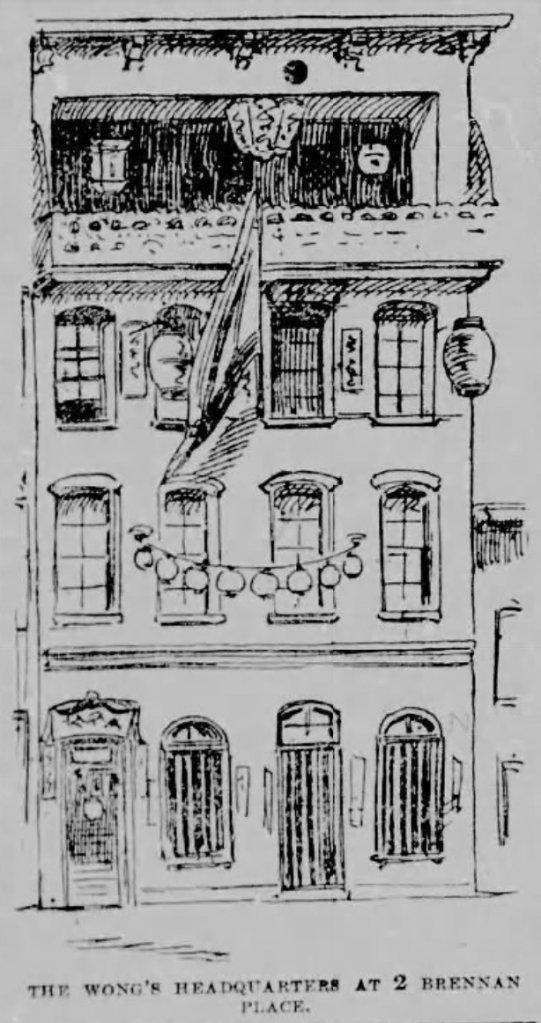
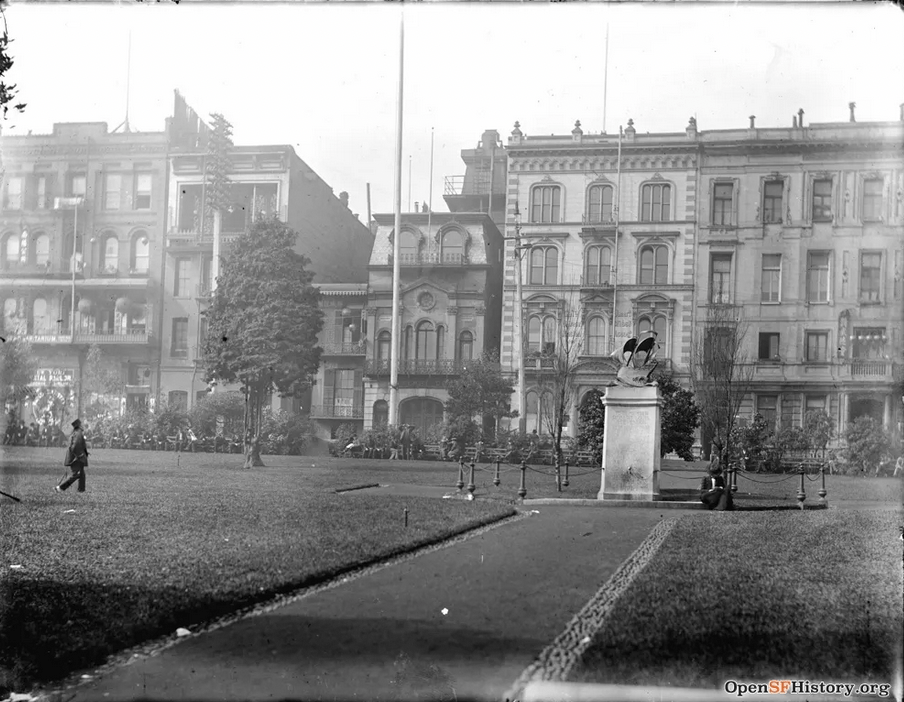
41. Tailor’s Guild shrine
Brenham Place | 1887 Sanborn | Temple map
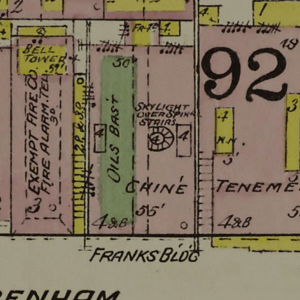
The Tailor’s Guild organized under the name Kum Yee Hong. In 1883 they reportedly set up a shrine hall on the third floor of “Frank’s Building,” the popular name for the building adjacent to the fire station on Brenham Place. According to a San Franscisco Call article, Chinese sewing machine operators organized and had struck for shorter hours and Sundays off. Having succeeded, they set up an altar tablet to a figure named On Sun, “the Almighty One,” chosing the auspicious day on the 1st day of the 9th month to undertake this endeavor.
“On Sun” might be an misunderstanding of Xuanyuan 軒轅 (Cantonese: Hinjyun), the personal name of the Yellow Emperor and traditional patron deity of tailors who is considered to have invented sewn clothing. The 1885 Supervisor’s map locates a Chinese tailor on Brenham, but does not indicate the address as a joss house.
42. Telephone Exchange shrine
743 Washington Street | 1905 Sanborn | Temple map
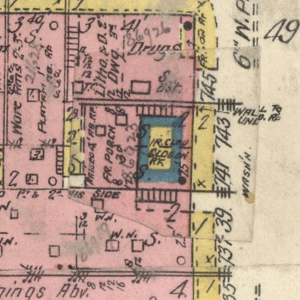
In the mid-1890s, fewer than fifty telephones operated in San Francisco’s Chinatown. By the turn of the century, that number surged past 200, prompting the Pacific Telephone and Telegraph Company to install a major switchboard system in a three-story building at 743 Washington Street in the fall of 1901. Managed by Loo Kum Shu alongside three staff operators, it became the nation’s only dedicated Chinese-language telephone exchange.
In November 1901, a San Francisco Examiner reporter visited the Chinatown telephone exchange building which occupied the upper floor. After describing the comforts of the reception area, the reporter describes an unexpected discovery: “At the extreme end of this room on an altar of considerable size and great richness, a richness of gold and silver and red lacquer, rests a joss whose special duty is to guard and care for the interests of those who send speech over wires. To many of the Chinese the telephone still holds, to a certain degree, its qualities of the supernatural, and the presence of a joss is not a luxury, but a prime necessity.
This passage in the Examiner reveals the anxieties around rapidly changing technologies. Transmitting a human voice long-distance across a series of wires and switchboards might seem like a supernatural act. (Equally, many Chinese through the 1890s did not want their photographs taken.) These anxieties were mitigated through the enshinement of a powerful and protective religious icon, placed just opposite the switchboard and the operators at work.
At one level, we can read this event through an exoticizing lens, treating the altar as a quaint or superstitious curiosity, and consequently viewing the Chinese community as conflating modern technology with antiquated tradition. At another level, it could be understood that Loo and the Chinese community were expressing their own religious worldview, asserting that technological advancement did not have to mean abandoning their cultural heritage to Western norms. In such a view, the icon represents a meaningful bridge between tradition and technology.
This convergence of technology and spiritual belief was not uniquely Chinese; it reflected a broader turn-of-the-century phenomenon. Across America, the boundary between science and the occult was porous. Spiritualists and occultists routinely treated new telecommunications technologies as mediums for communicating with the dead, mirroring the era’s widespread view that science could serve as an extension of religious and metaphysical aims.
The altar’s presence continued to draw public curiosity. When a San Francisco Call reporter later visited, Loo noted that he considered the icon a “pleasant idea” for a workspace. He directed the reporter’s attention to a purple and gold embroidered silk motto hung above the shrine: “A line will convey good news to you.” While acknowledging that telecommunication felt inherently uncanny to many, Loo also used a traditional convention found in shrine halls across Chinatown–a motto placed above a shrine–to gently reassure patrons of the technology’s practical and joyful potential, namely, that a telephone call might bring welcomed and exciting news.
A montage of photos was published with the Call article, with top-most photograph visually revealing the “telephone joss” sitting inside his shrine with embroidered Chinese motto above (see imagery tab below).
Similar comments by Loo concerning the “telephone joss” were published in The New Metropolitan and The Telephone Magazine, both with acompanying photographs. A more detailed response was printed in The American Telephone Journal: “‘No Chinese will think of patronizing a business that is not presded over by a joss,’ explained Manager Loo. ‘In China everyone who is recognized as a great public benefactor is deified. Every art, trade and science has its joss, who is both propitiatory and commemorative in character. The joss is a memorial to the man who first introduced the art, or made the first great scientific discovery, and it also directs the destiny of those who pursue that particular vocation.'”
Loo’s explanation completely reframes the altar, shifting away from Western assumptions of blind superstition and rooting the telephone in a systematic, rational tradition of honoring human innovation. Through the Chinese practice of euhemerism—the deification of historical figures—inventors and pioneers were elevated to divine status as a tribute to achievement, rather than worshipped through empty superstition.
At the same time, Loo walked a careful line. He subtly recognized that a religious icon evoked a deep sense of trust and ethical accountability for customers. Statues and paintings of figures like Guandi spiritually attested to honest business dealings, while the Earth God served as a moral witness against deceit. By emphasizing euhemerism over traditional folk beliefs, Loo presented a sophisticated cultural rationale to an outside press, successfully anchoring modern telecommunications within an ancient tradition of honoring technological progress.
Unfortunately, I have not been able to identify the icon enshrined at the telephone exchange building (although there is a curious juxtaposition here); there is no mention of the shrine and icon after the building was rebuilt.
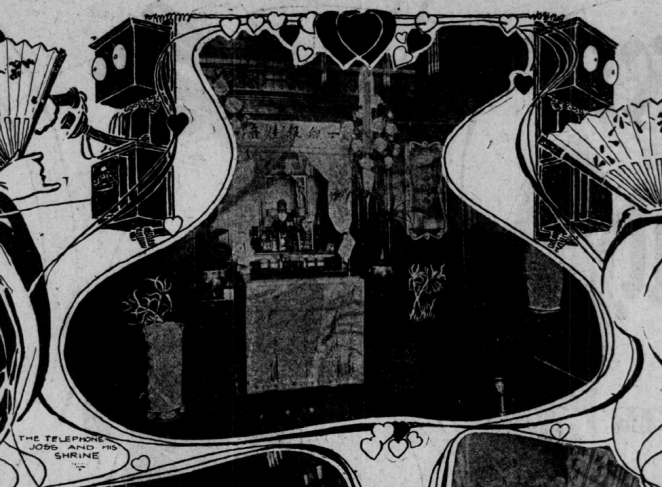
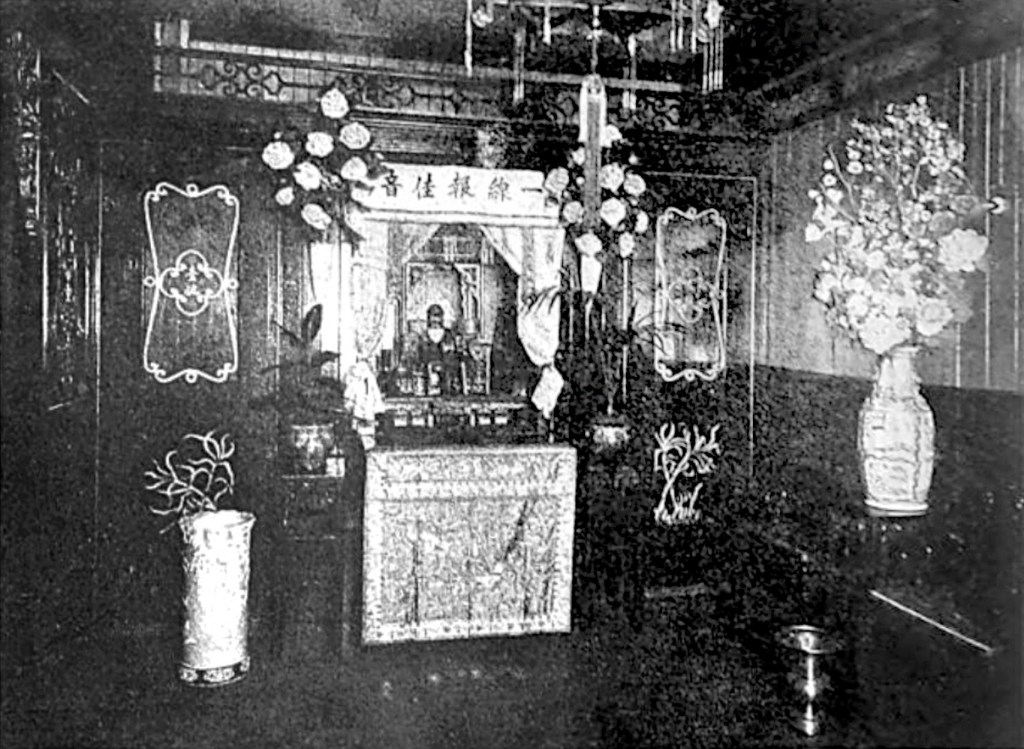
43. New Chinese Theater shrine
623 Jackson Street | 1887 Sanborn | Temple map
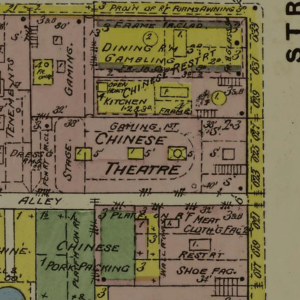
San Francisco’s Chinatown theaters enshrined religious icons high above the main stage. See relevant comments in Additional Shrines in San Francisco’s Chinatown below.
44. Suey Sing Society (Cuisheng tang 萃勝堂)
1004 Dupont | 1887 Sanborn | Temple map
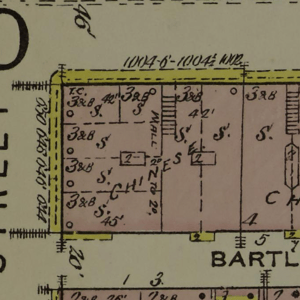
The Suey Sing Society first appears in San Fracisco newspapers in 1881 already enmensed in conflict with members of a splinter group, the Hop Sing Society, whose headquarters was less than a block away [#32]. The origin of the fued is disputed in contemporary accounts, but in the summer of 1881 Suey Sing members raided the joss house of the Hop Sing located on the southwest corner of Dupont and Pacific streets, trashing the shrine hall and “dethroning” the main icon, ultimately “casting it into the street.” In retailiation, Hop Sing members shot up a Suey Sing gambling house on Ross Alley. This is one of the earliest acounts of the nascent “tong wars” that grew in intensity in San Francisco through the late 1880s and 1890s.
These conflicts eventually triggerd a series of police raids on Chinatown secret society headquarters in 1891, 1893, and 1895 that were publicized in local newspapers. Following a series of fatal attacks between the Suey Sing and Hop Sing members in early March 1893, the Chinatown police squad raided both headquarters, intending to “smash idols, tear down tapestries, destroy carvings and wreak general havok.” The San Francisco Examiner vividly describes the wonton destruction at the Suey Sing Society shrine hall: “The altar was occupied by a joss, a hollow, fierce faced figure with black beard and mustache, the God of Revenge and Destruction. [A policeman] swung the ax and the hollow god toppled from his throne and lay cracked and torn head down in a corner. Blow followed blow and soon there was nothing left of all the brilliant worship of the Taoist highbinder but a tangle of red paper, tinsel, punk and wood.”
The accompanying sketch published with the article gives a clear illustration of the devastation (see imagery tab below). Despite the caption noting the destruction at the Hop Sing Society, the depiction matches the above description. Moreover, according to the reporting, Hop Sing members had already vacated and removed their joss when the police arrived, as it was made of “bronze” and “very valuable.” The police did rip apart a hanging scroll depicting a “life-size” image of the deity, described simply as a “bearded god.”
Another article covering this raid clarifies the Suey Sing headquarters was located on the top floor of the building on the corner of Bartlett and Jackson street with entrance at 1004 Dupont. This seems to have been an old haunt of the Suey Sing, as they are noted as occupying this building as early as 1882. The police raids of 1891, however, list the Suey Sing Society next door at 1006 Dupont or further north at 1024 Dupont.
In 1897, during heavy police pressure to solve the murder of secret society leader Fong Ching, known as “Little Pete,” the Suey Sing evacuated their headqarters fearing they were being fingered by the police. When the Chinatown squad arrivled at 1004 Dupont (some reports confuse the address with the Suey Ying meeting rooms at 1 Brenham), the main icon had already been removed and the altar dismantled. The San Francisco Examiner sketch artist apparently decided to envision what the altar may have looked like if it was still set up fully (see below).
While the sketch is rendered dramatically from a low perspective and embellished with radiating light and streams of incense smoke, many of the altar elements are fairly accurate. The icon is enshrined inside a niche with decorative framing screen and a traditional five-piece altar set of two vases and three censers is placed on the offering table. The two objects emerging at angles from the icon’s head represent peacock feathers, symbols of rank and nobility, and can be seen in the photograph of the Lung Kong Association shrine [#1]. The sketch artist in 1893 also included peacock feathers standing against the wall next to the broken icon.imagery
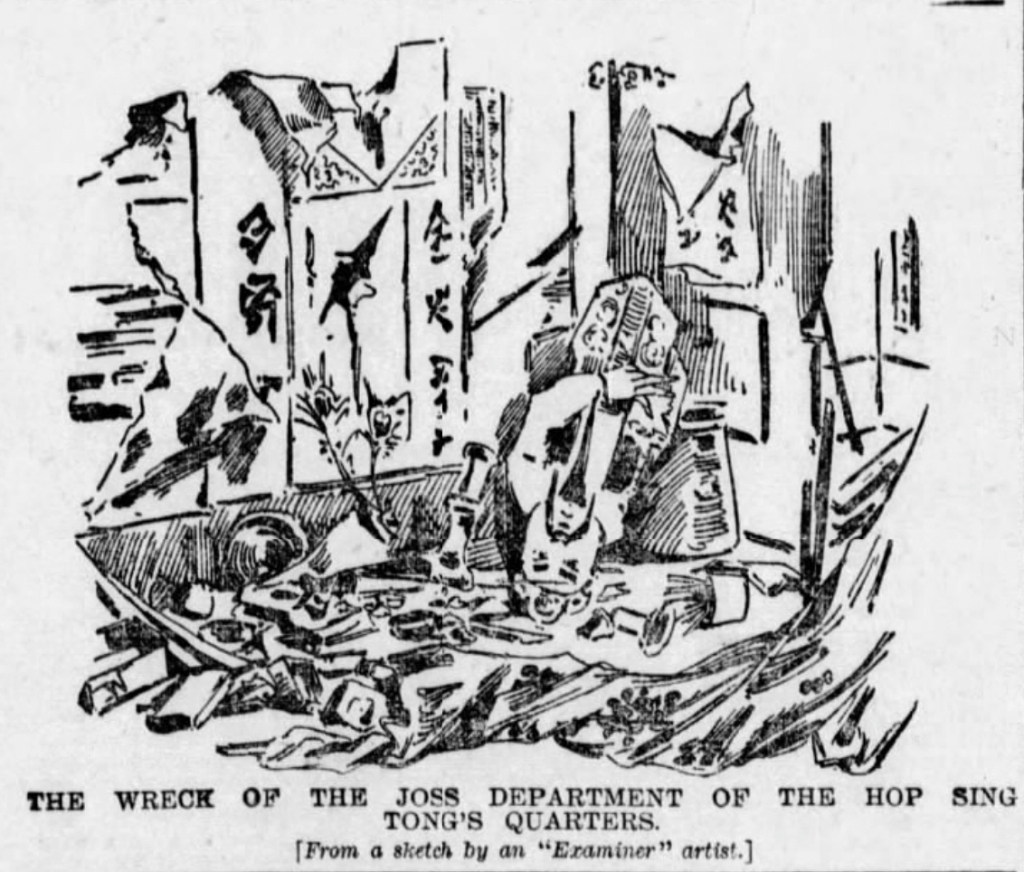
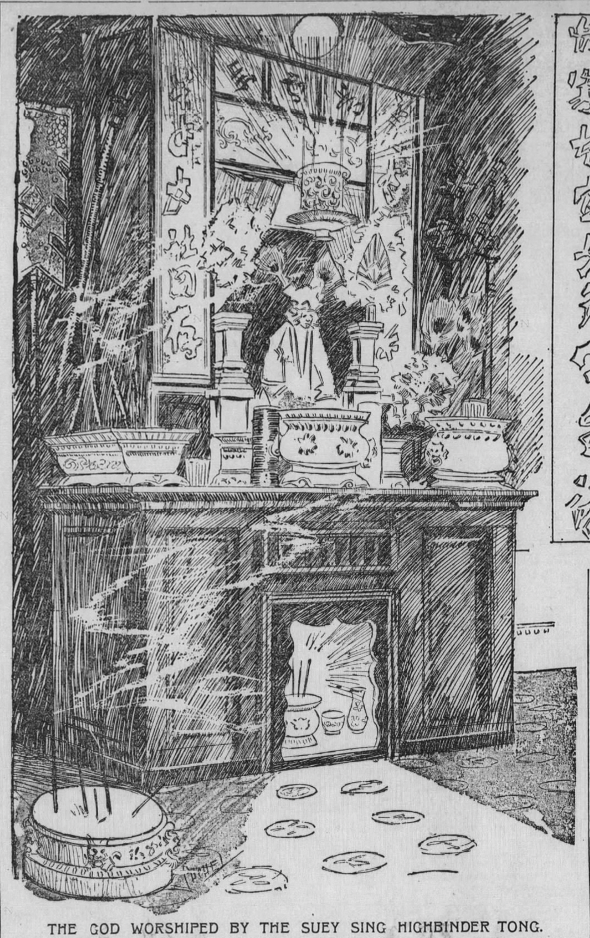
45. Ning Yung Association I (Ningyang huiguan 寧陽會館)
517 Broadway Street | 1887 Sanborn | Temple map
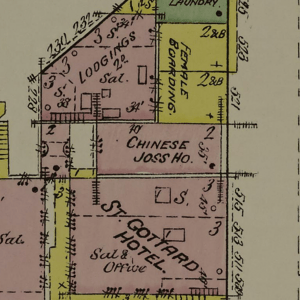
The first Ning Yung temple occupied the upper floor of an imposing two-story brick building on Broadway, just below Montgomery Avenue (The main entrance is sometimes described as being off the small alley positioned at 231 Montgomery). Although the organization was founded in 1853 following its secession from the Sze Yap Association, Ning Yung members did not establish a dedicated temple until 1864. (The company house was reported at 47 Broadway in 1855, presumably without a large public shrine hall.) The temple was consecrated amid considerable local media attention and remained in use until 1891, when the association relocated to Waverly Place [#6].
The temple’s central icon was a life-size image of Guandi, described by an early-career Mark Twain as “excessively fat,” with a “rotund face… painted excessively red” [source]. The original shrine hall was large with eighteen-foot ceilings and lavishly decorated with ornate carvings, inscribed plaques, and ritual implements. A lintel board on the building exterior suggests the temple enshrined three different deities (see image below), but no clear description is provided by Twain.
This temple was an early tourist favorite on the northern fringes of Chinatown, despite being located in the vice-ridden area then called Barbary Coast. After the privately owned Eastern Glory Temple opened in 1871 [#22], however, guidebooks increasingly redirected visitors to that site. The move of the Ning Yung Association to Waverly in the early 1890s relocated its temple into the heart of Chinatown’s religious district.

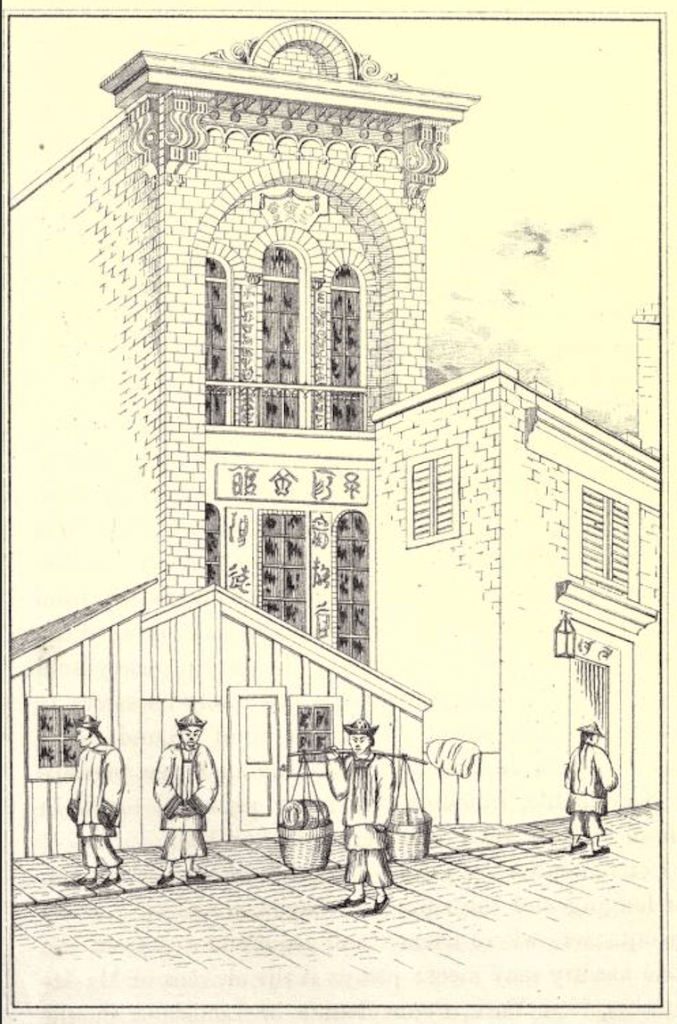

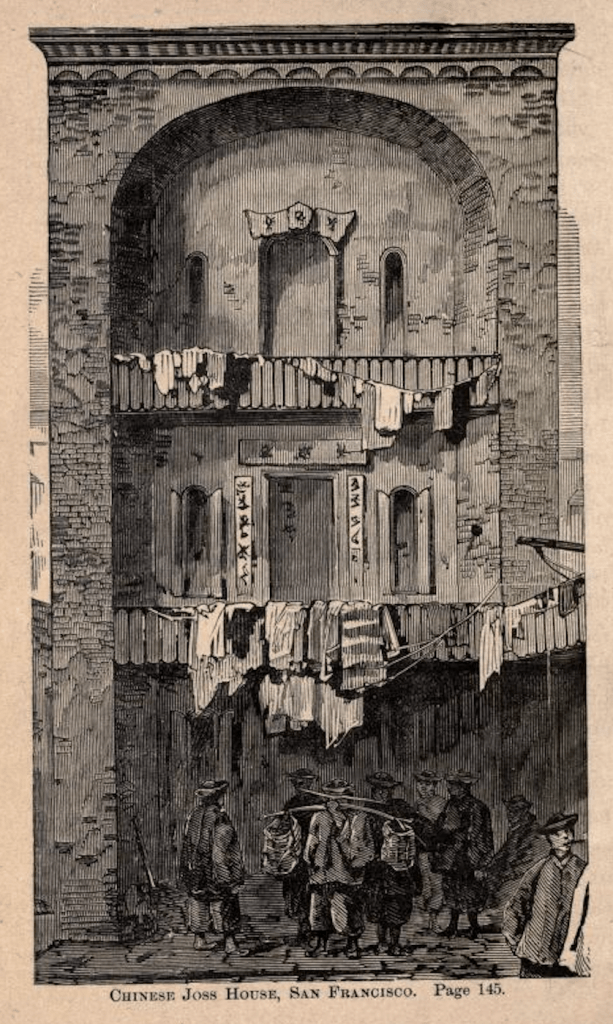


5. Early Chinese American Temples Beyond Chinatown [TOC]
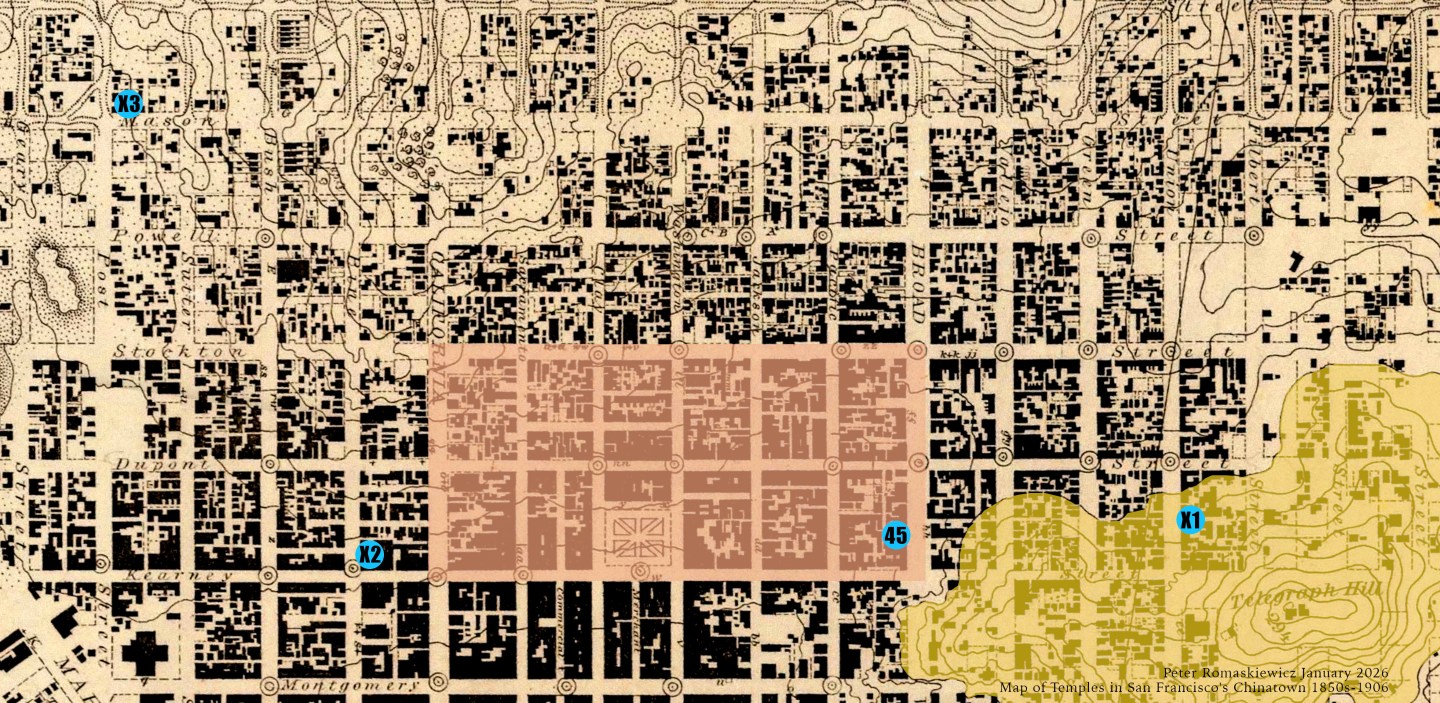
This map situates early Chinese religious sites within a broader view of San Francisco, extending beyond the conventional boundaries of Chinatown. The pink shading corresponds to the Chinatown map above, bounded by California Street to the south, Stockton Street to the east, Broadway to the north, and Kearny Street to the west. The underlying base map, prepared in 1857 by the United States Coast Survey [source], documents early structures throughout the city and provides valuable topographical information, including contour lines and spot heights. The gold shading highlights the elevated portions of Telegraph Hill relative to Chinatown and helps locate the first Yeong Wo joss house on its southwestern slope [#X1]. (The map is oriented with north pointing to the right.)
It should be emphasized that Yeong Wo temple, Sze Yup temple [#X2], and Ning Yung temple [#45] are now recognized as the three oldest Chinese American temples in San Francisco, having been built and subsequently dedicated in 1851/1852, 1853/1856, and 1864, respectively. The privately owned temple dedicated to Tianhou [#X3] appears in records starting in 1868, but may have been in operation much earlier. All four locations are on the margins or beyond the bounds of the area that came to be formally recognized as San Francisco’s Chinatown.
X1. Yeong Wo Association I (Yanghe huiguan 陽和會館) Update January 2026: Identify Varennes Street and “idol temple”
Varennes Street | 1886 Sanborn | Temple map
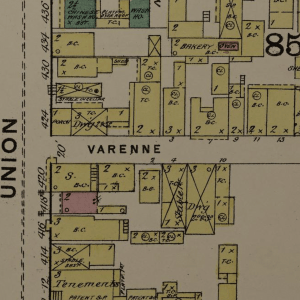
The recent discovery of a reference to an early Yeong Wo Association hospital on Varennes Street on the southwestern slope of Telegraph Hill not only resolves the long-standing question of the location of the first Yeong Wo joss house in San Francisco, but also helps identify what may be the earliest documented Chinese American temple in the United States, first reported in the fall of 1851.
Two documents are central to this identification: a sixteen-page pamphlet entitled Chinatown Declared a Nuisance! published in 1880, and a San Francisco Call Bulletin article from 1881 that appears to have been written as a reporter’s on-site follow-up to the concerns raised in the pamphlet.
The pamphlet was distributed by the Workingmen’s Committee of California, a labor organization and political party notorious for promoting racist and exclusionary anti-Chinese policies. Released on March 10, 1880, it presents an aggressively hostile portrayal of Chinese life in San Francisco, particularly focusing on alleged unsanitary conditions. The document calls for the condemnation of Chinatown as a “nuisance” and demands “its abatement without delay.”
Of particular relevance here is the Committee’s survey of Chinese hospitals, which notes the existence of a building “on Varennes street, off Union, with Joss-house attached, where the sick are placed to die.” The remainder of the passage uses inflammatory language to depict the Chinese as callous to suffering and death. This obscures several critical realities as municipal hospitals in San Francisco routinely denied admission to Chinese patients, leaving Chinese community organizations to provide care for their own sick and dying. Moreover, as Guenter Risse has demonstrated, early Chinese immigrants held cultural understandings of death and dying that diverged from Euro-American norms, particularly regarding the importance of proper burial rites and the eventual repatriation of bones to China for final interment near family. Consequently, dying in proximity to clan or district association members who could ensure these obligations were fulfilled was considered essential, regardless of how rudimentary or uncomfortable such facilities appeared to outside observers.
The identification of a hospital on Varennes Street with an attached joss house is especially significant as it points directly to the location of the first Yeong Wo temple, which was dedicated thirty years earlier in 1852, at an otherwise undocumented site on the “westerly side” of Telegraph Hill. Varennes Street is a short mid-block lane connecting Union and Filbert Streets. As both Union and Filbert extend eastward, they ascend Telegraph Hill, situating Varennes on the hill’s southwestern-facing slope (see map above). This topography also corresponds with contemporary descriptions by William Speer in 1855 and Augustus Loomis in 1868 who located the Yeong Wo temple on the “southern side” and “southwestern slope” of Telegraph Hill, respectively. The evidence thus allows for a more precise placement of the early Yeong Wo temple, namely on Varennes Street.
This conclusion is reinforced by the San Francisco Call reporter’s visit to the “Varennes Street Hospital” in March 1881. The reporter noted that the lintel board identifying the building was still visible and bore the name “Yeong Wo Company” in Chinese characters. The same lintel board had been observed by Speer in 1855, when he described the building as the Yeong Wo company house as containing temporary lodging rooms and company offices, along with “a few sick persons” recuperating on makeshift beds. It is important to emphasize that early district association headquarters commonly served multiple functions: they housed meeting rooms and shrine halls while also providing space for the sick and dying. The second-oldest district association building in San Francisco, erected by the Sze Yap organization in 1853, was deliberately designated an “asylum.” As Ho and Bronson observe, such early Chinese temple-asylums functioned broadly as “a hospital, hospice, or refuge of almost any kind.”
In addition, special organizations subordinate to district associations, known as charitable halls (shantang 善堂), soon formed to assist in repatriating the bones of the deceased for reburial in China. By 1856, the Yeong Wo Associaiton, the largest among Chinese district associations at the time, was reported to have more than one charitable hall in San Francisco.
By the time of the reporter’s visit in 1881, Yeong Wo leadership appears to have already relocated its meeting rooms and shrine hall elsewhere, leaving the older company house, now outside the formal boundaries of Chinatown, to serve as a place for the sick to recuperate in relative seclusion or to pass away so their bodies could be retrieved and properly cared for. As the Call article notes, all district associations maintained buildings that functioned as “hospitals” or hospices, but it is likely such buildings were in fact charitable halls. As noted by Ho and Bronson, charitable halls in San Francisco were often fitted with shrines.
The timing of Yeong Wo’s relocation remains uncertain, though the association still occupied the “old house” on Telegraph Hill in 1868. Its meeting rooms may have moved to Sacramento Street by the early 1870s, while the main shrine hall appears to have relocated to Brooklyn Place, in the early 1880s [#35].
The Call reporter also provides crucial evidence linking this site to an earlier 1851 report of an unnamed Chinese “idol temple” in San Francisco. The article notes the building was constructed in the “Summer of 1851,” information seemingly obtained from an elderly Chinese man staying at the old Yeong Wo location. The reporter describes the building’s construction as follows:
“The land was purchased and timber of Chinese spruce sent for. A building was erected on a modified Chinese plan, ornate and elegantly appointed. It was two stories in height with overjutting roof, supported by four slender columns with cross beams and ornamentally bracketed. Double doors gave entrance, but no window was upon the first floor in front. Three windows gave light to the upper story.”
This description closely conforms to known configurations of Chinese American temples of the period, in which the primary shrine was often located on the upper floor, accompanied by windows or a balcony. The article further describes, however, a second structure on the property – “a long, low, one-story affair” – in which one room contained “the remains of what was once a handsome altar.” The reporter concludes pointedly, “this was the Joss House of 1851, gone to rack and ruin.”
When William Speer visited the Yeong Wo building in 1855, he noted it was often referred to as a “temple,” but actually functioned as a company house. Speer specifically notes the first floor was used for offices and meeting rooms while the second floor was used for temporary lodging. Nevertheless, as we have seen elsewhere [#35], in the fall of 1852 a local newpaper reports that a small religious icon, which we can identify as the deity Houwang, was enshrined at the Yeong Wo Association building on Telegraph Hill. Speer makes no comment on an additional single-story building on the Yeong Wo property, perhaps this was where the Houwang icon was housed?
Regardless of how these two buildings on Telegraph Hill were used or repurposed over time, the article provides firm evidence for the presence of a joss house on Varennes Street, on the southwestern slope of Telegraph Hill, and connects it directly to both the Yeong Wo Association and a construction date of 1851. This not only confirms the specualtion of Ho and Bronson that the unnamed Chinese “idol temple” was identical to the Yeong Wo temple dedicated in 1852, but also specifically locates this temple on Varennes Street.
It should be noted that the Yeong Wo Association is believed to have been founded in September or October 1852, according to Him Mark Lai’s account, which draws on Yeong Wo’s own company history published in 1900. Thus, if the identification proposed above is correct, the Varennes Street property was purchased, the necessary construction materials were imported, and the building was erected in 1851—one year before the formal founding of the Yeong Wo Association—by Norman Assing and two other immigrants from Zhongshan. This apparent discrepancy is difficult to resolve. San Francisco’s Chinese community underwent considerable social and economic changes during 1851/52, including the formation of the first two district associations, the Sam Yup Association (or Canton Company) and the Sze Yup Association, in 1851. The following year, the number of Chinese immigrants in California surged to approximately 20,000, roughly ten times the previous year’s figure. The plans and institutional purpose of the Varennes Street property may therefore have changed over the course of these two critical years.
It is also worth emphasizing that when the Houwang icon was brought to California, it was reportedly first kept in a private residence on Mason Street. Moreover, both Norman Assing and his successor, Tong Achick, were Christian converts, suggesting that the establishment of a Chinese-style shrine hall may not have been the original or primary motivation for acquiring the Varennes Street property. The evidence may instead point to a more fluid process in which a building initially established for broader community purposes was subsequently adapted to accommodate religious functions as the Yeong Wo Association and San Francisco’s Chinese community developed.
I have been unable to determine the precise lot on Varennes Street where the Yeong Wo temple stood. Given the increasingly hostile political climate of the early 1880s, culminating in the passage of the federal Chinese Exclusion Act in 1882, it is unlikely that buildings attracting such intense public condemnation would have survived until the surveying of Telegraph Hill for the 1886 Sanborn maps. Nevertheless, a two-story wooden structure with a single-story building to its rear appears on the west side of the street as 7 Varennes, offering a possible, if tentative, correspondence with the description in the Call article (see inset map above).
I am aware of no illustrations or photographs of this early Chinese temple. When English photographer George R. Fardon (1806–1886) took a panorama of San Francisco in 1855, taken atop a building on the corner of Sacramento and Stockton Streets in Chinatown, he may have inadvertently captured the temple in the cluster of buildings at the base of Telegraph Hill (see below). Others who took early photographs of Telegraph Hill include T.E. Hecht in 1855 [here], Carlton Watkins in the 1860s [here] and Thomas Houseworth in the 1870s [here], among others. A view of Telegraph Hill from Portsmouth Square, believed to have been taken in 1851 by Sterling C. McIntyre, shows how desolate the hillside was just a few years earlier [here].
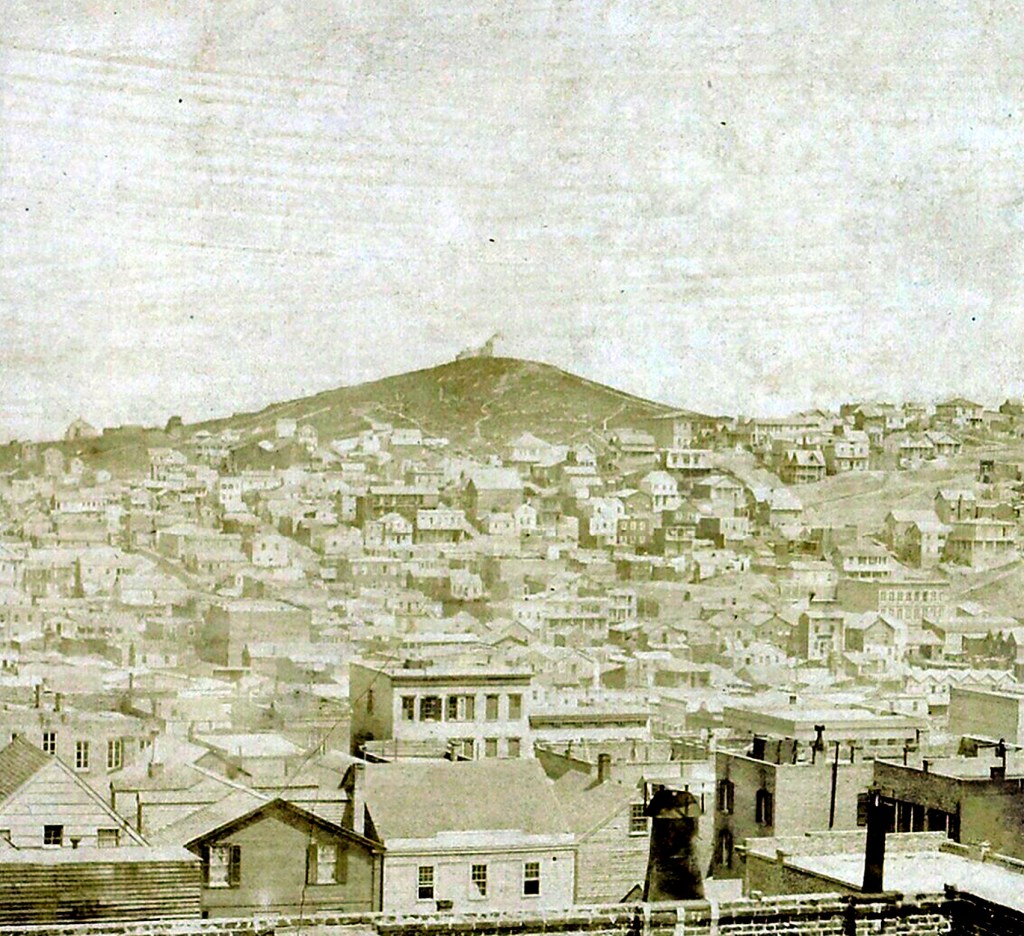
X2. Sze Yup Association I (Siba huiguan 四邑會館) / Kong Chow Association (Gangzhou huiguan 岡州會館)
512 Pine Street | 1887 Sanborn | Temple map
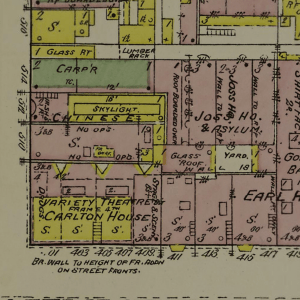
The Pine Street temple was first constructed by the Sze Yup Association in 1853, but the central icon of Guandi did not arrive from China until 1856. A multi-day celebration was held to consecrate the shrine hall on the second floor. It is commonly claimed the Sze Yup (alternatively, “Sze Yap”) temple was the first Buddhist temple in the United States, but this is without warrant. The sole icon enshrined was Guandi, as was common in district association temples, and no images of the Buddha or any other Buddhist figure were installed. Guandi was venerated primarily as a patron deity of loyalty, integrity, and fraternity – values that resonated strongly with district association members living far from their homeland. Moreover, contemporary accounts note that the 1856 consecration employed meat and alcohol offerings, practices common in Chinese popular religion, but not sanctioned within normative Chinese Buddhist ritual frameworks.
If any members of the Sze Yup Association sought a more appropriate religious setting with Buddhist icons (bracketing the thorny issue of Chinese religious affiliation during the late Qing), they would likely have turned to privately owned temples in San Francisco. Such temples typically enshrined a broader selection of deities, including the widely revered Buddhist figure Guanyin. Indeed, it may have been precisely the absence of certain deities in district association temples that encouraged the development of independent shrines, such as Ah Ching’s Tin How Temple [#X3], opening as early as 1856, and Li Po Tai’s Eastern Glory Temple [#22], opening in 1871 – both of which enshrined Guanyin in special rooms. Whatever the complexities surrounding the religious self-identification of early Chinese immigrants in San Francisco, the material practices of the Sze Yup Association shrine hall do not support its characterization as Buddhist.
In addition to these considerations, at least two newspaper reports identify a joss house in San Francisco prior to the completion of the Sze Yup building in 1853. One refers to a previously unknown joss house mentioned in articles in the fall of 1851, while the other concerns a temple built by the Yeong Wo Association on the southwestern slope of Telegraph Hill in the fall of 1852 [see #35]. We now know these were most likely the same temple located on Varennes Street which was built in 1851 and dedicated in 1852 [#X1]. Documentary evidence is clear that the Sze Yup Association shrine hall was not the first American Chinese temple, Buddhist or otherwise.
After the dissolution of the Sze Yup Association, as Him Mark Lai has shown, all of its property was legally deeded to the Kong Chow Association, one of the splinter groups of the Sze Yup in 1866. Despite the construction of new temples by other district associations over the years, the Kong Chow temple remained a special place of reverence for those devoted to Guandi. In both 1873 and 1880, and undoubtedly most other years as well, Guandi’s birthday celebrations (13th day of 5th lunar month) were held on Kong Chow temple grounds, a point underscored by Masters in 1892 who claimed the temple was viewed as particularly “efficacious.”
The 1856 celebration to consecrate the shrine hall drew attention from the local press and due to the commonplace practice of scissors-and-paste journalism, the Chinese celebration was reprinted in newspapers across the US. Notably, a local San Francisco printer, W.W. Kurtz & Company, issued a lettersheet commemorating the event with an engraving depicting the Chinese temple altar (see below). Released on April 26, 1856, Kurtz sold the lettersheets at a price of $10 per 100 copies. This engraving is earliest known depiction of a Chinese American temple interior. The lettersheets travelled across the Atlantic and the engraving was copied and republished in newspapers in both London and Paris (see below). The icon, Guandi, sits in the center of the frame, surrounded by an elaborate altar setting. Both Chinese and non-Chinese are depicted in the scene, quietly admiring the life-size icon.
The Presbyterian minister Augustus Loomis, who served as a missionary in Chinatown from 1859 until his death in 1891, wrote about San Francisco’s Chinese temples in 1870 and also provided a detailed description of the Kong Chow temple interior. An engraving accompanied his account, constituting only the second published depiction of a Chinese American shrine hall, following that of the Ning Yung temple [#45] (see below). In the engraving, Guandi occupies the central position on the main altar, surrounded by a wide array of ritual implements.
In addition, a rare anonymous photograph dating to the early 1880s captures the brick edifice that served as the entrance to the Kong Chow sanctuary, located mid-block in the 500 block of Pine Street (see below). The signboard over the entranceway says, in English, “Kong Chow Asylum.” Notably, the Chinese characters say Gangzhou kangqu 岡州康衢, or “Kong Chow Health Thoroughfare,” underscoring the frequent use of huiguan buildings as medical facilities for the Chinese community.
Two older photogrpahs also accidentally capture the entrance on Pine St. One was taken by San Francisco photographer Carlton Watkins in 1862, showing the steep eastward decline down Pine St. The Kong Chow building entrance is seen at the far right edge of the image with the triangular parapet. The second photograph was taken by True E. Hecht, possibly as early as 1870, and shows the corner of Pine and Kearny (see below). (As one scholar notes, Hecht’s dating was “anything but ‘true.'”) Up the hill, near the left edge of the photo, we can spot the older façade of the Kong Chow Association building.
The Kong Chow Association remained on Pine through 1906 and, unlike its sister organizations, was one of the few to rebuild its shrine hall after the San Francisco earthquake.
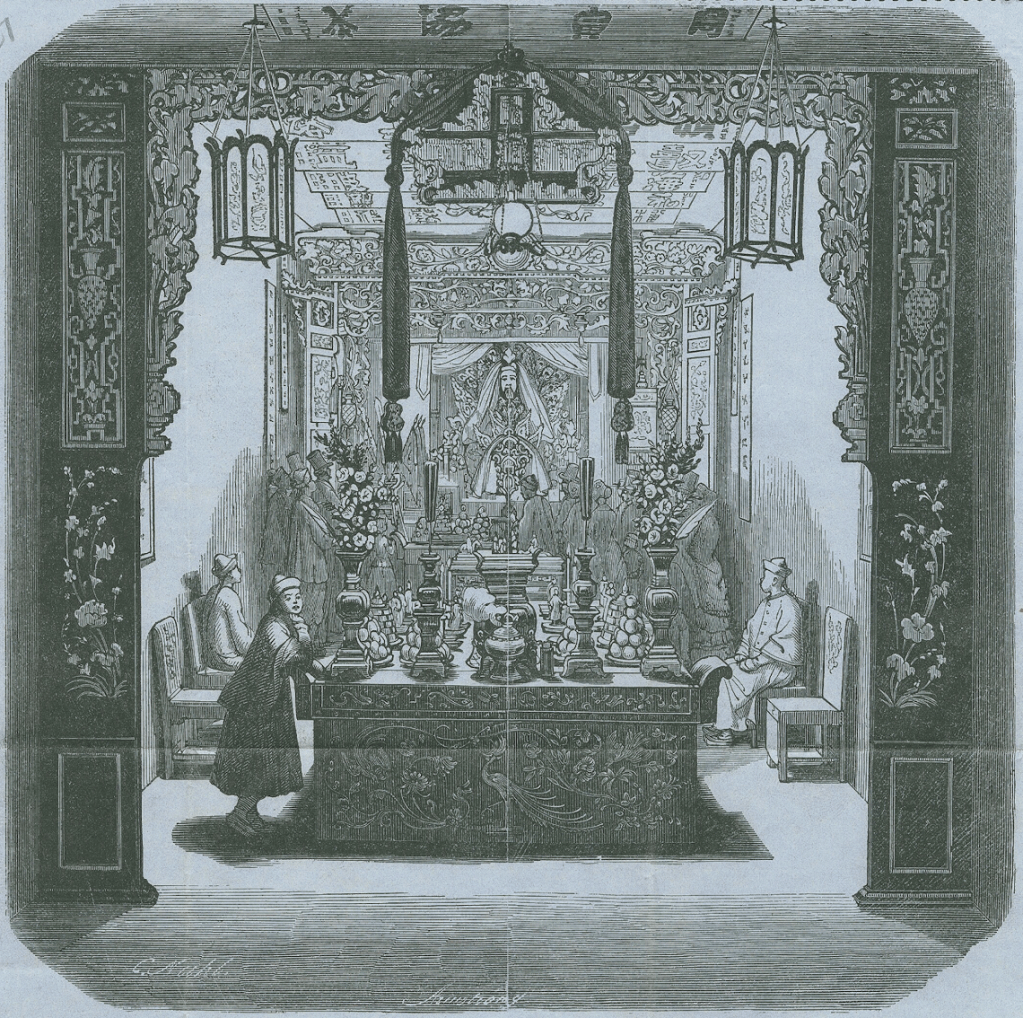


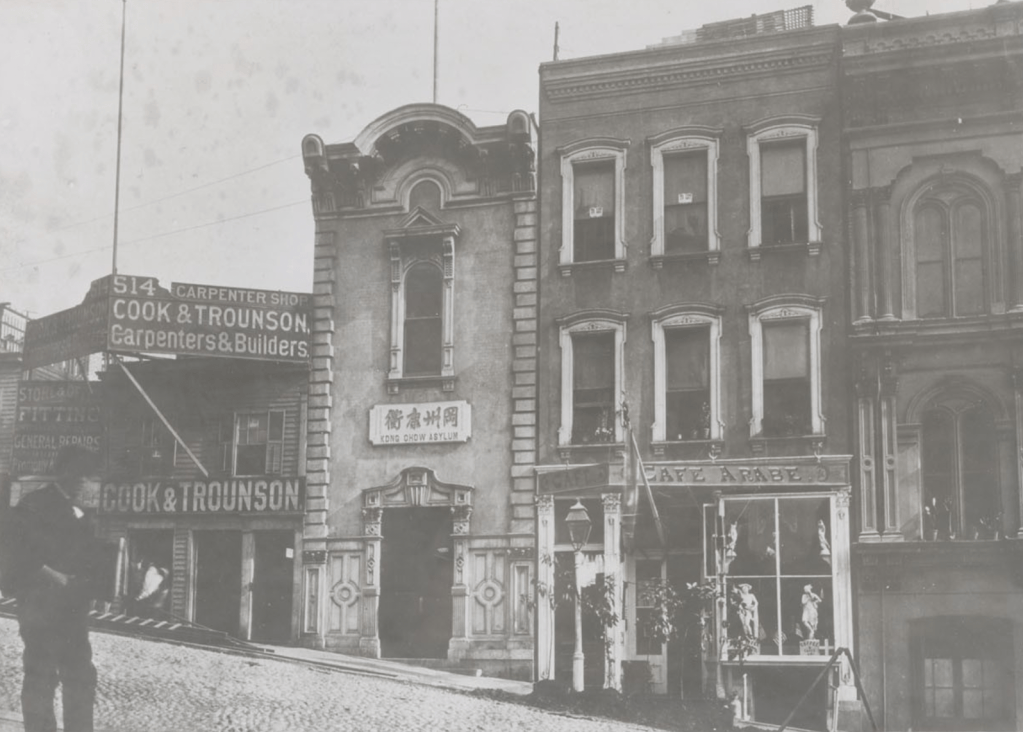
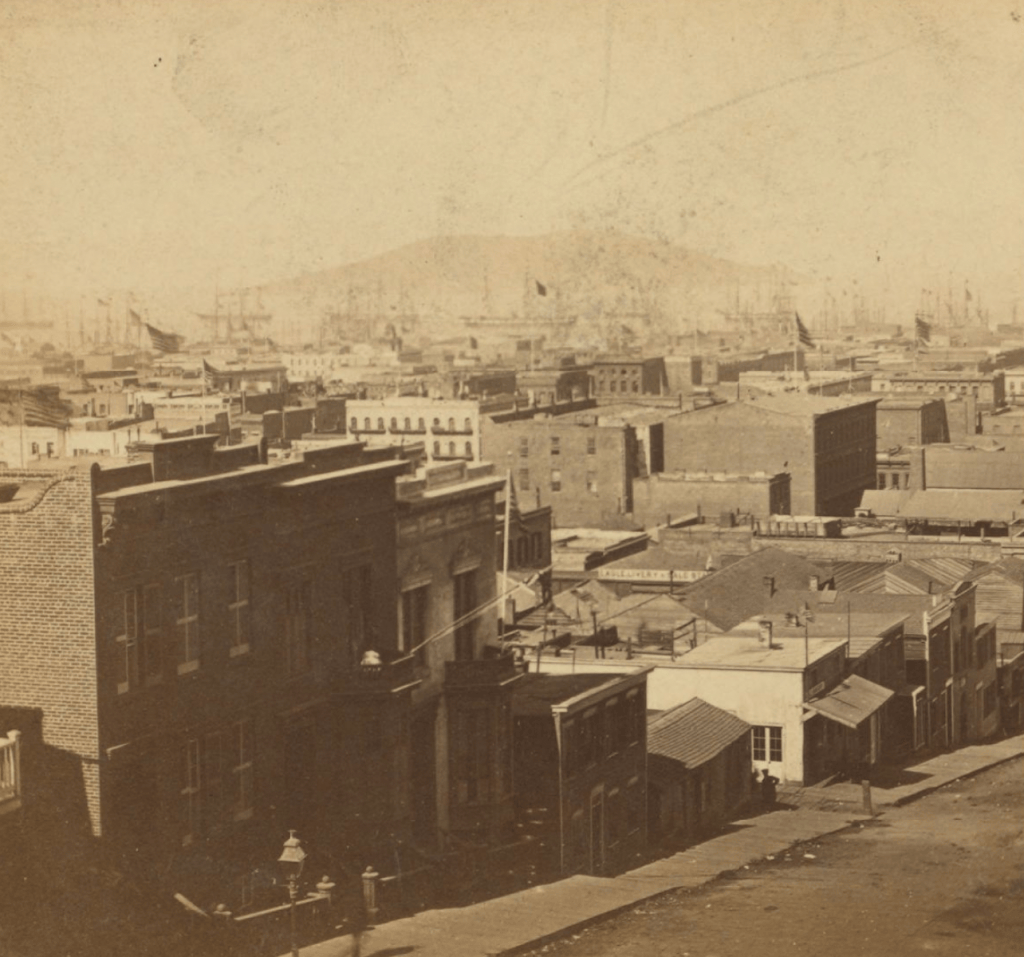
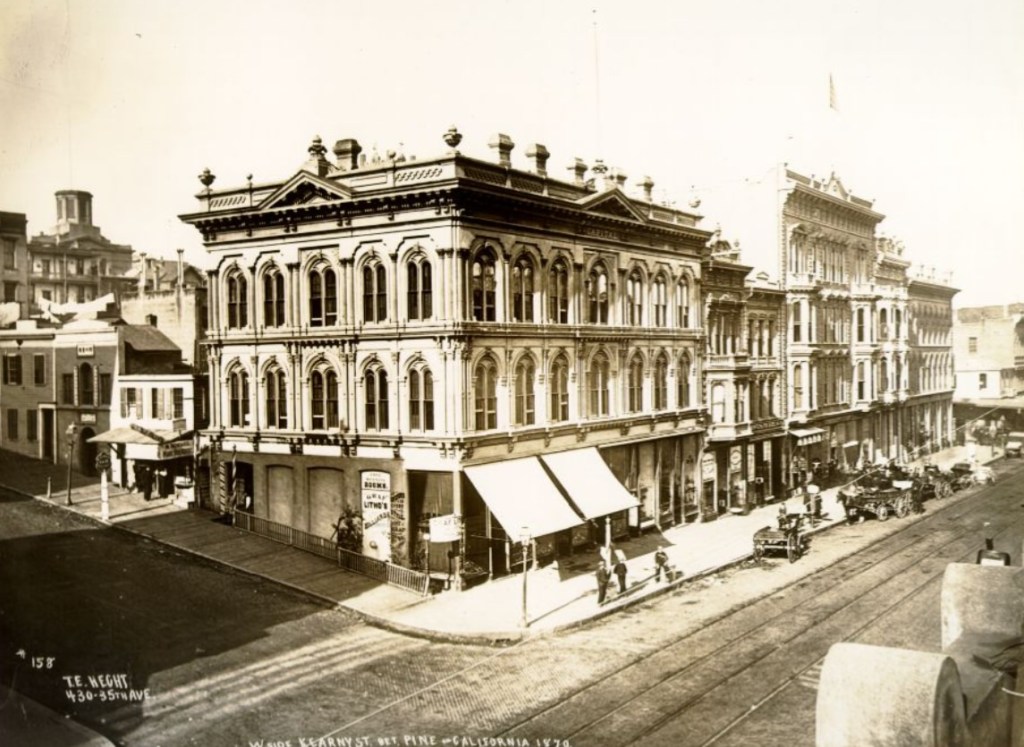

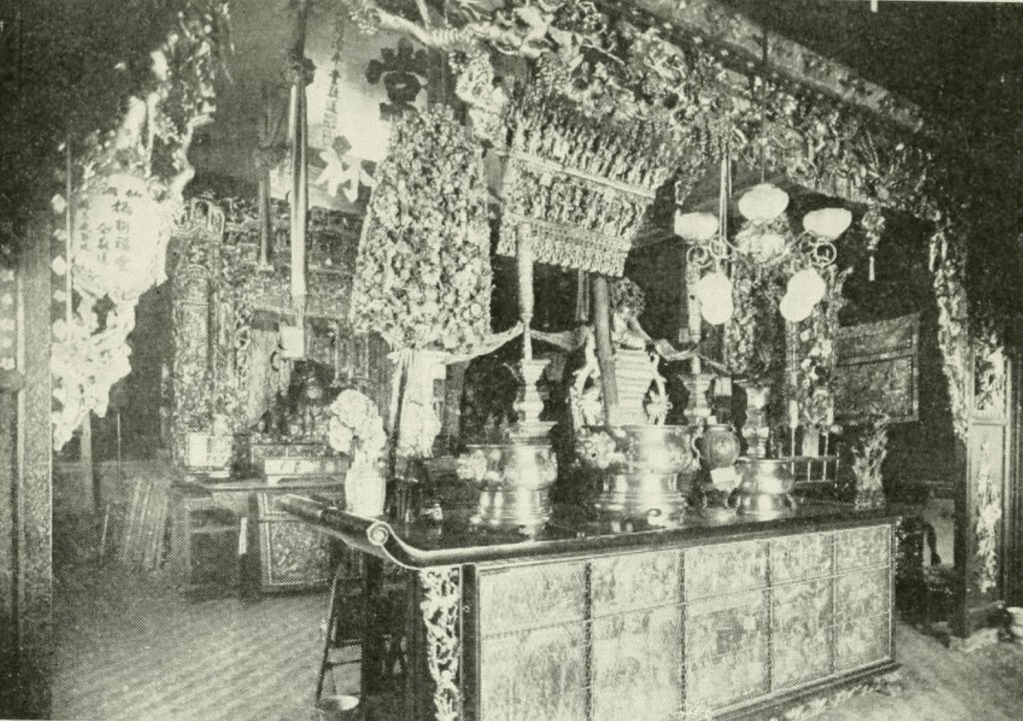
X3. Ah Ching’s Tin How Temple
Corner of Post Street & Mason Street | 1905 Sanborn | Temple map
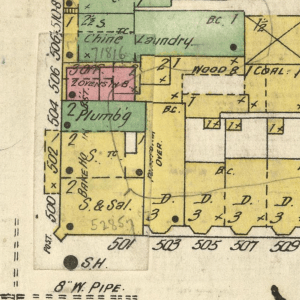
As reported in 1868, the merchant Ah Ching opened what might have been the first privately owned temple in San Francisco, located just west of Union Square on Mason Street near Post Street. The main icon was Tianhou, located on the first floor, but additional icons were also enshrined, including the standard fixtures of the God of Medicine (Huatuo), God of Wealth (Cai shen), and Guandi. This report is also the first account of Golden Flower (Jinhua), a figure that would be celebrated across Chinatown, but only come to have her own temple by the late 1880s [#2].
On the second floor of Ah Ching’s temple a singular icon of Guanyin was enshrined, making this the earliest attested altar dedicated to this vaunted Buddhist figure on American soil. At least by 1868, a short liturgy to Guanyin, printed on yellow paper and bearing her image holding a willow branch and vase, was distributed to devout temple visitors.
It is unknown when An Ching’s temple opened, but Ho and Bronson speculate it could have been as early as 1856. In 1873 and 1874, Chinatown’s three-day birthday celebrations for Tianhou are noted as taking place at this temple, suggesting it was an important gathering place for Chinese immigrants during this celebration. At least one newspaper article claims this temple was, “the resort of itinerant wash-house men and household servants,” contrasting it to the more upscale district association temples, such as the Sze Yup temple on Pine [#X2].
By the time of the report in 1868, Ah Ching had already died and the temple was in the hands of a former temple servant. The building Ah Ching founded did not last much longer. The temple succumbed to fire in December 1874 and appears to have not been rebuilt. Brief reports on the fire inform us the temple looked towards Mason and was next to a building owned by Emory & Sons. The 1894 city property directory shows the Emory Brothers still owning property on the northwest corner of Mason and Post, suggesting Ah Ching’s temple was just north of Post on Mason, on the west side of the street (approximately 503/505 on the 1905 Sanborn map, see inset above).
6. Additional Shrines in San Francisco’s Chinatown: Restaurants, Shops, Homes, and More [TOC]
Chinatown’s religious landscape should not be reduced to district and clan association temples or fraternal society shrines. Signs of religious life could also be found in less obvious settings, including restaurants, shops, and private homes. Such spaces were often small or private and left no trace in contemporary maps or city directories, yet they formed an important part of everyday religious practice. Many altars and other intimate religious sites were therefore overlooked, sometimes because they were quite literally hidden in plain view, embedded within the ordinary spaces of daily life.
The 1885 Board of Supervisors’ Map identifies thirteen “joss houses” in Chinatown, a rough figure that was also repeated in contemporary San Francisco guidebooks. This number, however, represents only the most visible institutional shrines and dramatically understates the extent of Chinatown’s religious landscape. Many smaller and privately maintained shrines would have gone unnoticed by outsiders traversing and mapping the neighborhood’s streets.
For example, in addition to the documented shrines of the tailors [#41] and washermen [#4], Chinatown supported guilds for carpenters, bootmakers, cigar makers, barbers, jewelers, and other trades. These organizations likely maintained meeting halls with their own altars, although their locations remain unknown.
Other evidence reveals that even some shrines documented by municipal authorities have remained largely invisible in scholarly accounts of Chinatown’s religious history. Property records from 1886, for example, identify at least three joss houses in the red-light district surrounding Sullivan’s Alley: one in a building owned by Henry Voorman at 722 Jackson Street and two “opium josshouses” in buildings owned by John Sullivan. These properties were apparently leased to Chinese occupants. The 1885 Board of Supervisors’ Map places the Voorman building shrine at the rear of 722 Jackson [#30] and locates one of the Sullivan building shrines in a structure on the southwest corner of Sullivan’s Alley and Baker’s Alley [#31].
The religious life of this district is particularly difficult to reconstruct because contemporary observers tended to focus on its perceived salacious character. Some tourist accounts even describe the worship of a supposed “Goddess of Prostitution.” One such report may have confused this figure with one of the female deities encountered at Eastern Glory Temple, which housed Tianhou, Guanyin, and Lady Golden Flower. By the 1880s, all three had temples of their own elsewhere in Chinatown, making it possible that one or more of their icons were also enshrined on Sullivan’s Alley. Evidence that memorial tablets for women who had worked in brothels were kept at the Golden Flower Temple on Brooklyn Place makes Lady Golden Flower an especially plausible candidate [#2].
We know little more about these Sullivan’s Alley shrines, although at least one appears to have been responsible for a fire that destroyed an entire building in 1891. Yet the very existence of these shrines complicates the familiar picture of Chinatown’s religious geography. Even in a neighborhood that attracted intense scrutiny from the local press because of its association with prostitution, religious practice was woven into the everyday lives of its residents.
Religious practice was not confined even to spaces associated with local residential life; it also extended into Chinatown’s most popular places of tourist entertainment. According to Frederic Masters, Chinese theaters maintained shrines to Lord Tam [#3] and Huaguang 華光, positioned in an alcove approximately ten feet above the main stage. Surviving photographs confirm the presence of these shrine alcoves in both the New Chinese Theater at 623 Jackson Street, operated by the Sam Yup Association [#43], and the Grand Chinese Theater at 814 Washington Street [#21].(Isaiah West Taber’s studio misidentifies the latter as the former, see discussion here).
During important festivals, religious icons could be physically transported through Chinatown and brought into theaters for performances and celebrations. In the early 1880s, for example, the Guanyin icon from the temple on Spofford Alley [#18] was carried to the Grand Chinese Theater at the north end of Waverly Place during her birthday celebration on the nineteenth day of the second lunar month. Entertainment continued until early the following morning. A similar event occurred in 1884, when the Yeong Wo Association’s Houwang icon was brought to a Chinese theater during his birthday festivities on the seventh day of the eighth lunar month.
Such events underscore an important feature of Chinese religious material culture: icons were not understood simply as representations of distant deities, but as embodiments of the deities themselves. Their movement through Chinatown, their placement within theaters, and the entertainments offered in their honor therefore formed part of religious practice rather than standing apart from it.


Outside of the often-overlooked clan, guild, and secret society shrines, there were also countless smaller, private devotional spaces. These might contain a modest statue, a painted scroll, or an inscribed tablet. One observer, describing the Chinese community in Santa Cruz, remarked “nearly every store has a small space dedicated to the Joss with incense punks and food before printed papers representing a Joss” [source].
We have some specific reports about this scenario in San Francisco. For example, writing in 1880, G.B. Densmore notes spotting a joss in the rear room at “Tune Fong” [Yuen Fong] Restaurant at 710 Jackson Street [#29]. Due to the research of Doug Chan, we also know that Carleton Watkins took several interior photographs of the tea room at Yuen Fong in the 1870s. In a number of these images a ceramic Laughing Buddha sits on an altar adorned with fruit and flower offerings (see below). Gordon H. Chang has speculated that this altar may have been erected in celebration of Chinese New Year. To my knowledge, Watkins’s series from Yuen Fong constitutes the earliest known interior photographs of a Chinese American restaurant to depict the display of the Laughing Buddha – a figure that would, in the decades that followed, become increasingly associated with Chinese American dining. Yet despite the Laughing Buddha’s later familiarity to Chinatown visitors, I am aware of no other visual representation or unambiguous textual reference to this figure in San Francisco prior to 1906.
A scene also reminiscent of a pioneer Chinese restaurant was painted by Theodore Wores, a native of San Francisco who created beautiful imagery of Chinatown in the mid-to-late 1880s. Wores was known to have made recurring donations to a Chinese district association, possibly Yeong Wo, to have access to their temple, so he was acutely aware of the role of religion in the daily lives of local Chinese. His “Chinese Musicians” portrays a restaurant (or society club room) environment with a small altar along the right side, ready with incense burner. The image on the scroll appears to be Fuxing 福星, a stellar deity associated with prosperity and good fortune (also seen here with merchants posing in front). A reproduction of Wores’ painting in Harper’s Monthly Magazine in 1892 adds trails of incense smoke to enliven the shrine space. Among the many nineteenth century photographs of Chinatown restaurant interiors it is sometimes possible to spot a small altar in the back, often with offering vessels placed in front of a scroll. For example, Watkins captured the interior of the famed Hang Far Low Restaurant at 713 Dupont Street in the early 1880s [#5]. If we look to the left side of the smoking divan we can clearly see the altar to Guandi with a full five-piece altar set (see below).(Other small altars might be visible here, here & here)


Elsewhere in his account, Densmore highlights the importance of Guandi, noting, “in nearly every house or store they have a picture of this god.” Historian Thomas Chinn has also written about the ubiquity of altars in stores throughout San Francisco’s Chinatown:
“In the back of nearly every shop in Chinatown there used to be an altar, before which the most venerable or senior member of the firm would offer incense every morning and before dinner. The altar was always a simple one, dedicated either to the Earth God (tudi shen) or to the God of Prosperity (cai shen), represented by a written inscription. In front of the altar would be an incense urn, candlesticks, and three cups of tea. On important occasions there would also be three thimbles of wine, flowers, fruit, and other food. Most of the altars disappeared after 1911.” [source]
There were also innumerable domestic shrines of varying size. Wealthy individuals could afford a large carved altar with full set of five ritual vessels and an ornately painted “joss” scroll. We find an example of such in a wood engraving published in 1875 by Harper’s Weekly. A very similar household shrine is seen in the photography of R. J. Waters who operated a studio in San Francisco around 1900 (see both below).

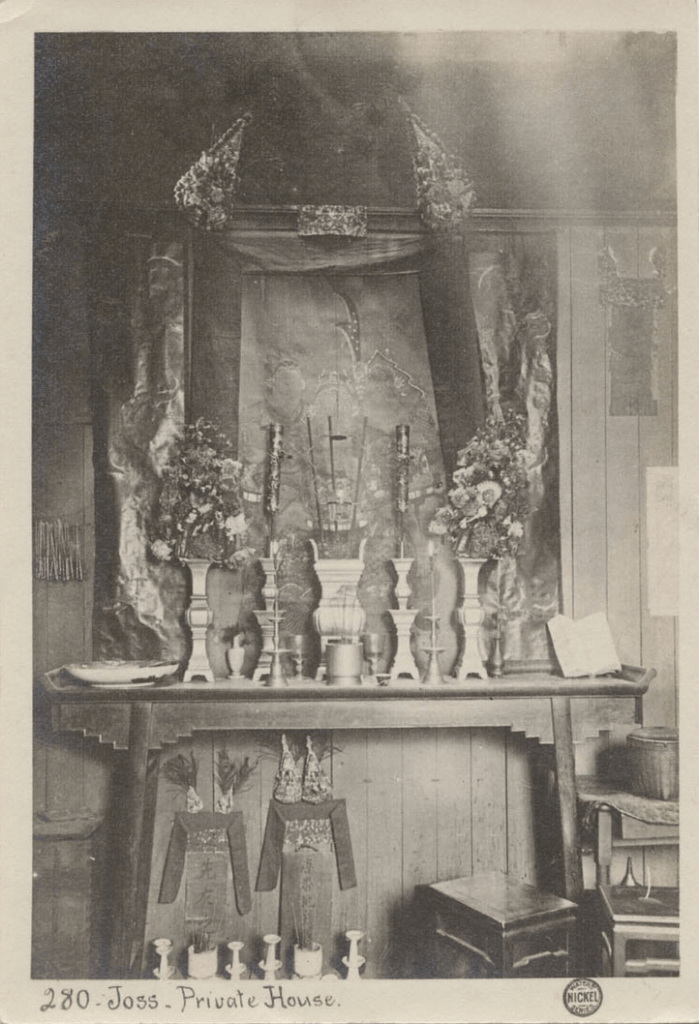
But what do we know about the simplest of household shrines? Not long after Waters’ photograph, San Francisco’s Board of Health blamed Chinatown’s residents for fears of a potential outbreak of the plague. This led to razing several buildings in 1903. Documentary photographs taken at the time show some of the poorest areas of the neighborhood where structures were removed. One photograph proves that even the simplest of Chinatown’s abodes still maintained a small shrine, made from an altar of stacked bricks (see below). Its notable that all three domestic shrines depicted here display the same trio of icons: Guandi flanked by his adoptive son, Guan Ping, and his subordinate general, Zhou Cang. The grouping was also enshrined in the Chee Kong Society joss house and was likely seen all over Chinatown, from small shops to large community meeting rooms. These three figures appear in the Ming novel Romance of the Three Kingdoms, a source for the development of much popular religious lore in the following centuries.

It is unknown how many altars, shines, and icons were destroyed by the 1906 San Francisco earthquake and fire, but a reasonable estimate would be in the many thousands. This is far beyond the dozen or so joss houses mapped by various authorities at the end of the nineteenth century.
We also know some stories of survival. At least one delicately carved wooden alcove, possibly originally containing an icon of Water Moon Guanyin, was recovered by the Hee family as they fled the oncoming fires [here]. This remains material evidence of the importance of the cult of Guanyin in San Francisco’s Chinatown at the turn of the twentieth century. Such evidence helps corroborate the observations of one visitor, writing in 1883, who noted the popularity of Guanyin among the residents of Chinatown, claiming, “her image or portrait occupies a prominent corner of every private home as well as temp
Appendix: Comparison of 1887 Sanborn Map and 1885 Board of Supervisors’ Map [TOC]
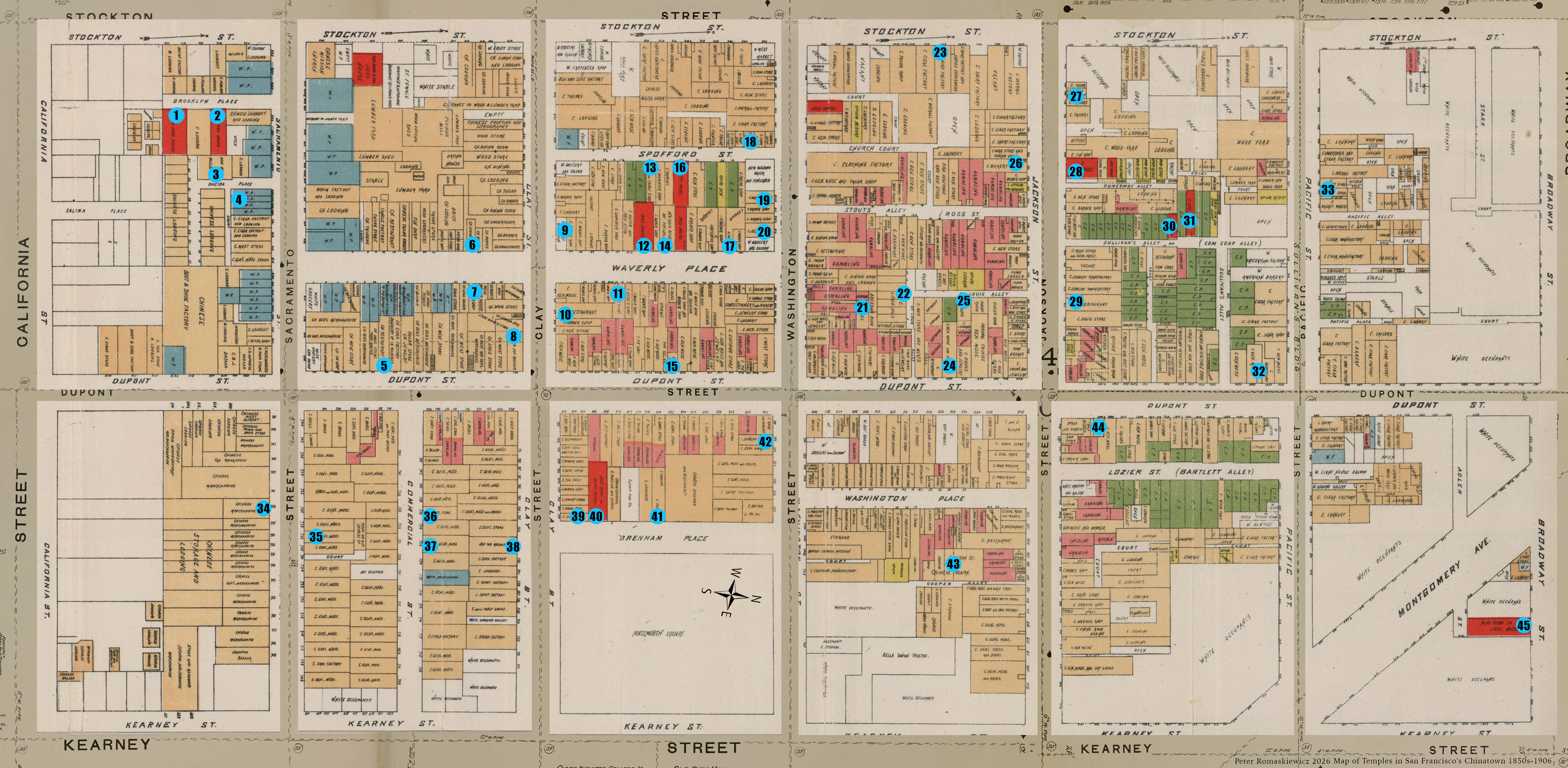
For a brief introduction to the 1885 Board of Supervisor’ Map, see Susan Schulten’s Mapping Vice in San Francisco.
About this Project [TOC]
While researching the religious life of the early Chinese diaspora in San Francisco, I found that many nineteenth- and early twentieth-century illustrations and photographs of temples and other religious sites remained unidentified. Artists, photographers, and writers in the popular press often labeled these sites indiscriminately as “joss houses,” leaving valuable visual records but little contextual information about the communities, institutions, and practices they documented. The reduction of Chinese American temples to undifferentiated “joss houses” was not simply an erasure of a complex and vibrant immigrant religious life; it also represents a significant loss to our understanding of American religious history.
A clear example can be found in the work of Eadweard Muybridge, who took several stereophotographs of an unidentified “Chinese joss house” [here]. These are extremely rare photographs of an early Chinese temple interior predating the 1906 earthquake and fire, revealing a delicately carved altar, ornate icons, and a priest dressed in ritual regalia. This is an astounding visual record, but its story remained locked behind anonymity.
Similarly, in 1871, Harper’s Weekly published an extraordinary wood engraving showing the interior of a “Chinese joss house” without further identification [here]. The illustration depicts an elaborately decorated shrine hall containing no fewer than five enshrined icons—all without names or identities. Images like these preserve an extraordinary wealth of visual information, but their anonymity has left that information detached from the historical contexts needed to understand it.
In these cases, further research has allowed me to repair this rupture between image and history. It is now possible to identify both the Muybridge stereophotographs and the Harper’s engraving as depictions of Eastern Glory Temple, located on St. Louis Alley and managed by the prominent Chinatown physician Li Po Tai. Identifying these images does more than attach a name to an otherwise anonymous photograph or illustration; it connects multiple visual fragments to a specific location, community, and historical moment, allowing us to recover aspects of Chinese American religious life that would otherwise remain obscured.
One of the primary goals of this project is to identify, map, and contextualize historical visual resources depicting the religious life of San Francisco’s Chinatown before the 1906 earthquake and fire. The project therefore brings together textual and visual evidence that has often survived in separate archival collections.
The research combines contemporary newspapers and magazine articles, travelogues, guidebooks, city directories, property records, block books, public tax records, historical maps, photographs, engravings, paintings, and other surviving visual materials. These sources are cross-referenced rather than treated in isolation. A newspaper account may establish that a temple existed but provide no reliable address; a city directory may establish the location of an association but not indicate whether its headquarters contained a shrine hall; a Sanborn map may reveal a building identified as a “joss house” or “society room” but provide no information about the community that used it. Historical photographs and engravings can supply further evidence, particularly when architectural features, neighboring buildings, street configurations, interior arrangements, inscriptions, or other visual details can be compared with documentary and cartographic evidence.
This process of triangulating independent sources is central to the project. Identifications are made by comparing multiple pieces of evidence—sometimes converging on a relatively secure identification, and sometimes leaving a site or image as probable or unresolved.
A related research goal has been to locate Buddhist icons within this early visual record. Such icons have long been claimed within American Buddhist Studies to have existed among early Chinatown temples, but their identification and documentation have often remained elusive. [See my preliminary comments to this pursuit in the introduction above.]
A Note on Dates
Secondary scholarship on the history of Chinatown’s temples often provides differing founding dates for the same institution. In some cases, these discrepancies reflect unresolved historical complexities, such as when organizations formally organized, split, or emerged from older institutional bodies.
Discrepancies may also result from conflating the formal organization of a district association with the subsequent construction of its district association building and accompanying shrine hall—two distinct events that could be separated by many years. For example, although the Ning Yung Association organized in 1853 after splitting from the older Sze Yup Association, the earliest known mention of a Ning Yung building with a shrine hall dates to 1864, an eleven-year gap. This should not be taken to mean that the Ning Yung Association lacked a company headquarters, whether leased or owned, during the intervening period. William Speer, for example, records a Ning Yung company house at 57 Broadway in 1855 where the association conducted its business.
My focus here is on the construction or dedication of shrine halls and temple buildings—events that were often reported with considerable fanfare in the contemporary press and that provide an opportunity to examine the reception and influence of Chinese religious material culture in the United States. In addition, the 1906 earthquake and fire not only destroyed Chinatown’s religious sites, but also almost all of the records of district associations and fraternal societies. As a result, some temples and associations that claim early origins in the United States must rely primarily on oral histories or much later historical documentation. While such accounts are valuable, they must be evaluated alongside the earliest surviving documentary evidence, which sometimes reveals a different chronology.
My focus in this project is generally on the construction, dedication, or documented use of shrine halls and temple buildings. These events were often reported with considerable fanfare in the contemporary press and provide particularly valuable opportunities to examine the reception and influence of Chinese religious material culture in the United States. Where possible, I therefore prioritize the earliest surviving documentary evidence for a religious building while distinguishing it from earlier evidence for the organization that maintained it.
The project builds substantially on the pioneering work of Philip Choy and other scholars of San Francisco Chinatown. As of this writing, the most comprehensive study of Chinese temples in San Francisco is Chuimei Ho and Bennet Bronson’s Chinese Traditional Religion and Temples in North America, 1849–1920: California (2022). I have benefited greatly from their expansive and nuanced historical research and archival work, which helped resolve many longstanding questions, uncertainties, and errors in earlier accounts. Several of the observations, identifications, and chronologies presented here extend or supplement their critical analysis.
I first published my working notes here in 2020 as the basis for a preliminary map of Chinatown temples and as an invitation to begin a public conversation about identifying historical images of Chinatown. The publication of Ho and Bronson’s study in 2022 provided an important foundation for expanding that research. In early 2025, following the publication of my initial survey of Buddhist material culture in the United States, I decided to organize and publish most of my working notes on Chinatown’s early temples here on my website.
As of September 2026, this resource maps 48 historical religious sites in San Francisco’s Chinatown before 1906 and brings together an archive of more than 100 period photographs, engravings, paintings, and other visual materials. The mini-essays, historical reconstructions, and commentaries now exceed 30,000 words.
The project continues to develop as new sources and identifications come to light, with major updates documented in the Page Revision History below.
The 1887 Sanborn Fire Insurance Map–which I have digitally stitched together ensure the full coverage of Chinatown–currently serves as the principal base map for the project. Its detailed documentation of building construction, lot divisions, and the locations of several “joss houses” and “society rooms” provides an especially useful framework for reconstructing Chinatown’s nineteenth-century religious world
Because this remains an ongoing research project, identifications and interpretations presented here should be understood as part of a continuing process of archival investigation.
Moreover, this is a digital research project whose full scholarly apparatus of citations has not yet been incorporated into the public-facing resource. I hope eventually to publish the project in a venue that can accommodate its complete documentation.
In the meantime, I welcome corrections, alternative identifications, and additional information about images or sites that remain unidentified. Please contact me directly: peter.romaskiewicz[at]gmail[dot]com.
May 2020: Publish post on Lung Kong temple postcard, unofficially kicking off this project [here]
June 2020: First publication of my working notes, map identified 22 temples and associated sites with minimal commentary
April 2021: Revisions based on comments received from Chuimei Ho
May 2025: Published significant revisions and expansion to map, commentary, and imagery; map identified 34 temples and associated sites; due to these significant updates, I decided to archive the older post here.
August 2025: Update to confirm the location of Eastern Glory Temple on St. Louis Alley with Hanh painting and West engraving
January 2026: Published revised & expanded map to 45 temples and associated sites with much expanded commentary and imagery, including update to location of Yeong Wo temple on Varennes; Incorporated 1857 United States Coast Survey with three additional temples, bringing total to 48 temples and associated sites
August 2026: Update to Yan Wo temple with identification of Watkins stereoview, update to Ning Yung temple with identification of Waters’ photographs, and identification of Ponting as Ning Yung stereoview photographer
September 2026: Published new commentary and imagery for Bink Kong Society I, City God I, City God II, Sze Yup II, Wong Shrine II, and Telephone Exchange; critical updates to Golden Flower Temple and Sze Yup I; Fully revised introductory sections and general editing nearly everywhere
Referenced Print Resources:
- Chang, Gordon. 2020. Ghosts of Gold Mountain: The Epic Story of the Chinese Who Built the Transcontinental Railroad.
- Chinn, Thomas W. 1989. Bridging the Pacific: San Francisco Chinatown and Its People. San Francisco: Chinese Historical Society of America. [Internet Archive]
- Chung, Sue Fawn. 2002. “Between Two Worlds: The Zhigingtang and Chinese American Funerary Rituals.” In The Chinese in America: A History from Gold Mountain to the New Millennium, edited by Susie Lan Cassel. AltaMira Press.
- Densmore, G. B. 1880. The Chinese in California: Description of Chinese Life in San Francisco. Their Habits, Morals, and Manners. San Francisco: Pettit & Russ. [source]
- Dillon, Richard H. 1962. The Hatchet Men: The Story of the Tong Wars in San Francisco’s Chinatown. New York: Coward-McCann.
- Ho, Chuimei, and Bennet Bronson. 2022. Chinese Traditional Religion and Temple in North America, 1849–1920: California. Seattle: Chinese in Northwest America Research Committee.
- Lai, Him Mark. 1987. “Historical Development of the Chinese Consolidated Benevolent Association/Huiguan System.” Chinese America: History and Perspectives, pp. 13–45. [Him Mark Lai Archive]
- Masters, Frederic J. 1892. “Pagan Temples in San Francisco.” Californian Illustrated Magazine, November: 727–741.
- Masters, Frederic J. 1895. “The Chinese Drama.” The Chautauquan 21 (4): 432–42.
- Risse, Guenter B. 2011. “Translating Western Modernity: The First Chinese Hospital in America.” Bulletin of the History of Medicine 85 (3): 413–47.
- Rodecape, Lois. 1944. “Celestial Drama in the Golden Hills: The Chinese Theatre in California, 1849-1869.” California Historical Society Quarterly 23 (2): 97–116.
Online Resources:
- Chinese in Northwest America Research Committee [This group published an initial map of Chinatown organizations in 2018 (here). I owe the initial impetus of creating a temple map to the outstanding editors of this website.]
- Chinatown 1905 [Chuimei Ho’s research project]
- Chinatown Streetscapes & Urban Memory [Doug Chan’s research project]
- 1857 U.S. Coast Survey: City Of San Francisco And Its Vicinity California [David Rumsey Map Collection]
- 1872 H.J. West’s Map of Chinatown [California Historical Society][Also Calisphere]
- 1873 Wells Fargo Directory of Chinese Merchants, San Francisco and Sacramento [Hathi Trust]
- 1882 Wells Fargo Directory of Chinese Business Houses [1871 & 1878 editions in Wells Fargo Museum]
- 1885 San Francisco’s Board of Supervisors’ Map [David Rumsey Map Collection]
- Sanborn Fire Insurance Map Collection [Library of Congress] [Map Key]
- 1887 Sanborn Fire Insurance Map [Library of Congress]
- 1905 Sanborn Fire Insurance Map [Library of Congress]
- 1888 John Hittell’s Chinatown Map [Library of Congress]
- 1873 “Who Owns Chinatown? Names of All Persons Holding Real Estate in the Chinese Quarter” [San Francisco Call, May 28]
- 1886 “Chinatown Property Owners” [San Francisco Examiner, Mar 6]
- 1894 Block Book of San Francisco, 1st ed.
- 1901 Block Book of San Francisco, 2nd ed.
- 1892 Chinese-Language Chinatown Business Directory and Lunar Calendar
- 1908 Chinese-Language Chinatown Business Directory and Lunar Calendar
- 1895 Chinese Business Directory of the City of San Francisco
- 1905 San Francisco Telephone Directory
- 1901 Chinese Map of San Francisco Chinatown [UC Berkeley, Bancroft Library]
- 1929 Chinese Map of San Francisco Chinatown [Boston Public Library]
- San Francisco City Directories I [San Francisco Public Library]
- San Francisco City Directories II [SF Genealogy]
- San Francisco Telephone Directories [Internet Archive]
- 1878 San Francisco Telephone Directory [Internet Archive]
- Kim Shan Jit San Luk | Golden Hills’ News, April 22, 1854 [Massachusetts Historical Society]
- Harper’s Weekly and the Chinese
- Harper’s Weekly [University of Pennsylvania, Online Book Page]
- Harper’s Monthly Magazine [Hathi Trust]
- Chinese in California Virtual Collection [UC Berkeley, Bancroft Library]
- Chinese in California, 1850-1925 [UC Berkeley, Bancroft Library]
- Chinese in California Newspaper Scrapbook, 1877–1878 [UC Berkeley, Bancroft Library]
- Chinese Americans Collection (w/Puck covers) [PICRYL]
- Secret Service comics [Stanford University]
- George R. Fardon’s San Francisco album (1855) [UC Berkeley, Bancroft Library]
- George R. Fardon’s San Francisco album panorama (1855) [Getty Museum]
- Panorama of Eadweard Muybridge San Francisco Panorama (1877) [Society of California Pioneers]
- Key to Muybridge’s San Francisco Panorama (1877) [Getty Museum](labelled)
- Edweard J. Muybridge Collection (joss house images)[Getty Museum]
- The Photographs of Carlton Watkins [Various](Stereoviews 1796, 3751–3765, Expo, Boudoir Card 3754)
- Isaiah West Taber’s Pacific Coast Scenery Catalogue (c.1889)
- Colorado, Utah, California, Yosemite Valley Album (1887) [Eastman Museum, w/Taber & Watkins photos]
- Robert N. Dennis Collection, Chinatown Stereoviews [NY Public Library]
- Arnold Genthe Collection [Library of Congress]
- Kransky Collection of Mitchell Postcards [UC Berkeley, Bancroft Library]
- Treu Ergeben Hecht Photographs [San Francisco Public Library][Sunny Jim Album, private collection]
- Charles A. Rogers Chinatown Paintings [UC Berkeley, Bancroft Library]
- Theodore Wores Chinatown Paintings [Ani Margaryan](Chinese Musicians, Chinese Restaurant)
- Wallace B. Chung and Madeline H. Chung Collection [University of British Columbia]
- Marilyn Blaisdell Photograph Collection [San Francisco Public Library]
- 1903 J. M. Williamson M.D. Board of Health Photograph Album of Chinatown [San Francisco Public Library]
- Jesse Brown Cook Scrapbooks (c.1895–1936) [UC Berkeley, Bancroft Library]
- Augustus Ward Loomis papers, 1803-1897 [Cornell University]
- Frederic J. Masters Chinese Missionary Collection, 1824-1974 [University of Oregon Libraries]
- Chinese Railroad Workers in North America Project [Stanford University]
- Philip P. Choy Papers [Stanford University]
- Him Mark Lai Digital Archive [Chinese Historical Society of America](digitized articles)
- *Despite the loss of many archival records during the 1906 earthquake and fire, some records have been preserved, with many in Chinese, that remain underutilized; see review and discussion in Lai, Him Mark. 1978. “The Chinese Language Sources Bibliography Project: Preliminary Findings,” Amerasia Journal 5(2): 95–107. [Him Mark Lai Archive]
Additional “Working Notes” Posts
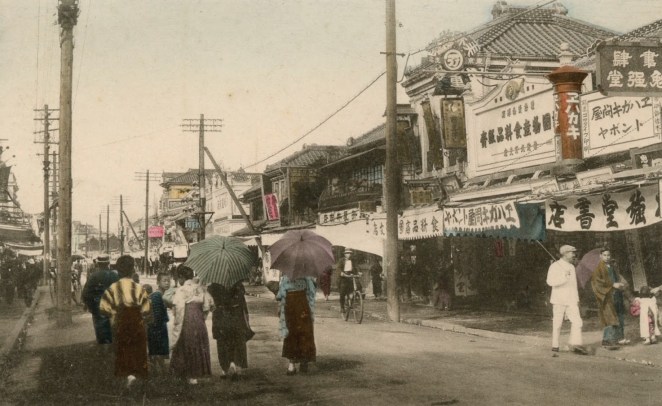


This is an amazing resource! I’ve sent you an email.
LikeLike
Thank you for your work.
LikeLike