For all the new Buddhas in the West posts follow us on Bluesky & Instagram
Tales of Tourist Photos, Pt. 2*: Old “wet-plate” photography required glass negatives to be coated, sensitized, exposed, and developed in less than fifteen minutes. Using the dry-plate method, negatives could be prepared beforehand; Wilhelm Burger was among the first to use this in Japan. *[Part 1]
Burger was photographer for the 1869 Imperial Austrian Expedition to East Asia, but illness allowed him to remain in Japan for the winter after the legation left. Tasked in part to photograph art objects, Burger visited the Kamakura Daibutsu with large glass negatives he prepared in Europe.
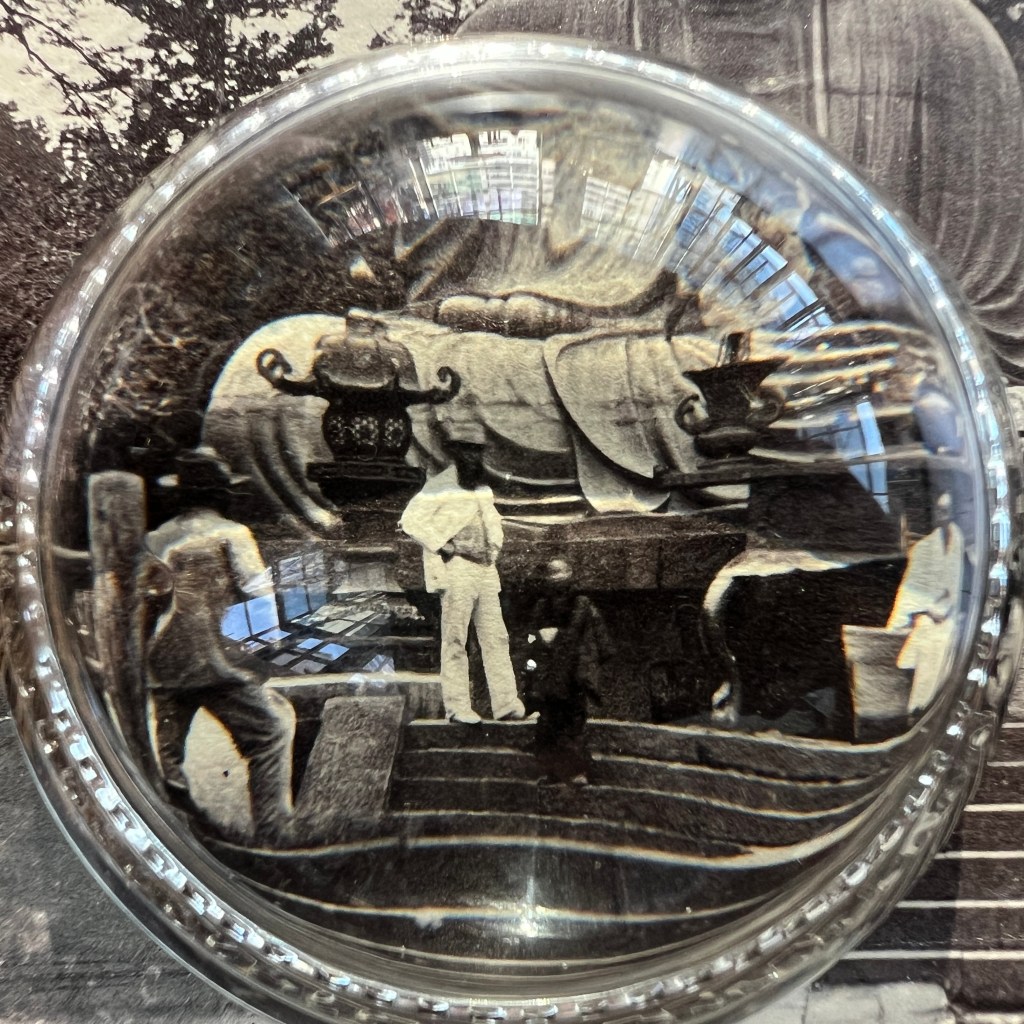
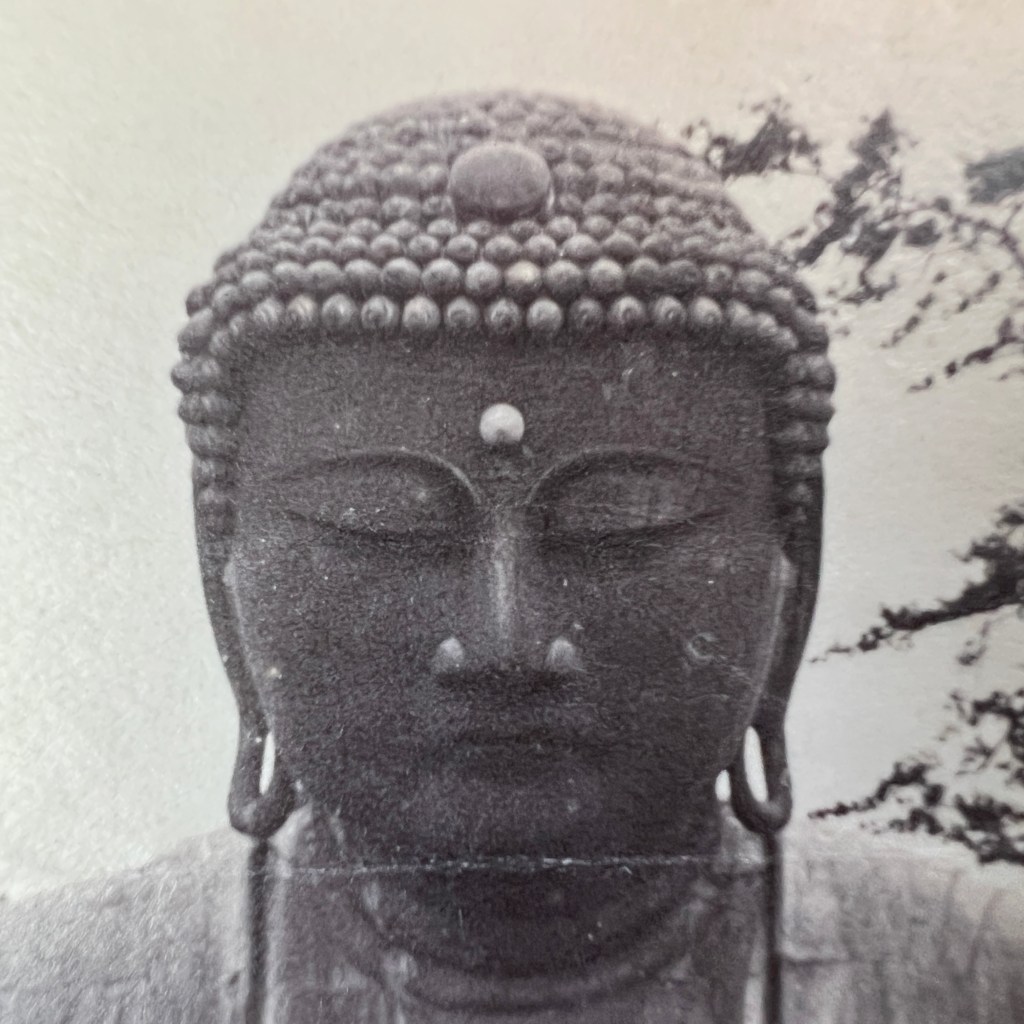
The handwritten inscription on the back of this photographic print reads, “This Image is all Bronze, name Diaboots.” “Diaboots,” or Daiboots, was the Yokohama treaty port vernacular for the Kamakura Daibutsu through the 1860s.
While Burger created a sizable portfolio of arts and crafts during the embassy, his photographs at Kōtoku-in in Kamakura appear more tourist-like than documentary. Here, several people pose for the camera, including what may appear to be Buddhist priests and three men in European attire.
To my knowledge, the people remain unidentified; Burger’s apprentice, Michael Moser, stayed in Japan after the embassy returned (and remained after Burger left). Moreover, Italian-born Felice Beato operated a successful Yokohama-based photography studio at the time – could either be seen here?
On his return to Vienna in 1870, Burger exhibited his Japanese portfolio to broad public acclaim. For more on Burger’s photographic process, see Tani Akiyoshi & Peter Pantzer’s “Wilhelm Burger’s Photographs of Japan,” PhotoResearcher 15 (2011): 40–50.
The Buddhas in the West Material Archive is a digital scholarship project that catalogues artifacts depicting Buddhist material culture for Western audiences. It’s comprised of prints, photos, and an assortment of ephemera and other objects. For a brief introduction to this archive, visit the main Buddhas in the West project page.
For Related Buddhas in the West Posts Featuring Historical Photography:
In 1868 Wilhelm Burger (1844–1920) was appointed as the official photographer to the Austria-Hungary ligation to Siam, China, and Japan. In preparation for this inaugural diplomatic and commercial enterprise, Burger prepared numerous photographic glass negatives that could be later exposed to capture images of the mission. By employing the dry collodion process for capturing photographs, Burger no longer needed to use a portable darkroom as was necessary with the older wet collodion process. Burger was among the first to use the dry collodion method in Japan.[1]
Recently, Luke Gartlan has shown that Burger did not arrive in Japan with the lead Austrian naval vessel, the Donau, in early September 1869, but was delayed in Shanghai taking photographic records of Chinese artworks. He arrived a few weeks later, skipping the customary port-of-call at Nagasaki and rejoining the ligation at Yokohama.[2] After falling ill and subsequently requiring hospitalization, Burger was allowed to remain in Japan to continue his photographic documentary work as the rest of the mission continued on to South America that November. Burger remained in Japan until March 1870, disembarking out of Nagasaki on his way back to the Austrian Empire.
During his sixth month stay Burger was able to amass a large portfolio of Japanese images, both larger format landscapes and smaller format studio portraits.[3] Based on studio furnishings and props, it has long been known that Burger’s portraits were taken in the pioneering Japanese photographic studios of Ueno Hikoma 上野彦馬 (1838–1904), established in Nagasaki, and Shimooka Renjō 下岡蓮杖 (1823–1914), established in Yokohama. More critically, it has recently been shown that some of Burger’s purported photographs were more than likely taken by Ueno Hikoma and Shimooka Renjō themselves. For example, as Tani Akiyoshi and Peter Pantzer have demonstrated, the studio portrait negatives that remain in the Austrian National Library were prepared with the wet collodion process used extensively across Japan.[4] We may assume that Burger purchased these smaller format negatives and their copyrights to print and sell back in Europe.[5]
Figure 1
When we turn to Burger’s published portfolio of fifty-seven Japanese views held at the British Museum, catalogued as A Series of 56 [sic] Views of Towns, Villages in Japan, we find Buddhist figural imagery prominent in eight photographs, including three individual plates of the Kamakura Daibutsu.[6] One of these latter photographs (plate 59), with another example shown above [Fig. 1], depicts three men in Western attire, with two looking towards the camera and one towards the colossal bronze.
This photograph has sometimes been attributed to the famous photographer and Yokohama resident Felice Beato (1832–1909), but I feel this is unwarranted.[7] In spite of the fact that a photograph published under Burger’s name does not necessarily prove he made the original exposure, Burger did arrive in Japan prepared to take larger format landscape photographs, just as we see with this image of the Daibutsu. Moreover, as noted by Akiyoshi and Pantzer, the average size of Burger’s surviving dry collodion plates was 150 x 200 mm.[8] These would be contact printed on photosynthesized paper, thus a resulting print would have the same dimensions. The print illustrated here measures 135 x 200 mm, approximating the average size of Burger’s negative plates.
Moreover, given the popularity of the Daibutsu among foreigners in Yokohama (it was one of the few places within the established treaty boundaries), it seems natural that Burger would make the excursion during his stay in Japan from late fall to early spring and attempt to preserve it as part of his photographic record.[9] Other commercial photographers, such as William Saunders (1832–1892), William Andrew (fl. 1865), and Felice Beato, all previously included the bronze Kamakura icon as part of their studio portfolios.[10] The statue was arguably one of the most photographed objects in the region at the time.
The men in Western clothing in Burger’s photo remain unidentified. Another print showing some the same men in different positions is held by the Yokohama Museum of Fine Art; this is also currently attributed to Beato.[11]
After Burger’s return to the Austrian Empire he was granted the title of imperial and royal photographer (k.k. Hofphotograph) in November 1871. That same year he published Bilder aus Japan, a portfolio of his Japanese prints. A copy is held by the British Museum under the aforementioned English name A Series of 56Views of Towns, Villages in Japan.
[1] Gartlan 2009: 73, Akiyoshi & Pantzer 2011: 44, 49. There are notices of the French photographer Paul Champion (1838–?) (albeit with very limited success) and English amateur photographer Angus C. Fairweather using dry collodion plates in Japan before Burger’s arrival, see Bennett 2006b: 124 and 307.
[3] Upon his return to Austria, Burger also sold stereoviews of his travels, but these were not taken with a stereo camera and thus do not produce stereoscopic 3-D images, see Bennett 2006a: 169.
[4] According to the estimates of Akiyoshi and Pantzer, out of the 188 surviving negatives of Japan, 27 plates should be ascribed to Ueno Hikoma and 44 plates to Shimooka Renjō, see Akiyoshi & Pantzer 2011: 41. The authors raise other concerns as well, such as the limited time Burger had to organize and set up all of the studio models as well as his apparent misunderstanding, as exemplified in his later captions, of the locals portrayed.
[5] Such a practice was not uncommon at the time, see Akiyoshi & Pantzer 2011: 49–50.
[6] This includes object numbers: c13562-26 (plate 19), c13562-30 (plate 23), c13562-33 (plate 26), c13562-37 (plate 30), c13562-54 (plate 47), c13562-66 (plate 59), c13562-67 (plate 60), and c13562-68 (plate 61). The final three objects listed here depict the Kamakura Daibutsu.
[7] See, for example, the identification of this photograph held by the Santa Barbara Museum of Art (Ac. 2003.42.3) and the National Library of New Zealand (Ref. PA1-f-021-057-2). The latter photograph is part of the album compiled by Alexander Fisher (fl. 1861–1879) and entitled Album of Photographs Compiled on Cruises aboard HMS Endymion with the Flying Squadron and in the Mediterranean. The HMS Endymion sojourned in Yokohama for a few days in April 1870, only a month after Burger departed Japan. I speculate the Burger left a few prints of his work in local Yokohama shops before returning to Austria. Another print showing some the same men in different positions is held by the Yokohama Museum of Fine Art (Ref. 91-PHF-008); it is also attributed to Beato.
[9] Judging from the three photographs, it appears Burger made at least two trips, a possibly three, to the Kamakura Daibutsu: once in winter when the foliage was absent from some trees (see British Library items c13562-66 [plate 59] and c13562-67 [plate 60]) and once in early spring when the foliage had returned (c13562-68 [plate 61]). This latter photograph also shows additional damage to the railing on the left side of the image, suggesting it was taken at a different time. Another photograph of the Daibutsu reputedly taken by Burger can be found in his published stereoview set. One copy of the stereograph is preserved in the Nagasaki University Library (No. 3436). This image shows the entire railing intact and thus was either taken during Burger’s winter excursion or he procured it from another photographer in Japan. In any regard, the non-stereo photograph is found in Burger’s K. K. Mission nach Ostasien 1868-1871 preserved by the Museum für angewandte Kunst (Ref. KI 13660-15-2). It measures 86 x 71 mm, an approximate size that is appropriate for a stereoview.
Burger may have also taken another photograph that was used for the inaugural publication of the The Far East: A Monthly Illustrated Journal on May 30, 1870. It shows the left side railing completely removed. This would suggest Burger took at least a third trip to the Kamakura Daibutsu (or it is possibly the work of another photographer). Nevertheless, a copy of the photo is found in Burger’s K. K. Mission nach Ostasien 1868-1871 preserved by the Museum für angewandte Kunst (Ref. KI 14291-395). It measures 195 x 141 mm, although it appears part of the glass negative extends beyond the print.
[10] An article in the October 25th, 1862 issue of the Japan Herald describes Saunders selling a photograph of the Daibutsu, see Bennett 2006a: 59. An advertisement in the October 14th, 1865 issue of the Japan Herald notes Andrew selling a Daibutsu print, see Bennett 2006b: 120. The Daibutsu was a staple of Beato’s albums in the 1860s, see, for example, Lacoste 2010: 15.
Akiyoshi, Tani, and Peter Pantzer. 2011. “Wilhelm Burger’s Photographs of Japan: New Attributions of His Glass Negative Collection in the Austrian National Library.” PhotoResearcher 15:40–50.
Bennett, Terry. 2006a. Old Japanese Photographs Collectors’ Data Guide. London: Bernard Quaritch Ltd.
Bennett, Terry. 2006b. Photography in Japan 1853-1912. Rutland, VT: Tuttle Publishing.
Gartlan, Luke. 2009. “Photography and the Imperial Austrian Expedition in Nagasaki (1869-70).” Koshashin Kenkyu 古写真研究 3:72–77.
Lacoste, Anne. 2010. Felice Beato: A Photographer on the Eastern Road. Los Angeles: J. Paul Getty Museum.









 Personal Site of Peter Romaskiewicz