For all the new Buddhas in the West posts follow us on Bluesky & Instagram
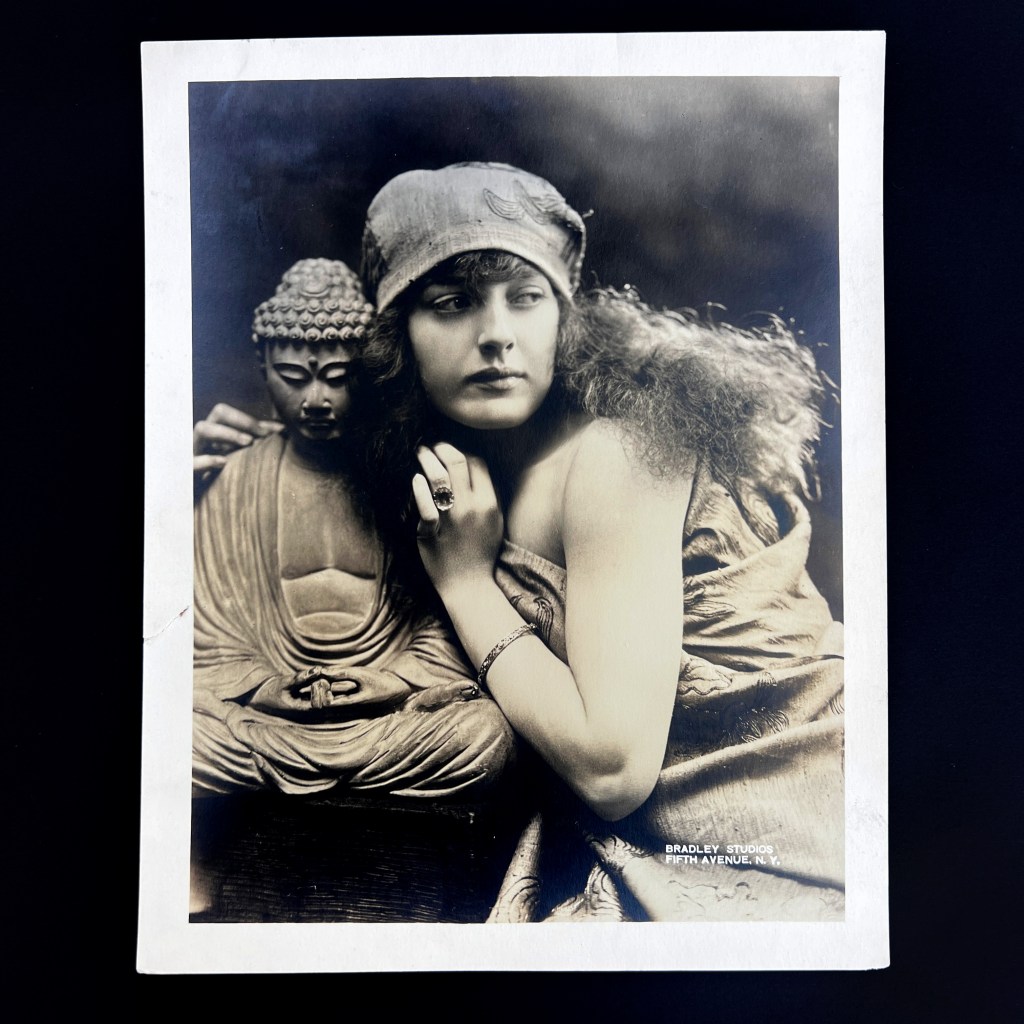
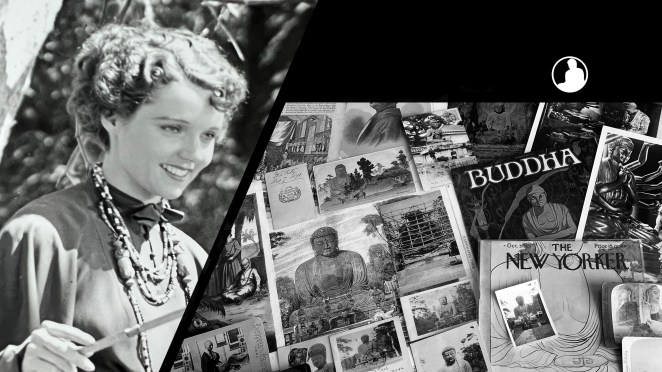
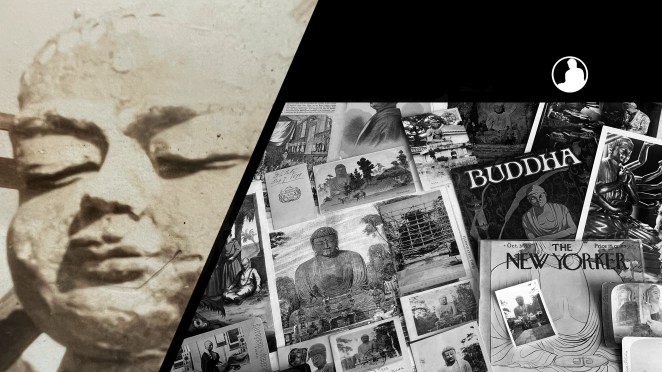
Silent film star Marguerite Courtot joined Pathé after WWI and became a centerpiece in the studio’s action-adventure serials. She starred in Pirate Gold (1920), Velvet Fingers(1920) and The Yellow Arm (1921), with the latter being a stereotypical “Yellow Menace” adventure.
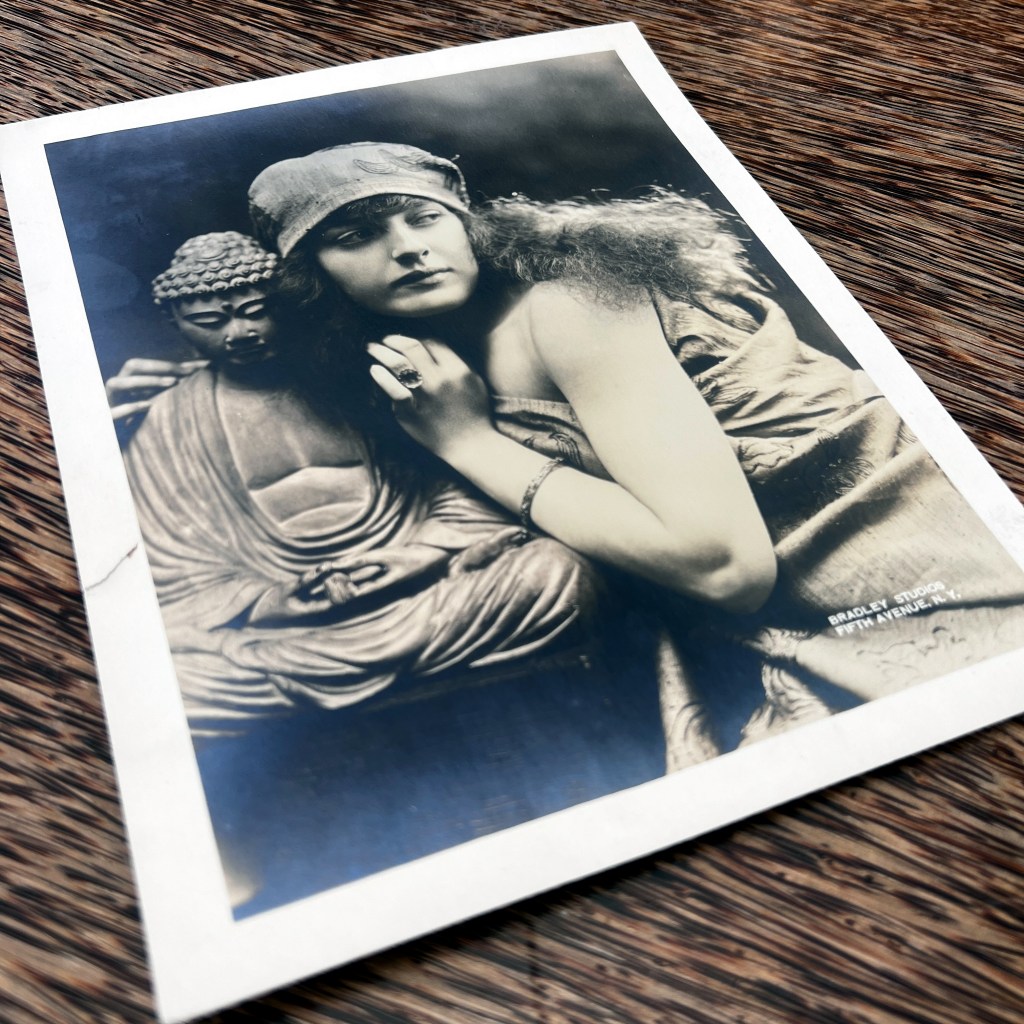
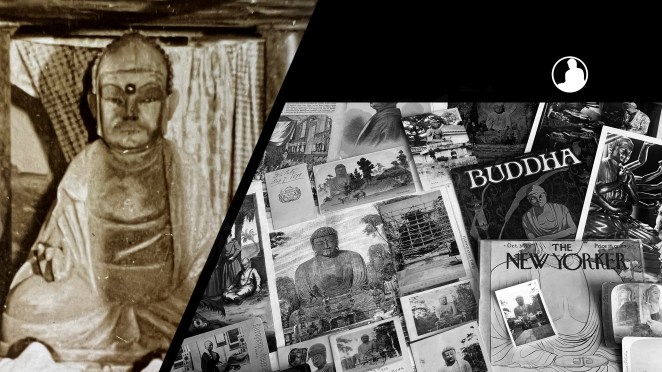
This photo does not appear to be a production still (a movie set photo), but a studio portrait taken in New York City. The portrait dates to around 1920 when the silent film industry was still centered in Fort Lee, New Jersey.
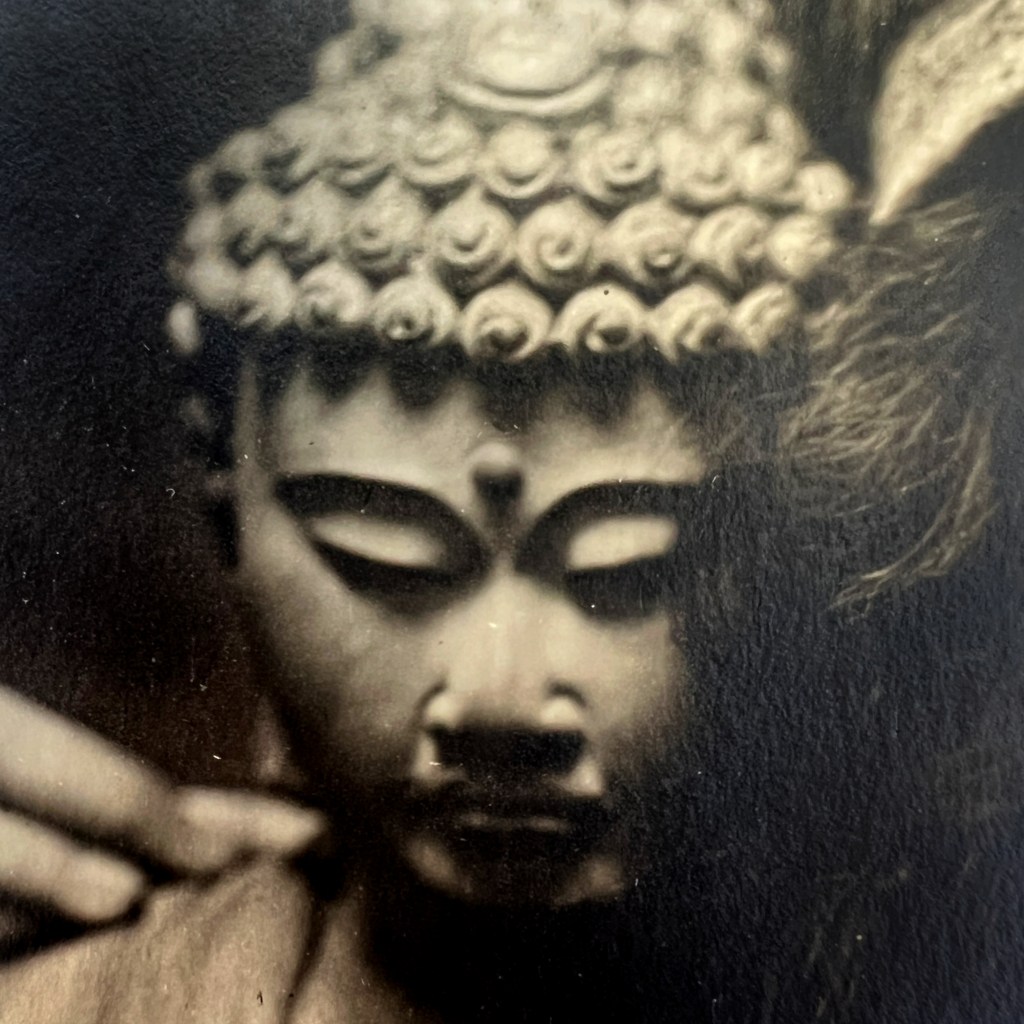
Courtout grasps on to the Buddha statue using a dramatic stage gesture, a relic of the theater age that was adopted in early film. While The Yellow Arm serial is considered lost, it is possible this was a cast portrait used in promoting the film.
Short written synopses survive for several of the Yellow Arm episodes as copyright claims. The synopsis for episode one is held by the Library of Congress, viewable here: https://www.loc.gov/item/s1229l16612/.
The Buddhas in the West Material Archive is a digital scholarship project that catalogues artifacts depicting Buddhist material culture for Western audiences. It’s comprised of prints, photos, and an assortment of ephemera and other objects. For a brief introduction to this archive, visit the main Buddhas in the West project page.
For Related Buddhas in the West Posts Featuring Silent Films:
For all the new Buddhas in the West posts follow us on Bluesky & Instagram
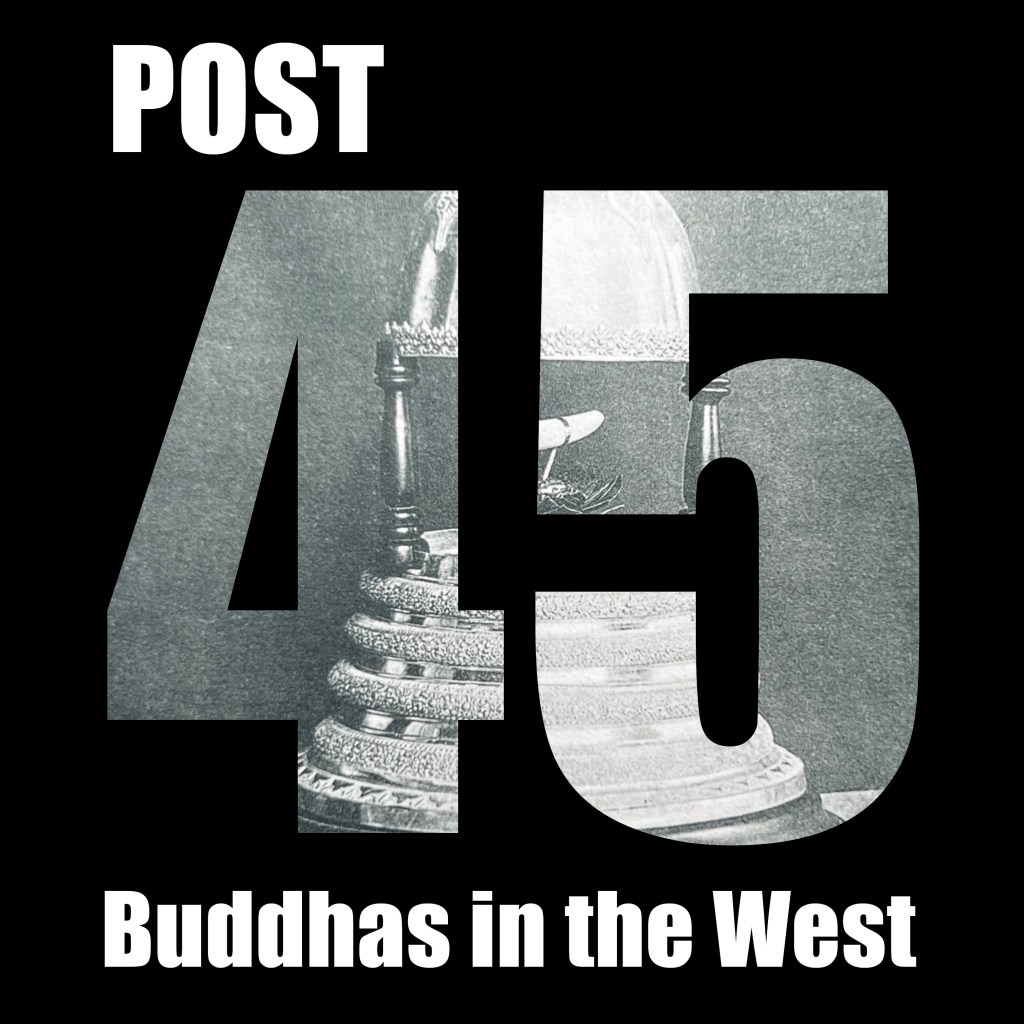
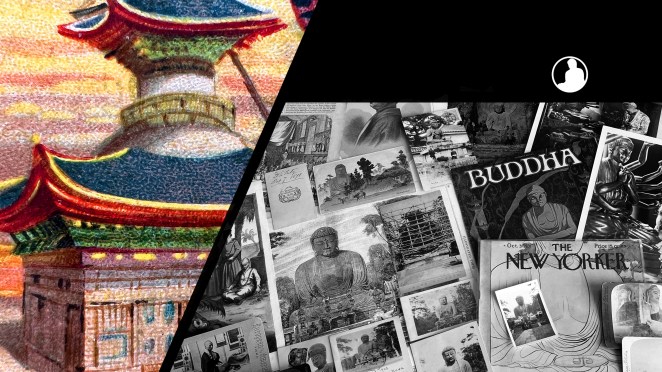
When the British re-enshrined the Buddha’s tooth relic at Kandy’s Temple of the Tooth in 1815, few among the British public were aware of the events. In 1875, however, when the Prince of Wales visits the relic, great interest in the sacred tooth spreads across England.
The undivided back design on the reverse indicates this card was printed before 1902, following British postal code. Unlike today, the message had to be written on the other side of the card, thus the blank space on the bottom edge of the obverse.
The “life story” of the tooth relic is preserved in the Dāṭhavaṃsa, compiled in the early 13th century. According to this work, in the ancient past a non-Buddhist Indian king tried to burn and smash the tooth, but it remained unscathed.
Consequently, as the story goes, the king converted to Buddhism and the tooth eventually made its way to Sri Lanka. Here we see the tooth encased in a stupa-shaped reliquary.
For a small collection of South Asian postcards, including a mailed version of the one shown here, see the offerings by the University of San Diego here: https://tinyurl.com/3nphs2k2.
The Buddhas in the West Material Archive is a digital scholarship project that catalogues artifacts depicting Buddhist material culture for Western audiences. It’s comprised of prints, photos, and an assortment of ephemera and other objects. For a brief introduction to this archive, visit the main Buddhas in the West project page.
For Related Buddhas in the West Posts Featuring Sri Lanka / Ceylon:
For all the new Buddhas in the West posts follow us on Bluesky & Instagram
A rather unique mixture of religion, science, and stage magic was playing out on the Vaudeville circuit at the end of the 19th century. Anna Eva Faye, billed as the “Indescribable Phenomenon,” played to full houses with her other-worldly displays of mentalism.
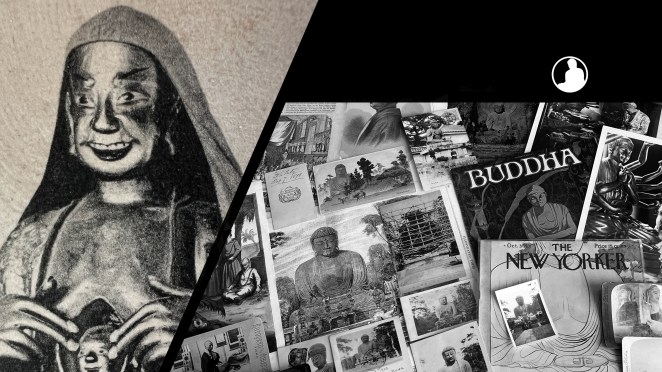
As a souvenir of her show and a token of good luck (the generic sense of “mascot”), Faye sold coins bearing the image of the multi-armed Indian icon Śiva. The AEF below the figure refers to Anna Eva Faye.
The reverse bears a wreath (common to US coins of the era) enclosing the magic letters: AYX-7OD-77O. The coin reflects how the religious import of Śiva is funneled into larger American beliefs in occult power during this period.
This souvenir coin shows a decent amount of rub wear. This suggests the coin was a trusty good luck companion for someone in the past. The coin is about the size of a US quarter.
For a curated list of old newspaper articles about Anna Eva Faye, see the offering presented by the Library of Congress here: https://tinyurl.com/3jhkjsze.
The Buddhas in the West Material Archive is a digital scholarship project that catalogues artifacts depicting Buddhist material culture for Western audiences. It’s comprised of prints, photos, and an assortment of ephemera and other objects. For a brief introduction to this archive, visit the main Buddhas in the West project page.
For Related Buddhas in the West Posts Featuring Historical Advertising:
For all the new Buddhas in the West posts follow us on Bluesky & Instagram
For visitors to Japan in the 1860s, Kyoto was seen as brimming with dangerous anti-foreign samurai. This changed in the 1870s when it was transformed by tourism, driven in part by foreign photography studios who were allowed to shoot the city for the 1872 Kyoto Exposition.
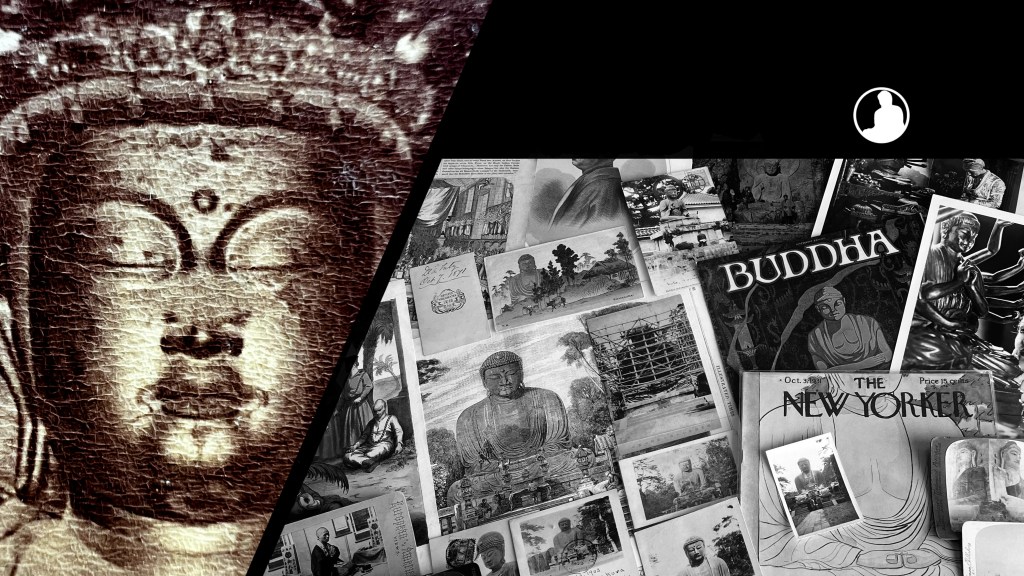
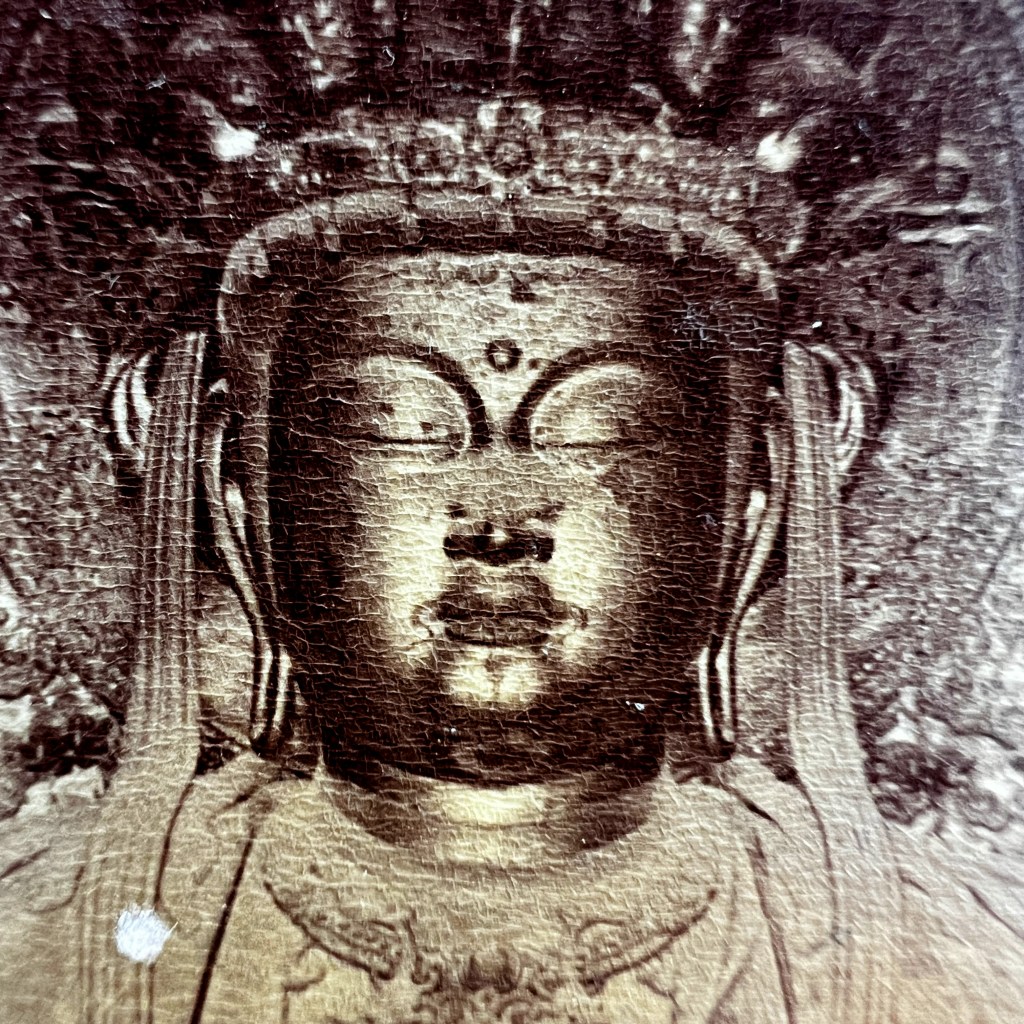
While Europeans knew of Kyoto’s Sanjūsangen-dō through late 17th century book engravings, the first photographs of the temple likely did not circulate until the early 1870s. This albumen print is by an unknown commercial photographer and likely dates to the 1880s.
The central icon is a Thousand-armed Kannon from the 13th century and is recognized as a National Treasure of Japan.
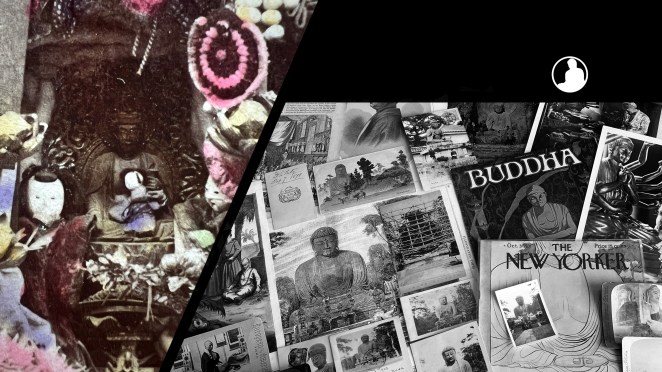
There appears to be a double exposure in this photograph, with a priest kneeling in front of the icon. The colorist gave the priest’s robes a wash of blue, but the paint did not cover over the woodwork designs of the altar.
Baron von Stillfried was among the foreign studio owners who photographed Kyoto in 1872. One of his albums, with views of Kyoto, can be seen through the Metropolitan Museum of Art here: https://tinyurl.com/yuuf52u9.
The Buddhas in the West Material Archive is a digital scholarship project that catalogues artifacts depicting Buddhist material culture for Western audiences. It’s comprised of prints, photos, and an assortment of ephemera and other objects. For a brief introduction to this archive, visit the main Buddhas in the West project page.
For Related Buddhas in the West Posts Featuring Kyoto, Japan:
For all the new Buddhas in the West posts follow us on Bluesky & Instagram
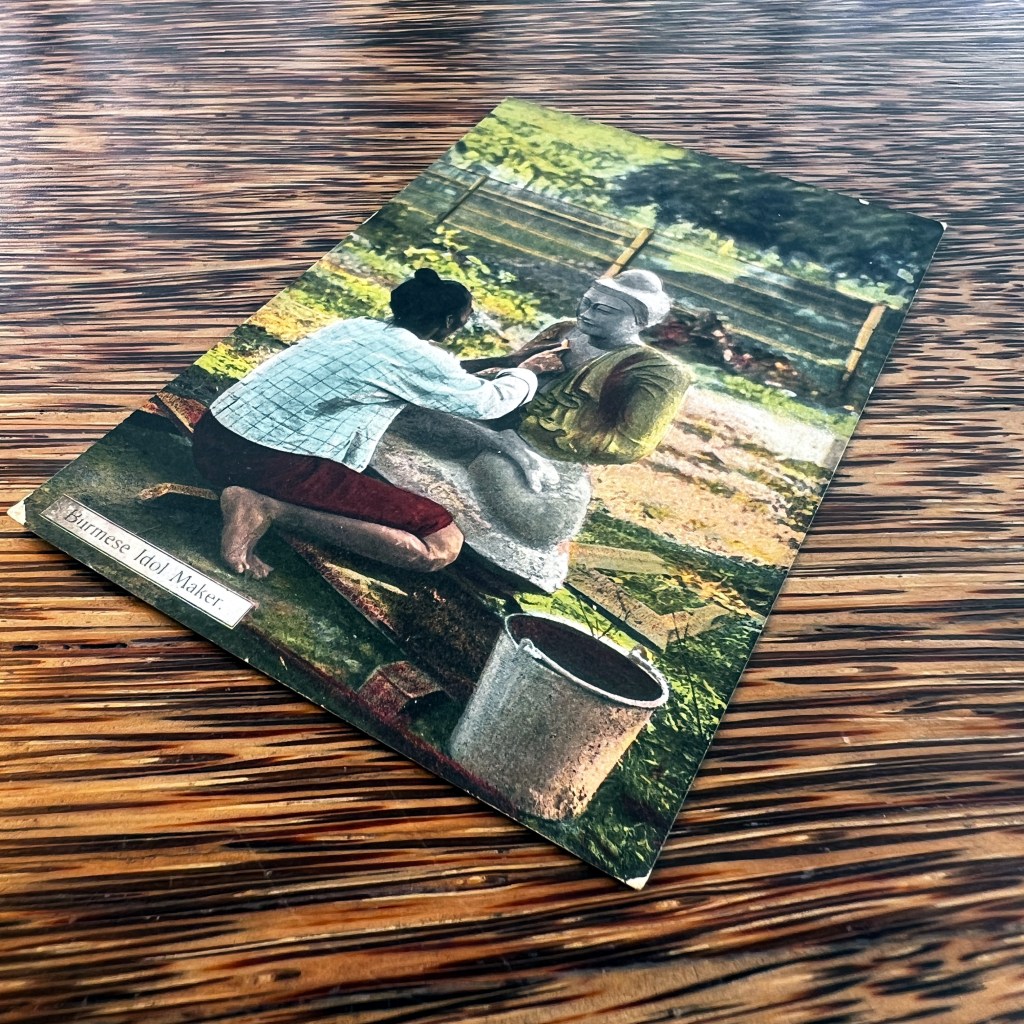
As new imagery of British colonial Burma circulated in the early 20th century, one trade received heightened interest: idol carving. The marble quarries north of Mandalay provided sufficient raw materials for the local carving industry centered around the village of Sagyin.
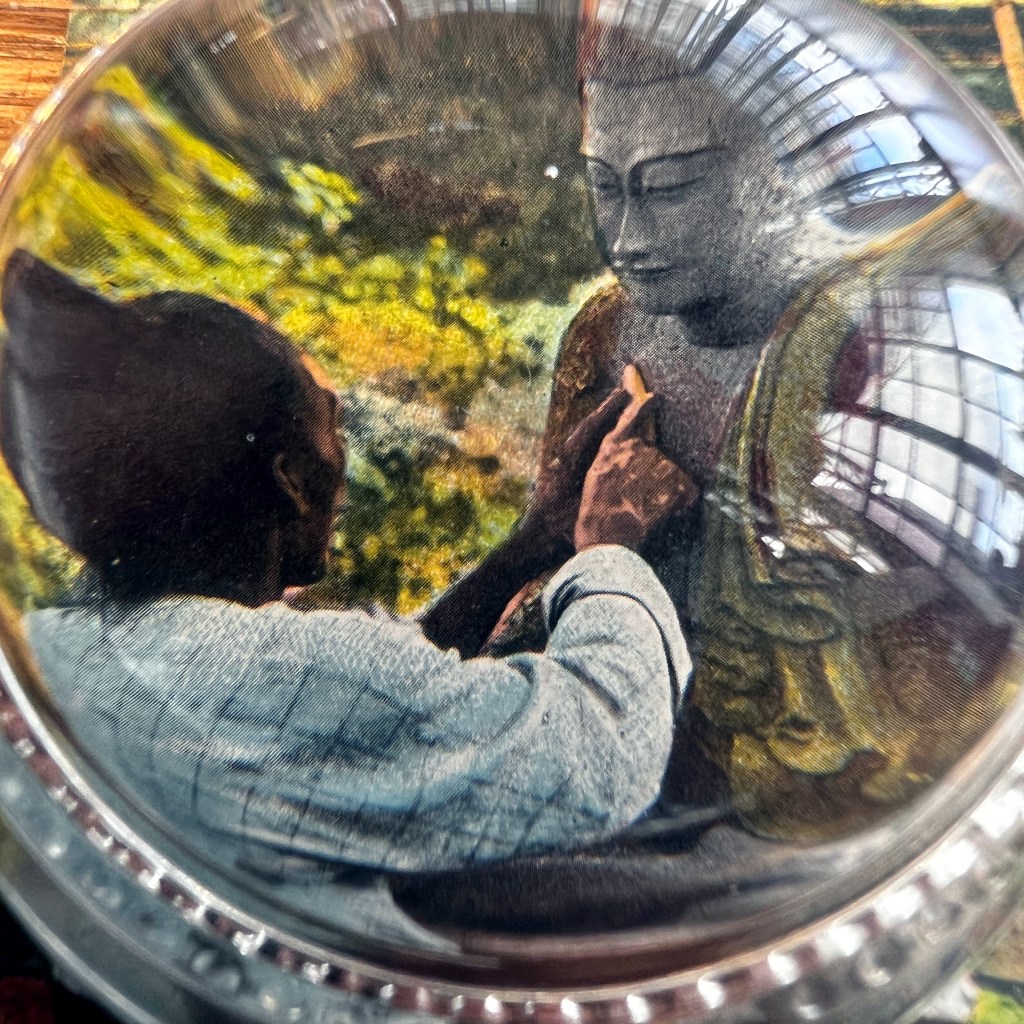
An active stone-workers’ quarter in Mandalay meant foreign travelers could encounter Burmese carvers working on Buddhist statuary. This postcard by D.A. Ahuja captures the crafting of a Mandalay-style marble Buddha, with thick garment folds and a band around the head.
The card reveals a lithographic-halftone hybrid process, whereby a black halftone screen was applied on top of a multi-color lithographic substrate. The reverse design suggests this card was printed around 1910.
Burmese white marble has been fashioned into Buddhist statuary since the Konbaung Dynasty (1752–1885). The trade continues in and around Sagyin and Mandalay today.
For further info on the history of Burmese marble carving and the early spread of Burmese Buddhas into China, see Deng, Beiyin. “Reimagining a Buddhist Cosmopolis: Conveying Marble Buddhas from Burma to China, 1890s-1930s.” Journal of Global Buddhism 24, no. 1 (2023): 25–46.
The Buddhas in the West Material Archive is a digital scholarship project that catalogues artifacts depicting Buddhist material culture for Western audiences. It’s comprised of prints, photos, and an assortment of ephemera and other objects. For a brief introduction to this archive, visit the main Buddhas in the West project page.
For Related Buddhas in the West Posts Featuring Myanmar / Burma:
For all the new Buddhas in the West posts follow us on Bluesky & Instagram
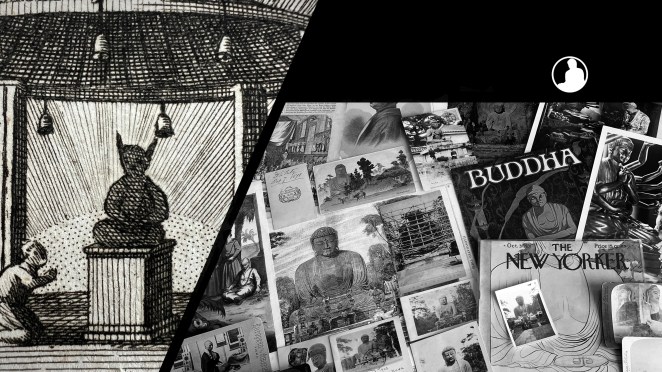
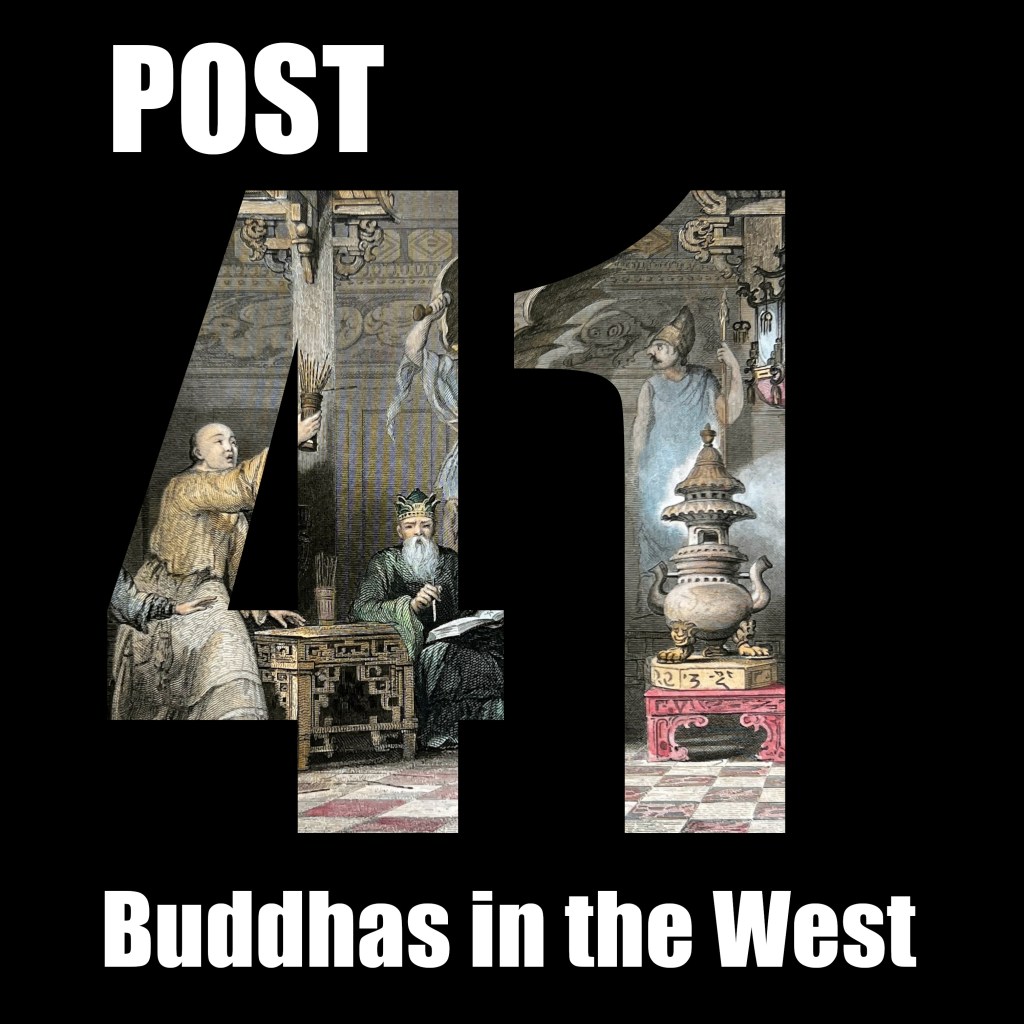
Having never traveled to China, Thomas Allom’s illustrations retain a touch of the fantastic common among his European pictorial predecessors. After the end of the Opium War in 1842 there was renewed interest in China and Allom’s book was among the first to serve this audience.
The text for China: In a Series of Views was composed by Rev. George Wright. He commonly portrayed the Chinese as inferior and infatuated with bizarre customs, reflecting a growing sentiment among Europeans after the Opium War.
A trained illustrator, Allom prepared watercolor paintings and had them engraved for his books. While some paintings were copies of earlier works by others, including those in the British military stationed in China, this illustration appears to be the creation of Allom.
Overall, Allom creates a dynamic image showing a commonplace Chinese temple practice of fortune telling. Some elements, however, appear out of place.
The New York Public Library has digitized Allom’s works on China with a layout of all his engraved illustrations viewable here: https://tinyurl.com/3b74hu7m.
The Buddhas in the West Material Archive is a digital scholarship project that catalogues artifacts depicting Buddhist material culture for Western audiences. It’s comprised of prints, photos, and an assortment of ephemera and other objects. For a brief introduction to this archive, visit the main Buddhas in the West project page.
For Related Buddhas in the West Posts Featuring China:
The Buddhas in the West Material Archive exhibit, entitled “Victorian Virtual Travel: Visions of Buddhism,” is featured at the San Diego Central Library through November 2024.
Welcome to the Companion Guide
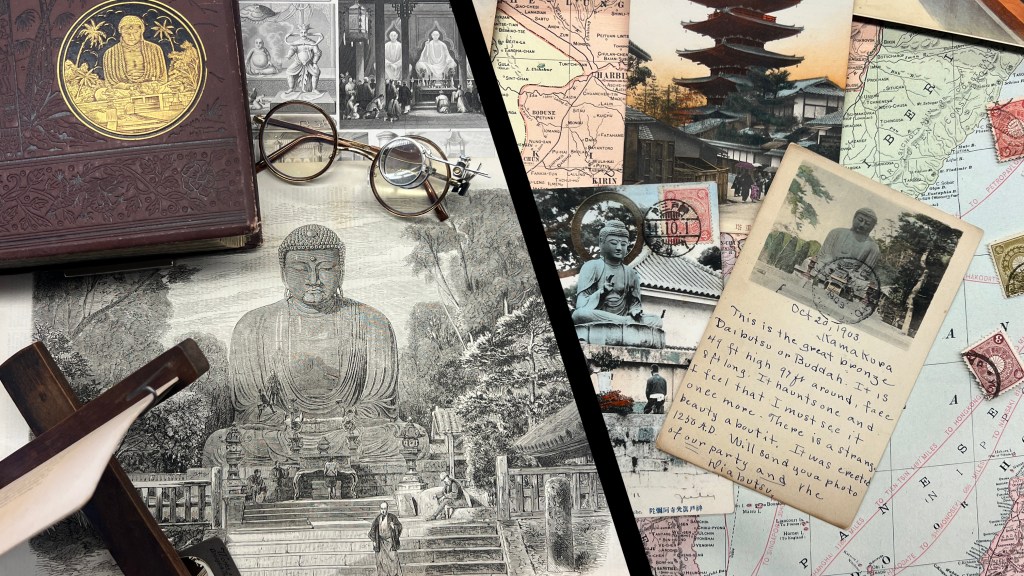
The exhibit contains forty artifacts that helped transport Victorian-era Americans to Japan through emerging print technologies at the end of the nineteenth century. Consequently, artifacts like these helped shape an early American visual literacy of Buddhism.
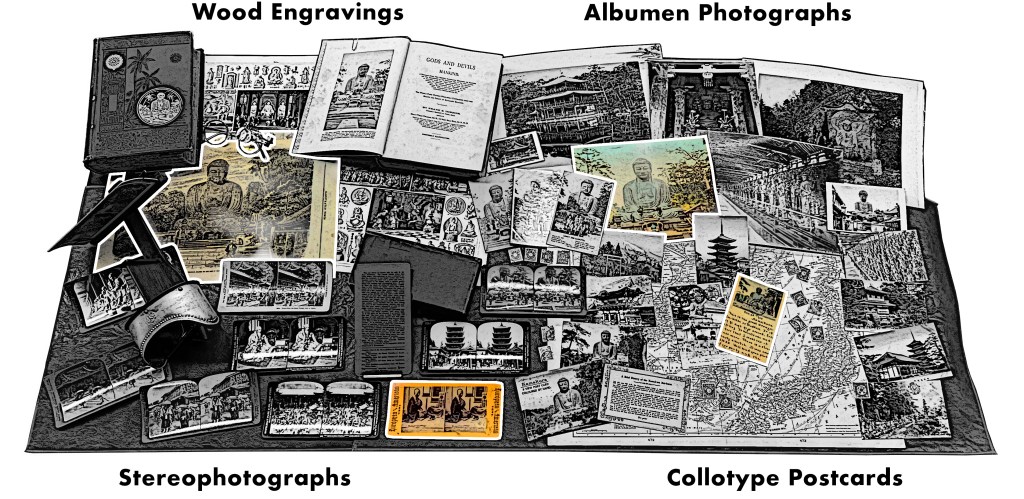
The display is roughly divided into four sections comprising engravings, hand-colored photography, stereophotography, and hand-colored postcards.
As you explore, what items stand out to you the most? Can you imagine stories or adventures a traveler might have imagined when viewing these objects? What can you learn about Buddhism through these items? Does any artifact or imagery challenge what you currently know about Buddhism?
Four Types of Victorian Visual Media
Wood Engravings
Materials related to mass publication engravings are found in the top left of the display case. The change from copperplate engravings to wood engravings revolutionized nineteenth century print illustration. By engraving the tight endgrain of boxwood blocks, illustrators could capture more details than regular woodcuts. Moreover, illustration blocks could now be inserted into the same form as type, considerably speeding up the printing process and giving birth to illustrated daily newspapers in the 1840s. The wood engraving of the Kamakura Daibutsu highlighted above was published by the Illustrated London News in 1868 and exemplifies the kind of illustrations seen in illustrated newspapers of the day. Many Victorian-era Americans first discovered Buddhist imagery though illustrated periodicals, travelogues, and other books.
Albumen Photographic Prints
Materials related to albumen photographic prints are found in the top right of the display case. Early photography employed a time-consuming wet-plate method which required photosensitive chemicals to be mixed, applied to a glass negative plate, exposed, and developed in a portable dark room in quick succession. The subsequent photograph was printed on paper coated with an emulsion of egg white, called albumen, giving rise to the name albumen print. Photography studios first opened in Japan in the 1860s, providing foreign travelers the opportunity to return home with souvenirs of sites they visited. The easier dry-plate method of photography was introduced into Japan by the 1880s and Japanese-owned studios began to overtake the souvenir market. The photograph of the Kamakura Daibutsu highlighted above was taken by Italian-born Adolfo Farsari (1841–1898) who opened a studio in Yokohama in 1885. As was common for larger formats, albumen prints were hand-colored and Farsari’s Japanese artists were known for creating some of the most brilliant palettes.
Stereophotographic Prints
Materials related to stereophotography are found in the bottom left of the display case. Stereophotography uses a pair of photographs taken from slightly different horizontal positions – typically the distance between a person’s eyes – to produce an illusory sense of depth when viewed through a stereoviewer. Stereocards first emerged as a popular form of entertainment in the 1860s, most often used as a home parlor room activity. At the end of the nineteenth century stereoview companies started to shift focus from entertainment to education and began publishing stereoview sets highlighting different regions of the world. The stereocard view of a Buddhist priest highlighted above reflects the variety of scenes and people introduced to Americans through this popular education and entertainment medium.
Collotype Postcards
Materials related to postcards are found in the bottom right of the display case. The Golden Age of postcards spans roughly from 1890–1915 and due to their inexpensive nature are sometimes considered the first “democratic” photographic medium. Postcards were not just mailed as souvenirs during this period, they were also collected in albums and shared with friends and family as a pastime. Moreover, the 1905 Russian-Japanese War caused a “postcard boom” in Japan, thus creating one of the largest postcard producers and consumers in the world. Translating the tonality of a photograph to black ink was accomplished through several methods by the end of the nineteenth century, but the gelatin-based collotype process was favored by Japanese postcard publishers. It created a fine reticulated “wormy” pattern that is barely visible to the naked eye. The collotype postcard of the Kamakura Daibutsu highlighted above bears a message from the sender. A majority of the postcards shown here were hand-colored, most likely by Japanese women working from home, and were intended for both domestic and foreign audiences.
The Buddhas in the West Material Archive is a digital scholarship project that catalogues artifacts depicting Buddhist material culture for Western audiences. It’s comprised of prints, photos, and an assortment of ephemera and other objects. For a brief introduction to this archive, visit the main Buddhas in the West project page.
A material analysis closely inspects an artifact’s material and sensorial qualities and asks questions about its use and significance. Oftentimes, the data gathered supplements more traditional disciplinary methods, such as data gathered from textual analysis.
Starting in the 1980s disciplines like anthropology, archaeology, and art history – all areas with close ties to objects and museums – began to explore more complex relationships between the “cultural” and “material.” Consequently, material artifacts, especially commonplace objects of daily use (like the postcard pictured here), were viewed as not only reflecting important social values and identities, but also as mediating human behavior. A material analysis attempts to reconstruct how and why objects were used, often resulting in a more complex interpretation of human behavior.
Why might we want to perform a material analysis?
For one, objects tell us about the lives and experiences of people. Sometimes this may add to or complicate our understanding of an historical event or biographical narrative. At other times, this may contradict our presumptions and reveal new paths of inquiry.
Second, a material analysis also reveals to us that objects have their own “life story.” As artifacts move from one person’s possession (or spatial and/or cultural context) to another, their value, use, and meaning may change even if their form changes little. Charting such changes is oftentimes called a “cultural biography” of an object.
Lastly, because people are enmeshed in a physical world, a material analysis reveals how objects help structure human activity in particular ways. For example, a large sun-lit cathedral hall will provoke different emotions and behaviors than a dark cave. Likewise, a sharp obsidian stone will shape a person’s response differently than a fluffy pile of goose down. In these cases, scholars have argued objects have agency because their materiality shapes human activity and subjectivity.
How do we perform a material analysis?
At one level, we examine the material properties of an artifact. This is best done with an object physically accessible to pokes and prods. This is a primary type of material analysis that directly inspects objecthood.
A secondary kind of analysis can be performed with care upon objects we access only by some kind of representational form, such as a photograph of the target artifact. This may be necessary if the artifact has been lost or destroyed or remains beyond our touch because it is hidden, restricted, or otherwise inaccessible. This may require amassing several visual documents (or written descriptions) to compile a more complete assessment of the target artifact. To take the postcard above as an example, one could use it as one documentary source to try and study the icon it depicts, the Kamakura Daibutsu. It would be more typical, however, to study the object at hand, namely the postcard itself.
On another level, we also analyze the various networks of materiality that support and give meaning to an artifact. This means we also pay attention to how an object was made and by whom. Furthermore, we also examine who uses the object and for which purpose. It may be the case that we can infer some of these answers by closely inspecting the object and applying our general knowledge. Often, however, questions of production, consumption, and signification require additional research beyond inspecting objecthood.
Overall, there is no codified set of questions for a “proper” material analysis, although we typically start with our senses and extend outward to broader and more complex layers of social and intercultural meaning. [I’ve also prepared a list of 88* Questions to Ask an Artifact]
What can we do with a material analysis?
A close investigation of an artifact will provide the groundwork for your own interpretations. A material analysis can inform something as brief as a museum label. But just because museum labels are short by convention does not mean they are insignificant. Labels tell us how to interpret an artifact: should we see it as a curious anthropological object or as a piece of art? To use the postcard from above, should we frame it as a quaint, hand-written souvenir from the turn of the century or as a highly-technical hand-colored collotype print?
In addition, a material analysis can be used to compliment or complicate interpretations based on different materials and documents. For example, we may ask if American tourists to the Kamakura Daibutsu in the early twentieth century envisioned it as a sacred icon or as a piece of art. The inscription on the postcard here documents the statue’s dimensions and material composition, suggesting the visitor appreciated the craftsmanship over its sacredness. This can lead to different kinds of questions such as comparisons to Daibutsu talismans that were also sold on site to Japanese pilgrims.
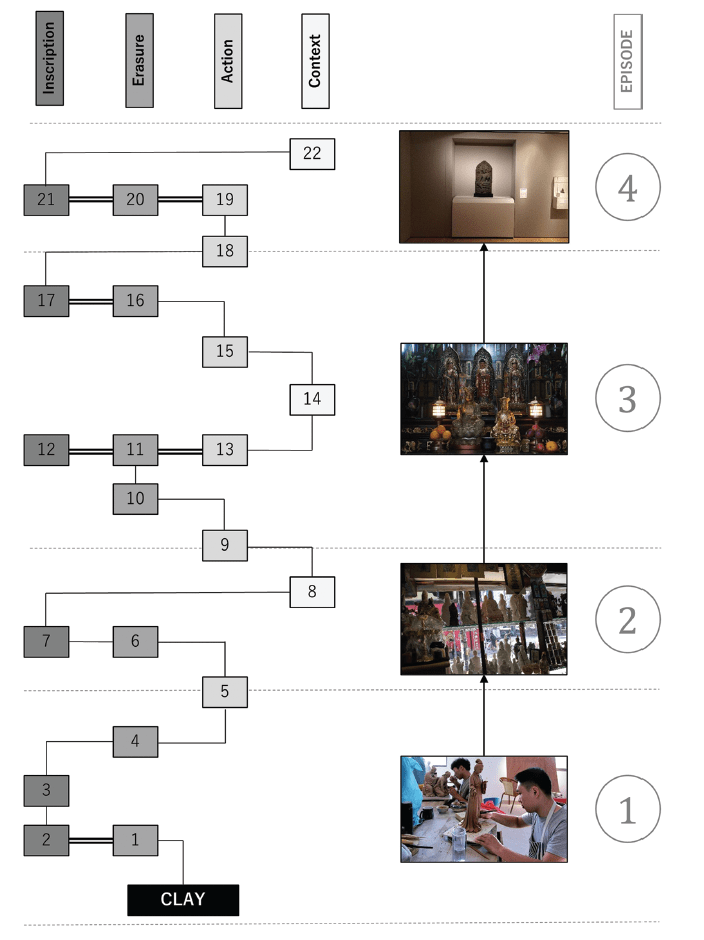
It is also possible to do a more extensive report on an object (or class of objects) in the vein of an “object biography.” In such a case it is important to consider how artifacts may go through different life episodes as they are modified and re-purposed throughout their lifespan. Chip Colwell has recently published an excellent overview of how one might envision this process. In his example, Colwell divides the lifespan of a Buddhist Guanyin statue into four episodes: its creation process, being sold in a store, being used as a ritual icon, and being displayed in a museum (see diagram).
During each stage the artifact can be modified (things are added/inscribed or taken away/erased), different actions are performed in service to it, and it is placed in different spatial and interpretive contexts. Such a perspective allow us to see that as artifacts enter new life stages they typically accumulate new layers of meaning, value, and status.
* See Chip Colwell, “A Palimpsest Theory of Objects,” Current Anthropology 63, no. 2 (2022): 129–57, https://doi.org/10.1086/719851.
*This handout was originally prepared by Peter Romaskiewicz as part of a university course that explored religion and material culture. Feel free to use and/or adapt to your needs. Email: peter.romaskiewicz@gmail.com.
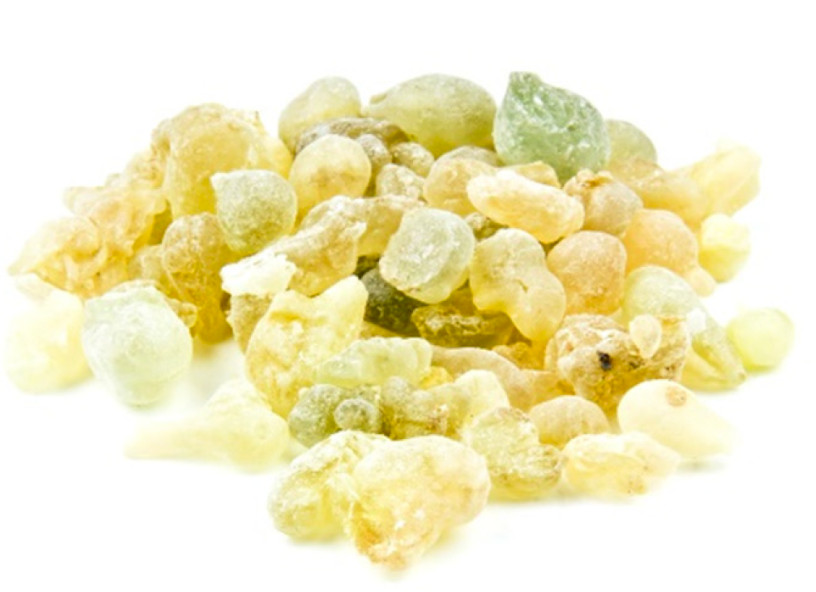
Frankincense and myrrh were two kinds of incense gifted to the baby Jesus according to the New Testament story of the Magi. Considering gold constituted the third gift, we can surmise how important such aromatics were to people in the ancient Mediterranean. Frankincense is an oleogum-resin with a distinctive balsamic-citrus scent that is produced by several species of the Boswellia tree. Biblical incense is thought to have traversed the two-to-three-month long trip along the so-called Incense Route connecting the eastern Mediterranean to the southern Arabian peninsula were Boswellia naturally occur. The subtropical-tropical climate of this region allows for the growth of many different kinds of fragrant resin-producing tress. There is also an Indian frankincense produced by the native Boswelliaserrata, but this does not seem to have significantly impacted classical Greco-Roman commerce. It might be the case, however, that Indian frankincense, or a mixture of Arabian and Indian frankincense, was brought into China by at least the mid-third century. The origin for the early Chinese name for frankincense, xunlu xiang, is contested by scholars, with some claiming it is a transcription of the Sanskrit kundurūka and others claiming it is a hybrid or fully Chinese name. By the eighth century a new name for frankincense becomes dominant, Milky Aromatic (ru xiang 乳香), reflecting the Arabic name for frankincense, luban, “milky, white,” and the growing commercial importance of the Arabic sea trade.
Facts and Features
Medieval Chinese Name: Xunlu Aromatic (xunlu xiang 薫陸香), Milky Aromatic (ru xiang 乳香)(additional names for different commercial grades)
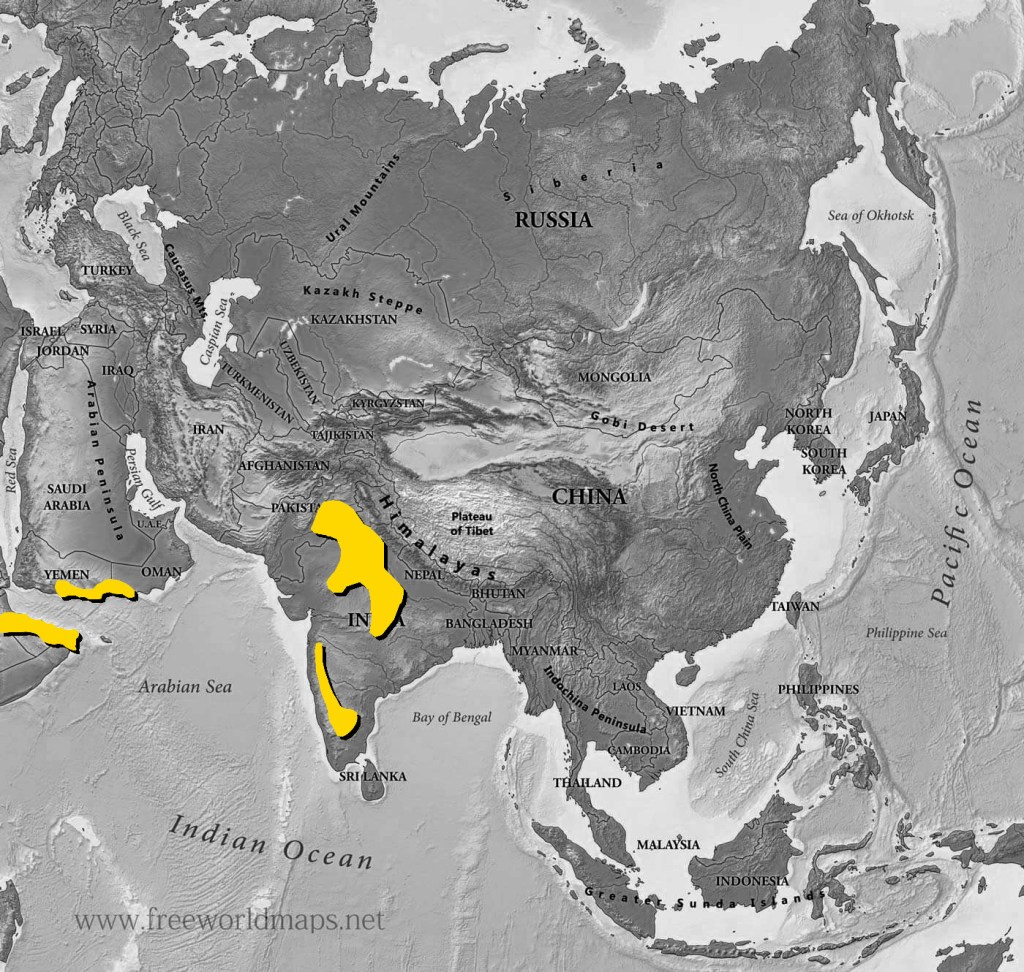
Phytogeographic Distribution: Ethiopia, Sudan, Somalia on the Horn of Africa, southern Arabian Peninsula, northwestern and southern India [approximate distribution* of frankincense is shown in golden yellow below]
Harvesting Process: the bark of the tree is notched or slashed causing the release of milky oleogum resin that thickens upon contact with the air, then the globule pear-shaped tears can be collected
Earliest Chinese Citation: mid-3rd century CE (e.g. dynastic history: Abridged Account ofWei [Weilüe 魏略]) & late 3rd century (translated Buddhist sutras)
Earliest Chinese Medicinal Use: 3rd/4th– late 5th century (Supplementary Record by Famous Physicians [Mingyi bielu 名醫別錄] and Collected Annotations on the Classic of Materia Medica of the Divine Husbandman [Shennong bencao jing jizhu 神農本草集注])
Comments: Frankincense first appears in extant Chinese sources in mid-third century when it appears alongside several other aromatic imports from the Roman Empire, including storax, saffron, and possibly rosemary. For the early medieval Chinese, frankincense was considered an export of the Roman Empire, but in reality the Romans were only transshipping the resin into India where it would have been sent onward to Chinese merchants via Central Asian middlemen. By the mid-seventh century frankincense was considered a direct export of India, possibly indicating the circulation of the Indian variety. By the late medieval period, frankincense was strongly connected to Arab trade and in such cases was sourced from the southern Arabian peninsula.
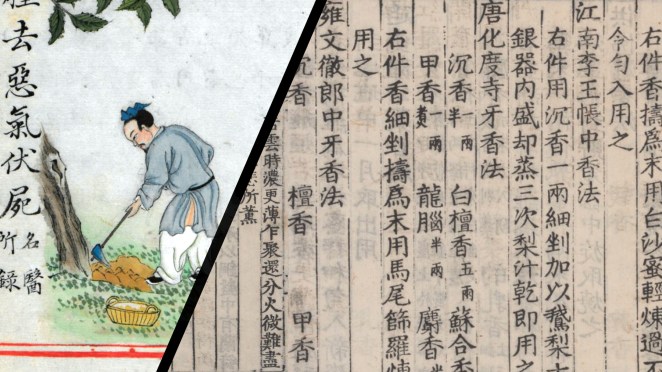
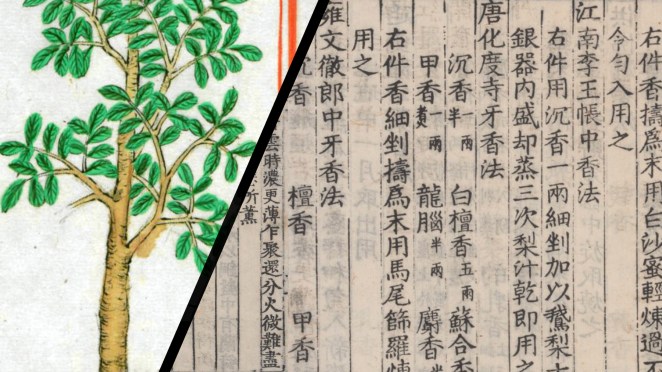
If we examine the Classified Essentials of Materia Medica (Bencao pinhui jingyao 本草品彙精要) from 1503 we find a pair of illustrations for the frankincense tree, one showing Xunlu Aromatic (on the left), the other showing Milky Aromatic (on the right). While the later shows clumps of resin forming on the bark (in uncharacteristic lime green), the former unexpectedly shows a collector digging into the ground around the base of the tree. Presumably, this was necessary when frankincense resin dripped from the bark wound on to the ground. The golden resin can be seen in the collection basket.
It is often claimed frankincense was used in pharaonic Egypt, but precise dating for its importation into Upper Egypt remains unclear. For example, there is a famous series of reliefs in the temple at Deir al-Bahri near Thebes which describe an expedition sent around 1500 BCE by Hatshepsut (r. 1481–1472 BCE) that crossed land and sea. The expedition to the unidentified land known as Punt returned with live trees preserved in pots as depicted in the reliefs. Moreover, it is noted the trees were used as fragrant ointment. Scholarly discussions over the depictions and associated terminology have not determined if these trees were Boswellia or a type of myrrh tree (or something else). Regardless of the famed Punt expedition, evidence suggests the Incense Route from southern Arabia commenced around the end of the eighth century BCE, supported by massive camel caravans. Herodotus speaks of Arabian frankincense in the mid-fifth century BCE as does Theophrastus in the third century BCE. The first century Periplus Maris Erythraei gives detailed accounts of both Arabian and Somali frankincense and notes that the fragrant resin is delivered into Indian ports. The history of frankincense in India, either imported or indigenous, is hampered by issues of terminology. Kunduru/kundurūka, śallakī/sallakī, and turuṣka are all treated as possible words for frankincense, among others. If we look towards the surviving Chinese translations of Indic Buddhist scriptures, we find the use of Xunlu Aromatic to translate (presumably) kundurūka at the end of the third century.
* The map is intended as a general heuristic for distribution and range, it ireflects selected data from modern scientific research and descriptions from medieval Chinese materia medica and gazetteers
For further information and additional references, see: Peter M. Romaskiewicz, “Sacred Smells and Strange Scents: Olfactory Imagination in Medieval Chinese Religions.” Ph.D. dissertation, University of California, Santa Barbara, 2022.
Arguably, the most famous singular piece of aloeswood in the world is held by the Shōsō-in 正倉院, the imperial Japanese treasury located at the famed Buddhist temple Tōdai-ji 東大寺 in Nara. This golden-colored piece of resinous wood with dark exterior is 1.56 meters long and weights 11.6 kilograms. Historically in Japan, unique fragrant materials categorized as meikō 名香, “famous aromatics,” were bestowed distinctive names. It is therefore commonly believed that upon entry into the Shōsō-in this piece of aloeswood was adorned with the name ranjatai 蘭奢待.
The ranjatai is sometimes praised in Japanese as the “World’s Most Famous Aromatic.” This is despite the fact this aromatic wood is rarely shown to the public and has an obscure history dressed in popular lore.
Part of the lasting interest in the ranjatai stems from its curious name. The word ranjatai inconspicuously hides the name of Tōdai-ji within its graphs (see above). One circulating story claims it would have been inauspicious to borrow the name of a prominent Buddhist monastery for naming a piece wood that would be burned as incense. Thus, using the characters for ranjatai was viewed as an elegant solution to honor the temple’s name while not indirectly threatening its safety.
Materially, the ranjatai is a large piece of aloeswood. Aloeswood is one of the most expensive materials by weight with higher quality pieces worth more than gold. This cost is directly related to its rarity. Aloeswood is a fragrant resin-infused wood that forms in several species of the Aquilaria tree growing across the tropical regions of southeast Asia. This fragrant material is only formed under certain conditions, typically when the tree is stressed by environmental, biotic, or abiotic factors. Consequently, not all Aquilaria trees contain aloeswood, making it among the most rare commodities for incense and perfume blending. (For more on aloeswood in medieval China, read this post.)
According to one of the more prominent stories circulating, this large piece of aloeswood was originally in possession of Emperor Shōmu 聖武 (r. 724–748) who received it as tribute from China. Accordingly, some believe the ranjatai was donated by Empress Kōmyō (701–760) upon the death of the abdicated emperor in 756. The many donations given by the empress form the foundation of Shōsō-in’s collection today. A more nuanced take claims that during a state protection ritual at Tōdai-ji in 753 the ranjatai may have been gifted as an act of pious generosity. Proponents point out this practice was documented for another rare piece of aloeswood held by the treasury. A related circulating story claims the ranjatai was originally in the possession of Empress Suiko 推古 (554–628) after the wood drifted ashore in 595. This appears to be a further elaboration of a story contained the Chronicles of Japan (Nihon shoki 日本書紀) where a piece of aloeswood, found by locals along the beach of Awaji Island, was gifted to the Empress. This story is often treated as the origin of incense in Japan. It should be noted this story is sometimes associated with a different famous aromatic once known as the taishi 太子 in possession of Hōryū-ji 法隆寺.
Such incongruity in origin stories not only underscores the importance of the ranjatai, but further preserves it as a topic of debate and conversation among the public. The history of the ranjatai is perhaps most embellished by the fact that a few of the most politically important figures in Japanese history have reputedly cut off small portions for their personal use. This includes shōgun Ashikaga Yoshimasa 足利義政 (1436–1490), daimyō Oda Nobunaga 織田信長 (1534–1582), and Emperor Meiji 明治天皇 (1852–1912). For example, imperial records from 1877 note that when Emperor Meiji burned a small piece, “fragrant smoke filled the palace.” In these scenarios, having access to the imperial storehouse, especially for those who did not sit on the Chrysanthemum throne, was viewed as a sign of true political power.
There have been few attempts in the modern era to capture the likeness of the ranjatai. The first record comes to use from when the treasury was opened in 1693 for repairs. During the summer, the chief priest of Tōdai-ji moved all of the objects to the upper level during renovations and ordered illustrations prepared for some of the artifacts. The original illustrated manuscript no longer exists, but several copies were made and circulated under the name illustrations of Shōsō-in Imperial Treasures (Shōsōin gohōmotsu zu 正倉院御寶物之圖) through the Edo period (1603–1868). In most cases the first illustration in the book depicts the ranjatai, such as we find in a copy held by Kyoto University (below).
Five years before Emperor Meiji took a small piece of the famed aloeswood, survey teams were sent out around Japan to record objects and artifacts that had historical and cultural importance. Some of the items in the Shōsō-in were photographed over the course of twelve days in the summer of 1872, including the ranjatai. Looking closely at the photograph taken during that survey (below) we can see a small rectangular section had previously been cut away on the hollowed-out end. In comparison to the modern photo above, we can also see where Emperor Meiji would soon cut off a 8.9 gram piece from the narrower end. The Meiji-era label confirms this was the case.
It was not until after World War II that modern scientific studies were undertaken on various artifacts from the imperial treasury, in part for material identification, but also for the sake of preservation. Wada Gun’ichi 和田軍一 (b. 1896–?), director of the Shōsō-in, was among the first in charge for overseeing these matters and he took a special interest in the famous aloeswood piece. After scouring numerous Shōsō-in documents he found no evidence supporting the ranjatai’s presumed benefaction in the eighth century. The oldest document possibly bearing witness to the aloeswood comes only in 1193 (Kenkyū 4), where it might appear under the name ōjukukō 黄熟香.
This corresponds in part to what we know about the history and evolution of kōdō 香道, “the way of incense,” in Japan. It was only during the Muromachi period (1336-1573) that distinctive names were given to famous pieces of aromatics; this did not yet occur in the eighth century. We have evidence of this naming practice growing through the Edo period until a list of sixty-one different “famous aromatics” was developed under the auspices of perfume and incense aficionados (although different enumerations exist). As a sign of prestige, it is typical for kōdō practitioners to place Tōdai-ji’s ranjatai at the head of such listings.
Nevertheless, it remains unknown who donated the ranjatai or when it arrived at the Shōsō-in, although scholars have offered several different speculations. Moreover, precisely when the fragrant wood received its “honorific name” of ranjatai is also in dispute.
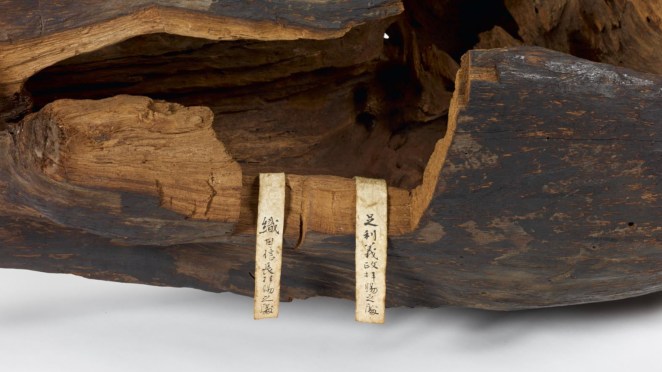
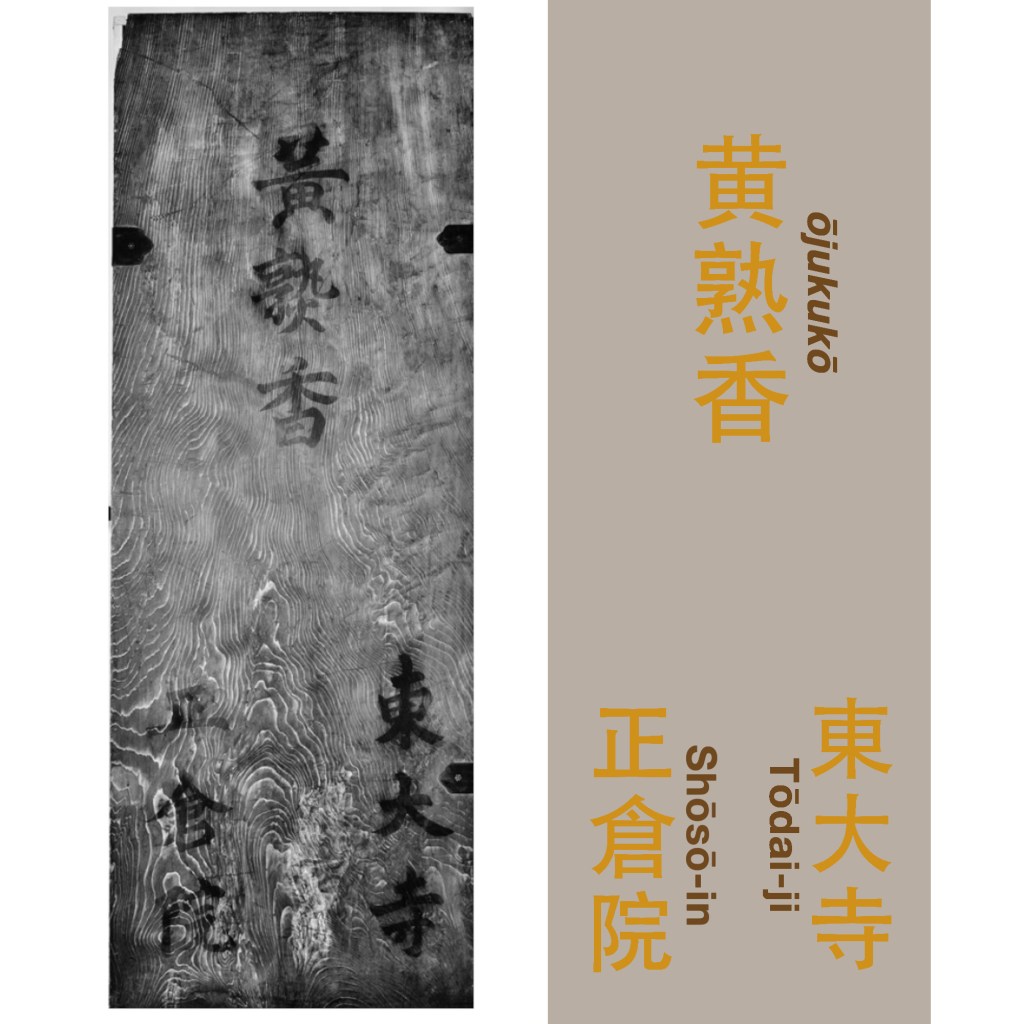
The Shōsō-in continues to officially catalogue the famous artifact under ōjukukō despite the widespread use of ranjatai in popular media. This former name can be seen, for example, in the copy of the 1693 illustrated shown above. Ranjatai, in smaller calligraphy, is listed as an “alternate name.” Ōkukukō is also written on the lid of the storage crate (below) were the famous piece of aloeswood is kept. It is believed this crate was also made in 1693 when the imperial treasures were inspected.
More recently, Yoneda Keisuke 米田該典 has performed a scientific analysis on the ranjatai to determine its botanical and graphic origins. Based on its chemical composition and comparison to chemical signatures of collected aloeswood samples, Yoneda concluded the Shōsō-in specimen originated from Aquilaria trees in Vietnam or Laos. This is a region closely associated with fine quality aloeswood since the third century in China.
Since 1946 various items from the Shōsō-in treasury are put on display each fall in the ancient capital of Nara. Many items are only available to be viewed by the public during these annual exhibitions. During the second exhibition in 1947 the ranjatai was selected for display. It was not displayed again until 1982, then again in 1997 and 2011. It was most recently displayed during the 72nd Annual Shōsō-in Exhibition in 2020. In addition, when Emperor Hirohito was enthroned in 2019, the ranjatai was put on special display in Tokyo for the occasion.
Like a scared relic only viewable to the few, these events further deepen the allure of the ranjatai, adding more layers to its already complex mythos.
External Links & Image Sources
Ōjukukō (Ranjantai) in the Illustrations of Shōsō-in Imperial Treasures (Shōsōin gohōmotsu zu 正倉院御寶物之圖) held by Kyoto University [here]
Ōjukukō (Ranjantai) at Shōsō-in’s Digital Repository [here]
Ranjatai photograph from 1872 Jinshi Survey of cultural assets [here]
Selected References
Hamasaki Kanako 濱崎加奈子. 2017. Kōdō no bigaku: Sono seiritsu to ōken renga 香道の美学: その成立と王権・連歌. Kyoto: Shibunkaku shippan 思文閣出版.
For further information and additional references, see: Peter M. Romaskiewicz, “Sacred Smells and Strange Scents: Olfactory Imagination in Medieval Chinese Religions.” Ph.D. dissertation, University of California, Santa Barbara, 2022.



















































 Personal Site of Peter Romaskiewicz