For all the new Buddhas in the West posts follow us on Bluesky & Instagram
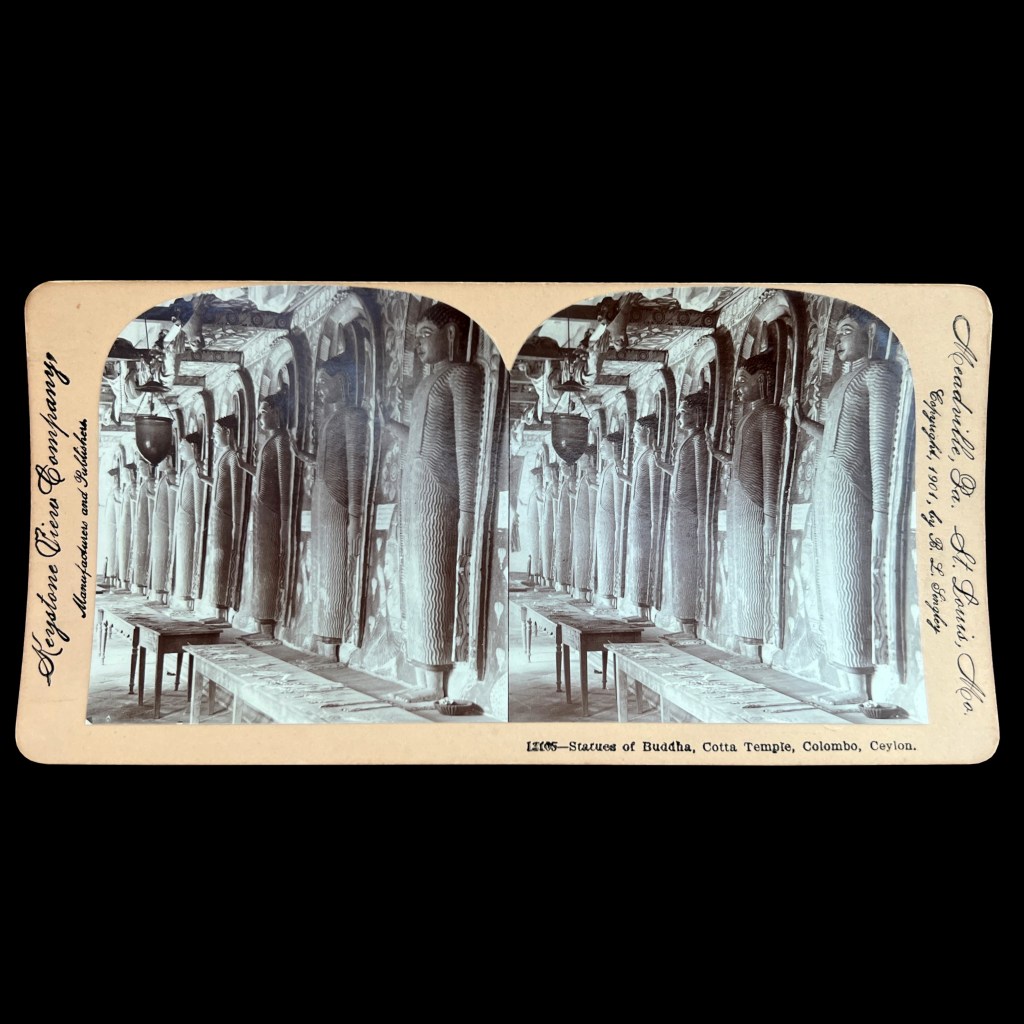
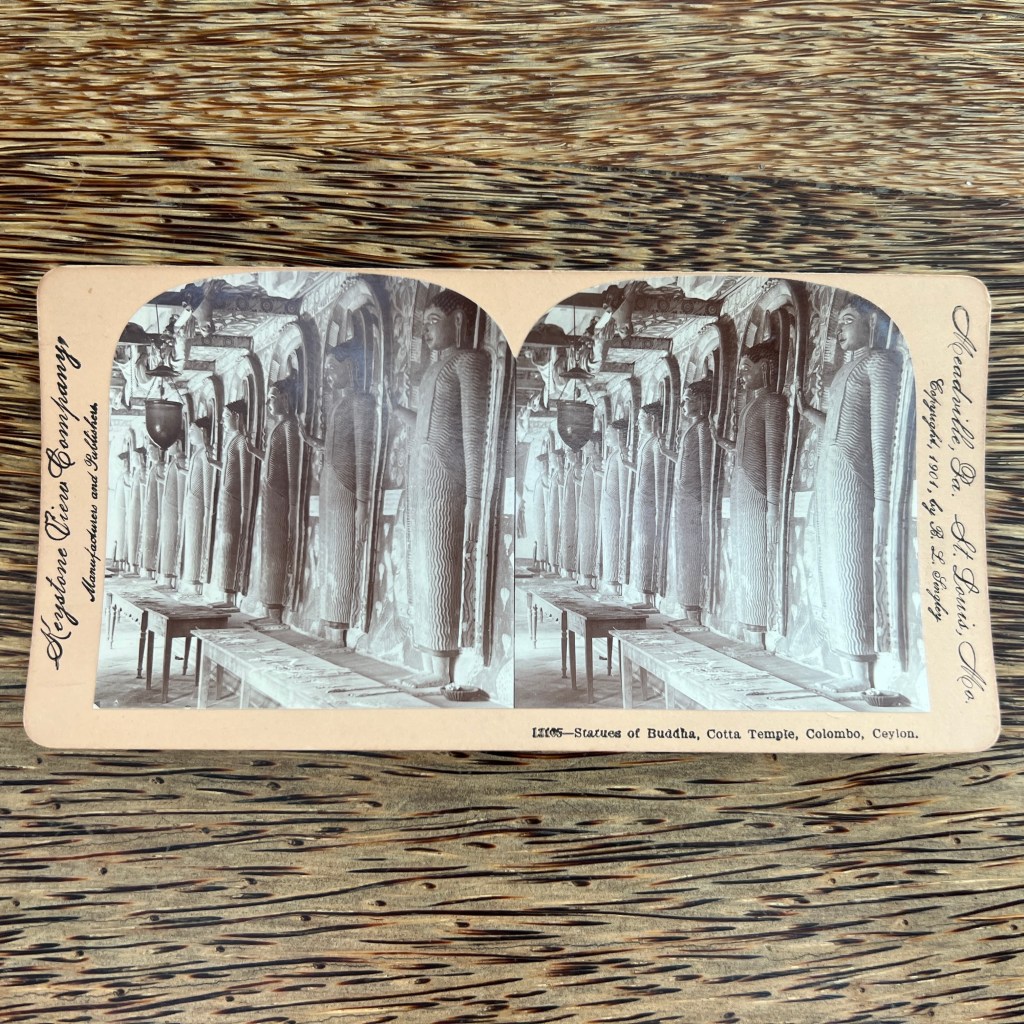
The Kotte Rajamaha Vihara was founded in the 15th century under royal patronage to house a sacred tooth relic of the Buddha. At the time, some considered this the holiest site in Sri Lanka, greater than Aśoka’s Bodhi tree in Anuradhapura and the Buddha’s footprint on Adam’s Peak.
The Cūḷavaṃsa, a Buddhist historical record, describes King Parākramabāhu’s construction of a golden reliquary for the tooth and annual festivals held in celebration. Unfortunately, Kotte temple was destroyed during the Dutch occupation of Sri Lanka, but was rebuilt in the early 19th century.
Marketed as education material, the information on the back of this stereoview offers a few generic facts about Buddhism. The unknown author also offers pointed criticism, calling the statues on the front “rigid” and chastising Buddhists for being “practically idolatrous.”
This stereophotograph was taken in 1900/01 and was incorporated into a 30-view set devoted to Ceylon. While the copyright is granted to B.L. Singley, the president of Keystone, this photo was taken by one of several unknown staff photographers scattered over the world.
According to lore, the tooth relic was removed from Kotte about a century after its enshrinement to save it from Portuguese looters. For further history on the tooth relic, see John Strong’s The Buddha’s Tooth: Western Tales of a Sri Lankan Relic (2021).
The Buddhas in the West Material Archive is a digital scholarship project that catalogues artifacts depicting Buddhist material culture for Western audiences. It’s comprised of prints, photos, and an assortment of ephemera and other objects. For a brief introduction to this archive, visit the main Buddhas in the West project page.
For Related Buddhas in the West Posts Featuring Sri Lanke / Ceylon:
The Keystone View Company dominated the stereoview market after acquiring the negative stocks of H.C. White in 1915 and Underwood & Underwood in 1921, effectively making them the last major publisher of this once immensely popular form of home entertainment and education.[1] Even though the development of “nickelodeons” and larger cinematic theaters would become the preferred form of “virtual travel” for most Americans through the early twentieth century, Keystone remained in operation through the 1970’s, long after the business’s highest commercial success.[2] Keystone had long emphasized the educational virtues of their products, regularly imprinting detailed descriptions on the reverse of their mounts or offering booklets with narrative accounts as accompaniments to their larger sets. In the 1920’s Keystone started offering massive 400 and 600 “World Tour” sets, both of which contained older images of late Meiji-era Japan, photographed between approximately 1896 and 1906. In 1935/6, Keystone unveiled its most audacious product to date, a monumental 1200-view “Tour of the World” set, weighing around 70 pounds with all of its cards and accoutrements. This Keystone set was the first to incorporate newly photographed images of Japan in two decades, all taken by an unknown photographer.
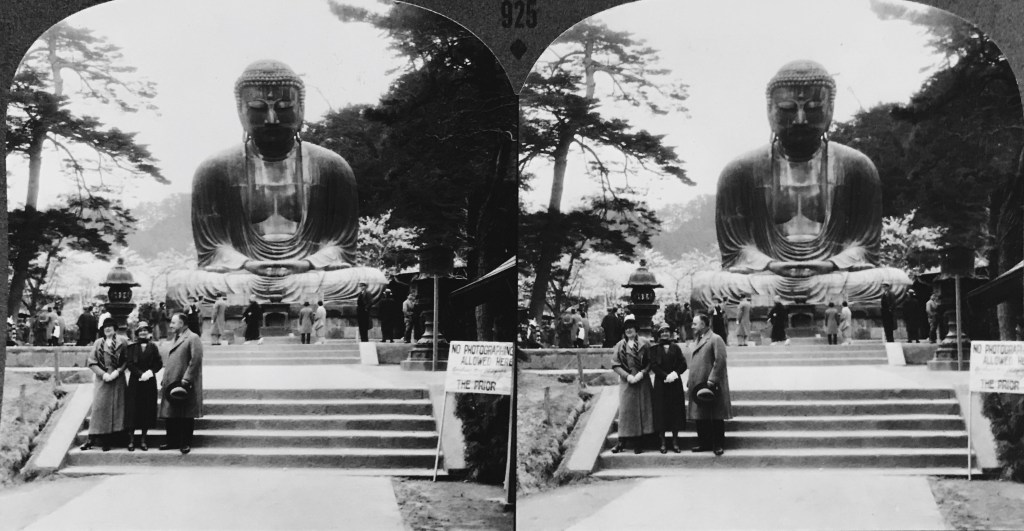
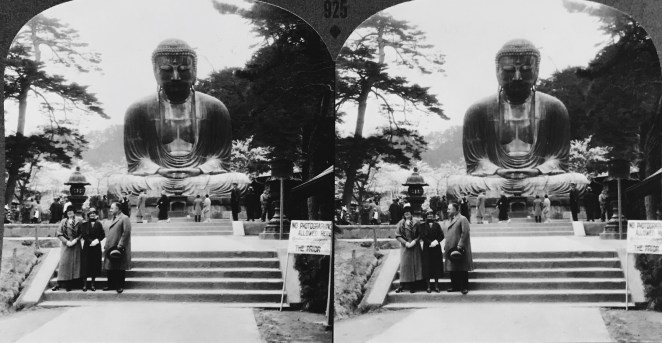
Title/Caption: The Colossal Daibutsu in Cherry-Blossom Time – the Great Buddha of Kamakura, Japan
Year: 1935-6
Photographer: unknown
Publisher: Keystone View Company (#925 out of 1200 card “Tour of the World” set)
Medium: sliver gelatin print; mounted on curved card
Dimensions: 7 in X 3.5 in
This final Keystone view of the Daibutsu would emerge as its most famous. Leering in from the right side of the photograph is a white hand-painted sign plainly stating, “No Photographing Allowed Here.”[3] By photographing this sign, our unknown photographer lays bare the long-standing tensions between tourists and the temple. For many travelers, the only reason to visit the Kamakura colossus was precisely to have their image taken, sometimes perched in his lap, as a sign of their conquest of the Orient. The infrequent, intrepid Yokohama globetrotter of the 1860’s had ballooned into the large-scale tourist excursion parties of the early 1900’s, promoted by a thriving tourism industry. By the 1930’s, the temple had decades-old regulations limiting amateur photography, and several Western travelogues describe the difficulty in procuring a good image of the Daibutsu, sometimes needing to distract the temple priest in order to surreptitiously take a quick photograph.
With the rules not permitting closer access with camera equipment, this late-issue Keystone image frames the Great Buddha at a greater distance than most stereoviews. Visual attention is directed to the foreground where three Western tourists stand with their backs towards the Daibutsu. With two women posed formally and a man holding his hat looking to the side, a crowd of Westerners is also seen touring the grounds behind them. A single Buddhist priest can be found strolling among the onlookers. The Daibutsu functions as a backdrop to the visual narrative centering on the three tourists. The statue efficiently signals the Otherness that envelopes the tourists throughout their foreign adventures. While many facets of their trip are the same as home, some things are wildly out of step with their norm and those are precisely the things that need to be seen. This photographic souvenir proves their success in capturing the exotic Other. Unlike the numerous stereoviews published previously, little visual focus is placed on the activities of the native Japanese; the sole priest walks casually, unaffected by the religious icon. The caption, too, supports a focus on tourist activities, noting this visit took place during “Cherry-Blossom Time,” a period optimal for camaraderie, sightseeing, and picture taking.
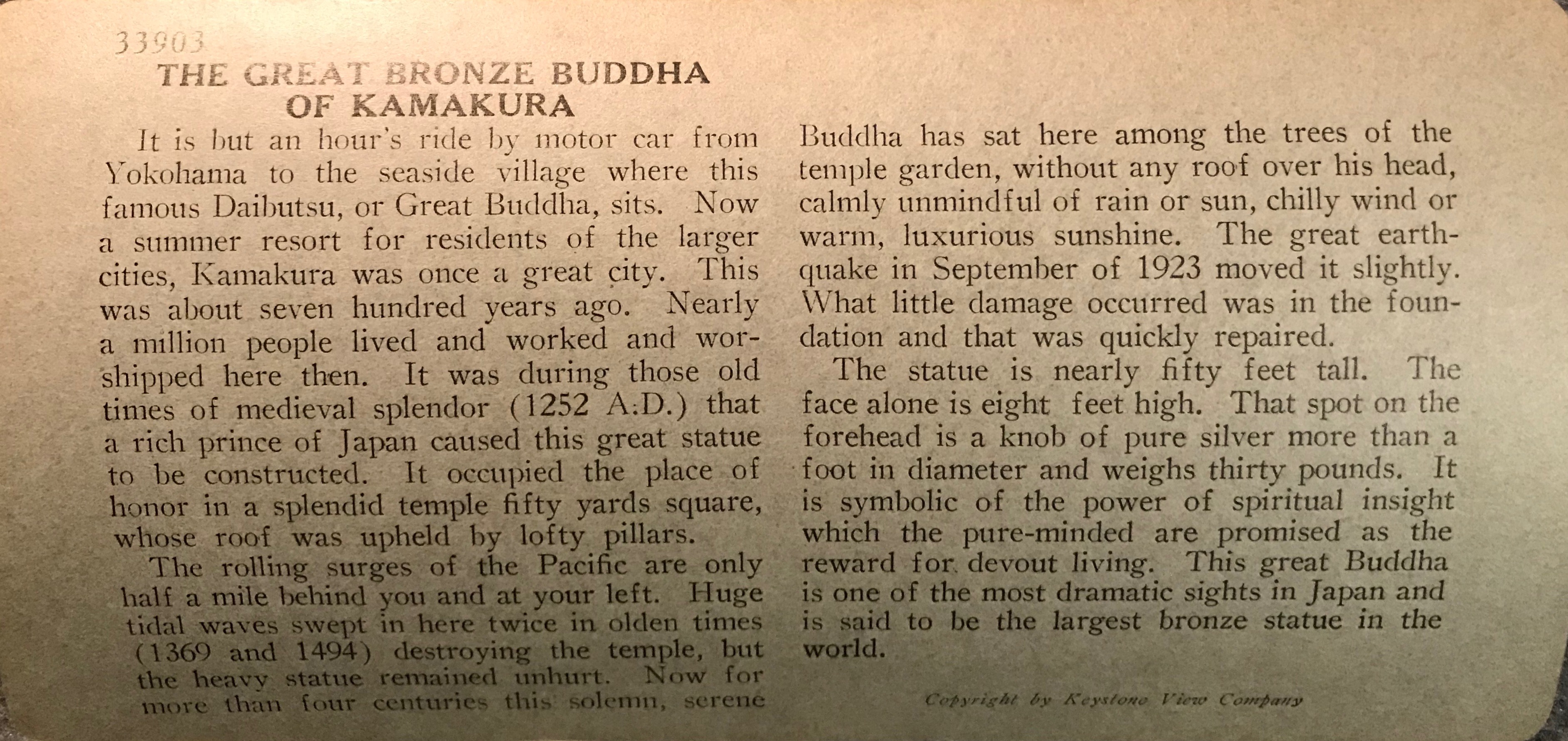
The description on the mount’s reverse cribs from the older Underwood & Underwood card, updating the preferred mode of transportation from rail to “motor car” and mentioning the Greant Kantō earthquake of 1923. Harkening back to the magnificent past of Kamakura and noting the immense dimensions of the Daibutsu, the reader is afforded the necessary contextualizing elements that make the “virtual tour” even more realistic. The last sentence dramatically underscores the appeal of the location, almost as if a pitch delivered in a travel magazine or tourist brochure: “This great Buddha is one of the most dramatic sights in Japan and is said to be the largest bronze statue in the world.” This fact would be all the more apparent for the numerous tourists who made the trip, both virtually and in real life.
Notes
*This is part of a series of posts devoted to exploring the development of a visual literacy for Buddhist imagery in America. All items (except otherwise noted) are part of my personal collection of Buddhist-themed ephemera.
[1] For more detailed information on the Keystone Company, see Bennett 2006.
[2] Although many images were looted in the intervening years, the remaining Keystone stock was donated to the California Museum of Photography, at the University of California, Riverside, and catalogued as the Keystone-Mast Collection. The contact print of the above stereoview is identified as 1996.0009.33903.SS.
[3] Based on the original negative from the Keystone-Mast Collection, the entirety of the sign reads, “No Photographing Allowed Here. Amateurs may Photograph from positions reserved for them. The Prior.”
References
Bennett, Terry. 2006. Old Japanese Photographs Collector’s Data Guide. London: Bernard Quaritch Ltd.
Additional Posts in Visual Literacy of Buddhism Series
Throughout the 1890’s the Keystone View Company, founded in Pennsylvania by Benneville Lloyd Singley (1864-1938), produced a steady stream of stereoviews, but nothing in comparison to its prodigious output in the coming decades.[1] Around 1901, Keystone issued its first images of Japan, a run of 23 odd-lot stereoviews taken by an unknown photographer. Even though Singley’s name is imprinted on the mounts as copyright holder, he is not believed to be the photographer of the small series of Japan views. The publishing and distributing arm of Keyston in London, operating under the name of Fine Art Photographer’s Publishing Company, also issued the same Japan series on a buff-tan colored mounts through 1905. In response to the popularity of the boxed sets dedicated to Japan offered by competitors C.H. Graves, H.C. White, and the Underwoods, Keystone debuted its own “Tour of Japan” sets in 1906, comprised of the original 23 views supplemented by new images taken during the Russo-Japan War of 1904-5. Even though Keystone was relatively late to the Japan-view market, by 1921 it had acquired the negative stocks of all its main competitors, and it emerged as the sole prolific publisher of Japan-view box sets, mostly drawing upon its massive portfolio of images taken more than a decade earlier, between 1896 and 1906.
Title/Caption: “Daibutsu” – The Colossal Bronze Statue of Buddha, Kamakura, Japan.
Year: c. 1906
Photographer: unknown
Publisher: Keystone View Company, Benneville Lloyd Singley (1864-1938)(#61 out of 72/100?)
Medium: sliver gelatin print; mounted on curved slate-colored card
Dimensions: 7 in X 3.5 in
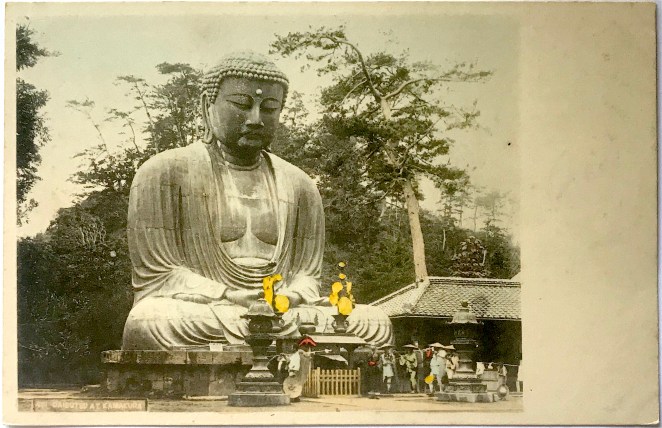
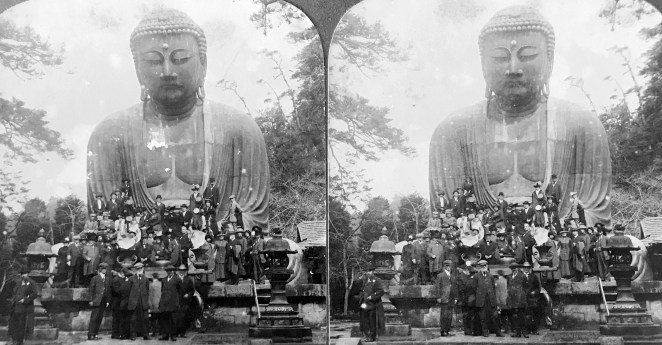
In the first Keystone release of the bronze colossus, the Daibutsu dominates the image. The top of its head is clipped by the frame, giving the impression that the statue it too large to behold.[2] Similar to the Strohmeyer image, our anonymous photographer places two well-groomed Japanese women in the foreground, cropped at the feet and waist, providing a sense of scale for the towering statue. Wearing lushly patterned garments and coiffured hair, the women appear more cosmopolitan than their rustic setting might suggest and their conspicuous presence hints at the hypersexual motifs flowing through Orientalist discourse. The formality of the composition is offset by two elements; the presence of a dog looking back at the viewer, and the positioning of a child on the far left, gazing towards the dog. These mundane elements clash with the distinctive, orchestrated dress of the women and overall diminish the sense that viewer is looking at a scene of pious activity. By virtue of its sheer size occupying most of the frame, the Daibutsu is given the most visual weight, and consequently the onlookers are relegated to secondary importance. Noting its “colossal” size, the caption gives literary form to the numerous visual cues asking the viewer to appreciate the aesthetics of the statue over its religious meaning to the worshipers.
Moreover, the description on the reverse immediately situates the Daibutsu among the greatest works of world art, claiming it is “the masterpiece of Japanese statuary,” and “one of the great art creations of all time.” This is immediately followed by a poetic verse taken from an Alfred Lord Tennyson poem, In Memoriam: “A statue solid-set, and moulded in colossal calm.” Strikingly in line with many contemporary descriptions of the Daibutsu (the original context for the lines, however, is overcoming loss and regret), this quote provides a lyrical force to the aesthetics of the statue. This then dovetails into a gloss description of Buddhism, where another quoted passage describes the beauty and majesty of the Daibutsu as a symbol for the profundity and power of the Buddhist religion as a whole (as was typical, the Daibutsu was mistaken for the historical founder of the tradition). Interestingly, the Tennyson quote and the astute characterization was not pulled from a scholarly reference, but Murray’s “red book” travel guide, authored by no less eminent authority than Basil Hall Chamberlain (1850-1935).[3]
Keystone also issued a tinted glass magic lantern slide of one-half of the stereostopic image. The framing and black masking covers the woman, thus allowing the viewer to focus on the statue, sitting in a light blue tinted sky. At the same time, the sheer “colossal” size of the Daibutsu is also obscured by lack of a reference point. Along with stereoviews, magic lantern slides were a popular form of visual media at the turn of the century and both were packaged as valuable educational materials. First marketed to schools by Underwood & Underwood, Ketsone started their educational department in 1905 and is often considered part of the early visual instruction movement in America. Moreso than the stereograph, the lantern slide was made meaningful through performance, namely the lecture that would often accompany the visual images.[4]
Title/Caption: “Daibutsu” – The Colossal Bronze Statue of Budda [sic], Kamakura Japan.
*This is part of a series of posts devoted to exploring the development of a visual literacy for Buddhist imagery in American mass media. All items are part of my personal collection of American Buddhist ephemera.
[1] For more detailed information on the Keystone Company, see Bennett 2006.
[2] Ponting also regularlyclipped the head of the Daibutsu in framing his shot, though for the different effect of including Japanese worshippers in the foreground.
[3] Chamberlain had significantly enlarged the original edition by Ernest Satow, but only added the Tennyson quote in the 5th edition, published in 1898, see A Handbook for Travellers in Japan, 5th ed., pp. 96-7.
[4] For more on this interesting point see Dellmann, Sarah. “Getting to Know th eDutch: Magic Lantern Slides as Traces of Intermedial Performance Practices,” in Performing New Media: 1895-1915, eds. Kaveh Askari, Scott Curtis, Frank Gray, Louis Pelletier, Tami Williams, and Joshua Yumibe, New Barnet: John Libby Publishing, pp. 236-244.
References
Bennett, Terry. 2006. Old Japanese Photographs Collector’s Data Guide. London: Bernard Quaritch Ltd.






















 Personal Site of Peter Romaskiewicz