Enami’s Dazzling Bronze Buddha Stereoview

The most widely published Meiji era (1868-1912) photographer was undoubtedly Enami Nobukuni 江南信國 (1859—1929), who worked under the professional alias T. Enami.[1] His shop in Yokohama was a few doors down from his legendary competitor and colleague, Tamamura Kōzaburō 玉村康三郎 (b. 1856), who hired Enami to help complete his order of one-million hand colored albumen prints for the multi-volume work Japan: Described and Illustrated by the Japanese, edited by Captain Francis Brinkley. Enami was expertly skilled in working with all of the popular photography formats, including larger-format prints, souvenir albums, portraiture, and glass lantern slides, but his most significant contributions were in the field of stereophotography. In addition to his considerable expertise, Enami fortuitously also worked during the “Golden Age” of Japanese themed stereoviews, roughly corresponding to the first decade of the twentieth century.

While Enami sold stereoviews under his own imprint in Japan, it was American and European publishers who bought the rights to sell his views that popularized Enami’s work abroad. As was standard practice at the time, publishers often omitted the names of photographers on stereocards, and thus even though American audiences may not have been acquainted with Enami’s name, his eloquent aesthetic vision was integral in shaping Western perceptions of Japan. The first major consigner of Enami’s stereoviews was Griffith & Griffith, a firm who first started issuing Enami’s views of Japan as odd-lots in 1900. Five years later, in response to the wildly popular box sets offered by  competitors, H.C. White, C.H. Graves, and the Underwoods, Griffith & Griffith debuted their inaugural 100-view set of Japan, comprised entirely of Enami stock. The set was revised in 1907, adding variant Enami images. In the intervening years since 1900, Enami’s reputation had grown considerably among the largest publishers of stereocards, and his images were being incorporated into sets issued by C.H Graves, Underwood & Underwood, and T.W. Ingersoll. This continued until the market was consolidated under the massive portfolio acquisition by the Keystone View Company, which then continued to publish Enami’s work several decades into the twentieth century.
IMG_E5866.jpg

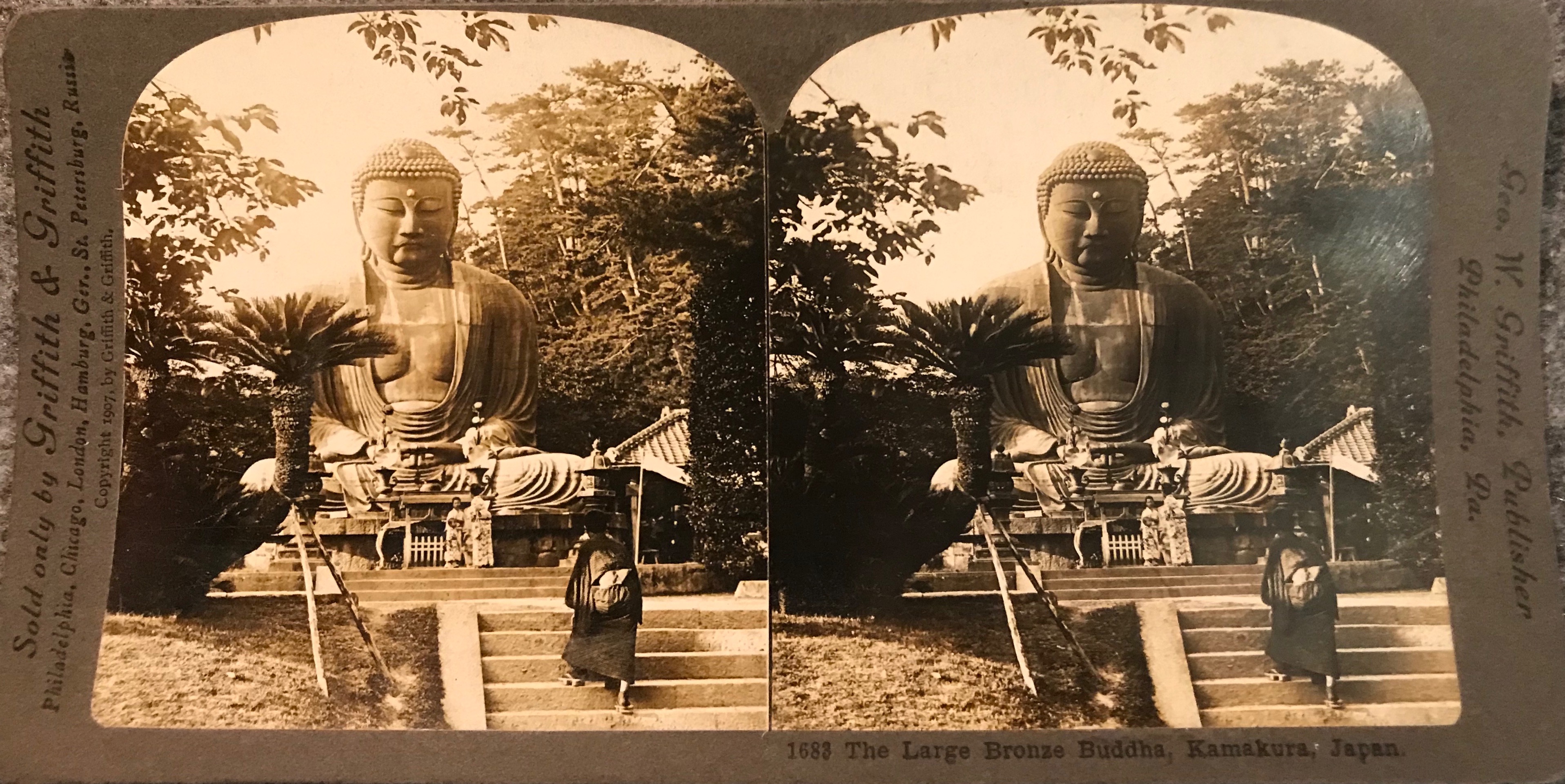
  • Title/Caption: The Large Bronze Buddha, Kamakura, Japan
  • Year: 1907
  • Photographer: Enami Nobukuni 江南信國 (1859-1929)
  • Publisher: Griffith & Griffith
  • Medium: sliver gelatin print; mounted on curved slate-colored card
  • Dimensions: 7 in X 3.5 in

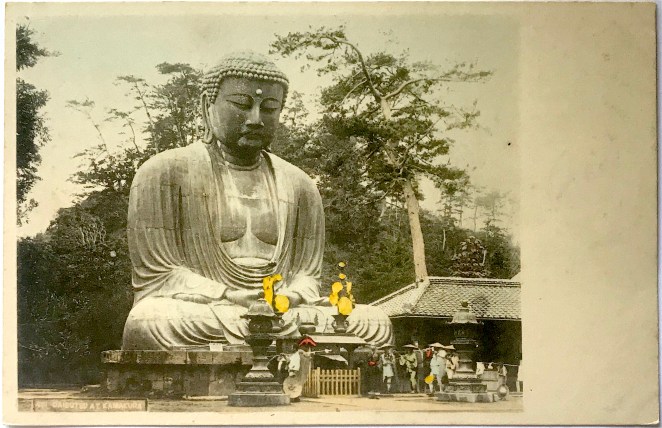
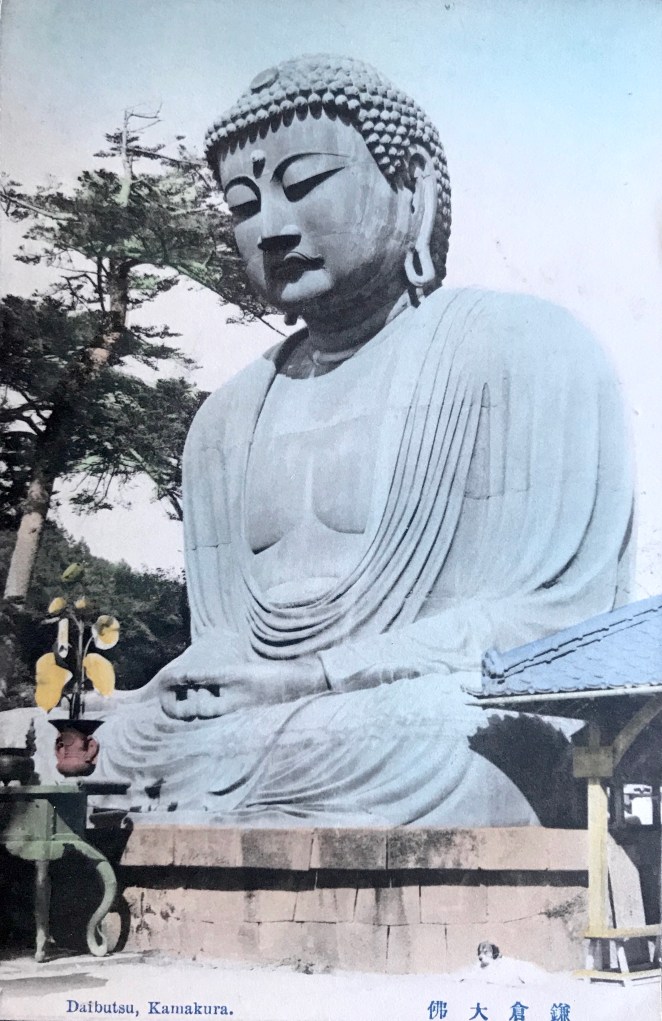
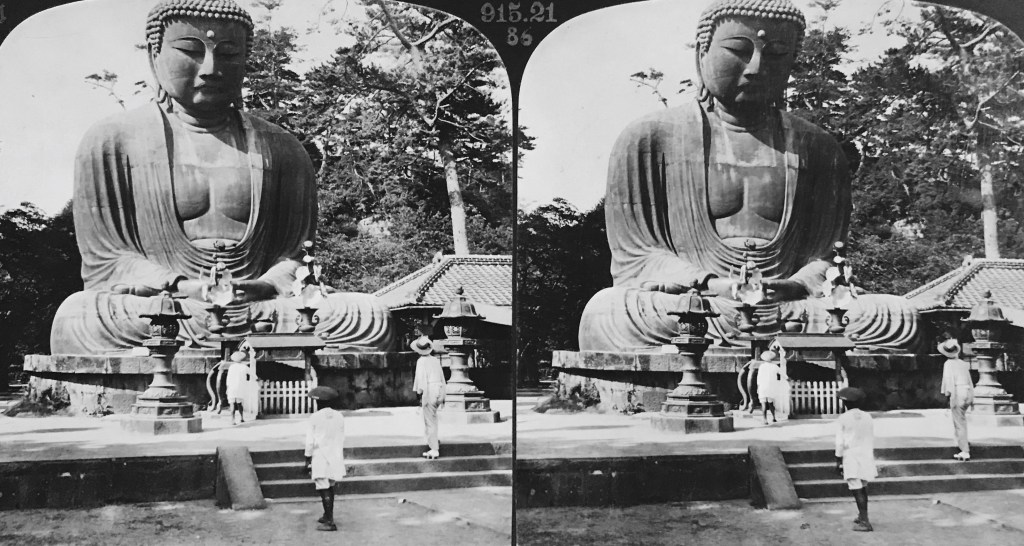
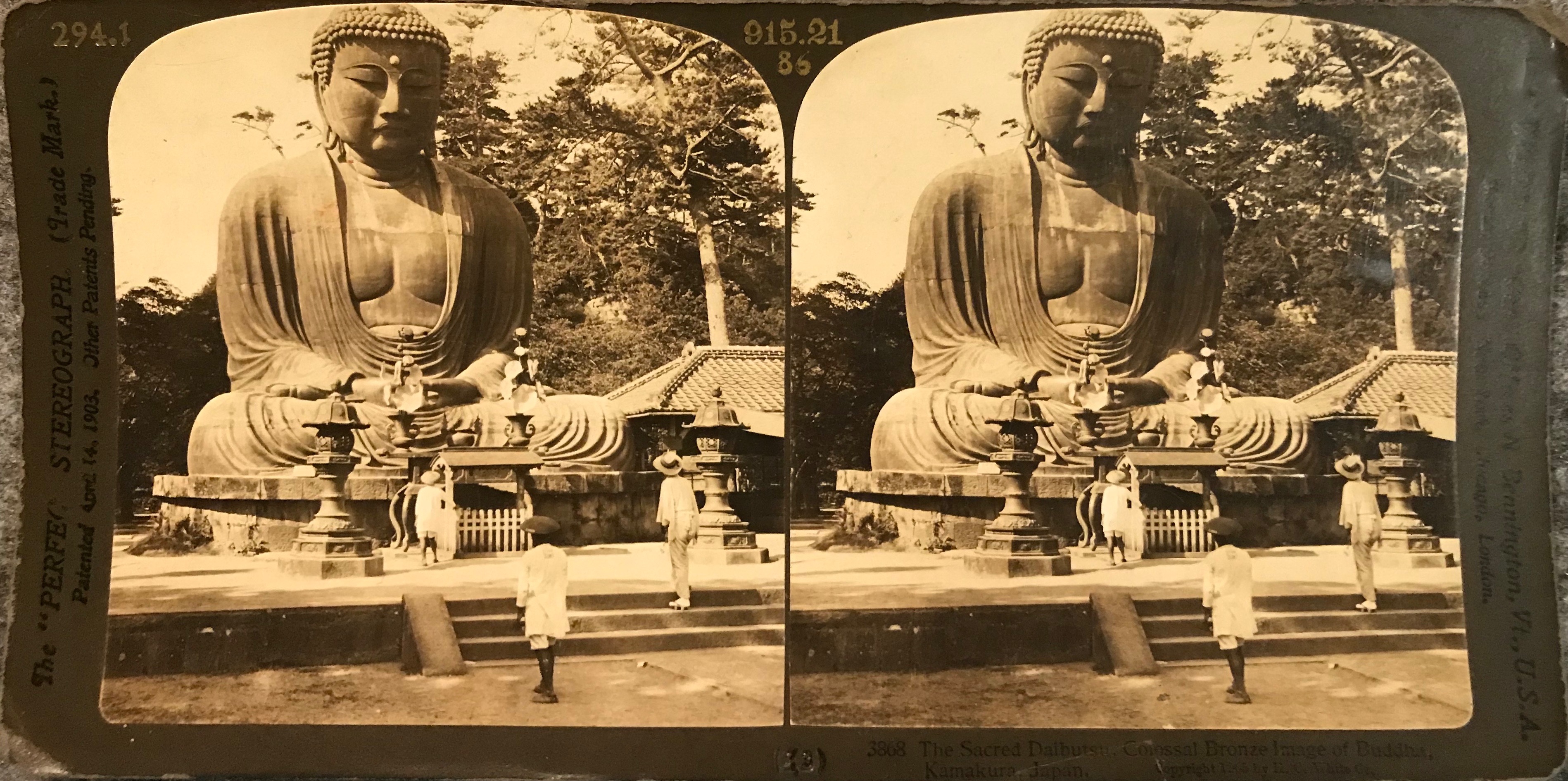
Of the views acquired by Griffith & Griffith, Enami’s treatment of the Daibutsu is among the most stunning. While many collectors consider the images of Herbert George Ponting (1870-1935) to be the pinnacle of Japanese stereophotography (Enami is often considered a close second), it is clear that Ponting took his cues in photographing the Daibutsu from Enami’s masterclass in layering and composition. It appears that most of Griffith’s Enami stock was originally photographed between 1895 and 1900, thus making this image, with the possible exception of Strohmeyer’s 1896 work, among oldest of the major publishers’ views of the Daibutsu [EDIT: It appears this image was taken after 1903]. Yet it also remains the most unique and sophisticated.

Setting his camera on the first landing, the furthest from the statue, Enami is able to visually narrate a story unlike his Western contemporaries. The viewer enters the image through the Japanese man at the lower right, who is photographed mid-stride ascending a small flight of steps. Due to the positioning of his head, the viewer presumes his gaze is directed at the woman and two small children down the pathway in front of him. The two children gaze back at him, creating a strong sense that we are observing a family about to reunite. Alone, this visual narrative is strikingly different from the images produced by Western photographers, who tend to highlight the pious religiosity of the Japanese people or the aesthetic qualities of the Daibutsu. Here the Kamakura statue is simply the location where the family gathers, presumably to pray and ask for blessings. There is no overt signaling of awe-struck piousness or odd bodily positioning rendering the scene unnatural. Furthermore, by placing the dwarf palm in the foreground with the man, partly obscuring the view of the Daibutsu, we are afforded a sense of entering a liminal space, within which we find family, safety, and serenity. There is a technical reason for incorporating these foreground elements as well, they would provide a greater illusion of depth when observed through a stereographic viewer.

In addition, there are also signs that Enami was trying to appeal to a Western clientele, most visibly through the elaborate dress. While operating out of his shop in Yokohama, Enami’s premier customer base were Western globetrotting tourists looking to capture a piece of the exotic orient, most typically through the conspicuous ownership of photography. By dressing his subjects in formal and decorative garments, Enami was still able to signal a sense of the Other so prized in souvenir memorabilia, while not fully embracing a hypersexualized or hyper-religious Oriental discourse.[2]

1921 July "The Geography of Japan" - Weston [National Geographic] p64.jpg

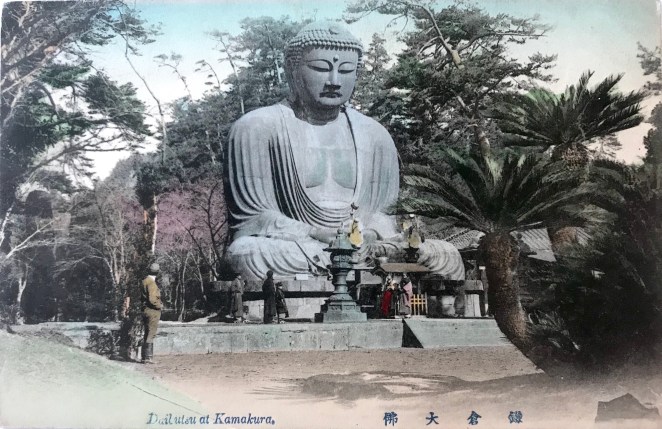
The other valued and incomparable skill of Enami was his ability to beautifully hand-tint his photographs. Japanese assistants had long been assigned hand-coloring tasks in the Western photography studios of Yokohama, and Enami and his workshop produced some of the most meticulous work. A wonderfully colored variant of the Griffith & Griffith view (likely of the “seconds or minutes” variety, meaning both shots were taken in close time proximity of one another) appeared in the pages of National Geographic in July 1921 (pg. 64/pl. IV), showcased along some of the finest journalistic photography of the twentieth century. It is possible the National Geographic variant was originally a stereograph, as Enami regularly used one half of the stereographic negative for his two-dimensional images.

IMG_E5868.jpg

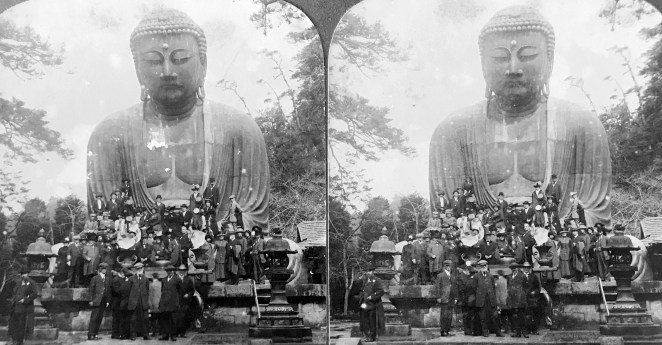
  • Title/Caption: Götzenbild, Japan [“Idolatry, Japan”]
  • Year: (modern reprint of 1912 original)
  • Photographer: Enami Nobukuni 江南信國 (1859-1929)
  • Publisher: Universal Stereoscop Company
  • Medium: (modern reprint on photographic paper)
  • Dimensions: 7 in X 3.5 in

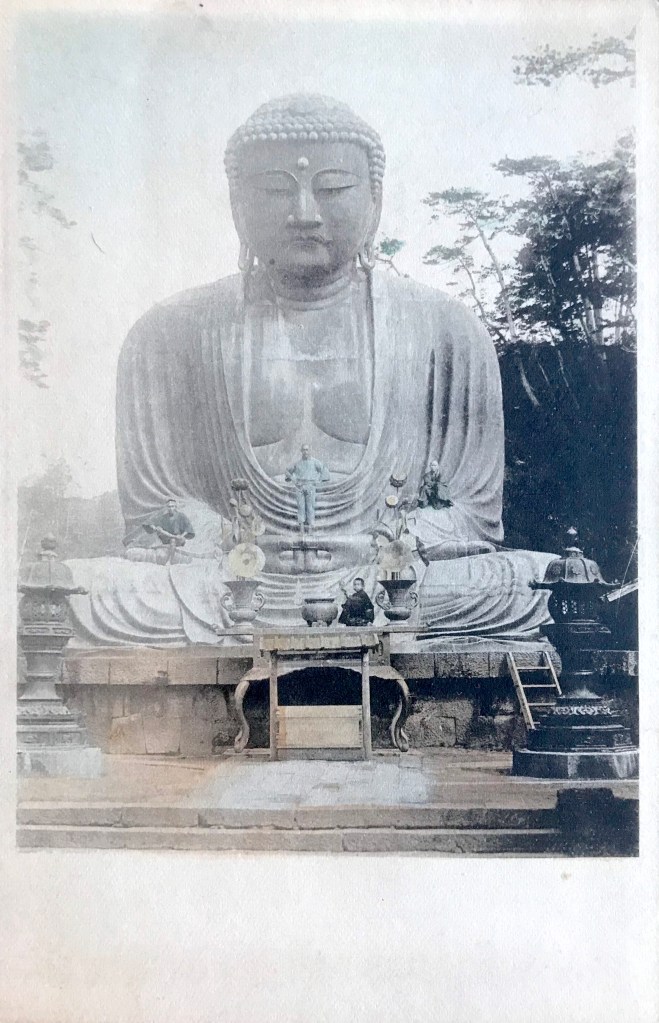
The Central European agency responsible for distributing Griffith & Griffith views was the German firm Nueu Photographische Gesellschaft (NPG), who published a series of 50 Enami views. In 1912, the German publisher Universal Stereoscop Company reissued the NPG stock, adding 50 additional views to make a full 100-view set. Unlike the original production run in the US, Enami’s German images were sold tinted, thus further enhancing the astonishing brilliance of Enami’s work.


Notes

*This is part of a series of posts devoted to exploring the development of a visual literacy for Buddhist imagery in America. All items (except otherwise noted) are part of my personal collection of Buddhist-themed ephemera.

[1] For more detailed information on the surprisingly elusive life of Enami, see Bennett 2006, and especially the sleuthing of Oechsle 2006. Rob Oechsle also runs the excellent site dedicated to Enami’s oeuvre, t-enami.org.

[2] The ability of Asian agents to navigate and sometimes subvert Orientalist discourses have been encapsulated by several theories of resistance, of which John Kuo Wei Tchen’s notion of “commercial Orientalism” is appropriate here, see Tchen 1999.

References

  • Bennett, Terry. 2006. Old Japanese Photographs Collector’s Data Guide. London: Bernard Quaritch Ltd.
  • Oechsle, Rob. 2006. “Searching for T. Enami,” in Old Japanese Photographs Collector’s Data Guide, by Terry Bennett. London: Bernard Quaritch Ltd, pp. 70-8.
  • Tchen, John Kuo Wei. 1999. New York Before Chinatown: Orientalism and the Shaping of American Culture. Baltimore: Johns Hopkins University Press.

Additional Posts in Visual Literacy of Buddhism Series

Keystone’s Tour of the World Stereoview

The Keystone View Company dominated the stereoview market after acquiring the negative stocks of H.C. White in 1915 and Underwood & Underwood in 1921, effectively making them the last major publisher of this once immensely popular form of home entertainment and education.[1] Even though the development of “nickelodeons” and larger cinematic theaters would become the preferred form of “virtual travel” for most Americans through the early twentieth century, Keystone remained in operation through the 1970’s, long after the business’s highest commercial success.[2] Keystone had long emphasized the educational virtues of their products, regularly imprinting detailed descriptions on the reverse of their mounts or offering booklets with narrative accounts as accompaniments to their larger sets. In the 1920’s Keystone started offering massive 400 and 600 “World Tour” sets, both of which contained older images of late Meiji-era Japan, photographed between approximately 1896 and 1906. In 1935/6, Keystone unveiled its most audacious product to date, a monumental 1200-view “Tour of the World” set, weighing around 70 pounds with all of its cards and accoutrements. This Keystone set was the first to incorporate newly photographed images of Japan in two decades, all taken by an unknown photographer.

IMG_E5849.jpg

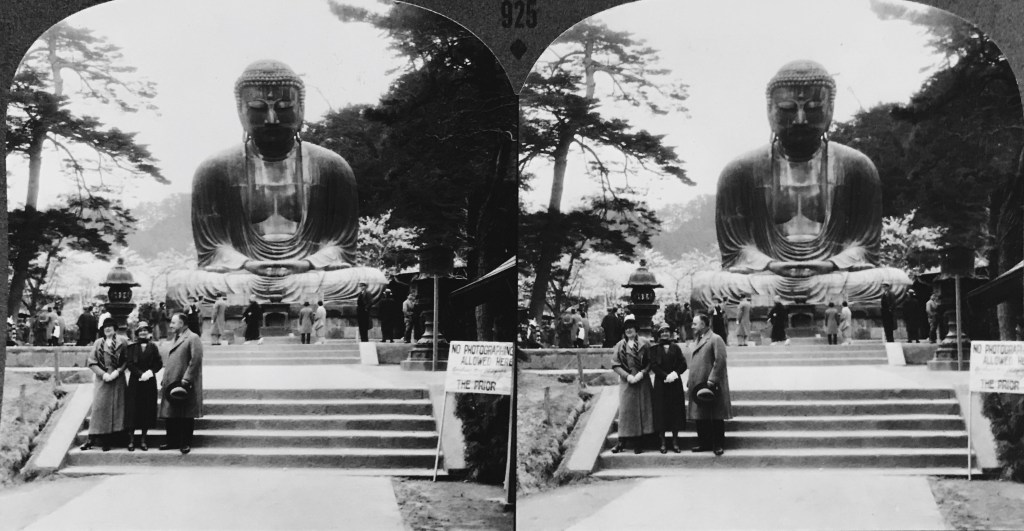
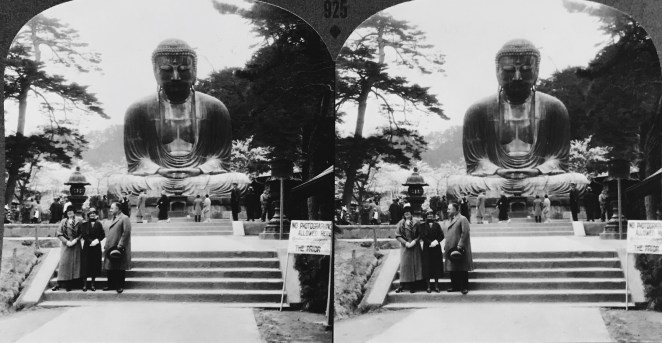
  • Title/Caption: The Colossal Daibutsu in Cherry-Blossom Time – the Great Buddha of Kamakura, Japan
  • Year: 1935-6
  • Photographer: unknown
  • Publisher: Keystone View Company (#925 out of 1200 card “Tour of the World” set)
  • Medium: sliver gelatin print; mounted on curved card
  • Dimensions: 7 in X 3.5 in

This final Keystone view of the Daibutsu would emerge as its most famous. Leering in from the right side of the photograph is a white hand-painted sign plainly stating, “No Photographing Allowed Here.”[3] By photographing this sign, our unknown photographer lays bare the long-standing tensions between tourists and the temple. For many travelers, the only reason to visit the Kamakura colossus was precisely to have their image taken, sometimes perched in his lap, as a sign of their conquest of the Orient. The infrequent, intrepid Yokohama globetrotter of the 1860’s had ballooned into the large-scale tourist excursion parties of the early 1900’s, promoted by a thriving tourism industry. By the 1930’s, the temple had decades-old regulations limiting amateur photography, and several Western travelogues describe the difficulty in procuring a good image of the Daibutsu, sometimes needing to distract the temple priest in order to surreptitiously take a quick photograph.

With the rules not permitting closer access with camera equipment, this late-issue Keystone image frames the Great Buddha at a greater distance than most stereoviews. Visual attention is directed to the foreground where three Western tourists stand with their backs towards the Daibutsu. With two women posed formally and a man holding his hat looking to the side, a crowd of Westerners is also seen touring the grounds behind them. A single Buddhist priest can be found strolling among the onlookers. The Daibutsu functions as a backdrop to the visual narrative centering on the three tourists. The statue efficiently signals the Otherness that envelopes the tourists throughout their foreign adventures. While many facets of their trip are the same as home, some things are wildly out of step with their norm and those are precisely the things that need to be seen. This photographic souvenir proves their success in capturing the exotic Other. Unlike the numerous stereoviews published previously, little visual focus is placed on the activities of the native Japanese; the sole priest walks casually, unaffected by the religious icon. The caption, too, supports a focus on tourist activities, noting this visit took place during “Cherry-Blossom Time,” a period optimal for camaraderie, sightseeing, and picture taking.

IMG_E5857.jpg

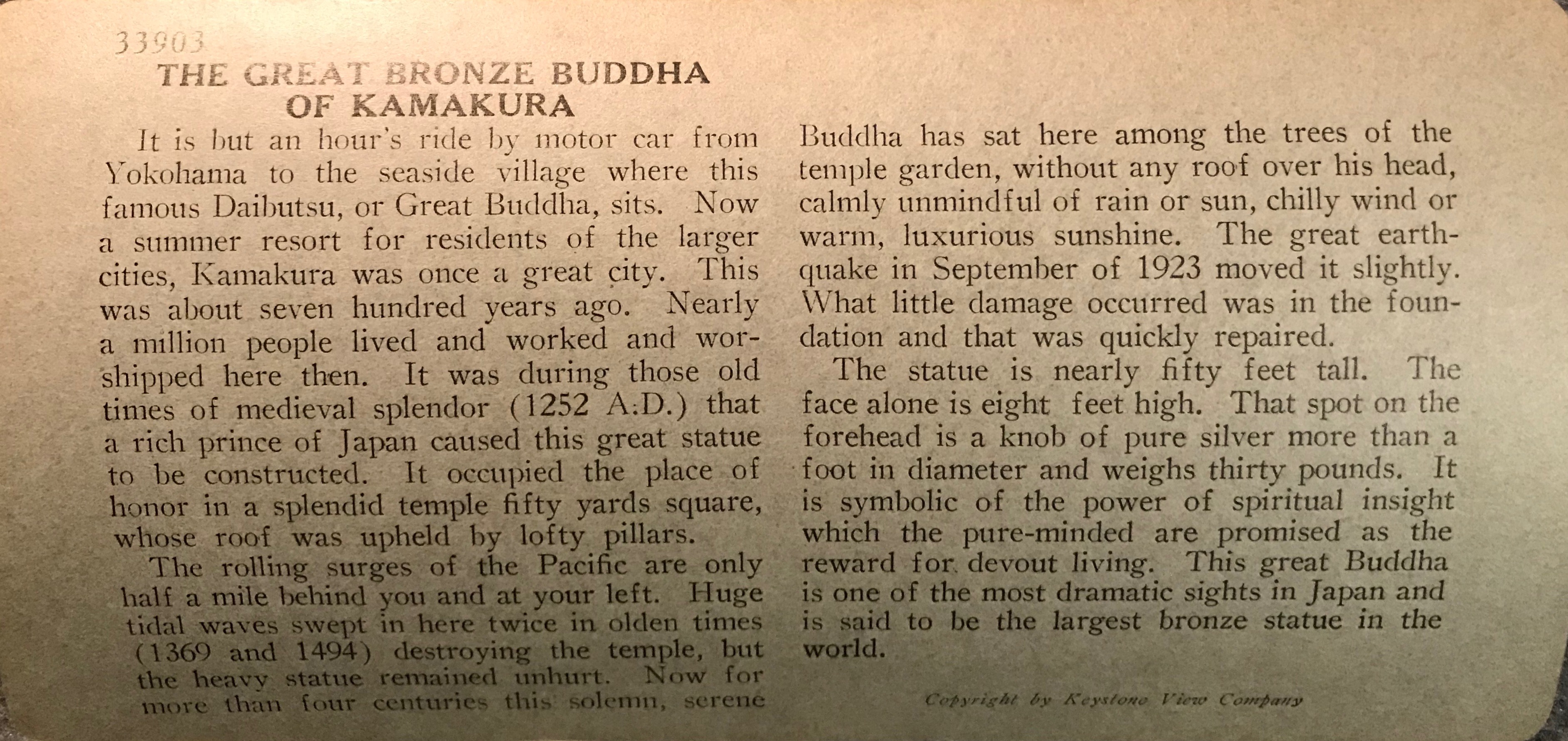
The description on the mount’s reverse cribs from the older Underwood & Underwood card, updating the preferred mode of transportation from rail to “motor car” and mentioning the Greant Kantō earthquake of 1923. Harkening back to the magnificent past of Kamakura and noting the immense dimensions of the Daibutsu, the reader is afforded the necessary contextualizing elements that make the “virtual tour” even more realistic. The last sentence dramatically underscores the appeal of the location, almost as if a pitch delivered in a travel magazine or tourist brochure: “This great Buddha is one of the most dramatic sights in Japan and is said to be the largest bronze statue in the world.” This fact would be all the more apparent for the numerous tourists who made the trip, both virtually and in real life.


Notes

*This is part of a series of posts devoted to exploring the development of a visual literacy for Buddhist imagery in America. All items (except otherwise noted) are part of my personal collection of Buddhist-themed ephemera.

[1] For more detailed information on the Keystone Company, see Bennett 2006.

[2] Although many images were looted in the intervening years, the remaining Keystone stock was donated to the California Museum of Photography, at the University of California, Riverside, and catalogued as the Keystone-Mast Collection. The contact print of the above stereoview is identified as 1996.0009.33903.SS.

[3] Based on the original negative from the Keystone-Mast Collection, the entirety of the sign reads, “No Photographing Allowed Here. Amateurs may Photograph from positions reserved for them. The Prior.”

References

  • Bennett, Terry. 2006. Old Japanese Photographs Collector’s Data Guide. London: Bernard Quaritch Ltd.

Additional Posts in Visual Literacy of Buddhism Series
Keystone’s “Colossal Bronze Statue of Buddha” Stereoview

Throughout the 1890’s the Keystone View Company, founded in Pennsylvania by Benneville Lloyd Singley (1864-1938), produced a steady stream of stereoviews, but nothing in comparison to its prodigious output in the coming decades.[1] Around 1901, Keystone issued its first images of Japan, a run of 23 odd-lot stereoviews taken by an unknown photographer. Even though Singley’s name is imprinted on the mounts as copyright holder, he is not believed to be the photographer of the small series of Japan views. The publishing and distributing arm of Keyston in London, operating under the name of Fine Art Photographer’s Publishing Company, also issued the same Japan series on a buff-tan colored mounts through 1905. In response to the popularity of the boxed sets dedicated to Japan offered by competitors C.H. Graves, H.C. White, and the Underwoods, Keystone debuted its own “Tour of Japan” sets in 1906, comprised of the original 23 views supplemented by new images taken during the Russo-Japan War of 1904-5. Even though Keystone was relatively late to the Japan-view market, by 1921 it had acquired the negative stocks of all its main competitors, and it emerged as the sole prolific publisher of Japan-view box sets, mostly drawing upon its massive portfolio of images taken more than a decade earlier, between 1896 and 1906.

IMG_E5858

  • Title/Caption: “Daibutsu” – The Colossal Bronze Statue of Buddha, Kamakura, Japan.
  • Year: c. 1906
  • Photographer: unknown
  • Publisher: Keystone View Company, Benneville Lloyd Singley (1864-1938)(#61 out of 72/100?)
  • Medium: sliver gelatin print; mounted on curved slate-colored card
  • Dimensions: 7 in X 3.5 in

In the first Keystone release of the bronze colossus, the Daibutsu dominates the image. The top of its head is clipped by the frame, giving the impression that the statue it too large to behold.[2] Similar to the Strohmeyer image, our anonymous photographer places two well-groomed Japanese women in the foreground, cropped at the feet and waist, providing a sense of scale for the towering statue. Wearing lushly patterned garments and coiffured hair, the women appear more cosmopolitan than their rustic setting might suggest and their conspicuous presence hints at the hypersexual motifs flowing through Orientalist discourse. The formality of the composition is offset by two elements; the presence of a dog looking back at the viewer, and the positioning of a child on the far left, gazing towards the dog. These mundane elements clash with the distinctive, orchestrated dress of the women and overall diminish the sense that viewer is looking at a scene of pious activity. By virtue of its sheer size occupying most of the frame, the Daibutsu is given the most visual weight, and consequently the onlookers are relegated to secondary importance. Noting its “colossal” size, the caption gives literary form to the numerous visual cues asking the viewer to appreciate the aesthetics of the statue over its religious meaning to the worshipers.

IMG_5862.jpg

Moreover, the description on the reverse immediately situates the Daibutsu among the greatest works of world art, claiming it is “the masterpiece of Japanese statuary,” and “one of the great art creations of all time.” This is immediately followed by a poetic verse taken from an Alfred Lord Tennyson poem, In Memoriam: “A statue solid-set, and moulded in colossal calm.” Strikingly in line with many contemporary descriptions of the Daibutsu (the original context for the lines, however, is overcoming loss and regret), this quote provides a lyrical force to the aesthetics of the statue. This then dovetails into a gloss description of Buddhism, where another quoted passage describes the beauty and majesty of the Daibutsu as a symbol for the profundity and power of the Buddhist religion as a whole (as was typical, the Daibutsu was mistaken for the historical founder of the tradition). Interestingly, the Tennyson quote and the astute characterization was not pulled from a scholarly reference, but Murray’s “red book” travel guide, authored by no less eminent authority than Basil Hall Chamberlain (1850-1935).[3]

Keystone also issued a tinted glass magic lantern slide of one-half of the stereostopic image. The framing and black masking covers the woman, thus allowing the viewer to focus on the statue, sitting in a light blue tinted sky. At the same time, the sheer “colossal” size of the Daibutsu is also obscured by lack of a reference point. Along with stereoviews, magic lantern slides were a popular form of visual media at the turn of the century and both were packaged as valuable educational materials. First marketed to schools by Underwood & Underwood, Ketsone started their educational department in 1905 and is often considered part of the early visual instruction movement in America. Moreso than the stereograph, the lantern slide was made meaningful through performance, namely the lecture that would often accompany the visual images.[4]

LSKD002k(o).jpg

  • Title/Caption: “Daibutsu” – The Colossal Bronze Statue of Budda [sic], Kamakura Japan.
  • Year: c. 1906
  • Photographer: unknown
  • Publisher: Keystone View Company, Benneville Lloyd Singley (1864-1938)(#14009)
  • Medium: glass and photographic emulsion, paper

Notes

*This is part of a series of posts devoted to exploring the development of a visual literacy for Buddhist imagery in American mass media. All items are part of my personal collection of American Buddhist ephemera.

[1] For more detailed information on the Keystone Company, see Bennett 2006.

[2] Ponting also regularly clipped the head of the Daibutsu in framing his shot, though for the different effect of including Japanese worshippers in the foreground.

[3] Chamberlain had significantly enlarged the original edition by Ernest Satow, but only added the Tennyson quote in the 5th edition, published in 1898, see A Handbook for Travellers in Japan, 5th ed., pp. 96-7.

[4] For more on this interesting point see Dellmann, Sarah. “Getting to Know th eDutch: Magic Lantern Slides as Traces of Intermedial Performance Practices,” in Performing New Media: 1895-1915, eds. Kaveh Askari, Scott Curtis, Frank Gray, Louis Pelletier, Tami Williams, and Joshua Yumibe, New Barnet: John Libby Publishing, pp. 236-244.

References

  • Bennett, Terry. 2006. Old Japanese Photographs Collector’s Data Guide. London: Bernard Quaritch Ltd.
  • Keystone View Company. 1917. Visual Education through Stereographs and Lantern Slides. Keystone View Company Educational department. https://catalog.hathitrust.org/Record/100762862.

Additional Posts in Visual Literacy of Buddhism Series
Ponting and White’s “Sacred Daibitsu” Stereoview

By 1902, the 72-view “Strohmeyer Set” issued by Underwood & Underwood dominated the market of Japanese themed stereoview cards. Hawley C. White (b. 1847?), motivated to transform the stereograph from novelty item to educational tool, worked for three years developing his “White Travel Tours” and issued the first challenge to the Underwood monopoly. White’s “Perfec” Stereograph company would publish its first set of 72-views of Japan in 1902, replacing them with a brand-new series of 100-views in 1905. To procure images for this new 100-view series, White called upon the now-experienced stereo-photographer Herbert George Ponting (1870-1935), who was commissioned by the studios run by H.C. Graves and the Underwoods in the preceding years to produce their catalogues of Japanese stereoviews.[1] This would mark the third trip to Japan for Ponting, who would arrive around the fall of 1904 and photograph through to the summer of 1905. Ponting would return to Japan two more times working for White and would eventually collect the reminiscences of his travels in his 1910 work, In Lotus-Land Japan, profusely illustrated by his own photography.

IMG_E5842.jpg

  • Title/Caption: The Sacred Daibutsu, Colossal Bronze Image of Buddha, Kamakura, Japan
  • Year: 1905
  • Photography:  Herbert George Ponting (1870-1935)
  • Publisher: The “Perfec” Stereograph; Hawley C. White (B. 1847?) (#23 out of 100)
  • Medium: sliver gelatin print; mounted on olive-colored card
  • Dimensions: 7 in X 3.5 in

This commissioned image on olive-colored mount shows the maturation of Ponting’s work over the years. He positions his camera in almost the exact same spot as for his Underwood & Underwood image a year prior, off-center to the left, almost at three-quarters view. The late-day sun hangs low in the sky, illuminating the near side of the Daibutsu’s face. These compositional conventions are also present in the work of Enami Nobukuni 江南信國 (1859-1929), a famed Yokohama photographer and stereographer with whose work Ponting was familiar.[2] Moreover, Ponting seems to have been influenced by Enami’s positioning of people, thinning out the crowd of people present in his Underwood funded excursion to Kamakura. Now, three Japanese men are placed at different depths, each appearing to be in mid-stride as they walk towards the Daibutsu. This creates an effect of motion as the viewer’s eyes are drawn into the mighty bronze statue. By placing these onlookers at different depths, the stereographic effect would also have greater impact, creating a better sense of three-dimensionality and dynamism. While the gaze of the visitors is towards the Daibutsu, the object of reverence, their attitude is more casual. This is in contrast to Ponting’s earliest attempts at creating the mise-en-scène where onlookers were directed to kneel, a transparent attempt to signal piety to the viewer. Even though the men here are not Western tourists, one cannot help think that they may be partaking in an afternoon stroll to see the local attractions. The caption presents a similar ambiguity. Although it qualifies the Daibutus as “sacred,” it does not refer to the nature of the visitors; are they worshippers or local sight-seers? Furthermore, by describing the Daibitsu as a “colossal bronze image,” it underscores its aesthetic dimensions and fine craftsmanship admired by Western sightseers.

IMG_E5847.jpg

The reverse of the card is imprinted with the caption in six different languages (omitting the word “sacred” in all of them, however) and a brief description of the locale. It is written in the style of a guidebook or travelogue, providing distances, historical dates, and some descriptive vocabulary. There is only the briefest passing mention on Buddhist belief, really just noting the “brooding calm” of the Buddha “musing upon Nirvana,” before continuing to describe the dimensions and material composition of the statue. It closes by advising the reader to consult with two books for more information about Japan, namely Edith Singleton’s Japan as Seen and Described by Famous Writers, published in 1905, and Anne C. Hartshorne’s Japan and Her People, published in 1902. Both are dominated by travel writing, and as such only add to the sense that viewing stereocards was presented as a form of virtual travel.


Notes

*This is part of a series of posts devoted to exploring the development of a visual literacy for Buddhist imagery in America. All items (except otherwise noted) are part of my personal collection of Buddhist-themed ephemera.

[1] For more detailed information on Ponting and White, see Bennett 2006.

[2] Ponting’s stereoviews were supplemented by Enami’s own work in both the sets commissioned by C.H. Graves and Underwood & Underwood.

References

  • Bennett, Terry. 2006. Old Japanese Photographs Collector’s Data Guide. London: Bernard Quaritch Ltd.

Additional Posts in Visual Literacy of Buddhism Series
Ponting and Graves’ “Largest Idol in the East” Stereoview

Carlton Harlow Graves (d. 1943?) started the Universal Photo Art Company in the early 1880’s and eventually offered pirated stereoscopic views of Japan in the late 1890s. Looking to enter into the market dominated by Underwood & Underwood’s “Strohmeyer Set,” Graves hired an inexperienced stereo-photographer, Herbert George Ponting (1870-1935), to expand and establish his company’s Japan portfolio.[1] Having only turned a professional photographer a year before, Ponting arrived in Japan around the fall of 1901 and photographed the scenery of Japan into early 1902. This was the first of at least five extended stays over the next five years for Ponting who would go on to work for three different seteroview publishers in his short career. Graves decided to use Ponting’s images as the base for a massive 200-view series on Japan, unprecedented in size given that only 72-view sets of Japan were issued at the time. It would be several years before other publishers would offer anything of a similar scope. This was the first and only time Ponting worked for Graves, but the portfolio of Japanese images Ponting would build over the next few years would increase his reputation significantly, ultimately allowing him to be invited as the official photographer for the ill-fated British Antarctic Expedition of 1910-13. On the eve of leaving for the expedition in 1910, Ponting published his reminiscences of his stays in Japan as In Lotus-Land Japan, profusely illustrated by his own photography.

IMG_E5827.jpg

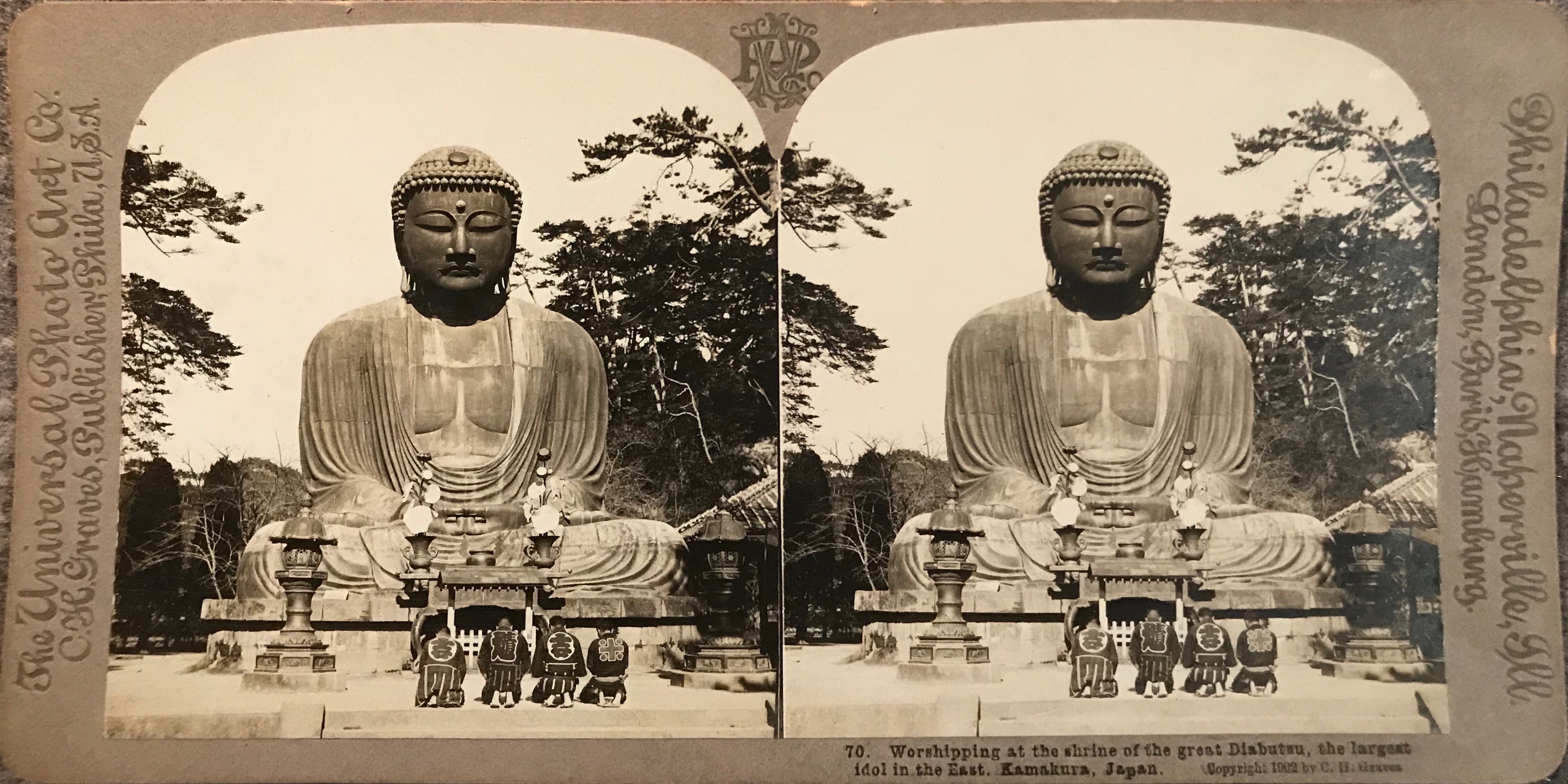
  • Title/Caption: Worshipping at the Shrine of the Great Daibutsu, the Largest Idol in the East. Kamakura, Japan
  • Year: 1902
  • Photography:  Herbert George Ponting (1870-1935)
  • Publisher: Universal Photo Art Company, Carlton Harlow Graves (d. 1943?)(#70 out of 200)
  • Medium: sliver gelatin print; mounted on curved slate-colored card
  • Dimensions: 7 in X 3.5 in

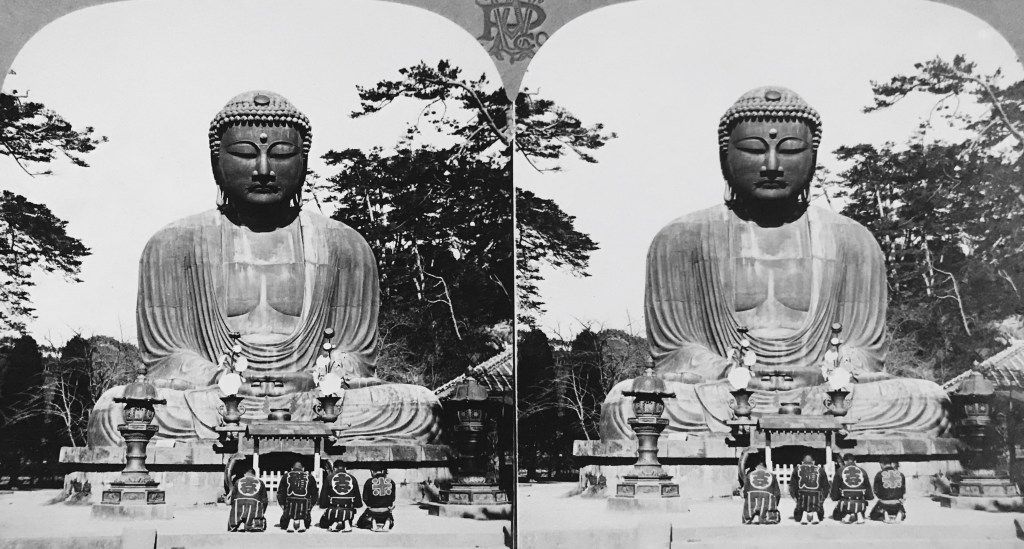
Ponting’s image of the Daibutsu is uncommon in several regards. It gives significant visual weight to the row of four Japanese men kneeling, eyes downcast, in apparent reverence to the Buddhist image. This kneeling posture is almost unique among the dozens of stereo-photographs of this temple scene. Indeed, the only other image with kneeling supplicants I have encountered I suspect to also be under Ponting’s artistic direction. The orchestration of such a scene should not be too surprising. The visual cue of kneeling would immediately signal to a Western audience a pious act of religiosity. The caption on the card also makes it apparent that the act of worshipping is to be highlighted, as are the non-aesthetic religious dimensions of the statue, which is clearly labeled an “idol.”

The lowered heads of the men mirror that of the Daibutsu, who in turn softly gazes down at them, creating an atmosphere of solemnity, possibly even penitence. The garments worn by the men create a strong contrast and the bold design keeps bringing the viewer’s eye back to their reverent posturing. The foreign-looking crests on their backs remind the viewer that they are not Western tourists. The clothing is traditional festival wear (happi 法被), and it remains unclear if Ponting was entirely fortunate to be photographing on the day of a festival, or if he hired the men to don the festive, bold attire; though I suspect the latter. In other regards, the images is fairly standard, taken from almost the same frontal position as Strohmeyer’s version, but cropped more tightly around the Daibutsu, who in turn becomes more centered. By having the men kneeling, an illusion is created whereby the perfectly centered Daibutsu appears larger, almost as if determining the fate of the men.


Notes

*This is part of a series of posts devoted to exploring the development of a visual literacy for Buddhist imagery in America. All items (except otherwise noted) are part of my personal collection of Buddhist-themed ephemera.

[1] For more detailed information on Ponting and Graves, see Bennett 2006.

References

  • Bennett, Terry. 2006. Old Japanese Photographs Collector’s Data Guide. London: Bernard Quaritch Ltd.

Additional Posts in Visual Literacy of Buddhism Series

Ponting and the Underwoods’ “Majestic Calm” of the Kamakura Daibutsu Stereoview

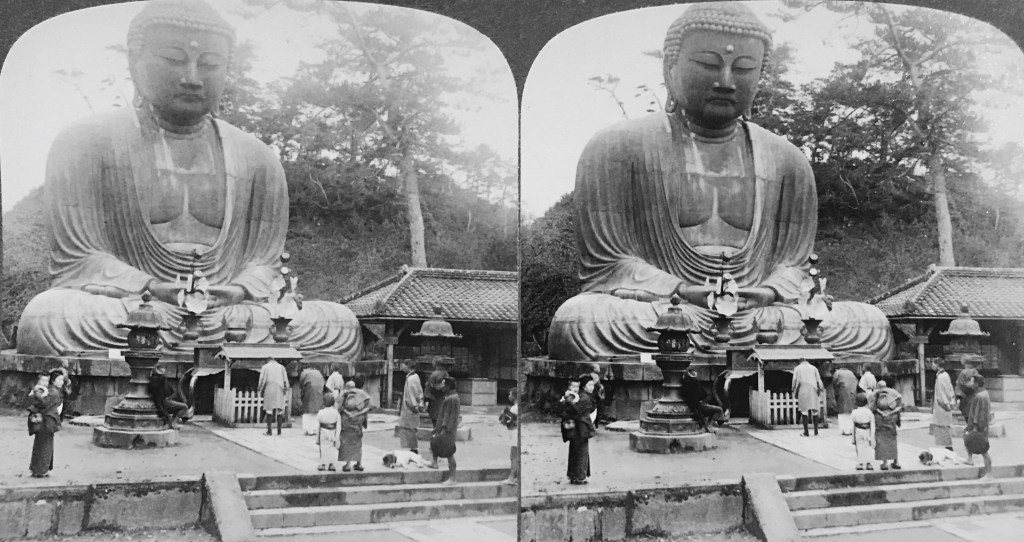
After completing his series of photographs commissioned by C.H. Graves and the Universal Photo Art Company, Herbert George Ponting (1870-1935) was hired by the premier publishers of stereoviews, Underwood & Underwood, in 1903 to take new stereo-photographs of the scenery of Japan.[1] These new images would replace the older series by Henry Strohmeyer, which was already almost a decade into its profitable run. For this set, Underwood & Underwood would expand the total number of views from 72 to 100, bringing them up to pace with their competitors who were enlarging their Japanese portfolios. Ponting was in Japan (or its neighboring regions) from spring to late fall 1903, and his images were published on the now-standard slate-colored mounts in 1904. By the end of his stereo-photography career, Ponting would have produced more images of Japan than any other Western stereo-photographer, having shot eight separate volumes of 100-view sets for an array of publishers in the first decade of the twentieth century. His reminiscences of his stays in Japan were published in 1910 as In Lotus-Land Japan, not surprisingly illustrated by copious amounts of his own photography.

IMG_E5835.jpg

  • Title/Caption: Majestic Calm of the Great Bronze Buddha, Revered for Six Centuries, (Facing S.W.) Kamakura, Japan
  • Year: 1904
  • Photographer: Herbert George Ponting (1870-1935)
  • Publisher: Underwood & Underwood; part of “Tour of Japan” (#11 out of 100)
  • Medium: sliver gelatin print; mounted on curved slate-colored card
  • Dimensions: 7 in x 3.5 in

Ponting’s approach to photographing the Daibutsu stands in contrast to that of Strohmeyer. Avoiding the all-too-common frontal symmetry employed by decades of professional and amateur photographers, Ponting takes his image from a few paces off-center, almost at three-quarters view (and abandons having his subjects kneel in reverence). It is possible he was imitating the composition made famous by his contemporary Enami Nobukuni 江南信國 (1859-1929), who fastidiously avoided the frontal view of the Daibutsu, albeit with far more panache than Ponting. In Ponting’s image, the scene is crowded by Japanese onlookers, comprised of men, women, and children, all paying homage to the Buddhist image, with those closest lowering their heads in reverence. With the worshiper’s feet firmly planted and their gaze seemingly synchronized, the scene appears a touch too orchestrated. There is one exception, however. In the lower left, a young woman and baby gaze off to the side and back, with the eyes of the child seemingly looking directly at the viewer. Due to this eye contact, the viewer is made uncomfortable; attention is brought to the ethnographic voyeurism at play in such images. Acting as a real tourist, the viewer is “sight-seeing” as well as being seen by the actors in this imaginary drama. [2]

The casualness of the worshipers, dressed in a variety of loose-fitting garments, and the presence of the resting dog reassert some of the mundaneness of the scene. Looking more closely, we can spot a young man reclining on the base of the left lantern, adding to the sense that the viewer is actually peering into the daily temple environs. The caption brings attention to the “majestic calm” of the Daibutsu, asking the viewer to recognize the serenity of the setting, despite the small crowd of worshipers looking frozen in their spots. The photograph and its accompanying caption strike a balance between highlighting the wonder of the statue and the religious activities of Japanese commoners.

In addition to the multi-lingual captioning on the reverse side of the card saved from its 72-view predecessor, this set also included a lengthy description and history of the scene depicted on the obverse (some variant editions lack this description, however). By opening with a second-person form of address (“You are about an hour’s ride by rail…”), the readers are immediately transported into the role of a globetrotting tourist making their way through the foreign terrain of Japan. The three-dimensional effect of stereoviews combined the stylized point-of-view of the description all act to make the beholder of the card a truly virtual tourist. The descriptive account employs ample amounts of pathos, drawing upon nostalgia for the “old times of mediæval splendor” and nuanced detail of the craftsmanship of the statue, highlighting the value of the “solid gold” eyes and “pure silver” ūrṇā. In form, this does not differ greatly from the genre of guidebooks and travel account narratives, of which many readers would likely be familiar. The description ends with comments on Japanese religious practice, and directs readers to Lafcadio Hearn’s (1850-1904) Glimpses of Unfamiliar Japan, first published in 1894 and which had become a popular seller.[3]

Underwood & Underwood also produced a half-stereo “positive” image (the inverse of the original negative image) as a magic lantern slide. Lantern slides were marketed for use during public “lecture-sermons” – often called stereopticon shows – where an individual could present on a topic to a crowd gathered at a theater, church, fraternal lodge, or private home. Underwood & Underwood sold (and rented) pre-made lecture-sermons which contained a script of about twenty-five to forty minutes and forty to sixty slides. While our specimen below is black and white, the set would contain sepia colored slides as well as full color slides to give “variety pleasing to the eye.”

LS001uu(o).jpg

  • Title/Caption: Great Bronz [sic] Buddha, Kamakura Japan.
  • Year: 1904
  • Photographer: Herbert George Ponting (1870-1935)
  • Publisher: Underwood & Underwood; (#3850)
  • Medium: glass and photographic emulsion, paper

Notes

*This is part of a series of posts devoted to exploring the development of a visual literacy for Buddhist imagery in America. All items (except otherwise noted) are part of my personal collection of Buddhist-themed ephemera.

[1] For more detailed information on Ponting and the publishers Underwood & Underwood, see Bennett 2006.

[2] It was not uncommon for stereoview publishers to sell the rights of their images for use in other printed media. Half of Ponting’s stereoview, for example, was used in Clive Holland’s Things Seen in Japan, published in 1907, (pg. 215). This stereocard can also be viewed here.

[3] As described by Thomas Tweed, Hearn was a romanticist, focusing on the exotic, aesthetic, and literary dimensions of Buddhism, see Tweed 2000. This would be a natural fit for the middle-to-upper class consumers of stereoviews, who would have shared many similar sentiments.

References

  • Bennett, Terry. 2006. Old Japanese Photographs Collector’s Data Guide. London: Bernard Quaritch Ltd.
  • Tweed, Thomas A. 2000. The American Encounter with Buddhism, 1844-1912: Victorian Culture and the Limits of Dissent, Revised Edition. Chapel Hill: University of North Carolina Press.

Additional Posts in Visual Literacy of Buddhism Series
Strohmeyer’s “Faithful at the Shrine of the Daibutsu” Stereoview

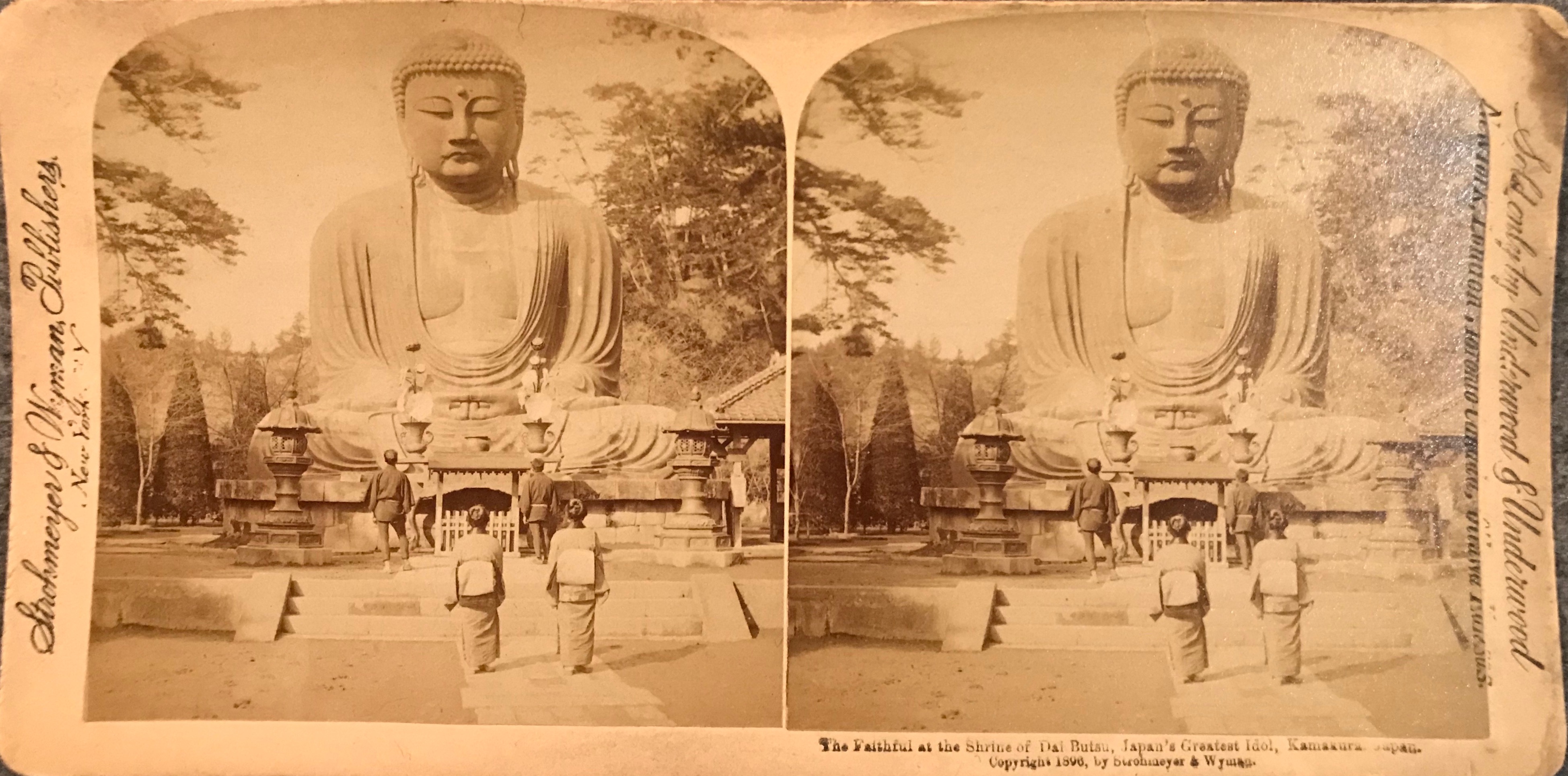
In early 1896, photographer and publisher Henry A. Strohmeyer (1858-1943) set off for an around the world photographic tour. His mission was to capture stereoscopic images from Japan, China, and India and various locations around the Middle East and Europe. After arriving in Japan in the Spring of 1896, Strohmeyer took around 200-300 photographic negatives that were curated into a final set of 72 images. This established the first mass-produced, dedicated box set of Japan stereoviews. This 72-view set was distributed exclusively by Underwood & Underwood, the largest producers of stereographic cards globally, making – and presumably selling – nearly 30,000 stereocards and 900 stereoviewers per day by 1900.[1] The Underwood & Underwood empire had perfected door-to-door canvassing, employing enterprising college students to directly market their stock to the public. The catalogue and publishing operation of Strohmeyer and business partner Nehemiah Dwight Wyman (1861-1934) was acquired by Underwood & Underwood in 1901 and the 72-view Japan set continued to be published under the Underwood & Underwood imprint until 1904 when it was replaced by the new “Ponting Set.” For eight years between 1896 and 1904, Strohmeyer’s photographs of Japan remained the premier set of Japanese imagery for the American mass public.[2]

Figure 1

IMG_E5822.jpg

  • Title/Caption: The Faithful at the Shrine of Dai Butsu, Japan’s Greatest Idol, Kamakura, Japan
  • Year: 1896
  • Photographer: Henry A. Strohmeyer (1858-1943)
  • Publisher: Strohmeyer & Wyman, distributed by Underwood & Underwood (out of a set of 72 views)
  • Medium: sliver gelatin print; mounted on curved buff/tan-colored card
  • Dimensions: 7 in X 3.5 in

Strohmeyer’s image of the Daibutsu produces a rather stilted mise-en-scène [Fig. 1]. Two pairs of Japanese onlookers, with the formally dressed women placed several paces behind the men, stand stoically facing the grand Buddhist image. The viewer enters the scene through the two well-groomed women in the lower right foreground, a visual pathway enhanced through the three-dimensional effect produced by stereoscopic viewing. The visual weight given to these two Japanese women immediately calls to mind the motif of the hypersexualized Orient, often signaled through the appearance of alluring geisha. Cultural difference is highlighted not only through the clothing of the worshippers, but also through the magnitude of the object of reverence. In contrast to William Henry Metcalf’s stereoview which elided a human presence, Strohmeyer’s incorporation of people allows for a better sense of scale of the towering bronze statue. In addition, by placing the women on the landing before the stairs, there is an apparent greater vertical distance between them and the head of the Daibutsu, which crowns the very top of the image. This creates an illusion of the statue being taller than it really is.[3] Yet, the wooden posturing of the onlookers makes the size of the Daibutsu appear more menacing than contemplative. Due to the artificial parallel placement and awkward stances, more attention is drawn to the awe-struck worshippers, casting the entire scene under an unnatural and ominous shadow. The caption to the photograph also focuses the viewer’s attention on the pious “faithful,” making this image less about the artistic virtue of the Daibutsu, and more about the foreign and unfamiliar religiosity that inspires such creations.

Figure 2

IMG_E5817.jpg

  • Title: The Faithful at the Shrine of Dai Butsu, Japan’s Greatest Idol, Kamakura, Japan
  • Year: 1901
  • Photographer: Henry A. Strohmeyer (1858-1943)
  • Publisher: Underwood & Underwood (#54 of 72)
  • Medium: sliver gelatin print; mounted on curved buff/tan-colored card
  • Dimensions: 7 in X 3.5 in

In 1901, after the acquisition of Strohmeyer and Wyman’s catalogue, Underwood & Underwood re-issued the 72-card set, now listed as both publisher and distributor on the mount [Fig 2.]. The cards were numbered sequentially and the reverse reprinted the caption in English along with five foreign language translations (French, German, Spanish, Swedish, and Russian) suggesting the international popularity of the series. The series would be re-issued one more time around 1902/3 on slate-colored mounts.

Figure 3

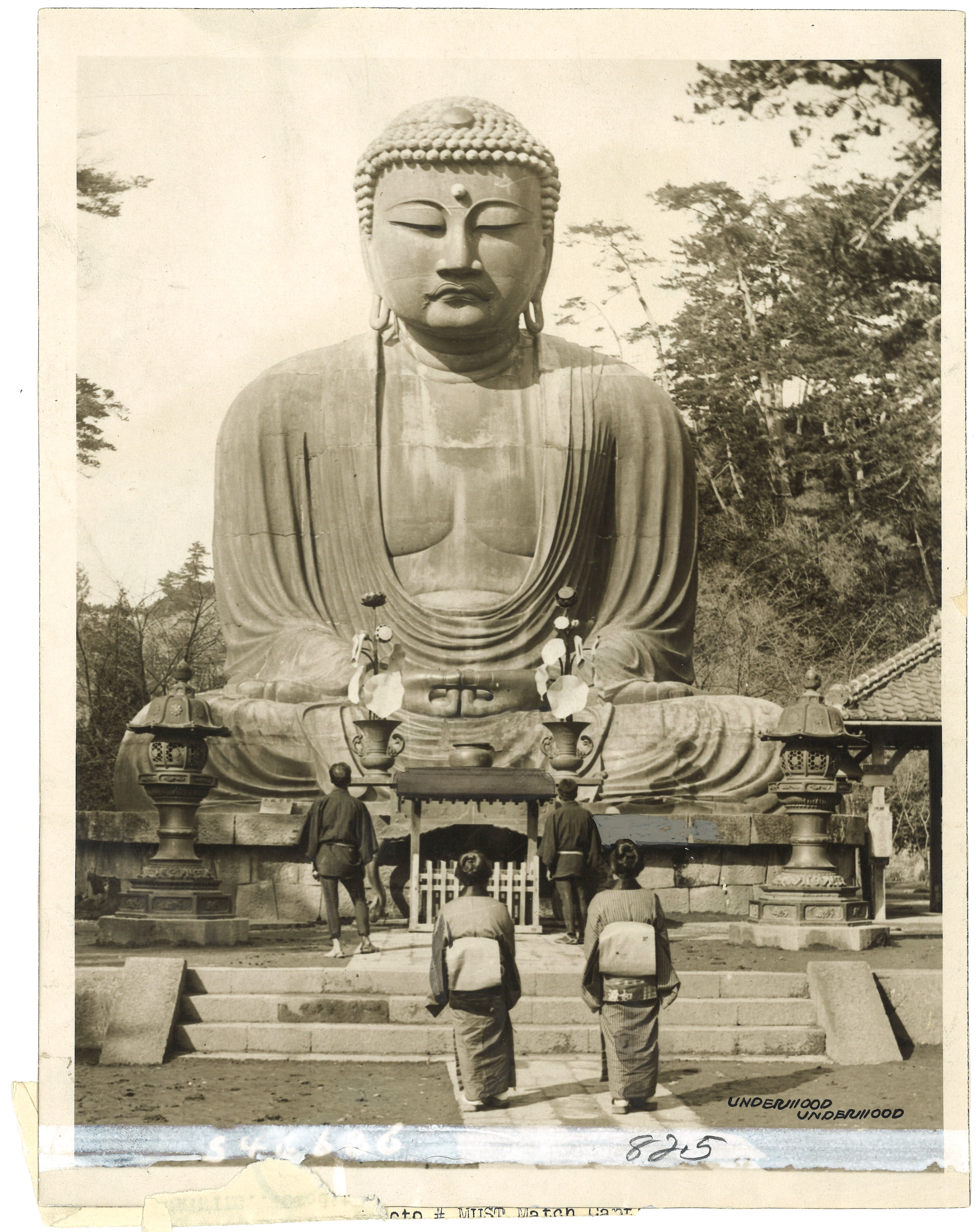
Strohmeyer UU print

  • Title: None (dated on reverse September 11, 1923)
  • Photographer: Henry A. Strohmeyer (1858-1943)
  • Publisher: Underwood & Underwood (#54 of 72)
  • Medium: sliver gelatin print
  • Dimensions: 7 in X 3.5 in

Around the end of the first decade of the twentieth century, Underwood & Underwood expanded into news photography, slowing their production of stereoviews through World War I until fully selling off their stock and rights to Keystone Viewing Company in 1921. They apparently continued to hold the non-stereographic rights to numerous photographs, however, including Strohmeyer’s 1896 image of the Great Buddha of Kamakura [Fig. 3]. This above photograph, dated September 11, 1923 on the reverse, was originally owned by the Baltimore Sun and was likely procured in response to the Great Kantō earthquake of September 1, 1923. The Kamakura Daibutsu was easily recognized as one of the most famous monuments of Japan by international audiences and numerous papers reported on the damage of the statue. I have been unable to locate this image among the published papers of the Baltimore Sun, however. It is the left side of Strohmeyer’s original stereoscopic image, photographed more than two decades earlier.


Notes

*This is part of a series of posts devoted to exploring the development of a visual literacy for Buddhist imagery in America.

[1] For estimates on card production at the turn of the century, see Darrah 1977: 47. Brey also discusses production and the scripted sales pitch that made the Underwoods’ enterprise highly successful, see Brey 1990.

[2] For more information on Strohmeyer and the publishers Underwood & Underwood, see Bennett 2006. Bennett notes that the first Japan views on Strohmeyer mounts appeared in 1890-91, when they reprinted Anthony’s “Views of Japan.”

[3] Most photographers would position their camera on this second landing, an optimal distance to fill a majority of the frame with the Daibutsu. Only a hand of photographers would position themselves further back, on the first landing, which minimizes the visual significance of the Daibutsu, but also opens the possibility for more visually compelling compositions. A different view from Strohmeyer & Wyman’s set is paced further back. Moreover, a third view of the Kamakura Daibutsu is without people. It is worth noting that a handful of other views contain Buddhist imagery.

References

  • Bennett, Terry. 2006. Old Japanese Photographs Collector’s Data Guide. London: Bernard Quaritch Ltd.
  • Brey, William. 1990. “Ten Million Stereo Views a Year,” Stereo World, Vol. 16, No. 6, pp. 6-12. [Digitized by the National Stereoscopic Association, www.stereoworld.org.]
  • Darrah, William C. 1977. The World of Stereographs. Gettysburg, Pennsylvania: W.C. Darrah.
  • [For a comparison between Strohmeyer and Herbert Ponting’s photography styles, see here]
  • [The Library of Congress has a good selection of Strohmeyer & Wyman’s 72-view Japan set, see here]

Additional Posts in Visual Literacy of Buddhism Series
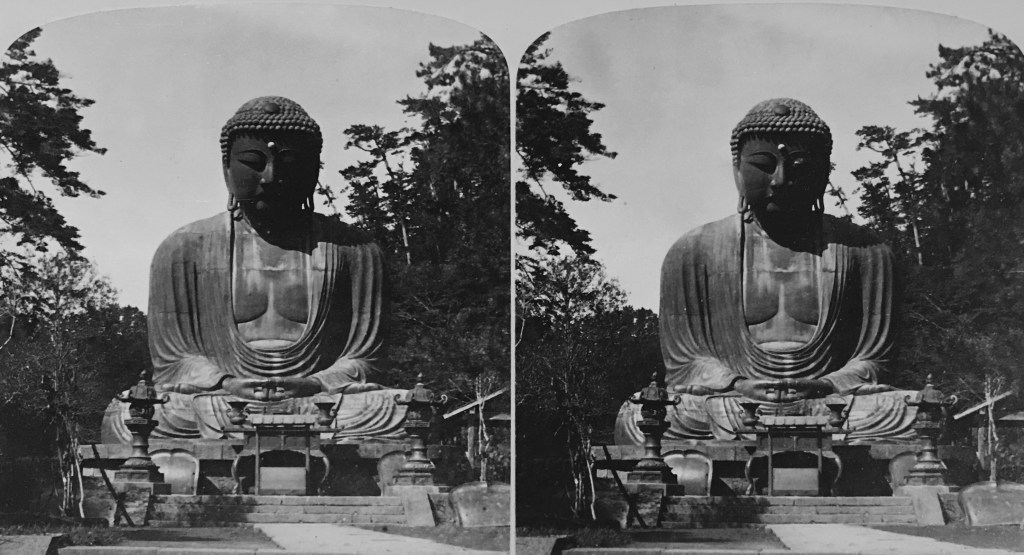
Metcalf and Bennet’s “A Summer In Japan” Stereoview

Although professional photography studios already crowded the Japanese treaty port of Yokohama by the 1870s, William Henry Metcalf (1821-1892) was one of the first intrepid amateur photographers who brought his own camera on his trans-Pacific trip to Japan.[1] More than a decade before portable Kodak cameras ushered in a new era of amateur photography, Metcalf commissioned his friend and fellow photographer Henry Hamilton Bennet (1843-1908) to construct a portable travel camera, equipped with both photographic and stereoscopic lenses. Arriving in Yokohama in June 1877 with the pioneering Japanologist Edward Sylvester Morse (1838-1925), Metcalf set out on a four-month tour photographing the Japanese landscape. More than two dozen of his stereographic photographs were consigned for publication by Bennet under the title “A Summer in Japan” and promoted to a ready market in the US hungry for imagery of the exotic Orient.

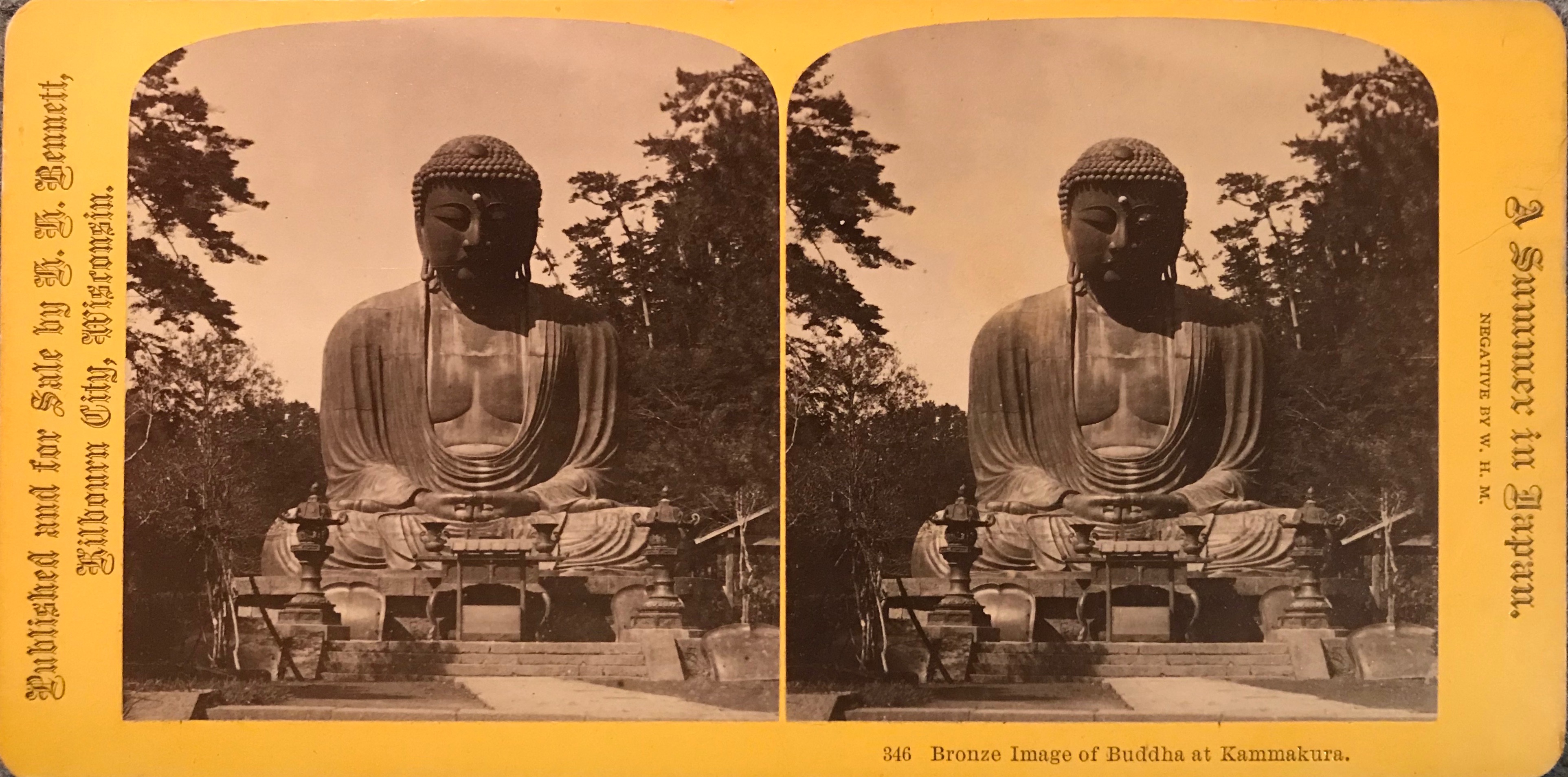
IMG_E5813.jpg

  • Title/Caption: Bronze Image of Buddha at Kammakura [sic]
  • Year: 1877
  • Photographer: William Henry Metcalf (1821-1892)
  • Publisher: Henry Hamilton Bennett (1843–1908), “A Summer in Japan” (#346)
  • Medium: albumen print, mounted on yellow-orange card
  • Dimensions: 7 in x 3.5 in

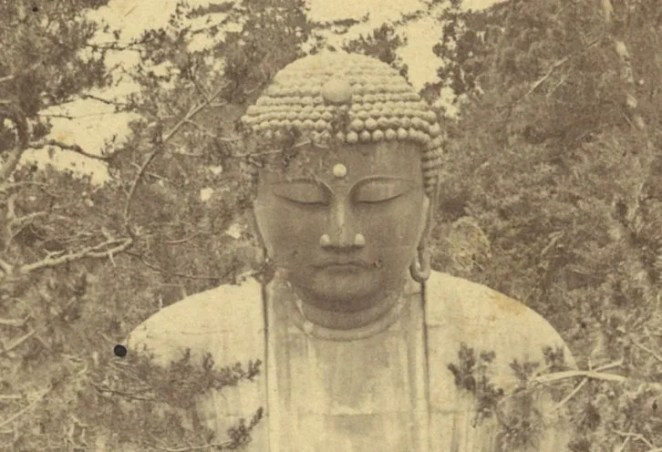
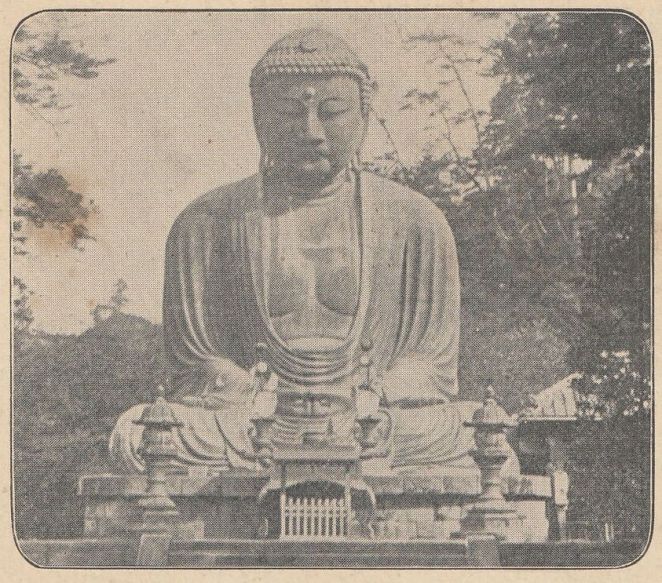
Metcalf’s image of the Daibutsu (Great Buddha) of Kamakura was not the first published stereoview card of this popular tourist attraction, yet it remains an early attempt at capturing the ancient bronze behemoth with this new and increasingly popular photographic technique.[2] It also presages the immense popularity of this subject for the stereographic trade of the late nineteenth and early twentieth centuries, when it became a staple image among the sets of Japan views issued by the larger publishers, such as Underwood, Graves, and White. Metcalf’s image is uncommon among contemporary photographs of the Daibutsu in that it captures the scene devoid of people, casting visual focus on the serene countenance of the statue and its rustic setting. More typically, people, oftentimes children, would be included in the shot to establish the sheer grandeur of the statue, but here the viewer is left to his or her own devices to estimate the size and dimensions. Moreover, by removing visitors from the scene, Metcalf was able to facilitate a more immediate encounter between the viewer and religious icon, creating a silent space to ponder the meaning of such a picturesque portrait.


Notes

*This post was incorporated into the article, “William H. Metcalf: Iconic pictures of 1870s Japan were taken by an amateur Milwaukee photographer,” published online in the Milwuakee Independent.

*This is part of a series of posts devoted to exploring the development of a visual literacy for Buddhist imagery in America. All items (except otherwise noted) are part of my personal collection of Buddhist-themed ephemera.

[1] For more on Metcalf’s travels and photography see Gartlin 2010.

[2] I am aware of at least two older stereoview cards bearing the image of the Kamakura Daibutsu, one photographed by Charles Weed and published in San Francisco by Thomas Houseworth & Co. in 1869, and one published internationally under several titles by Wilhelm Burger, also in 1869. (A image of Burger’s stereoview card can be found in the Database of Old Japanese Photographs in the Nagasaki University Library Collection.) For more information on these sets, see Bennett 2006.

References


Additional Posts in Visual Literacy of Buddhism Series