For all the new Buddhas in the West posts follow us on Bluesky & Instagram
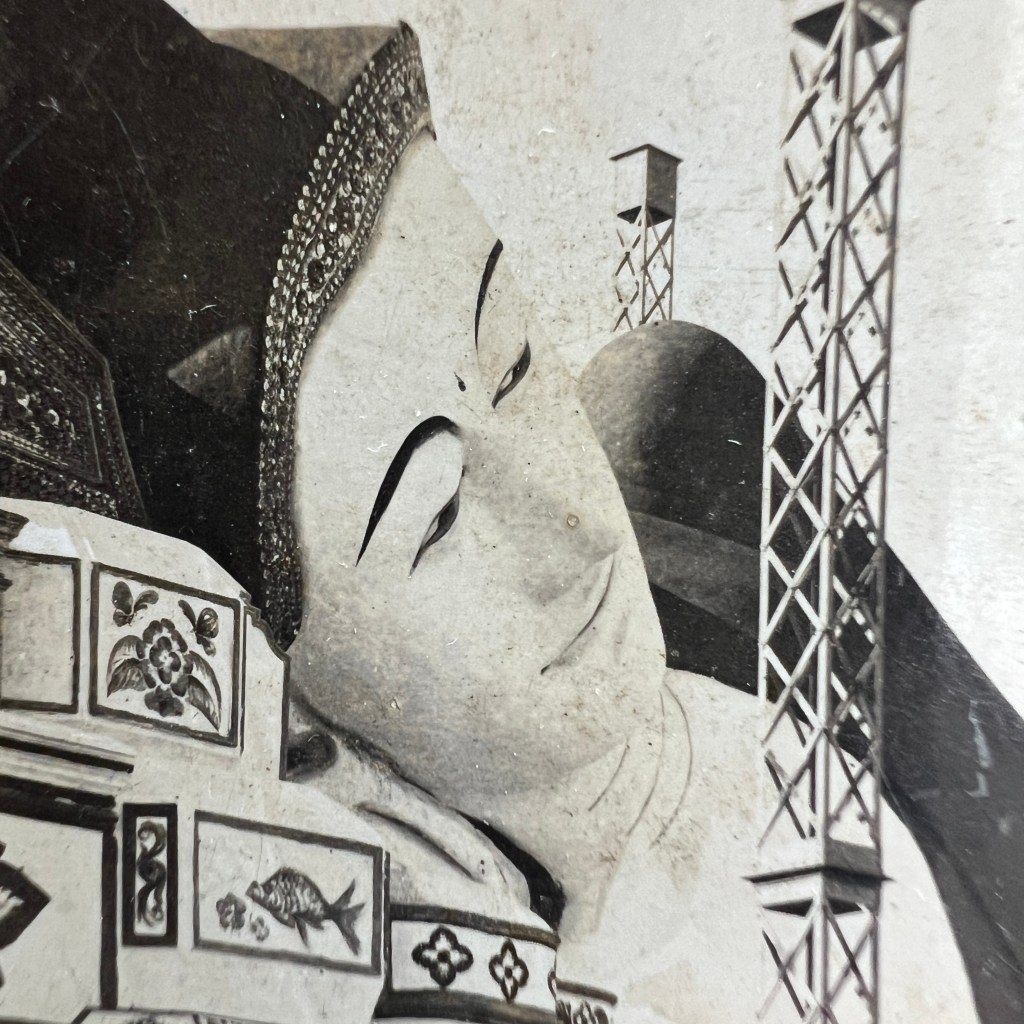
This colossal Sleeping Buddha was lost to the jungle when the Burmese city of Bago fell to invading forces in 1757. The statue was recovered in 1881 after railroad workers began digging through a tree-covered mound looking for scrap stone.
At 55 meters (180 ft) long and 16 meters (52 ft) high at the shoulder, the Shwethalyaung Buddha is among the largest reclining Buddha statues ever constructed. Made of brick and stucco, it is believed to have been built in the late tenth century under the patronage of a local king.
This stereograph was taken by Herbert Ponting who had returned from Manchuria after photographing the Russo-Japan War for publisher H. C. White.
Ponting had an expert eye; his placement of the man in the foreground produces a strong three-dimensional depth effect when viewed stereoscopically.
An earlier photograph of the Shwethalyaung Sleeping Buddha before decoration was published in Julius Smith’s Ten Years in Burma from 1902, viewable here: tinyurl.com/5n85dsxn.
The Buddhas in the West Material Archive is a digital scholarship project that catalogues artifacts depicting Buddhist material culture for Western audiences. It’s comprised of prints, photos, and an assortment of ephemera and other objects. For a brief introduction to this archive, visit the main Buddhas in the West project page.
For Related Buddhas in the West Posts Featuring Myanmar / Burma:
For all the new Buddhas in the West posts follow us on Bluesky & Instagram
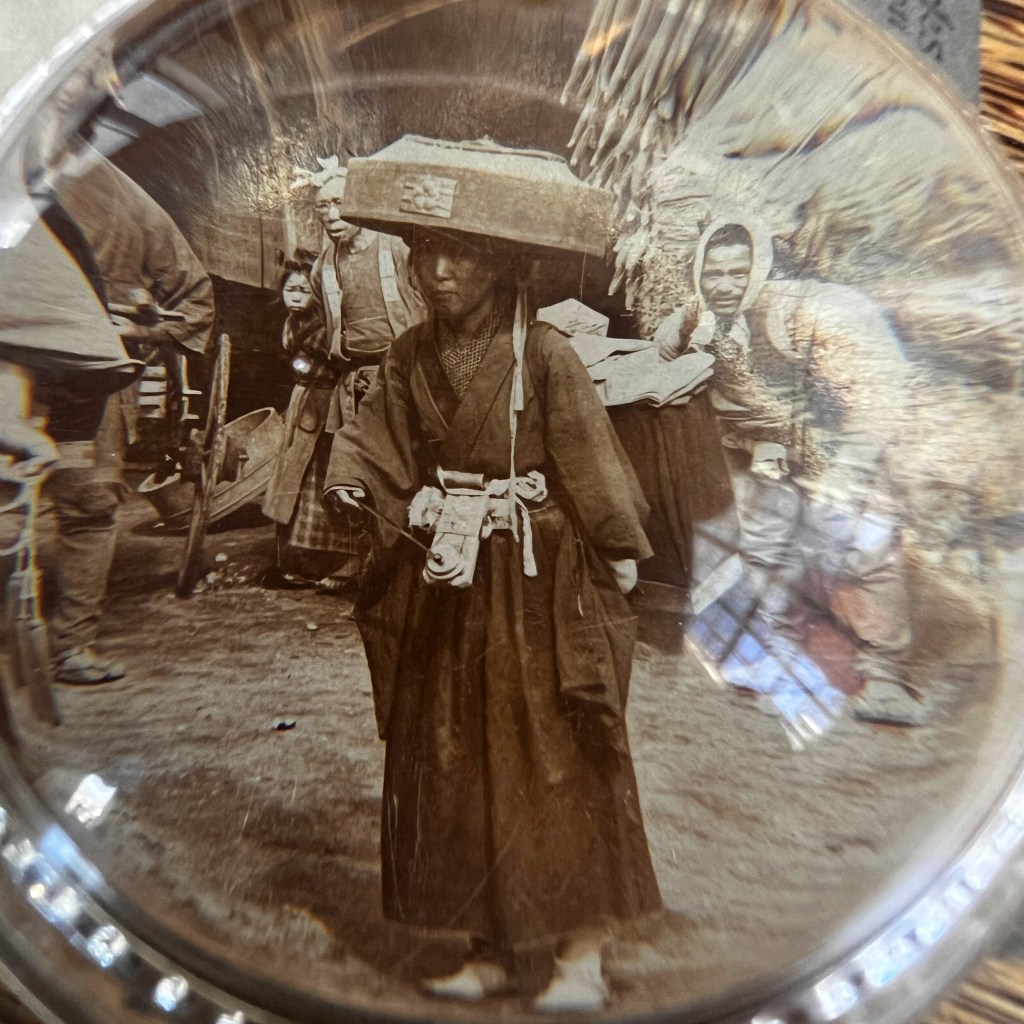
After 1900, publishers of stereoviews started emphasizing their educational rather than entertainment value, oftentimes selling thematic boxed sets. The card here is part of Underwood & Underwood’s 100-view Japan set from 1904.
We know from the negative number (#3852) this stereophoto was taken by expedition photographer Herbert Ponting during his trip to Japan in 1903. The location at Lake Kawaguchi was a well-known gathering spot for pilgrims looking to ascend Mt. Fuji.
By 1904 it was increasingly common to print educational information on the reverse of the card. Here we also find additional books recommended, including Lafcadio Hearn’s Glimpses of Unfamiliar Japan, from which much of the information is cobbled together.
The distinctive clothing and ritual apparatus mark the traveler as a religious pilgrim.
The Ponting-Underwood set, published on the outset of the Russo-Japanese War, became one of the more popular sets on Japan. A scan of the full collection by the Smithsonian Institute is viewable here: https://tinyurl.com/2ukzu87c
The Buddhas in the West Material Archive is a digital scholarship project that catalogues artifacts depicting Buddhist material culture for Western audiences. It’s comprised of prints, photos, and an assortment of ephemera and other objects. For a brief introduction to this archive, visit the main Buddhas in the West project page.
For Related Buddhas in the West Posts Featuring Herber Ponting’s Photography:
For all the new Buddhas in the West posts follow us on Bluesky & Instagram
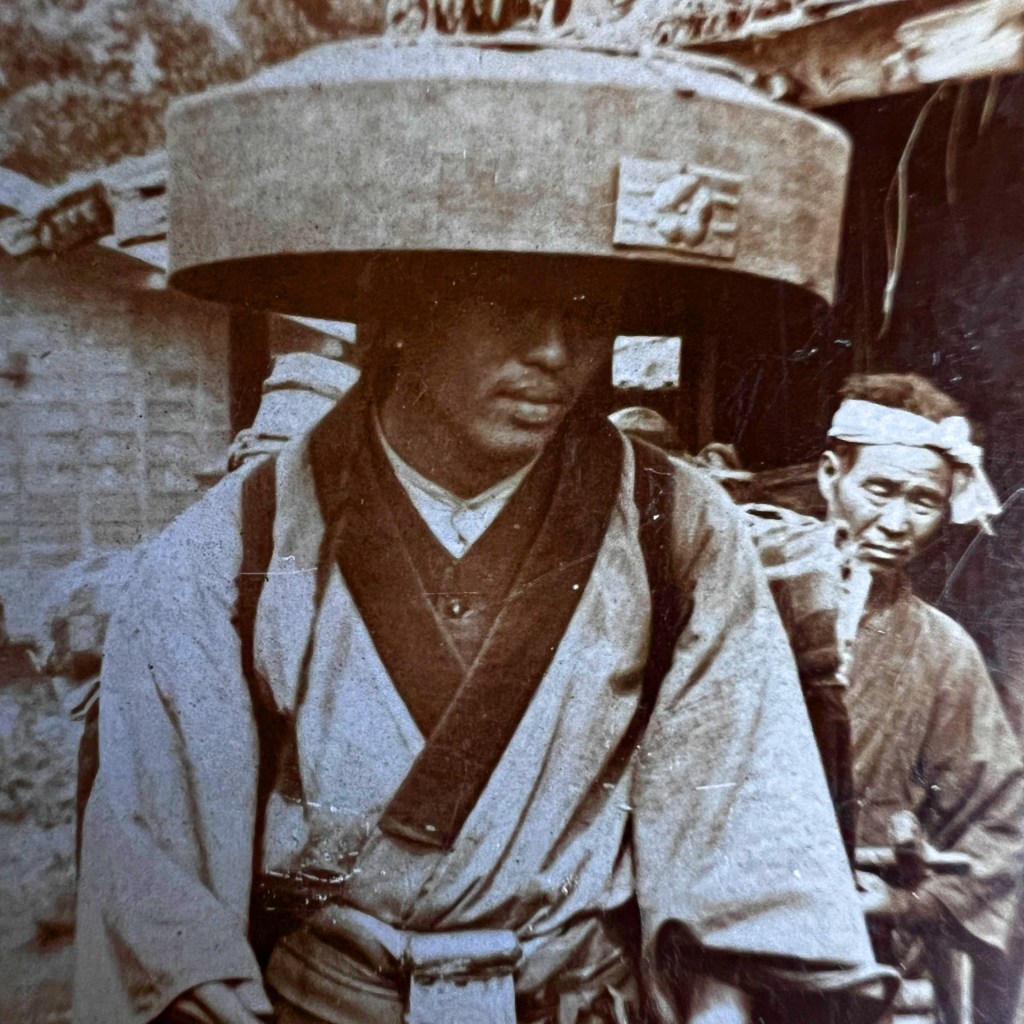
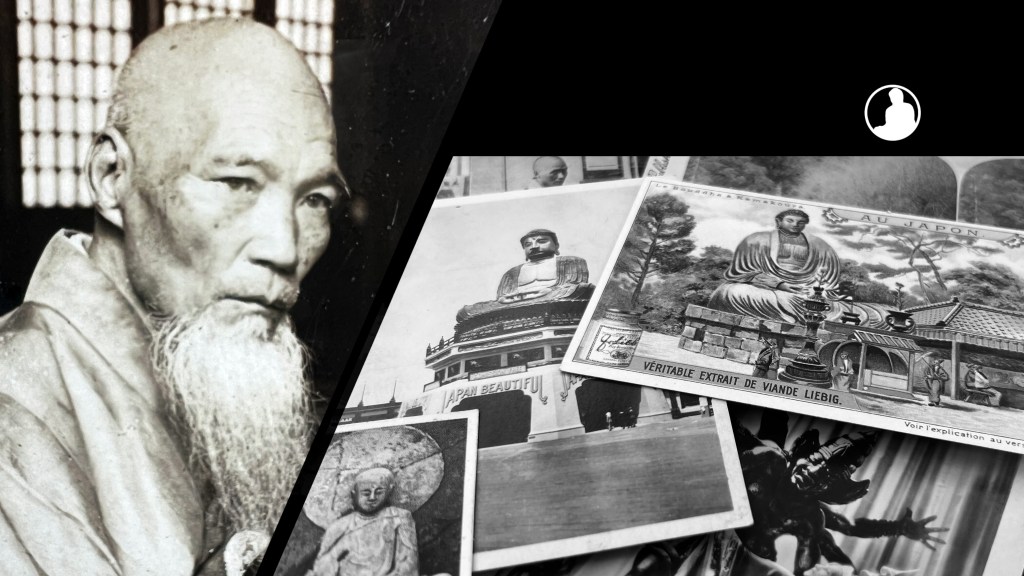
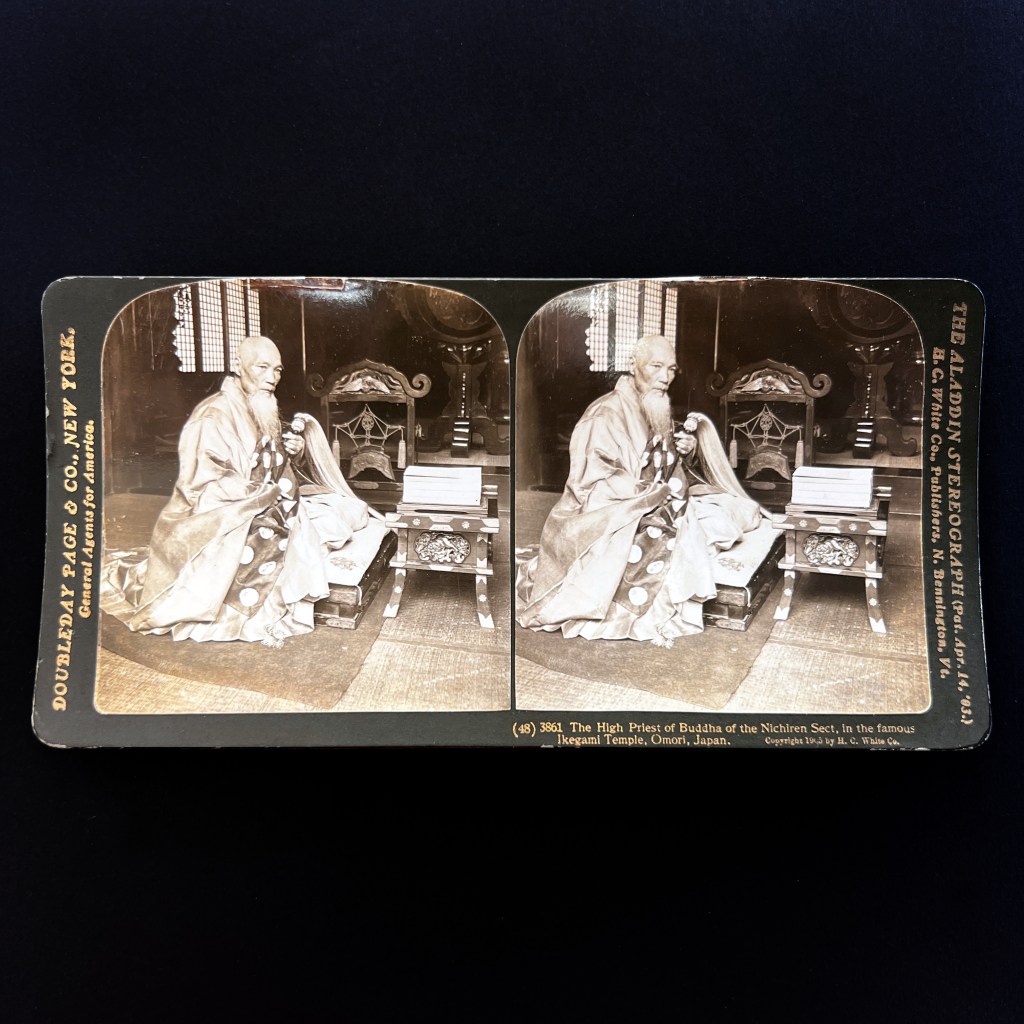
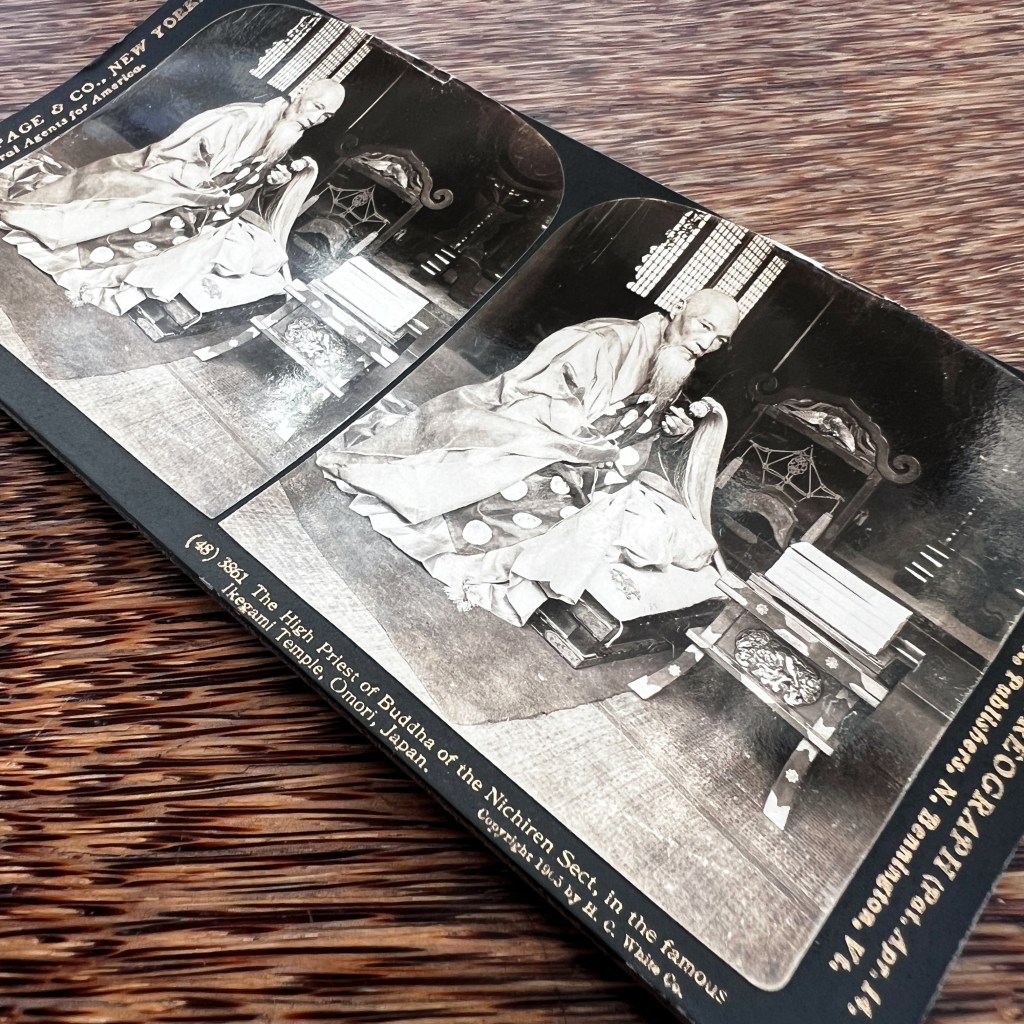
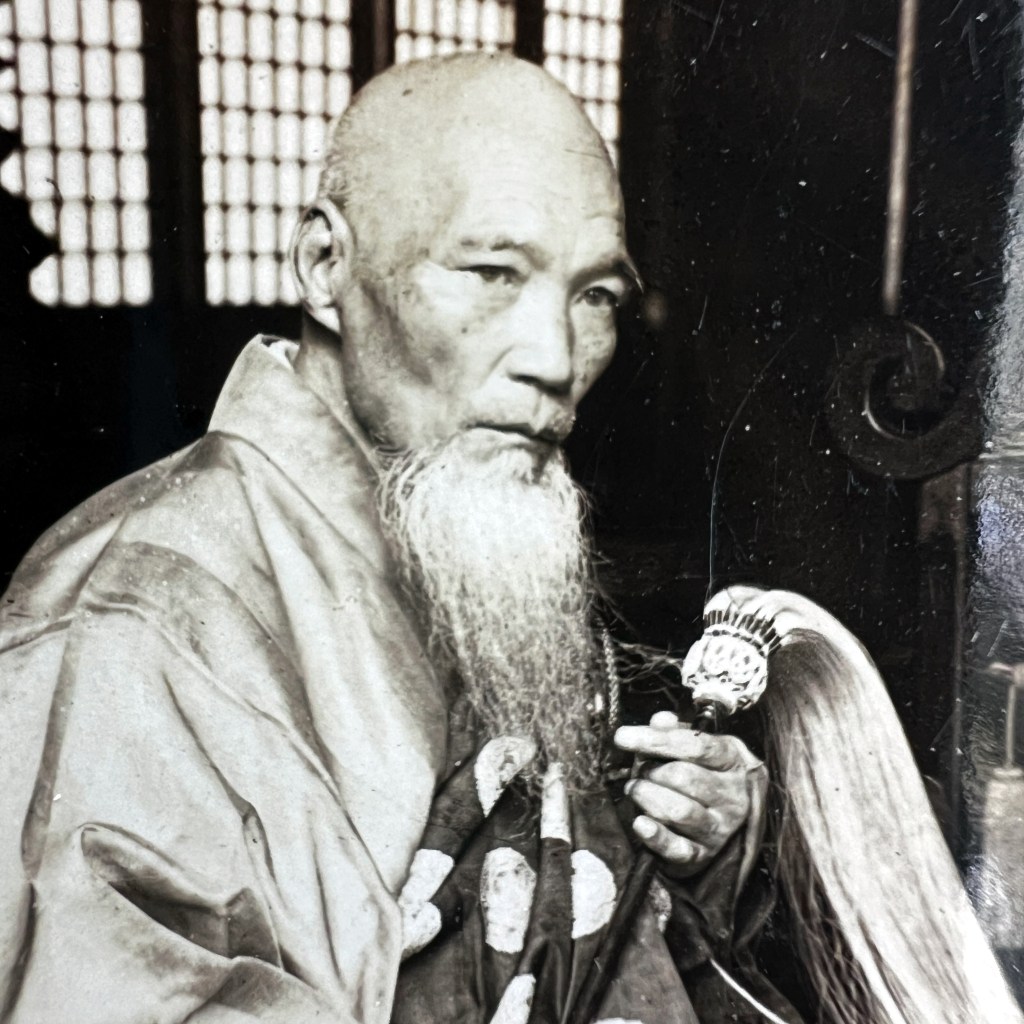
Is this the first stereoscopic 3D portrait of a Buddhist abbot? While many Japanese Buddhist priests were photographed for stereoviews by 1905, the year this card was issued, this is a rare occasion where we have an indication of the priest’s identity.
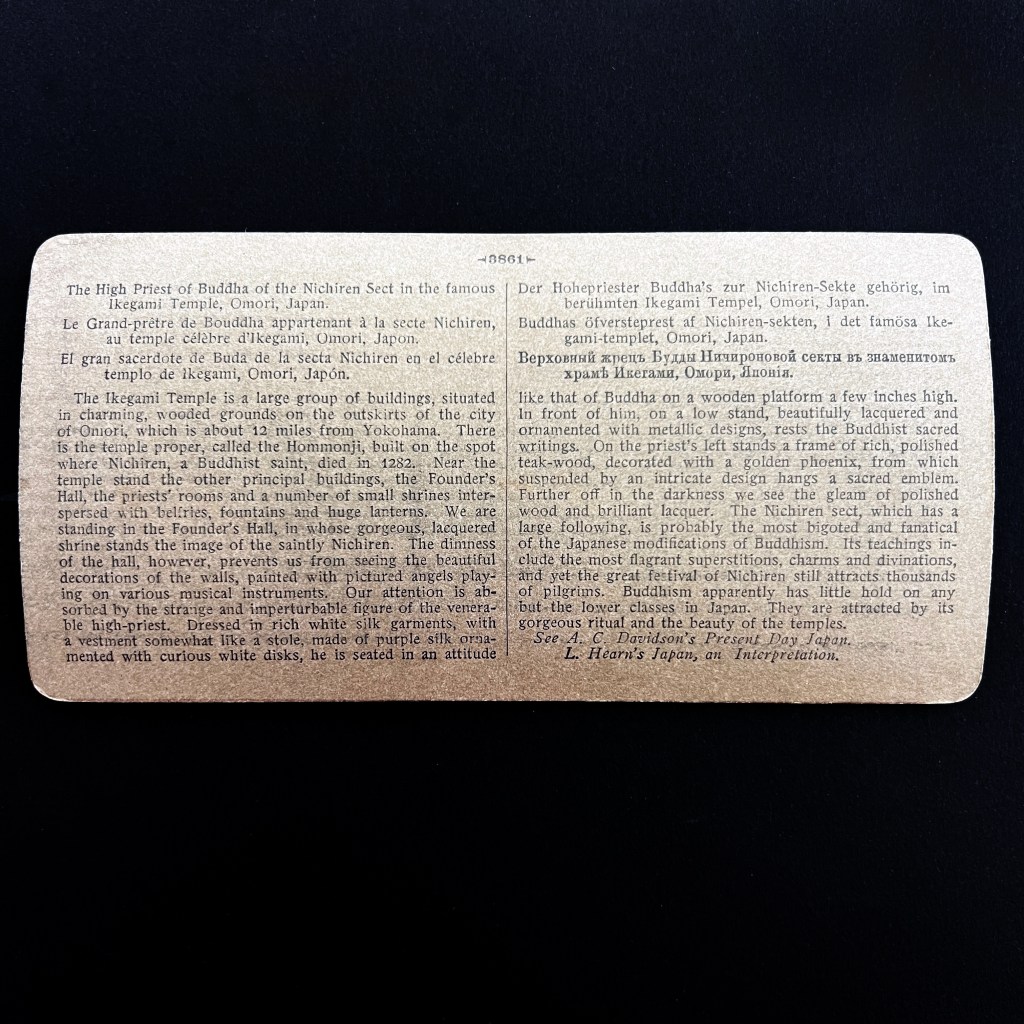
The caption tells us the priest is the head of Ikegami Temple (Honmon-ji #本門寺) of the Nichiren school. We also know the photographer, Herbert Ponting, was hired by H.C. White to take photos of the Russo-Japanese War and he toured Japan through the end of 1906.
There are two potential identifications of this priest, but it is likely Kubota Nichiki 久保田日亀(1841–1911), who became the 68th generation abbot in 1899. He holds a fly-whisk, a sign authority.
By the 20th century, stereoviews were seen as important educational tools and the backs of many cards were imprinted with information, sometimes reflecting contemporary views and biases. This description notes the Nichiren school emphasized “the most flagrant superstitions.”
Ponting would eventually author a book on his travels in Japan, entitled In Lotus-Land Japan, illustrated with photos he had originally taken as stereoviews. The book can be read here: https://tinyurl.com/hhzhsnm9
Additional Archived Posts for the Buddhas in the West Project
The Buddhas in the West Material Archive is a digital scholarship project that catalogues artifacts depicting Buddhist material culture for Western audiences. It’s comprised of prints, photos, and an assortment of ephemera and other objects. For a brief introduction to this archive, visit the main Buddhas in the West project page.
For Related Buddhas in the West Posts Featuring Historical Stereophotography:
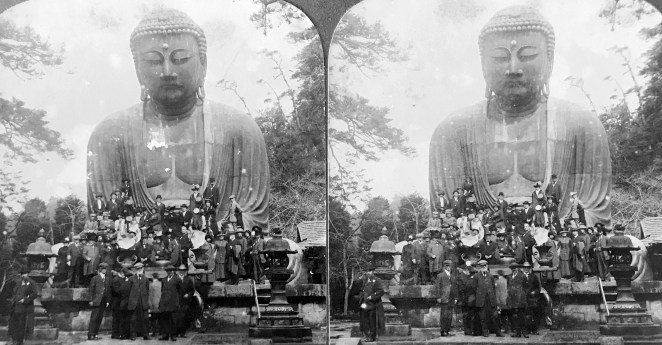
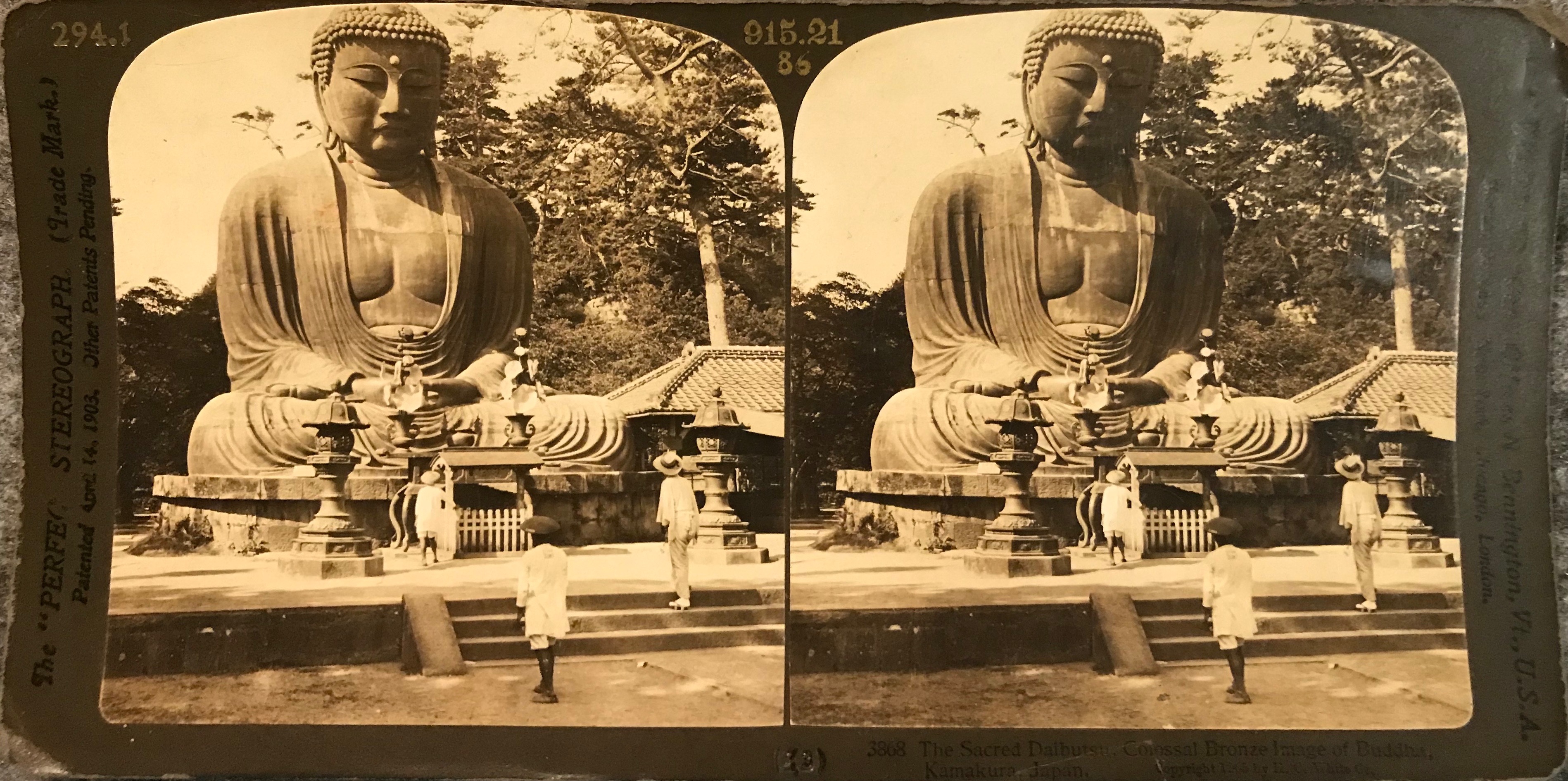
By 1902, the 72-view “Strohmeyer Set” issued by Underwood & Underwood dominated the market of Japanese themed stereoview cards. Hawley C. White (b. 1847?), motivated to transform the stereograph from novelty item to educational tool, worked for three years developing his “White Travel Tours” and issued the first challenge to the Underwood monopoly. White’s “Perfec” Stereograph company would publish its first set of 72-views of Japan in 1902, replacing them with a brand-new series of 100-views in 1905. To procure images for this new 100-view series, White called upon the now-experienced stereo-photographer Herbert George Ponting (1870-1935), who was commissioned by the studios run by H.C. Graves and the Underwoods in the preceding years to produce their catalogues of Japanese stereoviews.[1] This would mark the third trip to Japan for Ponting, who would arrive around the fall of 1904 and photograph through to the summer of 1905. Ponting would return to Japan two more times working for White and would eventually collect the reminiscences of his travels in his 1910 work, In Lotus-Land Japan, profusely illustrated by his own photography.
Title/Caption: The Sacred Daibutsu, Colossal Bronze Image of Buddha, Kamakura, Japan
Year: 1905
Photography: Herbert George Ponting (1870-1935)
Publisher: The “Perfec” Stereograph; Hawley C. White (B. 1847?) (#23 out of 100)
Medium: sliver gelatin print; mounted on olive-colored card
Dimensions: 7 in X 3.5 in
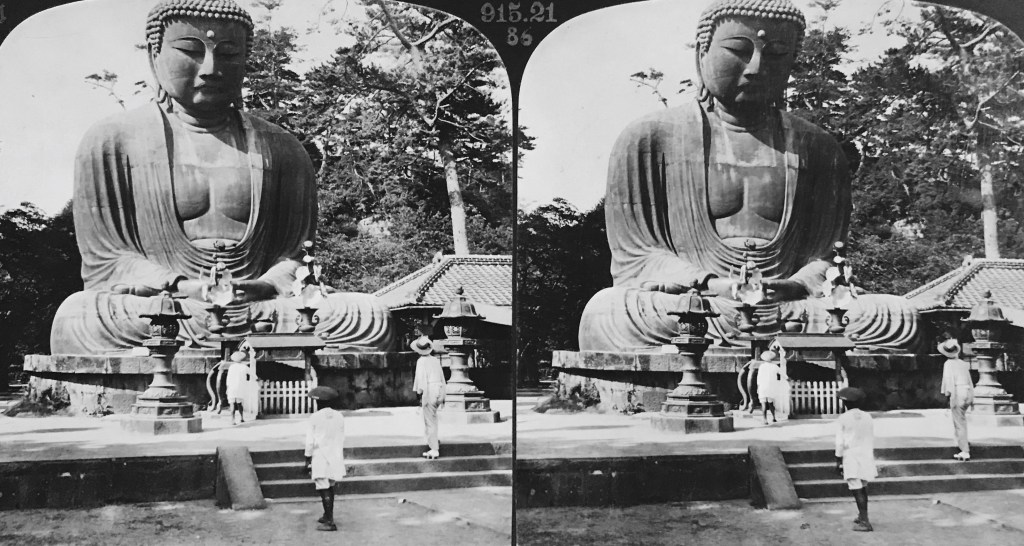
This commissioned image on olive-colored mount shows the maturation of Ponting’s work over the years. He positions his camera in almost the exact same spot as for his Underwood & Underwood image a year prior, off-center to the left, almost at three-quarters view. The late-day sun hangs low in the sky, illuminating the near side of the Daibutsu’s face. These compositional conventions are also present in the work of Enami Nobukuni 江南信國 (1859-1929), a famed Yokohama photographer and stereographer with whose work Ponting was familiar.[2] Moreover, Ponting seems to have been influenced by Enami’s positioning of people, thinning out the crowd of people present in his Underwood funded excursion to Kamakura. Now, three Japanese men are placed at different depths, each appearing to be in mid-stride as they walk towards the Daibutsu. This creates an effect of motion as the viewer’s eyes are drawn into the mighty bronze statue. By placing these onlookers at different depths, the stereographic effect would also have greater impact, creating a better sense of three-dimensionality and dynamism. While the gaze of the visitors is towards the Daibutsu, the object of reverence, their attitude is more casual. This is in contrast to Ponting’s earliest attempts at creating the mise-en-scène where onlookers were directed to kneel, a transparent attempt to signal piety to the viewer. Even though the men here are not Western tourists, one cannot help think that they may be partaking in an afternoon stroll to see the local attractions. The caption presents a similar ambiguity. Although it qualifies the Daibutus as “sacred,” it does not refer to the nature of the visitors; are they worshippers or local sight-seers? Furthermore, by describing the Daibitsu as a “colossal bronze image,” it underscores its aesthetic dimensions and fine craftsmanship admired by Western sightseers.
The reverse of the card is imprinted with the caption in six different languages (omitting the word “sacred” in all of them, however) and a brief description of the locale. It is written in the style of a guidebook or travelogue, providing distances, historical dates, and some descriptive vocabulary. There is only the briefest passing mention on Buddhist belief, really just noting the “brooding calm” of the Buddha “musing upon Nirvana,” before continuing to describe the dimensions and material composition of the statue. It closes by advising the reader to consult with two books for more information about Japan, namely Edith Singleton’s Japan as Seen and Described by Famous Writers, published in 1905, and Anne C. Hartshorne’s Japan and Her People, published in 1902. Both are dominated by travel writing, and as such only add to the sense that viewing stereocards was presented as a form of virtual travel.
Notes
*This is part of a series of posts devoted to exploring the development of a visual literacy for Buddhist imagery in America. All items (except otherwise noted) are part of my personal collection of Buddhist-themed ephemera.
[1] For more detailed information on Ponting and White, see Bennett 2006.
[2] Ponting’s stereoviews were supplemented by Enami’s own work in both the sets commissioned by C.H. Graves and Underwood & Underwood.
References
Bennett, Terry. 2006. Old Japanese Photographs Collector’s Data Guide. London: Bernard Quaritch Ltd.
Additional Posts in Visual Literacy of Buddhism Series
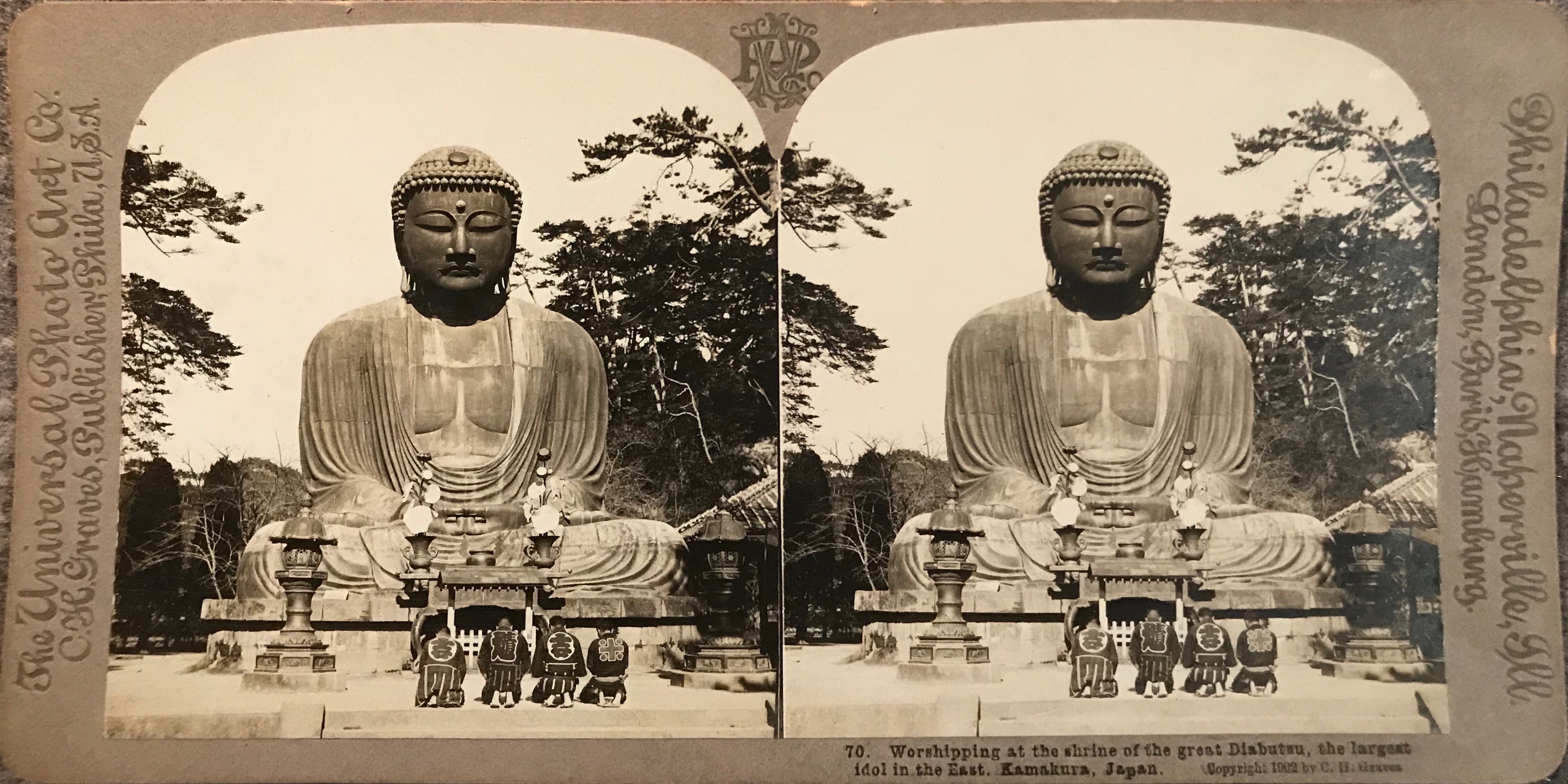
Carlton Harlow Graves (d. 1943?) started the Universal Photo Art Company in the early 1880’s and eventually offered pirated stereoscopic views of Japan in the late 1890s. Looking to enter into the market dominated by Underwood & Underwood’s “Strohmeyer Set,” Graves hired an inexperienced stereo-photographer, Herbert George Ponting (1870-1935), to expand and establish his company’s Japan portfolio.[1] Having only turned a professional photographer a year before, Ponting arrived in Japan around the fall of 1901 and photographed the scenery of Japan into early 1902. This was the first of at least five extended stays over the next five years for Ponting who would go on to work for three different seteroview publishers in his short career. Graves decided to use Ponting’s images as the base for a massive 200-view series on Japan, unprecedented in size given that only 72-view sets of Japan were issued at the time. It would be several years before other publishers would offer anything of a similar scope. This was the first and only time Ponting worked for Graves, but the portfolio of Japanese images Ponting would build over the next few years would increase his reputation significantly, ultimately allowing him to be invited as the official photographer for the ill-fated British Antarctic Expedition of 1910-13. On the eve of leaving for the expedition in 1910, Ponting published his reminiscences of his stays in Japan as In Lotus-Land Japan, profusely illustrated by his own photography.
Title/Caption: Worshipping at the Shrine of the Great Daibutsu, the Largest Idol in the East. Kamakura, Japan
Year: 1902
Photography: Herbert George Ponting (1870-1935)
Publisher: Universal Photo Art Company, Carlton Harlow Graves (d. 1943?)(#70 out of 200)
Medium: sliver gelatin print; mounted on curved slate-colored card
Dimensions: 7 in X 3.5 in
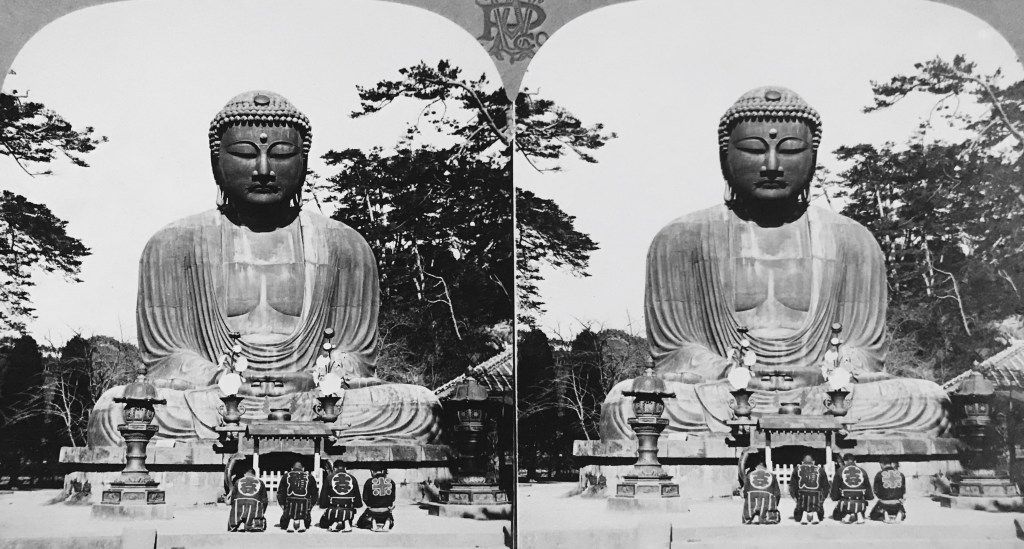
Ponting’s image of the Daibutsu is uncommon in several regards. It gives significant visual weight to the row of four Japanese men kneeling, eyes downcast, in apparent reverence to the Buddhist image. This kneeling posture is almost unique among the dozens of stereo-photographs of this temple scene. Indeed, the only other image with kneeling supplicants I have encountered I suspect to also be under Ponting’s artistic direction. The orchestration of such a scene should not be too surprising. The visual cue of kneeling would immediately signal to a Western audience a pious act of religiosity. The caption on the card also makes it apparent that the act of worshipping is to be highlighted, as are the non-aesthetic religious dimensions of the statue, which is clearly labeled an “idol.”
The lowered heads of the men mirror that of the Daibutsu, who in turn softly gazes down at them, creating an atmosphere of solemnity, possibly even penitence. The garments worn by the men create a strong contrast and the bold design keeps bringing the viewer’s eye back to their reverent posturing. The foreign-looking crests on their backs remind the viewer that they are not Western tourists. The clothing is traditional festival wear (happi 法被), and it remains unclear if Ponting was entirely fortunate to be photographing on the day of a festival, or if he hired the men to don the festive, bold attire; though I suspect the latter. In other regards, the images is fairly standard, taken from almost the same frontal position as Strohmeyer’s version, but cropped more tightly around the Daibutsu, who in turn becomes more centered. By having the men kneeling, an illusion is created whereby the perfectly centered Daibutsu appears larger, almost as if determining the fate of the men.
Notes
*This is part of a series of posts devoted to exploring the development of a visual literacy for Buddhist imagery in America. All items (except otherwise noted) are part of my personal collection of Buddhist-themed ephemera.
[1] For more detailed information on Ponting and Graves, see Bennett 2006.
References
Bennett, Terry. 2006. Old Japanese Photographs Collector’s Data Guide. London: Bernard Quaritch Ltd.
Additional Posts in Visual Literacy of Buddhism Series
After completing his series of photographs commissioned by C.H. Graves and the Universal Photo Art Company, Herbert George Ponting (1870-1935) was hired by the premier publishers of stereoviews, Underwood & Underwood, in 1903 to take new stereo-photographs of the scenery of Japan.[1] These new images would replace the older series by Henry Strohmeyer, which was already almost a decade into its profitable run. For this set, Underwood & Underwood would expand the total number of views from 72 to 100, bringing them up to pace with their competitors who were enlarging their Japanese portfolios. Ponting was in Japan (or its neighboring regions) from spring to late fall 1903, and his images were published on the now-standard slate-colored mounts in 1904. By the end of his stereo-photography career, Ponting would have produced more images of Japan than any other Western stereo-photographer, having shot eight separate volumes of 100-view sets for an array of publishers in the first decade of the twentieth century. His reminiscences of his stays in Japan were published in 1910 as In Lotus-Land Japan, not surprisingly illustrated by copious amounts of his own photography.
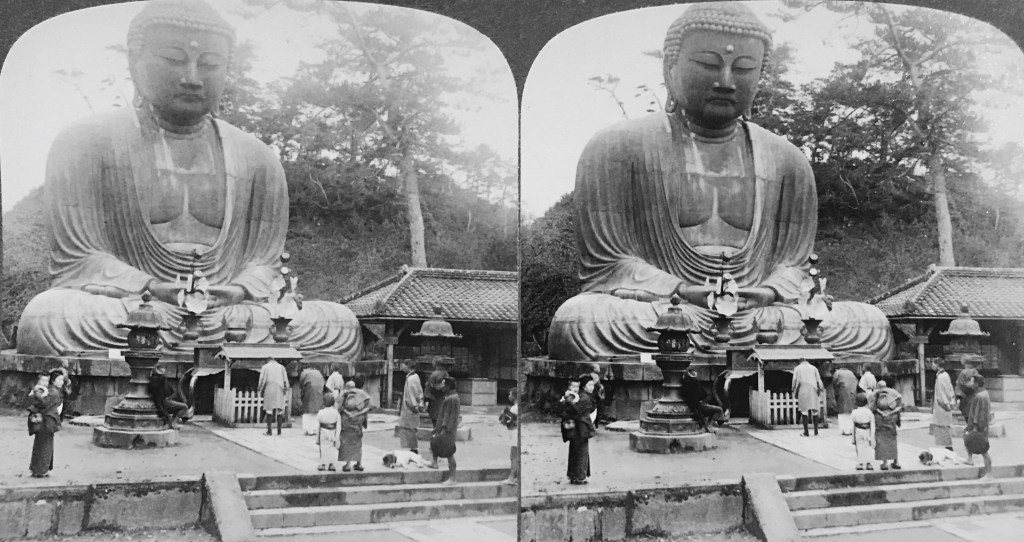
Title/Caption: Majestic Calm of the Great Bronze Buddha, Revered for Six Centuries, (Facing S.W.) Kamakura, Japan
Year: 1904
Photographer: Herbert George Ponting (1870-1935)
Publisher: Underwood & Underwood; part of “Tour of Japan” (#11 out of 100)
Medium: sliver gelatin print; mounted on curved slate-colored card
Dimensions: 7 in x 3.5 in
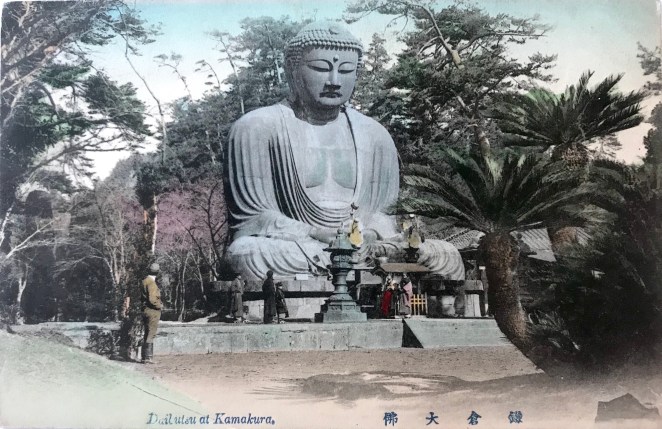
Ponting’s approach to photographing the Daibutsu stands in contrast to that of Strohmeyer. Avoiding the all-too-common frontal symmetry employed by decades of professional and amateur photographers, Ponting takes his image from a few paces off-center, almost at three-quarters view (and abandons having his subjects kneelin reverence). It is possible he was imitating the composition made famous by his contemporary Enami Nobukuni 江南信國 (1859-1929), who fastidiously avoided the frontal view of the Daibutsu, albeit with far more panache than Ponting. In Ponting’s image, the scene is crowded by Japanese onlookers, comprised of men, women, and children, all paying homage to the Buddhist image, with those closest lowering their heads in reverence. With the worshiper’s feet firmly planted and their gaze seemingly synchronized, the scene appears a touch too orchestrated. There is one exception, however. In the lower left, a young woman and baby gaze off to the side and back, with the eyes of the child seemingly looking directly at the viewer. Due to this eye contact, the viewer is made uncomfortable; attention is brought to the ethnographic voyeurism at play in such images. Acting as a real tourist, the viewer is “sight-seeing” as well as being seen by the actors in this imaginary drama. [2]
The casualness of the worshipers, dressed in a variety of loose-fitting garments, and the presence of the resting dog reassert some of the mundaneness of the scene. Looking more closely, we can spot a young man reclining on the base of the left lantern, adding to the sense that the viewer is actually peering into the daily temple environs. The caption brings attention to the “majestic calm” of the Daibutsu, asking the viewer to recognize the serenity of the setting, despite the small crowd of worshipers looking frozen in their spots. The photograph and its accompanying caption strike a balance between highlighting the wonder of the statue and the religious activities of Japanese commoners.
In addition to the multi-lingual captioning on the reverse side of the card saved from its 72-view predecessor, this set also included a lengthy description and history of the scene depicted on the obverse (some variant editions lack this description, however). By opening with a second-person form of address (“You are about an hour’s ride by rail…”), the readers are immediately transported into the role of a globetrotting tourist making their way through the foreign terrain of Japan. The three-dimensional effect of stereoviews combined the stylized point-of-view of the description all act to make the beholder of the card a truly virtual tourist. The descriptive account employs ample amounts of pathos, drawing upon nostalgia for the “old times of mediæval splendor” and nuanced detail of the craftsmanship of the statue, highlighting the value of the “solid gold” eyes and “pure silver” ūrṇā. In form, this does not differ greatly from the genre of guidebooks and travel account narratives, of which many readers would likely be familiar. The description ends with comments on Japanese religious practice, and directs readers to Lafcadio Hearn’s (1850-1904) Glimpses of Unfamiliar Japan, first published in 1894 and which had become a popular seller.[3]
Underwood & Underwood also produced a half-stereo “positive” image (the inverse of the original negative image) as a magic lantern slide. Lantern slides were marketed for use during public “lecture-sermons” – often called stereopticon shows – where an individual could present on a topic to a crowd gathered at a theater, church, fraternal lodge, or private home. Underwood & Underwood sold (and rented) pre-made lecture-sermons which contained a script of about twenty-five to forty minutes and forty to sixty slides. While our specimen below is black and white, the set would contain sepia colored slides as well as full color slides to give “variety pleasing to the eye.”
Title/Caption: Great Bronz [sic] Buddha, Kamakura Japan.
Year: 1904
Photographer: Herbert George Ponting (1870-1935)
Publisher: Underwood & Underwood; (#3850)
Medium: glass and photographic emulsion, paper
Notes
*This is part of a series of posts devoted to exploring the development of a visual literacy for Buddhist imagery in America. All items (except otherwise noted) are part of my personal collection of Buddhist-themed ephemera.
[1] For more detailed information on Ponting and the publishers Underwood & Underwood, see Bennett 2006.
[2] It was not uncommon for stereoview publishers to sell the rights of their images for use in other printed media. Half of Ponting’s stereoview, for example, was used in Clive Holland’s Things Seen in Japan, published in 1907, (pg. 215). This stereocard can also be viewed here.
[3] As described by Thomas Tweed, Hearn was a romanticist, focusing on the exotic, aesthetic, and literary dimensions of Buddhism, see Tweed 2000. This would be a natural fit for the middle-to-upper class consumers of stereoviews, who would have shared many similar sentiments.
References
Bennett, Terry. 2006. Old Japanese Photographs Collector’s Data Guide. London: Bernard Quaritch Ltd.
Tweed, Thomas A. 2000. The American Encounter with Buddhism, 1844-1912: Victorian Culture and the Limits of Dissent, Revised Edition. Chapel Hill: University of North Carolina Press.
Additional Posts in Visual Literacy of Buddhism Series









































 Personal Site of Peter Romaskiewicz