For all the new Buddhas in the West posts follow us on Bluesky & Instagram
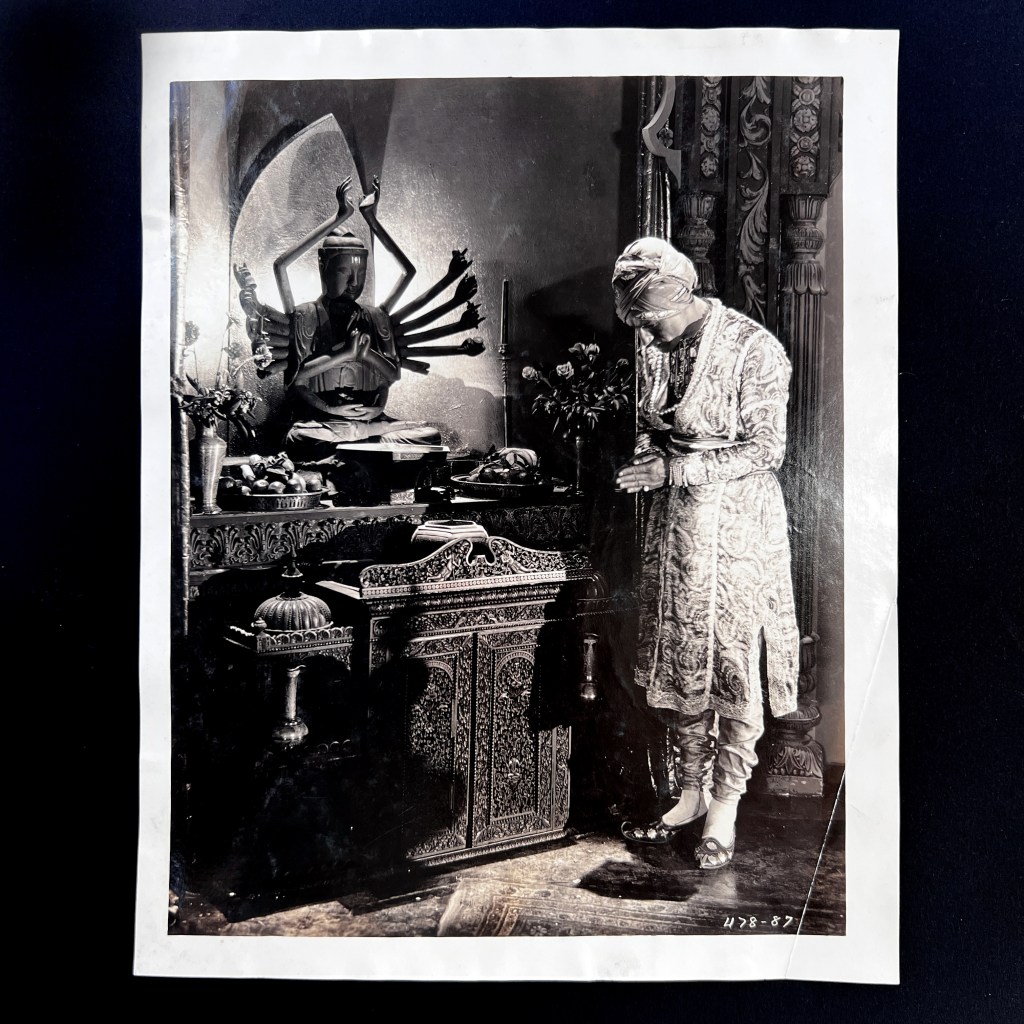
A Lost Film: The remake of The Cheat in 1923 starred Pola Negri in her second American film; she gave rise to the cinematic femme fatale. As with many silent films of the era, The Cheat is considered lost and theatrical stills are some of the only pictorial documents remaining.
Theatrical stills – shot since the advent of feature films in the 1910s – are simply production photographs. Over the last century they have become highly collected artifacts, here we can see where the photo was affixed to an album page.
The image here shows Charles de Rochefort playing a cunning art dealer masquerading as an East Indian Prince. The set design uses a multi-arm statue to underscore his foreign, and potentially nefarious, identity.
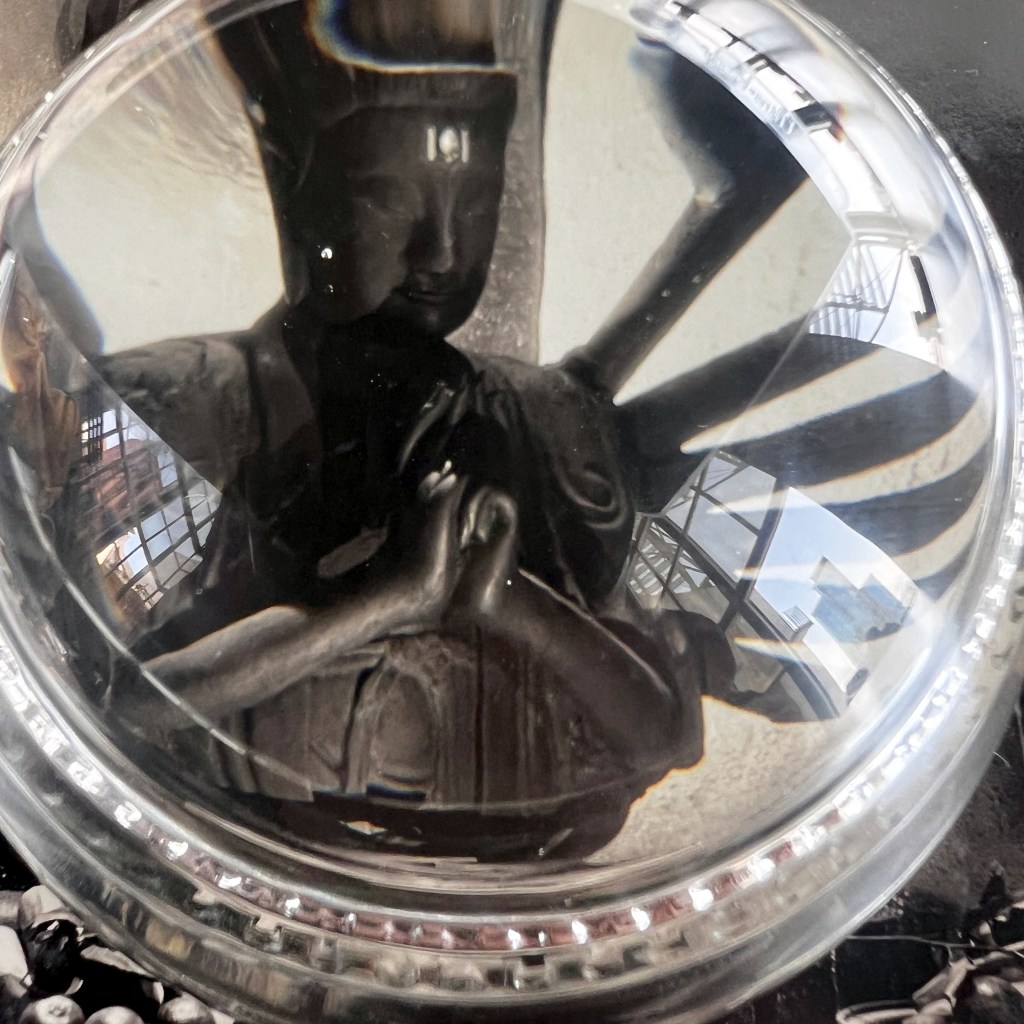
Looking closely at the statue, is does not appear to be a studio-made prop. The features and style suggest an authentic East Asian icon.
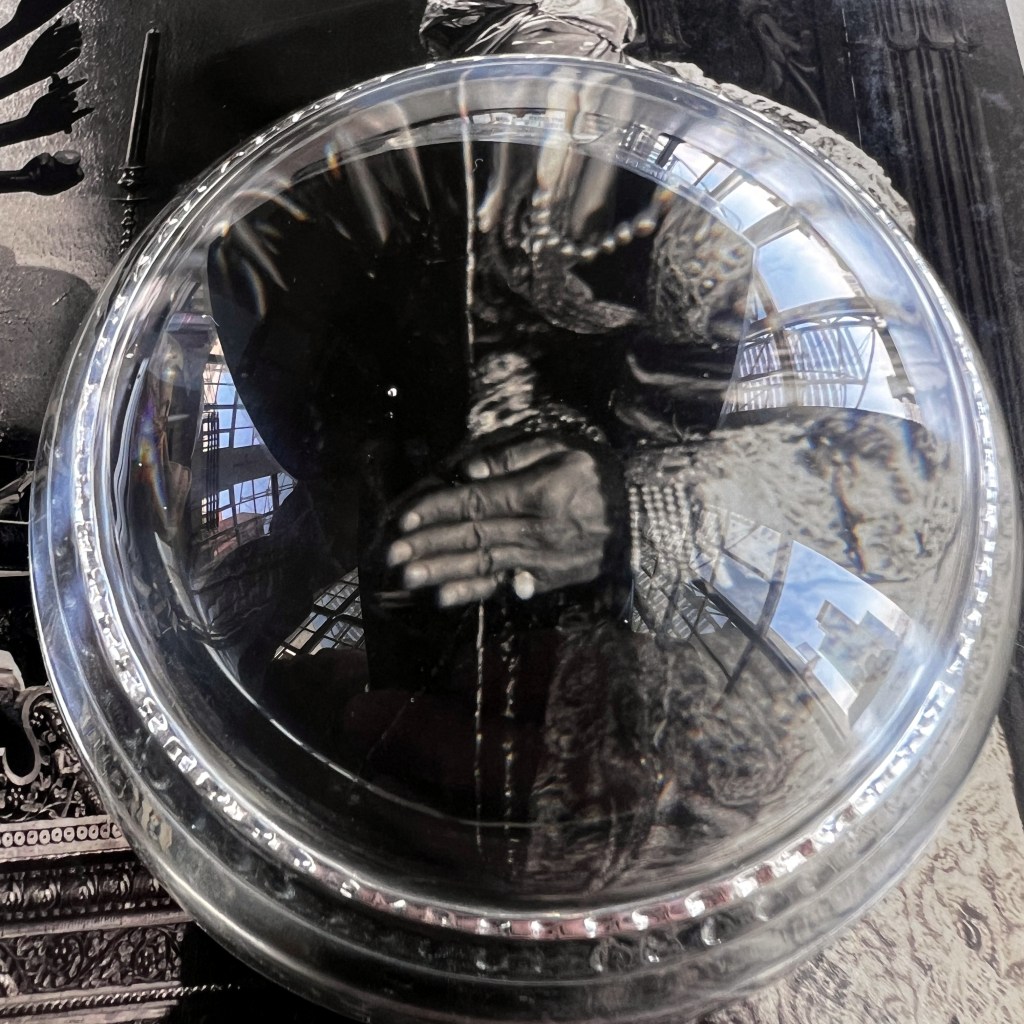
The richly brocaded costuming hints at the character’s royal pedigree, while his posture of reverence reveals his non-Christian religious allegiance.
A similar icon was photographed by German photographer Hedda Morrison in China between 1933–1946. It is viewable through Bristol’s Visualizing China project here: https://hpcbristol.net/visual/Hv08-085
The Buddhas in the West Material Archive is a digital scholarship project that catalogues artifacts depicting Buddhist material culture for Western audiences. It’s comprised of prints, photos, and an assortment of ephemera and other objects. For a brief introduction to this archive, visit the main Buddhas in the West project page.
For Related Buddhas in the West Posts Featuring Historical Photography:
For all the new Buddhas in the West posts follow us on Bluesky & Instagram
Early Photographic Souvenirs: When Baron Raimund von Stillfried (1839–1911) opened his Yokohama studio in 1871, globe-trotting was becoming the rage among wealthy elite. This phenomenon was reflected in Jules Verne’s Around the World in 80 Days, published in 1873.
A decade earlier, the small format carte-de-visite had emerged as one of the most popular products of commercial photography studios. Originally used as inexpensive family portraits carried in jacket pockets, they soon turned into common tourist souvenirs.
The 19th century globe-trotting circuit included port in Yokohama, the first landfall as you came west across the Pacific. Stillfried’s souvenir photo bears a handwritten note: This is Diaboots The Japanese God what they worship he is a big size
“Diaboots” refers to Daibutsu.
Stillfried became well known for his Japanese landscapes, a genre that was also popular among foreign globe-trotters.He would carefully frame Japanese people into his shots to underscore elements of foreignness.
Stillfried also published larger format prints bound into albums. An early exemplar from 1872, titled Views and Costumes of Japan, is held by the Metropolitan Museum of Art, viewable here: https://tinyurl.com/yuuf52u9.
The Buddhas in the West Material Archive is a digital scholarship project that catalogues artifacts depicting Buddhist material culture for Western audiences. It’s comprised of prints, photos, and an assortment of ephemera and other objects. For a brief introduction to this archive, visit the main Buddhas in the West project page.
For Related Buddhas in the West Posts Featuring Historical Photography:
For all the new Buddhas in the West posts follow us on Bluesky & Instagram
Buddhist Demon of Shangri-la: Andrew Marton’s 1952 film, Storm over Tibet, utilizes Buddhist material culture to drive the Cold War horror-fantasy narrative. Filmed in part at Lamayuru in Ladakh, a cursed cham dance mask is a surrogate for the menacing antagonist.
Storm Over Tibet was a remake of Marton’s pre-war German-Swiss film Demon of the Himalayas from 1935. For both films Marton used documentary footage from the 1934 International Himalayan Expedition. Some of the same footage also was used for Columbia’s Lost Horizon in 1937.
The co-lead, Diana Douglas, holds the hand of a Buddhist statue owed by the prop department of Columbia Pictures. It appears to be an image of Cundī. While large Asian statuary was oftentimes created by studio prop departments, this appears as if it was an authentic, yet incomplete, Buddhist artifact. [Update: This is the Daoist stellar deity Doumu, related to the Buddhist Cundī]
Marton’s 1935 German film, Demon of the Himalayas, incorporating on-location footage is available on the Internet Archive, viewable here: https://tinyurl.com/253rhr48.
The Buddhas in the West Material Archive is a digital scholarship project that catalogues artifacts depicting Buddhist material culture for Western audiences. It’s comprised of prints, photos, and an assortment of ephemera and other objects. For a brief introduction to this archive, visit the main Buddhas in the West project page.
For Related Buddhas in the West Posts Featuring Historical Film Photography:
For all the new Buddhas in the West posts follow us on Bluesky & Instagram
Barbed-wire Buddhas: Buddhist objects were precious – and rare – at American Japanese internment camps during WWII. Here, issei Buddhist priest Rev. Gyōdō Kōno, stands in front of a small shrine to Amida Buddha at the Jerome relocation camp in Arkansas.
In February 1942, Executive Order 9066 was authorized, forcing the incarceration of more than 110,000 Americans of Japanese descent. Most were Buddhist. Japanese Buddhist temples on American soil were closed and only a few small religious items could be brought to the camps.
Often, items like shrines (butsudan), altar tables, and other ritual implements were made from scraps of wood with delicate care.
Buddhist rosaries (o-nenju), like the one held by Rev. Kōno, were important ritual items for the Jodo Shinshu sect.
After leaving the Jerome camp, Rev. Kōno relocated to Chicago and founded the Midwest Buddhist Temple which is still open today.
The Smithsonian National Museum of American History owns one of the internment camp Buddhist shrines from Jerome along with other items from the internment era. The shrine can be viewed here: https://tinyurl.com/yvb3heut
The Buddhas in the West Material Archive is a digital scholarship project that catalogues artifacts depicting Buddhist material culture for Western audiences. It’s comprised of prints, photos, and an assortment of ephemera and other objects. For a brief introduction to this archive, visit the main Buddhas in the West project page.
For Related Buddhas in the West Posts Featuring Historical Photographs:
For all the new Buddhas in the West posts follow us on Bluesky & Instagram
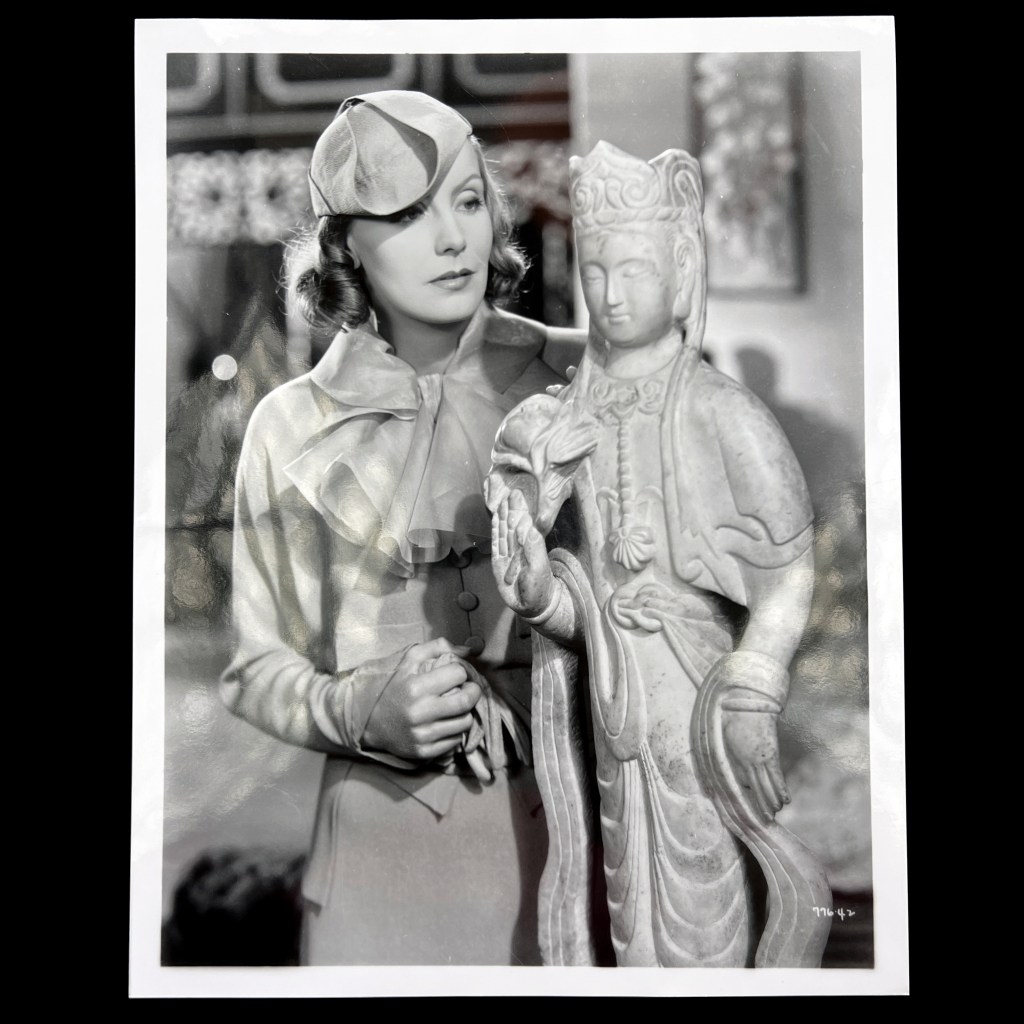
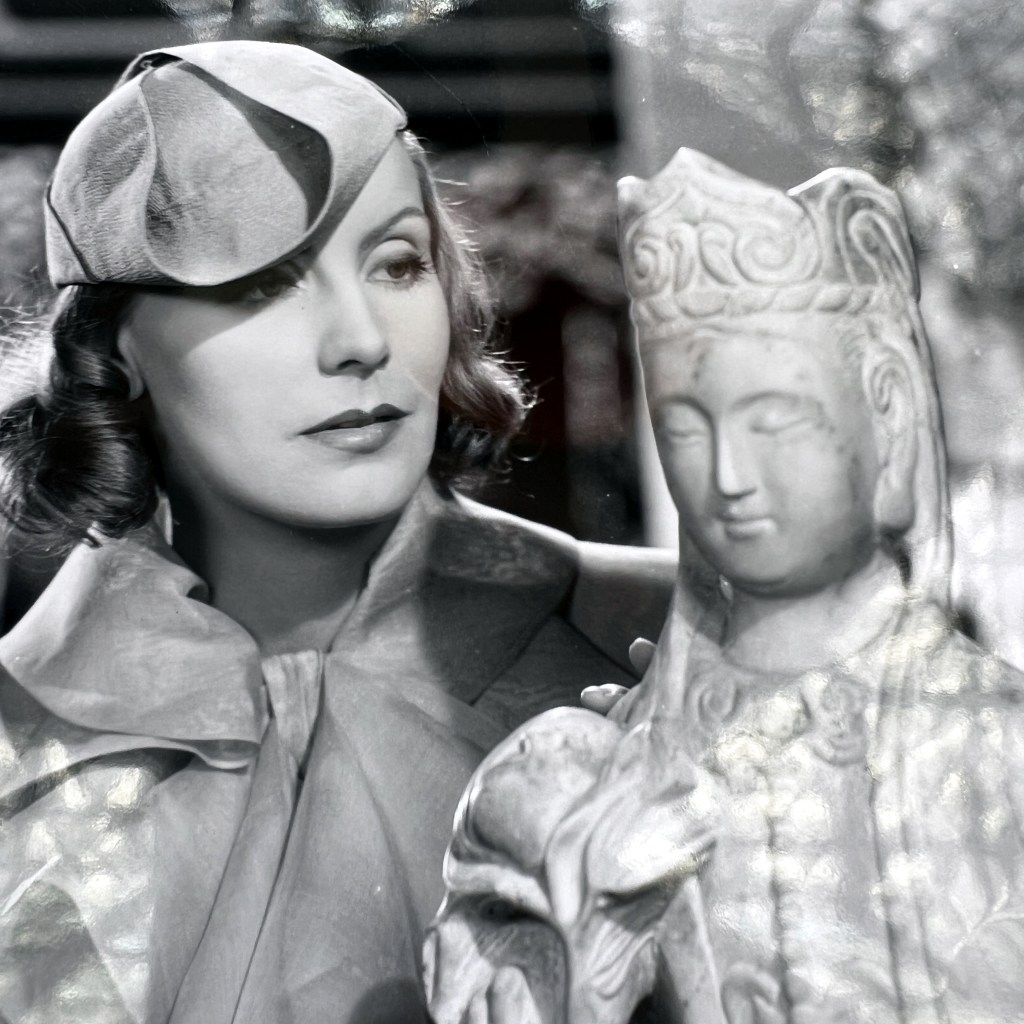
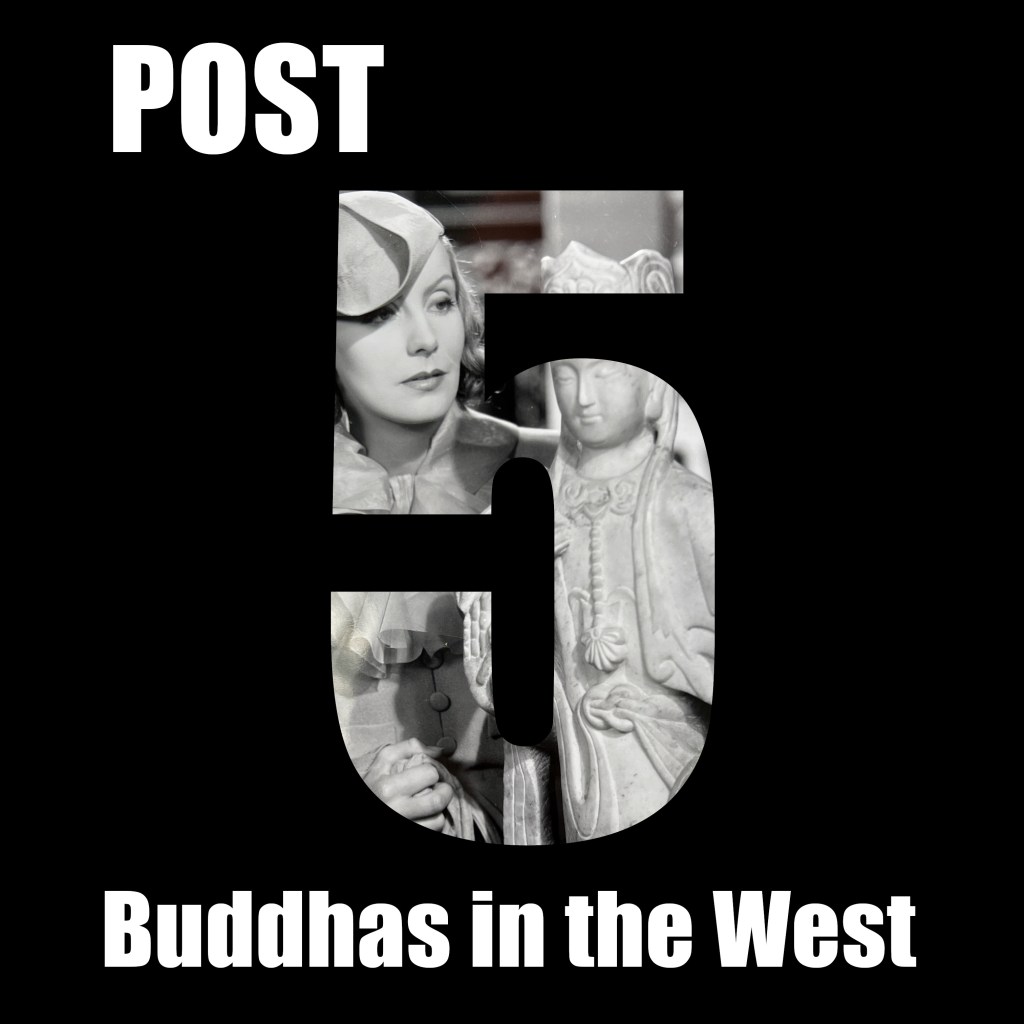
A theatrical still of Greta Garbo in the 1934 film The Painted Veil gazing upon a standing image of Guanyin. Looking closely, we see Garbo’s hand touching the shoulder of Guanyin, a moment of contact between the “icons.”
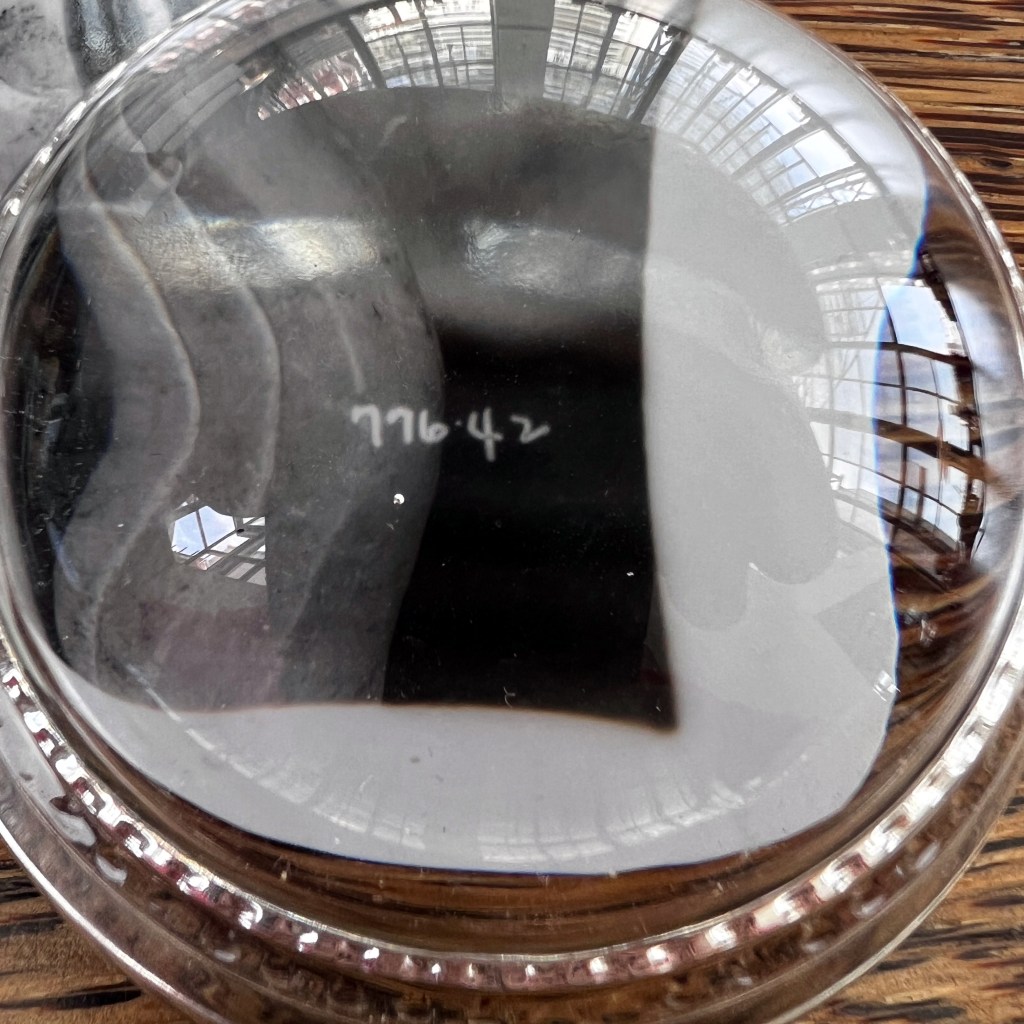
Theatrical stills – shot since the advent of feature films in the 1910s – are production photographs. Many were kept by the studio in albums called keybooks, while others were printed for promotional purposes, often marked with a code (here we see 776–42).
As advertising material, stills would often picture “tension, struggle, action,” but not reveal main elements of the plot, as noted by David Shields.
The scene here is not in the final edit of The Painted Veil, but would have occurred when Garbo’s character arrived in rural China during a cholera outbreak. The touch of the shoulder signaled an arrival into a far-away land, reflected in the materiality of the Buddhist icon.
For more on the history and interpretation of early film still photography, see David S. Shields’ Still: American Silent Motion Picture Photography (2013).
The Buddhas in the West Material Archive is a digital scholarship project that catalogues artifacts depicting Buddhist material culture for Western audiences. It’s comprised of prints, photos, and an assortment of ephemera and other objects. For a brief introduction to this archive, visit the main Buddhas in the West project page.
For Related Buddhas in the West Posts Featuring Historical Film Photography:
For all the new Buddhas in the West posts follow us on Bluesky & Instagram
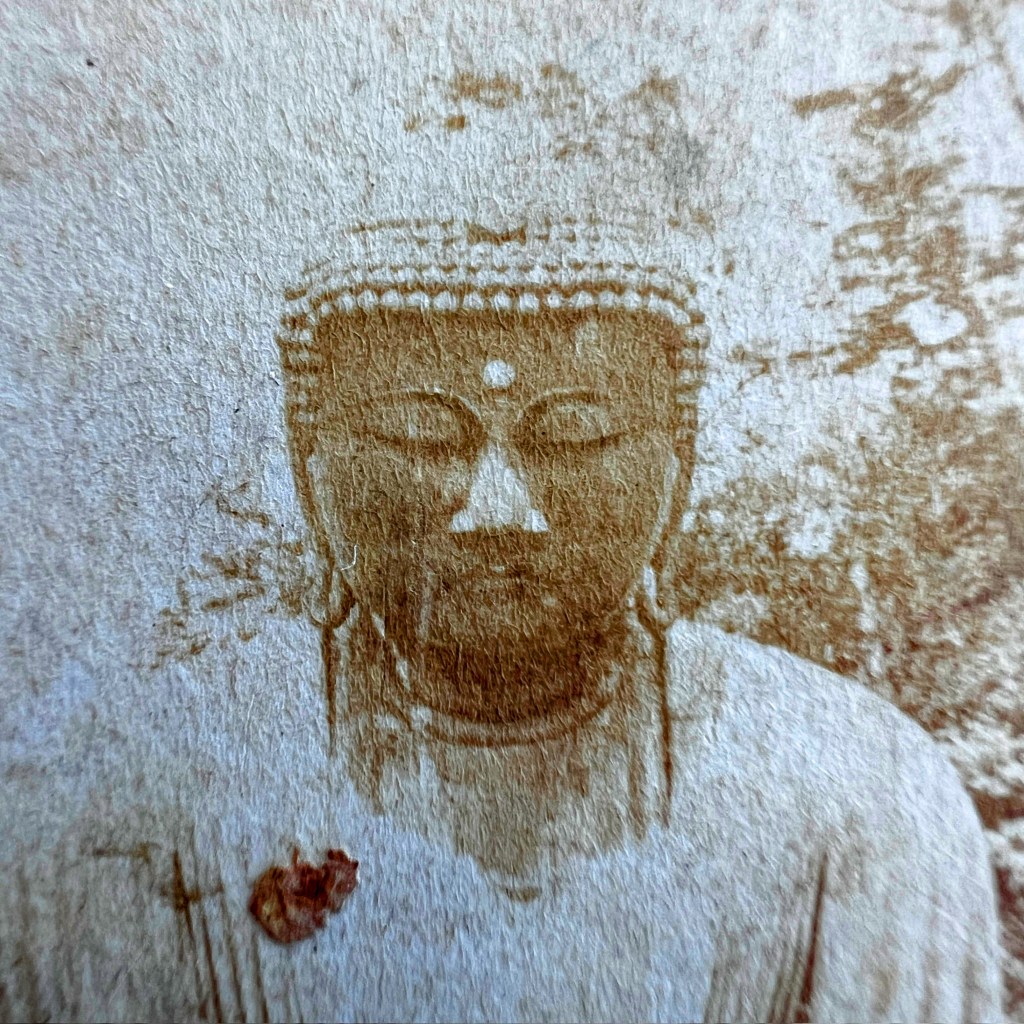
Shimooka Renjō 下岡蓮杖 was one of the first Japanese to practice commercial photography, opening a studio in Yokohama in 1862. A treaty port teaming with globetrotting tourists, Yokohama was also in close proximity to the Kamakaura Daibutsu.
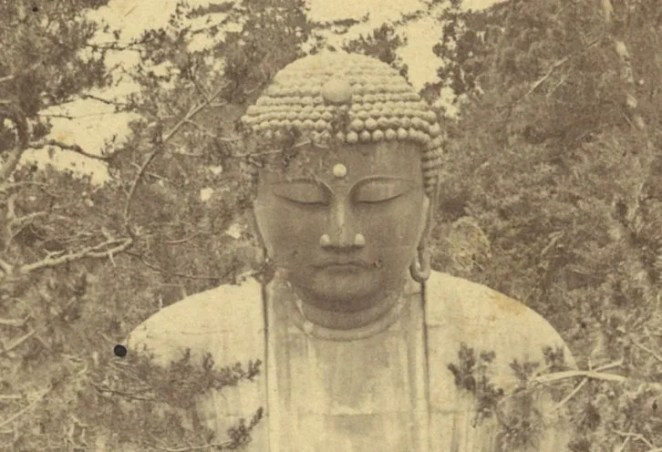
This is a bronze statue of Amida Buddha dating to the 13th century. The small format carte-de-visite (CDV) print shown here is hand dated to October 7, 1871 – possibly the date when a tourist visited the Daibutsu site. Renjō’s stamp identifies him as the photographer.
The portability of the CDV made them good souvenirs of travel, especially before the picture postcard industry blossomed a few decades later. The thin photosensitized print was affixed to thicker card stock for added durability.
Even small details can be captured by the relatively early wet-plate photographic process.
For an excellent introduction to early Japanese photography and 19th century tourist photography see the collection at Harvard Library here: https://tinyurl.com/yfsbj7du.
The Buddhas in the West Material Archive is a digital scholarship project that catalogues artifacts depicting Buddhist material culture for Western audiences. It’s comprised of prints, photos, and an assortment of ephemera and other objects. For a brief introduction to this archive, visit the main Buddhas in the West project page.
For Related Buddhas in the West Posts Featuring Historical Photography:
In 1868 Wilhelm Burger (1844–1920) was appointed as the official photographer to the Austria-Hungary ligation to Siam, China, and Japan. In preparation for this inaugural diplomatic and commercial enterprise, Burger prepared numerous photographic glass negatives that could be later exposed to capture images of the mission. By employing the dry collodion process for capturing photographs, Burger no longer needed to use a portable darkroom as was necessary with the older wet collodion process. Burger was among the first to use the dry collodion method in Japan.[1]
Recently, Luke Gartlan has shown that Burger did not arrive in Japan with the lead Austrian naval vessel, the Donau, in early September 1869, but was delayed in Shanghai taking photographic records of Chinese artworks. He arrived a few weeks later, skipping the customary port-of-call at Nagasaki and rejoining the ligation at Yokohama.[2] After falling ill and subsequently requiring hospitalization, Burger was allowed to remain in Japan to continue his photographic documentary work as the rest of the mission continued on to South America that November. Burger remained in Japan until March 1870, disembarking out of Nagasaki on his way back to the Austrian Empire.
During his sixth month stay Burger was able to amass a large portfolio of Japanese images, both larger format landscapes and smaller format studio portraits.[3] Based on studio furnishings and props, it has long been known that Burger’s portraits were taken in the pioneering Japanese photographic studios of Ueno Hikoma 上野彦馬 (1838–1904), established in Nagasaki, and Shimooka Renjō 下岡蓮杖 (1823–1914), established in Yokohama. More critically, it has recently been shown that some of Burger’s purported photographs were more than likely taken by Ueno Hikoma and Shimooka Renjō themselves. For example, as Tani Akiyoshi and Peter Pantzer have demonstrated, the studio portrait negatives that remain in the Austrian National Library were prepared with the wet collodion process used extensively across Japan.[4] We may assume that Burger purchased these smaller format negatives and their copyrights to print and sell back in Europe.[5]
Figure 1
When we turn to Burger’s published portfolio of fifty-seven Japanese views held at the British Museum, catalogued as A Series of 56 [sic] Views of Towns, Villages in Japan, we find Buddhist figural imagery prominent in eight photographs, including three individual plates of the Kamakura Daibutsu.[6] One of these latter photographs (plate 59), with another example shown above [Fig. 1], depicts three men in Western attire, with two looking towards the camera and one towards the colossal bronze.
This photograph has sometimes been attributed to the famous photographer and Yokohama resident Felice Beato (1832–1909), but I feel this is unwarranted.[7] In spite of the fact that a photograph published under Burger’s name does not necessarily prove he made the original exposure, Burger did arrive in Japan prepared to take larger format landscape photographs, just as we see with this image of the Daibutsu. Moreover, as noted by Akiyoshi and Pantzer, the average size of Burger’s surviving dry collodion plates was 150 x 200 mm.[8] These would be contact printed on photosynthesized paper, thus a resulting print would have the same dimensions. The print illustrated here measures 135 x 200 mm, approximating the average size of Burger’s negative plates.
Moreover, given the popularity of the Daibutsu among foreigners in Yokohama (it was one of the few places within the established treaty boundaries), it seems natural that Burger would make the excursion during his stay in Japan from late fall to early spring and attempt to preserve it as part of his photographic record.[9] Other commercial photographers, such as William Saunders (1832–1892), William Andrew (fl. 1865), and Felice Beato, all previously included the bronze Kamakura icon as part of their studio portfolios.[10] The statue was arguably one of the most photographed objects in the region at the time.
The men in Western clothing in Burger’s photo remain unidentified. Another print showing some the same men in different positions is held by the Yokohama Museum of Fine Art; this is also currently attributed to Beato.[11]
After Burger’s return to the Austrian Empire he was granted the title of imperial and royal photographer (k.k. Hofphotograph) in November 1871. That same year he published Bilder aus Japan, a portfolio of his Japanese prints. A copy is held by the British Museum under the aforementioned English name A Series of 56Views of Towns, Villages in Japan.
[1] Gartlan 2009: 73, Akiyoshi & Pantzer 2011: 44, 49. There are notices of the French photographer Paul Champion (1838–?) (albeit with very limited success) and English amateur photographer Angus C. Fairweather using dry collodion plates in Japan before Burger’s arrival, see Bennett 2006b: 124 and 307.
[3] Upon his return to Austria, Burger also sold stereoviews of his travels, but these were not taken with a stereo camera and thus do not produce stereoscopic 3-D images, see Bennett 2006a: 169.
[4] According to the estimates of Akiyoshi and Pantzer, out of the 188 surviving negatives of Japan, 27 plates should be ascribed to Ueno Hikoma and 44 plates to Shimooka Renjō, see Akiyoshi & Pantzer 2011: 41. The authors raise other concerns as well, such as the limited time Burger had to organize and set up all of the studio models as well as his apparent misunderstanding, as exemplified in his later captions, of the locals portrayed.
[5] Such a practice was not uncommon at the time, see Akiyoshi & Pantzer 2011: 49–50.
[6] This includes object numbers: c13562-26 (plate 19), c13562-30 (plate 23), c13562-33 (plate 26), c13562-37 (plate 30), c13562-54 (plate 47), c13562-66 (plate 59), c13562-67 (plate 60), and c13562-68 (plate 61). The final three objects listed here depict the Kamakura Daibutsu.
[7] See, for example, the identification of this photograph held by the Santa Barbara Museum of Art (Ac. 2003.42.3) and the National Library of New Zealand (Ref. PA1-f-021-057-2). The latter photograph is part of the album compiled by Alexander Fisher (fl. 1861–1879) and entitled Album of Photographs Compiled on Cruises aboard HMS Endymion with the Flying Squadron and in the Mediterranean. The HMS Endymion sojourned in Yokohama for a few days in April 1870, only a month after Burger departed Japan. I speculate the Burger left a few prints of his work in local Yokohama shops before returning to Austria. Another print showing some the same men in different positions is held by the Yokohama Museum of Fine Art (Ref. 91-PHF-008); it is also attributed to Beato.
[9] Judging from the three photographs, it appears Burger made at least two trips, a possibly three, to the Kamakura Daibutsu: once in winter when the foliage was absent from some trees (see British Library items c13562-66 [plate 59] and c13562-67 [plate 60]) and once in early spring when the foliage had returned (c13562-68 [plate 61]). This latter photograph also shows additional damage to the railing on the left side of the image, suggesting it was taken at a different time. Another photograph of the Daibutsu reputedly taken by Burger can be found in his published stereoview set. One copy of the stereograph is preserved in the Nagasaki University Library (No. 3436). This image shows the entire railing intact and thus was either taken during Burger’s winter excursion or he procured it from another photographer in Japan. In any regard, the non-stereo photograph is found in Burger’s K. K. Mission nach Ostasien 1868-1871 preserved by the Museum für angewandte Kunst (Ref. KI 13660-15-2). It measures 86 x 71 mm, an approximate size that is appropriate for a stereoview.
Burger may have also taken another photograph that was used for the inaugural publication of the The Far East: A Monthly Illustrated Journal on May 30, 1870. It shows the left side railing completely removed. This would suggest Burger took at least a third trip to the Kamakura Daibutsu (or it is possibly the work of another photographer). Nevertheless, a copy of the photo is found in Burger’s K. K. Mission nach Ostasien 1868-1871 preserved by the Museum für angewandte Kunst (Ref. KI 14291-395). It measures 195 x 141 mm, although it appears part of the glass negative extends beyond the print.
[10] An article in the October 25th, 1862 issue of the Japan Herald describes Saunders selling a photograph of the Daibutsu, see Bennett 2006a: 59. An advertisement in the October 14th, 1865 issue of the Japan Herald notes Andrew selling a Daibutsu print, see Bennett 2006b: 120. The Daibutsu was a staple of Beato’s albums in the 1860s, see, for example, Lacoste 2010: 15.
Akiyoshi, Tani, and Peter Pantzer. 2011. “Wilhelm Burger’s Photographs of Japan: New Attributions of His Glass Negative Collection in the Austrian National Library.” PhotoResearcher 15:40–50.
Bennett, Terry. 2006a. Old Japanese Photographs Collectors’ Data Guide. London: Bernard Quaritch Ltd.
Bennett, Terry. 2006b. Photography in Japan 1853-1912. Rutland, VT: Tuttle Publishing.
Gartlan, Luke. 2009. “Photography and the Imperial Austrian Expedition in Nagasaki (1869-70).” Koshashin Kenkyu 古写真研究 3:72–77.
Lacoste, Anne. 2010. Felice Beato: A Photographer on the Eastern Road. Los Angeles: J. Paul Getty Museum.
For nearly three decades after the first Japanese postal cards were issued in 1873, printing and distribution were strictly controlled by the government. Only with changes in postal codes in 1900 could private publishers start printing and selling their own postcards. Importantly, and for the first time, these privately issued cards could bear images on the obverse, thus being termed “picture postcards” (ehagaki絵葉書). Previous government-issued specimens were printed blank to accommodate a sender’s written message. Moreover, the growing use among Japanese print shops of inexpensive collotype printing equipment meant photographs could be easily reproduced for this new medium. Many early photographic postcards are reproductions of images originally created and sold in Japanese photography studios, as is the case with the examples here.
Figure 1
Title/Caption: DAIBUTSU AT KAMAKURA
Year: 1900-1907 (postally unused)
Photographer: Esaki Reiji 江崎礼二 (1845-1910)[?]
Medium: collotype print on cardstock, hand-tinted
Dimensions: 5.5 in X 3.5 in
Reverse Imprint: Union Postale Universelle. CARTE POSTALE, 萬國郵便聯合端書
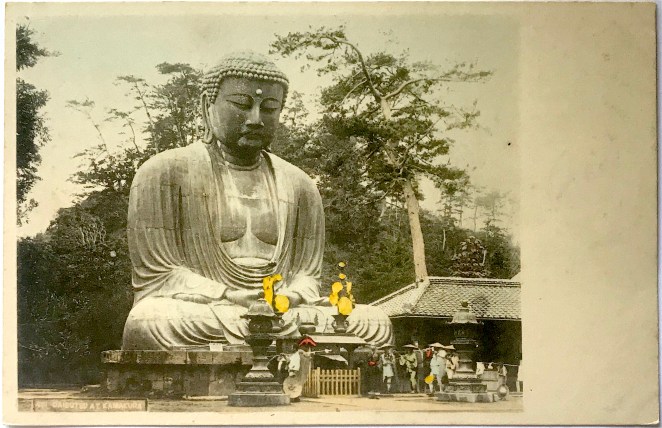
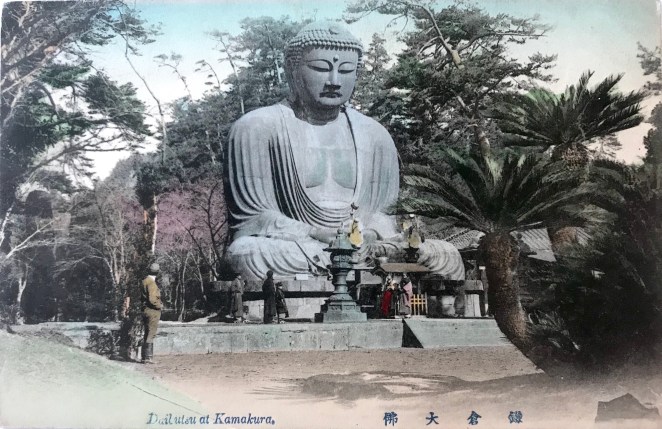
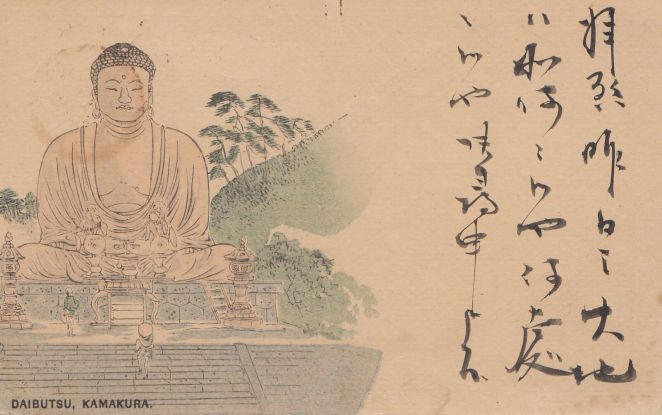
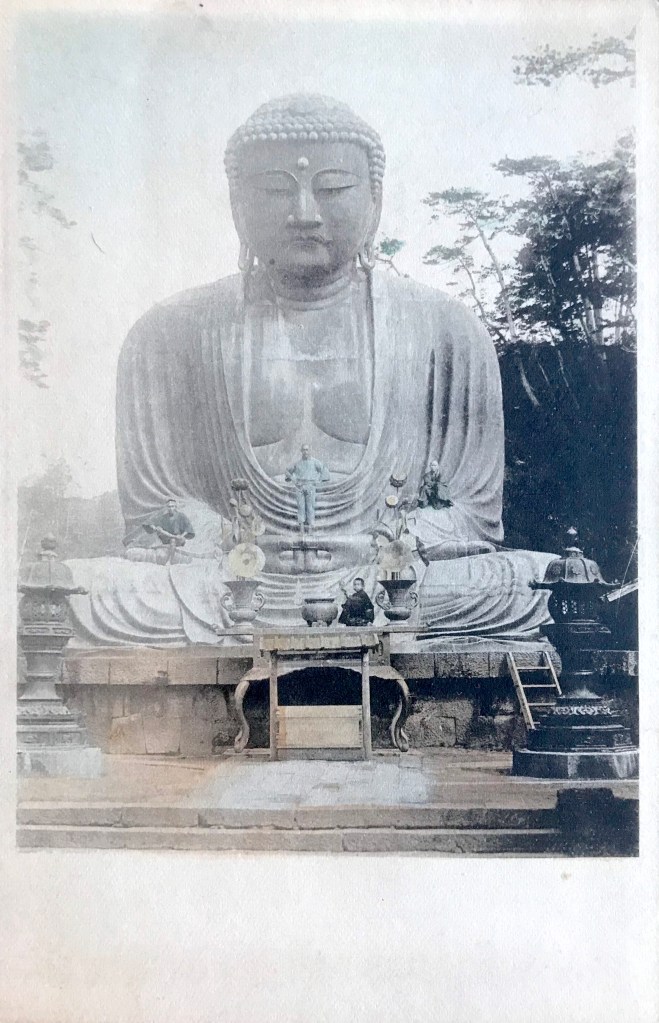
This postcard depicts the Kamakura Daibutsu, scaled to fit in the upper-left corner of the card [Fig. 1]. The blank space on the right side was reserved for a written message; Japanese postal code required the reverse side to be reserved solely for the name and address of the recipient. Once messages could be included on the reverse in 1907, postcard images were regularly scaled to fit the entirety of the obverse side.
For artistic flourish, the publisher of our card employed a subtle trompe-l’œil, making it appear as if the corner of the photographic image is curling off the paper. Visual illusions such as this would make the postcard stand out among a sea of similar imagery. Printed in large block lettering, the caption clearly denotes the subject of the photograph, the “Daibutsu at Kamakura.”
Figure 2
Title/Caption: 451 [or 461] DAIBUTSU AT KAMAKURA
Year: 1900-1907 (postally unused)
Photographer: Esaki Reiji 江崎礼二 (1845-1910)[?]
Medium: collotype print on cardstock, hand-tinted
Dimensions: 5.5 in X 3.5 in
Reverse Imprint: Union Postale Universelle. CARTE POSTALE, 萬國郵便聯合端書
Another postcard employs the same photograph. Here, the image covers a larger portion of the card, but lacks the trompe-l’œil effect [Fig. 2]. Additionally, the caption is much smaller and incorporates an identifying stock number, 451 (or possibly 461). It is of note that a caption which incorporates a stock number with a title is characteristic of prints made by Japanese photography studios of the 1880’s and 1890’s. By comparing this stock number to known lists gleaned from published Japanese studio albums, it appears likely the original photograph was taken by Esaki Reiji 江崎礼二 (1845-1910), a famed Tokyo-based photographer.[1]
Esaki apprenticed under the pioneering photographer Shimooka Renjō 下岡蓮杖 (1823-1914) in 1870 before opening his own studio in 1871 in Asakusa Park.[2] He soon established himself as a technical master, among the first of Japanese photographers to adopt the new gelatin dry-plate (zerachin kanpan ゼラチン乾板) technique in 1883 and executing technically difficult pictures of a naval mine detonating in the Sumida River (1883) and night-time exposures of a lunar eclipse (1884) and exploding fireworks (1885). The shorter exposure times of the dry-plate process also allowed Esaki to more easily photograph fidgeting children, an expertise he proudly displayed in a famous collage of more than 1700 young children and infants (1893).[3]
Figure 3
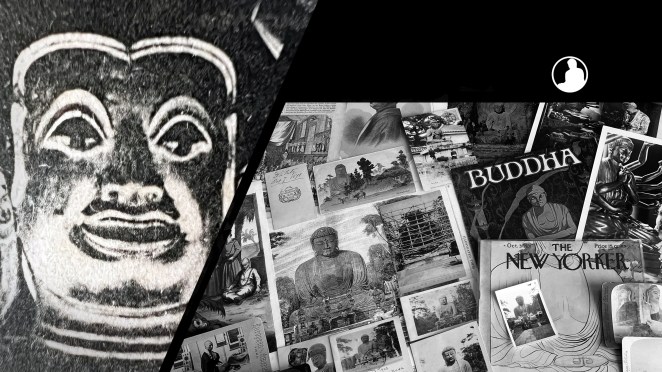
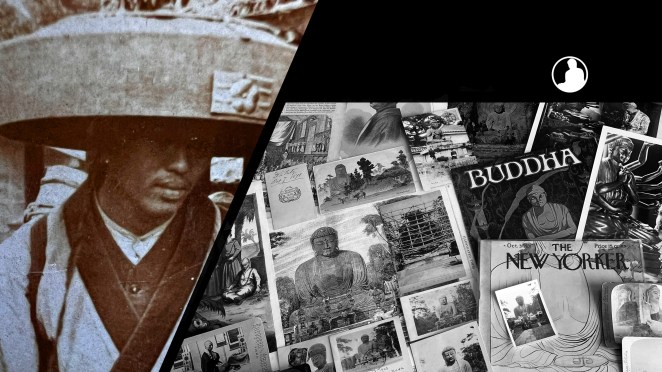
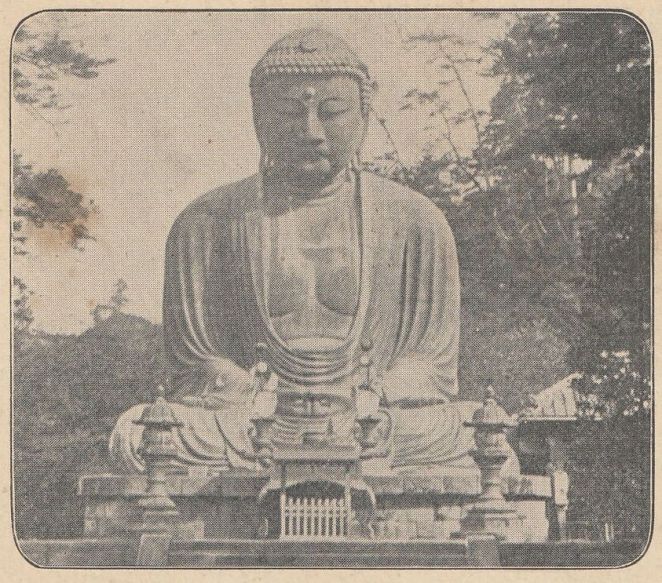
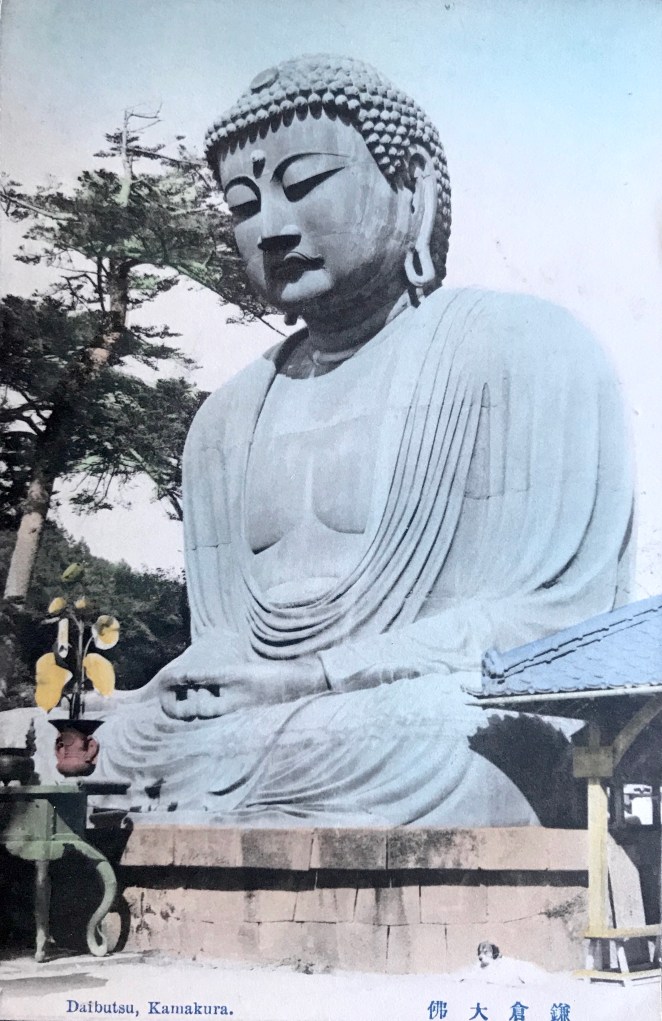
The photograph of the Daibutsu by Esaki (or one of his studio assistants) depicts the bronze statue from the southwest corner, an uncommon, but notunprecedented angle. More relevant to the site’s religious heritage, the photograph shows a line of Japanese pilgrims (jinreisha 巡礼者) in front of the Daibutsu, easily identified by their broad circular sedge hats and walking staffs carried over their shoulders [Fig. 3]. The mise-en-scène is more relaxed than reverent. The lead pilgrim, who holds his hat in his hand, appears to read the small rectangular sign perched on the pedestal (which, coincidentally, forbids climbing on the statue), while his fellow travelers casually stand conversing with one another. Only the temple priest by the offering table glances directly towards the camera.[4] This mundane expression of religious piety stands in contrast to the highly orchestrated images of devotion sometimes staged by Western photographers. Significantly, the distinction between Japanese pilgrim and tourist is often blurred, as both can engage in similar activities at a pilgrimage site, including visits to the temple souvenir shop.
Although faded, the hand-tinting is still visible in both cards, with the slate blue colossus overlooking his faithful visitors. The elements in the scene suggest this photograph was taken in the late 1890’s.[5]
Figure 4
The reverse of both cards is bordered by an ornamental filigree-like design in burgundy ink [Fig. 4]. These are examples of “undivided back” cards, since no line yet separates the areas on the back where the correspondence and address would later come to be written. This functions now as an easy identifier for dating old postcards, with these dating between 1900 and 1907. Since it was not yet common for publishers to imprint their names or trademarks on the back, it is difficult to tell who printed these beautifully rendered cards.
[1] Stock lists for Esaki’s studio do not include numbers 451 or 461, but numbers 452 to 460 are all images of Kamakura, specifically Hachiman Temple, the Daibutsu, and the lotus ponds in Kōtokuin (the temple that houses the Daibutsu). See Bennett 2006a: 129. Unfortunately, almost all attributions to Esaki and his studio remain tentative and more work desperately needs to be done on his photographic oeuvre.
[2] For Esaki’s biographical information, see Bennett 2006b: 165 and here and here. Several Japanese resources note his name as “Ezaki,” but I follow the standard English “Esaki,” which is also how he promoted his studio on photographic mounts and in other published materials (the older “Yesaki” can also be found).
[3] This image was also sold in the United States through Sears & Roebuck catalogues.
[4] Closer inspection reveals a young boy towards the far right of the photograph, holding his hat in his hand, also possibly peering towards the camera
.
[5] I have seen postcards of this image cancelled in January 1902, setting a firm terminus ante quem for the photograph. I have also seen a third postcard, oriented vertically, bearing this same photograph.
Additional Posts in Visual Literacy of Buddhism Series
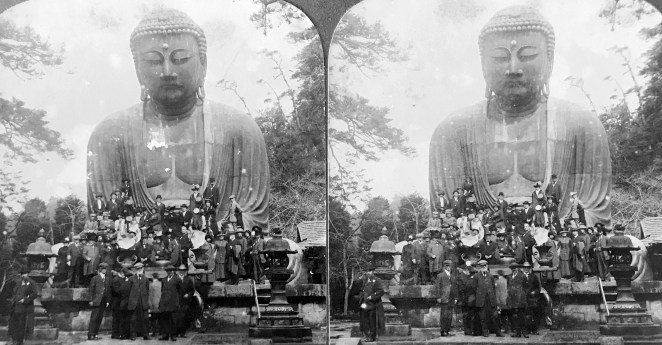
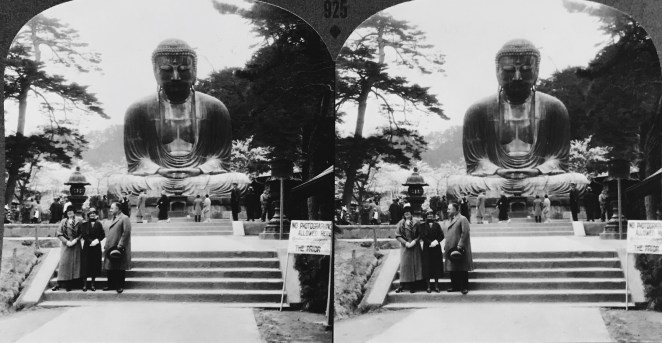
On October 16, 1909, the S.S. Cleveland left Hoboken, New Jersey on the first commercial around-the-world cruise. American tour operator, Frank C. Clark, chartered the Cleveland from the German operated Hamburg-American Line, leaving the east coast with a party of 650 passengers and traveling eastward through the Suez Canal before making landfall in San Francisco three months later on January 31, 1910. Because the Panama Canal was four years away from completion, the passengers completed the last leg of the around-the-world tour via train, returning to their origin point on the east coast. Thus, although Clark’s cruise was not a complete circumnavigation of the globe, the public and press treated it as such. Five days after landing in San Francisco, the Cleveland re-crossed the Pacific Ocean to start a second around-the-world tour, this time carrying more than 750 passengers. Clark’s pair of world tours generated significant amounts of publicity, with thousands appearing in San Francisco to send the ship off. The Cleveland made several subsequent trips between 1912 and 1914 until the advent of World War I interrupted access to the German-owned vessel.[1] The standard itinerary for trans-Pacific cruises of the period included a longer stopover in the port of Yokohama. Here, passengers could go ashore and enjoy the local sites, including a visit to the Kamakura Daibutsu.
One of the most popular publishers of stereocards, Underwood & Underwood, took advantage of these widely marketed luxury world tours and assigned a stereo-photographer to accompany the guests aboard the Cleveland to chronicle the trip. These new stereophotographs then became stock in Underwood & Underwood’s massive catalogue of Japan views and marketed to the general public.
Figure 1
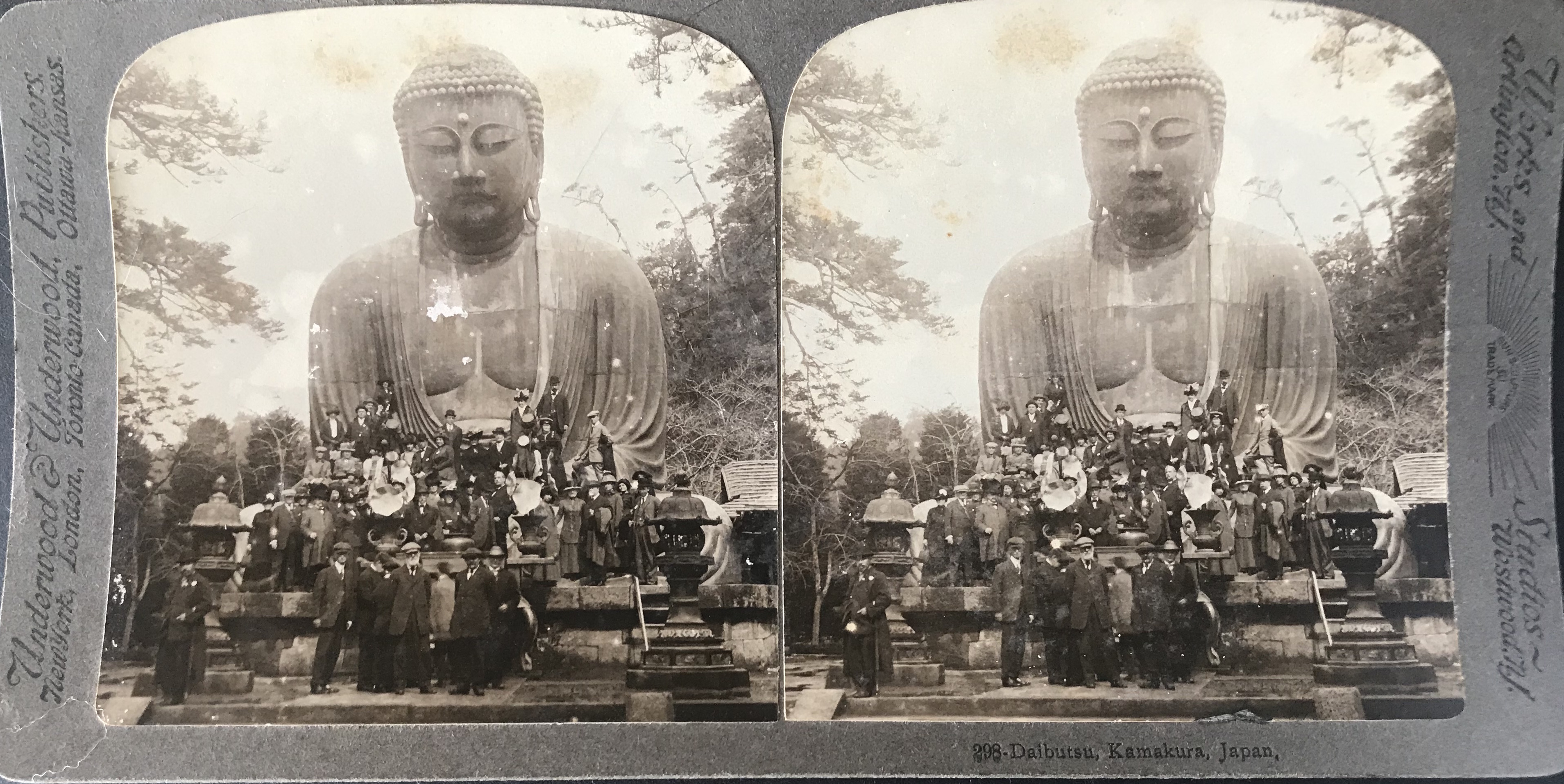
Title/Caption: 298-Daibutsu, Kamakura, Japan
Year: 1913-1914
Photographer: unknown
Publisher: Underwood & Underwood
Medium: sliver gelatin print; mounted on curved slate-colored card
Dimensions: 7 in X 3.5 in
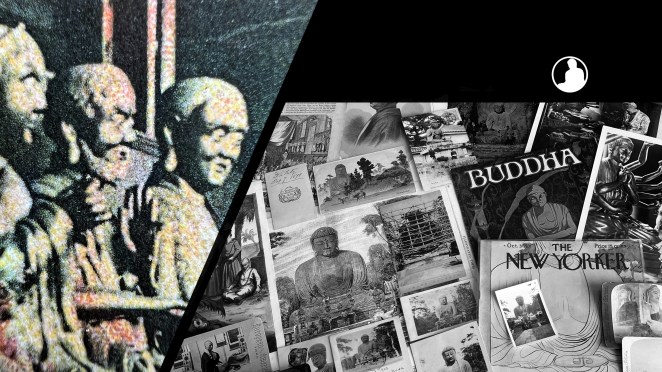
According to the account of R. H. Casey, a passenger aboard the Cleveland during its fourth trip across the globe which arrived in Japan on February 24, 1913, the tourist excursion trips were a sight to behold. Two hundred and forty passengers boarded a train to Kamakura and rode rickshaws from the train station to the temple of the Daibutsu, traveling en masse through the narrow roads of the rustic city’s back country.[2] This feeling of mass tourism is captured perfectly by our unknown photographer’s view, showing a cluster of nearly fifty people crowded in front of the Daibutsu [Fig. 1]. Almost all of the visitors are mounted atop the stone foundation or posing in the lap of the colossal statue. This posturing of gazing towards the viewer reflects a long-standing photographic tradition of collecting exotic “trophies” by being pictured in front of one’s cultural conquests.
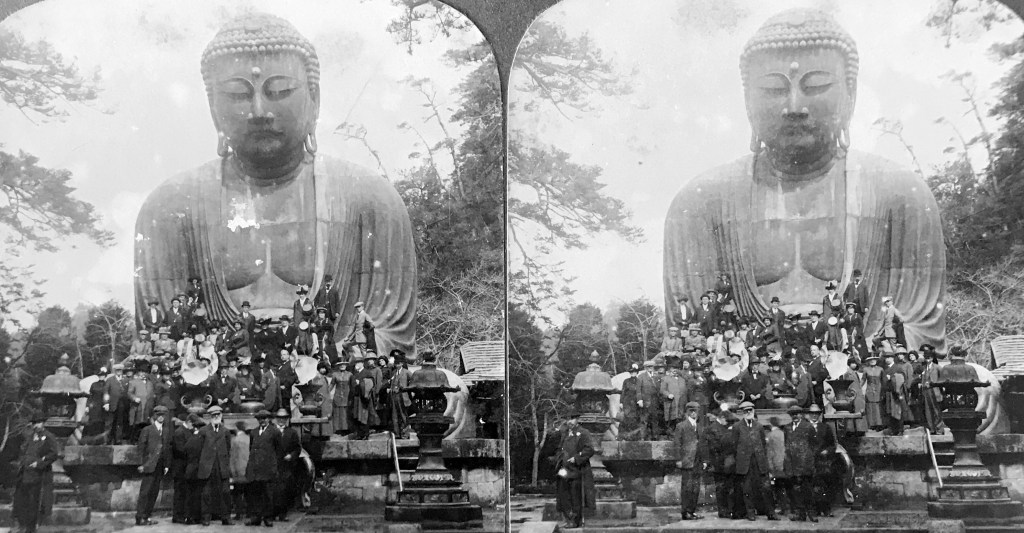
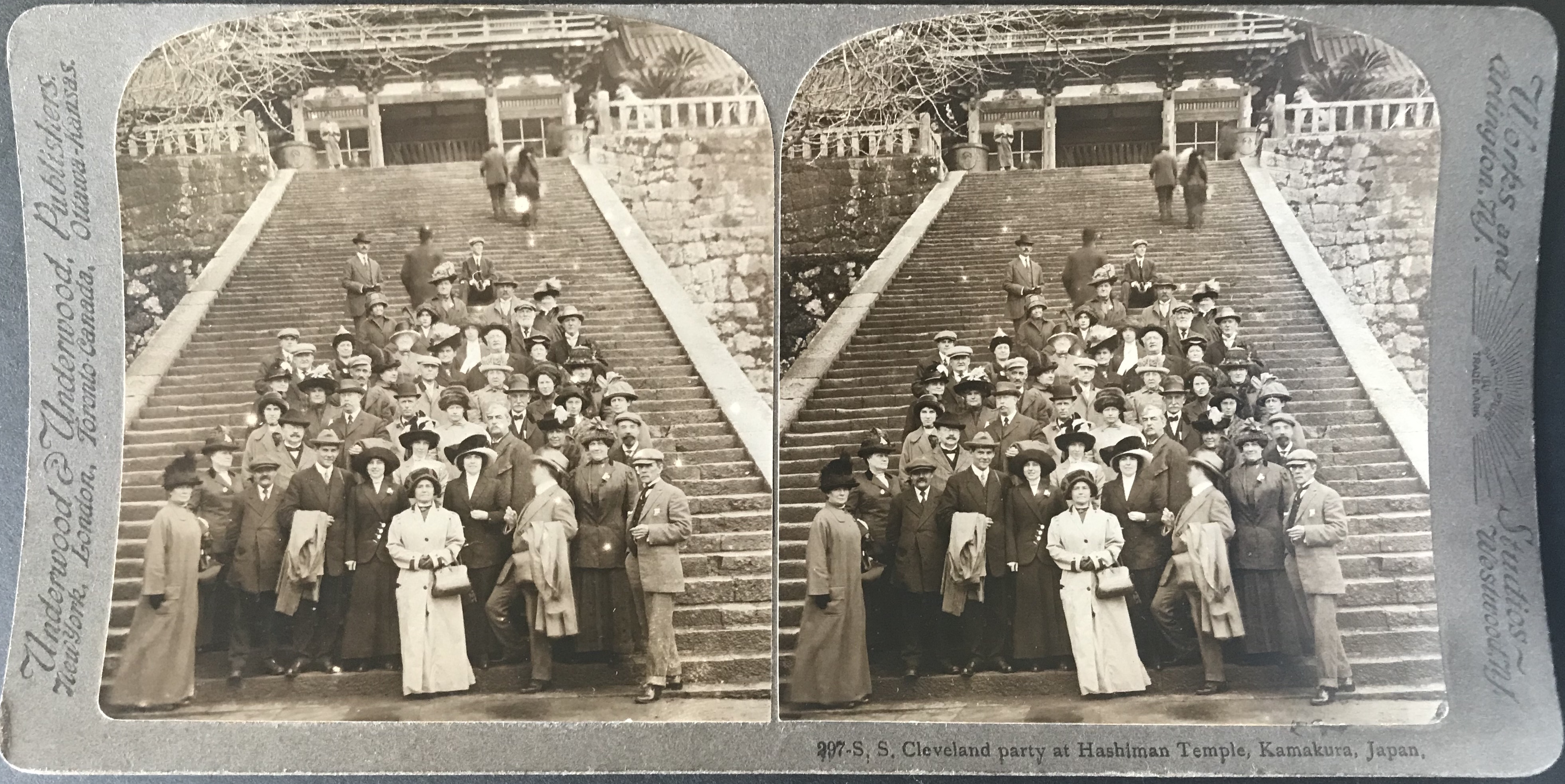
The card itself does not identify the party as originating from the Cleveland, but an adjacent card in the Underwood & Underwood catalogue (number 247, Fig. 2), does identify a large group of tourists perched along the tall stairway of Hachiman Shrine as traveling aboard the Cleveland. Moreover, a close inspection of these two photographs reveals the same individuals are depicted in both.[3] Thus, we can safely assume the visitors to the Daibutsu are among the globetrotters aboard the Cleveland.
Figure 2
It is difficult to determine which around-the-world cruise this group of people joined. Photographs from the initial pair of Clark’s trips, between 1909-1910, show the Daibutsu site displaying a picketed fence and gabled roof on the coin offering box (saisen–bako 賽銭箱), elements that appear – to my eye – to be missing in this stereoview.[4] It is possible this image was taken on one of the second pair of cruises, landing in Yokohama in January and February 1913, having departed from Hoboken and San Francisco respectively.[5] A fifth, and likely final, cruise aboard the Cleveland was scheduled to depart the east coast in January 1914 on a 93-day voyage to San Francisco, with no scheduled “return” trip.[6] Thus, it appears this photograph of the Daibutsu could have been taken during one of these three trips during 1913 or 1914.
In contrast to the other Underwood & Underwood view of tourists atop the Daibutsu, this composition has the feeling of formal portraiture. The visitors are spread out symmetrically along the ground, statue, and stone base, with most looking sternly at the camera lens. As around-the-world cruises became more popular in the interwar period, these large group photos also became more common, sometimes being used in promotional material for the cruise company. The photographs of the 1860s and 1870s that depicted small groups of intrepid travelers (and mostly men), were now festooned with tourists who draw as much attention to themselves as the statue in the background.
Notes:
*This post is in honor of my father, may your curiosity in the odd live on through me.
*This is part of a series of posts devoted to exploring the development of a visual literacy for Buddhist imagery in America. All items (except otherwise noted) are part of my personal collection of Buddhist-themed ephemera.
[1] The Hamburg-American Line advertised heavily for the Cleveland’s first trip through the Panama Canal, scheduled to disembark from Hoboken in January 1915 and bring passengers to San Francisco to celebrate the Panama-Pacific Exposition. I have found no evidence that this trip took place, and given that Germany was in the midst of war by the end of 1914, the excursion was most likely to have been abandoned by the Hamburg-American Line. Accounts of the previous completed trips, where the above information was extracted, can be found in Frizell & Greenfield 1910, Junkin 1910, Bush 1911, Forbes 1912, and Casey 1914.
[2] Casey 1914: 29. According to Casey, they also visited the Kaihin Hotel.
[3] The easiest individual to spot is the sole hat-less man with coiffed white hair and mustache. A second man in a brimmed newsboy hat and white beard is also easily identified in both.
The distinctive plumes in women’s hats also leads to several relatively easy identifications (not pictured). Moreover, Underwood & Underwood Japan-series cards issued with numbers in the 290’s all appear to be issued from the Cleveland cruises.
[4] The photograph by amateur photographer F. H. Wellcome and published in the travelogue of Frizell and Greenwod clearly shows the gabled coin box. (see Frizell & Greenwood 1910: 49).
[5] These dates are noted in Forbes 1912: 27 & 29. Forbes took two trips around the world, starting in Hoboken and travelling eastward until ultimately landing in San Francisco, where he then joined the “return” voyage, heading westwards until back in Hoboken
[6] The Cleveland would have needed to be back in Hoboken for its widely publicized trip leaving in January 1915 (see note above). It is possible the Cleveland left San Francisco and headed for the Panama Canal, testing the crossing without passengers before returning in January. This tour was operated by the Hamburg-American Line directly and Clark would not make his fifth trip around the world until after the war in 1924, when he chartered the S.S. California.
References:
Bush, George Tome. 1911. 40,000 Miles Around the World. Howard, PA: N.P.
Casey, R. H. 1914. Notes Made During a Cruise Around the World in 1913. New York: N.P.
Forbes, Edgar Allen. 1912. Twice Around the World. New York: Fleming H Revell Company.
Frizell, William G. and Greenfield, George H. 1910. Around the World on the Cleveland. New York: N.P.
Junkin, Paul S. 1910. A Cruise Around the World. Creston, IA: N.P.
Additional Posts in Visual Literacy of Buddhism Series
Often called the “founding father of Japanese photography,” Shimooka Renjō 下岡蓮杖 (1823-1914) was a true artistic pioneer. One of the first Japanese to practice commercial photography, Renjō (a self-styled nickname) was also likely the first oil painter and lithographer in Japan.[1] His personal reminiscence, recorded in 1891, claims his fascination with photography began when he saw his first daguerreotype in 1844 in Edo (now Tokyō). He then spent the next ten years trying to find a photographer who could teach him the craft. According to his own account, which is held in suspicion by modern scholars, in 1856 Renjō had a secret meeting with Henry Huesken (1832-1861), the translator to the American general consul at Shimoda, to learn the basic principles of photography. Regardless of the veracity of this story, Renjō opened the first Japanese commercial photography studio in the port city of Yokohama in 1862.[2] His business soon prospered and he apprenticed several of the next generation of famed Japanese photographers, including Usui Shūzaburō 臼井秀三郎, Suzuki Shin’ichi (I) 鈴木真一, and Suzuki Shinichi (II) 鈴木真一. A considerable majority of Renjō’s surviving photographic oeuvre consists of small format cartes de visite, several of which depict the bronze Daibutsu located in Kamakura, not far from his studio in Yokohama.
According to several Western travelers and tour guides from the 1860’s, the original pathway leading to the Daibutsu was a long, stone-paved walkway, tightly flanked by tall evergreen trees and ornately pruned shrubs. For some, the most picturesque view of the Daibutsu was looking down through this long pathway of greenery towards the statue at the end. By the early 1870’s, however, the temple landscaping had undergone significant renovations and the pleasant framing effect of the towering trees was lost. Algernon Bertram Mitford (1837-1916), secretary to the British Legation, described his two contrasting visits to the Kamakura Daibutsu:
“The first time I saw [the Daibutsu], in the autumn of 1866, the approach to it lay along an avenue of grand old evergreen trees, and the effect of the colossus, when seen from the beginning of the avenue, was most striking. Now, unhappily, the trees have been cut down by the avarice of the priests, who grudged the little bit of soil which might bear a few more vegetables, and who took advantage of the revolution to pretend that the trees had been destroyed by the soldiery. The beautiful coup d’oeil is lost, but the figure must always rank among the most wonderful monuments of the world.”[3]
Regardless of the reason behind the removal of the trees, the change in environment certainly altered the viewing experience of the Daibutsu, which was now left in an open grove.
Figure 1
Title/Caption: NA (Diabutz [sic] on reverse)
Year: 1869-1871 (dated Oct. 7, 1871 on reverse)
Photographer: Shimooka Renjō 下岡蓮杖 (1823-1914)
Medium: albumen silver print, mounted on card
Dimensions: 3in X 2in (cartes de visite)
Interestingly, while the early written accounts of visiting the Daibutsu often included a vivid description of the “avenue of grand old evergreen trees,” the surviving photographic record rarely included this aesthetic aspect. Renjō was one of only a few commercial photographers who placed his camera rig far enough away from the bronze statue to incorporate the tree branches that converged on the walkway.[4] [Fig. 1] It remains uncertain if the rarity of this composition is due to a technical consideration of early photography (such as problematic lighting) or the resulting visual product which creates a cramped and partly obstructed view of the Daibutsu. If the latter case, the long row of trees and shrubs which undoubtedly added a sense of depth and scale to the in-person viewing experience is lost in the two dimensional space of the photograph. In the image above, a lone Japanese individual faces directly towards the camera, taking a wide, aggressive stance. This ultimately creates a sense of tension between the image and the viewer.[5]
Figure 2
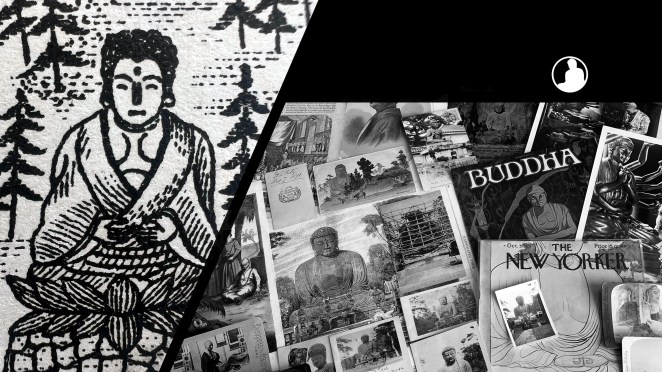
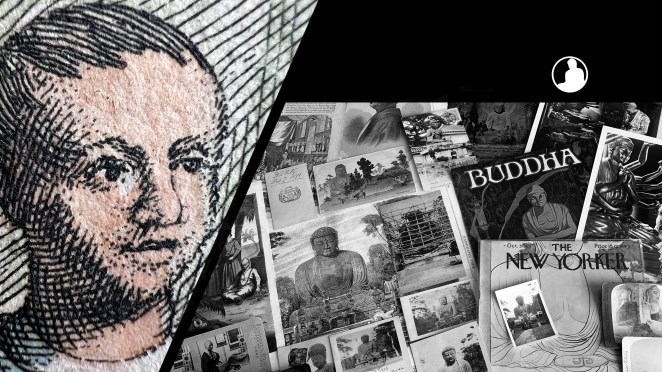
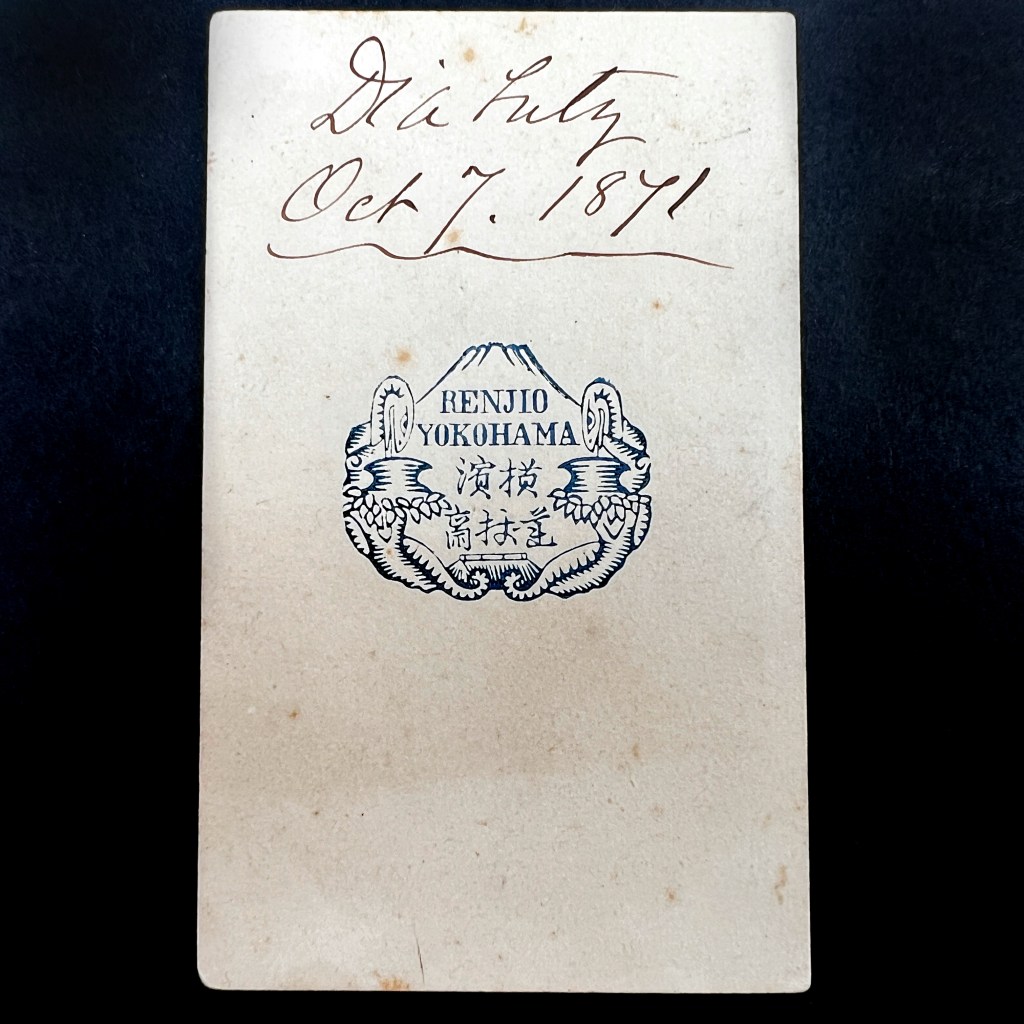
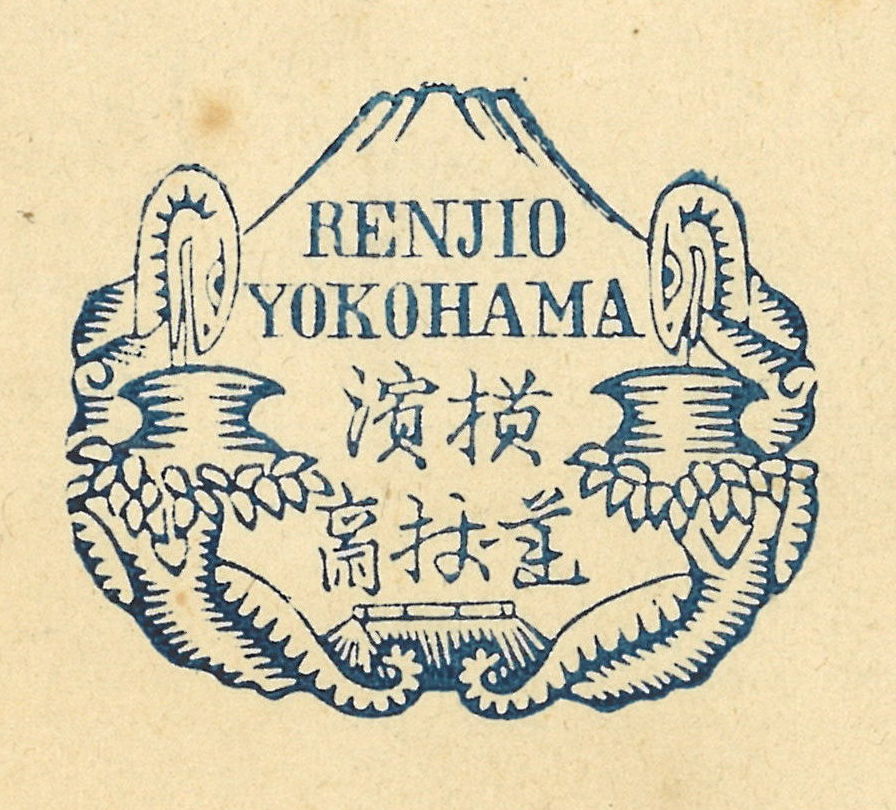
The back of the cartes de visite is stamped by Renjō’s studio mark in indigo blue [Fig. 2]. The hand stamp depicts two serpentine figures twisting around a pair of trees and peering into two pots. The peak of Mt. Fuji and the top of a thatched roof also appear the background. This specific imagery appeared to Renjō in a dream when his business first started to turn profitable, thus he decided to honor his vision by incorporating it into his studio mark. The Japanese characters, written in a variant script (itaiji異體字), simply say, “Yokomaha, Renjō Studio” (横浜 / 蓮杖斎).[6] The handwritten inscription at the top of the card notes the date as October 7, 1871, thus providing a firm terminus ante quem for the photograph. This possibly represents the date an unknown tourist visited the site. The popular name for the Daibutsu in the foreign port city of Yokohama in the 1870’s, “Daibutz,” is also imprinted at the top of the card, with an accidental inversion of the a and i (not all too uncommon a mistake).
During his professional photographic career, Renjō moved his studio to several locations, but never seems to have accumulated great wealth. In the mid-1870’s Renjō ended his commercial photography exploits and moved to the new capital of Tokyō (behind Sensō-ji 浅草寺) where he returned to his previous profession as a Western-style oil painter.
*This is part of a series of posts devoted to exploring the development of a visual literacy for Buddhist imagery in America. All items (except otherwise noted) are part of my personal collection of Buddhist-themed ephemera.
Notes:
[1] Bennett 2006, esp. p. 71. A more detailed examination of Renjō’s life can be found in Tokyo Metropolitan Museum of Photography 2014. Some also credit Renjō with inventing the rickshaw (jinrikisha 人力車), but while this man-powered, two-wheel vehicle first appeared in Japan in the 1860’s, its attribution to Renjō is almost certainly misplaced. For many years, Renjō was considered the first Japanese professional photographer, but recent research suggests this mantle belongs to Ukai Gyokusen 鵜飼玉川 (1807–1887), who opened the first commercial photography studio in Edo in 1860 or 1861.
[2] For analysis of Renjō’s personal account, see Tokyo Metropolitan Museum of Photography 2014: esp. pp. 130-5.
[3] Mitford 1872: 208.
[4] A photograph held in the University of Massachusetts at Amherst, attributed to Felice Beato, contain perhaps the most foliage of any image I have encountered [here]. Another image is here.
[5] Another similar image attributed to Renjō and dated to 1873 can be found at the Freer Gallery of Art and the Arthur M. Sackler Gallery (FSA A1999.35 465)[source]. The position of the camera and framing is almost exact, but the figures by the altar are different. Older images by Renjō (still depicting the railing and balusters on the left) can be found at the Tokyo Photographic Art Museum (here & here) and among the Tom Burnett Collection (here). All three are also depicted in Tokyo Metropolitan Museum of Photography: 2014. The Austrian photographer Wilhelm Burger (1844-1920) traveled in Japan for a year spanning 1869 and 1870, and only some of his photographs of the Daibutsu include the railing to the left of the stairs leading to the second landing. Because of this, Renjō’s photograph here must post-date late 1869.
[6] The mark and its origins is described in Tokyo Metropolitan Museum of Photography 2014: 16-7.
Mitford, A[lgernon] B[ertram]. 1872. “Wanderings in Japan,” The Cornhill Magazine, Vol. 25, No. 146 (February), pp. 196-213.
Ozawa Takesi. 1981. “The History of Early Photography in Japan,” History of Photography, Vol. 5, No. 4, pp. 285-303.
Tokyo Metropolitan Museum of Photography. 2014. Shimooka Renjō: Nihon shashin no kaitakusha 下岡蓮杖: 日本写真の開拓者 [Shimooka Renjō: A Pioneer Of Japanese Photography]. Tōkyō: Kokusho Kankōkai.
Additional Posts in Visual Literacy of Buddhism Series




















































 The photograph of the Daibutsu by Esaki (or one of his studio assistants) depicts the bronze statue from the southwest corner, an uncommon, but











 The back of the cartes de visite is stamped by Renjō’s studio mark in indigo blue [Fig. 2]. The hand stamp depicts two serpentine figures twisting around a pair of trees and peering into two pots. The peak of Mt. Fuji and the top of a thatched roof also appear the background. This specific imagery appeared to Renjō in a dream when his business first started to turn profitable, thus he decided to honor his vision by incorporating it into his studio mark. The Japanese characters, written in a variant script (itaiji
  Personal Site of Peter Romaskiewicz