For all the new Buddhas in the West posts follow us on Bluesky & Instagram
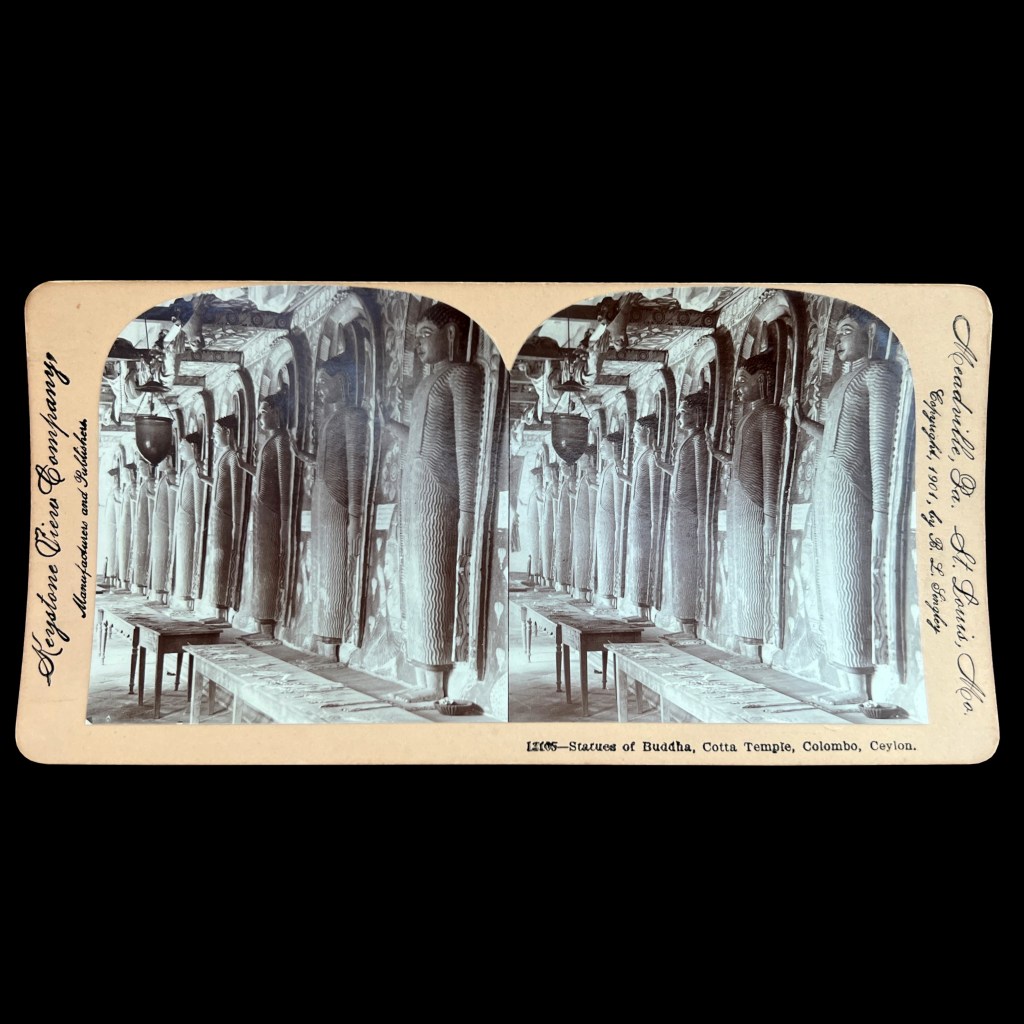
The Kotte Rajamaha Vihara was founded in the 15th century under royal patronage to house a sacred tooth relic of the Buddha. At the time, some considered this the holiest site in Sri Lanka, greater than Aśoka’s Bodhi tree in Anuradhapura and the Buddha’s footprint on Adam’s Peak.
The Cūḷavaṃsa, a Buddhist historical record, describes King Parākramabāhu’s construction of a golden reliquary for the tooth and annual festivals held in celebration. Unfortunately, Kotte temple was destroyed during the Dutch occupation of Sri Lanka, but was rebuilt in the early 19th century.
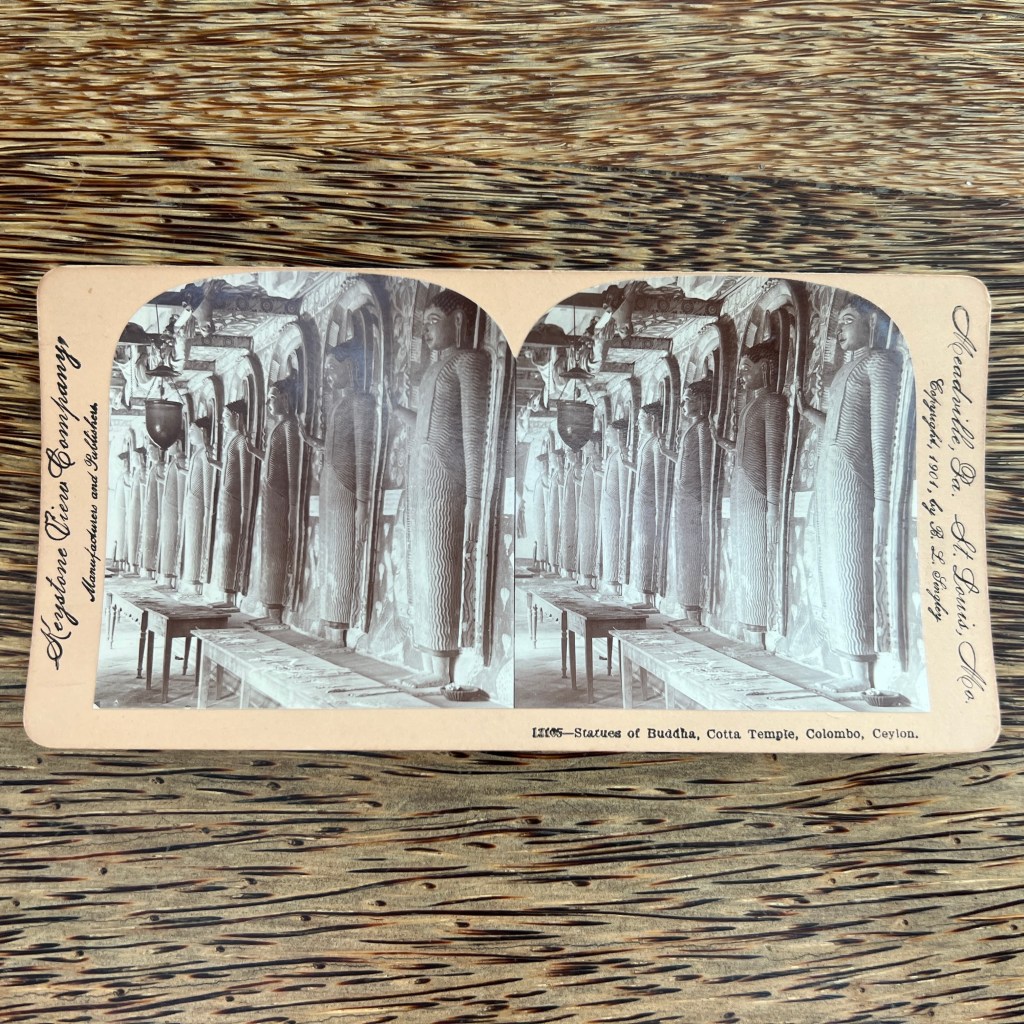
Marketed as education material, the information on the back of this stereoview offers a few generic facts about Buddhism. The unknown author also offers pointed criticism, calling the statues on the front “rigid” and chastising Buddhists for being “practically idolatrous.”
This stereophotograph was taken in 1900/01 and was incorporated into a 30-view set devoted to Ceylon. While the copyright is granted to B.L. Singley, the president of Keystone, this photo was taken by one of several unknown staff photographers scattered over the world.
According to lore, the tooth relic was removed from Kotte about a century after its enshrinement to save it from Portuguese looters. For further history on the tooth relic, see John Strong’s The Buddha’s Tooth: Western Tales of a Sri Lankan Relic (2021).
The Buddhas in the West Material Archive is a digital scholarship project that catalogues artifacts depicting Buddhist material culture for Western audiences. It’s comprised of prints, photos, and an assortment of ephemera and other objects. For a brief introduction to this archive, visit the main Buddhas in the West project page.
For Related Buddhas in the West Posts Featuring Sri Lanke / Ceylon:
For all the new Buddhas in the West posts follow us on Bluesky & Instagram
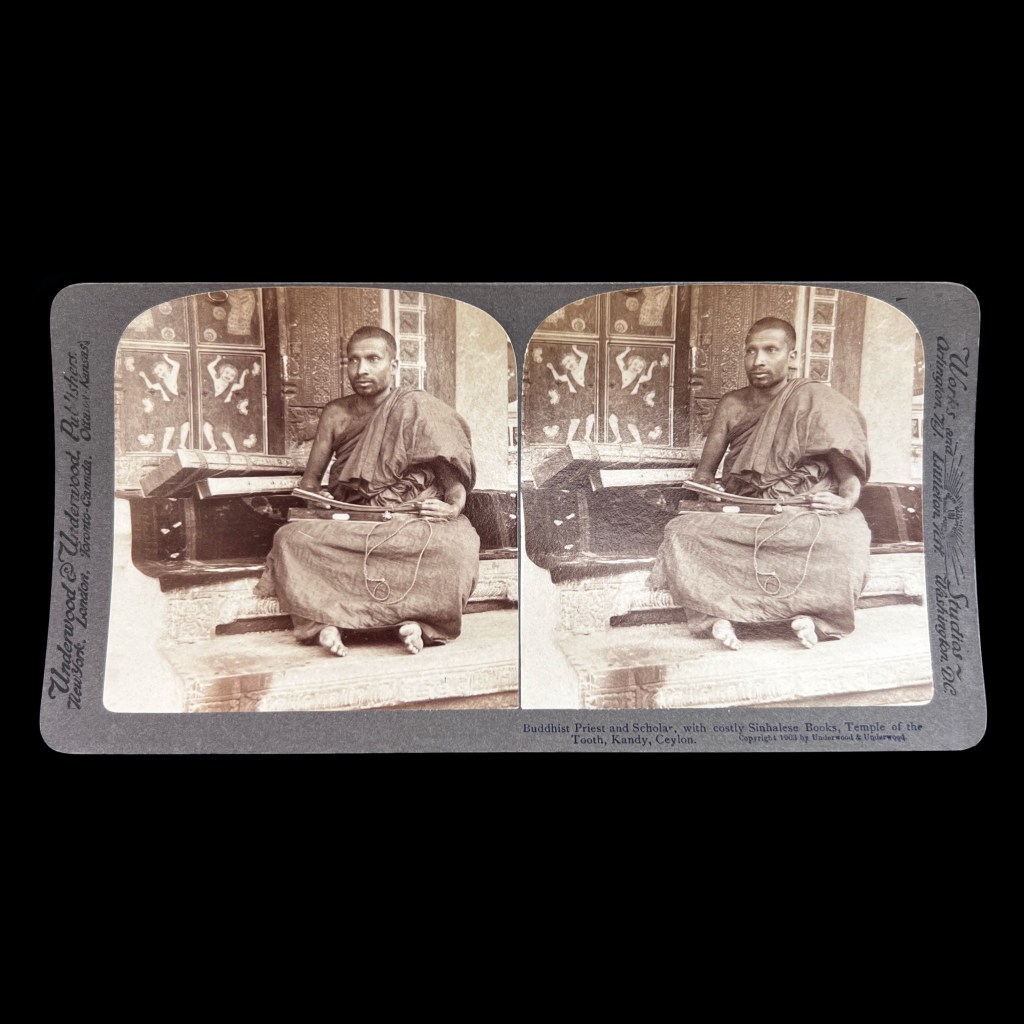
Just after the discovery of the Buddha’s relics at Piprahwa in 1898, James Ricalton was planning a photographic tour of the world. One of his planned stops was to visit the most famous Buddhist relic of his era, the Buddha’s tooth enshrined in the capital city of Kandy.
Ricalton’s employer, the largest stereoscope firm in the world, Underwood & Underwood, was launching several sets devoted to specific countries; Ceylon was slated to have 30 stereoview cards. Underwood’s slogan, ‘‘to see is to know,’’ drove its message that education was a main objective.
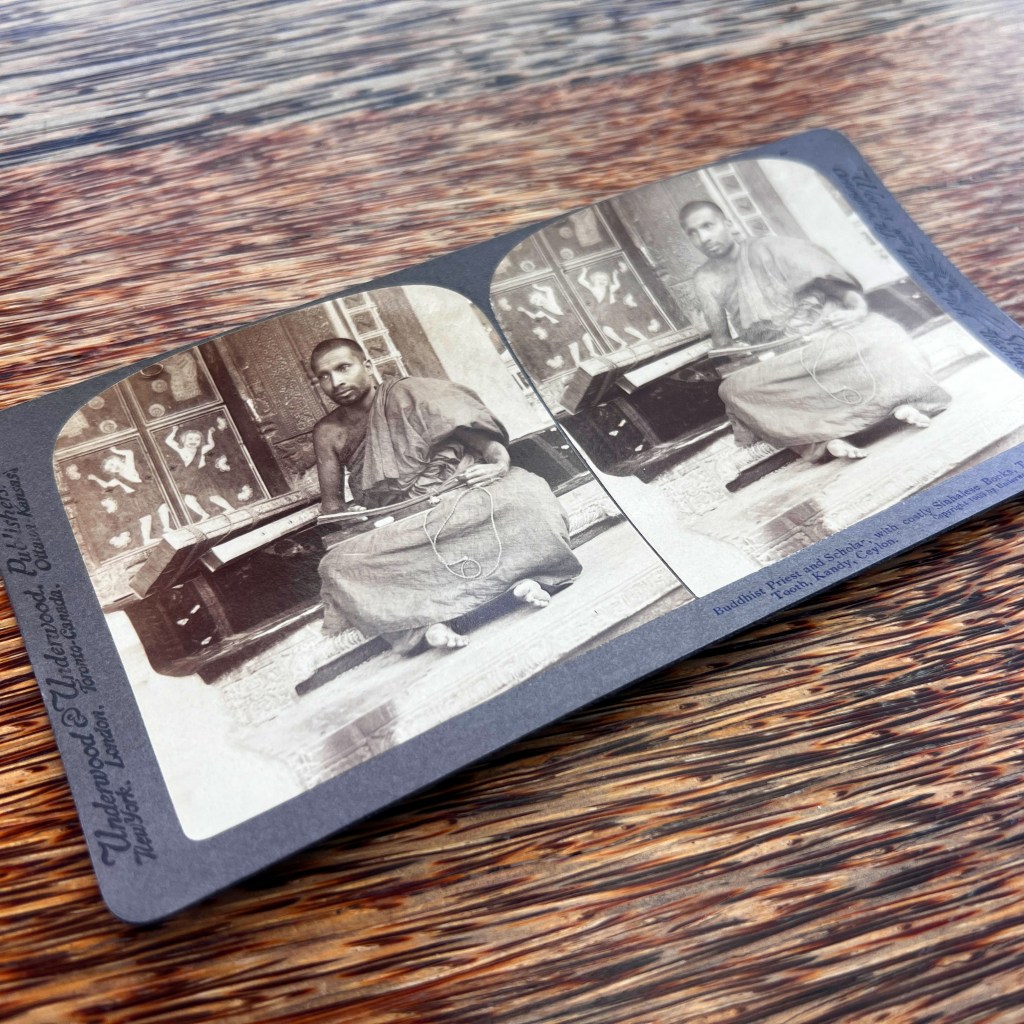
Shooting the Temple of the Tooth, Sri Dalada Maligawa, and a few stupas, this image was the only one for Ceylon showing a Buddhist monk. While it was common to depict monks on alms rounds, Ricalton shows this unnamed monk reading scripture, calling him a priest and scholar in the caption.
The monk sits holding the long, rectangular leaves of a Buddhist scripture in his lap. Views such as this were intended to give a glimpse into the “real lives” of the photographed subjects, thus allowing viewers to travel without the hassle of actually leaving home.
Selling “the world in a box,” stereoviews helped shape a vision of Buddhism for American consumers. For more on the powerful visual language of stereoviews, see Judith Babbitts’ “Stereographs and the Construction of a Visual Culture in the United States,” in History Bytes (2004).
The Buddhas in the West Material Archive is a digital scholarship project that catalogues artifacts depicting Buddhist material culture for Western audiences. It’s comprised of prints, photos, and an assortment of ephemera and other objects. For a brief introduction to this archive, visit the main Buddhas in the West project page.
For Related Buddhas in the West Posts Featuring Buddhist Clerics:
For all the new Buddhas in the West posts follow us on Bluesky & Instagram
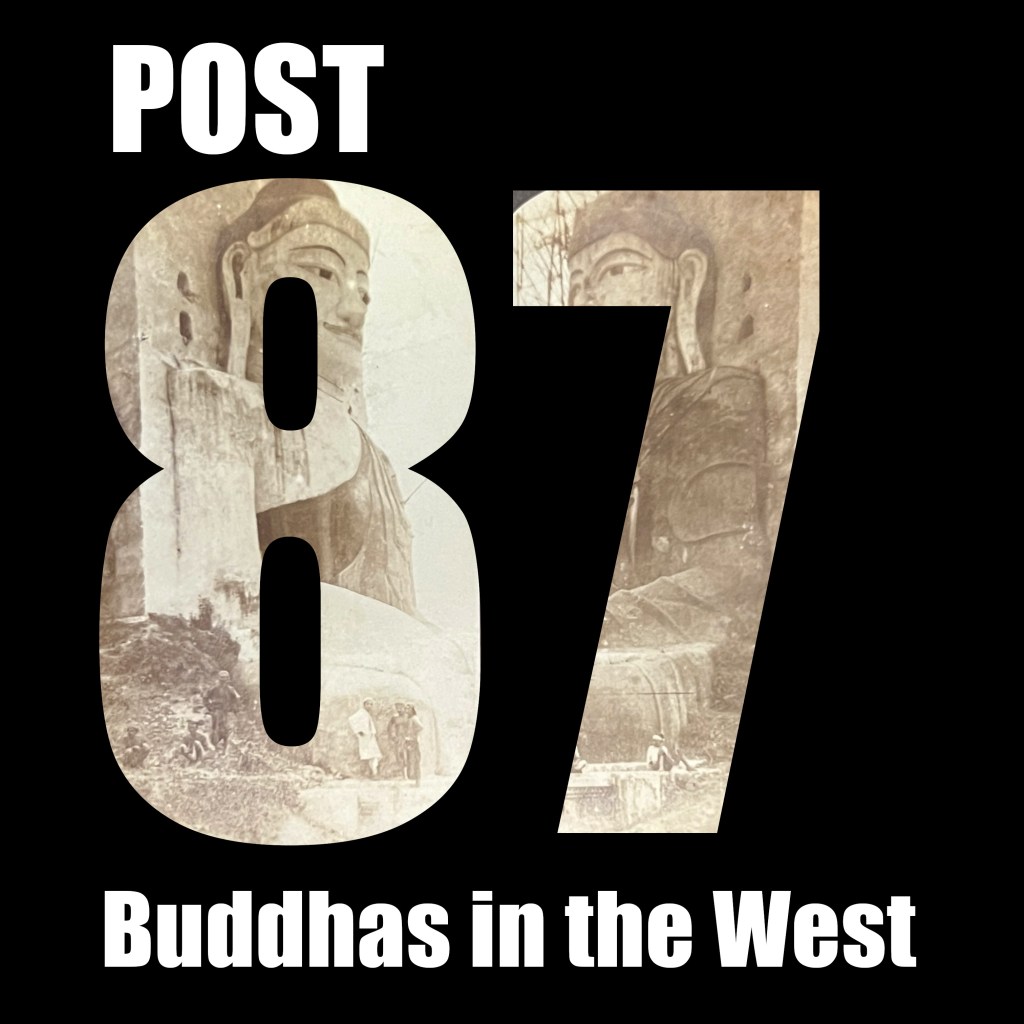
For nearly six centuries the four seated Buddhas of Bago have towered over the surrounding Burmese countryside. Constructed by the former Buddhist monk turned king, Dhammazedi, in 1476, the four colossal statues represent the four Buddhas of the past.
The Kyaikpun, as this site is known, also houses a relic chamber beneath the central rectangular pillar. Under Mon control, Bago served as a vital regional entrepôt and thriving hub of Theravada Buddhism with many shrines and monasteries.
This stereoview was part of the educational Underwood Stereoscopic Tour series from 1907, comprised of national sets with individual cards arranged as “a tourist might visit the actual scenes.” The Burma set was originally sold with fifty different views (this card is number 12).
The structure, which is over 90 ft. (27m) tall, was in near ruin by the 1890s, but local fundraising was able to repair the statues by the turn of the century. This stereoview, taken around 1905, still shows the remnants of rubble and scaffolding in the rear.
The Buddha facing north, representing Gautama Buddha, remained in the best condition, thus the other three statues were reputedly modeled after it during renovation. To see thirty-six views from Underwood’s Burma series held by the National Archives UK, visit tinyurl.com/3xwvkbsb.
The Buddhas in the West Material Archive is a digital scholarship project that catalogues artifacts depicting Buddhist material culture for Western audiences. It’s comprised of prints, photos, and an assortment of ephemera and other objects. For a brief introduction to this archive, visit the main Buddhas in the West project page.
For Related Buddhas in the West Posts Featuring Historical Stereophotography:
For all the new Buddhas in the West posts follow us on Bluesky & Instagram
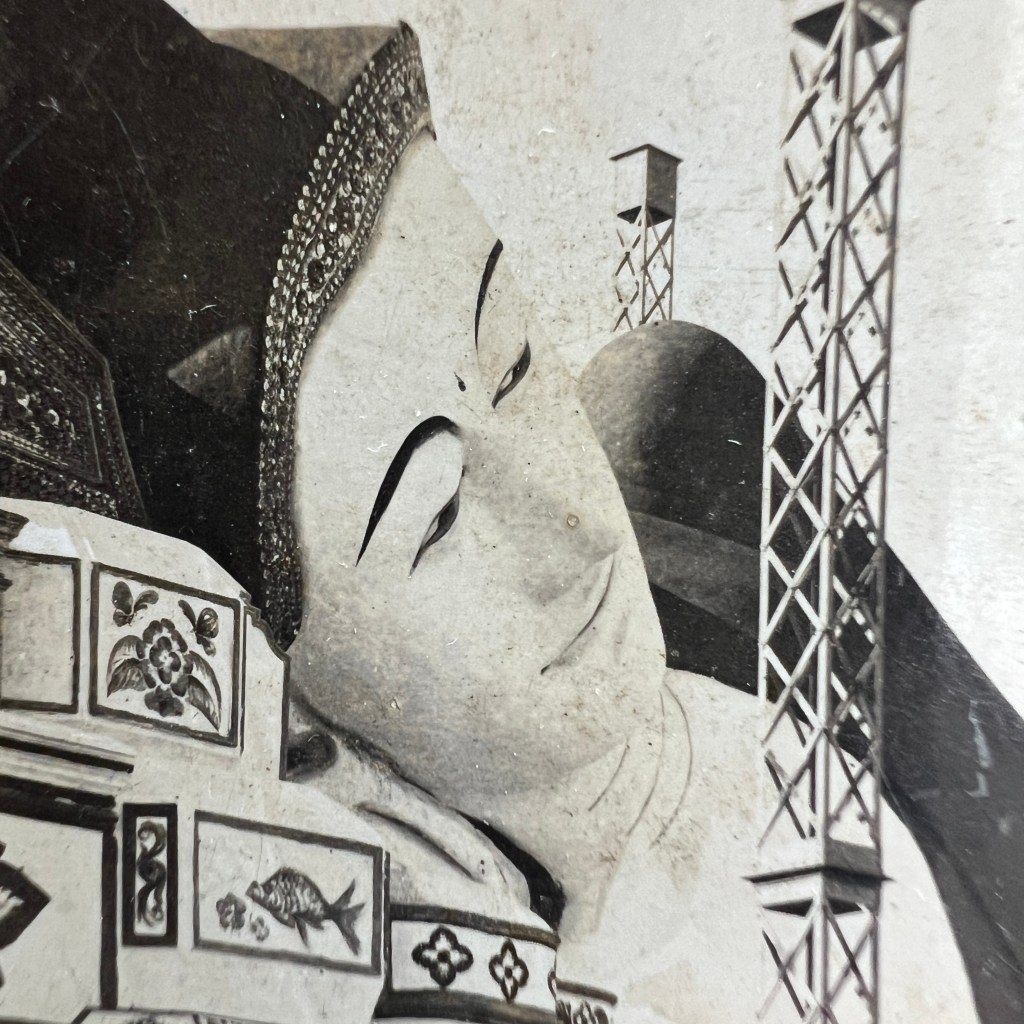
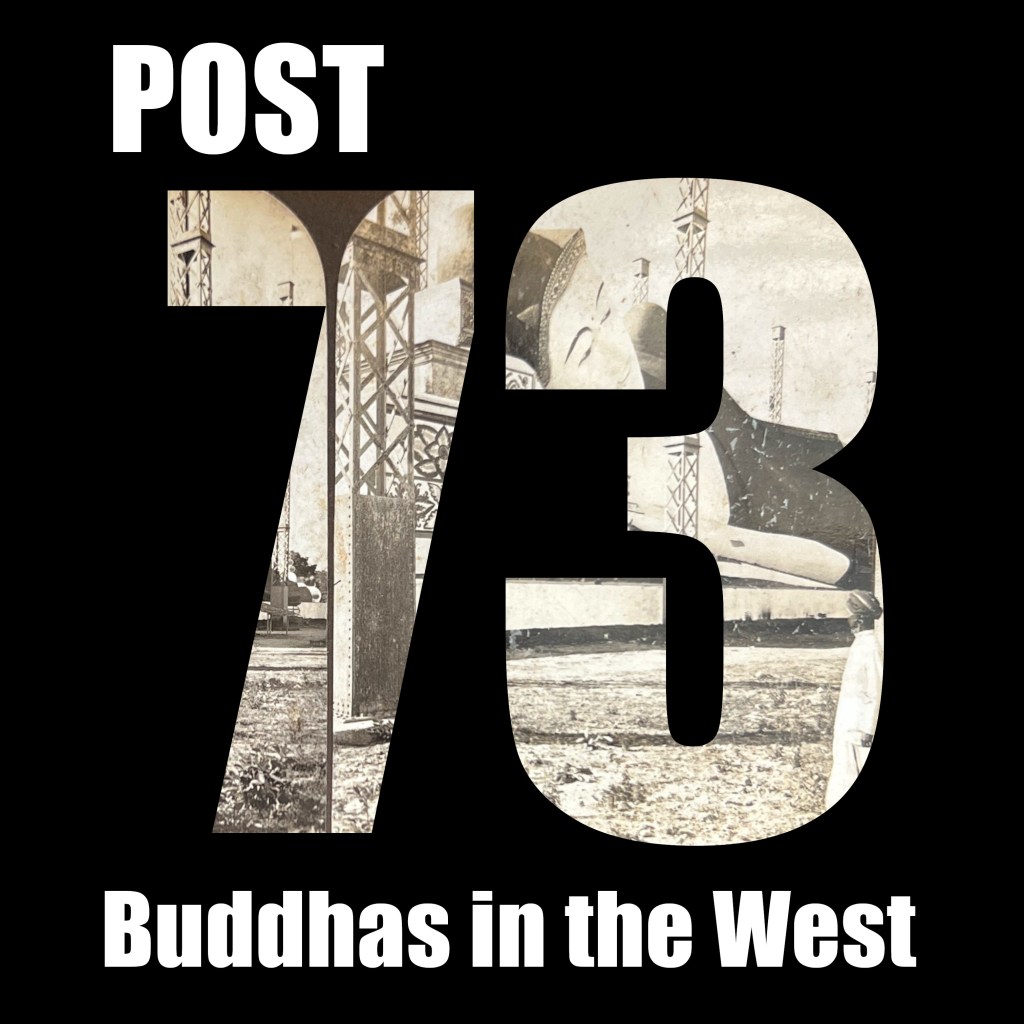
This colossal Sleeping Buddha was lost to the jungle when the Burmese city of Bago fell to invading forces in 1757. The statue was recovered in 1881 after railroad workers began digging through a tree-covered mound looking for scrap stone.
At 55 meters (180 ft) long and 16 meters (52 ft) high at the shoulder, the Shwethalyaung Buddha is among the largest reclining Buddha statues ever constructed. Made of brick and stucco, it is believed to have been built in the late tenth century under the patronage of a local king.
This stereograph was taken by Herbert Ponting who had returned from Manchuria after photographing the Russo-Japan War for publisher H. C. White.
Ponting had an expert eye; his placement of the man in the foreground produces a strong three-dimensional depth effect when viewed stereoscopically.
An earlier photograph of the Shwethalyaung Sleeping Buddha before decoration was published in Julius Smith’s Ten Years in Burma from 1902, viewable here: tinyurl.com/5n85dsxn.
The Buddhas in the West Material Archive is a digital scholarship project that catalogues artifacts depicting Buddhist material culture for Western audiences. It’s comprised of prints, photos, and an assortment of ephemera and other objects. For a brief introduction to this archive, visit the main Buddhas in the West project page.
For Related Buddhas in the West Posts Featuring Myanmar / Burma:
For all the new Buddhas in the West posts follow us on Bluesky & Instagram
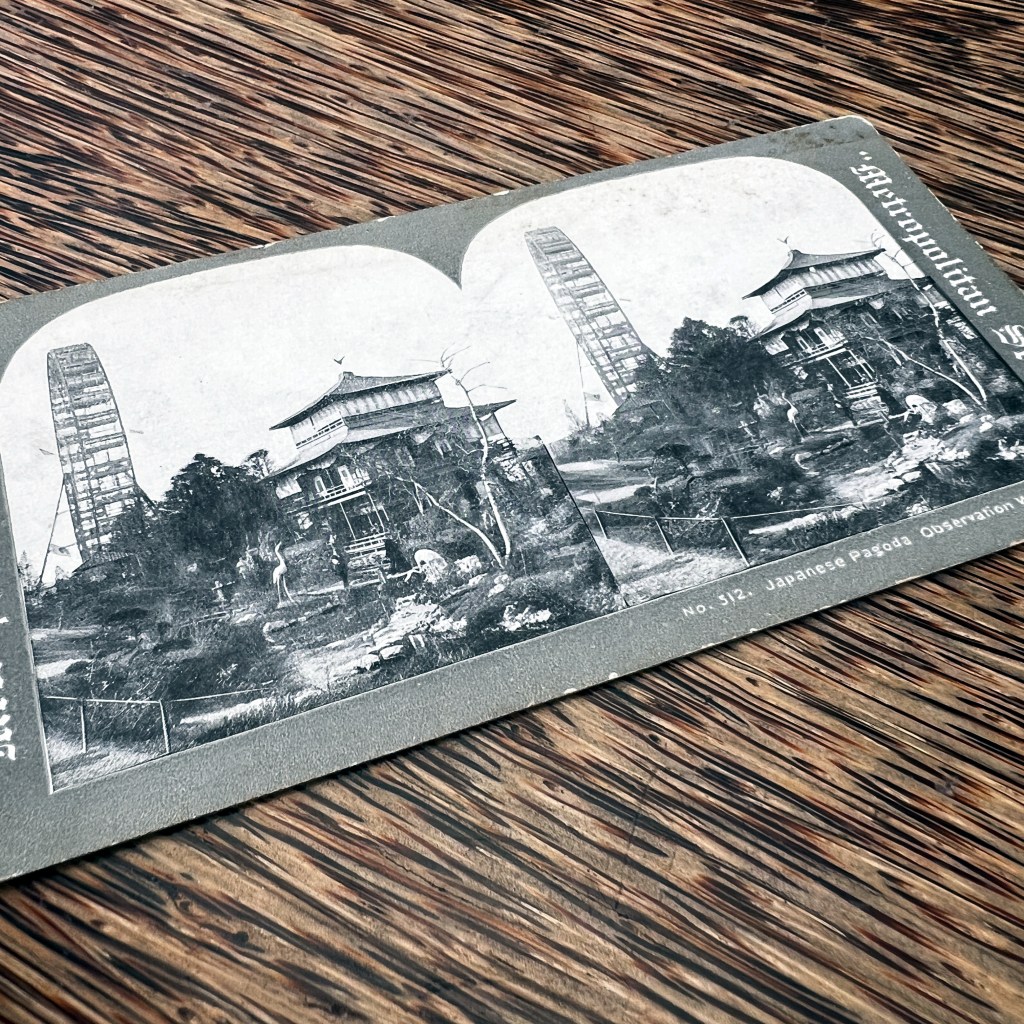
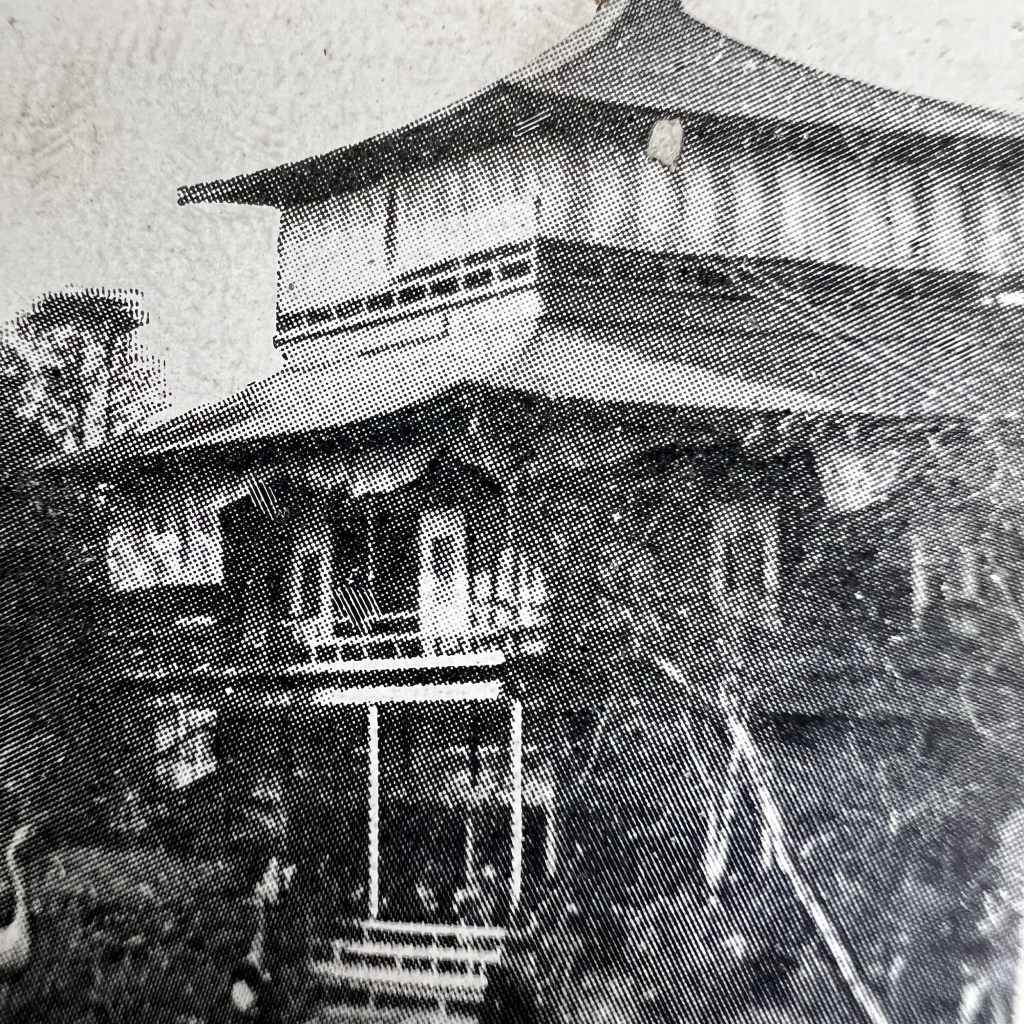
This is not an AI rendered image – it’s a Ferris Wheel towering over Kyoto’s famed Temple of the Golden Pavilion, known as Kinkaku-ji. More accurately, it’s a replica of Kinkaku-ji built for the 1904 St. Louis World’s Fair advertised as a Japanese imperial gardens pagoda.
The Kyoto original, dating to 1400, houses Buddhist relics while the St. Louis replica was built to serve Japanese tea. In both cases the respective buildings are surrounded by a garden and topped with a phoenix roof ornament.
The St. Louis garden was designed by the Japanese landscape architect Yukio Ichikawa 市川之雄.
Japan’s exhibitions were well attended, in part by the generally positive newspaper coverage as well as the publicity of the ongoing Russo-Japanese War. Many companies made stereoviews of the 1904 fairgrounds, with the Metropolitan Series sold through Sears catalogues.
Many attendees of the St. Louis fair expressed a sense of awe at Japan’s exhibitions. For more digitized photos of the St. Louis fair, see the offerings at the State Historical Museum of Missouri here https://tinyurl.com/5d7jcupa
The Buddhas in the West Material Archive is a digital scholarship project that catalogues artifacts depicting Buddhist material culture for Western audiences. It’s comprised of prints, photos, and an assortment of ephemera and other objects. For a brief introduction to this archive, visit the main Buddhas in the West project page.
For Related Buddhas in the West Posts Featuring Kyoto:
For all the new Buddhas in the West posts follow us on Bluesky & Instagram
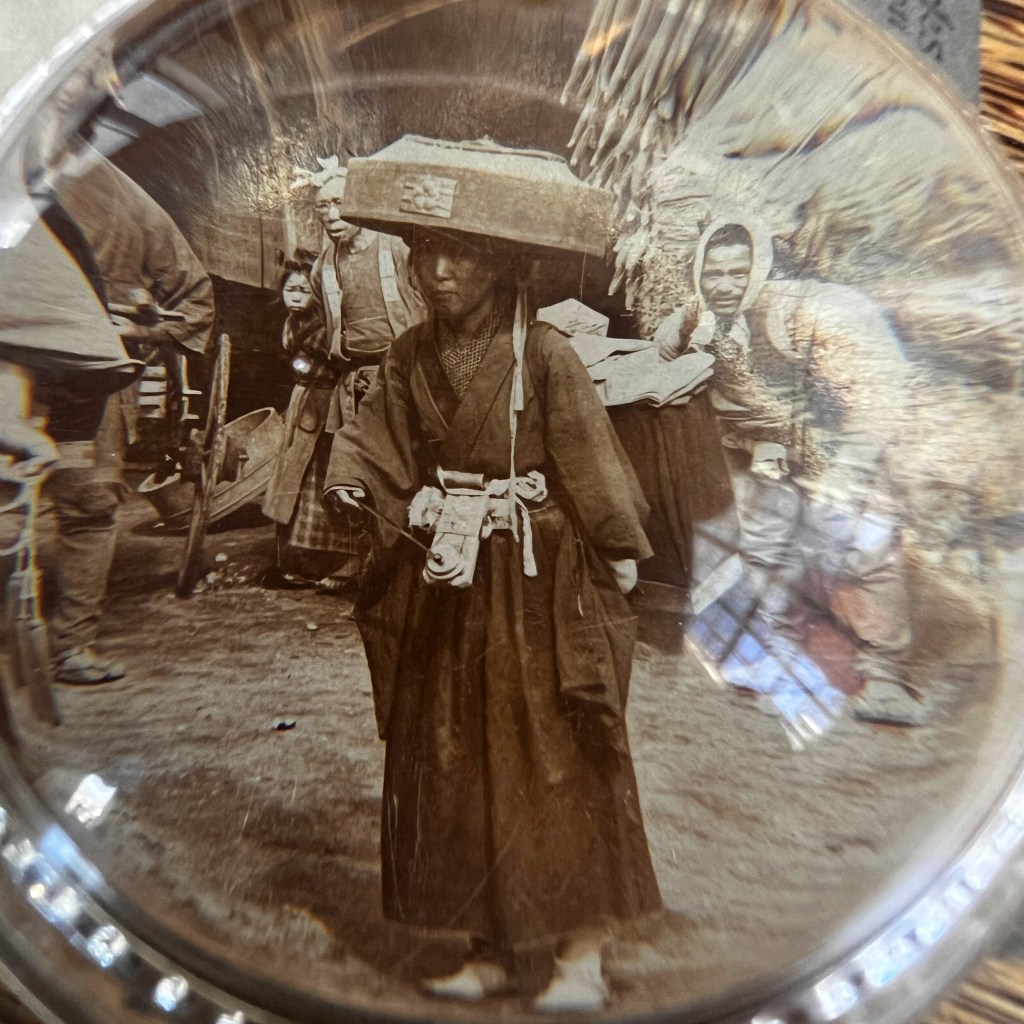
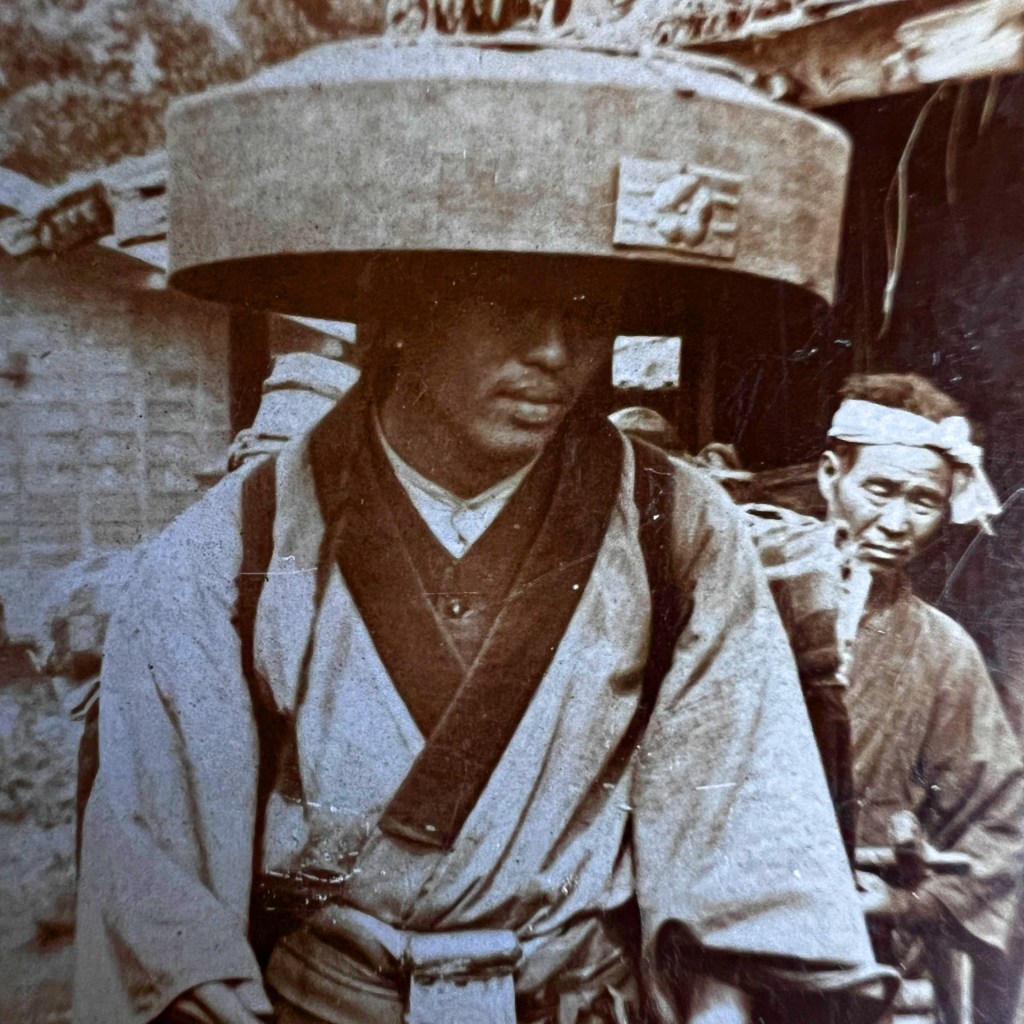
After 1900, publishers of stereoviews started emphasizing their educational rather than entertainment value, oftentimes selling thematic boxed sets. The card here is part of Underwood & Underwood’s 100-view Japan set from 1904.
We know from the negative number (#3852) this stereophoto was taken by expedition photographer Herbert Ponting during his trip to Japan in 1903. The location at Lake Kawaguchi was a well-known gathering spot for pilgrims looking to ascend Mt. Fuji.
By 1904 it was increasingly common to print educational information on the reverse of the card. Here we also find additional books recommended, including Lafcadio Hearn’s Glimpses of Unfamiliar Japan, from which much of the information is cobbled together.
The distinctive clothing and ritual apparatus mark the traveler as a religious pilgrim.
The Ponting-Underwood set, published on the outset of the Russo-Japanese War, became one of the more popular sets on Japan. A scan of the full collection by the Smithsonian Institute is viewable here: https://tinyurl.com/2ukzu87c
The Buddhas in the West Material Archive is a digital scholarship project that catalogues artifacts depicting Buddhist material culture for Western audiences. It’s comprised of prints, photos, and an assortment of ephemera and other objects. For a brief introduction to this archive, visit the main Buddhas in the West project page.
For Related Buddhas in the West Posts Featuring Herber Ponting’s Photography:
For all the new Buddhas in the West posts follow us on Bluesky & Instagram
3D Kokūzō 虛空: In the early 20th century, Keystone View Company emerged as a premier publisher of stereoviews with several tens-of-thousands of images in their catalogue. Around 1901, Keystone issued its first views of Japan, including a run of 23 odd-lot stereoviews.
Among their 1901 offerings, a 1/4 were stereo-photographs of religious sites or objects; this includes two views of Buddhist statues. At this time, other companies started offering special Japan box sets and following the Russo-Japanese War Japan sets became far more popular.
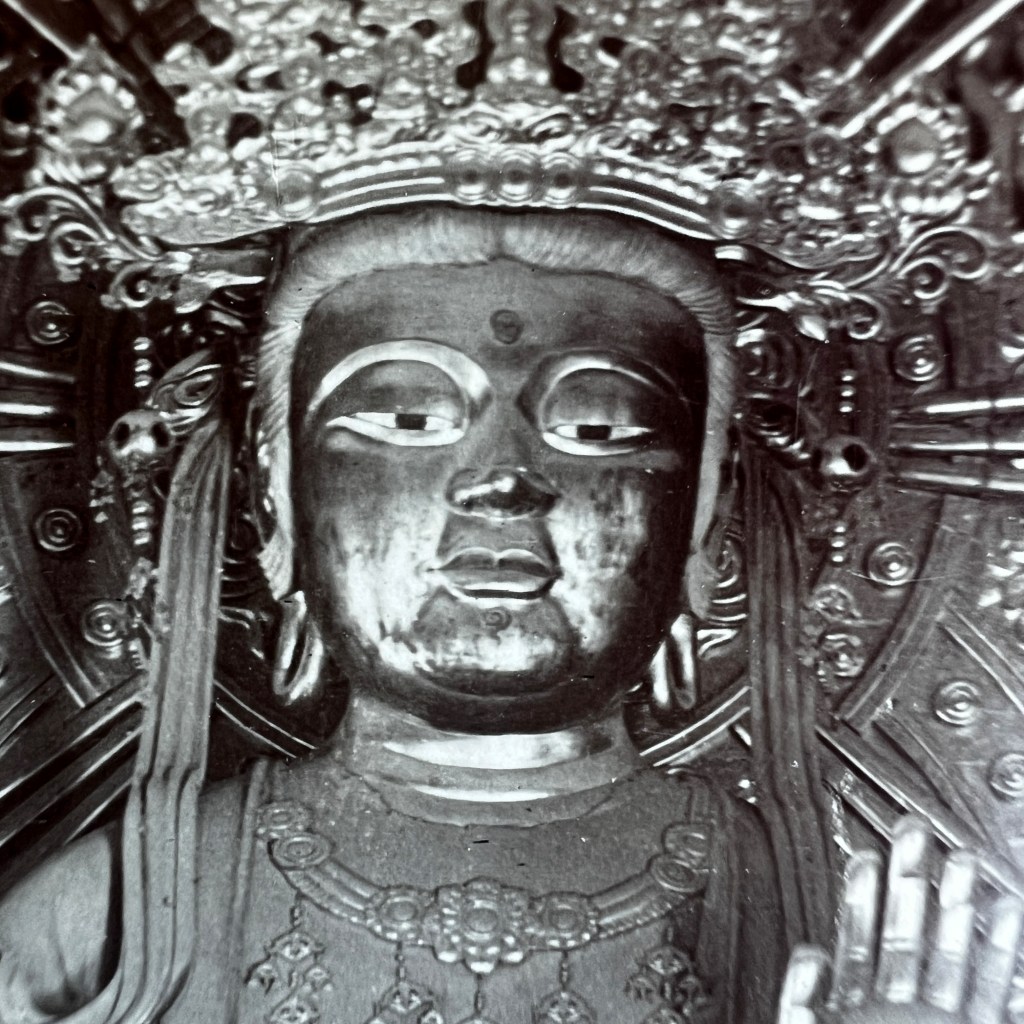
The card here depicts the Daibutsu Hall of Tōdai-ji in Nara. Curiously, it does not show the main figure for which the hall is named, the Nara Daibutsu. This icon is Kokūzō Bosatsu, otherwise known as Ākāśagarbha Bodhisattva (Keystone simply labelled it as a “god.”)
Part of Keystone’s commercial success was selling stereoviews to schools across the US. To view part of their early selection of Japan views, see the digitized collection at the Library of Congress, viewable here https://tinyurl.com/bdewbmva.
The Buddhas in the West Material Archive is a digital scholarship project that catalogues artifacts depicting Buddhist material culture for Western audiences. It’s comprised of prints, photos, and an assortment of ephemera and other objects. For a brief introduction to this archive, visit the main Buddhas in the West project page.
For Related Buddhas in the West Posts Featuring Japan:
For all the new Buddhas in the West posts follow us on Bluesky & Instagram
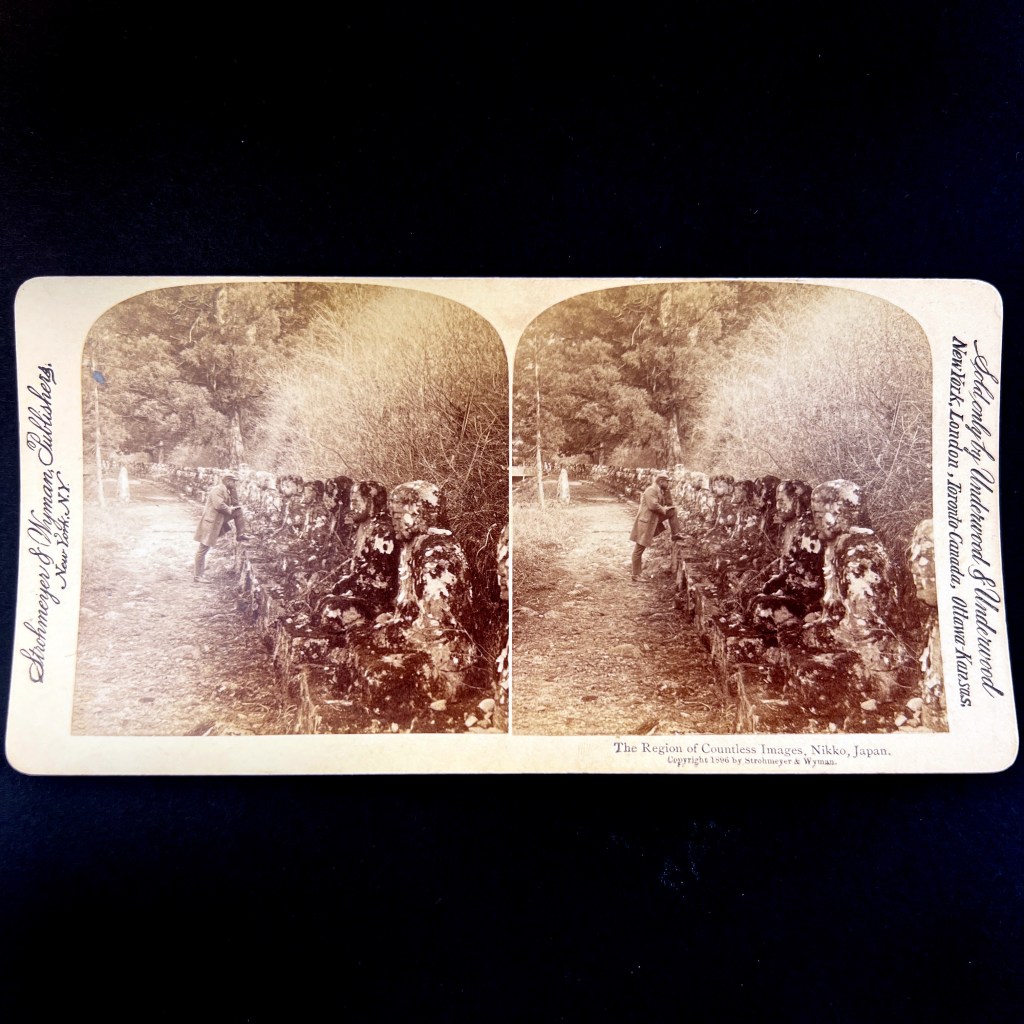
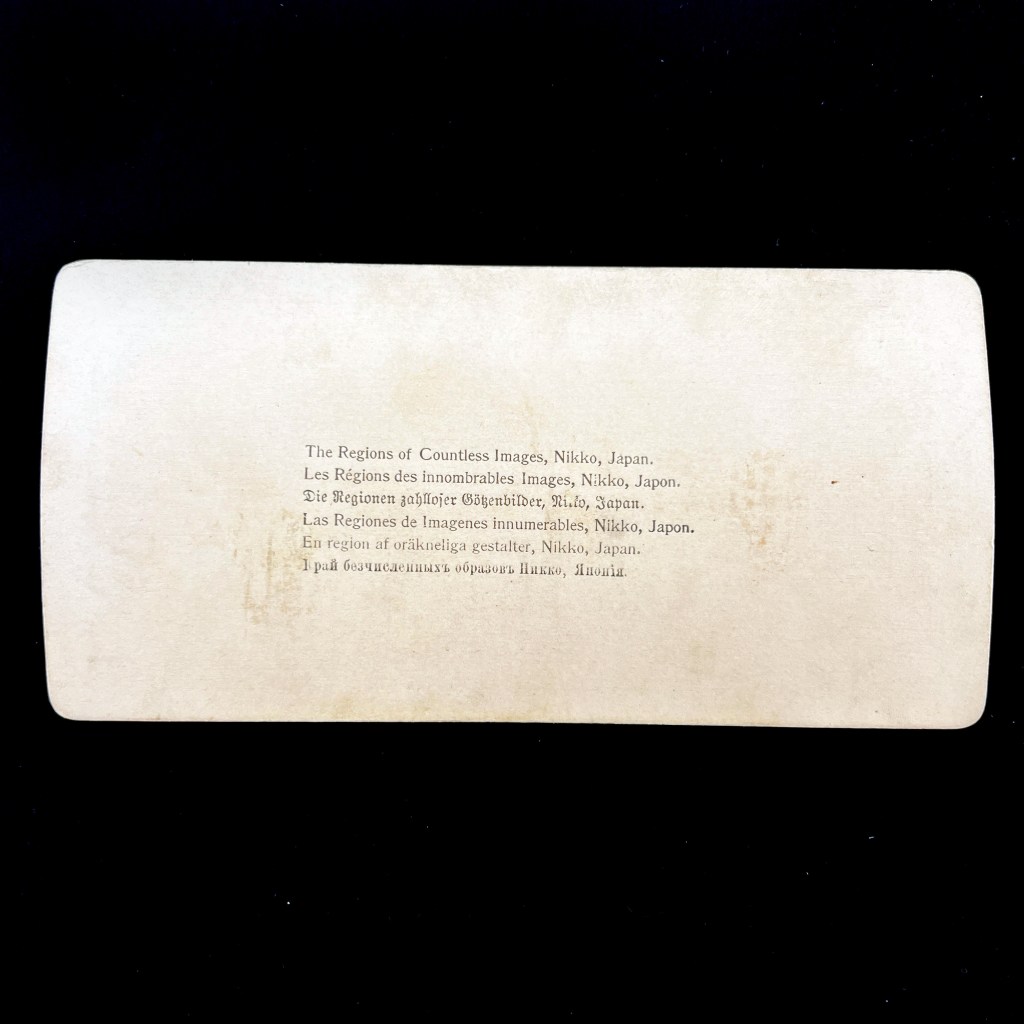
Countless Jizō: Tourist books from the early 20th century say no person could count the same number of Jizō statues in Nikko, Japan. In early 1896, Henry Strohmeyer left for an around-the-world tour and took this stereoscopic image; he left no report on how many he counted.
A dual-photograph stereoview card produces a single three-dimensional image when using a simple handheld device fashioned with special lenses (first invented by Oliver Wendell Holmes).
This was fashionable – and cutting edge – parlor room entertainment at the end of the nineteenth century for many American homes.
It provided people with the means for virtual reality travel and stereoviews were soon marketed to schools for educational purposes.
This card is a rare instance of where the cultural voyeurism is broken and we see a man in Western attire. It is believed this is Strohmeyer himself – a stereoscopic selfie.
For an insightful online illustrated essay on Strohmeyer’s impact on travel photography, see the exhibit by Tulane University here: https://tinyurl.com/5n7a28kf.
The Buddhas in the West Material Archive is a digital scholarship project that catalogues artifacts depicting Buddhist material culture for Western audiences. It’s comprised of prints, photos, and an assortment of ephemera and other objects. For a brief introduction to this archive, visit the main Buddhas in the West project page.
For Related Buddhas in the West Posts Featuring Historical Stereophotography:
For all the new Buddhas in the West posts follow us on Bluesky & Instagram
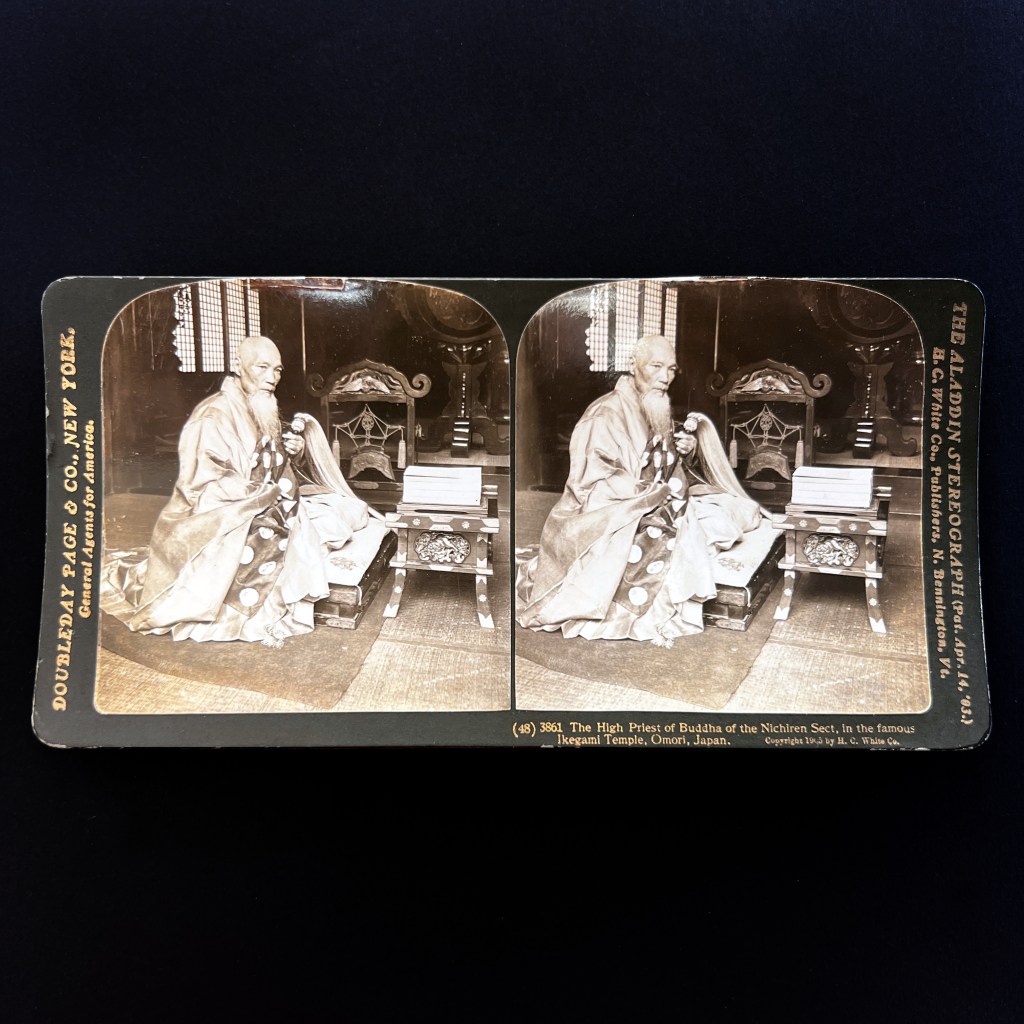
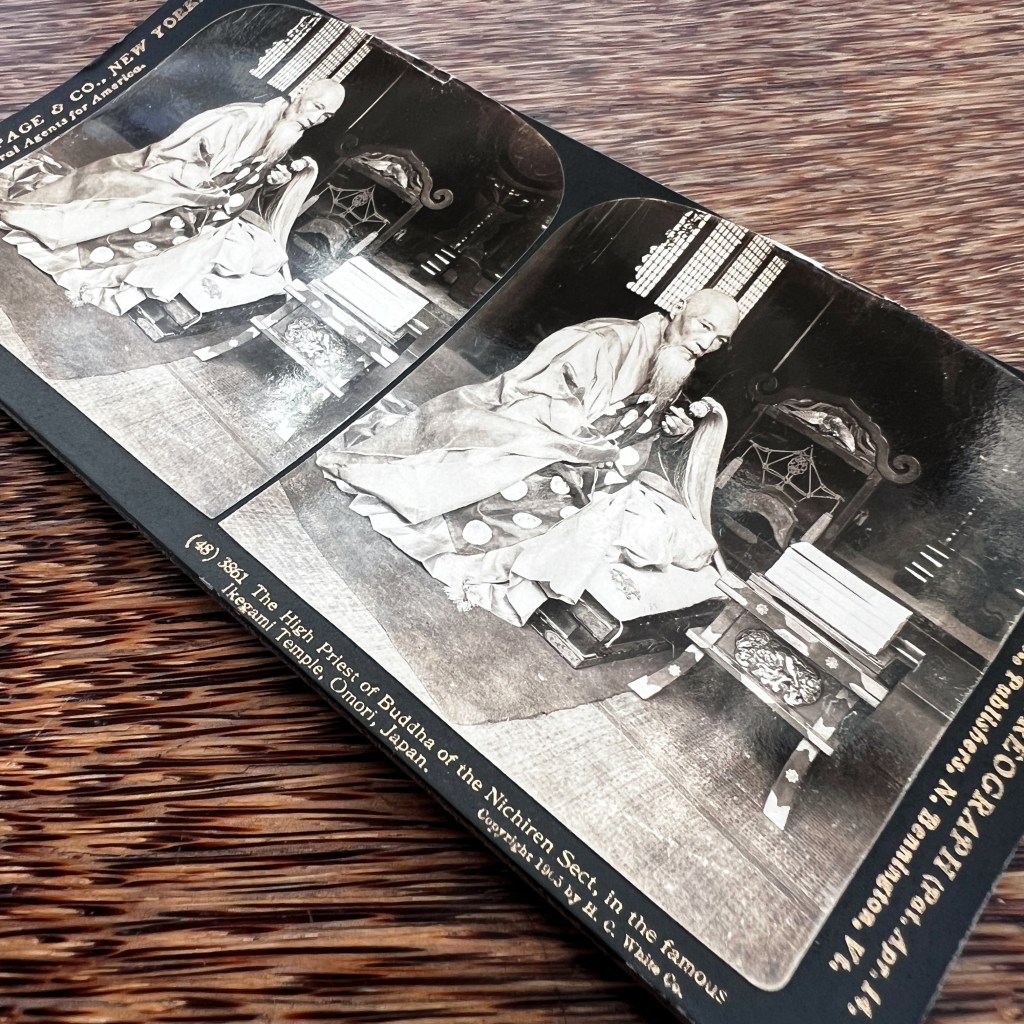
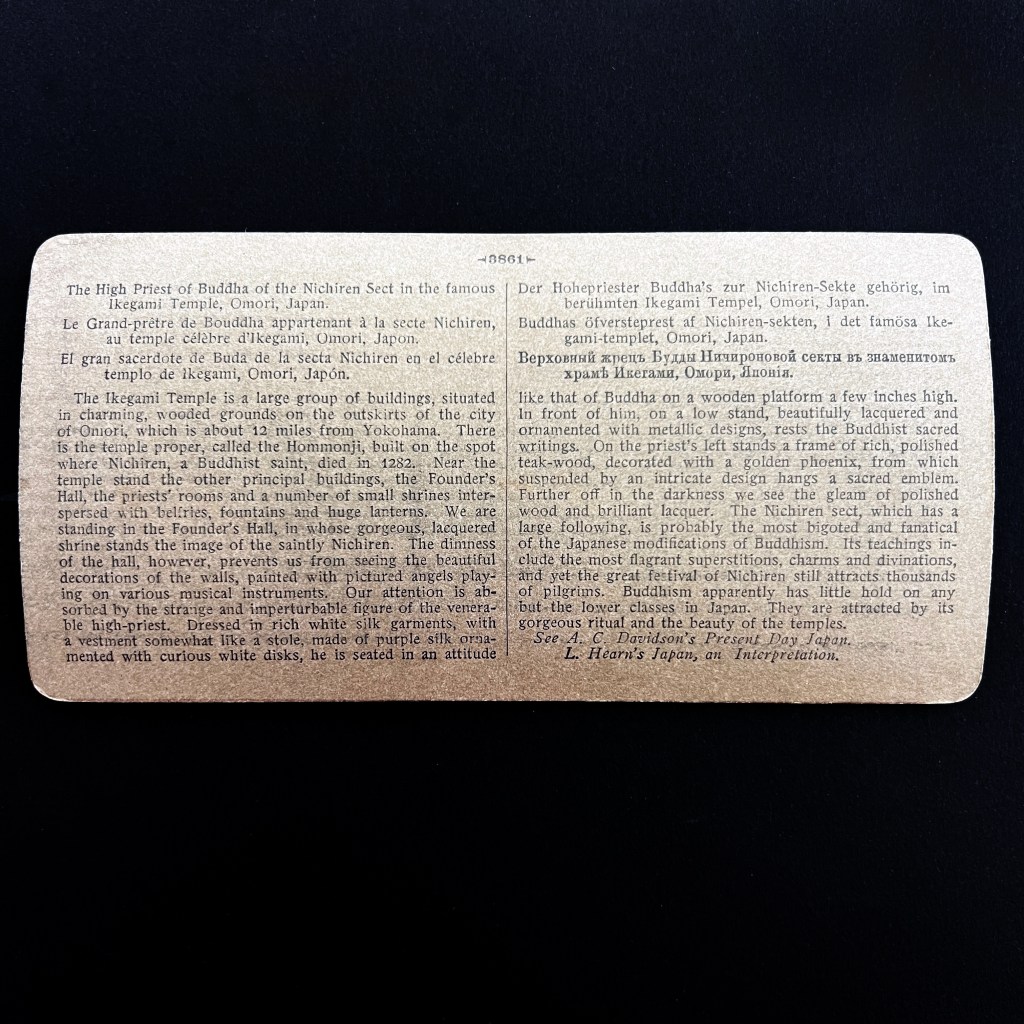
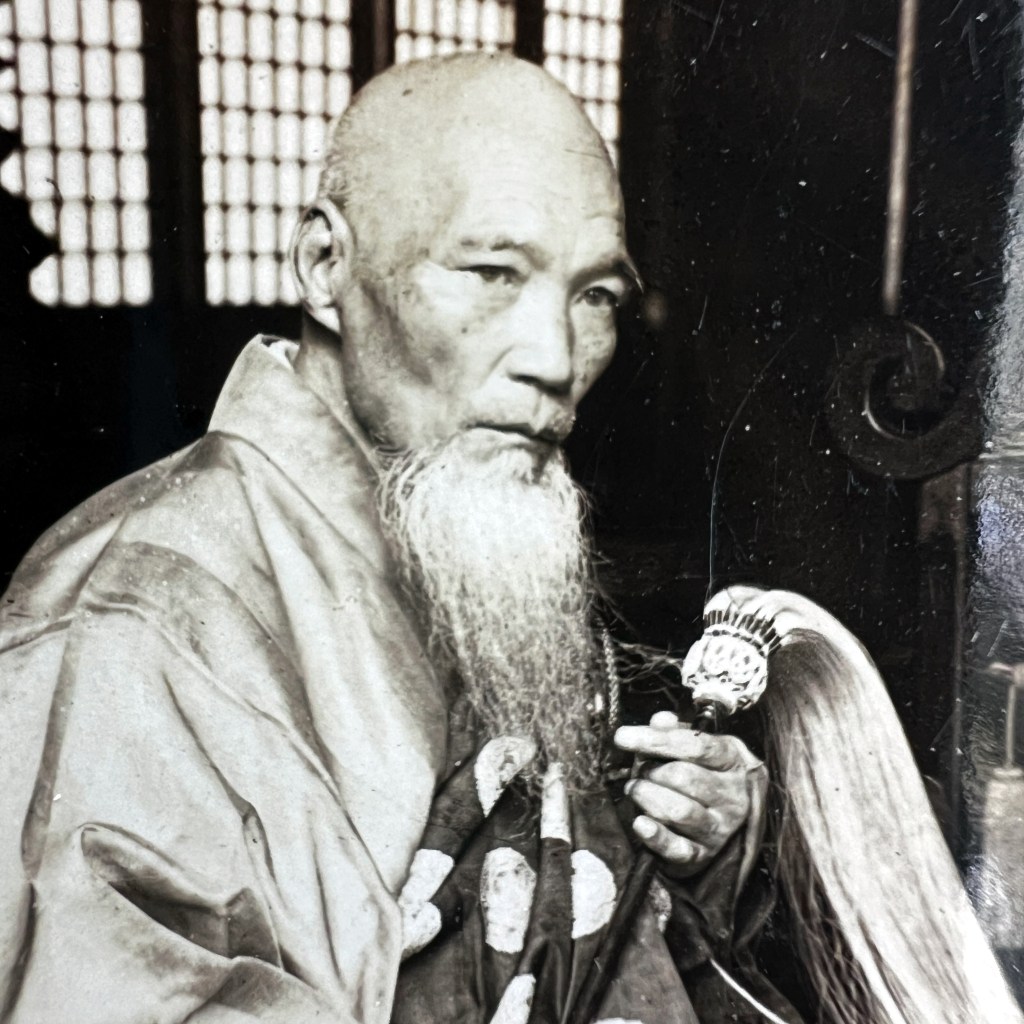
Is this the first stereoscopic 3D portrait of a Buddhist abbot? While many Japanese Buddhist priests were photographed for stereoviews by 1905, the year this card was issued, this is a rare occasion where we have an indication of the priest’s identity.
The caption tells us the priest is the head of Ikegami Temple (Honmon-ji #本門寺) of the Nichiren school. We also know the photographer, Herbert Ponting, was hired by H.C. White to take photos of the Russo-Japanese War and he toured Japan through the end of 1906.
There are two potential identifications of this priest, but it is likely Kubota Nichiki 久保田日亀(1841–1911), who became the 68th generation abbot in 1899. He holds a fly-whisk, a sign authority.
By the 20th century, stereoviews were seen as important educational tools and the backs of many cards were imprinted with information, sometimes reflecting contemporary views and biases. This description notes the Nichiren school emphasized “the most flagrant superstitions.”
Ponting would eventually author a book on his travels in Japan, entitled In Lotus-Land Japan, illustrated with photos he had originally taken as stereoviews. The book can be read here: https://tinyurl.com/hhzhsnm9
Additional Archived Posts for the Buddhas in the West Project
The Buddhas in the West Material Archive is a digital scholarship project that catalogues artifacts depicting Buddhist material culture for Western audiences. It’s comprised of prints, photos, and an assortment of ephemera and other objects. For a brief introduction to this archive, visit the main Buddhas in the West project page.
For Related Buddhas in the West Posts Featuring Historical Stereophotography:
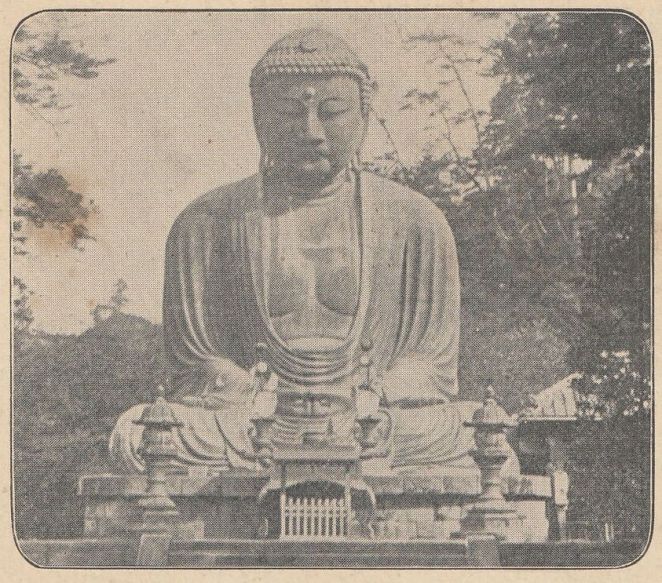
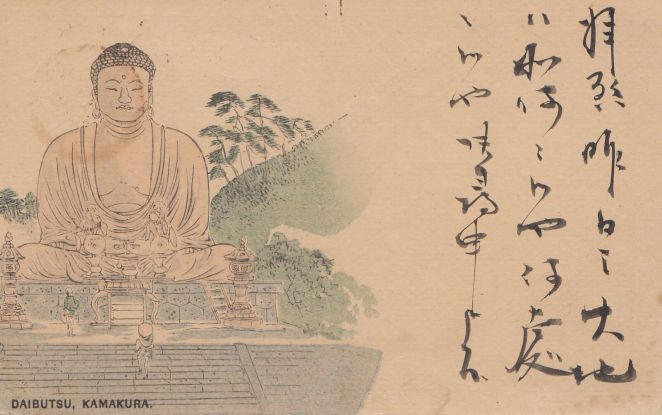
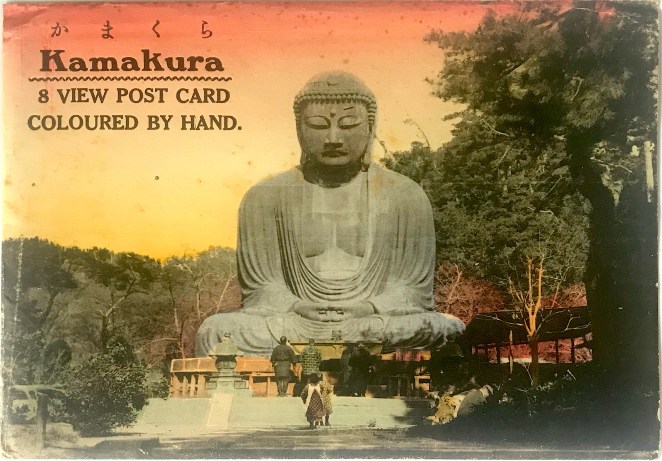
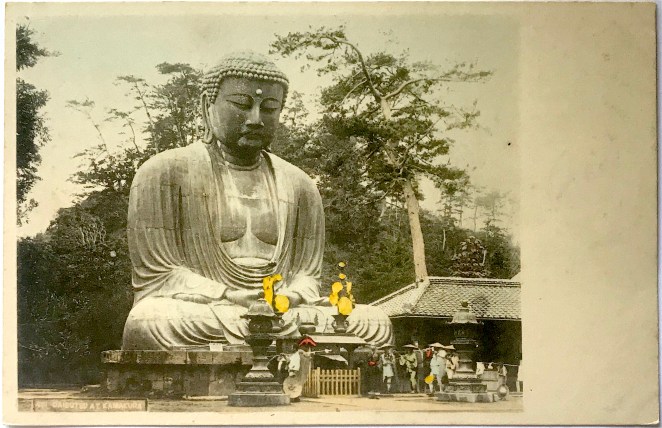
On October 16, 1909, the S.S. Cleveland left Hoboken, New Jersey on the first commercial around-the-world cruise. American tour operator, Frank C. Clark, chartered the Cleveland from the German operated Hamburg-American Line, leaving the east coast with a party of 650 passengers and traveling eastward through the Suez Canal before making landfall in San Francisco three months later on January 31, 1910. Because the Panama Canal was four years away from completion, the passengers completed the last leg of the around-the-world tour via train, returning to their origin point on the east coast. Thus, although Clark’s cruise was not a complete circumnavigation of the globe, the public and press treated it as such. Five days after landing in San Francisco, the Cleveland re-crossed the Pacific Ocean to start a second around-the-world tour, this time carrying more than 750 passengers. Clark’s pair of world tours generated significant amounts of publicity, with thousands appearing in San Francisco to send the ship off. The Cleveland made several subsequent trips between 1912 and 1914 until the advent of World War I interrupted access to the German-owned vessel.[1] The standard itinerary for trans-Pacific cruises of the period included a longer stopover in the port of Yokohama. Here, passengers could go ashore and enjoy the local sites, including a visit to the Kamakura Daibutsu.
One of the most popular publishers of stereocards, Underwood & Underwood, took advantage of these widely marketed luxury world tours and assigned a stereo-photographer to accompany the guests aboard the Cleveland to chronicle the trip. These new stereophotographs then became stock in Underwood & Underwood’s massive catalogue of Japan views and marketed to the general public.
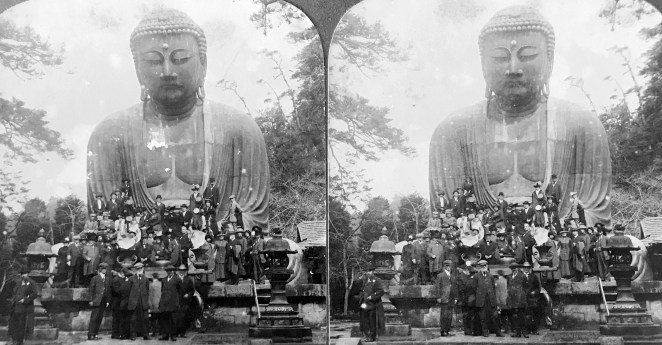
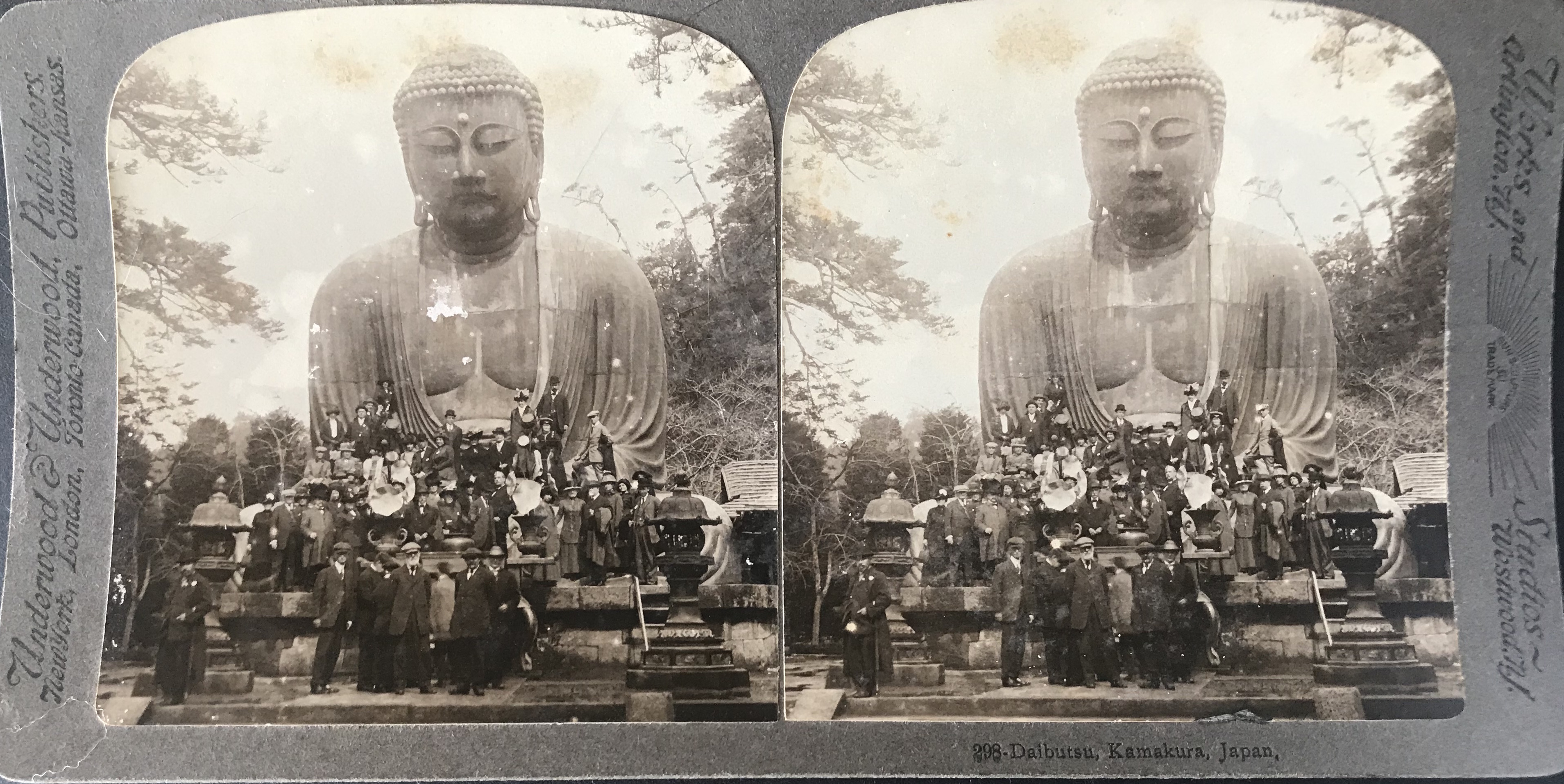
Figure 1
Title/Caption: 298-Daibutsu, Kamakura, Japan
Year: 1913-1914
Photographer: unknown
Publisher: Underwood & Underwood
Medium: sliver gelatin print; mounted on curved slate-colored card
Dimensions: 7 in X 3.5 in
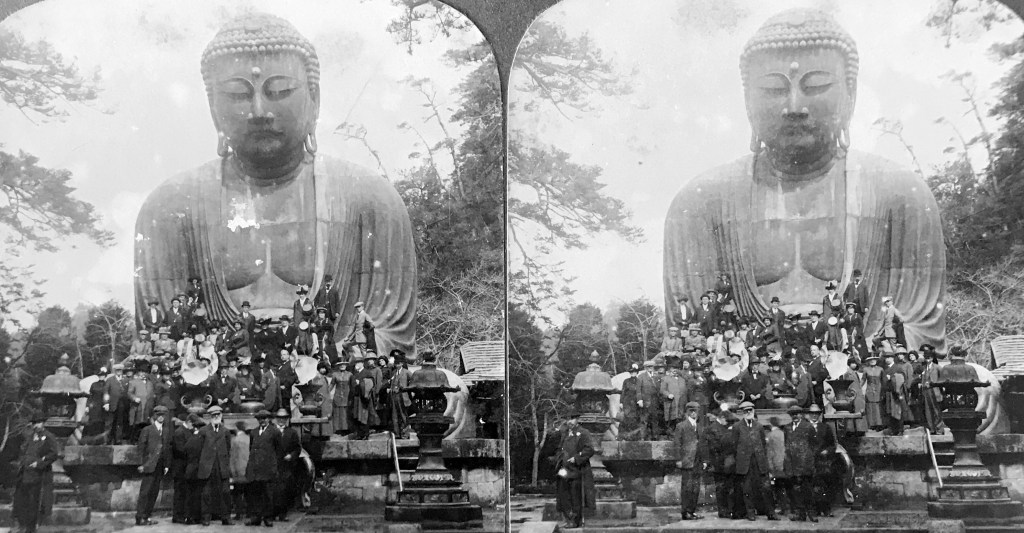
According to the account of R. H. Casey, a passenger aboard the Cleveland during its fourth trip across the globe which arrived in Japan on February 24, 1913, the tourist excursion trips were a sight to behold. Two hundred and forty passengers boarded a train to Kamakura and rode rickshaws from the train station to the temple of the Daibutsu, traveling en masse through the narrow roads of the rustic city’s back country.[2] This feeling of mass tourism is captured perfectly by our unknown photographer’s view, showing a cluster of nearly fifty people crowded in front of the Daibutsu [Fig. 1]. Almost all of the visitors are mounted atop the stone foundation or posing in the lap of the colossal statue. This posturing of gazing towards the viewer reflects a long-standing photographic tradition of collecting exotic “trophies” by being pictured in front of one’s cultural conquests.
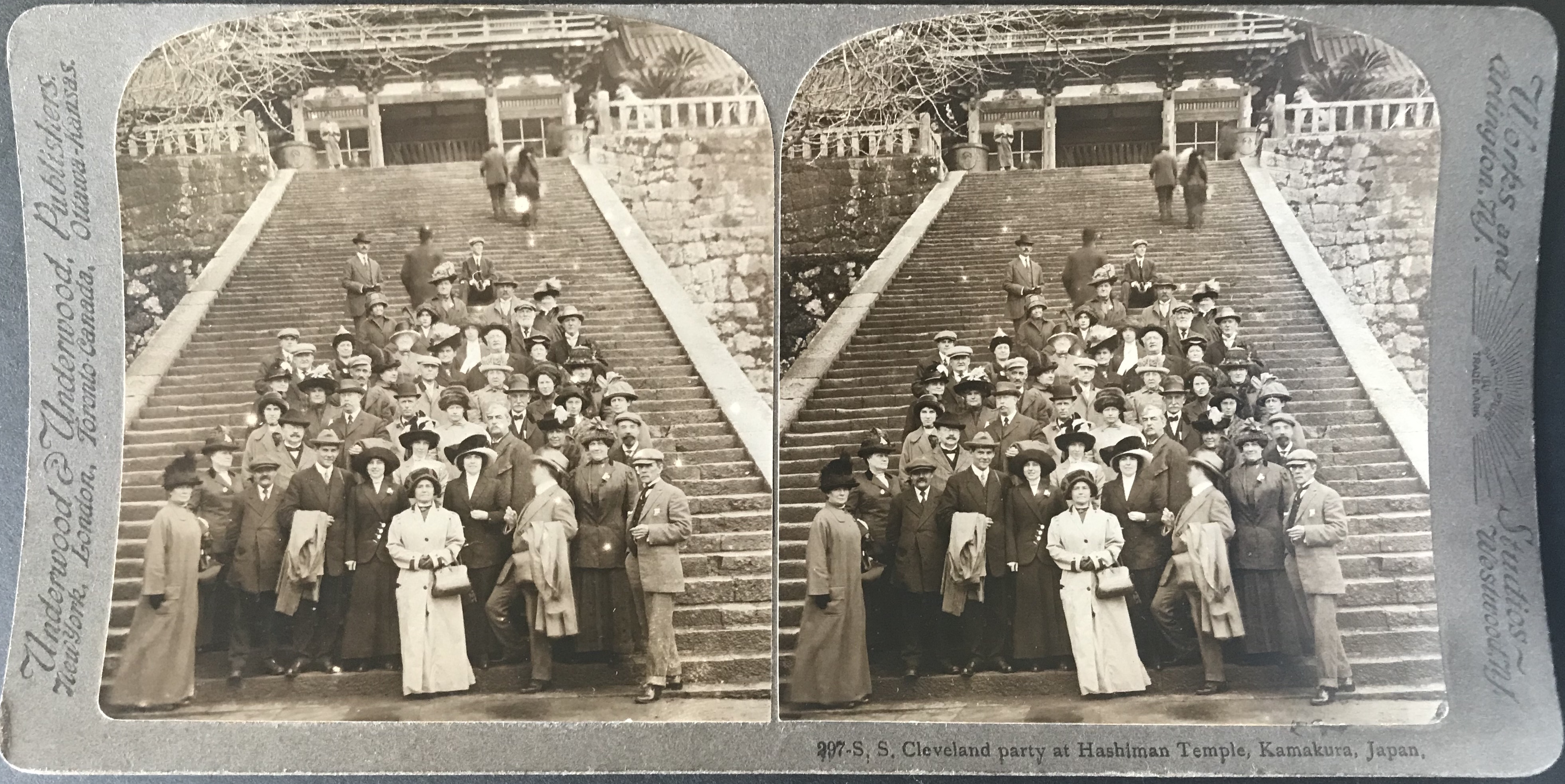
The card itself does not identify the party as originating from the Cleveland, but an adjacent card in the Underwood & Underwood catalogue (number 247, Fig. 2), does identify a large group of tourists perched along the tall stairway of Hachiman Shrine as traveling aboard the Cleveland. Moreover, a close inspection of these two photographs reveals the same individuals are depicted in both.[3] Thus, we can safely assume the visitors to the Daibutsu are among the globetrotters aboard the Cleveland.
Figure 2
It is difficult to determine which around-the-world cruise this group of people joined. Photographs from the initial pair of Clark’s trips, between 1909-1910, show the Daibutsu site displaying a picketed fence and gabled roof on the coin offering box (saisen–bako 賽銭箱), elements that appear – to my eye – to be missing in this stereoview.[4] It is possible this image was taken on one of the second pair of cruises, landing in Yokohama in January and February 1913, having departed from Hoboken and San Francisco respectively.[5] A fifth, and likely final, cruise aboard the Cleveland was scheduled to depart the east coast in January 1914 on a 93-day voyage to San Francisco, with no scheduled “return” trip.[6] Thus, it appears this photograph of the Daibutsu could have been taken during one of these three trips during 1913 or 1914.
In contrast to the other Underwood & Underwood view of tourists atop the Daibutsu, this composition has the feeling of formal portraiture. The visitors are spread out symmetrically along the ground, statue, and stone base, with most looking sternly at the camera lens. As around-the-world cruises became more popular in the interwar period, these large group photos also became more common, sometimes being used in promotional material for the cruise company. The photographs of the 1860s and 1870s that depicted small groups of intrepid travelers (and mostly men), were now festooned with tourists who draw as much attention to themselves as the statue in the background.
Notes:
*This post is in honor of my father, may your curiosity in the odd live on through me.
*This is part of a series of posts devoted to exploring the development of a visual literacy for Buddhist imagery in America. All items (except otherwise noted) are part of my personal collection of Buddhist-themed ephemera.
[1] The Hamburg-American Line advertised heavily for the Cleveland’s first trip through the Panama Canal, scheduled to disembark from Hoboken in January 1915 and bring passengers to San Francisco to celebrate the Panama-Pacific Exposition. I have found no evidence that this trip took place, and given that Germany was in the midst of war by the end of 1914, the excursion was most likely to have been abandoned by the Hamburg-American Line. Accounts of the previous completed trips, where the above information was extracted, can be found in Frizell & Greenfield 1910, Junkin 1910, Bush 1911, Forbes 1912, and Casey 1914.
[2] Casey 1914: 29. According to Casey, they also visited the Kaihin Hotel.
[3] The easiest individual to spot is the sole hat-less man with coiffed white hair and mustache. A second man in a brimmed newsboy hat and white beard is also easily identified in both.
The distinctive plumes in women’s hats also leads to several relatively easy identifications (not pictured). Moreover, Underwood & Underwood Japan-series cards issued with numbers in the 290’s all appear to be issued from the Cleveland cruises.
[4] The photograph by amateur photographer F. H. Wellcome and published in the travelogue of Frizell and Greenwod clearly shows the gabled coin box. (see Frizell & Greenwood 1910: 49).
[5] These dates are noted in Forbes 1912: 27 & 29. Forbes took two trips around the world, starting in Hoboken and travelling eastward until ultimately landing in San Francisco, where he then joined the “return” voyage, heading westwards until back in Hoboken
[6] The Cleveland would have needed to be back in Hoboken for its widely publicized trip leaving in January 1915 (see note above). It is possible the Cleveland left San Francisco and headed for the Panama Canal, testing the crossing without passengers before returning in January. This tour was operated by the Hamburg-American Line directly and Clark would not make his fifth trip around the world until after the war in 1924, when he chartered the S.S. California.
References:
Bush, George Tome. 1911. 40,000 Miles Around the World. Howard, PA: N.P.
Casey, R. H. 1914. Notes Made During a Cruise Around the World in 1913. New York: N.P.
Forbes, Edgar Allen. 1912. Twice Around the World. New York: Fleming H Revell Company.
Frizell, William G. and Greenfield, George H. 1910. Around the World on the Cleveland. New York: N.P.
Junkin, Paul S. 1910. A Cruise Around the World. Creston, IA: N.P.
Additional Posts in Visual Literacy of Buddhism Series


















































































 Personal Site of Peter Romaskiewicz