Government-Issued Halftone Postal Card of the Daibutsu

Capturing light on a photosensitive medium to make a photograph was a monumental technological achievement. Arguably more influential, however, was the ability to mechanically reproduce those images in ink and expose them to wider audiences. In the latter half of the nineteenth century, chemically processing individual photographs was technically difficult, time-consuming, and expensive. Newspaper, magazine, and book publishers needed a less labor-intensive method to produce the thousands of images needed for mass commercial printing.

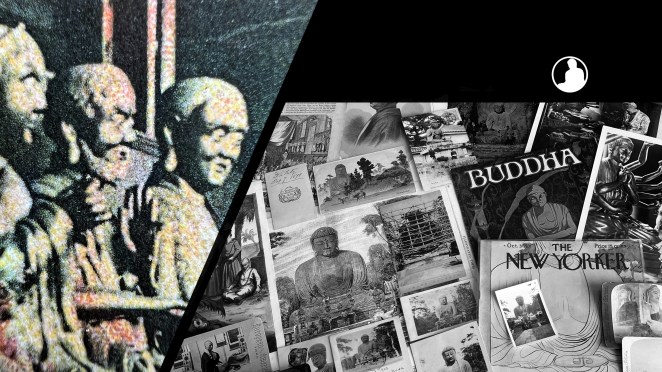
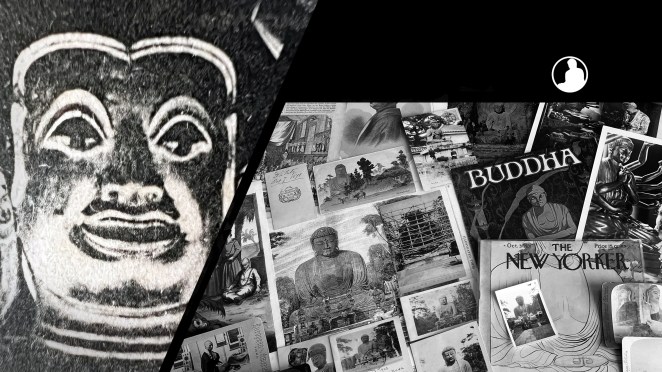
Consequently, translating the tonality of a photograph mechanically into black ink marks was developed not long after the discovery of photography. The collotype process, a planographic printing method using reticulated gelatin, produced a beautiful tonality with fine detail, but the process proved difficult and costly. On the other hand, the letterpress halftone process proved to a better investment for the inexpensive mass printing of images, especially for newspapers and magazines. This process is easily identified through its distinctive dot pattern creating the illusion of tonality [Fig. 1].

Figure 1

The tonality of the halftone print on the left, comprised of dots of differing size and spacing, is of lesser quality than the collotype print on the right. The wormy reticulation of a collotype print under high magnification can be seen here.

Ogawa Kazumasa 小川 一眞 (1860-1929) was a pioneer in the photomechanical reproduction of images in Meiji Japan. After a period of apprenticeship in the United States, Ogawa opened the first collotype (korotaipu コロタイプ) business for reproducing photographs in 1889, eventually introducing the halftone process to his Japanese customers. Having attended the Congress of Photographers at the Chicago World’s Fair in 1893, Ogawa learned about the halftone process and the following year procured the necessary equipment and had delivered to Tokyo.[1] As Kelly McCormick notes, under the guidance of Ogawa the Japanese newspaper, the Asahi Shimbun 朝日新聞, published its first photographs on June 16, 1894. Moreover, the halftone process allowed Japanese newspapers to fill their editions with multiple, full-page photographic images as well as incorporate text on the same plate. Additionally, to help expose his colleagues to the history of photography and modern photographic methods, Ogawa had Hermann Vogel’s The Chemistry of Light and Photography (1875, revised 1889) translated into Japanese (as Kōsen nami shashin kagaku 光線並写真化学); it remained in print for nearly 30 years.

The tonality of the halftone print was not as rich as the collotype (see above) and thus the collotype print remained preferential when image quality was more important.[2] This included the manufacturing of Japanese picture postcards (ehagaki 絵葉書), especially when changes in the postal code in 1900 allowed private publishers to issue their own cards. Collotype remained the main method of printing postcards through the first two decades of the twentieth century.

Figure 2
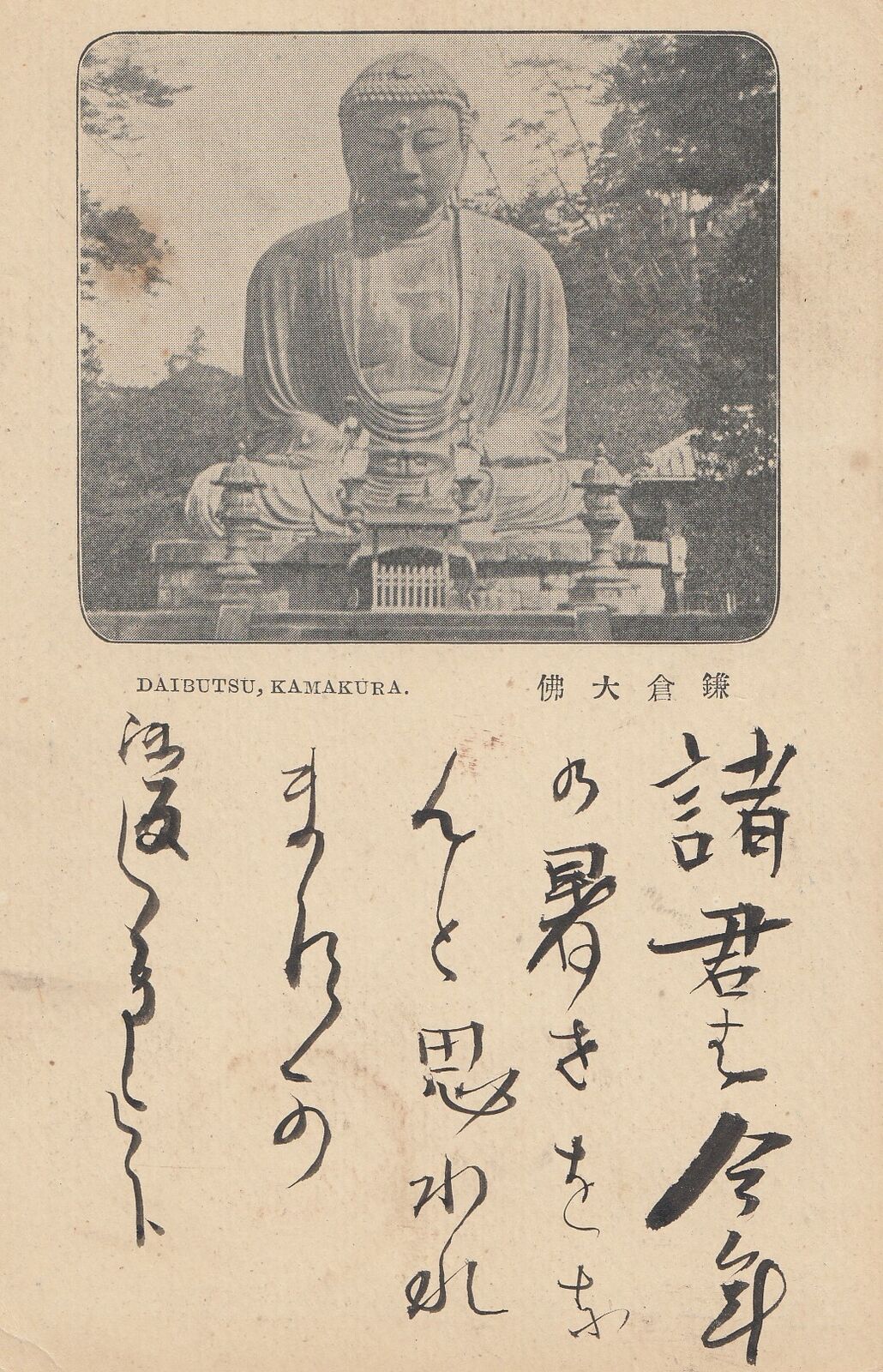
Fig 1 Halftone.jpg

  • Title/Caption: DAIBUTSU, KAMAKURA 鎌倉大仏
  • Year: 1897 (postally used)
  • Publisher: Printing Bureau, Ministry of Finance 大蔵省印刷局
  • Medium: halftone print on paper
  • Dimensions: 5.5 in X 3.5 in
  • Reverse Imprint: 大日本郵便, JAPANESE POST, 郵便はがき+

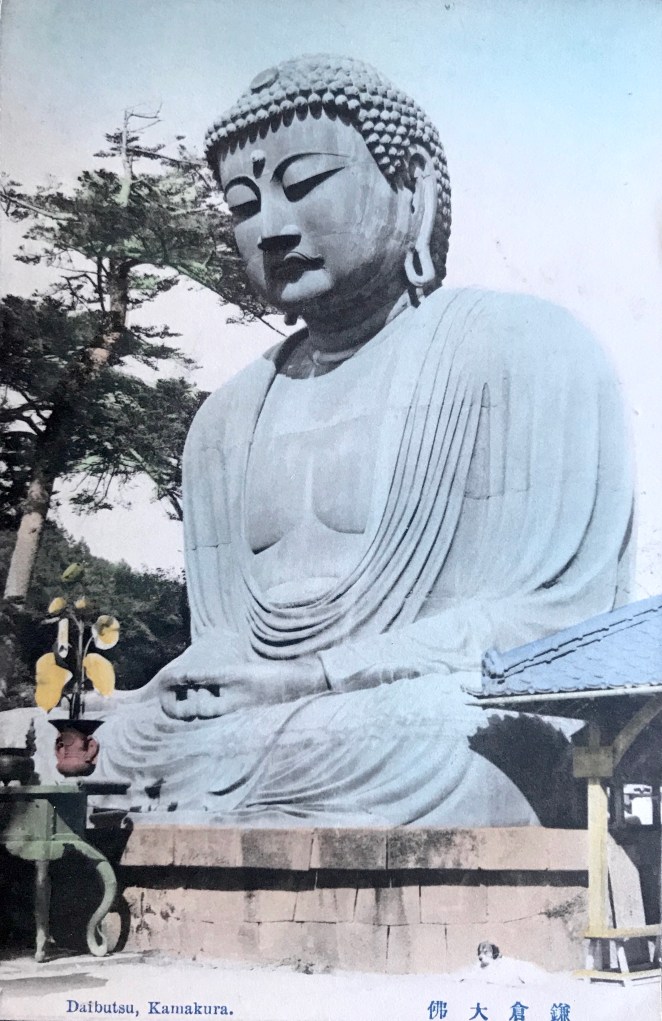
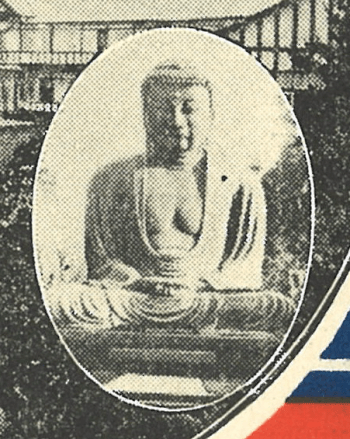
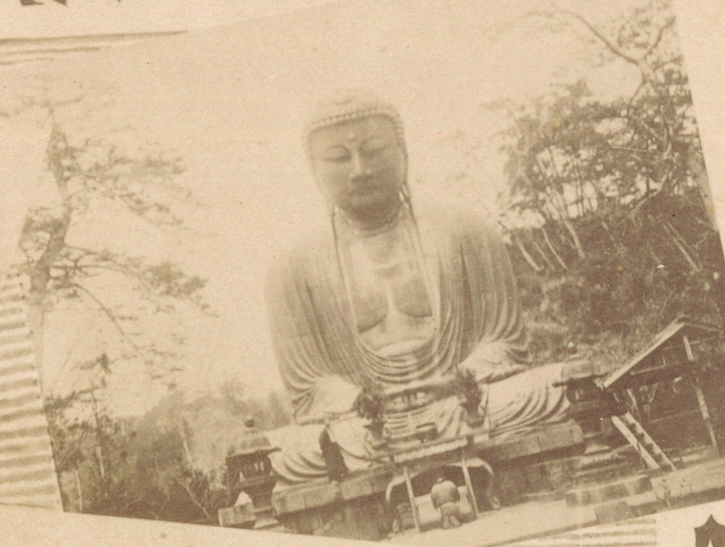
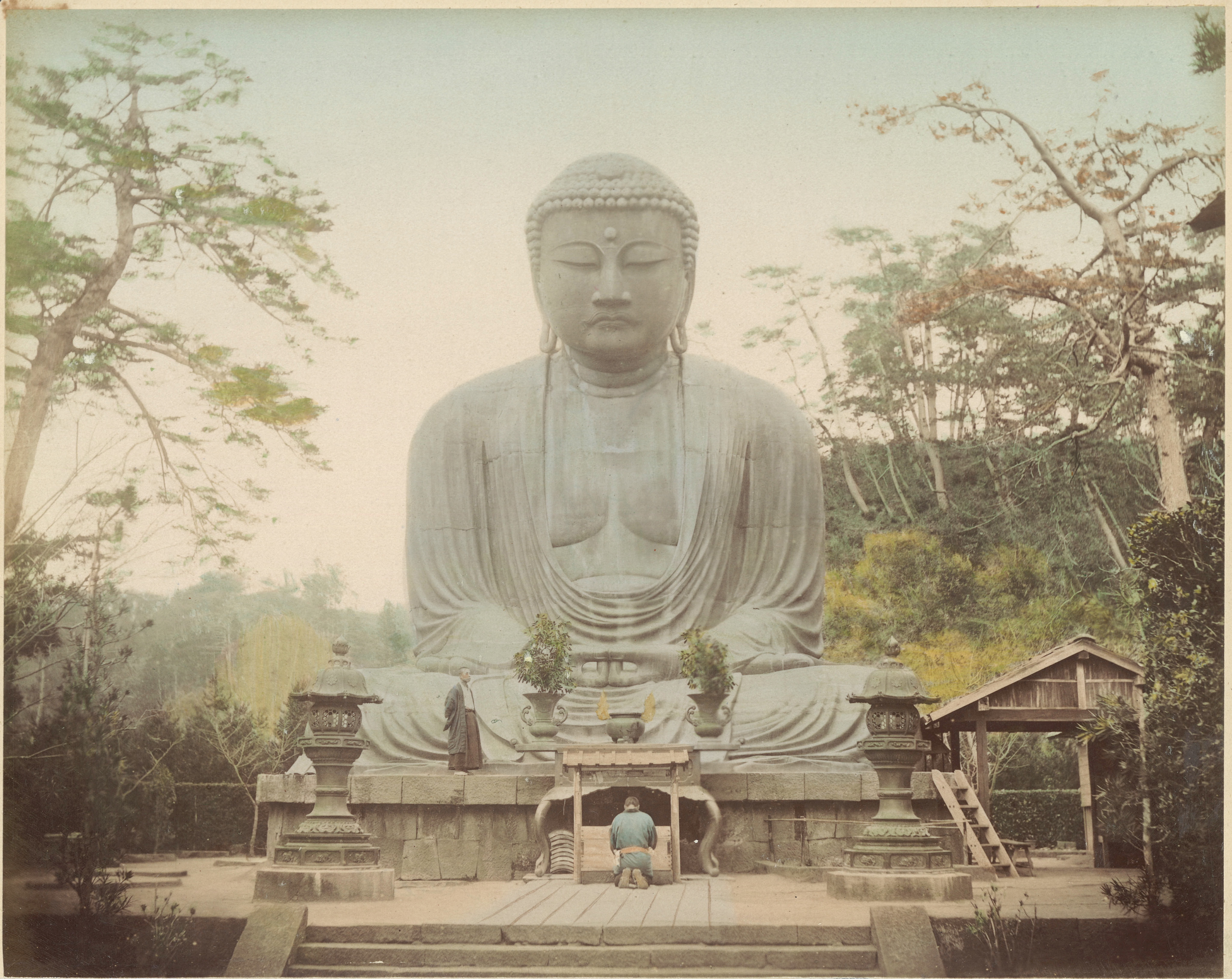
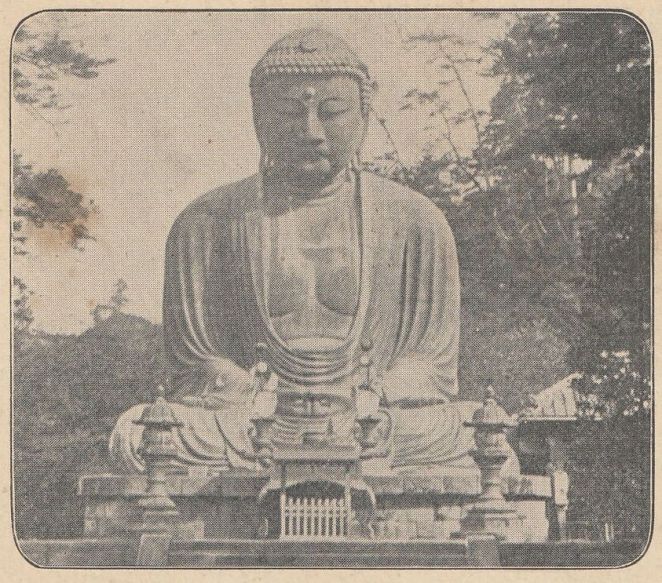
The government-issued postal card here, however, offers a rare glimpse at using the halftone process for mechanically reproducing a photograph previous to postal code changes [Fig. 2]. Sent in 1897 (Meiji 30[3]), this card reflects a rather early example of the halftone process, introduced by Ogawa only three years earlier. As noted by the caption, it depicts the Kamakura Daibutsu, a site that had developed into a popular international tourist destination by the 1890s. Interestingly, the image shows the site devoid of tourists, a rare depiction since people were often included to provide a sense of scale – the statue is over 40 feet in height. This photograph focuses the viewer’s attention to the craftsmanship of the work and the serenity of the image, thus creating a silent and contemplative portrait of the bronze colossus. The elements in the photograph suggest it was taken in the first half of the 1890s.

It is tantalizing to think that the Printing Bureau in the Ministry of Finance[4], the agency responsible for issuing postal cards, consulted Ogawa for this project.[5] It is also possible that the original photograph of the Daibutsu was taken by Ogawa or an associate of his studio.[6]

Figure 3
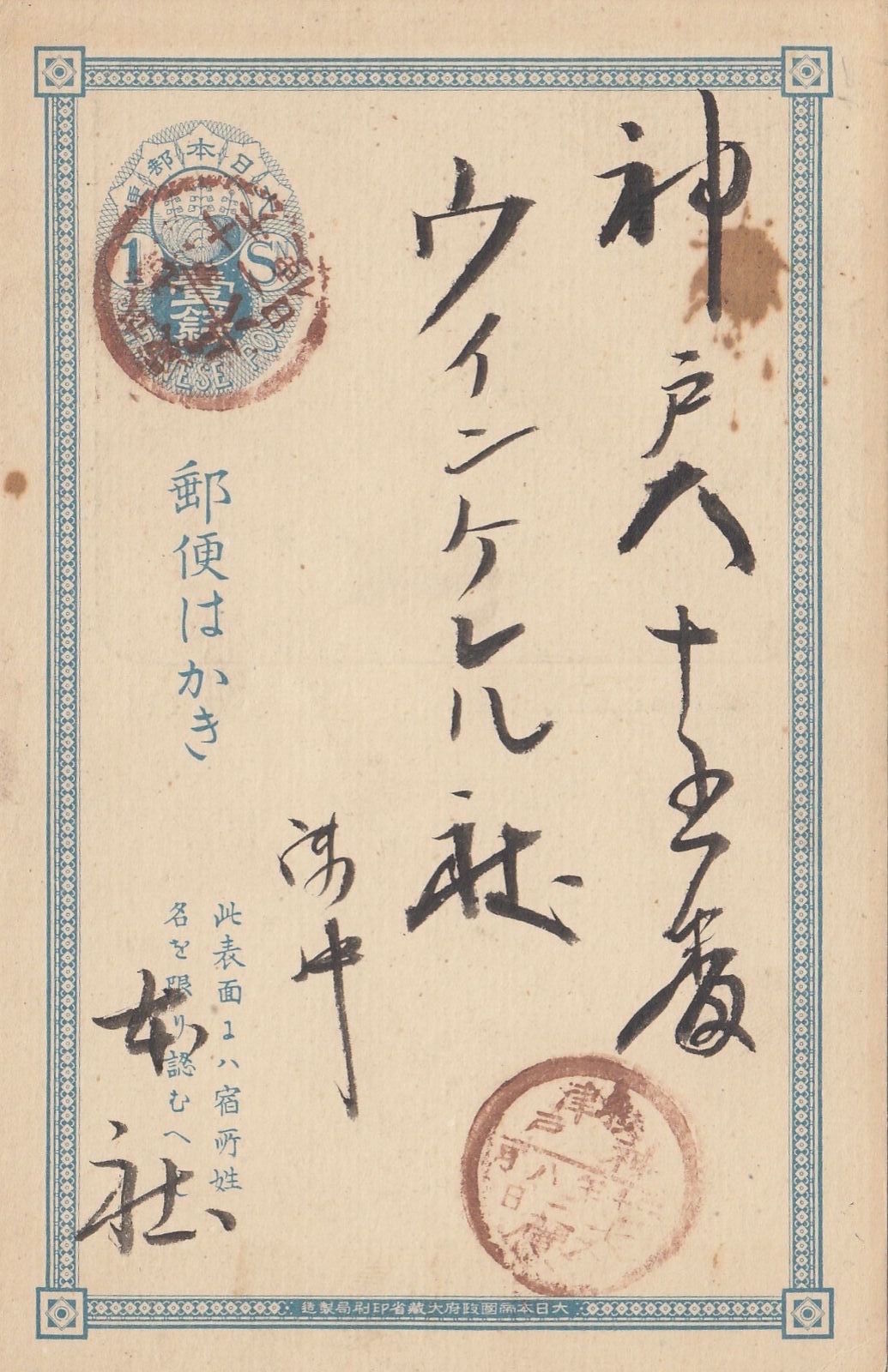
Fig 2 Halftone.jpg

Figure 4

1 sen franking and cancellation.png

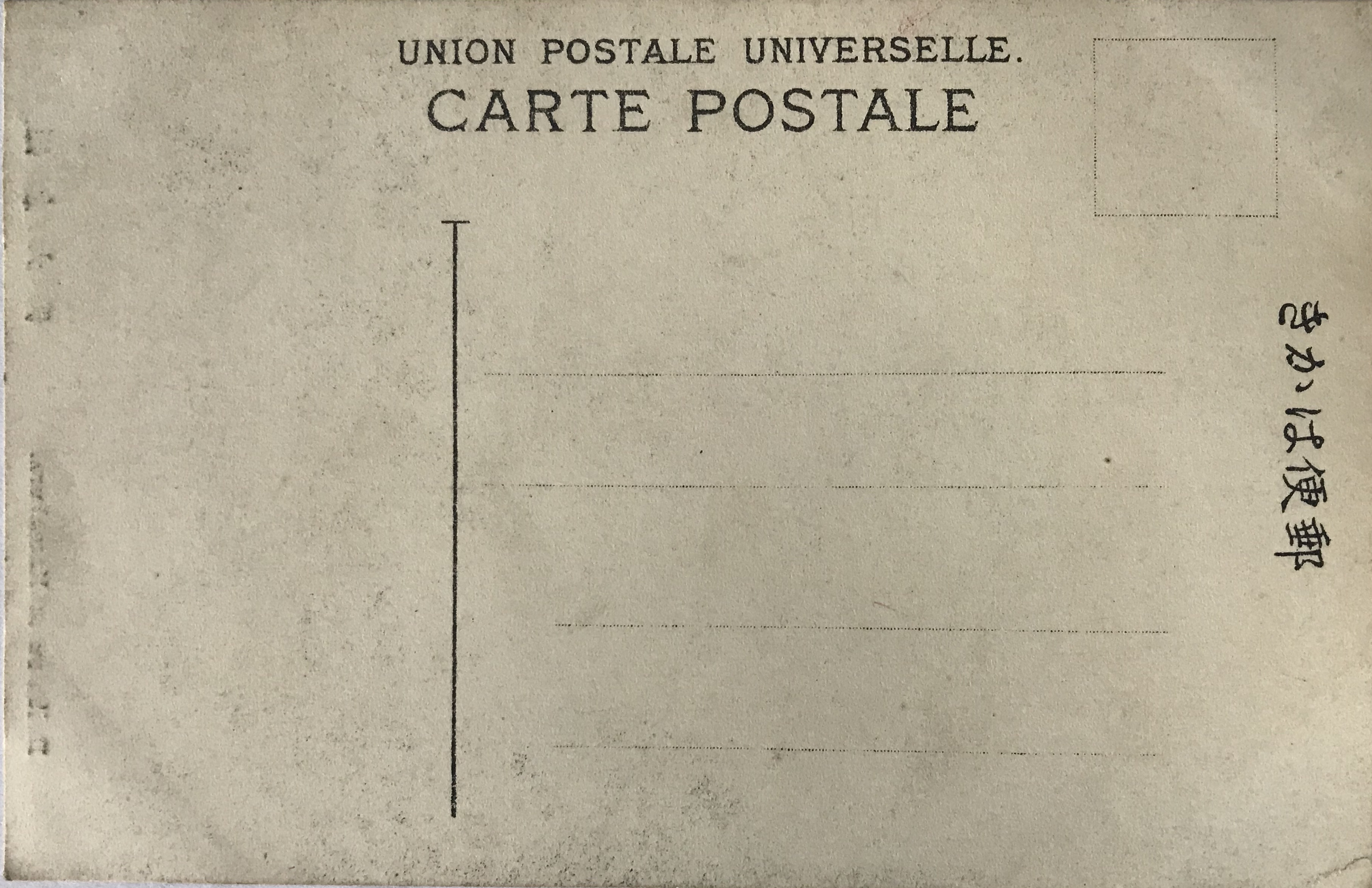
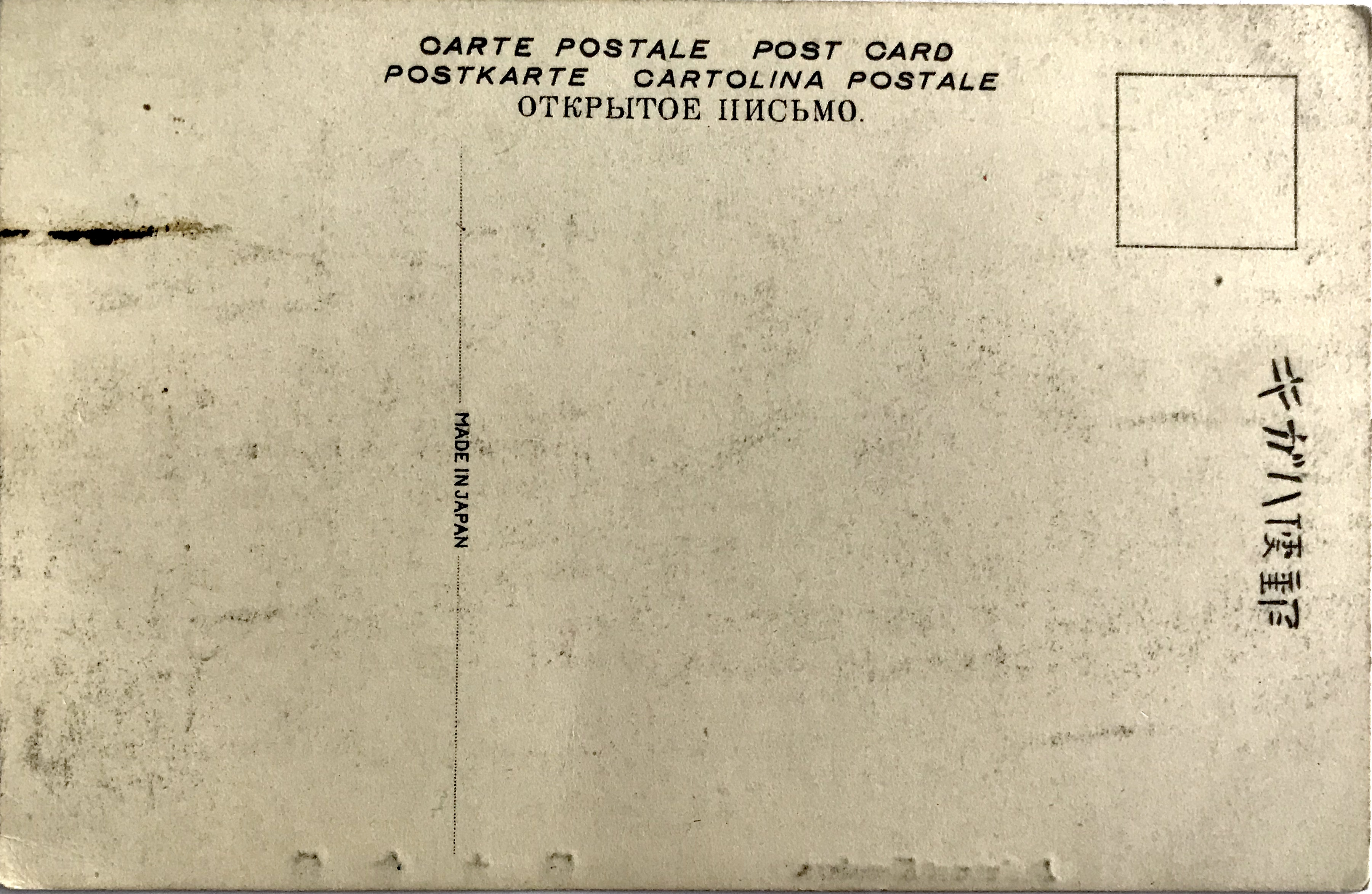
The reverse bears a simple filigree border and 1 sen oval-shaped frank printed in light blue [Fig. 3]. The pre-paid 1 sen rate covered domestic postage until 1899 when the rate was increased. The franking design incorporated the three-leafed paulownia seal (kirimon 桐紋), the official insignia of the Japanese government, in its center [Fig. 4]. Examining the border design (bottom) we can also find the government agency responsible for printing the card, namely the Printing Bureau in the Ministry of Finance. Instructions in Japanese (lower left) explain this side is reserved for the name and address of the recipient only. The paper is thinner than the card stock used by private publishers a few years later.

The cancellation stamp over the pre-paid postage reveals the card was sent on August 11, 1897 from the former Musashi Province 武蔵, an area that covered a location close to the Kamakura Daibutsu. The second cancellation stamp shows it was received the following day, August 12, at the post office in Kobe before it was sent out to the recipient.


*This post is dedicated to my mother, who introduced me to the beauty of printmaking.

**This is part of a series of posts devoted to exploring the development of a visual literacy for Buddhist imagery in America. All items (except otherwise noted) are part of my personal collection of Buddhist-themed ephemera.

Notes:

[1] For more information, see McCormick 2017. For a full biography of Ogawa in English, see Bennett 2006: 210-16. [For a quick chronology of his life, in Japanese, see here.]

[2] Perhaps most notably, the influential Japanese art magazine, Kokka 国華, employed collotypes and woodblock prints. Ogawa and his studio supervised the printing of the magazine until 1907. The magazine’s full title in English was Kokka, An Illustrated Monthly Journal of the Fine and Applied Arts of Japan and Other Eastern Countries. For more on this publication, see Hanley & Watanabe 2019. Ogawa also used collotypes in the Shashin Shinpō 写真新報 (Photography Journal), in which he was the editor, see Bennett 2006: 212. In the 1910s, Japanese postcard publishers switched to offset printing because this method produced images at a much faster rate.

[3] The cancellation stamp is not clear, but Meiji 30 seems appropriate. The bisected cancellation date stamp (maruichi-gata hiduke-in 丸一型日付印) was adopted in 1888 and the date reads year-month-day from right to left (this stamp was retired in 1909). Sanjū nen 三十年 (“year 30”) is barely legible and is equivalent to 1897. This dating also aligns with other evidence placing the cancellation between 1888 (signaling by the inclusion of the Printing Bureau 印刷局 instead of the Bureau of Paper Currency 紙幣寮 on the border inscription) and 1899, when the 1 sen oval frank was replaced by the 1½ sen chrysanthemum frank. These details are noted below.

[4] The full inscription reads, “issued by the Printing Bureau in the Ministry of Finance of the Empire of Japan” (Dainipponteikoku seifu Ōkurashō insatsu-kyoku seizō 大日本帝国政府大蔵省印刷局製造). The Ministry of Finance was also responsible for printing paper currency.

[5] Ogawa did have a close relationship with the Japanese government, and was appointed as the chief photography instructor for the Japanese army, see McCormick 2017. Furthermore, McCormick notes, “Ogawa skillfully aligned his name with the halftone process to the extent that if it was a halftone, it was likely that Ogawa was behind it.”

[6] In 1894, Ogawa published the Illustrated Companion to Murray’s Japan Guide-Book, the most popular tourist book for international travel in Japan. I have not seen a copy of this work, but the second image in the book is listed as the Kamakura Daibutsu.

References:

  • Bennett, Terry. 2006. Photography in Japan: 1853-1912. Rutland, VT: Tuttle Publishing.
  • Hanley, Keith & Watanabe, Aiko. 2019. “Kokka, Okakura Kakuzō, and the Aesthetic Construction of Late Meiji Cultural Nationalism.” Unpublished paper. [here]
  • McCormick, Kelly M. 2017. “Ogawa Kazumasa and the Halftone Photograph: Japanese War Albums at the Turn of the Twentieth Century,” Technologies, Vol. 7, No. 2. [here]

 Additional Posts in Visual Literacy of Buddhism Series

Illustrated State-Issue Postal Card of the Kamakura Daibutsu, c. 1897

[Update: June 2024]

The modern Japanese word for postcard, hagaki はがき, is derived from hashigaki はしがき (or 端書き), a reference to writing placed at the beginning or end of a document. During the early Meiji period (1868–1912), hagaki came to denote a brief letter or a note that was sent through the mail as a postcard.[1] The first postal card in Japan was issued in December 1873, just four years after this novel postal stationary was introduced in Austro-Hungarian Empire. Until the beginning of the twentieth century all Japanese postal cards were government issued (kansei 官製). Moreover, the vast majority were printed without images on the obverse since the non-address side was reserved for the written message. These plain cards are further identifiable through pre-paid franking printed on the address side (reverse) of the card. Changes in Japanese postal codes on October 1, 1900 afforded private companies the opportunity to publish picture postcards (ehagaki 絵葉書) where an illustration or design could be printed on the obverse. These changes altered the landscape of the postcard market and soon started a new cultural phenomenon known as the Japanese “postcard boom.”[2]

Figure 1

Figure 1 Gov Issued Illus.jpg

ID Info

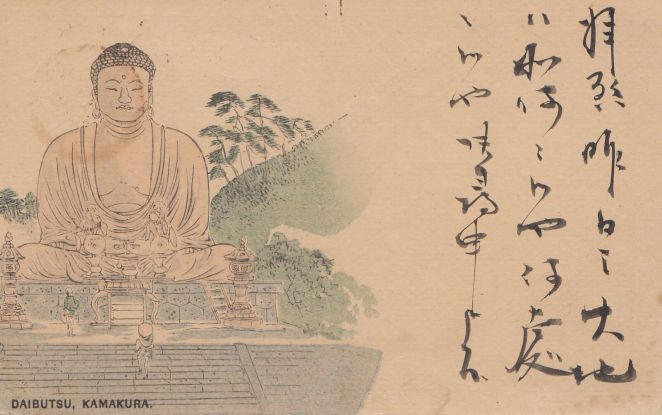
The state issued postal card shown here, postally canceled in 1897 (Meiji 30),[3] unconventionally bears a multi-color woodblock print on the obverse. It depicts the Kamakura Daibutsu colored with washes of ink [Fig. 1]. Notably, the image is offset to allow space for the written message; it would not be until 1907 that a message could be written on the reverse. Domestic illustrated postal cards from this period – that is, before the ban on privately printed cards was lifted in 1900 – are relatively uncommon and their origins are poorly understood.[4] Exemplars such as this suggest the state Printing Bureau (insatsu-kyoku 印刷局), the agency responsible for printing banknotes, stamps, and postal cards, may have been playing with designs before the postal code changes in 1900 or, alternatively, were ambivalent towards private companies who added illustrations to government cards and resold them to the public.[5]

For example, in addition to the circulation of illustrated New Year’s cards (nengajō 年賀状) in the 1890s, some government issued cards (as identified through the imprinted franking on the reverse) depict photographs of landscapes and a variety of scenes from daily Japanese life.[6] It is clear that some of these images draw heavily upon photographic genres, compositions, and conventions that developed under the Japanese foreign tourism and souvenir industry of the 1870s and 1880s.[7] More specifically, some state-issued postal card images can be traced to known Japanese photography studios that catered to both domestic and foreign clientele through the last decade of the nineteenth century.[8]

It remains unknown whether early picture postal cards were printed under the formal auspices of the Printing Bureau (to my knowledge, there is no documentation supporting such a view), or if Japanese photography studios privately issued or commissioned photomechanically printed cards on the “base” of state-issued cards, or if printing houses purchased copyrights of photographs and issued cards themselves (again, on a state-issued card “base”).[9] Current evidence gives most weight to the latter possibility. We know, for example, Ueda Yoshizō 上田義三 (1865–?), opened a collotype printing house in Yokohama in 1897 and is reported to have printed landscapes and images of people on state-issued cards.[10] The role of the Printing Bureau and other state agencies remains undetermined in such a business, but we may surmise these entrepreneurial activities helped encourage the postal regulation changes in 1900. Ueda would directly benefit from this change and became the one of the largest private postcard publishers in Yokohama through the early 1910s.

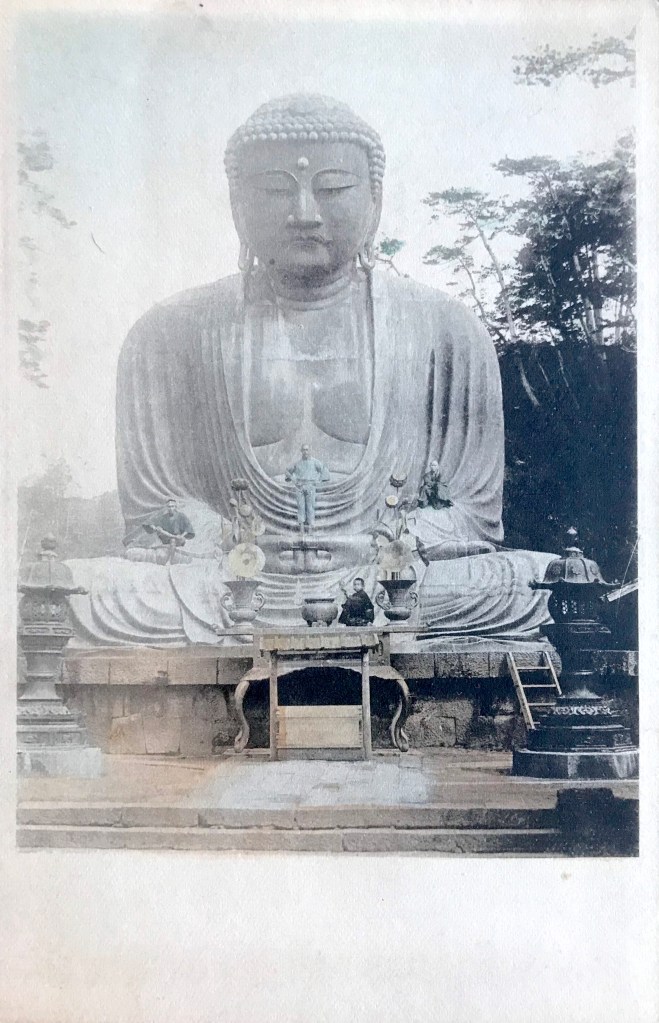
The postal card under consideration here is reminiscent of similar period photographs taken of the Daibutsu statue head-on. The unknown artist depicted a realistic scene with two Japanese travelers gazing upwards at the colossal image. It casts a gentle sign of reverence towards the Buddhist image without culturally reductionistic signs of deep religious piety as was sometimes choreographed by Western photographers. The overall scene is calm and peaceful, reflecting the beneficent gaze of the Daibutsu.

With the exception of the steeply banking hillside and tall flight of steps leading to the top landing, the illustration depicts the location faithfully as it was known in the 1880s, inclusive of the step ladder to help visitors climb atop the statue. Similar photographs were sold by the studios of Kusakabe Kimbei 日下部金兵衛 (1841–1934) and Tamamura Kōzaburō 玉村康三郎 (1856–1923?), both highly accomplished commercial photographers whose stock may have been the models upon which the unknown artist based this design.[11] The Daibutsu grounds were modified by the winter of 1890, thus while this postcard was probably printed in the latter half of the 1890s, it is likely based on a photograph taken a decade earlier.

The only curious element in the depiction of the statue is the inclusion of earrings, a detail often reserved for other Buddhist deities, but not for buddhas. In contrast, the original bronze work has long, pierced ear-lobes which one might easily confuse for earrings, especially from frontal photographs.[12]

Figures 2 & 3

In further examining the card we can infer it is a woodblock print. First, this is discernible through the telltale signs of “ink squash” along the margins of the color washes. This occurs when the pressure of printing forces ink to spill over the cut edge of the woodblock, creating a darker ink line [Fig. 2]. Moreover, we can observe partial embossing of the obverse image on the reverse of the print. The pressure of the print, most noticeable here with the trees on hillside, causes the paper to deform around the woodblock cuts [Fig. 3]. (Both figures show an unused version of the same postcard where these details are easier to see.)

Figure 4

Figure 2 Gov Issued Illus.jpg

Postmark Info

The reverse bears a rectangular filigree border and 1 sen oval-shaped frank printed in light blue [Fig. 4]. We may presume this card was intended for domestic use since international mail required higher 2 sen or 3 sen rates.[13] Additional postage could be affixed, however, to make up for the difference. There are other indications this card was produced with an international or cosmopolitan audience in mind. If we look back at the caption under the obverse illustration we see “Daibutsu, Kamakura.” While this uses Japanese terminology (Daibutsu means “Great Buddha”), it nevertheless employs the foreign Roman alphabet, not native kanji characters or the kana syllabary, such as we see on the reverse.

The franking design here incorporates the three-leafed paulownia seal (kirimon 桐紋), the official insignia of the Japanese government, in its center. Examining the border design we can also find the government agency responsible for printing the card, namely the Printing Bureau in the Ministry of Finance.[14] Instructions in Japanese explain this side is reserved for the name and address of the recipient only. The paper is thinner than the sturdier stock customarily used by private publishers a few years later. Not only was the paper more durable, it was also a better surface for the increasingly fashionable fountain pen, a Western implement that started to replace the traditional writing brush, especially for composing postcard messages.[15]


*This is part of a series of posts devoted to exploring the development of a visual literacy for Buddhist imagery in America. All items (except otherwise noted) are part of my personal collection of Buddhist-themed ephemera.

Notes:

[1] Scholars of postal history often distinguish between “postal cards” which are imprinted with prepaid franking (an imprinted stamp) and “postcards” which are privately issued and require the addition of an adhesive stamp. The Japanese term hagaki came to signify both state issued postal cards and privately issued postcards.

[2] For an English language introduction to the early history of Japanese picture postcards, see Satō 2002 and Morse 2004.

[3] The cancellation stamp is heavily degraded, but Meiji 30 seems appropriate. The bisected cancellation date stamp (maruichi gata hitsukein 丸一型日付印) was nationally adopted in 1888 and the date reads year-month-day from right to left below the dividing line. Sanjū nen 卅十年 (Year 30) is barely legible and is equivalent to 1897. This dating also aligns with other evidence placing the cancellation between 1878 (signaled by the inclusion of the Printing Bureau instead of the Bureau of Banknotes on the reverse border inscription) and April 1899, when the postage rate for postal cards increased from 1 sen to 1½ sen (additional postage would have been affixed to the card if mailed after the rate increase). In addition, the Printing Bureau changed the design of the oval frank postal card to a chrysanthemum frank in December 1898, thus the printing of this postal card – not necessarily its mailing – must predate this period.

[4] Traditional Japanese deltiological lore holds that the first privately issued picture postcard was designed by Ishii Kendō 石井研堂 and appended to the October 5th issue of the boy’s magazine Kinsei Shonen 今世少年, just four days after the new postal regulations. This story was first reported in Ishii’s own 1908 work, Origin of Meiji Things明治事物起源, where he proclaims himself to be the inaugural producer of private picture postcards. Most postal historians will point out that Ishii’s claims do not preclude the earlier existence of state issued cards bearing pictures, see for example Saitō 1999: 336. Nevertheless, Ishii’s own claims deserve further scrutiny. For example, in 2020, a privately issued picture postcard cancelled on October 1, 1900 came into the hands of collector Takao Hitoshi 高尾均, hinting the printing history of picture postcards is not as straightforward as traditional lore suggests.

[5] Postal cards had long been adorned with hand drawn illustrations prepared by the sender, now typically categorized as etegami 絵手紙, “hand drawn missives.” These were clear predecessors to the mass scale printing of picture postcards. In addition, many Japanese were previously familiar with picture postcards through European or American cards collected overseas or sent through international mail, see comments in Mōri 2013: 32.

[6] As noted in Kim 2011: 173. Such postal cards are can be categorized as landscapes (fūkei 風景) and customs (fūzoku 風俗). These are continuations of the two most important genres of Meiji-era export tourist photography, see Tucker 2003: 7–8.

[7] For discussion of early commercial photography in Japan, see Dobson 2004 and Wakita 2013.

[8] This personal observation is based on seeing several illustrated state-issue cards for sale on the secondary market. For example, I have seen postal cards depicting a photograph of geisha playing the shamisen and koto as well as a lakefront vista of the old Grand Hotel in Yokohama (destroyed during the 1923 earthquake). Both of these images were reproductions of photographs found in albums sold by Yokohama photographer Kusakabe Kimbei, catalogued as “371. Girls Playing on Samisen and Koto,” and “505. Grand Hotel, Yokohama”; for these catalogue number attributions, see Bennett 2006: 137. I saw the former photograph, with identifying caption, in a private collection while the latter, also with identifying caption, is held by the Syracuse University Art Museum (Object number 1986.510). Notably, the postal cards were printed with 4 sen franking, revealing they were intended for international mail.

[9] It should be noted that Meiji-era Japan had weak copyright regulations for photographs and pirating was fairly common, see Bennett 1996: 85–87.

[10] Saitō 1999: 336. Mid-to-late Meiji business documents from the many postcard sellers of the time have yet to be uncovered. As noted by Saitō Takio, a very large Yokohama postcard exhibit was held in 1985 in the hopes that descendants of these sellers would come forward with old business documentation or family anecdotes, but nothing of the sort occurred, see Saitō 1986.

[11] Relevant photographs would be Kusakabe Kimbei’s print sometimes labeled as “1020,” with an exemplar held by the Nagasaki University Library (Catalogue No. 4673), and Tamamura Kōzaburō’s print captioned “No. 535 Daibutsu at Kamakura,” with an exemplar held by Museé Guimet (AP15903).

[12] According to Buddhist lore, as a sign of his renunciation of princely life, the Buddha removed his earrings, thus leaving his pierced earlobes empty.

[13] International postal cards, issued between June 1879 and December 1898, were printed with 2 sen or 3 sen franking depending on destination, see EGASHIRA 2018: 2. The 1 sen rate covered domestic postage until April 1899 when the rate was increased.

[14] The full inscription reads, “issued by the Printing Bureau in the Ministry of Finance of the Empire of Japan” (Dainippon teikoku seifu Ōkurashō insatsu-kyoku seizō 大日本帝国政府大蔵省印刷局製造). The Printing Bureau in the Ministry of Finance was also responsible for printing paper currency.

[15] For comments on the relationship between postcards and fountain pens, see Satō 2002: 49.

Sources:

  • Bennett, Terry. 2006. Old Japanese Photographs Collectors’ Data Guide. London: Bernard Quaritch Ltd.
  • Dobson, Sebastian. 2004. “Yokohama Shashin.” In Art & Artifice: Japanese Photographs of the Meiji Era, by Sebastian Dobson, Anne Nishimura Morse, and Frederic A. Sharf, 15–40. Boston: MFA Publications.
  • EGASHIRA Tatsuo 江頭達雄. 2018. “Nihon no hagaki 3: Gaishin hagaki” 日本の葉書3: 外信葉書. Nagasaki yūshu 長崎郵趣 146: 1–5.
  • KIM Kyounghwa 金暻和. 2011. “‘Bungaku to shite no hagaki’: Nichirosensō-ki no “hagaki bungaku” o jirei ni shita media-ron no kokoromi”「文学としての葉書」: 日露戦争期の『ハガキ文學』を事例にした メディア論の試み. Masu komyunikēshon kenkyū マス・コミュニケーション研究 78: 169–88.
  • MŌRI Yasuhide 毛利康秀. 2013. “Ehagaki no media-ron-tekina yobi-teki bunseki” 絵葉書のメディア論的な予備的分析. Aikokugakuen daigaku ningen bunka kenkyū kiyō 愛国学園大学人間文化研究紀要15: 29–46.
  • Morse, Anne Nishimura. 2004. “Art of the Japanese Postcard.” In Art of the Japanese Postcard:
  • The Leonard A. Lauder Collection at the Museum of Fine Arts, Boston, 15–29. Boston: Museum of Fine Arts.
  • Satō, Kenji. 2002. “Postcards in Japan: A Historical Sociology of a Forgotten Culture.” International Journal of Japanese Sociology 11 (1): 35–55.
  • Tucker, Anne Wilkes. 2003. The History of Japanese Photography. New Haven: Yale University Press.
  • Wakita, Mio. 2013. “Sites of ‘Disconnectedness’: The Port City of Yokohama, Souvenir Photography, and Its Audience.” Transcultural Studies 2: 77–129.

Additional Posts in Visual Literacy of Buddhism Series
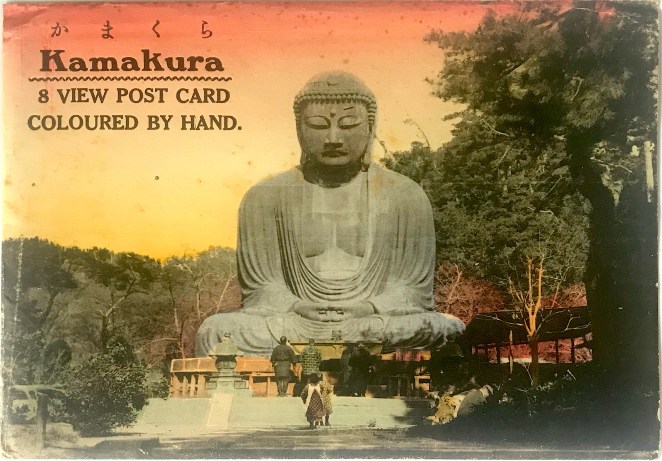
The Eight Postcard Views of Kamakura

Collage.png

The September 1, 1923 Great Kantō Earthquake changed Japan. Striking at just before noon, the 7.9 magnitude earthquake razed the capital of Tokyo and the port of Yokohama and caused severe destruction around the entire Kantō region. The resulting fire and tsunami triggered by the earthquake claimed many more casualties. The resulting reconstruction efforts, involving the rebuilding of homes, government buildings, factories, shops, roads, canals, and bridges was a monumental effort. After seven years of toil, the rebirth of the capital and the symbolic renewal of Japan was marked by a week-long series of celebratory events held in March 1930.

Among the many structures decimated by the disaster also included historic temples and shrines, several of which were in Kamakura, part of what is now considered the Greater Tokyo Area. The ancient capital of Kamakura, after which the Kamakura Period (1185-1333) is named, was the home to the shogunate (bakufu 幕府, “tent government”), a hereditary military dictatorship that ruled over Japan and which granted only nominal authority to the imperial court. While the institution of the shogunate persisted until 1867, the capital was moved at the end of the Kamakura period back to the cultural center of Kyoto. After centuries of gradual decline, significant domestic and international interest was thrust back on to Kamakura in the Meiji period (1868-1912), when its proximity to the newly created international port of Yokohama increased its exposure to travelers and businesses.

When the 1923 earthquake hit the region, one of the early storylines that spread through American newspapers concerned the survival of the Kamakura Daibutsu, a destination known worldwide among globetrotting tourists. While the 93 metric tonne bronze statue had shifted 30 centimeters forward, warping its back and neck, it survived relatively unharmed. Because of the shift in weight, a portion of the stone pedestal was pushed into the ground. The pedestal itself, however, received extensive structural damage requiring significant repair, which occurred early in 1925.

Sometime after the 1923 earthquake, an unknown publisher issued a set of eight postcards memorializing the scenic views of Kamakura. Thematic sets of postcards had long been manufactured by Japanese publishers, both by private printers and the government. When the government first printed its own picture postcards (ehagaki 絵葉書) in 1902 (private companies were allowed two years earlier), it issued a set of six cards commemorating the Japanese–Korea Treaty of Amity (Nitchō-shūkōjōki 日朝修好条規). Regardless of this precedent for publishing a set of six cards, issuing a set of eight cards soon became standard for postcard publishers.

Why issue a set of eight cards? On theory traces the origin to the artistic preferences of Song Dynasty China. A set of eight scenic vistas has its historical origins in the brush paintings of Chinese artist and government bureaucrat Song Di 宋迪 (c. 1067 – c. 1080) who is attributed with created the visual genre of the Eight Views of the Xiao and Xiang Rivers (Xiāoxiāng Bājǐng瀟湘八景)[Song Di’s paintings are now lost]. The notion that a set of “eight scenic vistas” or “eight views” (hakkei 八景) constituted a complete and integrated set made its way into Japan by the fourteenth-century. This motivated Japanese artisans and poets to find their own groupings of “famous sites” (meisho 名所) and by the Edo period (1615-1868) each province claimed to have its own set of eight special vistas.[1] For example, Kanazawa 金沢 in Sagami Province, in which Kamakura also resides, became among the most famous sets of eight views in Japan, which was visually represented by woodblock artists such as Utagawa Hiroshige 歌川広重 (1797-1858). Perhaps surprisingly, given Kamakura’s historical importance as a national capital, a specific set of eight views was never expressed among pre-Meiji poets, artists, and woodblock printers.[2]

Given the precedence of the literary and artistic value of the eight scenic vistas genre, one could conclude postcard publishers were naturally filling in the gaps of history when they issued sets of eight postcards depicting famous locations around Kamakura. Kanji Satō suggests this would be premature, as it overlooks the particular means of postcard manufacturing. The photomechanical process of printing late Meiji postcards was dominated by the collotype press, which used relatively large sheets of paper that were later cut into individual cards. Each of these sheets accommodated eight individual postcards, thus sets were most efficiently designed in groupings of eight cards, totaling 8, 16, 24, or 32 cards per set. Thus the relationship to the historical groupings of eight scenic vistas portrayed as a “complete” set is most likely coincidental, although it dovetails nicely into traditional Japanese arts.

Figure 1 [Set 1] & Figure 2 [Set 2]Figure 1.JPG

Figure 2.JPGSometime in the 1920s sets of picture postcards were more frequently issued in a paper sleeve or cover. These sleeves were initially imprinted with text or simple designs, but due to the highly competitive commercial market these utilitarian items became subject to the same visual expectations as the postcards themselves. The examples before us bear a hand-colored photographic image, which is given the same artistic care as the cards they hold [Fig. 1 & Fig. 2]. In addition to the minor and idiosyncratic coloring differences, each set uses a slightly different letterpress design. Set 2 also appears to be influenced by an Art Deco font style.

Figure 3 & Figure 4

Figure 3
Figure 4

The sleeve image of the Daibutsu matches the photograph of the Daibutsu on the interior postcard, save for the bokashi-style color wash of the sky. Both sleeves show a pink-hued twilight coloring of the sky while the cards are tinted with a daylight blue [Fig. 3 & Fig. 4]. The fact that these selves and cards are hand-colored is partly surprising. In the early part of the twentieth century many monochromatic photographic postcards were hand-tinted. In the early part of the Taishō period (1912-1926), however, a multi-color collotype printing process was developed, presenting a new option for publishers to speed up their production process. Some publishers took advantage of this technology and multi-color printed cards existed side-by-side with hand-tinted cards into the early 1920s. After the 1923 earthquake, however, almost all publishers adopted this new printing technology when they re-opened their businesses. Since these two sets of cards were issued post-1923 (see below), the fact that our unknown publisher was employing hand-coloring was an added selling point – justifiably noted on the sleeve.

Figure 5

Figure 5

Figure 6 [sleeve] & Figure 7 [postcard]

Figure 6
Figure 7.JPG

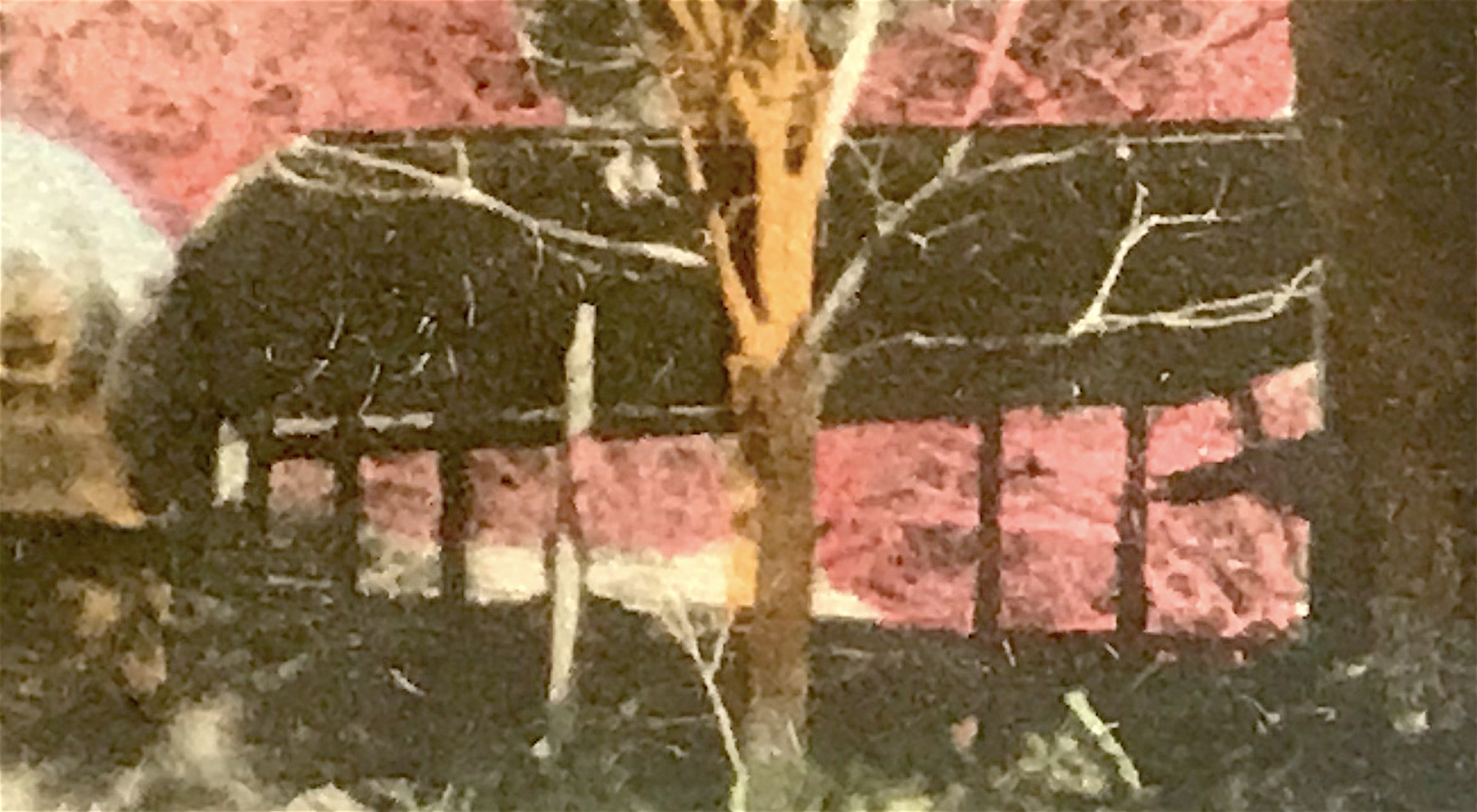
The photograph of the Daibutsu appears staged, as all of the onlookers face squarely towards the colossal statue with legs drawn together and arms at their sides. Upon close inspection, we also see very subtle signs of the 1923 earthquake that ravaged the Kantō region. The lanterns, for example, are shortened from their usual height, signs they needed to be pieced back together and re-erected. Additionally, the items normally arranged atop the offering table are now missing [Figs. 3 &4]. More significantly, the structure to the right of the Daibutsu appears slipshod, a significant difference from the ornate hipped roof building that stood in that same location for three decades [Fig. 5]. Moreover, in a detail that is only visible on the cover sleeves, wooden supports hold up the base of the pedestal, a clear indication of the damages rendered in 1923 [Fig. 6]. An artist carefully painted over the wooden supports for the postcard image, creating a new brick façade to complete the deception [Fig. 7]. The most evident sign of damage is the toppled tree that breaks into the foreground view from the left side [Figs. 3 &4].

Most likely, this photograph represents a period after the terrible destruction caused by the earthquake and after the initial clean-up of the temple grounds. Indeed, enough time has passed so the structure on the right could have been constructed. Yet, the ample work reported in refinishing the pedestal appears to have not yet been executed. Furthermore, in other photographs from April 1925 after the repairs, not only are the wooden supports removed, but the lanterns have been reconstructed fully and moved to the second landing. These details all suggest this photograph of the Daibutsu was taken after the Great Kantō earthquake on September 1, 1923, but before the repairs were finished in early 1925.

Figure 8 [Set 1] & Figure 9 [Set 2]

Figure 8
Figure 9

I suspect that Set 1 was printed in the mid-to-late 1920s. Regrettably, I have not yet been able to match the trademark of a drum (in the stamp box, see Fig. 8) to any known publisher. While Set 2 contains photographs of the same locations, only four of the eight photographs have been copied directly from Set 1. The other four cards offer different vantage points of those locations. Most importantly, the caption (in Japanese only) of the image of the bell tower at Kenchō-ji Temple in Set 2 distinguishes the bell as a National Treasure (kokuhō 國寶)[Fig. 23], a designation it received only on November 14, 1933, thus establishing a firm terminus post quem for this set. I would estimate that Set 2, also issued under an unknown publisher (although I’ve suspected Hoshinoya in the past), was printed in the mid-1930s. I remain uncertain if the same publisher issued both sets.

Below I offer brief historical commentary on the remaining seven views from both sets. The older set, i.e. Set 1, bears simpler captions that are set in blank spaces around the card. The newer set, i.e. Set 2, places the captions along the bottom edge of the cards, as is more traditional. The English in the bilingual caption is sometimes a loose translation of the Japanese, thus I provide a more literal rendering in square brackets.

Figure 10 & Figure 11

Figure 10
Figure 11
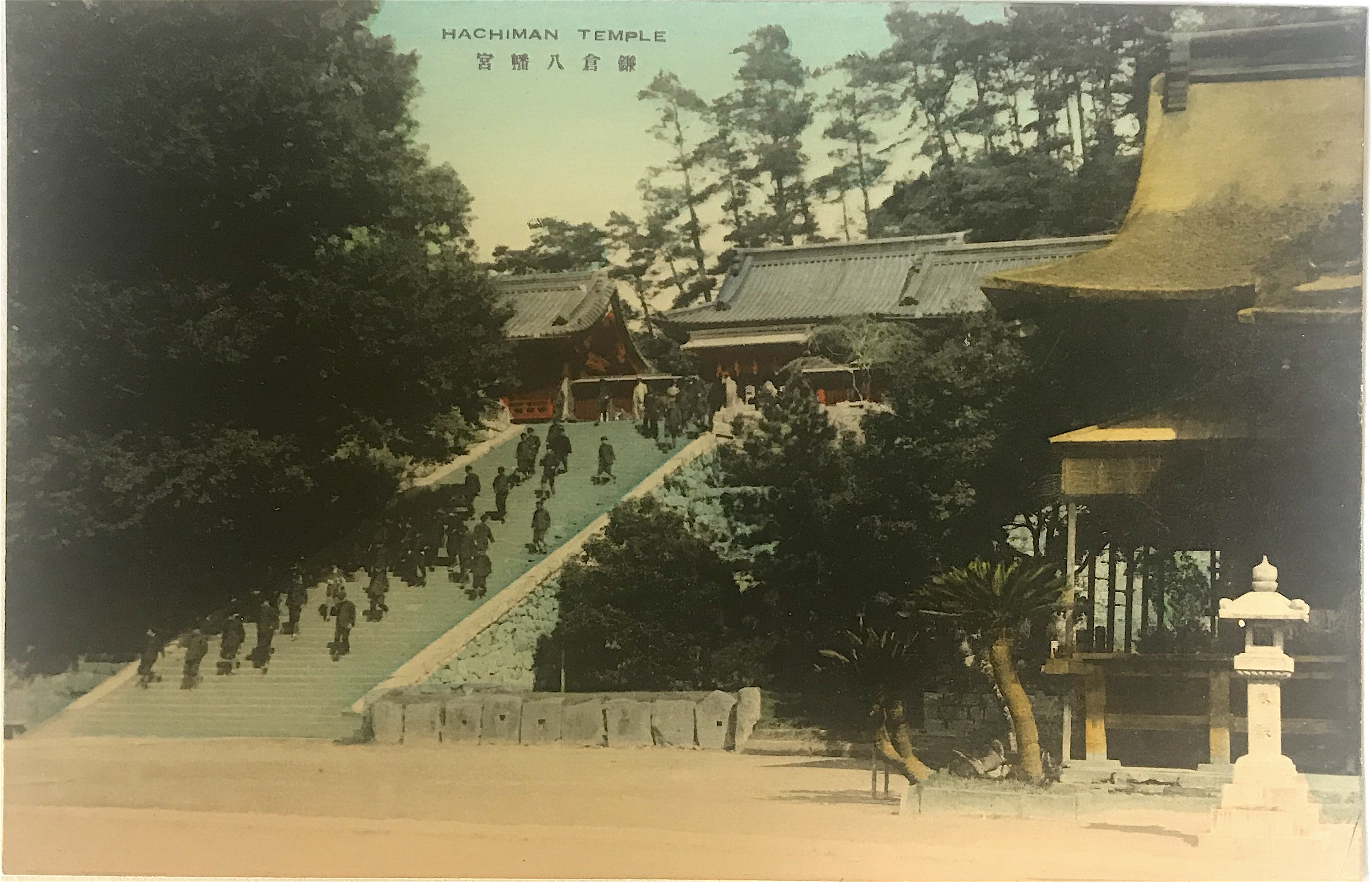
  • Set 1 caption: Hachiman Temple 鎌倉八幡宮 [Hachiman Shrine, Kamakura]
  • Set 2 caption: Hachiman Shrine Kamakura 鎌倉八幡宮 [Hachiman Shrine, Kamakura]

Residing at the geographical center of the city, the unusually long, nearly 2-kilometer long road leading to the Hachiman Shrine entrance traditionally doubled as the main thoroughfare of the city. Originally constructed in 1063, the founder of the Kamakura shogunate, Minamoto no Yoritomo 源頼朝 (1147-99), invited the tutelary kami of warriors, Hachiman 八幡, to reside in a new reconstruction of the shine in order to protect his fledgling government. Due to its relationship with the shogun and important political role, the Hachiman Shrine remains the most historically and culturally important site in Kamakura. Previous to 1868, this site was a shrine-temple complex (jingū-ji 神宮寺), meaning it was used as a place for Buddhist practice and the worship of kami.

Figure 12 & Figure 13

Figure 12
Figure 13
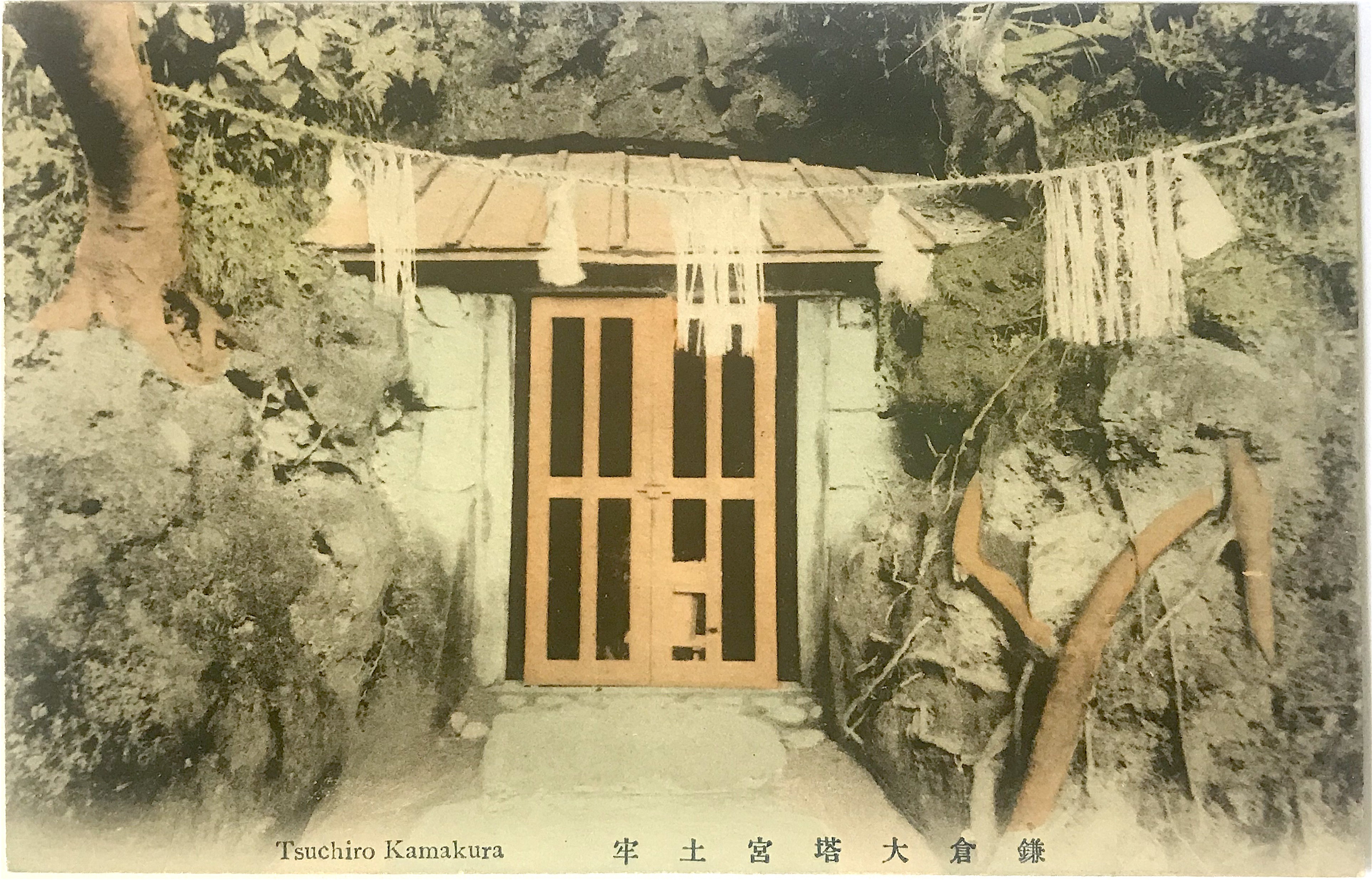
  • Set 1 caption: Tsuchiro Kamakura 鎌倉大塔宮土牢 [“The prison at Ōtōnomiya Shrine, Kamakura”]
  • Set 2 caption: Tsuchiro Kamakura 鎌倉大塔宮土牢 [“The prison at Ōtōnomiya Shrine, Kamakura”]

The Kamakura Shrine was erected by Emperor Meiji in 1869 to honor Prince Moriyoshi 護良親王 (also read Morinaga) (1308-1335) who was imprisoned and killed as an act of political retribution in 1335. Before he actively helped his father lead forces against the shogun, Moriyoshi was a Buddhist monk and previously held the position of head abbot of Enryaku-ji Temple 延暦寺, the prestigious seat of the Tendai school.[3] Moriyoshi’s life and unfortunate death captured the imagination of the Japanese and he was well known even before the creation of the shrine memorializing him. The postcard photograph depicts the cave behind the main shrine hall (haiden 拝殿), which according to tradition is where the prince was held captive for nine months. The alternate name of this site is Ōtōnomiya Shrine 大塔宮, for a pseudonym used by Moriyoshi.

Figure 14 & Figure 15

Figure 14
Figure 15

 Set 1 caption: View of Yenoshima 七里ヶ濱ヨリ江ノ島ヲ望 [Distant View of Enoshima from Shichirigahama]

Set 2 caption: View of Enoshima (Island) near Kamakura 七里ヶ濱ヨリ江ノ島ヲ望ム [Distant View of Enoshima from Shichirigahama]

 Figure 16 & Figure 17

Figure 16
Figure 17
  •  Set 1: View of Yenoshima 江ノ島入口 [The Entrance to Enoshina]
  • Set 2: Entrance of Enoshima (Island) near Kamakura 江ノ島入口棧橋 [The Entrance Bridge to Enoshina]

The famed island of Enoshima is a center of worship to the goddess Benzaiten 弁財天, a figure with origins in India and who entered Japan in the 6th through 8th centuries. As one of her roles, Benzaiten was considered the protector of the nation and thus was favored by military leaders. The founder of the Kamakura shogunate, Minamoto no Yoritomo 源頼朝 (1147-99), took advantage of the proximity of Enoshima to his new capital and mandated the construction of a torii on the island to memorialize his devotion to the goddess. Taking advantage of visitors to the islands, entrepreneurs soon set up a variety of shops, consequently making the excursion even more attractive to travelers. For early Western tourists, the sandy beaches made the island a favorite resort area. Older woodblock prints show that the island was connected to the Shichirigahama beach by a shallow sandbar before the bridge was constructed.

Figure 18 & Figure 19

Figure 18
Figure 19
  • Set 1 caption: Hase Temple 鎌倉長谷寺 [Hasa-dera Temple, Kamakura]
  • Set 2 caption: Hase Temple Kamakura 鎌倉長谷寺 [Hasa-dera Temple, Kamakura]

With origins in the 8th century, this temple is best known for housing one of the largest wooden statues in Japan. It is a 9 meter (approx. 30 foot) tall statue of the Buddhist goddess Kannon 觀音. Its purported origins are rather interesting. It is believed an artist named Tokudo 徳道 made two large Kannon statues from a single fragrant camphor tree in 721. One was enshrined in Hase-dera Temple in Nara, while the second was set adrift into the sea. Fifteen years later the wooden statue washed ashore near Kamakura and a temple, also named Hase-dera, was constructed to honor it. Like many religious sites in Kamakura during the Kamakura period, this temple was restored and expanded. Several later postcard sets of Kamakura include a view of the Kannon statue.

Figure 20 & Figure 21

Figure 20
Figure 21
  • Set 1: Yengakuji Temple Kamakura 鎌倉円覚寺舍利殿 [Reliquary Hall of Engaku-ji Temple, Kamakura]
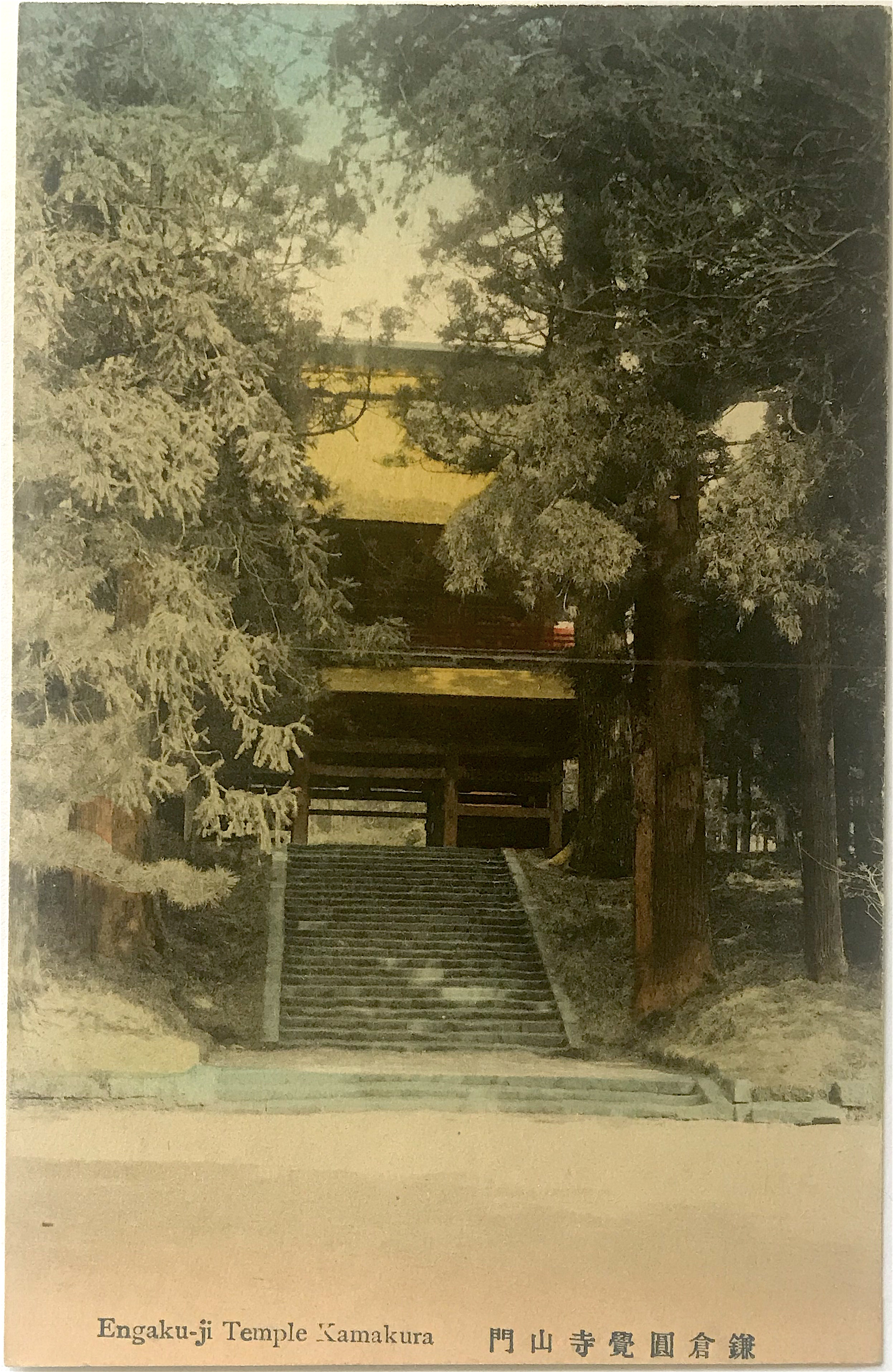
  • Set 2: Engaku-ji Temple Kamakura 鎌倉圓覺寺山門 [Front Entrance of Engaku-ji Temple, Kamakura]

Founded in 1282 during the Kamakura period, Engaku-ji Temple was included as one of the Kamakura’s “Five Mountains” (gozan 五山), a network of Zen Buddhist temples supervised by a state bureaucracy but that also received the state’s protection. In the Meiji period (1868-1912) it became the center for Zen study in the eastern part of Japan. Not coincidentally, the famed popularizer of Zen in America, D.T. Suzuki (1870-1966), trained there (though he remained a layperson until his death). Set 1 depicts the temple Reliquary Hall (noted in the Japanese caption) which houses a tooth of the Buddha. This building is registered as a National Treasure. Set 2 depicts the temple front gate (sanmon 山門, “mountain gate”), itself a prominent piece of architecture on the temple grounds.

Figure 22 & Figure 23

Figure 22
Figure 23
  • Set 1 caption: Kenchoji Temple Kamakura 鎌倉建長寺山門 [Front Entrance of Kenchō-ji Temple, Kamakura]
  • Set 2 caption: Tsurigane (Bell-Tower) Kencho-ji Temple Kamakura 鎌倉建長寺鐘樓(國寶) [Bell Tower at Kenchō-ji Temple, Kamakura (National Treasure)]

Founded in 1253 during the Kamakura period, Kenchō-ji is the oldest Zen training temple in Japan. Like Engaku-ji, it was also included among the “Five Mountains” network. Set 1 depicts the temple front gate. And while Set 2 depicts the bell tower, the significant historical entity is the temple bell (bonshō 梵鐘), itself designated as a National Treasure (kokuhō 國寶), the most precious of Japan’s historic and cultural properties. Cast in 1255 by Mononobe Shigemitsu 物部重光 it is the second largest in the Kantō region, only to one housed in Engaku-ji. It is believed that the goddess Benzaiten, who was thought to reside on the nearby island of Enoshima (see above), offered her divine protection to have it made. Some modern scholars have suggested Mononobe as the caster of the Kamakura Daibutsu since this bell was made around the same period, although this remains unlikely.


Notes:

*This is part of a series of posts devoted to exploring the development of a visual literacy for Buddhist imagery in America. All items (except otherwise noted) are part of my personal collection of Buddhist-themed ephemera.

[1] Shirane 2010.

[2] Nenzi (2004) outlines the development of Kamakura and Sagami generally into a destination spot through the identification of “tourist packages.”

[3] Moriyoshi (his Buddhist name was Son’un 尊雲) had a complex relationship to his monastic vocation, since his vital role as abbot was to enlist the help of important temples and warrior monks to help his father, Emperor Go-Daigo 後醍醐天皇 (1288-1339), in his fight against the Kamakura shogunate.


Additional Posts in Visual Literacy of Buddhism Series
Esaki’s Pilgrims at the Daibutsu

For nearly three decades after the first Japanese postal cards were issued in 1873, printing and distribution were strictly controlled by the government. Only with changes in postal codes in 1900 could private publishers start printing and selling their own postcards. Importantly, and for the first time, these privately issued cards could bear images on the obverse, thus being termed “picture postcards” (ehagaki 絵葉書). Previous government-issued specimens were printed blank to accommodate a sender’s written message. Moreover, the growing use among Japanese print shops of inexpensive collotype printing equipment meant photographs could be easily reproduced for this new medium. Many early photographic postcards are reproductions of images originally created and sold in Japanese photography studios, as is the case with the examples here.

Figure 1Esaki 01a.JPG

  • Title/Caption: DAIBUTSU AT KAMAKURA
  • Year: 1900-1907 (postally unused)
  • Photographer: Esaki Reiji 江崎礼二 (1845-1910)[?]
  • Medium: collotype print on cardstock, hand-tinted
  • Dimensions: 5.5 in X 3.5 in
  • Reverse Imprint: Union Postale Universelle. CARTE POSTALE, 萬國郵便聯合端書

This postcard depicts the Kamakura Daibutsu, scaled to fit in the upper-left corner of the card [Fig. 1]. The blank space on the right side was reserved for a written message; Japanese postal code required the reverse side to be reserved solely for the name and address of the recipient. Once messages could be included on the reverse in 1907, postcard images were regularly scaled to fit the entirety of the obverse side.

For artistic flourish, the publisher of our card employed a subtle trompe-l’œil, making it appear as if the corner of the photographic image is curling off the paper. Visual illusions such as this would make the postcard stand out among a sea of similar imagery. Printed in large block lettering, the caption clearly denotes the subject of the photograph, the “Daibutsu at Kamakura.”

Figure 2

Esaki 02a

  • Title/Caption: 451 [or 461] DAIBUTSU AT KAMAKURA
  • Year: 1900-1907 (postally unused)
  • Photographer: Esaki Reiji 江崎礼二 (1845-1910)[?]
  • Medium: collotype print on cardstock, hand-tinted
  • Dimensions: 5.5 in X 3.5 in
  • Reverse Imprint: Union Postale Universelle. CARTE POSTALE, 萬國郵便聯合端書

Another postcard employs the same photograph. Here, the image covers a larger portion of the card, but lacks the trompe-l’œil effect [Fig. 2]. Additionally, the caption is much smaller and incorporates an identifying stock number, 451 (or possibly 461). It is of note that a caption which incorporates a stock number with a title is characteristic of prints made by Japanese photography studios of the 1880’s and 1890’s. By comparing this stock number to known lists gleaned from published Japanese studio albums, it appears likely the original photograph was taken by Esaki Reiji 江崎礼二 (1845-1910), a famed Tokyo-based photographer.[1]

Esaki apprenticed under the pioneering photographer Shimooka Renjō 下岡蓮杖 (1823-1914) in 1870 before opening his own studio in 1871 in Asakusa Park.[2] He soon established himself as a technical master, among the first of Japanese photographers to adopt the new gelatin dry-plate (zerachin kanpan ゼラチン乾板) technique in 1883 and executing technically difficult pictures of a naval mine detonating in the Sumida River (1883) and night-time exposures of a lunar eclipse (1884) and exploding fireworks (1885). The shorter exposure times of the dry-plate process also allowed Esaki to more easily photograph fidgeting children, an expertise he proudly displayed in a famous collage of more than 1700 young children and infants (1893).[3]

Figure 3

Esaki 01 pilgrimsThe photograph of the Daibutsu by Esaki (or one of his studio assistants) depicts the bronze statue from the southwest corner, an uncommon, but not unprecedented angle. More relevant to the site’s religious heritage, the photograph shows a line of Japanese pilgrims (jinreisha 巡礼者) in front of the Daibutsu, easily identified by their broad circular sedge hats and walking staffs carried over their shoulders [Fig. 3]. The mise-en-scène is more relaxed than reverent. The lead pilgrim, who holds his hat in his hand, appears to read the small rectangular sign perched on the pedestal (which, coincidentally, forbids climbing on the statue), while his fellow travelers casually stand conversing with one another. Only the temple priest by the offering table glances directly towards the camera.[4] This mundane expression of religious piety stands in contrast to the highly orchestrated images of devotion sometimes staged by Western photographers. Significantly, the distinction between Japanese pilgrim and tourist is often blurred, as both can engage in similar activities at a pilgrimage site, including visits to the temple souvenir shop.

Although faded, the hand-tinting is still visible in both cards, with the slate blue colossus overlooking his faithful visitors. The elements in the scene suggest this photograph was taken in the late 1890’s.[5]

Figure 4

Esaki 01b

Esaki 02b

The reverse of both cards is bordered by an ornamental filigree-like design in burgundy ink [Fig. 4]. These are examples of “undivided back” cards, since no line yet separates the areas on the back where the correspondence and address would later come to be written. This functions now as an easy identifier for dating old postcards, with these dating between 1900 and 1907. Since it was not yet common for publishers to imprint their names or trademarks on the back, it is difficult to tell who printed these beautifully rendered cards.

Notes:

*This is part of a series of posts devoted to exploring the development of a visual literacy for Buddhist imagery in America. All items (except otherwise noted) are part of my personal collection of Buddhist-themed ephemera. I have also published my working notes on identifying publishers of Meiji and early Taishō postcards and establishing a sequential chronology for Kamakura Daibutsu photographs.

[1] Stock lists for Esaki’s studio do not include numbers 451 or 461, but numbers 452 to 460 are all images of Kamakura, specifically Hachiman Temple, the Daibutsu, and the lotus ponds in Kōtokuin (the temple that houses the Daibutsu). See Bennett 2006a: 129. Unfortunately, almost all attributions to Esaki and his studio remain tentative and more work desperately needs to be done on his photographic oeuvre.

[2] For Esaki’s biographical information, see Bennett 2006b: 165 and here and here. Several Japanese resources note his name as “Ezaki,” but I follow the standard English “Esaki,” which is also how he promoted his studio on photographic mounts and in other published materials (the older “Yesaki” can also be found).

[3] This image was also sold in the United States through Sears & Roebuck catalogues.

[4] Closer inspection reveals a young boy towards the far right of the photograph, holding his hat in his hand, also possibly peering towards the camera

.Esaki 01 boy

[5] I have seen postcards of this image cancelled in January 1902, setting a firm terminus ante quem for the photograph. I have also seen a third postcard, oriented vertically, bearing this same photograph.


Additional Posts in Visual Literacy of Buddhism Series
Underwood and Underwood’s Cleveland Cruise Portrait Stereoview

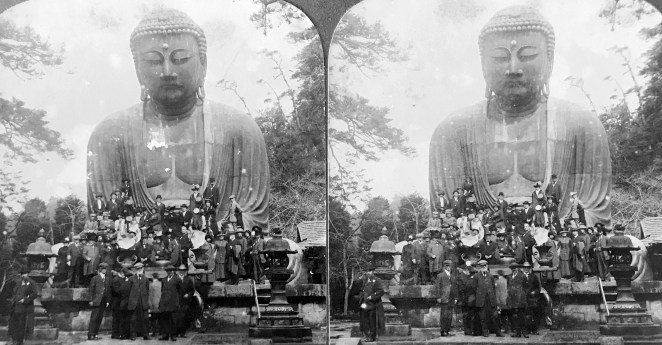
On October 16, 1909, the S.S. Cleveland left Hoboken, New Jersey on the first commercial around-the-world cruise. American tour operator, Frank C. Clark, chartered the Cleveland from the German operated Hamburg-American Line, leaving the east coast with a party of 650 passengers and traveling eastward through the Suez Canal before making landfall in San Francisco three months later on January 31, 1910. Because the Panama Canal was four years away from completion, the passengers completed the last leg of the around-the-world tour via train, returning to their origin point on the east coast. Thus, although Clark’s cruise was not a complete circumnavigation of the globe, the public and press treated it as such. Five days after landing in San Francisco, the Cleveland re-crossed the Pacific Ocean to start a second around-the-world tour, this time carrying more than 750 passengers. Clark’s pair of world tours generated significant amounts of publicity, with thousands appearing in San Francisco to send the ship off. The Cleveland made several subsequent trips between 1912 and 1914 until the advent of World War I interrupted access to the German-owned vessel.[1] The standard itinerary for trans-Pacific cruises of the period included a longer stopover in the port of Yokohama. Here, passengers could go ashore and enjoy the local sites, including a visit to the Kamakura Daibutsu.

One of the most popular publishers of stereocards, Underwood & Underwood, took advantage of these widely marketed luxury world tours and assigned a stereo-photographer to accompany the guests aboard the Cleveland to chronicle the trip. These new stereophotographs then became stock in Underwood & Underwood’s massive catalogue of Japan views and marketed to the general public.

Figure 1

SVKD011uu.JPG
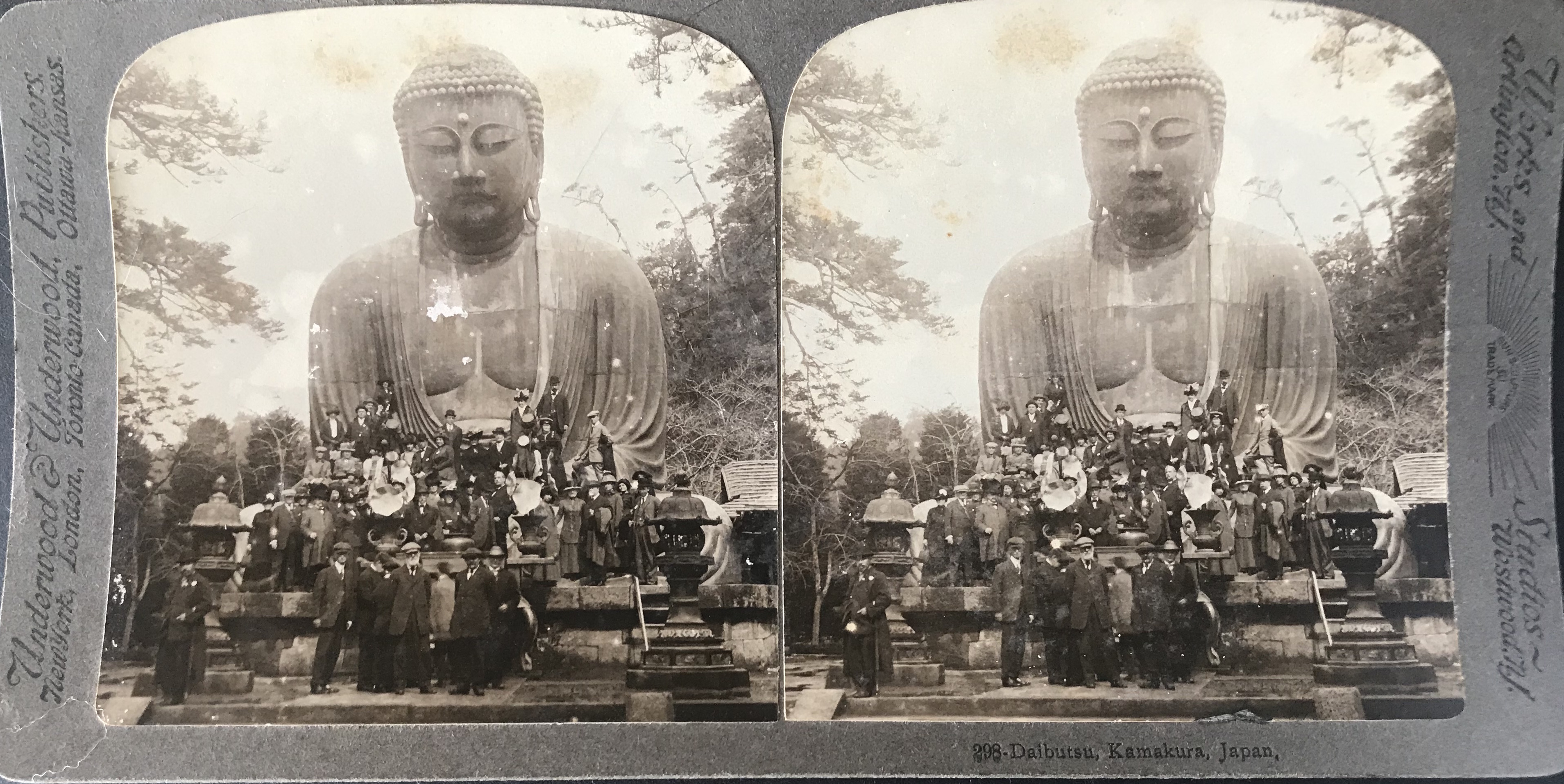
  • Title/Caption: 298-Daibutsu, Kamakura, Japan
  • Year: 1913-1914
  • Photographer: unknown
  • Publisher: Underwood & Underwood
  • Medium: sliver gelatin print; mounted on curved slate-colored card
  • Dimensions: 7 in X 3.5 in

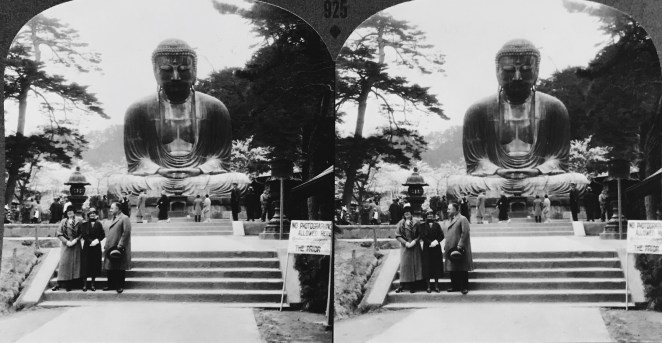
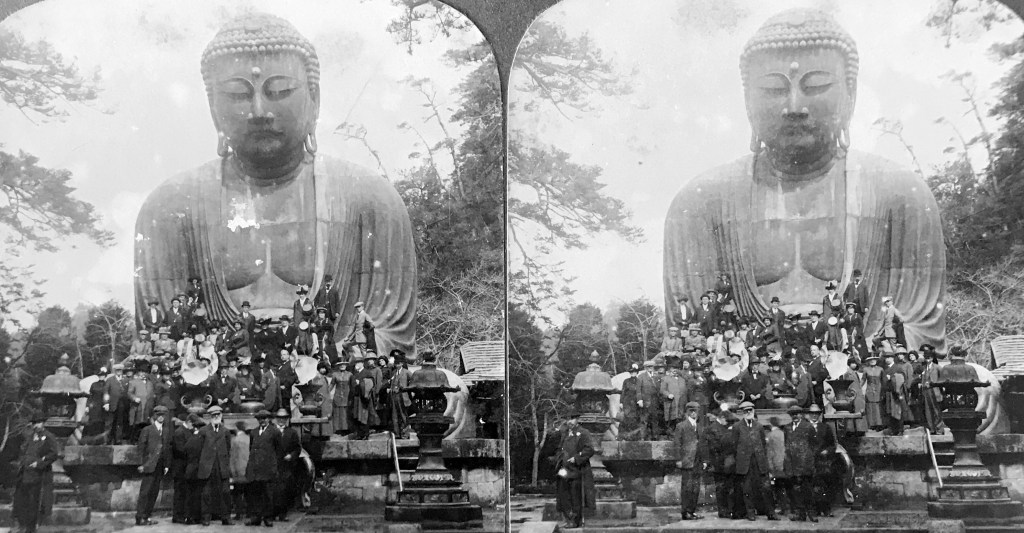
According to the account of R. H. Casey, a passenger aboard the Cleveland during its fourth trip across the globe which arrived in Japan on February 24, 1913, the tourist excursion trips were a sight to behold. Two hundred and forty passengers boarded a train to Kamakura and rode rickshaws from the train station to the temple of the Daibutsu, traveling en masse through the narrow roads of the rustic city’s back country.[2] This feeling of mass tourism is captured perfectly by our unknown photographer’s view, showing a cluster of nearly fifty people crowded in front of the Daibutsu [Fig. 1]. Almost all of the visitors are mounted atop the stone foundation or posing in the lap of the colossal statue. This posturing of gazing towards the viewer reflects a long-standing photographic tradition of collecting exotic “trophies” by being pictured in front of one’s cultural conquests.

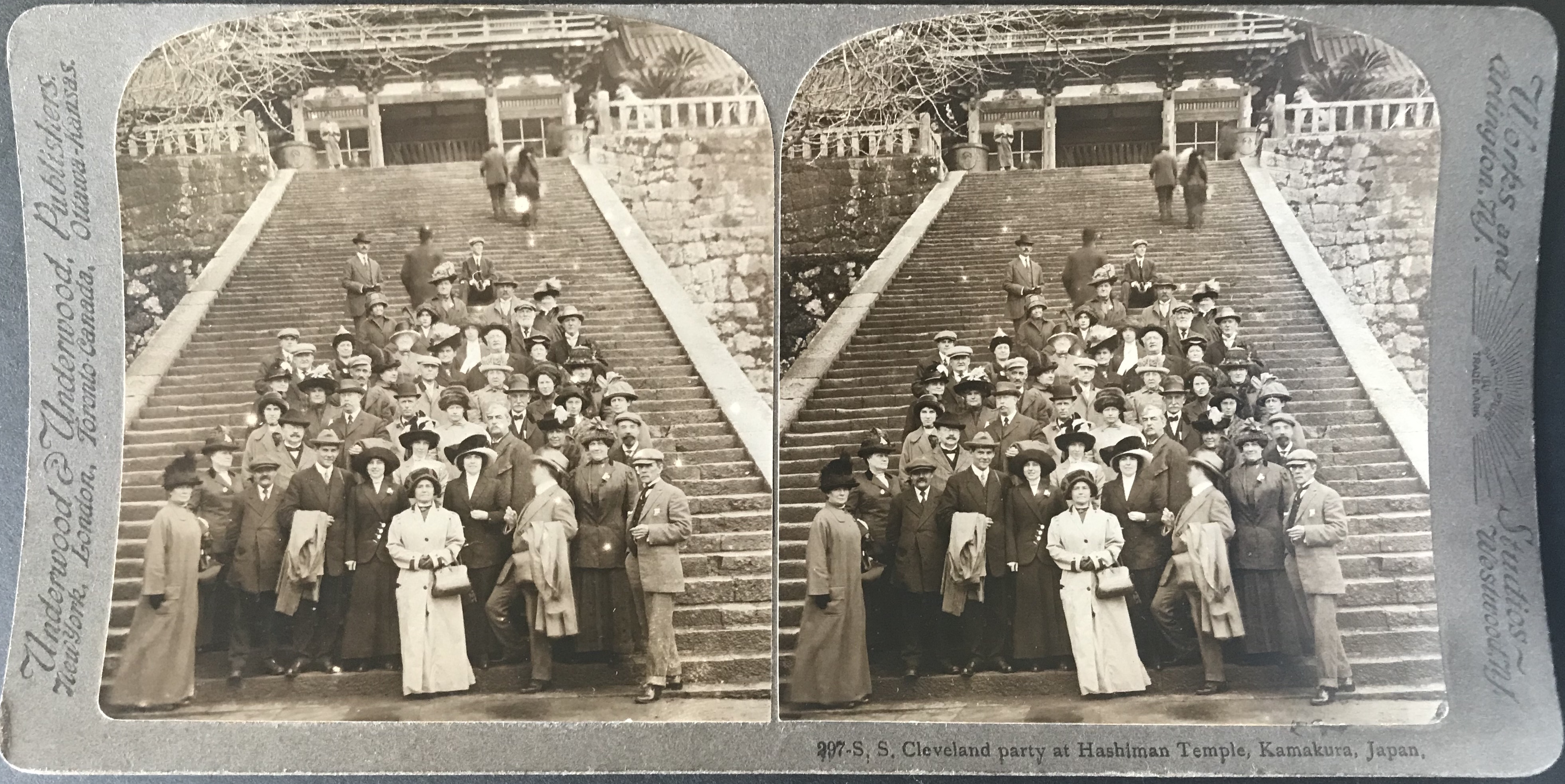
The card itself does not identify the party as originating from the Cleveland, but an adjacent card in the Underwood & Underwood catalogue (number 247, Fig. 2), does identify a large group of tourists perched along the tall stairway of Hachiman Shrine as traveling aboard the Cleveland. Moreover, a close inspection of these two photographs reveals the same individuals are depicted in both.[3] Thus, we can safely assume the visitors to the Daibutsu are among the globetrotters aboard the Cleveland.

Figure 2

SVHS001uu.JPG

It is difficult to determine which around-the-world cruise this group of people joined. Photographs from the initial pair of Clark’s trips, between 1909-1910, show the Daibutsu site displaying a picketed fence and gabled roof on the coin offering box (saisenbako 賽銭箱), elements that appear – to my eye – to be missing in this stereoview.[4] It is possible this image was taken on one of the second pair of cruises, landing in Yokohama in January and February 1913, having departed from Hoboken and San Francisco respectively.[5] A fifth, and likely final, cruise aboard the Cleveland was scheduled to depart the east coast in January 1914 on a 93-day voyage to San Francisco, with no scheduled “return” trip.[6] Thus, it appears this photograph of the Daibutsu could have been taken during one of these three trips during 1913 or 1914.

In contrast to the other Underwood & Underwood view of tourists atop the Daibutsu, this composition has the feeling of formal portraiture. The visitors are spread out symmetrically along the ground, statue, and stone base, with most looking sternly at the camera lens. As around-the-world cruises became more popular in the interwar period, these large group photos also became more common, sometimes being used in promotional material for the cruise company. The photographs of the 1860s and 1870s that depicted small groups of intrepid travelers (and mostly men), were now festooned with tourists who draw as much attention to themselves as the statue in the background.


Notes:

*This post is in honor of my father, may your curiosity in the odd live on through me.

*This is part of a series of posts devoted to exploring the development of a visual literacy for Buddhist imagery in America. All items (except otherwise noted) are part of my personal collection of Buddhist-themed ephemera.

[1] The Hamburg-American Line advertised heavily for the Cleveland’s first trip through the Panama Canal, scheduled to disembark from Hoboken in January 1915 and bring passengers to San Francisco to celebrate the Panama-Pacific Exposition. I have found no evidence that this trip took place, and given that Germany was in the midst of war by the end of 1914, the excursion was most likely to have been abandoned by the Hamburg-American Line. Accounts of the previous completed trips, where the above information was extracted, can be found in Frizell & Greenfield 1910, Junkin 1910, Bush 1911, Forbes 1912, and Casey 1914.

[2] Casey 1914: 29. According to Casey, they also visited the Kaihin Hotel.

[3] The easiest individual to spot is the sole hat-less man with coiffed white hair and mustache. A second man in a brimmed newsboy hat and white beard is also easily identified in both.

The distinctive plumes in women’s hats also leads to several relatively easy identifications (not pictured). Moreover, Underwood & Underwood Japan-series cards issued with numbers in the 290’s all appear to be issued from the Cleveland cruises.

[4] The photograph by amateur photographer F. H. Wellcome and published in the travelogue of Frizell and Greenwod clearly shows the gabled coin box. (see Frizell & Greenwood 1910: 49).

[5] These dates are noted in Forbes 1912: 27 & 29. Forbes took two trips around the world, starting in Hoboken and travelling eastward until ultimately landing in San Francisco, where he then joined the “return” voyage, heading westwards until back in Hoboken

[6] The Cleveland would have needed to be back in Hoboken for its widely publicized trip leaving in January 1915 (see note above). It is possible the Cleveland left San Francisco and headed for the Panama Canal, testing the crossing without passengers before returning in January. This tour was operated by the Hamburg-American Line directly and Clark would not make his fifth trip around the world until after the war in 1924, when he chartered the S.S. California.

References:

  • Bush, George Tome. 1911. 40,000 Miles Around the World. Howard, PA: N.P.
  • Casey, R. H. 1914. Notes Made During a Cruise Around the World in 1913. New York: N.P.
  • Forbes, Edgar Allen. 1912. Twice Around the World. New York: Fleming H Revell Company.
  • Frizell, William G. and Greenfield, George H. 1910. Around the World on the Cleveland. New York: N.P.
  • Junkin, Paul S. 1910. A Cruise Around the World. Creston, IA: N.P.

Additional Posts in Visual Literacy of Buddhism Series

Renjō’s Daibutsu Photograph: A Pioneer of the Path

Often called the “founding father of Japanese photography,” Shimooka Renjō 下岡蓮杖 (1823-1914) was a true artistic pioneer. One of the first Japanese to practice commercial photography, Renjō (a self-styled nickname) was also likely the first oil painter and lithographer in Japan.[1] His personal reminiscence, recorded in 1891, claims his fascination with photography began when he saw his first daguerreotype in 1844 in Edo (now Tokyō). He then spent the next ten years trying to find a photographer who could teach him the craft. According to his own account, which is held in suspicion by modern scholars, in 1856 Renjō had a secret meeting with Henry Huesken (1832-1861), the translator to the American general consul at Shimoda, to learn the basic principles of photography. Regardless of the veracity of this story, Renjō opened the first Japanese commercial photography studio in the port city of Yokohama in 1862.[2] His business soon prospered and he apprenticed several of the next generation of famed Japanese photographers, including Usui Shūzaburō 臼井秀三郎, Suzuki Shin’ichi (I) 鈴木真一, and Suzuki Shinichi (II) 鈴木真一. A considerable majority of Renjō’s surviving photographic oeuvre consists of small format cartes de visite, several of which depict the bronze Daibutsu located in Kamakura, not far from his studio in Yokohama.

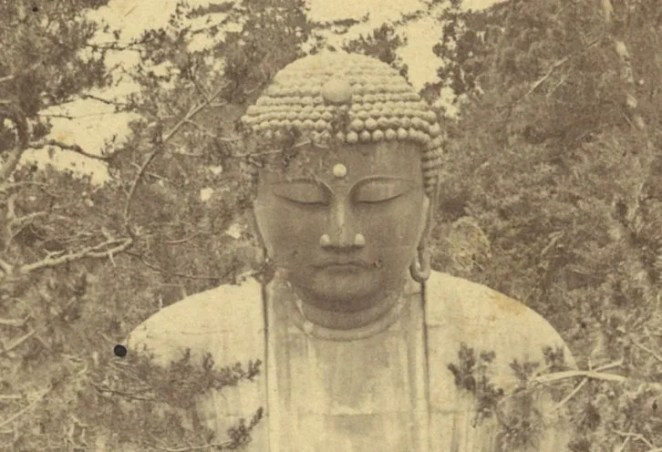
According to several Western travelers and tour guides from the 1860’s, the original pathway leading to the Daibutsu was a long, stone-paved walkway, tightly flanked by tall evergreen trees and ornately pruned shrubs. For some, the most picturesque view of the Daibutsu was looking down through this long pathway of greenery towards the statue at the end. By the early 1870’s, however, the temple landscaping had undergone significant renovations and the pleasant framing effect of the towering trees was lost. Algernon Bertram Mitford (1837-1916), secretary to the British Legation, described his two contrasting visits to the Kamakura Daibutsu:

“The first time I saw [the Daibutsu], in the autumn of 1866, the approach to it lay along an avenue of grand old evergreen trees, and the effect of the colossus, when seen from the beginning of the avenue, was most striking. Now, unhappily, the trees have been cut down by the avarice of the priests, who grudged the little bit of soil which might bear a few more vegetables, and who took advantage of the revolution to pretend that the trees had been destroyed by the soldiery. The beautiful coup d’oeil is lost, but the figure must always rank among the most wonderful monuments of the world.”[3]

Regardless of the reason behind the removal of the trees, the change in environment certainly altered the viewing experience of the Daibutsu, which was now left in an open grove.

Figure 1

  • Title/Caption: NA (Diabutz [sic] on reverse)
  • Year: 1869-1871 (dated Oct. 7, 1871 on reverse)
  • Photographer: Shimooka Renjō 下岡蓮杖 (1823-1914)
  • Medium: albumen silver print, mounted on card
  • Dimensions: 3in X 2in (cartes de visite)

Interestingly, while the early written accounts of visiting the Daibutsu often included a vivid description of the “avenue of grand old evergreen trees,” the surviving photographic record rarely included this aesthetic aspect. Renjō was one of only a few commercial photographers who placed his camera rig far enough away from the bronze statue to incorporate the tree branches that converged on the walkway.[4] [Fig. 1] It remains uncertain if the rarity of this composition is due to a technical consideration of early photography (such as problematic lighting) or the resulting visual product which creates a cramped and partly obstructed view of the Daibutsu. If the latter case, the long row of trees and shrubs which undoubtedly added a sense of depth and scale to the in-person viewing experience is lost in the two dimensional space of the photograph. In the image above, a lone Japanese individual faces directly towards the camera, taking a wide, aggressive stance. This ultimately creates a sense of tension between the image and the viewer.[5]

Figure 2

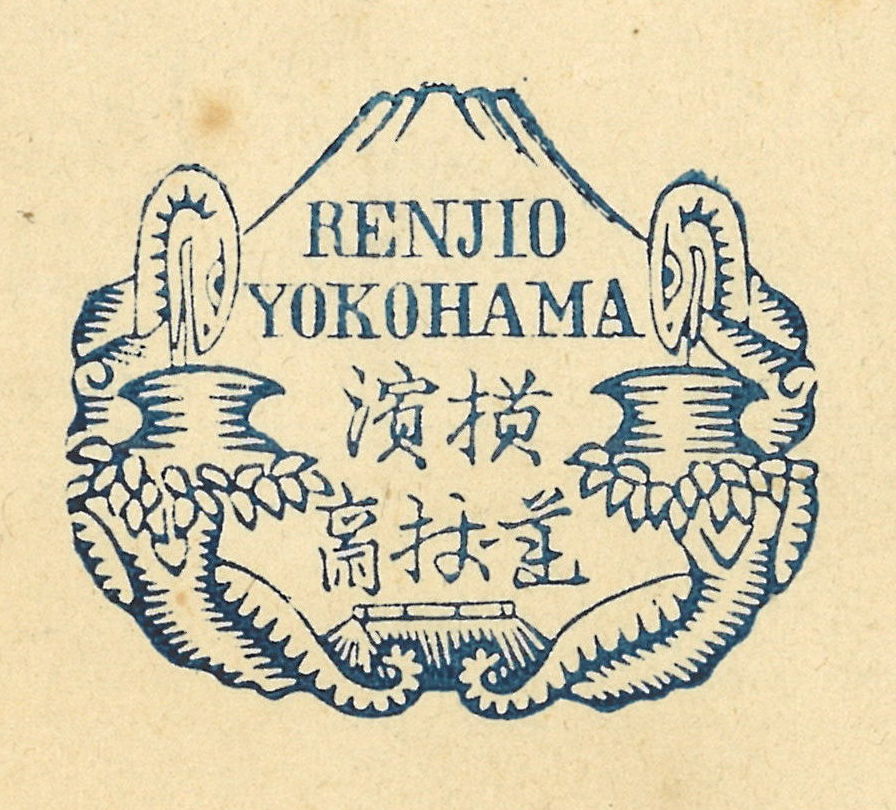
APKD Renjō Reverse mark.jpgThe back of the cartes de visite is stamped by Renjō’s studio mark in indigo blue [Fig. 2]. The hand stamp depicts two serpentine figures twisting around a pair of trees and peering into two pots. The peak of Mt. Fuji and the top of a thatched roof also appear the background. This specific imagery appeared to Renjō in a dream when his business first started to turn profitable, thus he decided to honor his vision by incorporating it into his studio mark. The Japanese characters, written in a variant script (itaiji 異體字), simply say, “Yokomaha, Renjō Studio” (横浜 / 蓮杖斎).[6] The handwritten inscription at the top of the card notes the date as October 7, 1871, thus providing a firm terminus ante quem for the photograph. This possibly represents the date an unknown tourist visited the site. The popular name for the Daibutsu in the foreign port city of Yokohama in the 1870’s, “Daibutz,” is also imprinted at the top of the card, with an accidental inversion of the a and i (not all too uncommon a mistake).

During his professional photographic career, Renjō moved his studio to several locations, but never seems to have accumulated great wealth. In the mid-1870’s Renjō ended his commercial photography exploits and moved to the new capital of Tokyō (behind Sensō-ji 浅草寺) where he returned to his previous profession as a Western-style oil painter.


*This is part of a series of posts devoted to exploring the development of a visual literacy for Buddhist imagery in America. All items (except otherwise noted) are part of my personal collection of Buddhist-themed ephemera.


Notes:

[1] Bennett 2006, esp. p. 71. A more detailed examination of Renjō’s life can be found in Tokyo Metropolitan Museum of Photography 2014. Some also credit Renjō with inventing the rickshaw (jinrikisha 人力車), but while this man-powered, two-wheel vehicle first appeared in Japan in the 1860’s, its attribution to Renjō is almost certainly misplaced. For many years, Renjō was considered the first Japanese professional photographer, but recent research suggests this mantle belongs to Ukai Gyokusen 鵜飼玉川 (1807–1887), who opened the first commercial photography studio in Edo in 1860 or 1861.

[2] For analysis of Renjō’s personal account, see Tokyo Metropolitan Museum of Photography 2014: esp. pp. 130-5.

[3] Mitford 1872: 208.

[4] A photograph held in the University of Massachusetts at Amherst, attributed to Felice Beato, contain perhaps the most foliage of any image I have encountered [here]. Another image is here.

[5] Another similar image attributed to Renjō and dated to 1873 can be found at the Freer Gallery of Art and the Arthur M. Sackler Gallery (FSA A1999.35 465)[source]. The position of the camera and framing is almost exact, but the figures by the altar are different. Older images by Renjō (still depicting the railing and balusters on the left) can be found at the Tokyo Photographic Art Museum (here & here) and among the Tom Burnett Collection (here). All three are also depicted in Tokyo Metropolitan Museum of Photography: 2014. The Austrian photographer Wilhelm Burger (1844-1920) traveled in Japan for a year spanning 1869 and 1870, and only some of his photographs of the Daibutsu include the railing to the left of the stairs leading to the second landing. Because of this, Renjō’s photograph here must post-date late 1869.

[6] The mark and its origins is described in Tokyo Metropolitan Museum of Photography 2014: 16-7.

References:

  • Bennett, Terry. 2006. Photography in Japan: 1853-1912. Rutland, VT: Tuttle Publishing.
  • Mitford, A[lgernon] B[ertram]. 1872. “Wanderings in Japan,” The Cornhill Magazine, Vol. 25, No. 146 (February), pp. 196-213.
  • Ozawa Takesi. 1981. “The History of Early Photography in Japan,” History of Photography, Vol. 5, No. 4, pp. 285-303.
  • Tokyo Metropolitan Museum of Photography. 2014. Shimooka Renjō: Nihon shashin no kaitakusha 下岡蓮杖: 日本写真の開拓者 [Shimooka Renjō: A Pioneer Of Japanese Photography]. Tōkyō: Kokusho Kankōkai.

Additional Posts in Visual Literacy of Buddhism Series
Panoramic Postcard of the Kamakura Kaihin Hotel

In the summer of 1887, Nagayo Sensai 長与専斎 (1838-1902), a physician and director of the recently incorporated Bureau of Health 衛生局, founded Japan’s first sanatorium, the Kaihin-in 海濱院, on the beaches of Kamakura. Since many Japanese physicians during the early Meiji (1868-1912) were trained under German doctors they soon adopted the contemporary belief in Western medicine that regular exposure to seawater would ameliorate people stricken with tuberculosis. German doctor Erwin Bälz (1849-1913) first recommended the mild climate of Kamakura as an optimal location for sea bathing therapy. This motivated Nagayo to work with wealthy Yokohama silk merchants to construct a vast Western-style resort on Yuigahama Beach 由比ヶ浜海岸 in Kamakura, replete with several acres of pine groves and spacious lawns. Called Kaihin-in (“Seaside Facility”), patients would participate in regular sea bathing sessions and enjoy the open-aired, scenic vistas. Within a year, however, mismanagement would cause the facility to be repurposed into a hotel and resort that catered to foreign visitors.[1]

 The hotel was renamed the Kamakura Kaihin Hotel 鎌倉海濱ホテル and quickly became a tourist destination in its own right. In 1891, an American sailor, M. B. Cook, described his pleasurable visit as such:

“From the streets of Kamakura we drove to the Kaihinin, a large hotel or marine sanitarium facing the sea, and surrounded by beautiful walks and drives. In the summer season it is full of guests, and being in one of the most healthy places in Japan, and the visitors are given so much attention, that it is becoming a center of attraction to all American tourists.[2]

The hotel was also featured in Murray’s A Handbook for Travellers in Japan, the premier English language guidebook for foreign tourists in Japan. It remained a wildly popular destination into the twentieth century, located a mile from the main Kamakura train station (the Yokosuka Line 横須賀線 opened in 1889) and was famed for its European-style cuisine, affordable rates, and English language guest services. It was also located less than a mile directly south from the most important foreign tourist attraction in the region, the Kamakura Daibutsu.

Figure 1

Kaihin obverse.jpg

Kaihin reverse.jpg

  • Title/Caption: Kamakura Kaihin Hotel Kamakura, Japan. // Telephone No. 4 & 331 The Best Bathing Beach in Japan // Telegram “Kaihin” Home of Daibutsu
  • Year: 1903-1907 [postally unused]
  • Publisher: unknown
  • Medium: collotype print on cardstock
  • Dimensions: 5.5 in X 3.5 in
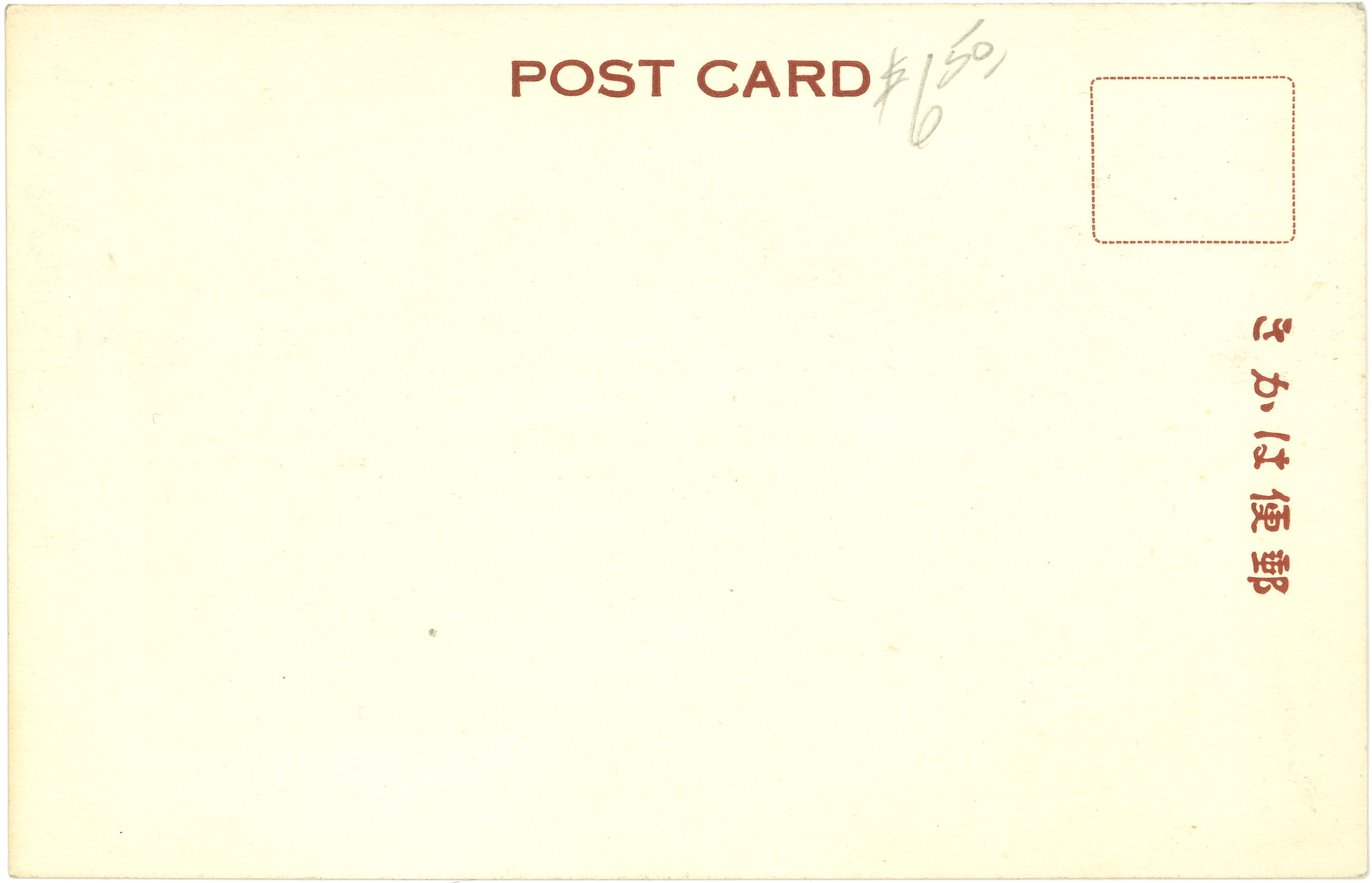
  • Reverse Imprint: Post Card, 郵便はかき

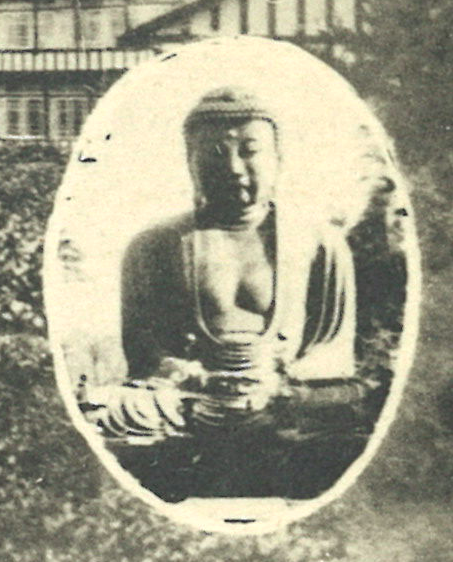
The image on the postcard obverse [Fig. 1] shows the lawns and landscaping of the hotel grounds that led out towards the ocean (seen on the far left). The sprawling multi-storied complex is topped by a flag emblazoned with “KKH,” for the Kamakura Kaihin Hotel. The sweeping, panoramic photograph provides a potent combination of modern (Western) luxury and natural beauty, sure to lure even the most cagey tourist. The text under the photograph proclaims that the site offers “the best bathing beach in Japan,” a callback to its origins as a bathing sanatorium. Importantly, the photograph is overlaid with an oval image of the Kamakura Daibutsu, with the caption proclaiming that the hotel is the “home of Daibutsu.”[3] These elements show that the postcard was also used as an  advertisement, tying together the exotic Buddhist icon of the “Orient” with the scenic luxury of the resort grounds. Roaming, half-day long horseback rides to and from the port of Yokohama were no longer necessary to enjoy the Kamakura colossus. Daytime visitors could enjoy a short trek to the temple, expose or purchase a few photographs, and return to picnic by the beach.

Figure 2

Kaihin Daibutsu.png

This photograph of the Daibutsu [Fig. 2] likely dates from after 1903 (due to the outward facing metal lotus flowers atop the offering table). The reverse of the card shows that it is an “undivided back,” definitively dating it previous to 1907 (a “dividing line” was introduced the following year). This also proves the design on the front of the card was purposeful, with the bottom blank half of the card reserved for correspondence; only the address and name of the recipient was allowed on the back. The photographer(s) and publisher remain unknown.

Figure 3

TMKD Kaihin Obverse.jpg

  • Title/Caption: Kamakura Kaihin Hotel Kamakura // Telephone No. 4 & 331, Kamakura // Japan
  • Year: 1930s
  • Printer: unknown
  • Medium: halftone print and ink on paper
  • Dimensions: 5 in X 3.5

The same photograph of the hotel compound was later used on paper luggage tags [Fig. 3] for the Kamakura resort. Affixed to suitcases and steamer trunks, luggage tags were very popular in the interwar period. In addition to helping sort luggage in transit, these tags signaled the cosmopolitan sophistication of the tourist and thus were often designed with bold images and bright colors. The oval inset of the Daibutsu closely mirrors the postcard design, yet this photograph of the Kamakura colossus is of a much later vintage, quite possibly dating from the 1930’s [Fig. 4].

Figure 4

TMKD Kaihin CU.png

The Kamakura Kaihin Hotel suffered significant damage during the 1923 Great Kantō earthquake, but was rebuilt to its previous grandeur. The hotel would remain in operation up through World War II, until a series of fires resulted in its closing in the mid-1940s.


Notes:

*This is part of a series of posts devoted to exploring the development of a visual literacy for Buddhist imagery in America. All items (except otherwise noted) are part of my personal collection of Buddhist-themed ephemera.

[1] An overview of the cultural encounters between Germany and Japan in the field of medicine are discussed in Kim 2014. For more information on Nagayo, see Rogaski 2004, esp. pp. 136ff. The best available information on Nagayo’s role in the founding of the Kaihin-in appears to have been discussed in the Exhibition Reminiscing the Kamakura Kaihin Hotel 鎌倉海浜ホテル追憶展, organized by Hirata Emi 平田恵美 of the Kamakura Central Library, Modern Historical Materials Division 鎌倉市中央図書館近代史資料室 in 2011. I am indebted to the review of this event by Noriyuki Takagi 高木規矩郎 found here, here, and here. Other scattered information can be found here. Certainly, far more archival research needs to be done for a full account of this story. I have not been able to consult this work: Kamakura kaihin hoteru: Nipponhatsu no kaihin rizōtohoteru 鎌倉海濱ホテル 日本初の海浜リゾートホテル [The Kamakura Kaihin Hotel: Japan’s First Seaside Resort Hotel], by Shimamoto Chiya 島本千也 and Hirata Emi 平田恵美.

[2] Cook 1891: 29. A handful of other late nineteenth and early twentieth-century tourist remarks can be found here.

[3] There are versions of this postcard without the small overlay of the Daibutsu. The caption instead reads “The only resort in the Far East.” The best online collection of Kamakura Kaihin Hotel memorabilia remains here.

References:

  • Cook, M. B. 1891. A Sailor’s Visit to the Island Empire. New York: John R. Alden.
  • Kim, Hoi-eun. 2014. Doctors of Empire: Medical and Cultural Encounters between Imperial Germany and Meiji Japan. Toronto, University of Toronto Press.
  • Rogaski, Ruth. 2004. Hygienic Modernity: Meanings of Health and Disease in Treaty-Port China. Berkeley: University of California Press.

Additional Posts in Visual Literacy of Buddhism Series
Tonboya’s Failed Voyeurism of the Daibutsu

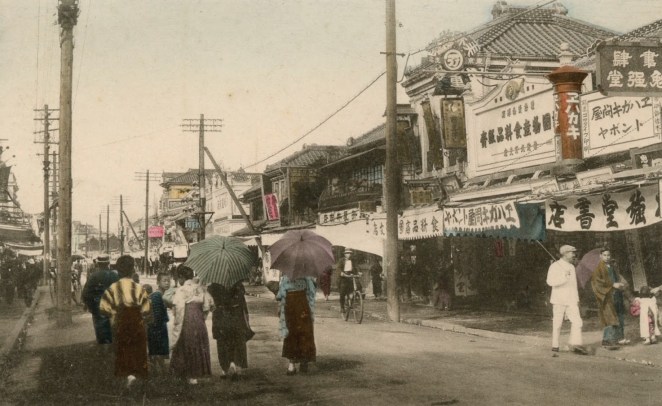
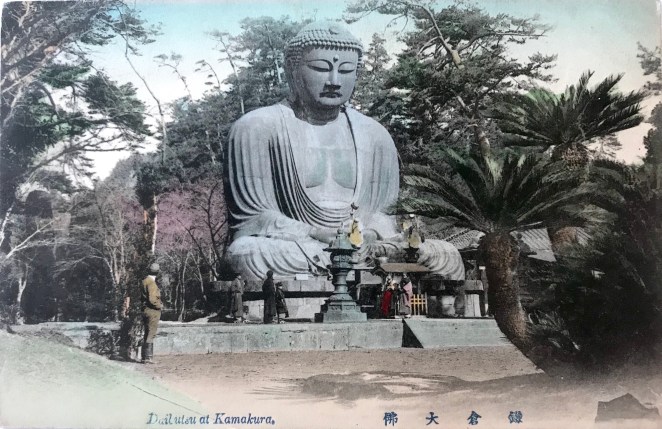
After the Meiji Restoration, the popularity of photography began to overshadow traditional Japanese woodblock printing. Increasingly, woodblock artisans came to find employment with photography studios, adapting their technical painting skills to add vivid color to monochromatic photographs. In the beginning of the twentieth century, due to the craze surrounding Japanese picture postcards (ehagaki 絵はがき), artisans continued to ply their trade by adding translucent water-soluble pigments to these small format calotypes. One of the most famous postcard distributers was Tonboya トンボヤ, or the “Dragonfly Studio,” first opened by Yoshimura Kiyoshi 吉村清 around 1905.[1] The Tonboya storefronts in Yokohama, first located in the Isezakichō 伊勢佐木町 district before moving to the more heavily trafficked Motomachi 元町 district, were easily identifiable because of large signboards made to look like red cylindrical postal boxes (yūbin posuto 郵便ポスト) widely adopted in Japan. One side of the signboard had the word “POSTALCARDS” painted on it, while the other said ehakaki エハカキ [sic](“picture postcards”), suggesting Yoshimura catered to both foreign and domestic travelers.[2] One image that would represent the photographic interests of both groups would be the Kamakura Daibutsu, located close to the port of Yokohama [Figure 1].

PCKD009t(o)

Figure 1

PCKD009t(r).JPG

  • Title/Caption: Daibutsu at Kamakura. 佛大倉鎌
  • Year: 1907-1918
  • Publisher: Tonboya トンボヤ
  • Medium: collotype print on cardstock, hand tinted
  • Dimensions: 5 in X 3.5 in
  • Reverse Imprint: Union Postale Universelle.[+], 郵便はかき

By setting the camera on the second landing of the paved walkway, this unknown photographer filled the frame with the image of the Daibutsu; positioning the statue frontally and symmetrically, this framing is similar to many of the images produced by Yokohama photography studios. The image depicts three figures, two women and a young child, facing the Buddhist icon in the center of the photograph. This setting might elicit other images of religious piety at this site, but the mise-en-scène is complicated by the presence of two more children, standing at each of the sides, who stare directly at the viewer. Their presence might have been obscured had it not been for the colorist who painted them in light hues of blue and pink. Notably, their casual posturing is stark contrast to staged “photo ops” of foreign travelers who try to visually suggest their domination of the Orient. Because of these elements, on the whole, we are made to feel as if the scene is staged and that we have been caught in an act of  voyeurism. The women and child, positioned center-stage, engage in a orchestrated religious performance while the children at the edges observe us watching them. A rather apt visual metaphor for the Orientalist gaze, where the artist attempts to create a certain controlled vision of the East, but with “unruly” actors foiling the illusion.[3]

This postcard is not imprinted with a trademark to identify the publisher. The black ink and serif font used for the reverse, however, in addition to the guide lines provided for writing the address, all suggest this card was made by Tonboya.[4] In addition, the position of the diving line for correspondence indicates this card was printed between 1907 and 1918. If the image on the obverse was not self-evident enough, bilingual cerulean letterpress (note the impression the reverse) identifies the scene clearly: “Daibutsu at Kamakura.”


Notes:

*This is part of a series of posts devoted to exploring the development of a visual literacy for Buddhist imagery in America. All items (except otherwise noted) are part of my personal collection of Buddhist-themed ephemera.

[1] Several online English sources claim Tokutaro Maeda was the founder of Tonboya, but I have found no Japanese sources that confirm this. I prefer here to follow the print Japanese sources (e.g. Saitō 1985: 1), but leave the question unsettled.

Red postal sign.png

[2] Several early-century postcards depicting the streets of Yokohama show this red cylindrical signboard, as seen here: The full postcard can be found here (not part of the Archive).

[3] By shooting one woman mid-stride ascending the small flight of steps, this photographer is (accidentally?) paying homage to Enami Nobukuni 江南信國 (1859—1929), but without the overal effects of sterling visual narrative.

[4] The best site for identifying Tonboya cards remains here: http://tamayochankankousya.seesaa.net/article/421306802.html. Another common reverse printing of Tonboya during this period is discussed here.

References:

  • Handy, Ellen. 1998. “Japonisme and American Postcard Visions of Japan,” in Delivering Views: Distant Cultures in Early Postcards,  Christraud M. Geary and Virginia-Lee Webb, eds. Washington: Smithsonian Institution Press.
  • Saitō Takio 斎藤多喜夫. 1985. “Yomigaeru shinsaizen no Yokohama fūkei よみがえる震災前の横浜風景,” Kaikō no hiroba 開港のひろば, No. 12, pp. 1, 4.
  • Satō, Kenji. 2002. “Postcards in Japan: A Historical Sociology of a Forgotten Culture,” International Journal of Japanese Sociology, No. 11, pp. 35-55.
  • Yokohama Open Port Museum 横浜開港資料館, ed. 1999. Nen mae no Yokohama Kanagawa ehagaki de miru fūkei 年前の横浜・神奈川―絵葉書でみる風景. Tokyō: Yurindo 有隣堂.

Additional Posts in Visual Literacy of Buddhism Series
Tonboya’s Onlooker of the Daibutsu

By the end of the nineteenth century the port city of Yokohama had developed into a thriving tourist destination. Consequently, numerous Japanese shops opened to cater to the needs of both domestic and foreign travelers. Perhaps surprising to a modern reader, among the prized goods offered for sale were picture postcards (ehagaki 絵はがき), the first truly commodified form of the photograph which unexpectedly became a collectors craze in the first decade of the twentieth century.[1] Around 1905, Yoshimura Kiyoshi 吉村清, the proprietor of the well-known Tokyō-based publisher Kamigataya 上方屋, started a new venture in Yokohama, called Tonboya トンボヤ, or the “Dragonfly Studio.”[2] The dragonfly was long seen as symbol of courage and strength in Japanese culture, and thus it was cherished by the samurai and bestowed the romantic name of the “Victorious Insect” (kachimushi 勝ち虫). This lore notwithstanding, Tonboya postcards – emblazoned with its distinctive dragonfly trademark – soon became some of the most famous and widely circulated postcards of the period.

Figure 1

PCKD008t(o).JPG

PCKD008t(r).JPG

  • Title/Caption: Daibutsu at Kamakura. 佛大倉鎌
  • Year: c. 1909
  • Publisher: Tonboya トンボヤ
  • Medium: collotype print on cardstock, hand tinted
  • Dimensions: 5 in X 3.5 in
  • Reverse Imprint: Carte Postale Post Card [+],  郵便ハガ[キ]

This image of the Kamakura Daibutsu [Figure 1] highlights the rustic setting of the colossal statue, framing the statue between sprawling tree branches and the silhouette of a sago palm. With the camera placed in the southwest corner, our unknown photographer creates a voyeuristic scene as a man in knee-high mud boots and western attire peers towards group of Japanese visitors from behind a tree. Seeing this observer from behind, we take his perspective and also gaze upon the group of Japanese visitors dwarfed by the overlooking bronze statue. The brightly colored garments of the women on the right stand in contrast to the uncolored gray shades of the men and boy on the left [Figure 2]. The boy wears a school uniform (gakuran 学ラン), a style adopted decades earlier based on French and Prussian military outfits.[3] Among this group, only a single man looks up towards the Buddhist statue. The others stand and stare at each other from several paces apart. The gives an unnatural effect to the scene, as the stationary bodies and odd spacing fails to build up a clear visual narrative. What is the relationship of these temple visitors to each other? What is their purpose for being there? As was typical of cards from this period, bilingual cerulean letterpress informs us as to the identity of the Buddhist figure, the “Daibutsu at Kamakura” (note the imression left on the reverse along the bottom edge).

Figure 2

PCKD008t(men).JPG
PCKD008t(women0.JPG


Often, Tonboya would impress its dragonfly logo at the lower right on the front of the card, but our variant lacks this identifying element.[4] Turning to the reverse of our card [Figure 1], we still fail to easily locate the characteristic mark of the dragonfly. So, just how can this card be distinguished? The designers at Tonboya devised a creative and playful way to identify their publishing studio; they replaced the ki (キ) in hagaki (ハガキ, “postcard”) with a highly stylized dragonfly illustration [Figure 3]. Only the most attentive observer would notice this subtle alteration, but once noticed it becomes an easily identifiable marker of this studio. This creative design can be dated back to around 1909 and remained throughout Tonboya’s existence into the late 1920’s.

Figure 3

PCKD008t(logo).JPG

Notes:

*This is part of a series of posts devoted to exploring the development of a visual literacy for Buddhist imagery in America. All items (except otherwise noted) are part of my personal collection of Buddhist-themed ephemera.

[1] Satō 2002: 41.

[2] Several online English sources claim Tokutaro Maeda was the founder of Tonboya, but I have found no Japanese sources that confirm this. I prefer here to follow the print Japanese sources (e.g. Saitō 1985: 1), but leave the question unsettled. Another unresolved question remains the relaitonship between Kamigataya and Tonboya. It appears that Tonboya may have been a distribution name of postcards printed by Kamigataya (which continued to also publish postcards under its own name). Some sources claim Tomboya opened as early as 1904, other as late as 1907.

[3] The development of Japanese school uniforms are detailed here: http://journal.media-culture.org.au/index.php/mcjournal/article/view/1041.

[4] Tonboya would also often include an identifying letter and stock number in the lower left, but this is also missing in our specimen. It is also possible to find cards with the letter and numbering system, but still lack the dragonfly icon, see here: https://www.maryevans.com [then search for the reference number 10989247]

References:

  • Handy, Ellen. 1998. “Japonisme and American Postcard Visions of Japan,” in Delivering Views: Distant Cultures in Early Postcards,  Christraud M. Geary and Virginia-Lee Webb, eds. Washington: Smithsonian Institution Press.
  • Saitō Takio 斎藤多喜夫. 1985. “Yomigaeru shinsaizen no Yokohama fūkei よみがえる震災前の横浜風景,” Kaikō no hiroba 開港のひろば, No. 12, pp. 1, 4.
  • Satō, Kenji. 2002. “Postcards in Japan: A Historical Sociology of a Forgotten Culture,” International Journal of Japanese Sociology, No. 11, pp. 35-55.
  • Yokohama Open Port Museum横浜開港資料館, ed. 1999. Nen mae no Yokohama Kanagawa ehagaki de miru fūkei 年前の横浜・神奈川―絵葉書でみる風景. Tokyō: Yurindo 有隣堂.

Additional Posts in Visual Literacy of Buddhism Series
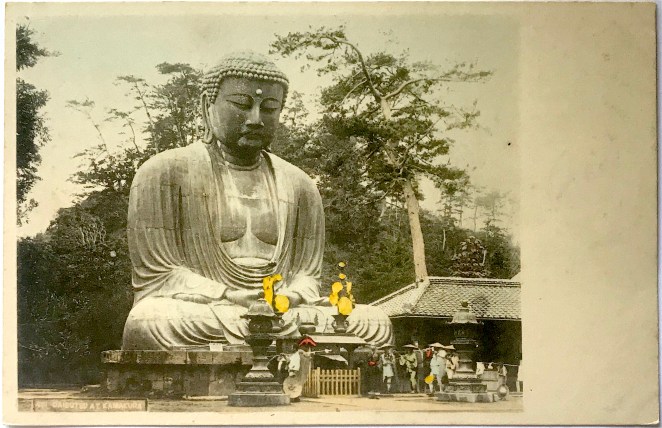
Farsari’s Dai Butsu

Adolfo Farsari (1841-1898), an Italian adventurer who ended up fighting for the North during the American Civil War, settled in the port city of Yokohama in the 1870’s and taught himself photography. By the early 1880’s the Western dominance of the Yokohama tourist photography industry had waned, but Farsari would still grow into a commercial success. In 1885 he acquired the negative and stocks of the famed Stillfried and Anderson firm and opened his own professional photography studio, named A. Farsari & Co., on the main street in the bustling port. Like his competitors, he sold photographs and pre-made albums to wealthy “globetrotters” who sought to return home with photographic souvenirs of famous sites. By this period, photography no longer relied upon the difficult technical skills it once required, in large part due to the adoption of the easier “dry-plate” process. Consequently, this change in technology also motivated a shift in social significance, as the photograph started a transition from a fine piece of art to a commodified object.[1] Farsari’s early successes in Yokohama were almost robbed of him completely, as a devastating fire ravaged the port just a year after he opened his business, subsequently destroying his studio and prized collection of negatives. Unfortunately, not only were all of Farsari’s negatives destroyed, but also those recently acquired of Stillfried and Anderson, as well those of the pioneering photographer Felice Beato, who was bought out by Stillfried and Anderson in 1877. A year after the Yokohama fire, in 1887, Farsari reopened his studio with a stock of around 1,000 new images.

Figure 1

apkd004af

  • Title/Caption: Japan, A. Farsari & Co., Yokohama [photographic frontispiece]
  • Year: c. 1887
  • Photographer: Adolfo Farsari (1841-1898)
  • Medium: albumen silver print, sepia tinted
  • Dimensions: 10.25in X 8.25in

The photographic frontispiece that adorned Farsari’s new studio albums  was an amalgamation of Orientalist visual motifs [Fig. 1]. Sharply-eaved pagodas, irenic bridges, beautiful geisha, antiquated rickshaws, and the famed Mt. Fuji all converge around the simple title of the album – Japan. In the center of the frontispiece we find the iconic Kamakura Daibutsu, a main attraction for tourists sojourning in Yokohama [Fig. 2]. One could travel to Kamakura and back on horseback within a day’s time. Unsurprisingly, Farsari also sold this photograph for individual purchase [Fig. 3].

Figure 2 (detail of Figure 1)

apkd004af(cu)

Figure 3

APKD002af.jpg

  • Title/Caption: NA
  • Year: c. 1887
  • Photographer: Adolfo Farsari (1841-1898)
  • Medium: albumen silver print, hand tinted
  • Dimensions: 10.25in X 8.25in

Farsari’s image of the Kamakura Daibutsu is bold. Balanced and symmetrically positioned within the frame, the colossal statue’s stoic countenance greets the viewer with warmth. One of the characteristic, and highly marketable, traits of Farsari’s prints were their superior coloring. He boasted that his teams of Japanese painters tinted his photos in a realistic manner, unlike the work of his rivals’ studios. He attributed the effects to the rigorous training of his artists, who would apprentice between two and four months before they were set to work. Reportedly, an individual artist under Farsari’s tutelage would only color two to three photographs per day, in contrast to the sixty prints issued by other studios’ artists. Furthermore, Farsari guaranteed the colors on his photographs would not fade, lasting “as long as ordinary oil paintings.” This he attributed to his stock of imported British paper. Farsari’s work earned the praise of the famed novelist and poet, Rudyard Kipling. He complimented the faithful coloring of Farsari’s prints once he saw the scenic vistas of Japan first hand on his trip through the countryside in 1889.[2] The gentle greenish-blue hue of the bronze statue here reflects the blue tinting of the sky above, as well as the garment of the kneeling supplicant, creating a cool, but not frigid, overall feeling in this image.

This photo is commonly assumed to be taken after Farsari’s studio fire in 1886, and was one of the centerpieces of his new collection of images given its prominent position in his photographic frontispiece. Farsari also sold a version of the Kamakura Daibutsu in vertical format, possibly taken on the same photography excursion [Fig. 4]. The kneeling man remains, but four more people are added in a row and all made to gaze upon the idol, causing the scene to look oddly staged. Our vertical image bears the catalogue number of Farsari’s stock in the lower left corner, a standard practice among Japanese photography studios (the horizontal image above is sometimes marked with “L19 Daibutsu (A)”). Curiously, the vertical image  appears – in contrast to Farsari’s bold advertising claims – to have faded.

Figure 4

APKD003af.jpg

  • Title/Caption: L20 DAI BUTSU (B)
  • Year: c. 1887
  • Photographer: Adolfo Farsari (1841-1898)
  • Medium: albumen silver print, hand tinted
  • Dimensions: 10.25in X 8.25in

Always eccentric, Farsari returned home to Italy in 1890, after a twenty-tree year absence, and never returned to Japan.


Notes:

*This is part of a series of posts devoted to exploring the development of a visual literacy for Buddhist imagery in America. All items (except otherwise noted) are part of my personal collection of Buddhist-themed ephemera.

[1] Bennett 2006: 219. Many details of Farsari’s exciting life – of which I am merely summarizing here – are discussed in Bennett 2006: 219-223.

[2] Bennett 2006: 221, 223.

References:

  • Bennett, Terry. 2006. Photography in Japan: 1853-1912. Rutland, VT: Tuttle Publishing.

Additional Posts in Visual Literacy of Buddhism Series