Asking Thought-Provoking Questions Workshop

Introduction

Questions drive thinking.

As I’ve discussed before, “punctuated lecturing” has its rightful place in the repertoire of a university instructor. When we lecture, however, we are often placed in the role of answering questions posed by students. An equally important skill is the ability to ask probing questions of students.

When we want to stimulate class discussion, having the ability to generate, hold, and gently direct conversation requires a bit of mental dexterity and social finesse. But these aspects are built upon a foundation of effective questioning strategies.

I’ll freely admit, discussion can be a slog at times. But having a range of questioning strategies can make us better prepared to face the wilds – and natural beauty –  of the discussion-based classroom.

Below, I offer several of the slides I presented for a workshop organized by my university’s Instructional Development program. I will also provide some commentary and context to the slides themselves.

Crib Notes: Of the strategies I’ve found easiest to implement are Checking for Understanding questions and Redirection questions (third section below). Arguably of greater importance, however, is creating a classroom culture of student discussion. This is often developed through other strategies discussed below, such as Priming the Pump, and well as structured, time-constrained Group Activities.


1. Setting the Stage

Using Mentimeter, I first asked the workshop participants “Why should we ask students questions? (Why not just lecture at them all the time?)” This was a not-so-sly way to introduce two different techniques I would discuss: Entrance Tickets (“Priming the Pump,” see below) and the critical rephrasing of questions (“Stirring the Silence”). Nevertheless, I was not expecting such thoughtful, insightful replies created on the spot (I should have known better):

Screen Shot 2019-05-01 at 19.28.58.png

After recapping some of the comments (and asking about some of the jargon in the responses), it was clear the room was already actively engaged, which is the purpose of an exercise such as this. After noting the importance of using questions to drive and develop student thinking, we dove into several actionable strategies. Overall, I planned to address six different sets of techniques and protocols.
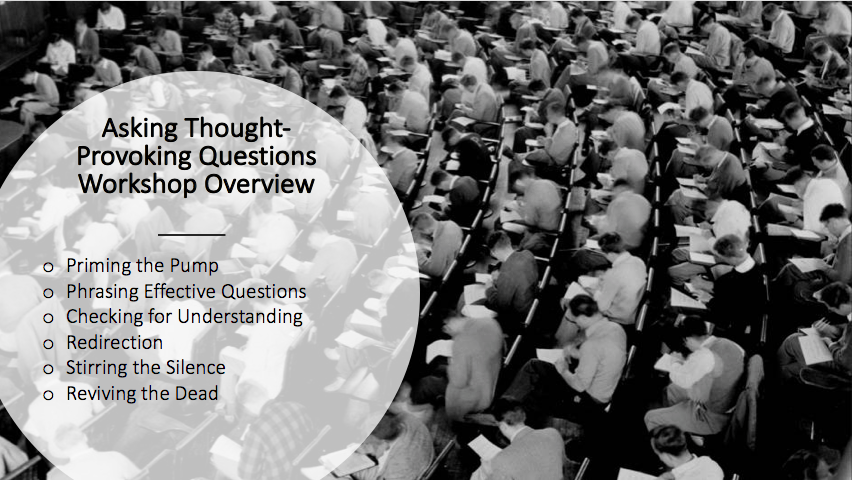
Screen Shot 2019-05-01 at 20.37.54.png

2. Priming & Phrasing

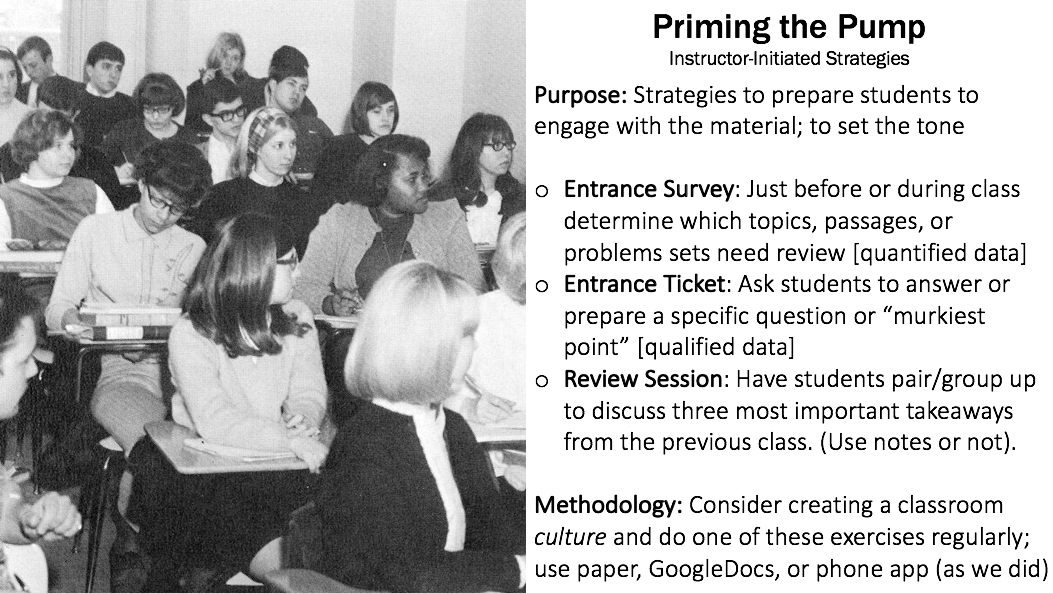
The first group of strategies was oriented around fielding potential discussion topics and  priming the students to think about the day’s material. Moreover, asking questions as soon as students arrive in class creates an expectation that they need to engage and, hopefully, contribute to our discussion (if not individually, in small groups).
Slide 2.png
Priming the Pump Strategies

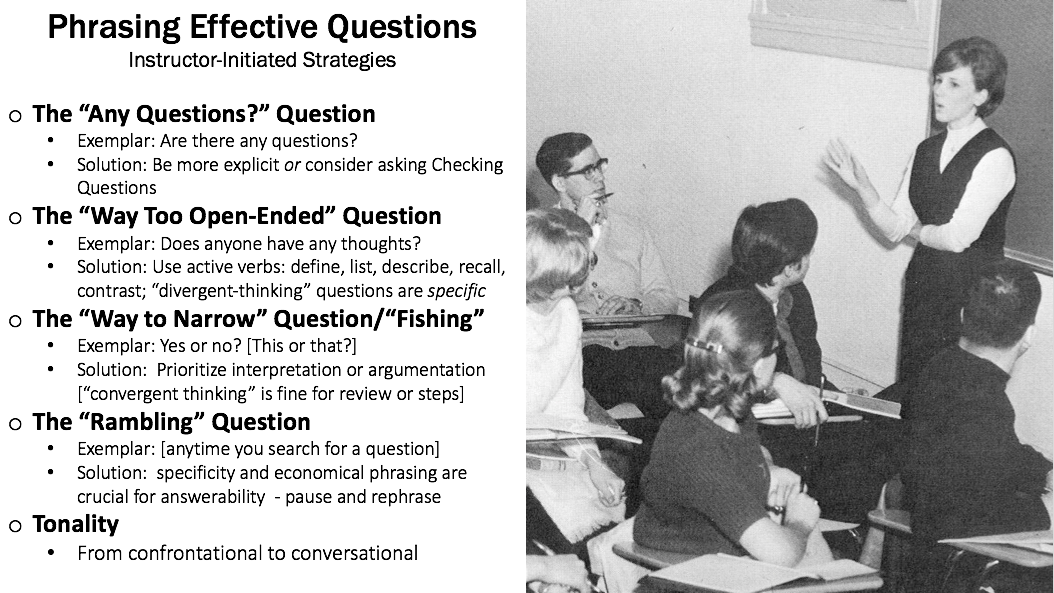
The second grouping of strategies concerned the general phrasing of questions. Several very common forms of questions, while valid in certain contexts, can also sometimes be squealing-brake showstoppers. These are potential problems that need solutions.
Screen Shot 2019-05-01 at 19.40.36.png
Phrasing Effective Questions Strategies

3. Understanding & Redirection

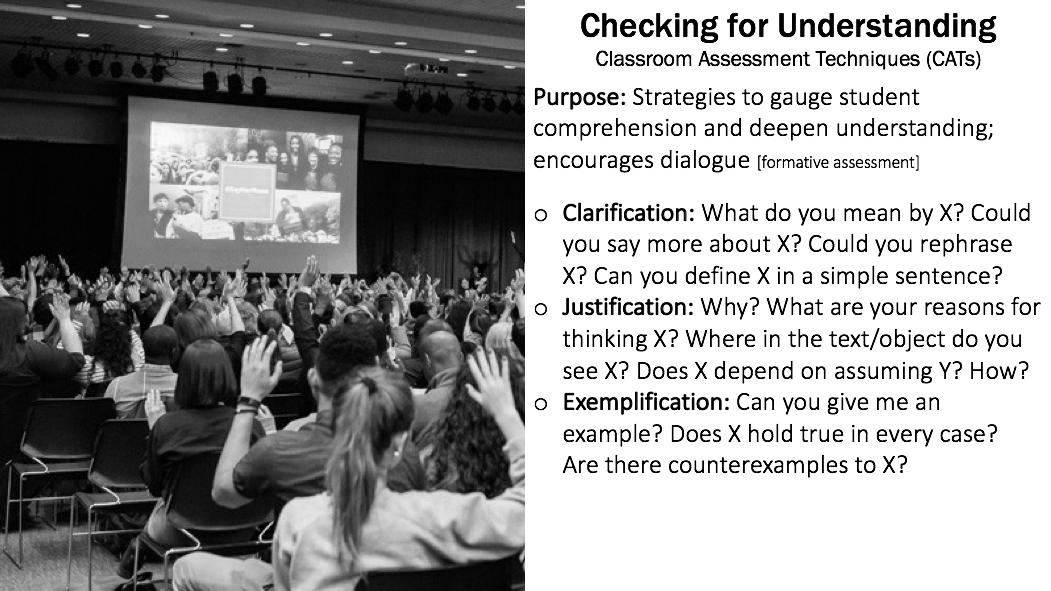
We next moved to a series of strategies developed to provoke more complex conceptual processes. These form a broad category of questions sometimes called Checking Questions or Checking for Understanding Questions. When wielded artfully, these can  turn a rather blasé response into a moment of valuable class reflection. Truthfully, many of us already have these in our repertoire, with the most common simply being the follow-up question, “why?” (under “justification” in the slide below).
Screen Shot 2019-05-01 at 20.05.40.png
Checking for Understanding Strategies I
Screen Shot 2019-05-01 at 20.08.50.png
Checking for Understanding Strategies II

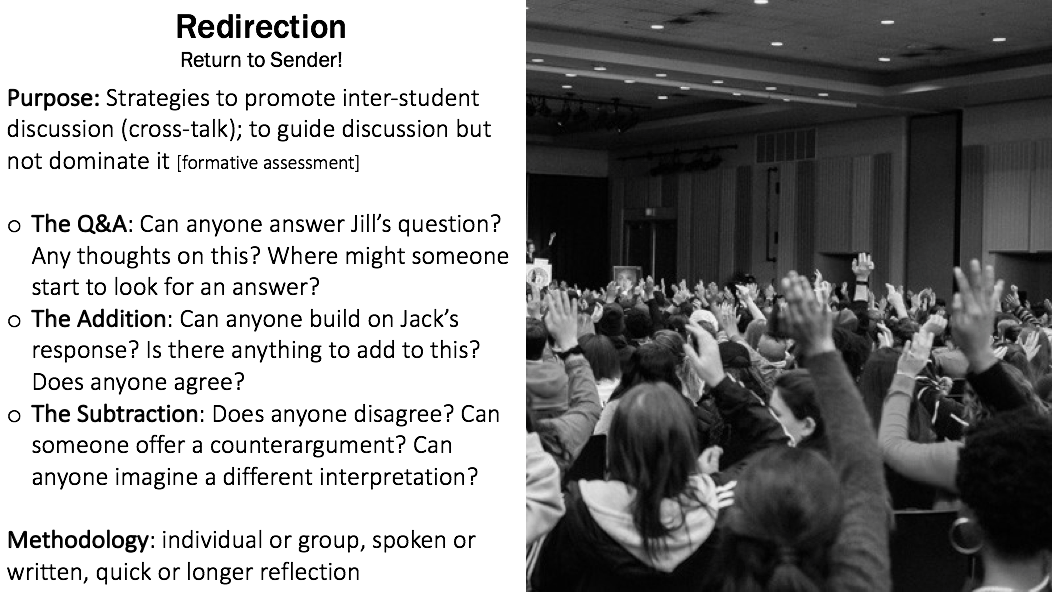
The next set of techniques are used to try and “decenter” the classroom from the instructor. The back-and-forth “yo-yo” pattern between student and instructor is modified to include more inter-student “cross-talk.” In many cases, the instructor still remains the moderator, but that largely depends on the purpose of the discussion exercise.
Screen Shot 2019-05-01 at 20.28.00.png
Redirection Strategies

4. Stirring the Silence & Reviving the Dead

The last pair of strategies were protocols I’ve casually developed when consulting with other TA’s and instructors about how they handle general classroom unresponsiveness. Specifically, when a question to the class appears to be “dead-on-arrival.”

Screen Shot 2019-05-01 at 20.15.16.png
Stirring the Silence Strategies
Screen Shot 2019-05-01 at 20.15.27
Reviving the Dead Strategies

In the last few minutes of our workshop, we turned to the potentially awkward social scenario of a “wrong” or “non-optimal” student response to one of our questions (I prepared no slides for this, I preferred to hear what others thought). We discussed some ways that we’ve maneuvered through this scenario, always mindful of not chastising or “isolating” the student. Depending on the type of question, I’ve often found asking “why?” helps to determining the student’s reasoning. In some cases the rationale may be sound, but just not what I am “looking for,” and thus allows me to thank the student (“That’s a good take, I didn’t think of that”) and pivot to another response. Otherwise, if there’s a problem in the rationale, I may try to give clues to see if the student can find his or her own mistake (or problematic assumption) and offer a chance to respond again. Other times, I may ask for another student to provide a counterargument. In the end, I usually try to validate some aspect of the student’s original response, if possible. (Particularly sensitive or controversial views may need a different approach, but that’s a discussion for another workshop.)

I closed our workshop by handing out “Exit Tickets” – providing a moment of reflection for people to think about something that was meaningful or even unclear to them. I was curious which strategies were the most helpful to my workshop attendees; I received a range of replies. Around half explicitly noted the value of Redirection. Another large chunk approved of the Reviving the Dead, and the rest were evenly split between Checking for Understanding and Priming the Pump (Mentimeter is frequently a hit).


Last Thoughts: This was my last Instructional Development workshop for the academic year and the amount I’ve learned in the process has been quite gratifying. Of the workshops I’ve given, this was probably the most time intensive and interesting for me to think about, as well as the best attended (with Managing Teaching Anxiety being a close second). Is it just coincidence that the two workshops I’ve offered that most directly deal with student interactions were the most attended? Nevertheless, I will now be transitioning into my role as a facilitator for the Summer Teaching Institute for Associates, more workshop planning abounds!


Workshop Posts

Panoramic Postcard of the Kamakura Kaihin Hotel

In the summer of 1887, Nagayo Sensai 長与専斎 (1838-1902), a physician and director of the recently incorporated Bureau of Health 衛生局, founded Japan’s first sanatorium, the Kaihin-in 海濱院, on the beaches of Kamakura. Since many Japanese physicians during the early Meiji (1868-1912) were trained under German doctors they soon adopted the contemporary belief in Western medicine that regular exposure to seawater would ameliorate people stricken with tuberculosis. German doctor Erwin Bälz (1849-1913) first recommended the mild climate of Kamakura as an optimal location for sea bathing therapy. This motivated Nagayo to work with wealthy Yokohama silk merchants to construct a vast Western-style resort on Yuigahama Beach 由比ヶ浜海岸 in Kamakura, replete with several acres of pine groves and spacious lawns. Called Kaihin-in (“Seaside Facility”), patients would participate in regular sea bathing sessions and enjoy the open-aired, scenic vistas. Within a year, however, mismanagement would cause the facility to be repurposed into a hotel and resort that catered to foreign visitors.[1]

 The hotel was renamed the Kamakura Kaihin Hotel 鎌倉海濱ホテル and quickly became a tourist destination in its own right. In 1891, an American sailor, M. B. Cook, described his pleasurable visit as such:

“From the streets of Kamakura we drove to the Kaihinin, a large hotel or marine sanitarium facing the sea, and surrounded by beautiful walks and drives. In the summer season it is full of guests, and being in one of the most healthy places in Japan, and the visitors are given so much attention, that it is becoming a center of attraction to all American tourists.[2]

The hotel was also featured in Murray’s A Handbook for Travellers in Japan, the premier English language guidebook for foreign tourists in Japan. It remained a wildly popular destination into the twentieth century, located a mile from the main Kamakura train station (the Yokosuka Line 横須賀線 opened in 1889) and was famed for its European-style cuisine, affordable rates, and English language guest services. It was also located less than a mile directly south from the most important foreign tourist attraction in the region, the Kamakura Daibutsu.

Figure 1

Kaihin obverse.jpg

Kaihin reverse.jpg

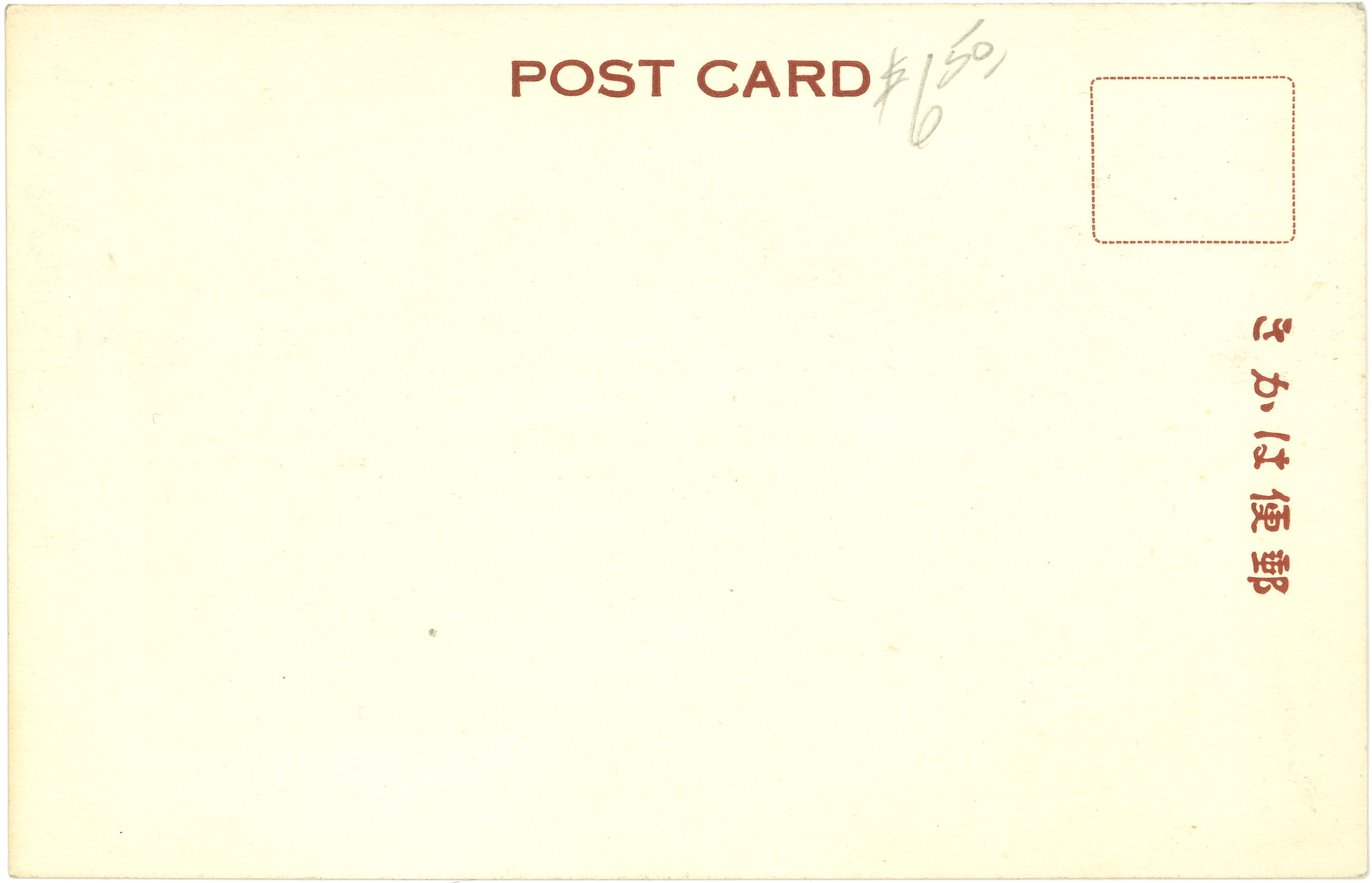
  • Title/Caption: Kamakura Kaihin Hotel Kamakura, Japan. // Telephone No. 4 & 331 The Best Bathing Beach in Japan // Telegram “Kaihin” Home of Daibutsu
  • Year: 1903-1907 [postally unused]
  • Publisher: unknown
  • Medium: collotype print on cardstock
  • Dimensions: 5.5 in X 3.5 in
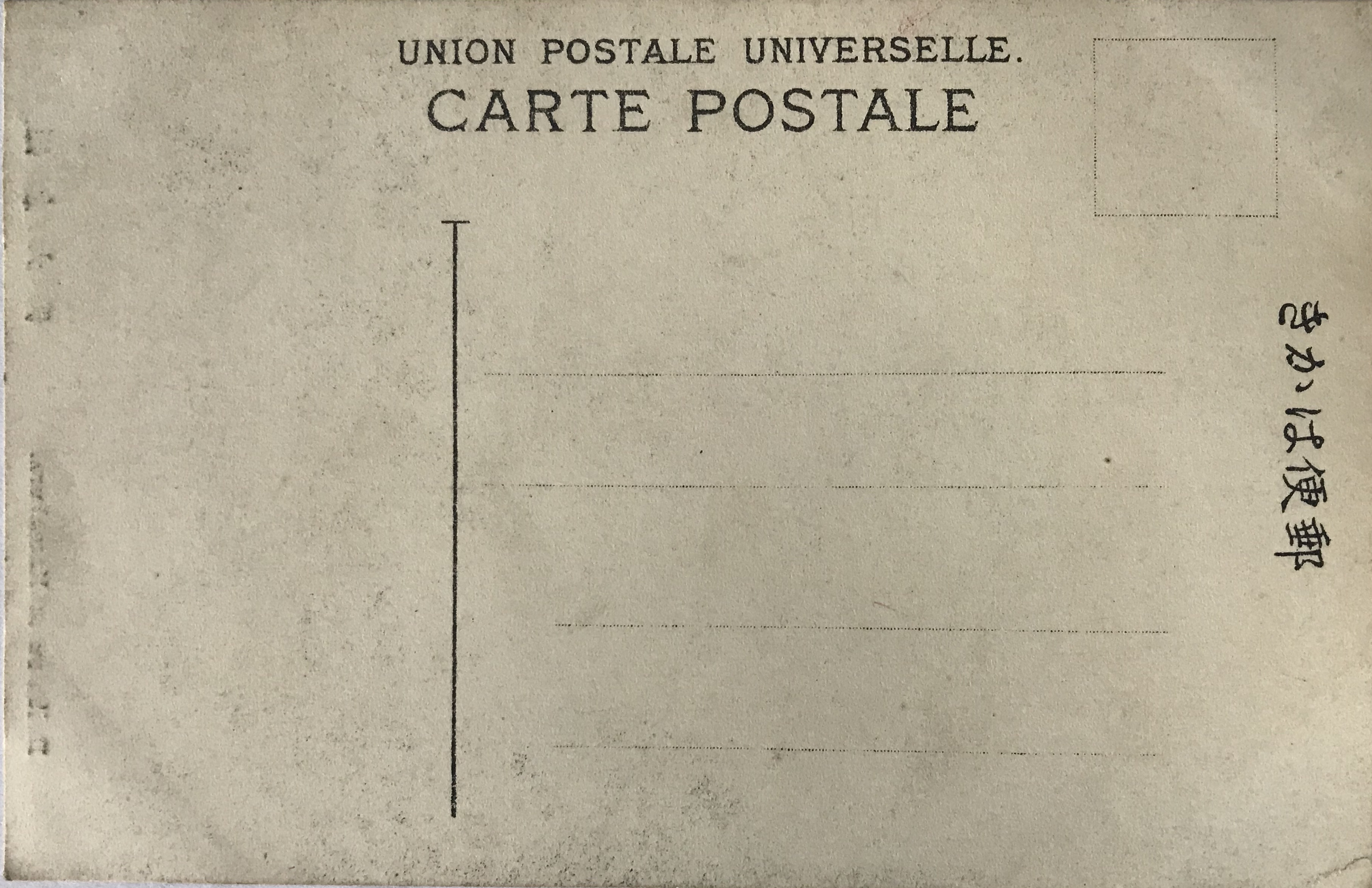
  • Reverse Imprint: Post Card, 郵便はかき

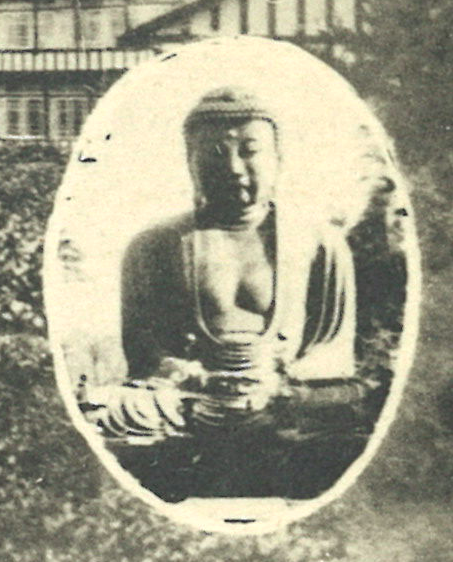
The image on the postcard obverse [Fig. 1] shows the lawns and landscaping of the hotel grounds that led out towards the ocean (seen on the far left). The sprawling multi-storied complex is topped by a flag emblazoned with “KKH,” for the Kamakura Kaihin Hotel. The sweeping, panoramic photograph provides a potent combination of modern (Western) luxury and natural beauty, sure to lure even the most cagey tourist. The text under the photograph proclaims that the site offers “the best bathing beach in Japan,” a callback to its origins as a bathing sanatorium. Importantly, the photograph is overlaid with an oval image of the Kamakura Daibutsu, with the caption proclaiming that the hotel is the “home of Daibutsu.”[3] These elements show that the postcard was also used as an  advertisement, tying together the exotic Buddhist icon of the “Orient” with the scenic luxury of the resort grounds. Roaming, half-day long horseback rides to and from the port of Yokohama were no longer necessary to enjoy the Kamakura colossus. Daytime visitors could enjoy a short trek to the temple, expose or purchase a few photographs, and return to picnic by the beach.

Figure 2

Kaihin Daibutsu.png

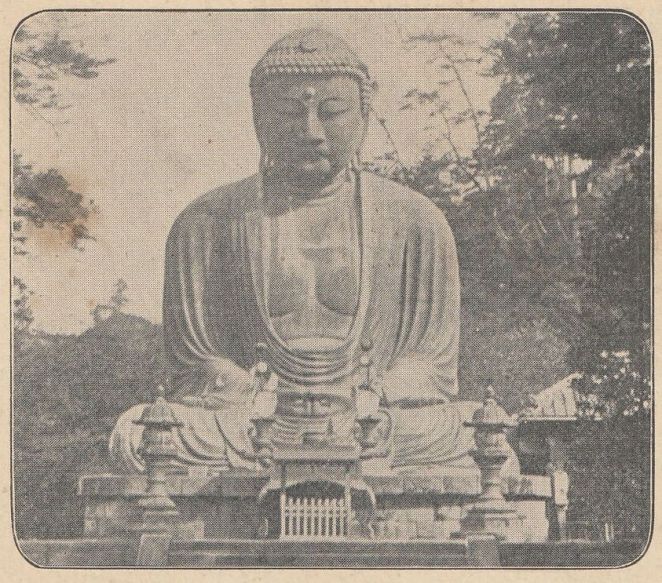
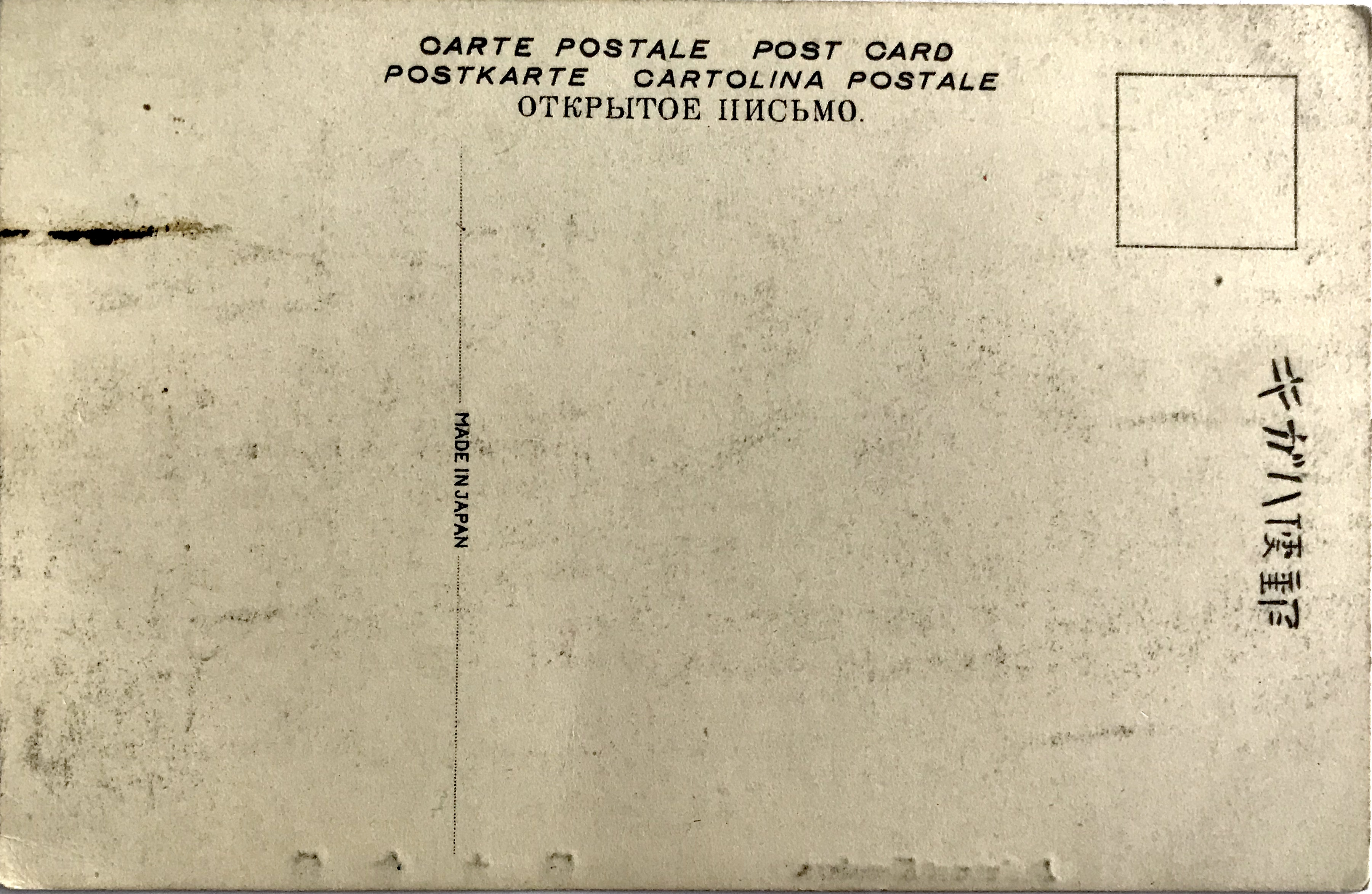
This photograph of the Daibutsu [Fig. 2] likely dates from after 1903 (due to the outward facing metal lotus flowers atop the offering table). The reverse of the card shows that it is an “undivided back,” definitively dating it previous to 1907 (a “dividing line” was introduced the following year). This also proves the design on the front of the card was purposeful, with the bottom blank half of the card reserved for correspondence; only the address and name of the recipient was allowed on the back. The photographer(s) and publisher remain unknown.

Figure 3

TMKD Kaihin Obverse.jpg

  • Title/Caption: Kamakura Kaihin Hotel Kamakura // Telephone No. 4 & 331, Kamakura // Japan
  • Year: 1930s
  • Printer: unknown
  • Medium: halftone print and ink on paper
  • Dimensions: 5 in X 3.5

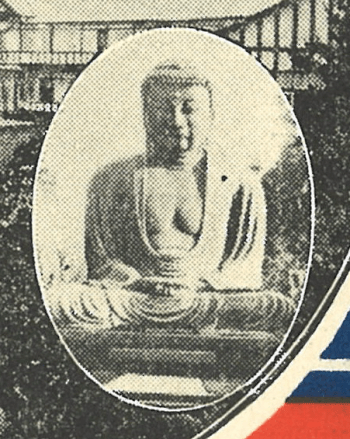
The same photograph of the hotel compound was later used on paper luggage tags [Fig. 3] for the Kamakura resort. Affixed to suitcases and steamer trunks, luggage tags were very popular in the interwar period. In addition to helping sort luggage in transit, these tags signaled the cosmopolitan sophistication of the tourist and thus were often designed with bold images and bright colors. The oval inset of the Daibutsu closely mirrors the postcard design, yet this photograph of the Kamakura colossus is of a much later vintage, quite possibly dating from the 1930’s [Fig. 4].

Figure 4

TMKD Kaihin CU.png

The Kamakura Kaihin Hotel suffered significant damage during the 1923 Great Kantō earthquake, but was rebuilt to its previous grandeur. The hotel would remain in operation up through World War II, until a series of fires resulted in its closing in the mid-1940s.


Notes:

*This is part of a series of posts devoted to exploring the development of a visual literacy for Buddhist imagery in America. All items (except otherwise noted) are part of my personal collection of Buddhist-themed ephemera.

[1] An overview of the cultural encounters between Germany and Japan in the field of medicine are discussed in Kim 2014. For more information on Nagayo, see Rogaski 2004, esp. pp. 136ff. The best available information on Nagayo’s role in the founding of the Kaihin-in appears to have been discussed in the Exhibition Reminiscing the Kamakura Kaihin Hotel 鎌倉海浜ホテル追憶展, organized by Hirata Emi 平田恵美 of the Kamakura Central Library, Modern Historical Materials Division 鎌倉市中央図書館近代史資料室 in 2011. I am indebted to the review of this event by Noriyuki Takagi 高木規矩郎 found here, here, and here. Other scattered information can be found here. Certainly, far more archival research needs to be done for a full account of this story. I have not been able to consult this work: Kamakura kaihin hoteru: Nipponhatsu no kaihin rizōtohoteru 鎌倉海濱ホテル 日本初の海浜リゾートホテル [The Kamakura Kaihin Hotel: Japan’s First Seaside Resort Hotel], by Shimamoto Chiya 島本千也 and Hirata Emi 平田恵美.

[2] Cook 1891: 29. A handful of other late nineteenth and early twentieth-century tourist remarks can be found here.

[3] There are versions of this postcard without the small overlay of the Daibutsu. The caption instead reads “The only resort in the Far East.” The best online collection of Kamakura Kaihin Hotel memorabilia remains here.

References:

  • Cook, M. B. 1891. A Sailor’s Visit to the Island Empire. New York: John R. Alden.
  • Kim, Hoi-eun. 2014. Doctors of Empire: Medical and Cultural Encounters between Imperial Germany and Meiji Japan. Toronto, University of Toronto Press.
  • Rogaski, Ruth. 2004. Hygienic Modernity: Meanings of Health and Disease in Treaty-Port China. Berkeley: University of California Press.

Additional Posts in Visual Literacy of Buddhism Series

What Does a Thesis Statement ‘Look’ Like – Thesis as Metaphor

Peter Romaskiewicz

Introduction

Early in the semester, I have my students tell me what a thesis statement looks like. They break into groups and write out a few bullet points listing the non-negotiable components of the ideal thesis.

Additionally, I ask them to think of a metaphor that best conveys what a thesis statement does (examples below). Finally, I ask them why that metaphor was chosen and to explain how it reflects their itemized bullet points.

It’s a relatively quick exercise (no more than 3-4 minutes of group collaboration, and another 10-15 of class discussion) and I encourage creativity in the metaphors. If the metaphor component is confusing the groups, I will give one example, often saying something like this: “A thesis is like a map, because it shows you where you are going [i.e. it foreshadows the conclusion] and highlights important landmarks [i.e. foreshadows some evidence] along the way.”

I wish I was far more fastidious over the years in copying down the metaphors created by my students. Nevertheless, scribbled in the margins of my lesson plans are the following examples:

  • A thesis is like a compass (because it gives direction)
  • blueprint (provides an overview)
  • billboards (works like advertising)
  • food label (lists contents)
  • skeleton (provides general shape)
  • receipt (tells you what you got)
  • shopping list (tells you what to look for)
  • bridge (brings you to a new place of understanding)
  • flashlight (tells you where you are going and is “flashy”)
  • treasure chest (holds all the “valuables”)
  • heart (vital organ, the core)
  • pyramid (strong foundation; made of blocks/components)
  • magnifying lens (it focuses)
  • spine (directs the body [paragraphs])
  • recipe (provides instruction)
  • Tinder profile (makes people interested).

In any individual class, the groups’ suggestions are usually diverse enough to point out that no single metaphor can characterize all of the functions of an ideal thesis statement. This is why I like this exercise. Choosing a metaphor is an argument; students have to come to some consensus on which aspect is the most important, which is then memorialized through the metaphor.

In sum, the metaphors above suggest that a thesis statement provides direction and cues the organization and methods of a paper. Furthermore, a thesis should also be focused (or relatively concise) and bring the reader to a new understanding of a topic. Ideally, a thesis should also be “attractive” (compelling or interesting).


Function Over Form
epigraph 1.1

I prefer focusing class discussions on the function of the thesis statement rather than on its forms (i.e. the listed bullet points they generate in groups). In the language of genre analysis, we are looking for the rhetorical purpose of the thesis, not its conventions.

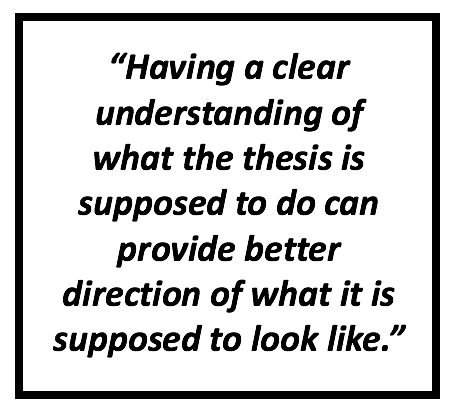
I prefer this because many students have already been drilled in the conventions: a thesis is one sentence; a thesis needs to provide three points of support; a thesis is the last sentence of an introduction. These are all guidelines, not hard-and-fast rules.[1] Having a clear understanding of what the thesis is supposed to do can provide better direction of what it is supposed to look like. I would say the description above provides a good foundation for a generalized thesis.[2]

But a thesis can do more than summarized above, much more in fact, depending on the writing genre it is used in. Generally, I focus on argumentative/persuasive essays (but expository essays are common in my religious studies discipline), and thus a thesis in this context should also make a claim or take a stand, an aspect not clearly articulated in the above metaphors. In other words, you should imagine a reasonable person raising possible objections to your claim. This has two purposes. First, it draws in the skeptical reader who wants to see how you defend your claim. Second, it makes you a more thoughtful writer since it asks you to imagine, and possibly mitigate, potential counterarguments.[3]

Often, another aspect of a strong thesis is that it passes the “So What?” Test, meaning that a person’s first thought after reading the thesis should not be, meh, so what? To me, this is a very complex issue because it relates to significance. Often, scholarly theses do not pass the “So What?” Test for students because students often do not understand the broader disciplinary issues the scholar is tackling. In other words, the significance may not made explicit because the scholar is writing for his or her professional peers and who already know the gaps of knowledge in the field, not students who are novices in the topic. (Although I would contend that good, effective scholarship should make a paper’s significance explicit).

epigraph 1.2

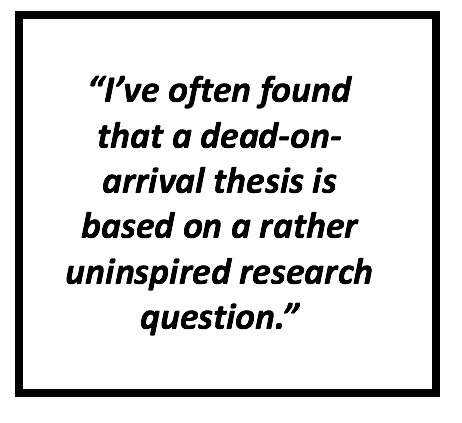
For students, I’ve found success in enlivening their thesis claims by having them clearly articulate the question they are asking. Among all the other things we’ve talked about, a thesis is a response to a question (and a conclusion based on premises).  I’ve often found that a dead-on-arrival thesis is based on a rather uninspired research question. Instead of working on the thesis, I’ve had better responses talking to students about the questions they, often implicitly, are asking. While writing can be tortuous (and sometimes torturous), I suggest students return frequently to their question and try to refine it in terms of the new evidence they gather. In some situations, students find that the significance of their thesis can be rhetorically heightened by explicitly working their research question into the paper (according to the rhetorical principle of anthypophora).


Final Thoughts

Overall, I’ve found that defining the principle elements of a thesis statement can elicit deeply personal reactions. This may be due to personal preferences, misunderstanding regarding the genre of essay, or even disciplinary norms. These can be mitigated if we just tell our students, as clearly as we can, what we want a thesis to look like…but more importantly, what we want it to do.

So – What Can a Thesis Statement Do? (Anything else?)

  • It can preview (or provide) the conclusion of the argument
  • It can capture the interest of the reader
  • It can take a stance on an arguable claim
  • It can point to the significance of the argument or conclusion
  • It can preview the organization or structure of the essay (as reflected in the structure of the thesis statement)
  • It can encapsulate or highlight the most important points of the essay

So – What Does a Thesis Statement Look Like?

As you can start to see now, as long as a thesis statement accomplishes its necessary purpose(s), it can actually look different for different writing projects. If you still are looking for some more concrete starting points (that’s ok!) see the resources in the notes below.


Notes

[1] I have had colleagues use “starter formulas” for creating thesis statements, such as: Primary Sources + Observations = Conclusion or Evidence + Claim = Conclusion. In these cases, the Observation or Claim should change the understanding of the underlying evidence. Elsewhere, I have seen more specific directives to fill in the blanks: While critics argue_____, I argue_____, because_____./By looking at_____, I argue that_____, which is important because_____./The text, _____, defines _____as_____, in order to argue_____. I think these are all reasonable ways to jump start students who are struggling, but I would also be careful of pigeonholing student creativity or artificially limiting their argument styles.

[2] The advice available online for how to craft a thesis statement is absolutely daunting. It behooves us as instructors to help student navigate these resources if they have more questions. Arguably, one of the best online resources is the Perdue Online Writing Lab (Perdue OWL), but I would not say their thesis discussion is all that robust (a claim which pains me because it is such a valuable resource overall). I like the Harvard College Writing Center site because it provides some thesis caveats, and the University of Toronto Writing Support site because it talks about some myths. In addition to these, there are plenty of online materials which describe the process of developing a strong thesis, such as the University of Wisconsin Writing Center. I’ve used the handout from Vanderbilt University Writing Studio to develop my own worksheet for the thesis drafting process. Finally, for fun, if my student are having problems with crafting a draft thesis, I tell them to go here http://www.wonder-tonic.com/filmthesis/.

[3] I have a friend who likes to tell a story of his college writing instructor who made all students develop their theses (claims) until no one in the class agreed with the claim. Only once no one agreed with the thesis, was my friend set to writing to convince his peers to agree with him!

Resources:

Zhao, Jun. 2007. “Metaphors and Gestures for Abstract Concepts in Academic English Writing,” Dissertation, University of Arizona. [here]


Other Posts on Writing and Researching Skills

Teaching Writing When You Don’t (Want to) Teach Writing

epigraph.png

(Or…Teaching Writing in a ‘Content Course’)

I know. Student writing is horrible. The sky is falling. Doomsday has come. I’ve had several conversations with colleagues about the sordid state of student writing. I once hooped and hollered atop that bandwagon too. It was so easy to blame high school teachers and college writing instructors (or anyone else) for not preparing students adequately in the fine art of written argumentation.

Then, I got a job as a university writing instructor. I’ve come to see that the problem partly lies with me and my curmudgeon colleagues (its a blight that extends beyond religious studies). It’s our duty to teach writing too, we just don’t want to do it.[1] Student writing is also not that bad, if you give students a fighting chance.

I’m a traitor to the “but-I-don’t-teach-writing” cause. I know.

If I haven’t angered you to rage-close the browser tab, then let me explain. At one level, writing is a skill, not a “fact”; all students know how to write, but some may not be proficient at it. They need more practice – and guidance in The Writing Process.

When I say instructors need to teach writing, I really mean they need to apportion time and structure activities that allow students to critique and develop their own ideas. Once students thoughtfully struggle with their ideas and arguments, they are more likely to want to “own” those ideas. As a result, almost magically, their writing will get better. In our religious studies courses (or humanities more broadly), we do not need to formally “teach writing,” as much as we need to give students the opportunity to work out their ideas in a strategic and structured manner. Teaching “writing” is just code for teaching critical thinking skills.

One of the key aspects of my writing courses focuses on (re)shaping student writing habits. We talk at length about “The Writing Process” and students develop their own ideal Process. While many facets are individual – some do their best writing in the library, some in their rooms; some listen to background music, some prefer silence; and so forth – other facets are non-negotiable. My writing course is structured around these non-negotiable facets, namely drafting, peer-review, and revision (see below). Ideally, my goal is to have students incorporate these elements into their natural Process, but like many new habits, they can be hard to adopt.[2]

In the non-teaching-writing classroom, it can be easy to omit drafting, peer-review, and revision activities (hereafter DPR). But these are precisely what students – and us scholars – need to produce our best writing. If done skillfully, DPR can all be handled by students themselves; there is no extra work for our already-exhausted teaching souls. I will admit, however, it does take time to devise drafting prompts, structured peer-review sessions, and direction for revision. Undoubtedly, these activities will go wrong before experience teaches us how to make them right (online research will certainly help too, or, gasp, conversations with colleagues about our failures).

Of course, I do think students benefit greatly from our expert insights on their ideas. If we can provide verbal, recorded audio, or written commentary at early stages in the Process, this will greatly assist students in developing their ideas. Spending time to get students to talk about their research in class with other is also valuable.

Overall, here are some thoughts about incorporating writing good critical thinking habits into your non-teaching-writing-classroom based around DPR.

Drafting: A simple recipe for disaster is to assign a big writing project due at the end of the term which does not also formally schedule several “checking-in” assessments along the way. These formative assessments could be a simple conversation with individual students or classroom activities where students discuss the early stages of their work. Drafting is another option. This does not have to be a full draft of the final essay. I’ve seen colleagues assign small segments of the essay that are due regularly throughout the term, such as drafting the introduction with a thesis, or body paragraphs with solid evidence, or the conclusion with the potential significance of the findings. More commonly, I’ve seen colleagues assign research proposals or annotated bibliographies, which discuss proposed research questions and potential lines of argument. Personally, I prefer (when possible) to assign smaller writing assignments that allows students to work on certain facets of their larger argument for their final paper. This works best if students don’t have an open-ended final research project, but are expected to address a pre-determined topic or theme at the end of the term (but I’m sure savvy instructors could still craft prompts that function in an open-ended manner). Overall, there are plenty of drafting options to help stimulate student thinking along the way, including daily writing reflections, for example. [3]

Peer-Review: It is important to remember that drafts can also be read by other students (even as homework), if reading students’ work is too time consuming for an instructor. Peer-review can be tricky to run effectively, however. One thing to keep in mind is that students will need assistance on how to critique the work of others; offering truly constructive criticism and thoughtful insight on writing is a skill in itself (as I’ve painfully learned as a writing instructor). Consequently, review sessions need to be highly structured. Provide a commentary rubric or the grading rubric you would use for evaluating the assignment. Or, at the very least, provide a list of things for students to pay attention to. I’d suggest saving the best papers from each term and sharing them during subsequent peer-review sessions. The entire class can read and comment upon the paper(s), thus helping to align expectations about the review process. I’d also strongly suggest having student converse with each other after providing written commentary; talking can easily clarify confusions on both sides. There are numerous discussions of running peer-review online, I’d suggest finding a method that might work best with your class and tinker with it.

Revision: The purpose of doing the above activities is so students think through their ideas and potentially see how others attempt to tackle the same or similar issues. Depending on the drafting assignment (suggestions above), you would have to decide how to have students build off of their initial insights. In other words, what is the next step in the Process? Does their thesis statement need to be re-thought (and possibly re-drafted)? Does their research proposal need to be more focused and peer-reviewed again? Is their annotated bibliography missing an important work? Will students’ smaller writing assignments dovetail cleanly into their larger argument or are there potential flaws which need to be redressed? While some of these interventions can be performed by other students, instructor commentary (or even better, conversation) will prove invaluable. Importantly, only work that will be revised merits extensive feedback, there is little pedagogical value in heavy commentary on final products – the real critical thinking work has already been done.

A final note: There are numerous other suggestions to consider as well when focusing on the Writing Process. One that was not immediately apparent to me was “exposing” myself as a writer to my students. I now regularly tell my classes about all of the writing projects I need to engage professionally as a writer: conference proposal, book review, dissertation chapter, journal submission, and so forth. I share with them the struggles, setbacks, and new insights gained through developing my work. It’s important for students to see or hear about writing that isn’t published, that isn’t perfect, that needs further reflection. By seeing the care that goes into our professional work, students can come to emulate that process.

Notes:

*Some of my comments here developed out of my ruminations on abandoing page-lengths for student writing.

[1] Duty might seem like a strong word, but I’ve used it purposefully. If we consider our course goals to include cultivating critical thinking skills, this almost certainly includes (there are reasonable exceptions) some form of writing assessment. As you will see, I do not consider the teaching of writing in the non-teaching-of-writing-classroom to be a review of low-level mechanics or refinement of diction, but the critique and development of ideas that normally happens in the Writing Process. In this case, the teaching of writing is, simply, the teaching of critical thinking.

[2] I’ll say it again, but now as a footnote: So-called “good writing” is not the memorization of facts. Most students are fully aware of the elements of a good thesis or how to make a strong argument. In many circumstances, what limits them is not their misunderstanding of these facts, but the underdeveloped ideas they have. By spending time on their ideas (researching, conversing, debating, refining, reflecting, etc. ) students generally come to care for those ideas. When folks don’t care about their ideas, they hand in “poorly written” work or plagiarize it.

[3] Even regular, short responses to readings can include a few comments by students on their relevance to a proposed final project. In other words, responses to readings don’t always need to be simple summary.

Further References:

Wingate, Ursula; Andon, Nick & Cogo, Alessia. 2011. “Embedding Academic Writing Instruction into Subject Teaching: A Case Study.” Active Learning in Higher Education, Vol. 12, No. 1., pp. 69–81.

Efficient and Effective Grading of Student Writing Workshop

Introduction

Once, over the course of five weeks, I graded – and commented upon – just over four hundred student papers.

It was mind-blistering work. I was asked by a colleague if this experience passed a cost-benefit analysis. Many of these papers were drafts (or important student reflections) and thus demanded more care; students would be building their ideas off my comments.

In the end, their final papers – which received minimal comments from me – were mostly enjoyable to read. In my assessment, my work had paid off. Ultimately, efficient and effective grading requires the front-loading of instructor effort as well as strategic off-loading to students.

After several years, I like to think I’ve become better at offering constructive criticism of student writing and becoming more effective at helping students write critically. Below, I offer some of the slides I presented on this topic for our university’s Instructional Development program for TAs and add some additional commentary.

The workshop was divided into three discussion themes: Before Grading, While Grading, and After Grading. (The slides below carry most of the information.)


Setting the Scene

Our workshop was fairly small so I started by surveying our group’s attitudes towards elements of the writing process. Using Mentimeter, the first question asked the attendees to rate their opinions of the importance of drafting, peer-review, and creating rubrics:

Question 1: On scale of 1-5, how necessary would you evaluate each action/activity: student rough drafts, creating grading rubric, student peer-review.

The numbers above represent the averages of the individual responses (“5” being the most “necessary”). Of those, creating grading rubrics was deemed the most important among our group. Happily, this aligned with the work-shopping component of my presentation. Drafting and peer review require some “experience” (ahem, failures) on the teacher’s part to get it “right.” Nevertheless, I consider all three to be closely related, I’ll return to this below.

The second question asked the participants to do a cost-benefit analysis of creating rubrics, setting up peer-review, and giving ample commentary:

Question 2: What is your relative impact-effort evaluation of each action/activity: student rough drafts, creating grading rubric, student peer-review.

MMQ2

Not surprisingly, providing feedback was the most time-intensive, but it’s value was on par with crafting a good rubric. As I noted above, there’s an inverse value to feedback as the semester progresses. It’s most valuable early in the term, when students can adjust their habits and styles (and build their ideas); there is minimal value on maximal feedback at the end of the term.

The final question was more straightforward: how long does it take to read, comment significantly, and grade a five-page paper?

Question 3: How long does it take for you to comment on a 5-page student paper?

MMQ3

I asked this question to get a sense of how others operate – we instructors often don’t talk about these types of things with each other. At the very least, I think its important to have an internal estimate of our grading times so we do not go overboard with commenting.

Personally, I have not been able to break the 15 minute barrier for five-page papers. I average about 18 minutes.

As such, I set a timer for each paper I read at 20 minutes and always try to “beat” it. (Perhaps I can call this a variant of the Pomodoro Technique.)


Before Grading

Before diving into my presentation formally, my favorite suggestions for managing paper load comes from Shelley Reid’s insightful thoughts posted in her “Shelley’s Quick Guides for Writing Teachers.” Many of Reid’s principles are sprinkled into my presentation here.

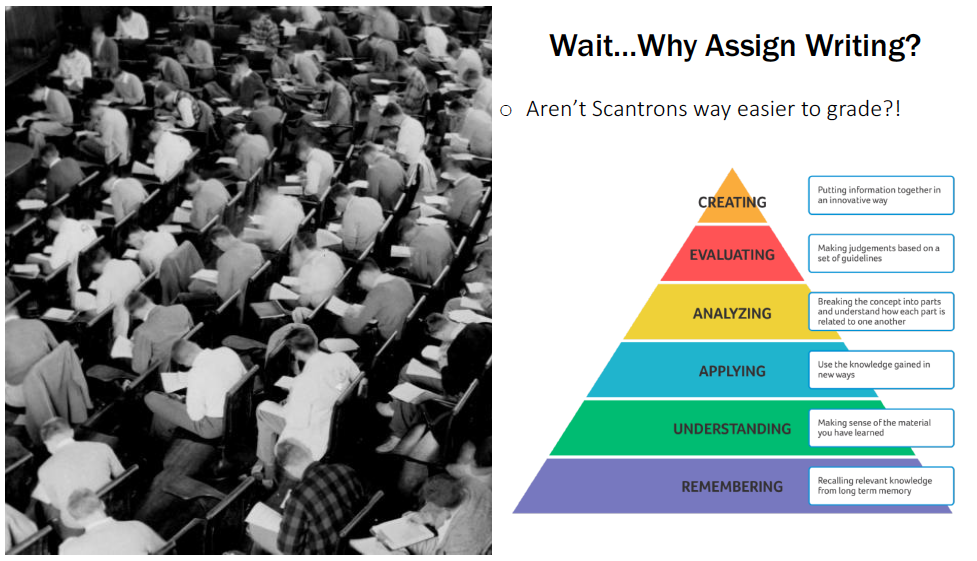
I start by asking why instructors should assign papers at all. Its important to keep in mind the value of writing for recruiting “higher orders” of thinking: applying, evaluating, creating, etc. This kind of thinking is impossible to access, for example, through multiple choice exams.

It’s also important to think about which orders of thinking your writing prompt(s) address; some writing prompts may only ask students to list elements of a concept or theory. This remains in the lower order of “remembering” (see Bloom’s Taxonomy below).

It is, of course, harder to evaluate, comment upon, and grade higher orders of thinking.

Slide 1

Slide 1.png

Instructors can do several things to off-load more of the conceptual “heavy lifting” to students – and thus have them build more of the conceptual “muscle.”

Having students draft is an important step in the writing process because it allows them to develop (and become more invested in) their ideas. If you pair this with a structured peer-review, there is actually minimal work for the instructor. Of course, peer-review requires structure and guidance. Students need to practice and learn the skill of critical reading and constructive criticism.

This is important to keep in mind if you are the only one providing commentary on student writing, you are doing some of the “muscle-building work” students could – should? – be doing themselves.

I offer the next few slides with minimal comment, but feel free to review the text in each one.

Slide 2

Slide 2.png

Slide 3

Slide 3.png

Slide 4

Slide 4.png
“Before you Grade” considerations

After reviewing the basic components of grading rubrics (criteria, description, scale), we spent time looking for relevant rubric templates online – there is no need to re-invent the wheel! There are many resources available that can inspire your rubric divisions. I provided the following handout for consultation: Creating Grading Rubrics Handout.

After discussing some strategies “before you grade,” I switch to pragmatic suggestions “while you grade.”


While Grading

Slide 5

Slide 5

Slide 6

Slide 6

Slide 7

Slide 7.png
“While you Grade” considerations

I have long been a covert to audio commentary and have suggested it to many of my colleagues. If you have the space (the one limiting factor is you need a generally quiet location), it’s worth a try. Finally, I ended with a few thoughts on “after you grade.”


 After Grading

Slide 8

Slide 8.png
“After you Grade” considerations

Slide 9

Slide 9.png

 Slide 10

Slide 10.png

Edit: This post below addresses several similar issues, but adds other interesting insights: https://movingwriters.org/2018/07/16/sy-2017-2018-top-ten-in-pursuit-of-meaningful-feedback/


 Workshop Posts
Tonboya’s Failed Voyeurism of the Daibutsu

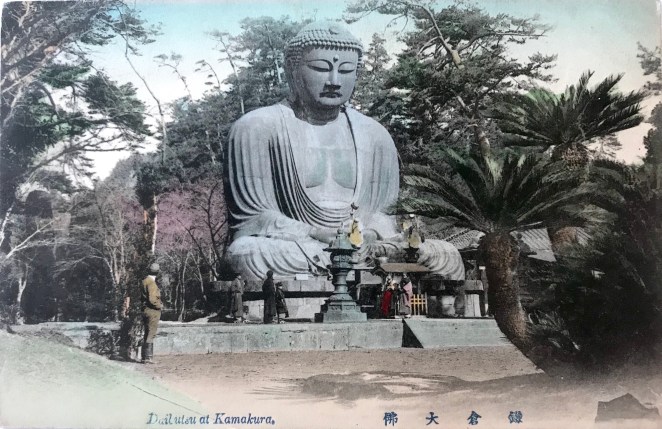
After the Meiji Restoration, the popularity of photography began to overshadow traditional Japanese woodblock printing. Increasingly, woodblock artisans came to find employment with photography studios, adapting their technical painting skills to add vivid color to monochromatic photographs. In the beginning of the twentieth century, due to the craze surrounding Japanese picture postcards (ehagaki 絵はがき), artisans continued to ply their trade by adding translucent water-soluble pigments to these small format calotypes. One of the most famous postcard distributers was Tonboya トンボヤ, or the “Dragonfly Studio,” first opened by Yoshimura Kiyoshi 吉村清 around 1905.[1] The Tonboya storefronts in Yokohama, first located in the Isezakichō 伊勢佐木町 district before moving to the more heavily trafficked Motomachi 元町 district, were easily identifiable because of large signboards made to look like red cylindrical postal boxes (yūbin posuto 郵便ポスト) widely adopted in Japan. One side of the signboard had the word “POSTALCARDS” painted on it, while the other said ehakaki エハカキ [sic](“picture postcards”), suggesting Yoshimura catered to both foreign and domestic travelers.[2] One image that would represent the photographic interests of both groups would be the Kamakura Daibutsu, located close to the port of Yokohama [Figure 1].

PCKD009t(o)

Figure 1

PCKD009t(r).JPG

  • Title/Caption: Daibutsu at Kamakura. 佛大倉鎌
  • Year: 1907-1918
  • Publisher: Tonboya トンボヤ
  • Medium: collotype print on cardstock, hand tinted
  • Dimensions: 5 in X 3.5 in
  • Reverse Imprint: Union Postale Universelle.[+], 郵便はかき

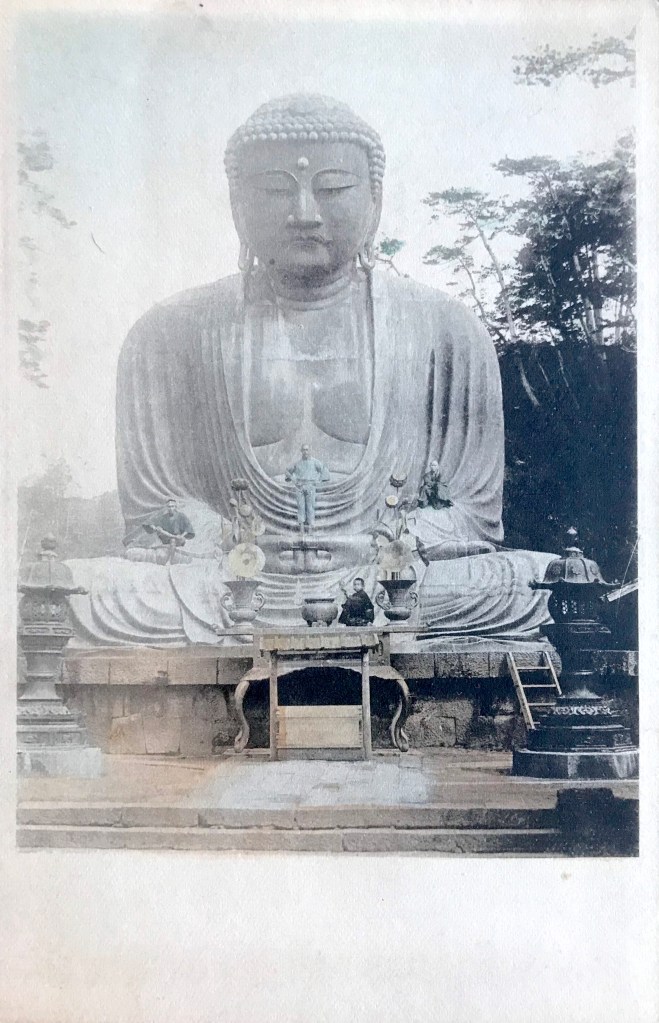
By setting the camera on the second landing of the paved walkway, this unknown photographer filled the frame with the image of the Daibutsu; positioning the statue frontally and symmetrically, this framing is similar to many of the images produced by Yokohama photography studios. The image depicts three figures, two women and a young child, facing the Buddhist icon in the center of the photograph. This setting might elicit other images of religious piety at this site, but the mise-en-scène is complicated by the presence of two more children, standing at each of the sides, who stare directly at the viewer. Their presence might have been obscured had it not been for the colorist who painted them in light hues of blue and pink. Notably, their casual posturing is stark contrast to staged “photo ops” of foreign travelers who try to visually suggest their domination of the Orient. Because of these elements, on the whole, we are made to feel as if the scene is staged and that we have been caught in an act of  voyeurism. The women and child, positioned center-stage, engage in a orchestrated religious performance while the children at the edges observe us watching them. A rather apt visual metaphor for the Orientalist gaze, where the artist attempts to create a certain controlled vision of the East, but with “unruly” actors foiling the illusion.[3]

This postcard is not imprinted with a trademark to identify the publisher. The black ink and serif font used for the reverse, however, in addition to the guide lines provided for writing the address, all suggest this card was made by Tonboya.[4] In addition, the position of the diving line for correspondence indicates this card was printed between 1907 and 1918. If the image on the obverse was not self-evident enough, bilingual cerulean letterpress (note the impression the reverse) identifies the scene clearly: “Daibutsu at Kamakura.”


Notes:

*This is part of a series of posts devoted to exploring the development of a visual literacy for Buddhist imagery in America. All items (except otherwise noted) are part of my personal collection of Buddhist-themed ephemera.

[1] Several online English sources claim Tokutaro Maeda was the founder of Tonboya, but I have found no Japanese sources that confirm this. I prefer here to follow the print Japanese sources (e.g. Saitō 1985: 1), but leave the question unsettled.

Red postal sign.png

[2] Several early-century postcards depicting the streets of Yokohama show this red cylindrical signboard, as seen here: The full postcard can be found here (not part of the Archive).

[3] By shooting one woman mid-stride ascending the small flight of steps, this photographer is (accidentally?) paying homage to Enami Nobukuni 江南信國 (1859—1929), but without the overal effects of sterling visual narrative.

[4] The best site for identifying Tonboya cards remains here: http://tamayochankankousya.seesaa.net/article/421306802.html. Another common reverse printing of Tonboya during this period is discussed here.

References:

  • Handy, Ellen. 1998. “Japonisme and American Postcard Visions of Japan,” in Delivering Views: Distant Cultures in Early Postcards,  Christraud M. Geary and Virginia-Lee Webb, eds. Washington: Smithsonian Institution Press.
  • Saitō Takio 斎藤多喜夫. 1985. “Yomigaeru shinsaizen no Yokohama fūkei よみがえる震災前の横浜風景,” Kaikō no hiroba 開港のひろば, No. 12, pp. 1, 4.
  • Satō, Kenji. 2002. “Postcards in Japan: A Historical Sociology of a Forgotten Culture,” International Journal of Japanese Sociology, No. 11, pp. 35-55.
  • Yokohama Open Port Museum 横浜開港資料館, ed. 1999. Nen mae no Yokohama Kanagawa ehagaki de miru fūkei 年前の横浜・神奈川―絵葉書でみる風景. Tokyō: Yurindo 有隣堂.

Additional Posts in Visual Literacy of Buddhism Series

Tonboya’s Onlooker of the Daibutsu

By the end of the nineteenth century the port city of Yokohama had developed into a thriving tourist destination. Consequently, numerous Japanese shops opened to cater to the needs of both domestic and foreign travelers. Perhaps surprising to a modern reader, among the prized goods offered for sale were picture postcards (ehagaki 絵はがき), the first truly commodified form of the photograph which unexpectedly became a collectors craze in the first decade of the twentieth century.[1] Around 1905, Yoshimura Kiyoshi 吉村清, the proprietor of the well-known Tokyō-based publisher Kamigataya 上方屋, started a new venture in Yokohama, called Tonboya トンボヤ, or the “Dragonfly Studio.”[2] The dragonfly was long seen as symbol of courage and strength in Japanese culture, and thus it was cherished by the samurai and bestowed the romantic name of the “Victorious Insect” (kachimushi 勝ち虫). This lore notwithstanding, Tonboya postcards – emblazoned with its distinctive dragonfly trademark – soon became some of the most famous and widely circulated postcards of the period.

Figure 1

PCKD008t(o).JPG

PCKD008t(r).JPG

  • Title/Caption: Daibutsu at Kamakura. 佛大倉鎌
  • Year: c. 1909
  • Publisher: Tonboya トンボヤ
  • Medium: collotype print on cardstock, hand tinted
  • Dimensions: 5 in X 3.5 in
  • Reverse Imprint: Carte Postale Post Card [+],  郵便ハガ[キ]

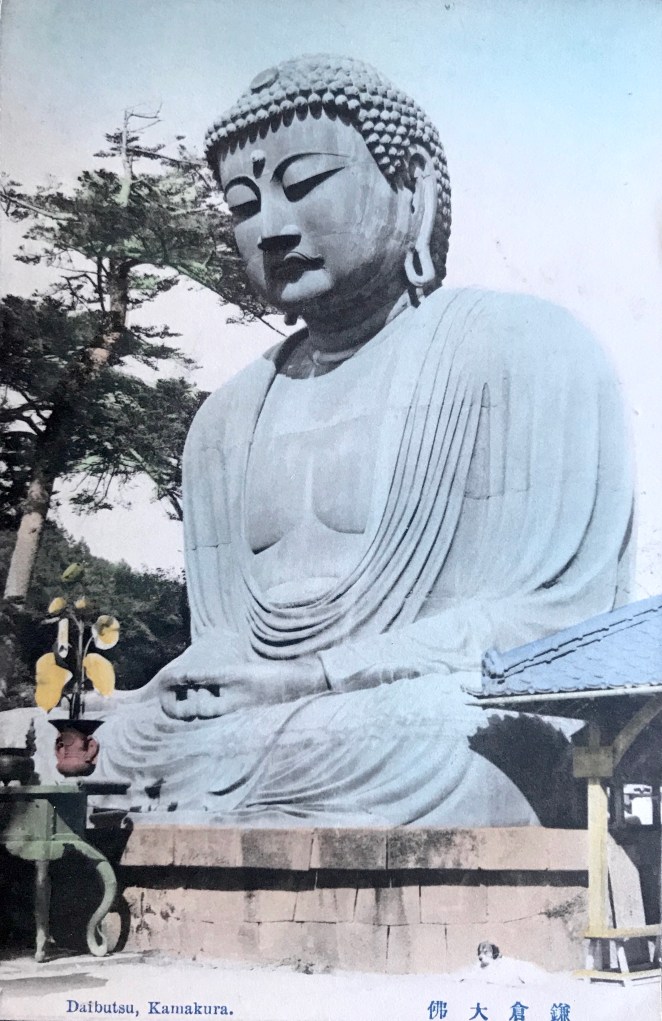
This image of the Kamakura Daibutsu [Figure 1] highlights the rustic setting of the colossal statue, framing the statue between sprawling tree branches and the silhouette of a sago palm. With the camera placed in the southwest corner, our unknown photographer creates a voyeuristic scene as a man in knee-high mud boots and western attire peers towards group of Japanese visitors from behind a tree. Seeing this observer from behind, we take his perspective and also gaze upon the group of Japanese visitors dwarfed by the overlooking bronze statue. The brightly colored garments of the women on the right stand in contrast to the uncolored gray shades of the men and boy on the left [Figure 2]. The boy wears a school uniform (gakuran 学ラン), a style adopted decades earlier based on French and Prussian military outfits.[3] Among this group, only a single man looks up towards the Buddhist statue. The others stand and stare at each other from several paces apart. The gives an unnatural effect to the scene, as the stationary bodies and odd spacing fails to build up a clear visual narrative. What is the relationship of these temple visitors to each other? What is their purpose for being there? As was typical of cards from this period, bilingual cerulean letterpress informs us as to the identity of the Buddhist figure, the “Daibutsu at Kamakura” (note the imression left on the reverse along the bottom edge).

Figure 2

PCKD008t(men).JPG
PCKD008t(women0.JPG


Often, Tonboya would impress its dragonfly logo at the lower right on the front of the card, but our variant lacks this identifying element.[4] Turning to the reverse of our card [Figure 1], we still fail to easily locate the characteristic mark of the dragonfly. So, just how can this card be distinguished? The designers at Tonboya devised a creative and playful way to identify their publishing studio; they replaced the ki (キ) in hagaki (ハガキ, “postcard”) with a highly stylized dragonfly illustration [Figure 3]. Only the most attentive observer would notice this subtle alteration, but once noticed it becomes an easily identifiable marker of this studio. This creative design can be dated back to around 1909 and remained throughout Tonboya’s existence into the late 1920’s.

Figure 3

PCKD008t(logo).JPG

Notes:

*This is part of a series of posts devoted to exploring the development of a visual literacy for Buddhist imagery in America. All items (except otherwise noted) are part of my personal collection of Buddhist-themed ephemera.

[1] Satō 2002: 41.

[2] Several online English sources claim Tokutaro Maeda was the founder of Tonboya, but I have found no Japanese sources that confirm this. I prefer here to follow the print Japanese sources (e.g. Saitō 1985: 1), but leave the question unsettled. Another unresolved question remains the relaitonship between Kamigataya and Tonboya. It appears that Tonboya may have been a distribution name of postcards printed by Kamigataya (which continued to also publish postcards under its own name). Some sources claim Tomboya opened as early as 1904, other as late as 1907.

[3] The development of Japanese school uniforms are detailed here: http://journal.media-culture.org.au/index.php/mcjournal/article/view/1041.

[4] Tonboya would also often include an identifying letter and stock number in the lower left, but this is also missing in our specimen. It is also possible to find cards with the letter and numbering system, but still lack the dragonfly icon, see here: https://www.maryevans.com [then search for the reference number 10989247]

References:

  • Handy, Ellen. 1998. “Japonisme and American Postcard Visions of Japan,” in Delivering Views: Distant Cultures in Early Postcards,  Christraud M. Geary and Virginia-Lee Webb, eds. Washington: Smithsonian Institution Press.
  • Saitō Takio 斎藤多喜夫. 1985. “Yomigaeru shinsaizen no Yokohama fūkei よみがえる震災前の横浜風景,” Kaikō no hiroba 開港のひろば, No. 12, pp. 1, 4.
  • Satō, Kenji. 2002. “Postcards in Japan: A Historical Sociology of a Forgotten Culture,” International Journal of Japanese Sociology, No. 11, pp. 35-55.
  • Yokohama Open Port Museum横浜開港資料館, ed. 1999. Nen mae no Yokohama Kanagawa ehagaki de miru fūkei 年前の横浜・神奈川―絵葉書でみる風景. Tokyō: Yurindo 有隣堂.

Additional Posts in Visual Literacy of Buddhism Series

Educational Tech in the Old School Classroom: A Review

Introduction

I have to admit, at times, I am a proud Luddite. I still love writing on the board, using handouts, and having students read in print (curse those liquid crystal displays![1]). Yet, I would be lying if I have not seen the potential value of educational technology in the classroom. I would also argue that it would be irresponsible to ignore the wave of digitally literate students coming into our classrooms and the skills they possess in those domains – with digital storytelling and data visualization having the most promise in my eyes. Of course, us Luddites do not need to mindlessly drink at the well of technology! There is an overabundance of educational apps and software being produced every year, and not all of it can easily be made to align with our pedagogical goals.

Moreso, the flash of technology should not blind us to its circumscribed value. The hanging question should not be how do we integrate technology into our classrooms, but whether technology can sustain or even advance our educational aims. Our expenditure of time and resources should not go into finding the newest educational tech iteration, but how to identify the technology’s potential to deepen our students’ learning. Sometimes, new technology may make us reconsider our final course outcomes (say, replacing a traditional reserch paper with image-driven scholarship), but I hope we also identify clear pedagogical reasons to do so.[2]

“But wait,” you may object, “I already use my university’s learning management system, I am tech savvy!” True, Moodle, Blackboard, Canvas, and other lesser known learning management systems (LMS) are often integrated into a school’s network and offer many educational avenues not available to the traditional non-digital learning environment. The question, I suggest, is how many of us use it beyond a digital repository for assignments and readings? Often there are many uses – such as online discussion forums – that can add a new teaching modality. Unfortunately for fans of LMS software, the new educational tech is more user friendly. In my view, this new tech (often marketed as apps) will not replace the more comprehensive LMS software (at least in the near future); but it does augment it in valuable ways. Overall, many of the new educational apps are more intuitive, interactive, and collaborative than the functions found in university learning management software.

Below I review several different kinds of digital education tools and the potential for their use in discussion based humanities courses, such as those found in Religious Studies.[3] Almost all of the educational tools below offer free versions of their applications with limited functionality. Since I have not paid the subscription for any of these tools, I will only discuss the free features. Regrettably, I have been introduced to many of these tools only recently and my comments remain, overall, rather cursory. Nevertheless, I have already imagined clear benefits to incorporating several of these tools into my course planning. I hope to update this page as my opinions develop and new tools emerge.


Polling Apps

Instead of using expensive classroom clickers, students can download an app on their cell phone and respond to questions set up by the instructor. Honestly, I see narrow value for technology like this because it too easily breeds an impersonal classroom environment. If I wanted to take a quick vote, I would rather ask for a simple show of hands (excepting large lectures). If I wanted to gather a variety of responses on a topic, I would rather engage in dialogue with a few students.

Of course, there are moments when polling apps could be very useful. For example, if you wanted to vote or gather data anonymously, such as providing a mid-term evaluation or “exit ticket” at the end of class.[4] Or, if you wanted to set up a debate between competing perspectives or interpretations, you may gather data to set the topics and parameters of the discussion. Alternatively, I could see a ranking task working well to stimulate discussion. In any regard, I suggest using polling apps judiciously and would say their ideal implementation includes a meaningful class discussion (e.g. analysis, interpretation, debate, perspective-taking, etc.)

  • Mentimeter: Perhaps my favorite because you have several visually appealing layouts to select when displaying student responses (like the “spider chart” for the scales-type question). There are ten types of questions to choose from (Multiple Choice, Open Ended, Scales, Image Choice, Ranking, etc.), but you can only ask three questions total in the free version of this app (hack: when using the scales-type, you can actually add several more questions). Students go to the Mentimeter website and enter a code to gain access to the poll; it’s pretty easy to use.
  • Poll Everywhere: More types of questions (around 20) than Mentimeter, but several are just variants of the open-ended type. One interesting question type allows an image to be uploaded (even a map) and students can click on various parts of it. Students have to text a rather long code to a designated number to get access to the poll.
  • VoxVote: This backend interface is not as easy to use as the others and I honestly just stopped trying to figure it out, but I’ll list it here as another free option.

Game-Style Quizlets

Naturally one could use these apps for exam review or even to review material from the previous day’s class (say, a casual five minute review as students stroll into class). Truly, the benefit of these apps is the ability to assign students to teams, which ramps up the competitive spirits of almost everyone. As with the polling apps, I am hesitant to use these games when simple class discussion would suffice. Additionally, multiple choice testing overall has limited educational value, but that is not to say it cannot be used effectively or wisely. Not surprisingly, some functionality of these quiz apps overlap with the polling apps above.

  • Kahoot: You can create three types of questions: multiple choice, a jumble (think of putting options into a correct order), or a survey. In order to lessen test anxiety, I presume, the potential answers are a mixture of shapes and colors, not the traditional letters (A-D). You can select to have the game played individually or as teams. It is easy to incorporate background images into the quiz, and the overall design is simple and visually appealing. Students go to the Kahoot website and enter a code to gain access to the quiz.
  • Socrative: You can create a quiz with three types of questions: multiple choice, true/false, and short answer (NB: the answer the student types has to match the answer you provide exactly, so it’s more of a fill in the blank than short essay). The “Space Race” option allows you to assign teams. There is also an option to make an “Exit Ticket” directly. Students go to the Socrative website and enter a code to gain access to the quiz or exit ticket. In my opinion, the visual appeal of Kahoot is better than Socrative.

Digital Storytelling

This is a broad category of tools that I divide into two categories, timelines and annotated media tools. The one common aspect is that these tools allow for a more visual and multi-media approach to creating narrative. Instructors could use these to supplement lecture, but I would argue their best usage is through having students create the content. As individuals or in groups, students could be given assignments to utilize these tools to create stimulating review, research, or presentation projects. These tools, in effect, represent a new(ish) genre of writing and content creation, and thus require the crafting of careful guidelines (or grading rubrics). Some instructors may find these suitable substitutes for traditional research papers.

      Timelines

  • Tiki-Toki: An interactive timeline tool which allows you to add interactive cells along a timeline and incorporate a multimedia source (image, video, audio) or weblink to the written text in the cell. The cells can be tagged and assigned colors so they are easy to visually identify (such as for distinguishing people, places, events, and so forth). The backend interface is relatively easy to use.
  • TimelineJS: This is among the suite of open-source tools for digital story-telling originally designed for journalists known as Knightlab. As with Tiki-Toki, you can add multimedia or weblinks to each cell with text. The backend interface uses a spreadsheet, and thus is not as intuitive as Tiki-Toki. The published presentation has a slightly more polished feel than Tiki-Toki, but ultimately they are quite comparable.
  • Sutori: Similar to the timeline tools above, this app allows you to create cells with multimedia sources or weblinks, as well as discussion forums and quizzes. This added functionality gives this online tool the feeling of LMS software, but with a graphical interface on the front end. While the cells are distributed sequentially along a line, the line does not incorporate dates, offering a streamlined vision of events (it is easy to add dates to the text within the individual cells if absolute dating is necessary). The backend interface is relatively easy to use.
  • StorylineJS: Not technically a timeline, but also part of the Knightlab suite. This tool allows you to annotate a line chart to give context behind the number represented.

      Annotated Media

  • Thinglink: A tool that allows you to imbed interactive cells into images (including an image of a map) and video. In addition, multimedia sources (images, videos, audio) or web links can be added to the embedded cells. Essentially, this allows for the creation of a non-linear narrative structured on a visual base. Perhaps the most interesting use of this tool involves creating interactive 360 degree photographs (the site provides a library of 360 degree images), but this function is behind the paywall. The finished 360 degree product could have more interactive capacities than the e-Dunhuang site, which provides some interactive cells in many of its cave photographs.
  • StorymapJS: Part of the Knightlab suite, this allows you to imbed interactive cells into a map and add multimedia sources (images, videos, audio) or web links. The published presentation can be quite stunning.
  • SoundciteJS: Part of the Knightlab suite, this allows soundclips (taken from Soundcloud) to be directly embedded in text. This works best with the blogging site WordPress.

Communication Applications

These tools are primarily meant to foster communication between students (and teacher-to-students) outside of the classroom setting. Most LMS cover the same functionality, but these newer technologies are better than the old online discussion forums found in most institutions.

  • Slack: An online communication hub that dispenses with the need for emails, online message boards, and discussion groups and provides the necessary space for conversation, questions, and file sharing. Slack is marketed as a more mobile-device-friendly LMS, and it has its ardent supporters among the MOOC community. Communication is accomplished through a mixture of channels, threads, and direct messages.
  • Screencast-o-matic: A rather easy-to-use tool for creating screencasts, i.e. videos that capture computer desktop activity and your voice (or image). This can be used for audio feedback on student assignments (with the digital document also captured in the video) or students can create screen-based videos as projects.

Grist for the Mill: On one hand, polling apps and game-style quizlets could easily be incorporated into an active, student-centered classroom. With careful planning, their use could foster discussion among students and even provide stimulus for lively debate. The digital storytelling tools, on the other hand, could be used as new creatvie expressions for student projects or as online sites for class collaboration. Finally, the communication apps can facilitate an out-of-class experience, allowing students and instructors to maintain avenues of contact that exceed the capacities of email or online discussion forums.


Notes

I would like to thank Mindy Colin for her workshop introducing many of these tools to me, and the members of the Japanese Religions Pedagogy seminar, Fabio Rambelli, Ellen Van Goethem, Ori Porath, Emm Simpson, Diamante Waters, Kaitlyn Ugoretz, and Daigengna Duoer, for our invaluable and spirited conversations about how to best implement them.

*This is part of a series where I discuss my evolving thought process on designing a new university course in Religious Studies. In practice, this process will result in a syllabus on Japanese Religions. These posts will remain informal and mostly reflective.
[1] I am being facetious, sorry my Luddite brothers and sisters! In reality, I try to consciously use a hybrid of old school and new school approaches. For example, I use a mix of print and digital reading resources in my courses. The more conceptually complex a reading – where I could imagine needing to flip back and forth between pages and ideas quickly – the more likely I am to assign it in print form.

[2] If you are hoping students will just like the techy new tools, or think they are cool, well, I would suggest that is not good enough.

[3] Generally, I see problem solving and task-oriented courses – think STEM classes and lab sessions – as employing different pedagogical methodologies. Of course, there is considerable overlap, but I could imagine a calculus instructor envisioning different uses for the tools I discuss.

[4] I suppose one could also these apps to ask questions about a sensitive topic where students would prefer to remain anonymous. In my view, however, I would rather use these tools to stimulate a good conversation, which might be difficult in this scenario – though I imagine it could be done strategically and skillfully.


More Pondering Pedagogy: Course Design Posts
In Defense of Lectures? [Part II]

[Part IX of the series Pondering Pedagogy: Course Design; Read Part III, III, IV, V, VI, VII, VIII, X]

[NB: In the first half of In Defense of Lectures? I note how most modern lecturing is mischaracterized and discuss the basic principles of an active learning environment.]

Defenders of the didactic lecture format will often point to a widely popular lecturing style seen on the internet – TED Talks (Technology, Entertainment, and Design Talks).[1] These talks typically combine the spoken word with various media (audio, video, image), thus resembling a tech savvy university lecture. The reasoning follows that college and university lecturers should emulate these TED Talks to best capture the attention of students.

Yet, TED Talks also keep a relatively tight time cap at 18 minutes, a fraction of the time for a typical university class period. What is our aspiring lecturer to do in the face of a 55 minute – or longer – lecture?

The emerging consensus seems to advocate for 10 to 15 minute blocks of “classic” lecture (i.e. straight presenting) divided by some sort of class activity where students reflect upon or apply the lecture content. This blend is often represented as an interactive lecture-tutorial hybrid, sometimes referred to as “lectorials” or sometimes “lecturettes.”[2] The assumption is that students will reset their internal “attention clocks” through these interspersed activities. Then have another 15 minutes before students attention precipitously wanes. Tick-tock tick-tock.

I would like to reflect on this for a moment. To me, the scenario above seems to conflate two different concerns. First, interactive teaching-learning activities (TLAs) are typically implemented in order to allow the students to deepen their knowledge of the concepts – this is what transforms the passive learning environment of the classic lecture into the active learning environment of the flipped classroom. It seems odd to me that TLAs would be considered “dead time” where students recharge their attention clocks.

Secondly, the worry over the attention span of students is a very different matter – one that is not based on empirical studies. A recent analysis offered by Neil Bradbury criticized the magical 10-15 minute window, summarily noting:

“A review of the literature on this topic reveals many discussions referring to prior studies but scant few primary investigations. Alarmingly, the most often cited source for a rapid decline in student attention during a lecture barely discusses student attention at all. Of the studies that do attempt to measure attention, many suffer from methodological flaws and subjectivity in data collection. Thus, the available primary data do not support the concept of a 10- to 15-min attention limit. Interestingly, the most consistent finding from a literature review is that the greatest variability in student attention arises from differences between teachers and not from the teaching format itself.”

Interestingly, and as other recent scholarship has shown, the ability to captivate the audience is not due to the format of the learning environment, but the performative ability of the instructor. Unsurprisingly, a bad performance can turn even a 5 minute lecture into an interminable affair. Eleanor Sandry makes an astute observation that educational research frequently excludes personality and rhetorical style from the quantitative evaluations of pedagogy, thus leaving the lecture to be uncharitably characterized as dead learning environment.[3]

I do not think it was accidental that the champion of the didactic argumentative style, Aristotle, was also the champion of rhetorical techniques (noted in our last post). According to Aristotle’s analysis of rhetoric, cool-headed logical persuasion (logos) was most effective when it was combined with emotional flourish (pathos). Academic writing, for better or worse, trains young scholars to avoid emotive expression in favor of logical argumentation. Yet, the ability to craft a sound argument is not the sole criterion for devising a good lecture that holds attention.[4] The performance, or acting if you will, of that argument in front of the class also matters.

Thomas Buchanan and Edward Palmer also pose an interesting critique on the anti-lecture paradigm – much of the current research focus on STEM disciplines, especially the applied sciences, where skill acquisition and demonstration is paramount. What of disciplines where interpretation is the primary skill? It can be argued that the act of interpretation necessitates the acquisition of large amounts of contextualizing information – of which the lecture is most effective at disseminating. Additionally, in the disciplines of history or religious studies, narrative creation and story-telling is not only central to their research agendas, but also in their classroom deployment, thus making lecture a valuable modality of pedagogy.[5]

Outside of having students engaging with higher-order thinking, a better argument for breaking up a lecture into segments than attention (or performance) deficit involves “cognitive load,” the idea that our working memory can manage a relatively limited amount of information at one time. Load increases based on the difficulty of the material itself (intrinsic cognitive load), the elements that aid in the information processing (germane cognitive load), and the elements that potentially distract from the information (extraneous cognitive load). Cognitive capacity diminishes not at a set point in time, but at a certain threshold of information – thus it is advised that we pay closer attention to the difficulty and amount of information provided, than merely the time it takes to present it.

Grist for the Mill: I am in no position to settle these arguments – and certainly wish to read more stimulating research – but it seems to me that if your goal is to simply deliver data, especially to students who have very little background, then lecturing would be entirely sufficient. If you have any performance chops or can craft a good story, that lecture could certainly last far longer than 10 or 15 minutes. More importantly, we should pay attention to the quantity and difficulty of the data, and intersperse activities accordingly so students can work with the data in more encompassing ways in order to form a better comprehension of it.

Yet, if we want students to do more than simply recognize and recall facts, or in other words to perform certain skills (such as interpretation, analysis, assessment, and so forth) we need to allow them to practice those skills in a more active classroom environment and this is where lecture falls flat.


Notes

*This is part of a series where I discuss my evolving thought process on designing a new university course in Religious Studies. In practice, this process will result in a syllabus on Japanese Religions. These posts will remain informal and mostly reflective.

[1] E.g. Freisen 2014, Bradbury 2016.

[2] The concept of the lectorial, punctuated with 10-15 minutes blocks, is discussed in Cavanagh 2011.

[3] Suggestions for livening-up a lecture include watching motivational or charismatic speakers (Bradbury 2016), and incorporating paralinguistic expression and kinesics (non-verbal voice qualities and bodily movement)(Sandry 2006).

[4] I am unaware of any studies that look at the reception of the classic lecture that is ritually delivered at almost every academic conference. If there are apologists among my readers who claim that you enjoy conference lectures, and consequently students should learn to enjoy all classroom lectures, please let me suggest this. The conference papers you enjoyed are either performed by charismatic scholars or are related to your deeply invested academic interests. Imagine at a conference I asked you to take copious notes on a poorly performed presentation of which you had no background knowledge. Then, after you sat bleary-eyed through the presentation, I would give you a quiz on it. Or even better, make you write a paper about it. Performance and motivation matters for lecturing and learning.

[5] Buchanan & Palmer 2017.

References:

  • Bradbury, Neil A. 2016. “Attention Span During Lectures: 8 Seconds, 10 Minutes, or More?” Advanced Physiological Education, Vol. 40, pp. 509–513
  • Buchanan, Thomas & Palmer, Edward. 2017. “Student Perceptions of the History Lecture: Does this Delivery Mode have a Future in the Humanities?” Journal of University Teaching & Learning Practice, Vol. 14, No. 2, pp. 1-17.
  • Cavanagh, Michael. 2011. “Students’ Experiences of Active Engagement through Cooperative Learning Activities in Lectures,” Active Learning in Higher Education, Vol. 1, No. 1, pp. 23–33.
  • Friesen, Norm. 2014. “A Brief History of the Lecture: A Multi-Media Analysis.”  Medien Pädagogik, Vol. 24, pp. 136–153.
  • Sandry, E. 2006. “Positively Speaking – Actively Listening: Interdisciplinary Reflections on Lecturing as Valuable in Higher Education,” in Critical Visions, Proceedings of the 29th HERDSA Annual Conference, Western Australia, 10-12 July 2006, pp. 324-330.

More Pondering Pedagogy: Course Design Posts

In Defense of Lectures? [Part I]

Screen Shot 2019-02-19 at 11.03.07.png

Introduction

Here at the Religious Studies blogging headquarters, we enjoy a good lecture.

Admitting this in certain circles may seem tone-deaf given the focus on student-centered learning.[1] If you have been hiding in a cave for the past few years (or ignoring the pleas of the Chronicle of Higher Education), the sage-on-the-stage format has been widely rejected in favor of the now-preferred guide-on-the-side.

Of course, over the past two decades good data has emerged from educational psychology announcing the successes of more “active learning” models of teaching, while the field of instructional design has tailored these theories to suit the needs of university environments. In preparation for a short seminar on the deficits of the classroom lecture for my colleagues, I wanted to take the stance of the apologetic – what was the best research-based defense of lectures I could muster?

The motivation was slightly nefarious, I had long been a convert to active learning environments, but found many of my colleagues in the humanities hesitant (if not hostile) to modify their lecture format, thus I wanted to be equipped with the best possible argument for lecture, in order to defeat it. At least, so went my thinking.


Punctuated Lectures

The two basic arguments against the lecture format can be boiled down to the efficacy of engendering “deep learning” and the ability to hold the attention of students for a sufficient period of time (typically, for the entire 50-55 minute lecture). Both of these actually require interesting caveats, which I will return to below (and in the next post).

Before we fully dive into this topic, I feel duty bound by my history training to cover some groundwork. The term “lecture” derives from Latin legere, “to read,” but more specifically here it means to read aloud, the dominant form of reading throughout the medieval period in Europe. Traditionally, the method of the lecture is more didactic than dialectical (or Socratic), a division stemming from ancient Greek distinctions in styles of argumentation. Aristotle is often presented as the champion of the didactic “lecture” style, where the straightforward presentation of information was paramount. Importantly for our brief analysis, Aristotle is also known for his interest in the artful use of rhetoric – for simplicity’s sake we can just call this “strategies of persuasion.” Thus Aristotle’s didactic style, suffused by artful presentation, became the origins of classic Roman oratory and even early ecclesiastical sermons.[2]

Moreover, the material conditions of the medieval European university helped maintain the lecture as the primary means of pedagogy. Manuscripts and other text media were relatively scarce, thus the most efficient means of disseminating information was to read aloud the written material that was available. In this case, the act of lecturing and reading aloud were functionally equivalent.[3]

Let us pause here. I do not think many would disagree that, given the widespread availability of textual materials, the bland and pedantic reading of a text retains little value in the modern university. I would also suggest in modern practice the lecture is more varied than simply reading text aloud. University lectures are often rife with multimodal media, incorporating image, audio, and video, in addition to text (via various presentation software, but also chalkboards and whiteboards).[4]

Consequently, one concern I have with several arguments against lecture is that they offer only the most uncharitable and limited definition of what lecture is in modern practice (at least in my personal experience).[5] To offer the full spectrum of definitions of lecture would bring me too far afield here, but I offer one characteristic gloss to situate my claims: “50-55 minutes of largely uninterrupted monologue from a lecturer with student activity being focused on listening and note-taking.”[6] Again, in my experience, lecture is oftentimes punctuated by instructor or student questions (or even brief analytical activities, such as inviting comments on a video), allowing for a calibration of understanding on both sides. In a strict senses, these activities fall outside the purview of the “classic lecture.”

This is important for university instructors to note, by calling for student responses they are already moving towards a flipped classroom. A bedrock claim of student-centered learning advocates is that the more students are involved in the learning process, the more effective knowledge acquisition becomes. Of course, the quantity and quality of these student-centered moments vary greatly by teacher, and at a basic level, I would encourage non-conformists to expand and explore more of these techniques. Nevertheless, a diagram depicting an active learning environment may already look like what many others simply call lecturing [Figure 1].

Figure 1 (from Lumpkin et. al. 2015)

Screen Shot 2019-01-31 at 09.22.19.pngCommon consensus “best practices” recommends that “classic lecturing” be divided frequently by student-centered exercises. Active learning does not replace lecturing, it complements it by structuring the learning experience with moments where students can reflect, analyze, evaluate or synthesize the material that was presented. This is, of course, not a full-throated defense of lecturing, but a qualified defense that it should be paired with other modalities of learning.

But for how long can a lecture captivate a student audience? How regularly do we need to incorporate student activities and what should be their purpose? We will return to these questions in out next post.


Notes

*This is part of a series where I discuss my evolving thought process on designing a new university course in Religious Studies. In practice, this process will result in a syllabus on Japanese Religions. These posts will remain informal and mostly reflective.

[1] For those unfamiliar with this jargon, here’s a brief primer: student-centered learning is opposed to teacher-directed learning and refers to the primary mode of educational engagement. This maps imperfectly to, but is oftentimes used synonymously with, active and passive learning as well as deep and surface learning, respectively. Student-centered, active, deep learning is often theoretically grounded in constructivist theories of learning, while teacher-directed, passive, surface learning is typically aligned with a vessel theory of learning. The flipped classroom signals a shift from the latter forms of pedagogy to the former. As with any theorized dichotomy, however, these distinctions are blurred quite frequently in practice.

[2] Many of these points are notes in Sandry 2006 and Friesen 2014.

[3] Friesen 2014: 138-9.

[4] Points raised in Freisen 2014.

[5] It seems to me that the modern attack on the lecture has its beginnings in the early 1990’s, specifically with the publications of Charles Bonwell and James Eison’s Active Learning: Creating Excitement in the Classroom (1991) and Diana Laurillard’s Rethinking University Teaching: A Framework for the Effective Use of Educational Technology (1993).

[6] Wood, et. al. 2007

References:

  • Friesen, Norm. 2014. “A Brief History of the Lecture: A Multi-Media Analysis.”  Medien Pädagogik, Vol. 24, pp. 136–153.
  • Lumpkin, Angela; Achen, Rebecca M.; Dodd, Regan K. 2015. “Student Perceptions of Active Learning.” College Student Journal, Vol. 49, No. 1, pp. 121-133.
  • Sandry, E. 2006. “Positively Speaking – Actively Listening: Interdisciplinary Reflections on Lecturing as Valuable in Higher Education,” in Critical Visions, Proceedings of the 29th HERDSA Annual Conference, Western Australia, 10-12 July 2006, pp. 324-330.
  • Wood, Leigh Norma; Petocz, Peter; Joyce, Sadhbh; Rodd, Melissa. 2007. “Learning in Lectures: Multiple Representations.” International Journal of Mathematical Education, Vol. 38, No. 7, pp. 907-915.

More Pondering Pedagogy: Course Design Posts