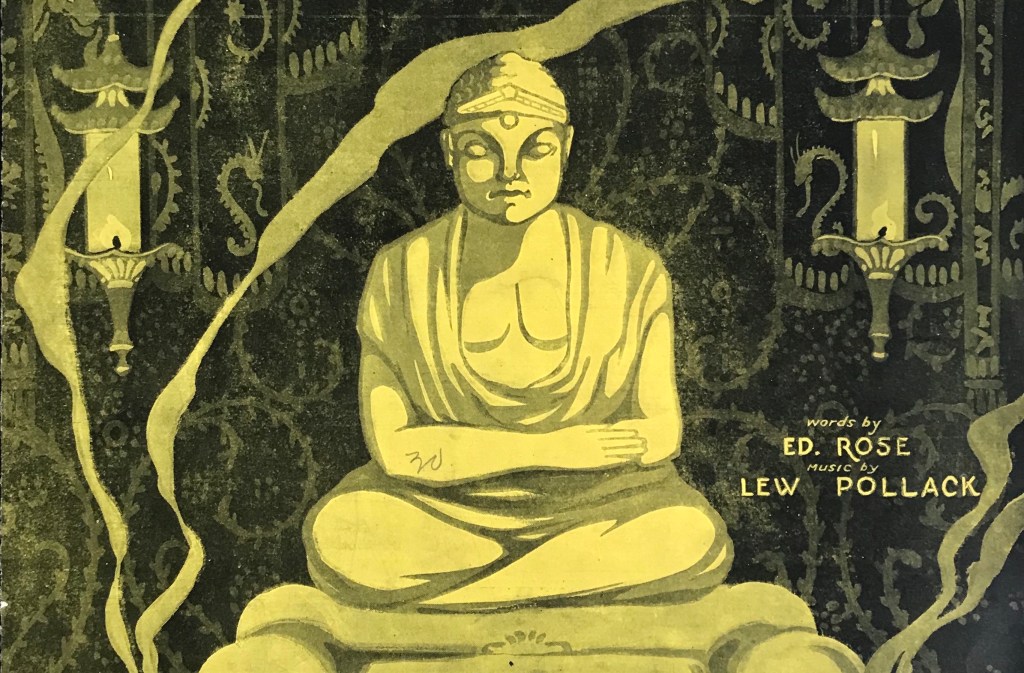
The “Buddha Foxtrot” by Pollack and Rose


Listen to the Victor Record’s 1920 recording of Pollack and Rose’s “Buddha” here: 


What is the sound of the “Orient”? As Edward Said has shown, the “Orient” is more of an imaginary idea than a physical location. Because of this, several musical tropes have emerged in American consciousness that create an “Oriental atmosphere,” perhaps none more famous than the nine-note “Oriental riff” (da-da-da-da dah-dah, dah-dah daah). This simple tune became widely popular in the 1910s and was utilized, for example, in numerous racially stereotyped cartoons of the 1930’s through the 1950’s[1].

It should be remembered, however, that before the widespread popularity of the phonograph, music still had to be played live to be heard. The publishing and selling of sheet music for home use was still widely practiced in the early twentieth century and because the American working class still clamored for the exotic Orient, musicians continued to compose “yellowvoice” Orientalist music.[2]

Early in his career, the composer and Vaudeville accompanist, Lew Pollack (1895-1946), started to experiment with Orientalist musical tropes, including a prototype of the Oriental riff. In 1918, he composed a piece entitled “Buddha” for an act performed by the singing and dancing “Mellette Sisters,” Helen and Rosalie (he would go on to marry Helen in 1921).[3] Lyrics were added to the musical composition by Ed Rose (1875-1935) and the work was published in 1919 by McCarthy & Fisher, Inc. [Figure 1].

Figure 1
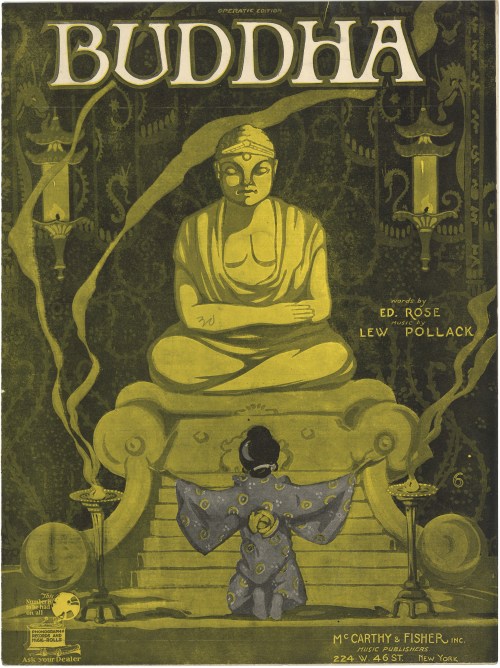
01 cover.jpg

  • Title: Buddha [Operatic Edition]
  • Date: 1920 (date on reverse)[4]

  • Cover Artist: Unknown
  • Composer: Lew Pollack (1895-1946)
  • Lyricist: Ed Rose (1875-1935)
  • Publisher: McCarthy & Fisher Inc. (NY)

Given the title of the composition and the accompanying lyrics, it is not surprising to see that a Buddhist figure graced the cover of the sheet music. The cover depicts a scene of religious devotion, as a woman in traditional Japanese dress is positioned kneeling with her arms outstretched praying to the Buddhist image. A pair of incense burners beside the supplicant cast fragrant smoke trails into the air, while the background is festooned with decorative Asian motifs and ornamental lanterns. The overall golden hue of the scene is punctuated by the vibrant purple garment, focusing the viewer’s eye on the woman. The unknown artist employed these visual tropes to establish a setting of exoticism, femininity, and sensuousness – all established visual cues of the Orient.   

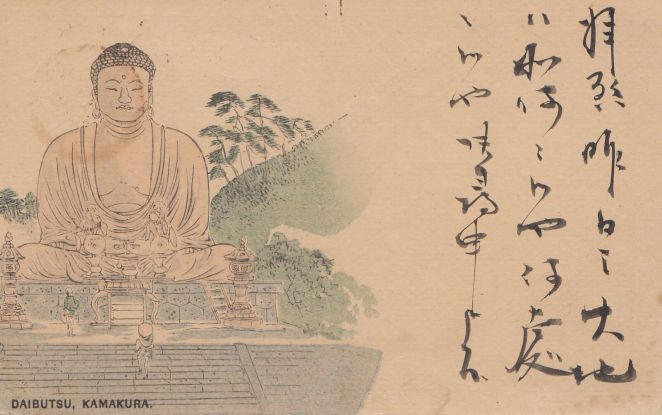
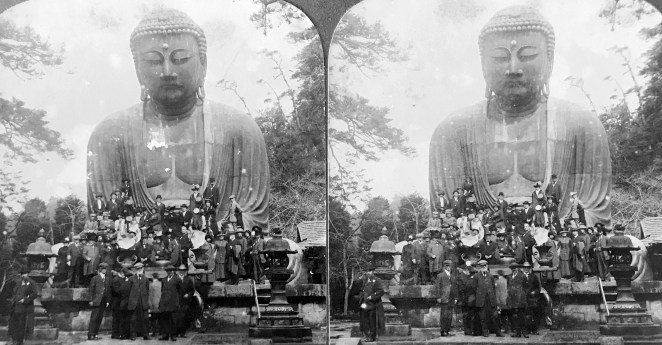
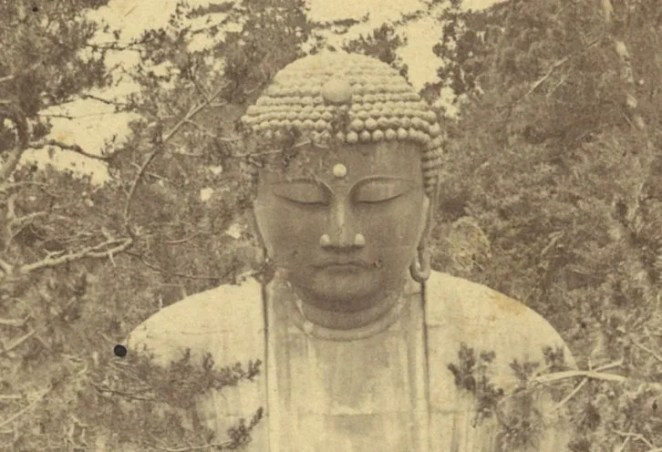
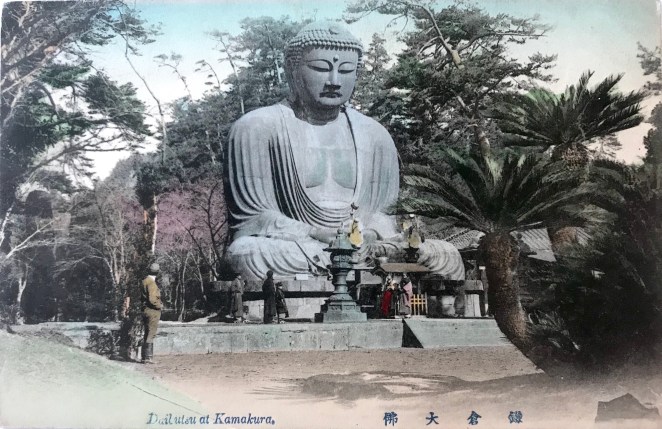
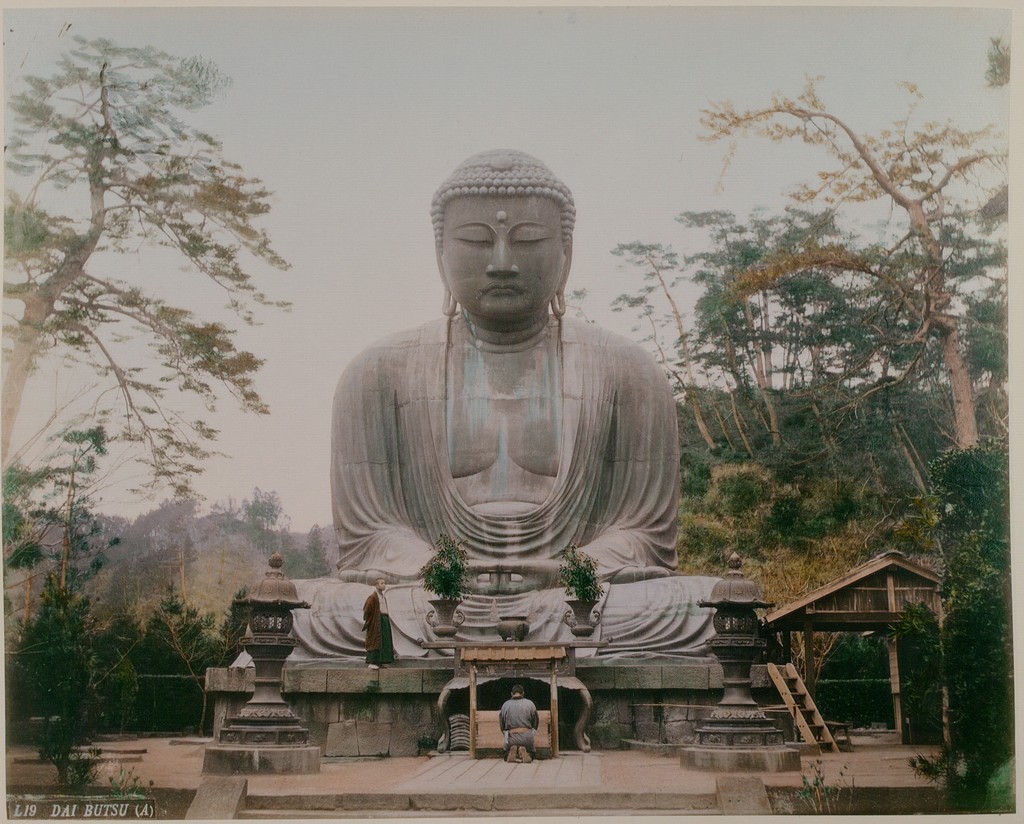
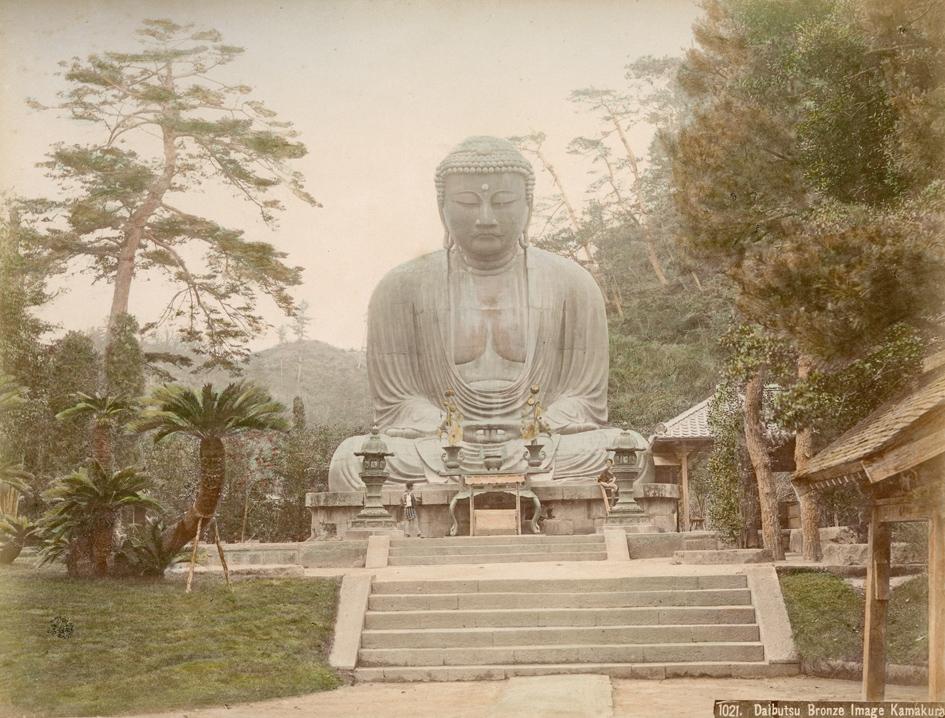
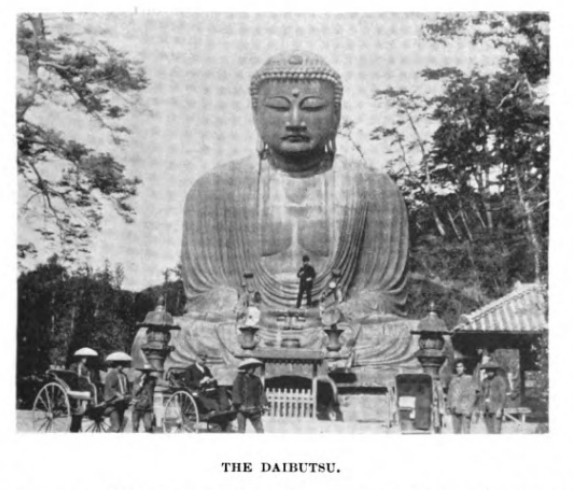
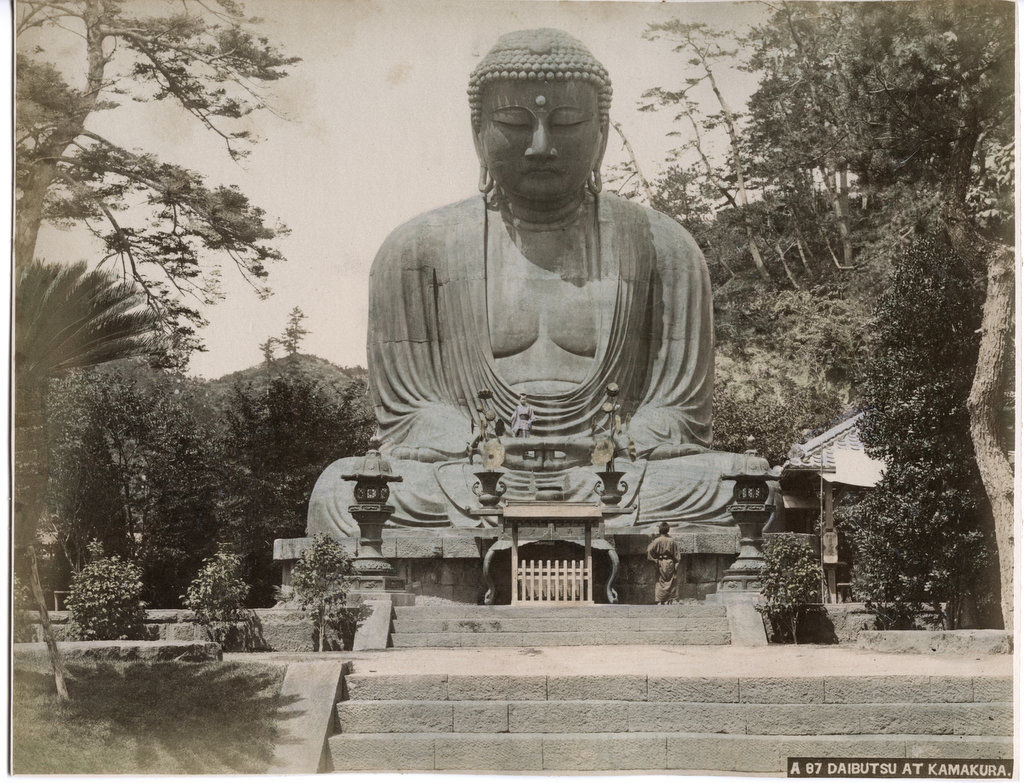
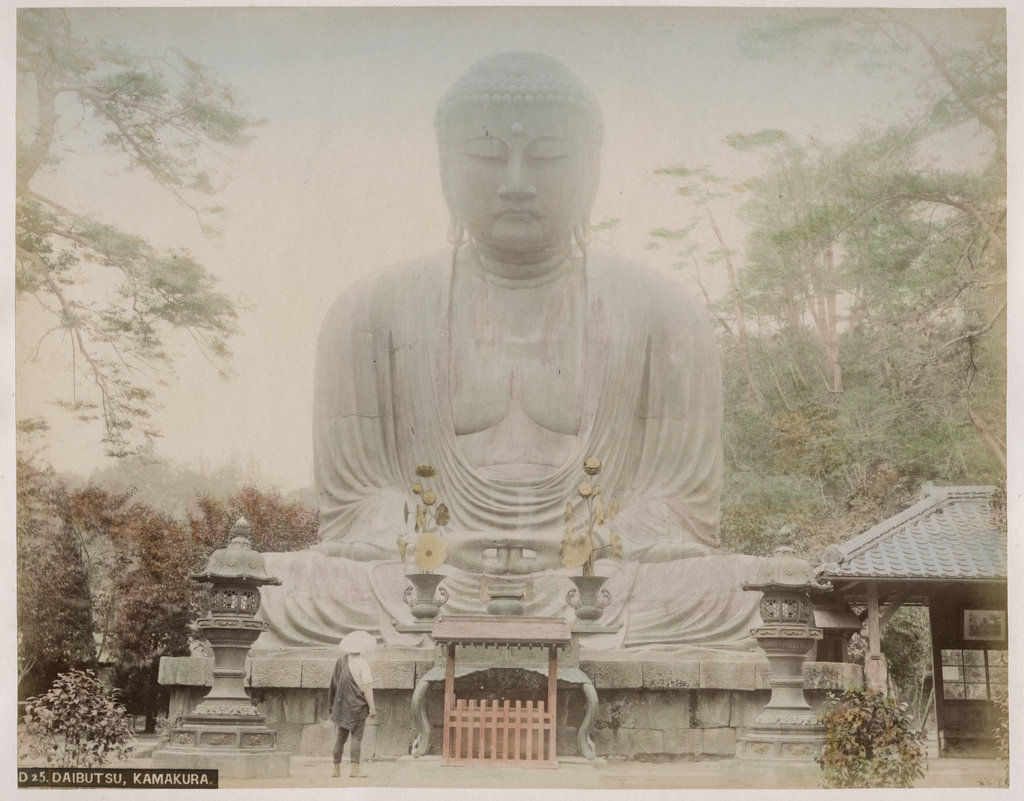
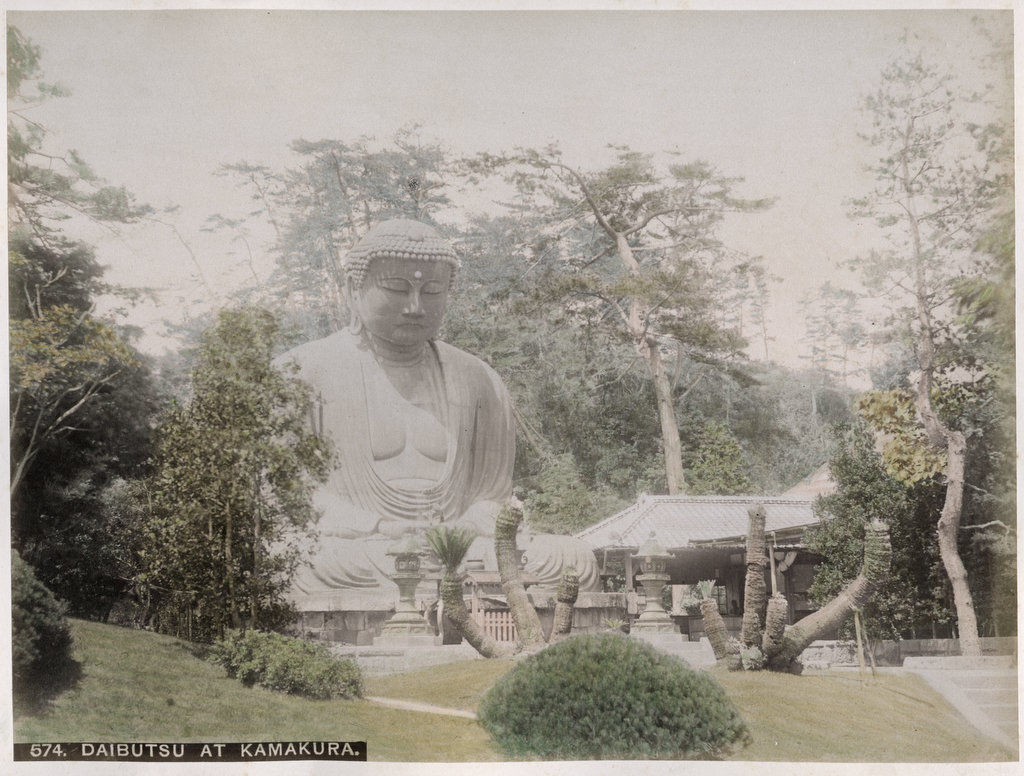
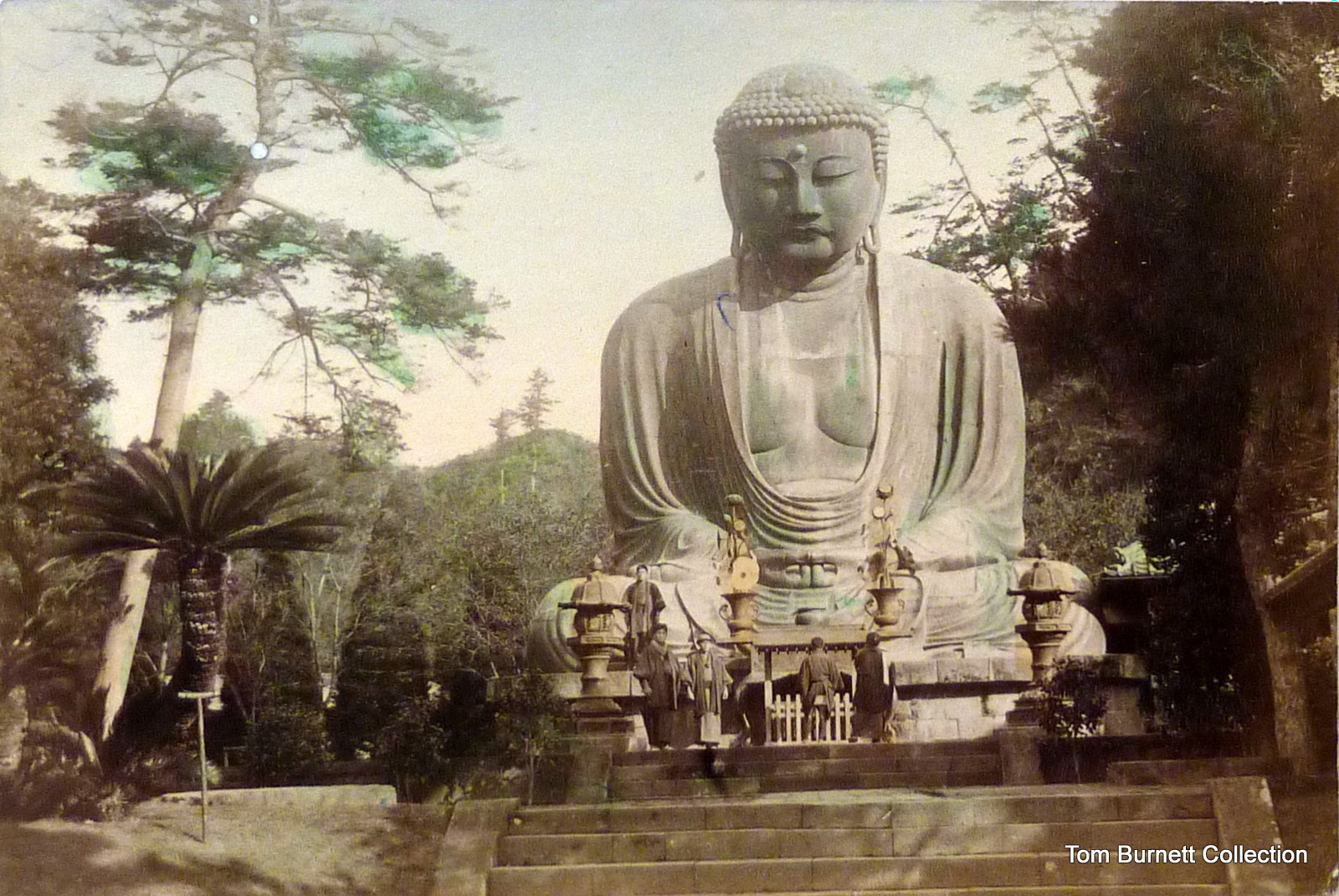
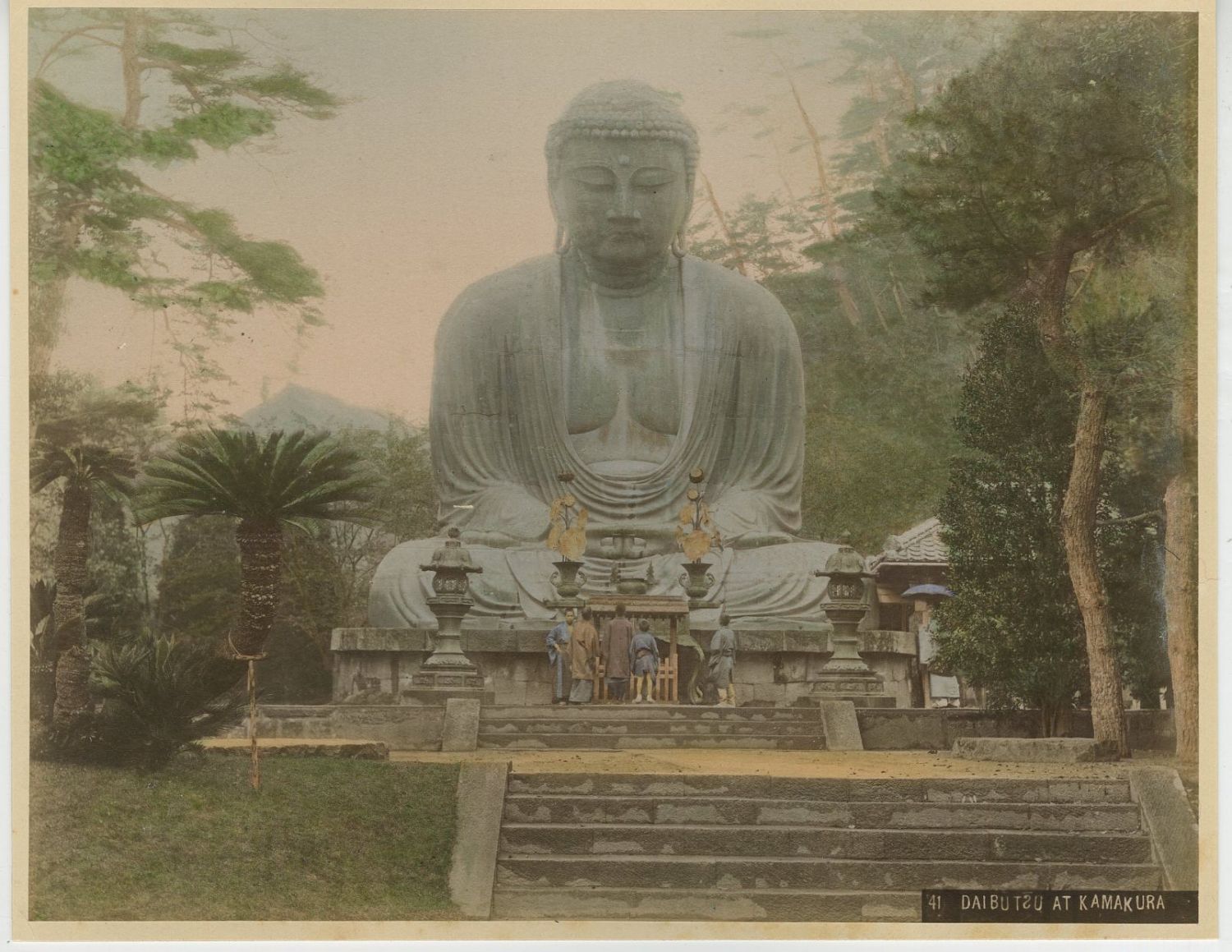
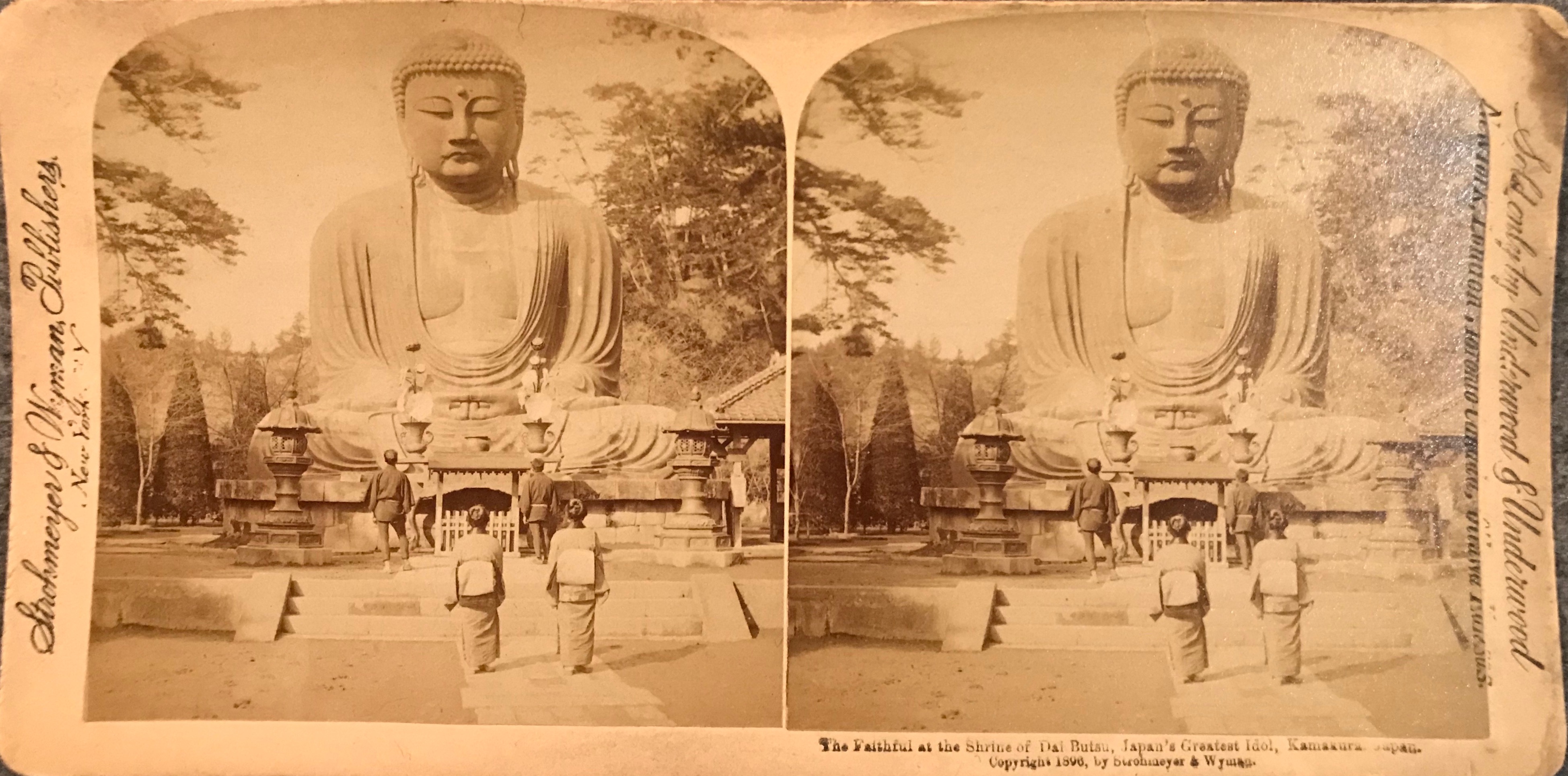
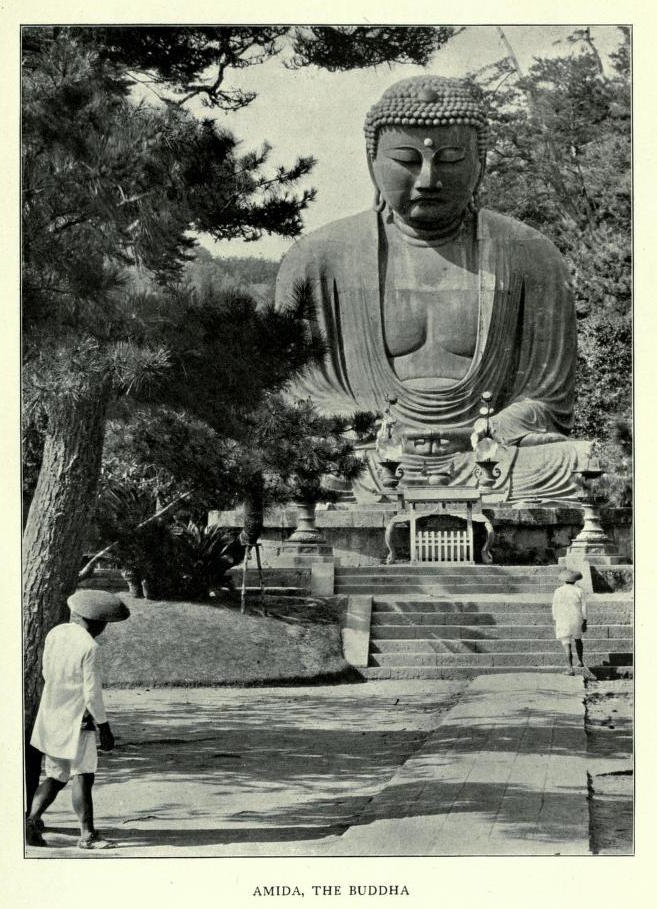
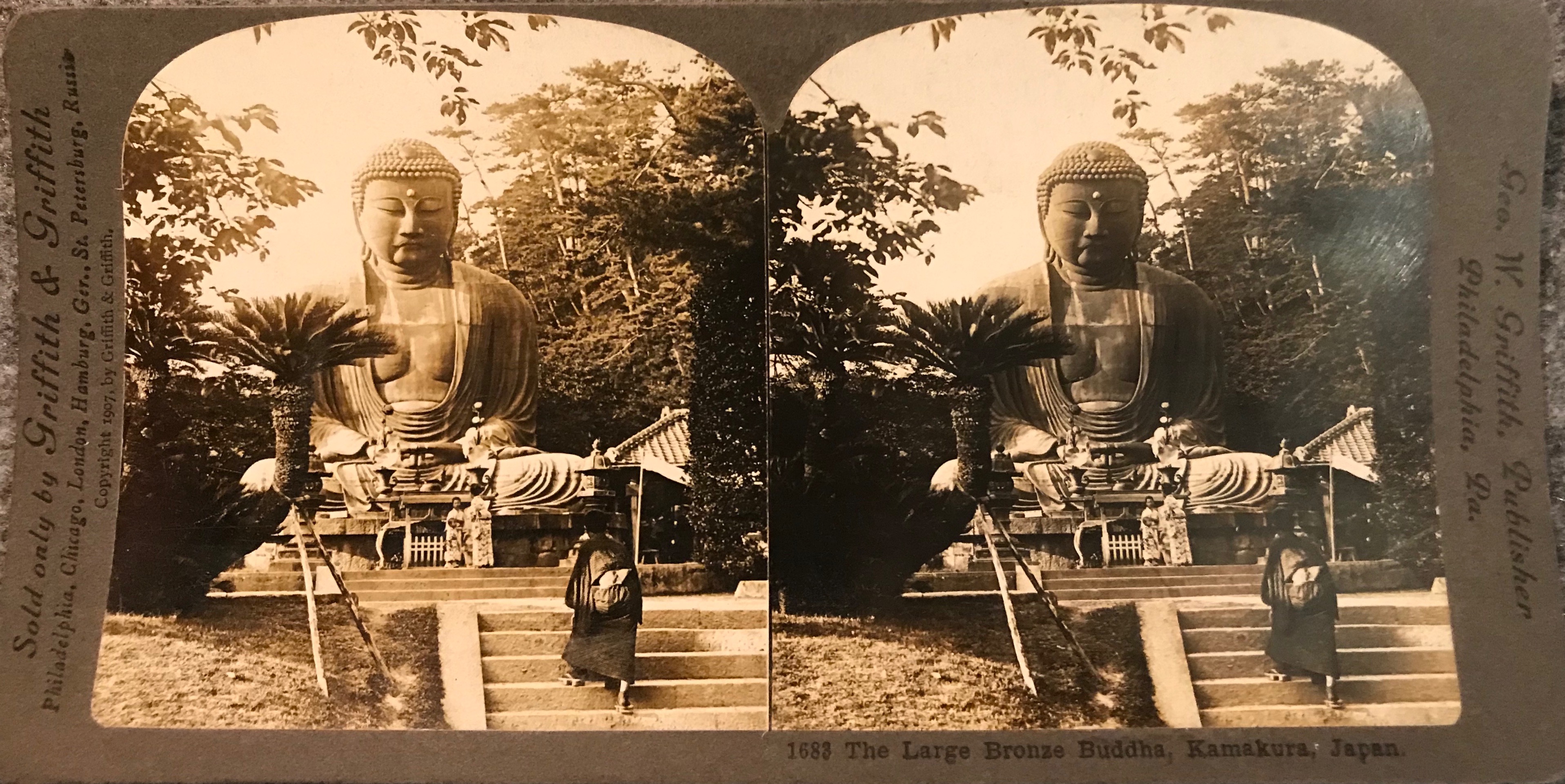
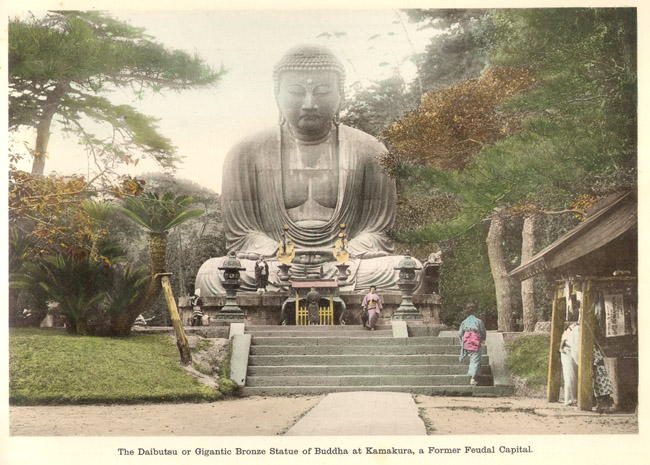
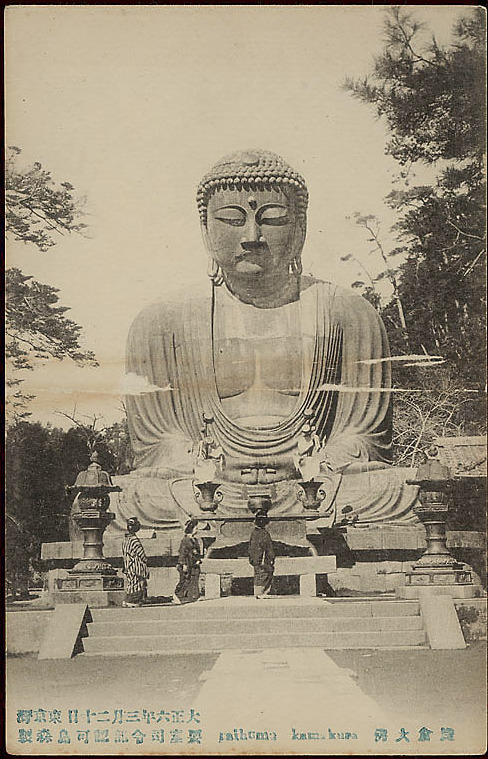
This illustration does not represent an authentic scene of Asian Buddhist worship, but the Western idea of Oriental religiosity. The Buddhist image only mimics traditional Asian art forms. The arms are folded atop one another, unlike the traditional joining of the hands in various meditative mudra positions, and the head appears to wear a crown or tiara, more like the vogue of early twentieth century American woman’s fashion than traditional Asian headwear. Even though the artist was not attempting to draw a particular Buddhist image, it is clear that the Kamakura Daibutsu was the iconic model. The overall style is definitively East Asian, but the open, draped robe exposing the chest and simple positioning of the arms in the lap closely mirror that of the Daibutsu. In addition, the frontward-facing, symmetrical composition would have echoed the numerous photographic images of the Kamakura colossus that had circulated for decades.  

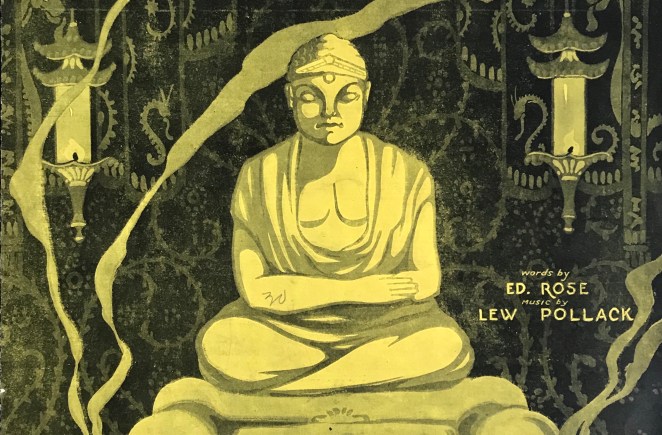
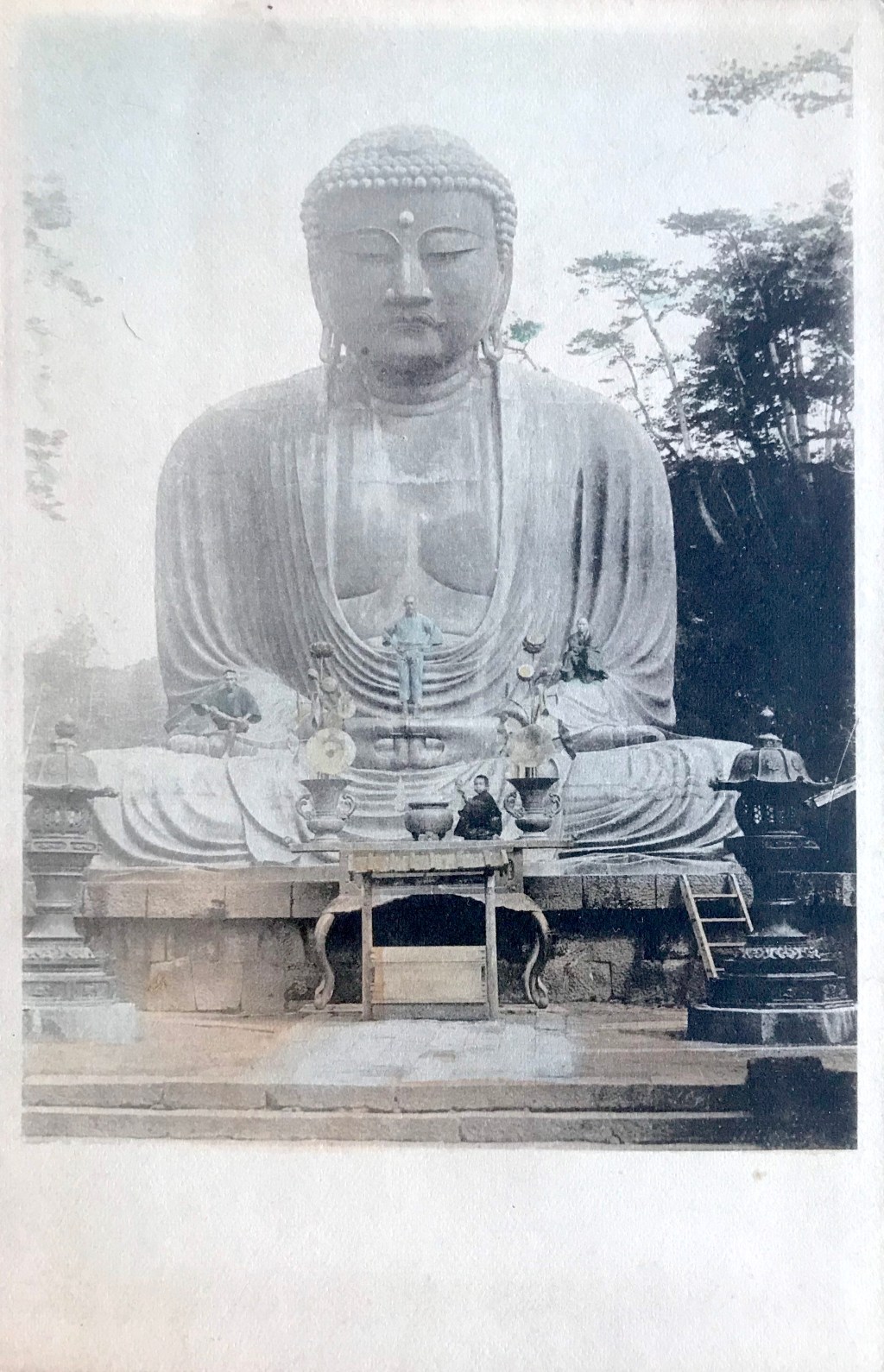
What is likely the original cover for this piece was illustrated by André De Takacs (1880-1919), an artist known for his strong graphic style [Figure 2]. It is possible that De Takacs copied this image of the Kamakura Daibutsu from figural domestic bottles sold in department stores in the United States. The scene on the cover is spartan, but the whisps of smoke from the small fires suggest religious practice and the burning of incense. By examining the details of the image, it seems as if the unknown artist of the variant cover modified the origianal illustration of De Takacs, who died suddently in 1919. 

07cover28detackas29

Figure 2

  • Title: Buddha Fox Trot
  • Date: 1919 (date on reverse)
  • Cover Artist: André De Takacs (1880-1919)

  • Composer: Lew Pollack (1895-1946)
  • Lyricist: Ed Rose (1875-1935)
  • Publisher: McCarthy & Fisher Inc. (NY)

The small yellow phonograph icon on the lower left is inscribed with the words, “This Number is to be had on all Phonographic Records and Music Rolls. Ask your Dealer.” “Buddha” was recorded and published by several record companies, including the Lyraphone Company of America (as played by the Jazzarimba Orchestra; catalogue number 4204), Aeolian Company (Aeolian Dance Orchestra, 12166), Pathé Frères Phonograph Company (The Tuxedo Syncopaters, 22209; Peerless Quartet, 22334), Columbia Graphophone Company (Columbia Saxophone Sextette, A2876), and Victor Records (Sterling Trio and Peerless Quartet, 18653)[Figure 3].

Figure 3
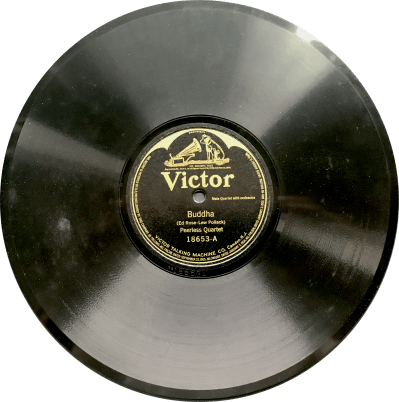
MBVR.png

  • Title: Buddha
  • Date: 1920
  • Vocals: Peerless Quartet (Frank Croxton , John H. Meyer, Albert Campbell , Henry Burr)
  • Composer: Lew Pollack (1895-1946)
  • Lyricist: Ed Rose (1875-1935)
  • Publisher: Victor Talking Machine Company

  • Catalogue Number: 18653-A

The full musical score and lyrics of “Buddha” can be found here. The song opens with these lyrics: “In an oriental clime, seated on a mystic shrine, Buddha dwells, and dispels hate.” The lyrics of Ed Rose do not identity Japan or Kamakura as the setting for this song, but a more mystical “Oriental” location. The rest of the song sadly describes a woman who prays to the Buddha, pleading for her lover to return to her. This is not a novel melodic narrative. It clearly refelcts a story made famous by Giacomo Puccini’s opera Madame Buttefly, first performed in America in 1906. Even though neither of these musical pieces directly refers to the Kamakura Daibutsu, by the early twentieth century, the Kamakura colossus was the icon of the imaginary Orient for American audiences, thus the choice of cover illustration remains fitting.


Notes:

*This is part of a series of posts devoted to exploring the development of a visual literacy for Buddhist imagery in America. All items (except otherwise noted) are part of my personal collection of Buddhist-themed ephemera.

[1] This rhythmic device is discussed in Lancefield 2004: 730-35. The most popular recent use of this riff (in what might be its most iconic form) is found in Carl Douglas’ 1974 hit, Kung Fu Fighting.

[2] As coined by Robert Lancefield, “yellowvoice” refers to the ways in which Orientality was evoked through sound and music, see especially Lancefield 2004: 599-768. A rather exhaustive list of popular American songs with Chinese subjects or themes is found in Appendix A of Moon 2005.

[3] See the Vaudeville program information noted in Lancefield 2004: 604n.13. Pollack would compose another Asian themed piece, “Oh Sing-a-Loo, Whad’Ya Do with Your Que?” (1922).

[4] The song on the back cover is “Daddy, You’ve Been a Mother to Me” by Fred Fisher, with copyright date of 1920. Other prints have “While Others are Building Castles in the Air,” also by Fred Fisher, but copyrighted in 1919.

References:

  • Lancefield, Robert Charles. 2004. “Hearing Orientality in (White) America, 1900-1930.” Ph.D. dissertation, Wesleyan Universoty.  
  • Franceschina, John. 2017. Incidental and Dance Music in the American Theatre from 1786 to 1923 [Volume 3]. Albany: BearManor Media.
  • Moon, Krystyn. 2005. Yellowface: Creating the Chinese in American Popular Music and Performance, 1850’s – 1920’s. New Brunswick: Rutgers University Press.
  • Selth, Andrew. 2016. Burma, Kipling and Western Music: The Riff from Mandalay. London: Routledge.

Additional Posts in Visual Literacy of Buddhism Series

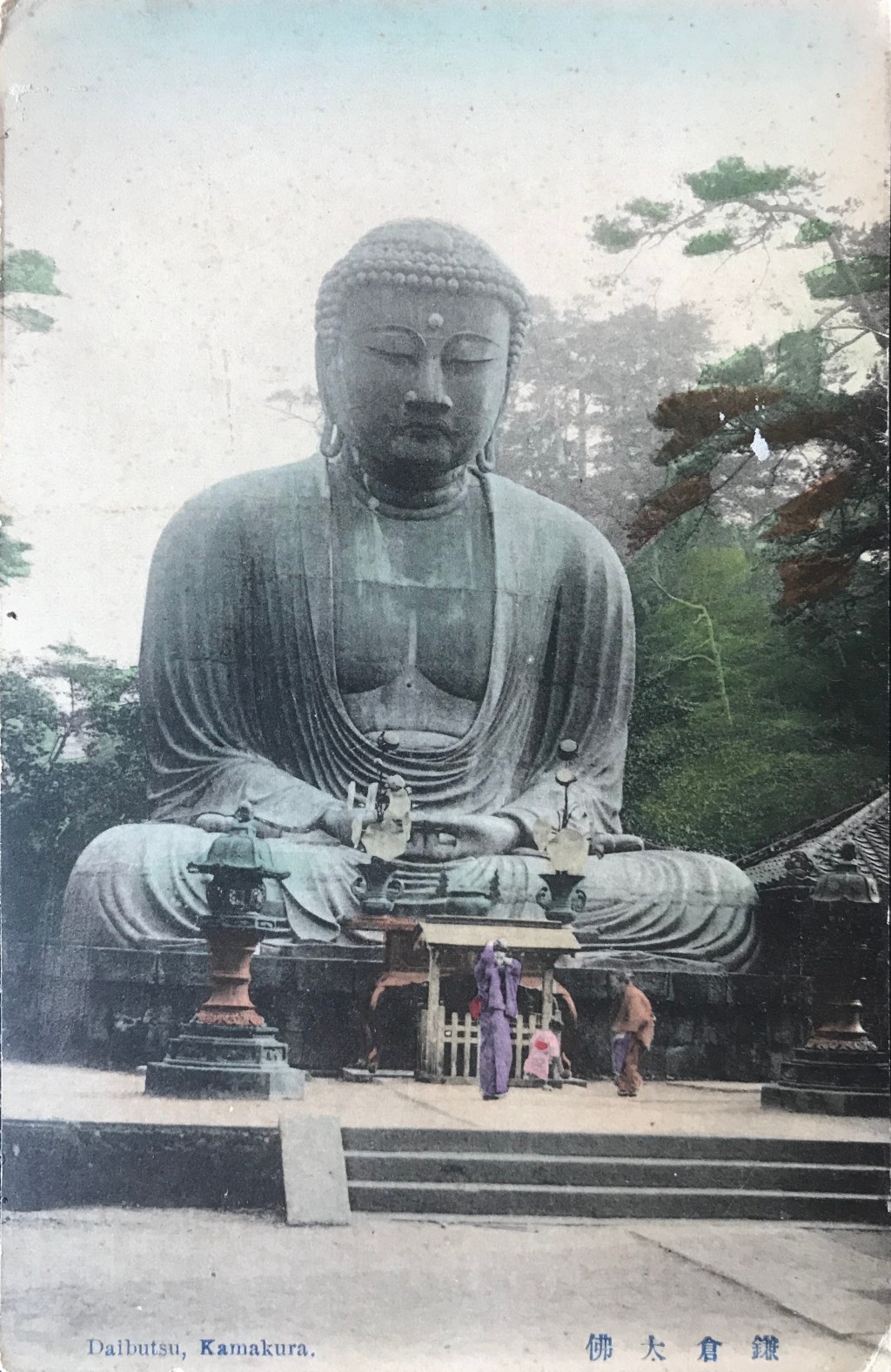
Ueda’s Unfussy Daibutsu Postcard

pckd006u(o)

Figure 1pckd006u(r)

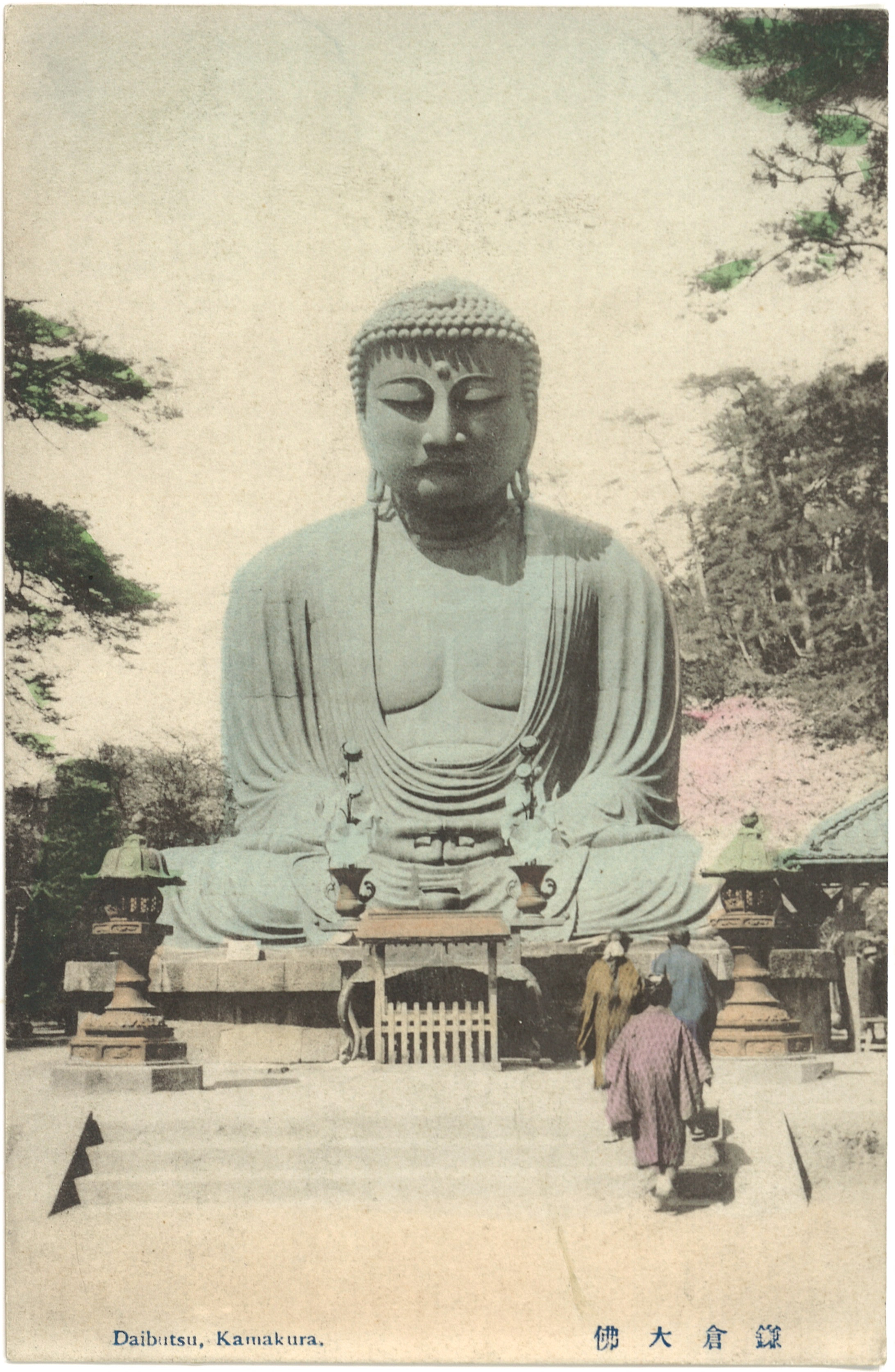
  • Title/Caption: Daibutsu, Kamakura. 佛大倉鎌
  • Year: c. 1907 [postally unused]
  • Publisher: Ueda Photographic Prints Corp. 上田写真版合資会社
  • Medium: collotype print on cardstock, hand tinted
  • Dimensions: 5.5 in X 3.5 in
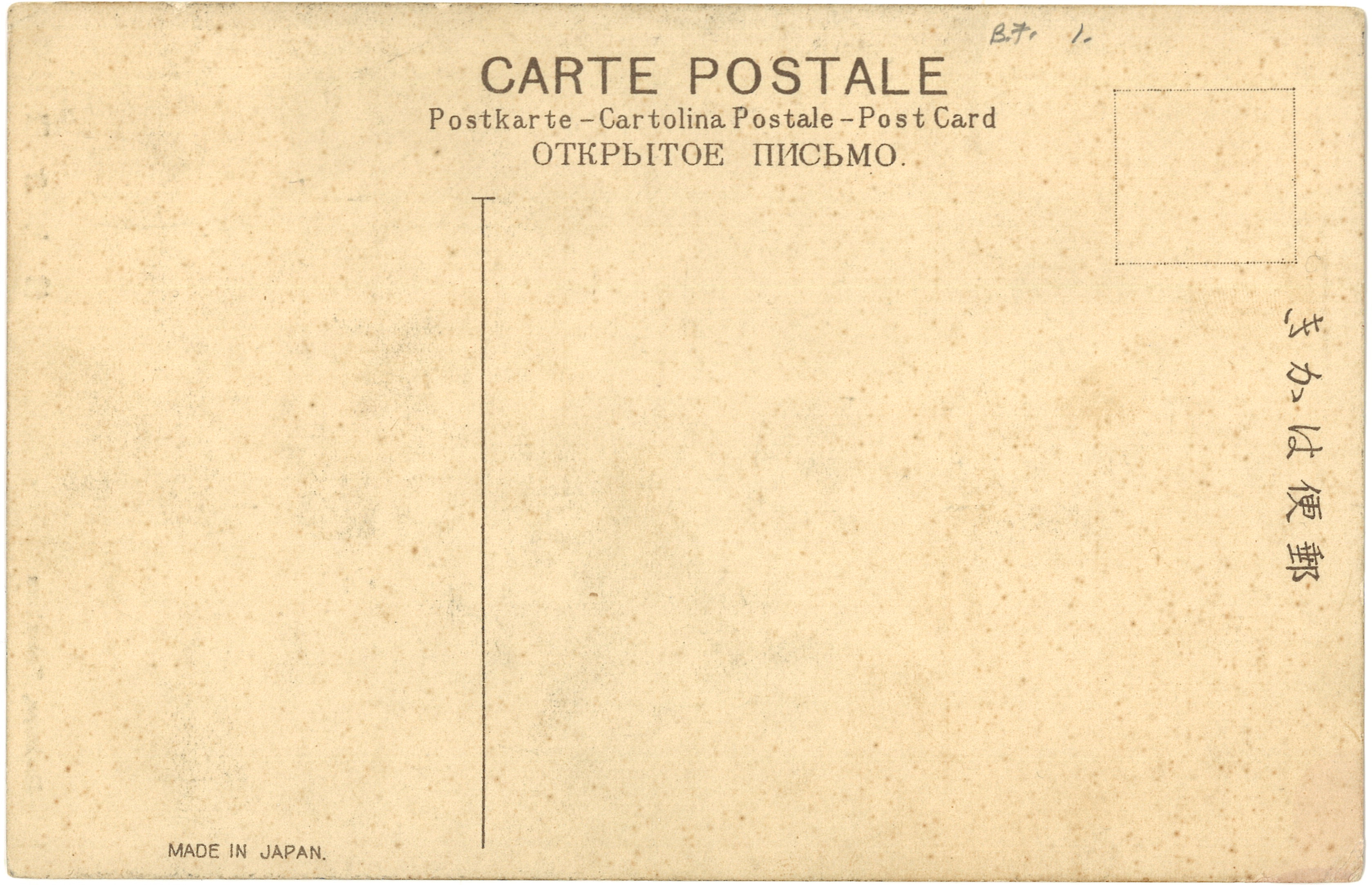
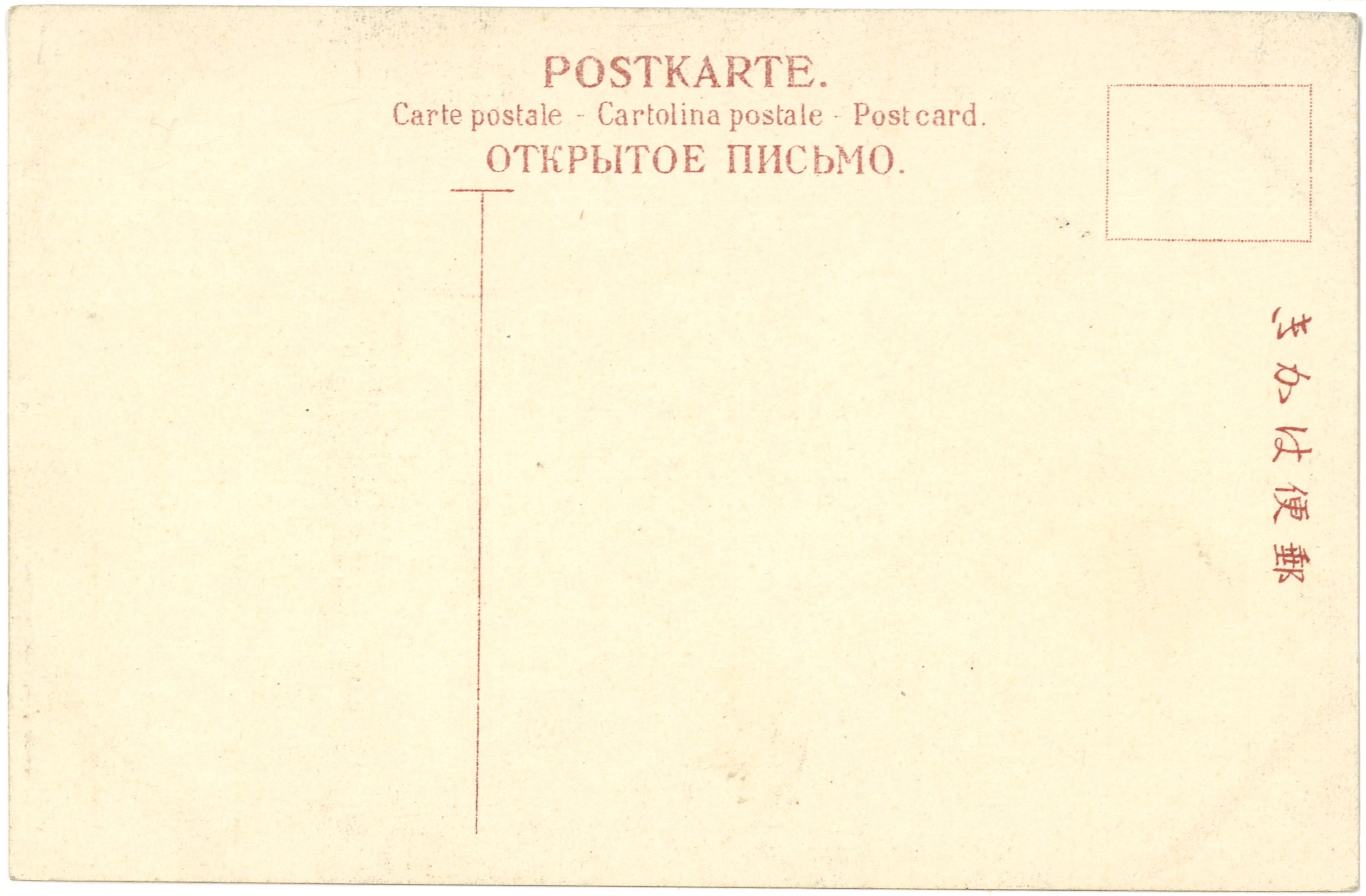
  • Reverse Imprint: Carte Postale [Type 2], Made in Japan, 郵便はかき

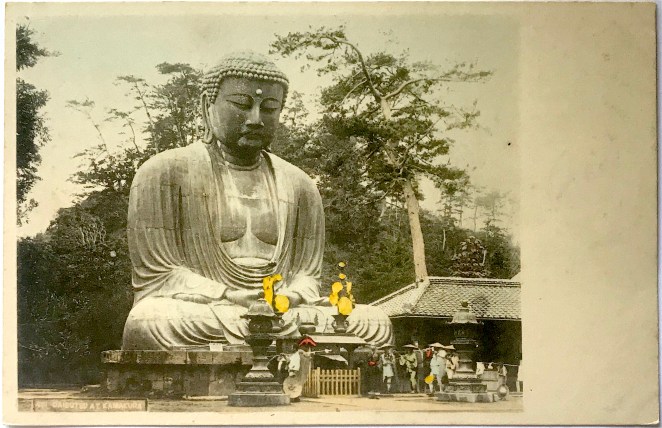
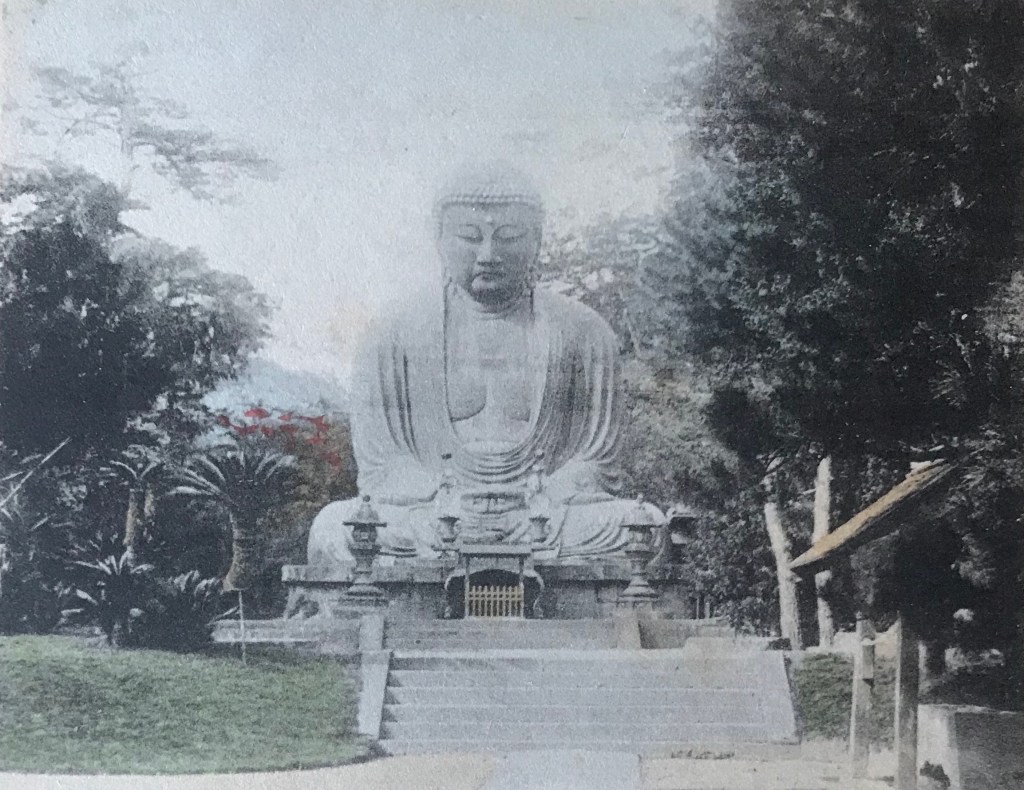
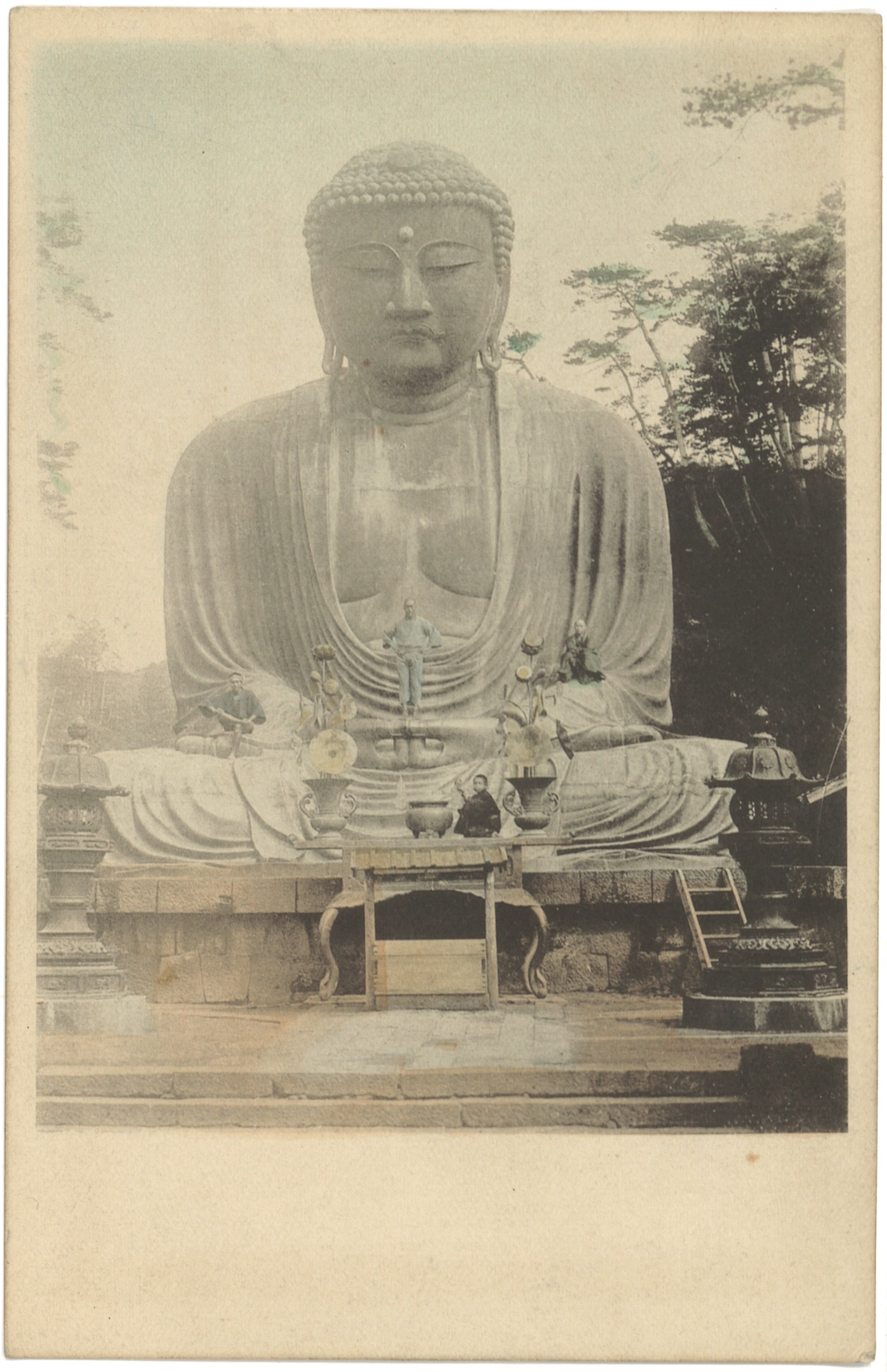
The unknown photographer of this image set the camera slightly off-center, positioning it just to the left of the shoulder of the three-step stairway leading to the first landing. From this position the Daibutsu does not peer directly at the viewer, but slightly off to the side, creating a more restful, nonconfrontational composition. The Japanese visitors add to this genial environment, casually positioning their bodies in front of the Buddhist statue [Figure 2]. It appears as if one woman is fixing her hair as she casually looks back towards the camera. Another, older woman, appears to look dotingly upon a child who is plafully placing a foot on the fence around the coin box. Unlike other staged photographs where Japanese supplicants are made to kneel in prostration in front of the Daibutsu, this presents a mundane scene. All of  these elements combine to create a spontaneous and unfussy mise en scène, a seeming “snap shot” of the daily affairs on temple grounds.

Figure 2

PCKD006u(o) visitors.jpg

The hand coloring is fairly typical of postcards of the period, with the Japanese garments painted in vibrant colors. We do not see pink cherry blossoms painted behind the Daibutsu, thus directing our attention to the brightly clothed visitors in the foreground. The reverse of the card does not indicate the publisher, but the design corresponds to the Type 2 back of Ueda publishing, dating this card between 1907-1918. The reverse is slightly unusual since the “Made in Japan” mark is on the lower edge of the card and not in the dividing line splitting the correspondence and address sections. Another small detail suggesting Ueda as the publishers is the coloring of the child clothing (pink with a red dot) as we find on other Ueda cards. In bold, cerulean letterpress (not the slight embossing on the back of the card from the lettering), the caption simply states the object and location, in English and Japanese – Daibutsu, Kamakura.


*This is part of a series of posts devoted to exploring the development of a visual literacy for Buddhist imagery in America. All items (except otherwise noted) are part of my personal collection of Buddhist-themed ephemera.

Additional Posts in Visual Literacy of Buddhism Series
Working Notes on Identifying Ueda Postcards, 1907-1918

Peter Romaskiewicz [Last Update: June 2024]

Introduction: Identifying publishers for early twentieth-century Japanese postcards can be daunting. Publishers oftentimes omit their name or trademark – or in the case of some postally used cards, the trademark is printed in the stamp box, under the stamp.

I have stumbled upon two methods for tentatively identifying publishers of unknown cards. One method is to trace the image on the obverse (tsūshin-men 通信面, “communication side”) of the unknown card to a different printed postcard with shared image where the publisher is clearly indicated. This process is not fool-proof, however. Some images seem to have become the common property of several publishing houses, especially when considering older photographic stock commonly seen on the “undivided period” of cards (early Japanese laws only provided five to ten years of copyright protection, see Bennett 2006a: 123, Bennett 2006b: 308). Moreover, it is possible that the rights to certain photographs were sold between publishing house – or outright pirated – thus making definitive identification difficult.

The second method is to identify the distinctive printing designs on the reverse (atena-men 宛名面, “address side”) of an unknown postcard and determining any plausible relationships between variant cards where the publisher is identified (e.g. matching general design, fonts, printing colors, etc.).

Using a combination of these two methods I propose the following identification for Ueda Photographic Prints Corporation 上田写真版合資会社 (historically Romanized as “Uyeda”) postcards printed between 1907 and 1918 (corresponding to Period II of Urakawa Kazuya’s 浦川和也 chronology). For a brief history of the company see here.

I identify five variant “types” that appear to follow a general chronological sequence, arranged into two “phases.” Much more work needs to be done to determine if an earlier type or phase ends with the introduction of a new type or phase, or if they were printed concurrently. The basic principle follows that the final type in the second phase (see below), Ueda incorporated its crest/trademark [a stylized “Ueda” 上田, see Figure 1] atop the dividing line on the reverse of the card. Thus, if any connection can be established to older variants without the publisher’s mark, they too would possibly (or even likely) be Ueda products.

Figure 1: The Ueda Photographic Prints Corp. trademark/crest.

Visual Literacy of Buddhism P.Romaskiewicz

Again, I have accomplished this by matching cards with the same obverse image but different reverse designs (as seen here) and complemented this procedure by looking for overarching similarities among different exemplars in the printing and design on the reverse. The design of the reverse is the most distinctive aspect of mass-produced postcards, and identifying the font, ink color, or overall design may help in determining publishers (see a Hoshinoya exemplar here). For Udea, the multilingual printing on the reverse in umber brown (or burgundy) ink appears as one of its most easily identifiable hallmarks. An outline of the progressive changes (Type 1 to Type 5) for Udea’s reverse printing is found below.

Relative Chronology of Ueda Cerulean-Umber Design from 1907–1918 (Urakawa Period II)

Visual Literacy of Buddhism P.Romaskiewicz

Urakawa Period II – Phase I (German or French header)

  • Type 1 (top card above): divided back; topped with German “Postkarte” header [TPQ 1907]
  • Type 2 (second card from top): divided back; topped with French “Carte Postale” header and imprinted with “Made in Japan” in dividing line (or sometimes in the bottom left corner)[TPQ 1907] (Update: I have found images that have also matched to later Tonboya backs, this identification needs more consideration.)
  • Notes: As of June 2024, I possess a Type 1 “German” header on an undivided back card (Urakawa Period I, pre-1907) with the old Udea company name printed along the side edge in Japanes. The header is printed in burgundy. I have yet to locate a Period II/Type 1 card with Ueda’s name, but believe there are grounds to make the association between the Period I and Period II/Type 1 cards. Type 2 cards switched from German to French headers. I have yet to find a Period II/Type 2 specimen on an undivided back, but the same sans-serif “Carte Postale” type (omitting the other languages) is found on undivided cards. Some sources claim that foreign language designations (i.e. non-Japanese) only appeared in 1905, but I have found that to be inaccurate. [There are two more types of Urakawa Period II cards not published here, I am still gathering more information.]

Urakawa Period II – Phase 2 (French-German-English header)

  • Type 3 (middle card): divided back; topped with French-German-English header and imprinted with “Made in Japan” in dividing ling, capped by single bar [appears c.1910]
  • Type 4 (second card from bottom): same as Type 3, but with a double bar capping the dividing line; possibly coincidental, this resembles the trademark for the Japanese Post Office (〒) [appears c.1910]
  • Type 5 (bottom card): same as Type 3, but with Udea crest capping the dividing line [appears c.1912]
  • Notes: These types all also contain the following ten languages in order: Italian, Estonian, Czech, Polish, Dutch, Austrian, Spanish, Sweedish, Norwegian, and Russian. Type 4 variants exist with “Made in Japan” imprinted on the short edge of the card.
    • As of June 2024, I now posses a Period II/Type 4 card with “Printed by Uyeda, Yokohama” on the side edge (Caption on the obverse: “Ogosho, Kyoto”). When considering the fact that I have not yet found Period II/Type 3 or Period II/Type 4 cards with a different publisher’s name strongly suggests there is firm grounding to assume Period II/Type 3 and Period II/Type 4 cards are the products of the Udea publishing house.

Color Variations on the Reverse of Ueda Postcards from 1907-1918 (Urakawa Period II)

The color of the ink on the Ueda reverse can vary between a burgundy red, light or dark orange, and cinnamon or umber brown (see below). It is difficult to determine if these distinctive hue variations were intended or are due to printing irregularities, light fading, or general aging. Regardless, these ink colors stand out in comparison to the blues and black used by several other contemporary publishers (Tonboya and Hishinoya specifically). Because a large portion of Ueda cards are brown or dark brown, I use the term “umber” as an umbrella term to include the variant warm color inks.

Visual Literacy of Buddhism P.Romaskiewicz

Color Variations on the Obverse of Ueda Postcards from 1907-1918 (Urakawa Period II)

Turning to the front of the card, captioning was a fairly common practice among many postcards publishers and is not a viable way, in isolation, to identify Ueda prints. In addition, not all Udea postcards are captioned, especially more generic images, such as those of geisha. Nevertheless, an immense amount of Ueda cards are captioned bilingually in English and Japanese in a cerulean or cobalt blue ink. Sometimes a caption is printed in another color, such as brown, but this is rare and most are printed in a light to dark cerulean blue (see below). After 1917, however, Ueda revamps its design and more captions are printed in scarlet red. This is just another factor to consider when assessing the origins of a postcard. Irregularly, some captions are printed with an index number on the lower left, but this was far more common among the Tonboya publishing house.

Visual Literacy of Buddhism P.Romaskiewicz

After 1918…

When shifting to Period III of Urakawa‘s chronology, the postal regulations move the dividing line to the middle of the postcard in 1918, and Ueda follow suit by shifting the crest-capped line to the center of the card. In this new period, I have seen this dividing line position with the Type 5 and Type 2 design, and have also seen a new design absent the multilingual translations.

Overall, I only offer this typology and chronology as a possible starting point for historical research, as more work remains to be done to develop a more robust history of Ueda postcard printing. Unsurprisingly, there is a lot more research on the Yokohama shashin 横浜写真 (“Yokohama photography”) industry which produced many of the oldest and most significant tourist photographs of Meiji Japan. Much more research will be necessary to identify the photographers of these inexpensive and mass-produced postcards.


Notes:

I have found at least two different Urakawa Period I Udea backs. One is Type 1 (as noted above). Another has a “Union Postale Universelle” header in serif font, with “Carte Postale” in serif font underneath.


Additional “Working Notes” Posts

Kōzaburō’s Undivided Back Postcard

Many early Japanese turn-of-the century postcards were colorful illustrations, cartoons, or woodblock prints, some of which were made by famed Japanese artists, but these traditional arts forms would soon lose favor to the photograph. One of the shifts that ushered in the visual dominance of photographic postcards was the introduction of private company postcards 私製はがき, which had been illegal to print until new postal regulations were introduced in 1900. In addition, the adoption of a new photomechanical printing technique, called the collotype, allowed for the wide availability of inexpensive photographic images of Japan.

Many early photographic postcards first circulated as albumen or silver gelatin prints sold by commercial photography studios. Early postcard publishers experimented with the orientation of the old images on the new format. By placing the image on the top half of a vertically oriented card, the bottom half could be reserved for the message [Figure 1]. Strategically designed areas or blank spots were necessary on the front of the card, because the reverse of the card was reserved solely for the name and address of the recipient until 1907. The regulations were determined by the Union postale universelle, the body which oversaw the postal system worldwide. These postcards, known today as “undivided back” cards, were replaced by “divided back” cards in 1907 in Japan, where the message could be included on the reverse of the card.

Figure 1

pckd002tk(o)
pckd002tk(r)

  • Title/Caption: NA
  • Year: 1900-1907
  • Photographer: Tamamura Kōzaburō 玉村康三郎 (1856-1923?)[?]
  • Medium: collotype print on cardstock, hand tinted
  • Dimensions: 5.5 in X 3.5 in
  • Inscription: Union Postale Universelle. CARTE POSTALE, 萬國郵便聯合端書

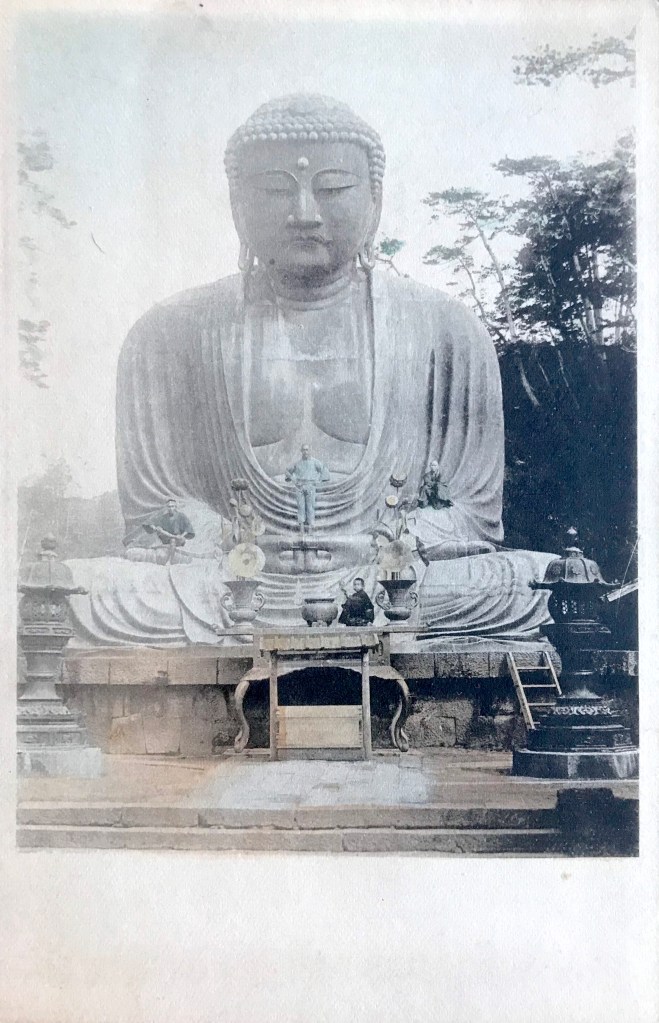
The image depicts a wide angle view of the Daibutsu taken from the third landing. The positioning of the camera shows the rustic, yet landscaped grounds surrounding the Daibutsu statue. Lacking the presence of people, this bucolic setting exhibits a more quiet moment of the famous tourist destination.  On the right, the supports and roof of the ablution pavilion stick out from under an evergreen tree. The water basin (chōzubachi 手水鉢) for washing hands is found underneath (dating from 1749).

The photographer of this image is debated. Older studio albumen prints of this image are imprinted with “661 Daibuthu [sic] at Kamakura.” This numbering is consistent with the studio catalogue of Tamamura Kōzaburō 玉村康三郎 (1856-1923?)(See Bennett 2006: 152), but other sources attribute this image to Ogawa Kazumasa 小川 一眞 (1860-1929). (A similar, but not exact, photo has been identified in an Ogawa studio album). This exemplifies the difficulty in determining the correct attribution and age of old Daibutsu photographs, and more research still needs to be done.

Moreover, because the publishers of the postcard did not imprint their name on the back, it is difficult to tell who printed this tourist souvenir. The reverse of this card is bordered by an ornamental filigree-like design in umber brown ink. This card is an example of an “undivided back,” since no line appears separating the sections on the back where the correspondence and address would later come to be written. This functions now as an easy identifier for dating old postcards, with this exemplar dating between 1900 and 1907. (The photograph was probably taken in the mid-to-late 1890s). In addition, a small scalloped square appears in the top right corner, indicating the location to affix the necessary postage.


*This is part of a series of posts devoted to exploring the development of a visual literacy for Buddhist imagery in America. All items (except otherwise noted) are part of my personal collection of Buddhist-themed ephemera.


Additional Posts in Visual Literacy of Buddhism Series
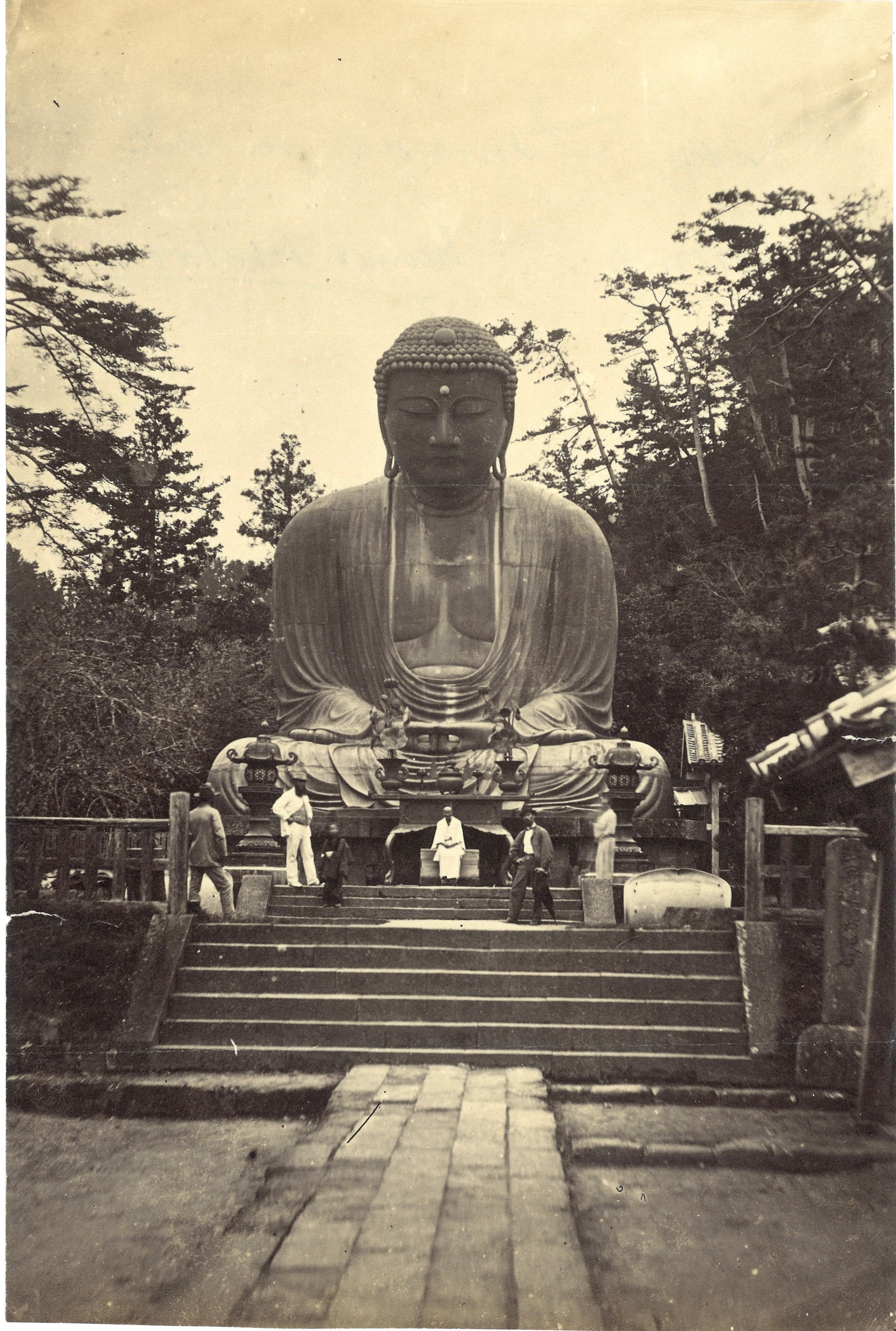
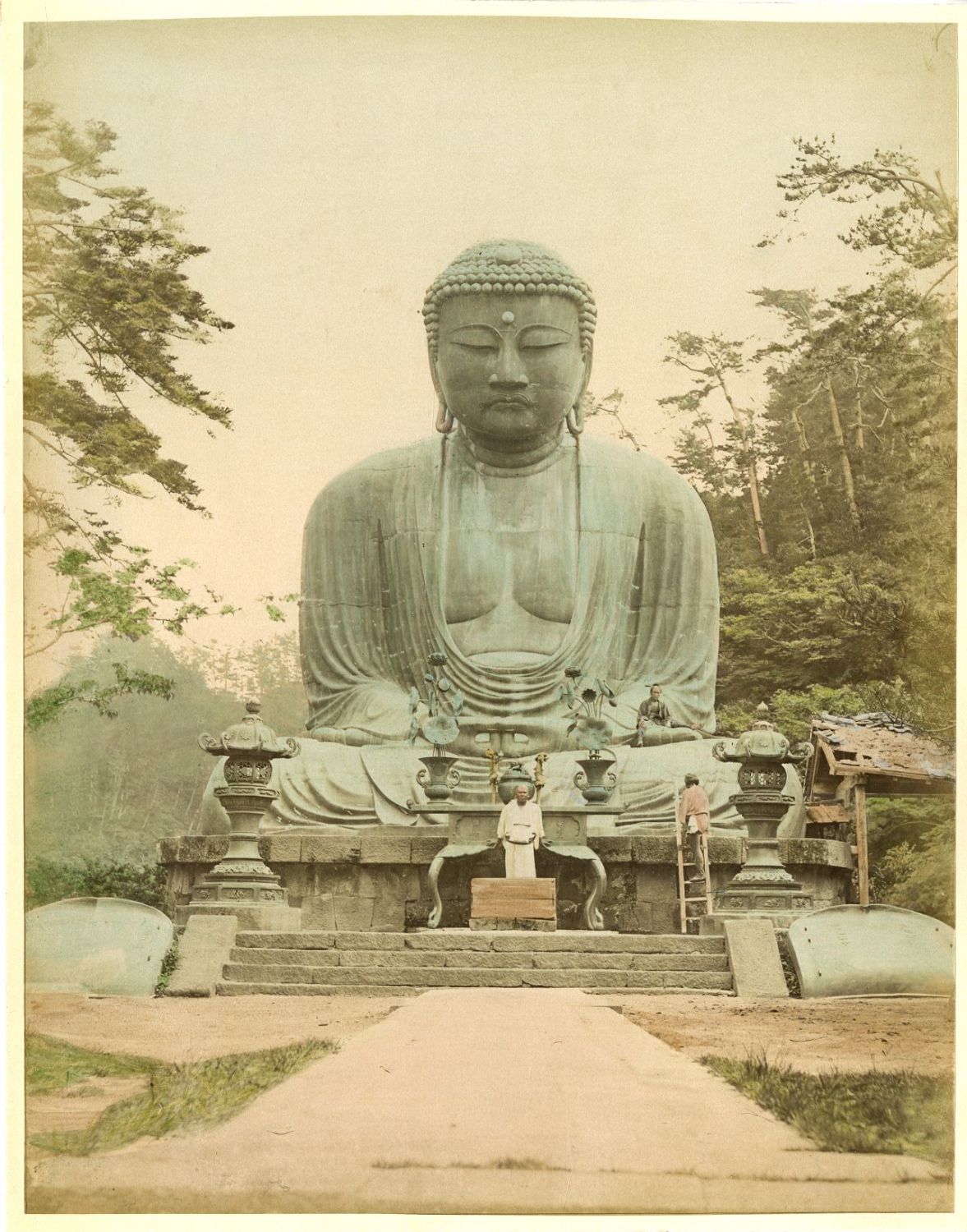
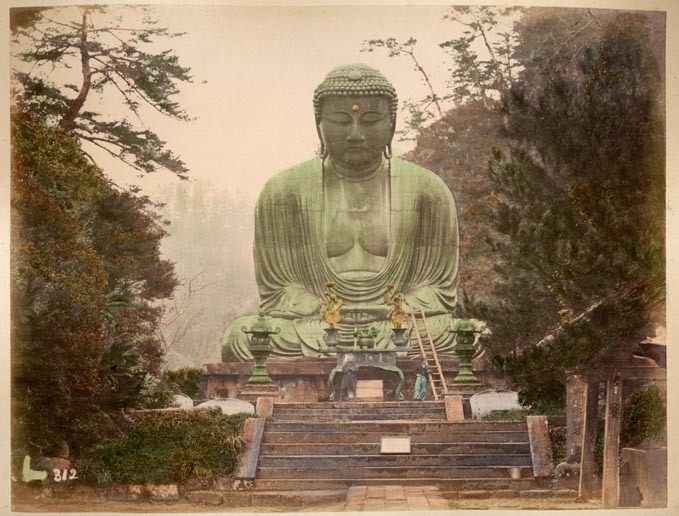
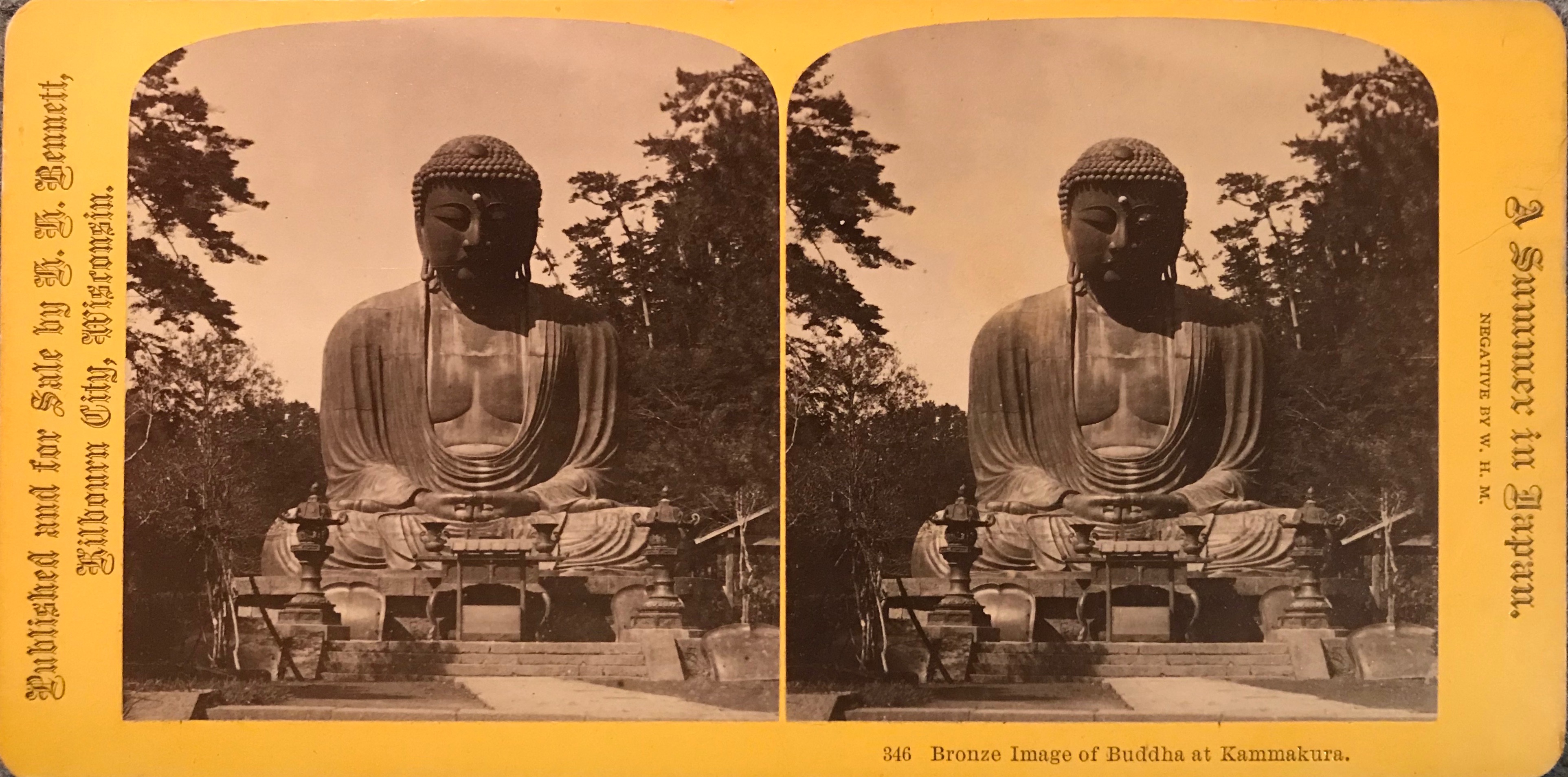
Working Notes on Dating Kamakura Daibutsu Photographs, 1860’s–1920’s

Peter Romaskiewicz [Last Update: June 2024]

Prelude: Within a decade after the Kamakura Daibutsu was “discovered” by non-Japanese foreigners in the 1860s, it emerged as a requisite tourist destination for globetrotters hoping to document their trips to exotic, picturesque locals. Photographic images taken by professional studios and amateur photographers soon started to circulate and by the first few decades of the twentieth century the imagery of the Kamakura Daibutsu began to exert a significant impact on American print media and other commodities.

Many thousands of photographs were taken of the Kamakura colossus between 1860 and 1930, but reliably dating many of these images remains a difficult task. It is my hope to provide a few suggestions on criteria which can be used to determine the relative age of old photographs of the Kamakura Daibutsu. I am primarily interested in determining the when the photographic negative was exposed, not when the photographic document was printed or published, both subsequent events that could happen at considerably later dates. An extraordinarily helpful resource has been the Metadata Database of Japanese Old Photographs In Bakmatsu-Meiji Period, hosted by the Nagasaki University Library. Several of the items below are part of my personal Archive.

Methods: Precisely dating the photographs of many professional Yokohama studios can be difficult. One method for determining the age of a photograph involves dating the album into which it was collated. Many title pages of old tourist albums did not include publication dates, thus other information – such as investigating the named partners of the firm or the address of the studio, among other details – need to be compared with known facts to best ascertain its age. Sometimes the owner of the album inscribed the book with a date, thus helping to determine an album’s possible age.

This method not without its own difficulties. New studios would buy (or pirate) the negative stock of older studios, and thus certain photos were reproduced for decades after they were first taken. Consequently, knowing the publication date of a photograph only provides us with a terminus ante quem, or the date before which the negative was necessarily exposed.

In addition, unless we are privy to the travel schedules of professional photographers in Japan (or Yokohama specifically), we may only know the period of a photo’s creation to within the span of several years. In some cases, the dating of amateur tourist photography, more common by the late 1880’s, can be more precise. For example, published travelogues or information gleaned by accounts written in newspapers can provide information regarding the season or even the month or day an intrepid photographer visited a site. I will utilize all of these methods to establish a framework of absolute dates, which will be interspersed with additional photos based on relative dating and sequencing. I can only hope this may assist in determining the creators of several studio albumen and silver-gelatin prints which now remain anonymous or contested.

Executive Summary: The easiest way to estimate the age for the negative exposure of a Kamakura Daibutsu photograph is to examine the coin donation box (saisenbako 賽銭箱) directly in front of the offering table. In the oldest photos, the donation box starts as an unadorned, mid-thigh height wooden box. A terminus post quem for the summer of 1877 can be established for the small gabled roof attached to the top of the box. In addition, a terminus post quem of November 1890 can be established for the picketed fence surrounding the box. In the early twentieth century, the arrangement of the lotus flowers on the offering table are the best means for estimating a date. Even more precise methods for estimating age are discussed below. The basic abbreviations are as follows:

  • TAQ: terminus ante quem [the negative was exposed before this date]
  • TPQ: terminus post quem [the negative was exposed after this date]

Contact: Please contact me (Peter) should you wish to offer any thoughts or insights, it will be much appreciated! Email: peter.romaskiewicz[at]gmail[dot]com.


Sequential Chronology: 01

Visual Literacy of Buddhism P.Romaskiewicz

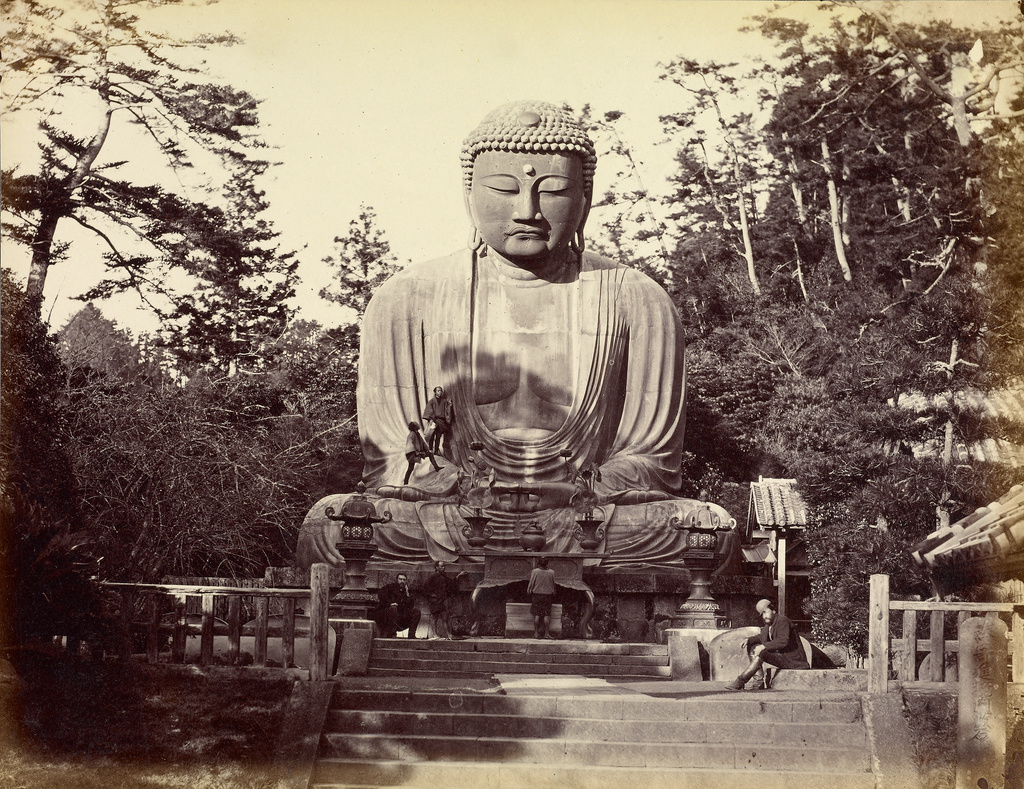
  • Date: c. late 1864/early January 1865 TAQ: January 1865
  • Information: Found in albums sold by Felice Beato (1832–1909) before his studio fire in 1866, this image is often dated to 1863 when Beato first arrived in Yokohama and toured with the Swiss diplomat Aimé Humbert. Some prints are alternatively dated to January 1865 and a full-page engraving of this photo was published in the Illustrated Times on October 28, 1865, establishing a firm terminus ante quem. Humbert’s account was first published in 1866 and included an engraving of this photograph. It has been suggested that Beato is the man sitting on the left (Bennett 1996: 140). [A similar framing, without people, can be found here and here, with the last inscribed with the date 1864.] As of June 2024, I believe this negative was exposed November/December 1864 or January 1865 at the latest.
  • Description: Large cast metal lotus petals sit as the base of the first landing which are partly obscured by a railing erected at the front end of the second landing. Fronds of a Japanese sago palm are visible at the left in front of the railing.

Sequential Chronology: 02

Visual Literacy of Buddhism P.Romaskiewicz

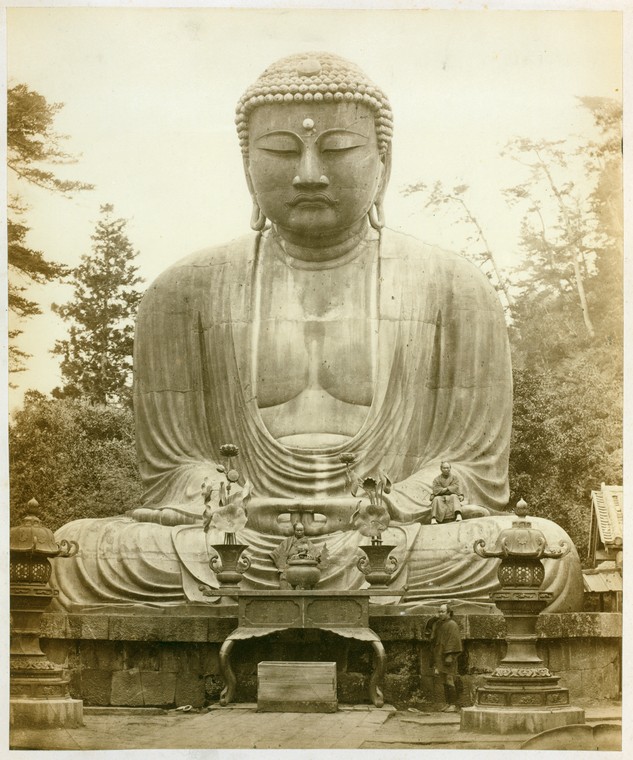
  • Date: c. 1868
  • Information: After the great Yokohama fire destroyed Beato’s studio in 1866, this photograph was part of the new negative stock made between 1867–1868 and sold to tourists at his new studio. This image is often dated to 1868.
  • Description: Here we see a clear view of the coin box in front of the offering table and the long, curled finials atop the metal lanterns. Also note the distinctive placement of the metal lotus flowers in the urn atop the offering table, especially the bend in the stem on the right-side flower. It is possible to see the uppermost tip of the large cast metal lotus petal in the lower right.

Sequential Chronology: 03

Visual Literacy of Buddhism ⓒ P.Romaskiewicz

  • Date: TAQ: March 1870
  • Information: The National Library of New Zealand holds the same image. In that collection, the photograph is described as part of an “album of photographs compiled on cruises aboard HMS Endymion with the Flying Squadron,” which made an around-the-world voyage in 1869–1870, landing in Japan in April 1870. The National Library dates this image between 1867–69 and suggests Beato as photographer, but this is incorrect. I have seen this image in Wilhelm Burger’s (1844–1920) A Series of 56 Views of Towns, Villages, etc. in Japan, published in 1871 (for more on Burger, see below). This would date the image to late 1869 or early 1870. Burger left Japan in March 1870. I discuss this further here.
  • Description: Same as above but two small altar implements have been added between the pair of flower urns and the central incense burner.

Sequential Chronology: 04Visual Literacy of Buddhism P.Romaskiewicz

  • Date: c. 1870; TAQ: May 30, 1870
  • Information: John Reddie Black (1826/7–1880) published the first issue of The Far East: A Monthly Illustrated Journal at the end of May 1870 and included a photograph of the Daibutsu. No photo credit is provided in the publication, but the same image is attributed to Wilhelm Burger (1844–1920), who traveled in Japan from the Fall of 1869 to the Spring of 1870. It is possible that Burger’s negative came to Black through Michael Moser, Burger’s photographic assistant who became the staff photographer at the Far East (see Bennett 1996: 37 & 2006b: 90–91).
  • Description: The railing on the left has been removed, but the railing on the right remains intact. Other photographs attributed to Burger still show the left-side railing standing, however, suggesting its removal occurred during his travels in Japan. One Daibutsu photograph in a Burger album held by the British Museum, entitled A Series of 56 Views of Towns, Villages, etc. in Japan, depicts the left handrail as displaced and balusters tilted. One anonymous photograph depicts the damaged balusters of the left railing.

Sequential Chronology: 05

Visual Literacy of Buddhism ⓒ P.Romaskiewicz

  • Date: TAQ: 1873
  • Information: This carte de visite print is attributed to Shimooka Renjo 下岡蓮杖 (1823–1914) in the Freer-Sackler Gallery archives. The reverse of the card indicates it was printed in 1873, providing a (presumably) reliable terminus ante quem. The photo was reproduced in Thomas Woodbine Hinchliff’s Over the Sea and Far Away in 1876. The image above was analyzed for the Visual Literacy of Buddhism series here.
  • Description: It is difficult to determine, but it appears the newel post of the railing atop the third landing on the right still remains. The railing on the left is clearly missing. The base of the stone marker at the bottom of the second landing noting the donation of the paving stones is also visible.

Sequential Chronology: 06

Visual Literacy of Buddhism P.Romaskiewicz

  • Date: TPQ: 1870; TAQ: 1877
  • Information: From the studio of Baron Raimund von Stillfried-Ratenicz (1839–1911), this image was sold as part of an album entitled Views and Costumes of Japan at the State Library of Victoria, which dates roughly to 1876, after the move of the Anderson & Stillfried studio in late 1875 and before the studio fire of January 1877. Stillfried opened his Yokohama studio in August 1871 and apprenticed in Beato’s Yokohama photography studio starting in 1870 (Bennet 2006a: 309).
  • Description: The railing on both sides atop the third landing has disappeared, but large cast metal lotus petals remain at the base of the second landing. The coin box is unadorned, the lamps have long finials, and the urns atop the offering table still hold metal lotus flowers.

Sequential Chronology: 07

Visual Literacy of Buddhism P.Romaskiewicz

  • Date: TPQ: 1870; TAQ: 1877
  • Information: The photographer is unknown.
  • Description: This image shows the damaged structure to the right of the Daibutsu (the same damaged structures is seen in another picture in the Archive). The roof here slopes north-south, and the newer building has an east-west sloping roof.

Sequential Chronology: 08

Visual Literacy of Buddhism P.Romaskiewicz

  • Date: TPQ: 1870, TAQ: 1877
  • Information: Attributed to Suzuki Shin’ichi (II) 鈴木 真一 (1855–1912), this image is found at the Musée Guimet (see also Bennett 2006b: 149). Notably, Suzuki’s father was also an outstanding photographer.
  • Description: It shows the overgrown temple grounds surrounding the Daibutsu before the major landscaping renovation. The long ladder is also featured in several other photos from this period. The small sign on the steps, placed there by Suzuki, reads: “Daibutsu Kamakura 仏大倉鎌.” The large cast metal petals at the base of the first landing are moved slightly from their original positions.

Sequential Chronology: 09

Visual Literacy of Buddhism ⓒ P.Romaskiewicz

  • Date: Summer 1877
  • Information: William Henry Metcalf (1821–1892), arriving in Yokohama in June 1877 with the pioneering “Japanologist” Edward Sylvester Morse (1838–1925), set out on a four-month tour photographing the Japanese landscape. The image above was analyzed for the Visual Literacy of Buddhism series here.
  • Description: This image gives a definitive terminus ante quem for the small gabled roof atop the coin box and the removal of the metal lotus flowers from the urn on the offering table. It also shows that two large cast metal lotus petals were moved to rest against the pedestal of the Daibutsu before being removed altogether. The lamps still retain their long, curling finials. The new gabled roof structure can be seen to the right of the Daibutsu.

Sequential Chronology: 10

Visual Literacy of Buddhism P.Romaskiewicz

  • Date: TPQ: 1877; TAQ: 1879/80
  • Information: From the studio of Baron Franz von Stillfried-Ratenicz (1837–1916), this image at the Edinburgh Library (also numbered 351) was incorporated into a tourist volume entitled Views and Costumes of China & Japan, which dates from between 1879–1883. Franz (not to be confused with his brother, Raimund) opened his photography firm in 1879 (at 80 Main Street, as noted on the cover page), but he received negatives from his brother, Raimund, who previously owned a studio in Yokohama (Bennett 2006a: 139–140, 154). It remains undetermined who took this photograph.
  • Description: This image is important because it depicts a groomed temple landscape just previous to the major renovation project. The large cast metal lotus petals have been removed and replaced by small shrubs at the base of the first landing. The grass at the base second landing has been cut and the sago palm is more easily identifiable on the left. This image also shows that the metals lotuses atop the offering table remain missing. Additionally, the spiral finials on the lamps were removed before other signs of renovation work appeared. The stone marker at the base of the second landing noting the donation of the paving stones has also been removed.

NOTE: The sequence of photographs depicting temple renovation through 1896 remains highly conjectural. There are numerous small adjustments made in the landscaping and altar design, thus making it difficult to determine a precise chronology.


Sequential Chronology: 11

Visual Literacy of Buddhism ⓒ P.Romaskiewicz

  • Date: c. 1879; TAQ: 1880
  • Information: From the studio of Baron Raimund von Stillfried-Ratenicz (1839–1911), this image was taken from Views and Costumes of Japan at the Musée Guimet, which dates from 1877–1880. (A similar image depicting the same priest can be found here and here).
  • Description: Showing clear evidence of the renovation process, the urns holding the metal lotuses have also been removed altogether. It is claimed that construction lasted from 1877–1887, with donor name signboards (on the left above) appearing since 1879. A wider view of the renovation project can be seen here.

Sequential Chronology: 12

Visual Literacy of Buddhism 
P.Romaskiewicz

  • Date: July 1882
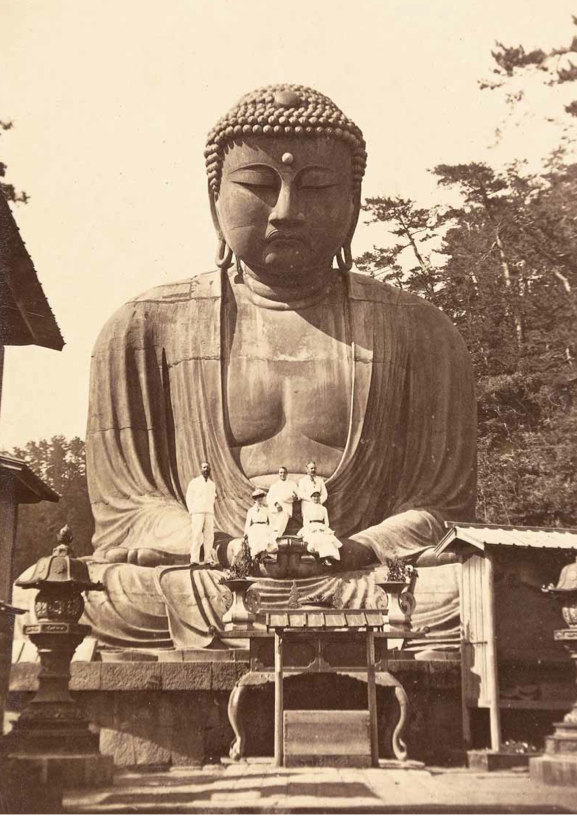
  • Information: This image depicts the British globetrotter Francis Guillemard and his excursion party at the Kamakura Daibutsu. It may have been taken by Usui Shūzaburō 井秀三郎 (fl. 1867–1884), who was commissioned to take photographs during part of Guillemard’s trip (photo and information from Bennet 2006a: 226).
  • Description: This image shows plants placed in the urns atop the offering table and roof tiles in the structure at the left knee of the Daibutsu. Presumably, these tiles were used to roof the structure to the immediate right of the statue.

Sequential Chronology: 13

Visual Literacy of Buddhism 
P.Romaskiewicz

  • Date: c. 1882
  • Information: Attributed to Kusakabe Kimbei 日下部金兵衛 (1841–1934), but sold in several studio albums. (Cf. Bennett 2006b: 140)
  • Description: This image is very similar to the Guillemard photograph above, but  the plants in the urns on the altar are different.

Sequential Chronology: 14

Visual Literacy of Buddhism P.Romaskiewicz

  • Date: c. 1887
  • Information: Often attributed to Adolfo Farsari (1841–1898), this image, taken from an album entitled Photographs Relating to Japan, is commonly dated to after the fire at Farsari’s studio in 1886, and before he reopened his studio in 1887. (see also Bennett 2006b: 133). It was reprinted in William Caine’s A Trip Around the World in 1887–8, in 1888, thus providing a firm terminus ante quem for its printing.
  • Description: This image defies some expectations and I am unsure of my assessment. In an earlier version of this chronology, I speculated that the photograph may have been previous to 1879/80, but I now think the evidence better aligns with the more traditional c. 1887 dating. The gabled roof on the coin box and the lack of metal lotuses in the urns clearly indicate it was post-c. 1877.  The branches placed in the urns are in accord with what is seen during the renovation of the early 1880s (but also see Usui image noted below). Curiously, the fact that the structure on the right of the Daibutsu has a gabled roof (not a hip roof) suggests the new building was not even started before all other signs of renovation were cleared away. In fact, it has been suggested the roofing tiles (for the new structure) can be seen piled up behind the offering table. The small shrubs at the base of the first landing may have been natural growth during the renovations (see previous image). Finally, the rather sturdy looking five-step ladder continues to be present for a while after the renovation. Part of my lack of confidence stems from a comparable photo attributed to Usui Shūzaburō 井秀三郎 (fl. 1867–1884) – but showing the lantern finials still attached. That image is definitively dated to c. 1877. In any regard, Farsari’s reputed image would have to post-date that, and considering my recent thoughts, that would be by about a decade.

Sequential Chronology: 15Visual Literacy of Buddhism P.Romaskiewicz

  • Date: TPQ: c. 1887; TAQ: November 1890
  • Information: This photograph has been attributed to Tamamura Kōzaburō 玉村康三郎 (1856–1923?) and Kusakabe Kimbei 日下部金兵衛 (1841–1934)[for Kusakabe attribution see comments section here]. (Cf. Bennett 2006b: 140)
  • Description: This image shows a curious structure next to the Daibutsu, presumably a temporary structure before the hipped roof building was erected.   Importantly, the metal lotus flowers have been placed back into the urns atop the offering table (note the slightly different arrangement from earlier), in positions they will remain for the next two decades. The foliage creeping in from the right of the frame suggests the row of evergreens are cropped out of this photograph (see next image).

Sequential Chronology: 16

Visual Literacy of Buddhism P.Romaskiewicz

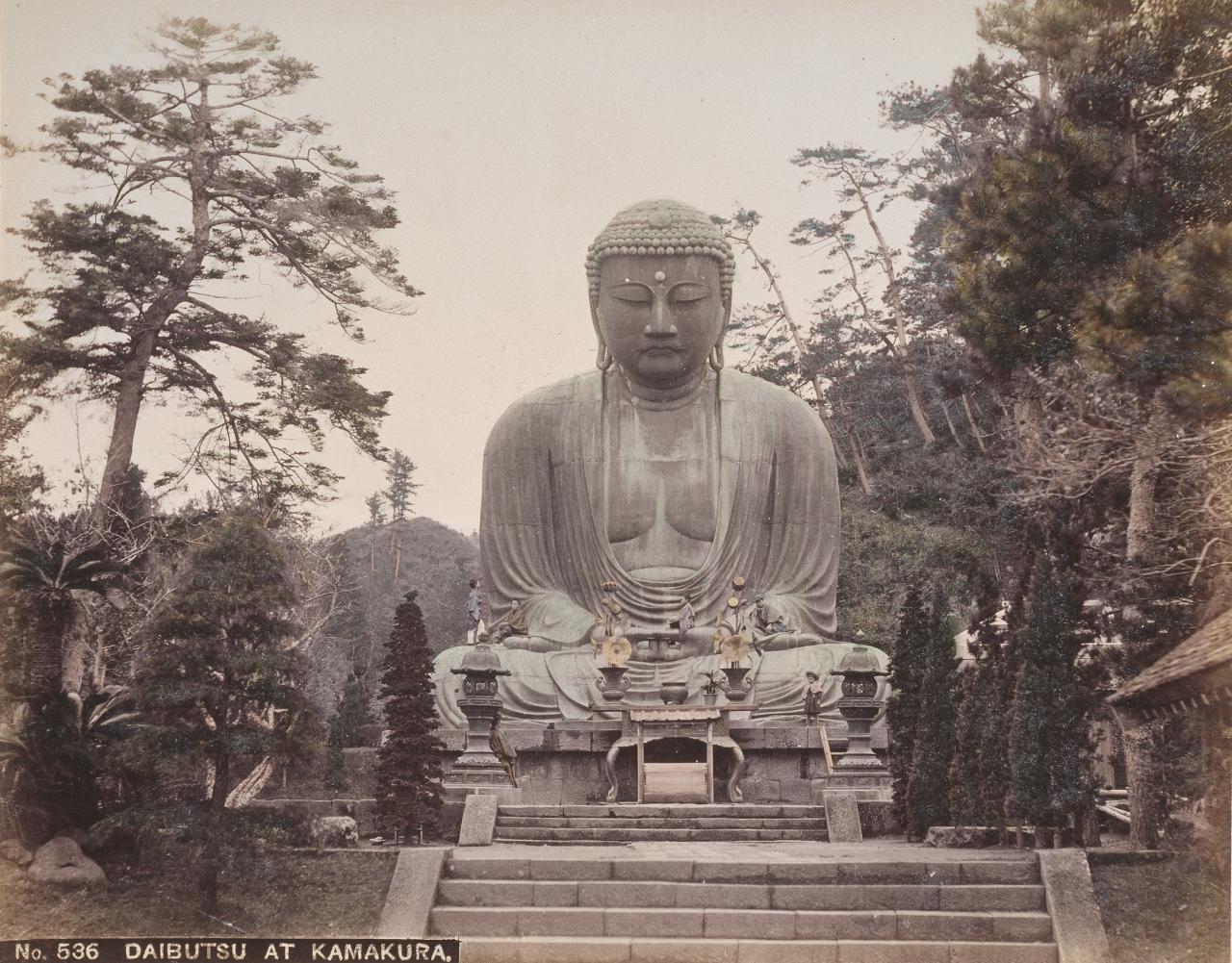
  • Date: TPQ:c. 1887; TAQ: November 1890
  • Information: Three photographs regularly attributed to Tamamura Kōzaburō 玉村康三郎 (1856–1923?) are sequentially numbered 534, 535, and 536 (see Bennett 2006b: 152)[although Kimbei attributions exist]. These three photographs were taken on the same day (the small boy with the hat is seen in all three, here seen by the ladder on the pedestal)
  • Description: Number 535 is taken from the closest distance, and number 534 is taken slightly further away, showing the skinny evergreens at the base of the first landing on the left and a row of evergreens running down the second landing on the right (it is possible these were planted behind the Daibutsu as seen in later photographs). Number 536, shown above, is taken from the furthest distance, on the third landing, and shows more of the landscaping. Importantly, it depicts a small tree in front of the sago palms at the base of the second landing. The metal lotus flowers have been placed back into the urns atop the offering table (note the slightly different arrangement from earlier photographs). One can get a glimpse of the new hipped roof on the structure to the right of the statue between the evergreens.

Sequential Chronology: 17

Visual Literacy of Buddhism P.Romaskiewicz

  • Date: TPQ: c. 1887; TAQ: November 1890
  • Information: Commonly attributed to Kusakabe Kimbei 日下部金兵衛 (1841–1934). (Cf. Bennett 2006b: 140)
  • Description: This image shows a more barren landscaping design, with the evergreens removed from the second landing and the tree removed from in front of the sago palms. Importantly, this landscaping was finished before the coin box was reconstructed and surrounded by a picketed fence. This photo clearly shows the new hip roof on the structure next to the Daibutsu, replacing the older gabled roof.

Sequential Chronology: 18

Visual Literacy of Buddhism P.Romaskiewicz
  • Date: November 1890
  • Information: Rev. Thomas Hobbs Stacy, armed with his Scovill camera rig, arrived in Yokohama on November 9, 1890 after nineteen days crossing the Pacific Ocean on the Belgic of the Occidental and Oriental Steamship Company (often abbreviated as O&O). Stacy does not inform us exactly when he visited Kamakura, but it was certainly in November, since by the middle of the month he was already setting sail to Kobe. He took the trip to the Daibutsu with his American travelling companion, Rev. Frank Weston Sanford, who was photographed sitting in the rickshaw, and Rev. Philip Wilson Pitcher, a missionary returning to Amoy, who was standing in the lap of the statue. Stacy also notes the presence of a small photography studio to the right of the Daibutsu, where local photographers would take photos of visitors. This information is summarized from the accounts Stacy wrote for The Amateur Photographer in May 1892 and his self-authored In the Path of Light Around the World in 1895. Shots with rickshaws were common in this period, I believe they were furnished by an on-site photography studio who hoped to give the shot a more exotic, Japanese feel.
  • Description: This image provides us with a reliable terminus ante quem for the fenced coin box positioned in front of the Daibutsu. (Of course, this fence could have been erected before 1890; notably, I have seen a photograph hand-dated to 1886 that does not show the picket fence.) Presumably, this is before the small shrubs were (re)planted at the base of the first landing since they are not seen in the foreground (see following photograph). Regrettably, not know if the outstretched sago palm has a dual-arm or single-arm support makes identifying the sequence for the next few photographs difficult.

Sequential Chronology: 19

Visual Literacy of Buddhism P.Romaskiewicz

  • Date: TPQ: November 1890?; TAQ: Spring 1896
  • Information: Sometimes attributed to Ogawa Kazumasa 小川 一眞 (1860–1929). (Cf. Bennett 2006b: 158)
  • Description: This image shows a row of small shrubs planted at the base of the first landing. replacing the young evergreens which were planted after the renovation. A dual-arm brace still supports the outstretched sago palm in the foreground. A small sign-board is also attached to the column of the building. It is possible this image was taken before Stacy’s photograph in November 1890 if the shrubs were planted and removed by the time of Stacy’s photograph. I cannot tell definitively if this was taken before or after the next photograph.

Sequential Chronology: 20

Visual Literacy of Buddhism P.Romaskiewicz

  • Date: TPQ: November 1890?; TAQ: Spring 1896
  • Information: Sometimes attributed to Kusakabe Kimbei 日下部金兵衛 (1841–1934). (Cf. Bennett 2006b: 159)
  • Description: This image shows a closer view of the Daibutsu with the shrubs in the foreground at the base of the landing. It is possible this image was taken before Stacy’s photograph in November 1890 if the shrubs were planted and removed by the time of Stacy’s photograph. I cannot tell definitively if this was taken before or after the previous photograph.

Sequential Chronology: 21

Visual Literacy of Buddhism P.Romaskiewicz

  • Date: TPQ: November 1890; TAQ 1894
  • Information: This photo is unattributed, but possibly belongs to Enami Nobukuni 江南 信國 (1859–1929) who has other shots from a similar angle. This photograph is published in Jame Clark’s Story of China and Japan, published in 1894, establishing a firm terminus ante quem.
  • Description: This image shows an unusual vantage point from the southwest corner. Importantly, it depicts the sago palms without their fronds (possibly from a cold-weather spell?). The outstretched palm at the base of the second landing is still upheld by a dual-arm brace. It appears the rows of shrubs at the base of the first landing have been removed?

Sequential Chronology: 22

Visual Literacy of Buddhism P.Romaskiewicz

  • Date: TPQ: November 1890?; TAQ Spring 1896
  • Information: Possibly attributable to Enami Nobukuni 江南 信國 (1859–1929) (see Bennet 2006a: 125).
  • Description: This image shows the removal of the small shrubs at the base of the first landing and the barren sago palm (a see previous image). As with the previous image, this could be older than November 1890. Note there is a later photograph captioned with stock number 41.

Sequential Chronology: 23

Visual Literacy of Buddhism P.Romaskiewicz

  • Date: TPQ: November 1890?; TAQ Spring 1896
  • Information: Attributed to Ogawa Kazumasa 小川 一眞 (1860–1929).
  • Description: This image in the Tom Burnett collection shows a single-arm support bracing the outstretched sago palm (replacing the dual-arm support) with the small shrubs still planted at the base of the first landing. It is difficult to ascertain this photograph’s sequential position, it too could have been taken before Stacy’s image in November 1890 if the shrubs, clearly taller here than in the previous photographs, were removed before Stacy visited the Daibutsu. If this was the case, then the single-arm support was also present by that time.

Sequential Chronology: 24

Visual Literacy of Buddhism P.Romaskiewicz

  • Date: TPQ: November 1890?; TAQ Spring 1896
  • Information: Possibly attributable to Enami Nobukuni 江南信國 (1859–1929) (see Bennet 2006a: 125).
  • Description: This image shows the removal of the small shrubs at the base of the first landing. As with the previous image, this could be older than November 1890. (A small detail in this image is the man holding an umbrella near the building and the step appear wet as well, indicating a rainy day. Stock photo 42 is also attributed to Enami, but it shows a sunny day.) Note there is an earlier photograph captioned with stock number 41.

Sequential Chronology: 25

Visual Literacy of Buddhism ⓒ P.Romaskiewicz

  • Date: Spring 1896
  • Information: Henry A. Strohmeyer (1858–1943) arrived in Japan in the Spring of 1896 to take a series of stereophotographs that would eventually comprise a 72-view set. The image above was analyzed for the Visual Literacy of Buddhism series here.
  • Description:  This is the first time a small placard is clearly visible resting by the right shin of the Daibutsu. Furthermore, a different stereocard from this set, including the same two pairs of Japanese men and women, takes a wider perspective of the landscaping and shows the outstretched sago palm is still upheld by a single-arm support. In both cards, the metal lotuses placed in the urns atop the offering table continue to face in opposite directions. This positioning of the lotuses (and small placard) remains in the first Keystone set (c. 1901) and the Stereoscopic Gems set and Universal set (both taken by Herbert Ponting late 1901 to early 1902). It is also found in the watercolor painting of Henry Roderick Newman (1843–1917), finished in 1898.

Sequential Chronology: 26

Visual Literacy of Buddhism ⓒ P.Romaskiewicz

  • Date: 1903
  • Information: Returning to Japan to take photographs for Underwood & Underwood, Herbert Ponting traveled through Japan and its surroundings from Spring to Fall 1903. The image above was analyzed for the Visual Literacy of Buddhism series here.
  • Description: This image is important because it clearly shows that both lotus flowers are now facing away from the Daibutsu. The small placard remains by the right shin of the Daibutsu.

Sequential Chronology: 27

Visual Literacy of Buddhism P.Romaskiewicz

  • Date: TPQ: 1903
  • Information: Published in Herbert Ponting’s reminiscence of his travels in Japan in 1910, this image is certainly earlier.
  • Description: It reveals that the single-arm support of the sago palm was replaced by a dual-arm support. There is also minor rain runoff damage by the stairs leading up to the second landing.

Sequential Chronology: 28

Visual Literacy of Buddhism ⓒ P.Romaskiewicz

  • Date: TPQ: 1903
  • Information: The stereoscopic masterpiece by Enami Nobukuni 江南信國 (1859–1929) is analyzed here.
  • Description: The outward turned lotus flowers prove this image was taken after 1903. This image also shows that the new dual-arm support for the sago palm was replaced by a sturdier dual-arm support. There is also minor rain runoff damage by the stairs leading up to the second landing.

Sequential Chronology: 29

Visual Literacy of Buddhism P.Romaskiewicz

  • Date: TAQ: 1910
  • Information: Attributed to Ogawa Kazumasa 小川 一眞 (1860–1929) and published in his Sights and Scenes in Fair Japan from 1910. The second round-the-world cruise of the S.S. Cleveland landed in Japan in late February/early March 1910 and photos of the Daibutsu in the travelogue of William Frizell and George Greenfield depict a similar scene.
  • Description: The brace of the sago palm has been reinforced by a large single log and there is significant rain runoff damage to the base of the second landing by the stairs.

Sequential Chronology: 30

Visual Literacy of Buddhism P.Romaskiewicz

  • Date: TAQ: 1917
  • Information: The printed caption on this card is dated Taishō 6, or 1917. [A photograph in a private collection shows the picket fence still around the coin box in August 1912.]
  • Description: A low waist-high stone bench or table has been placed in front of the offering table. Additionally, the picket fence and gabled roof coin box appear to have been replaced with a new box. The old hip-roof structure on the right of the statue has also been altered.

Sequential Chronology: 31

Visual Literacy of Buddhism P.Romaskiewicz

  • Date: 1918
  • Information: James Maxwell Pringle took this photograph during his trip to Japan in 1918.
  • Description: The two lotus flowers still remain on the offering table, but the one on the right appears to be facing more towards the west. The small placard remains by the right shin of the Daibutsu. The slab bench/table appears to have been removed. After the removal of the gabled-roof and picket fence around the coin box (after August 1912), and the removal of the slab bench, the altar arrangement is very similar to pre-1877 photographs. The positioning of the flowers can help determine the correct age.

Sequential Chronology: 32

Visual Literacy of Buddhism P.Romaskiewicz

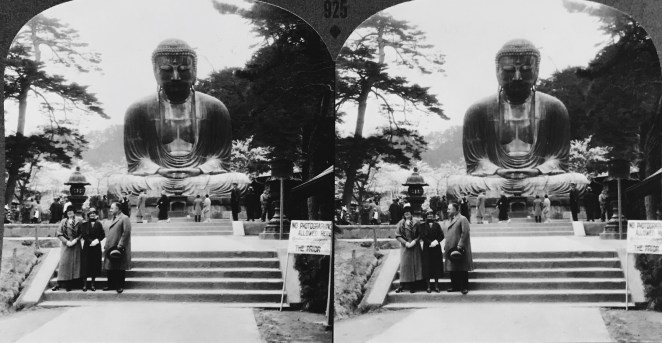
  • Date: December 6, 1919 [dated on obverse]
  • Information: Unknown tourist photograph from Knights of Columbus.
  • Description: The two lotus flowers still remain on the offering table, but at a different angle. It is difficult to know for certain, but the row of individuals immediately in front of the offering table is possibly on top of a low stone table or bench. In other photographs, the heads of people are typically below the top of the table, suggesting the tourists here are not standing directly on the ground.

Sequential Chronology: 33

Visual Literacy of Buddhism P.Romaskiewicz

  • Date: September 1923
  • Information: Postcard held at the Kanagawa Prefectural Library 神奈川県立図書館所蔵.
  • Description: This image shows the destruction of the Great Kantō earthquake to the pedestal of the Daibutsu and the building immediately to the right. The lamps and offering table have also been overturned. I have seen later photographs showing the bowed-leg offering table placed behind the Daibutsu. This image offers a good view of the new coin box introduced in the 1910s.

Sequential Chronology 34

Visual Literacy of Buddhism ⓒ P.Romaskiewicz

  • Date: Between September 1923–December 1924
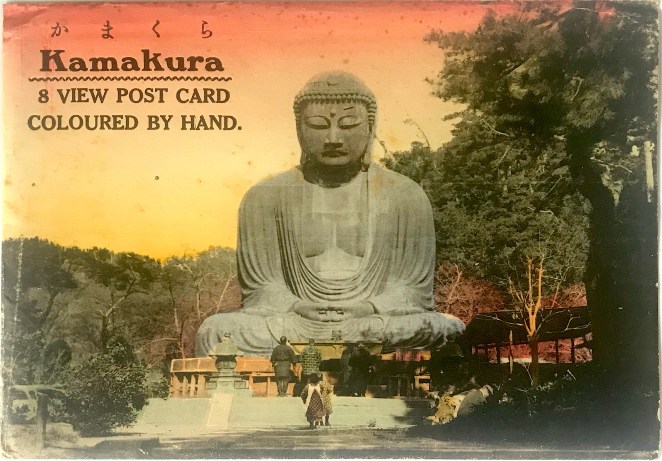
  • Information: Postcard envelope for eight card set of Kamakura views. The image above was analyzed for the Visual Literacy of Buddhism series here.
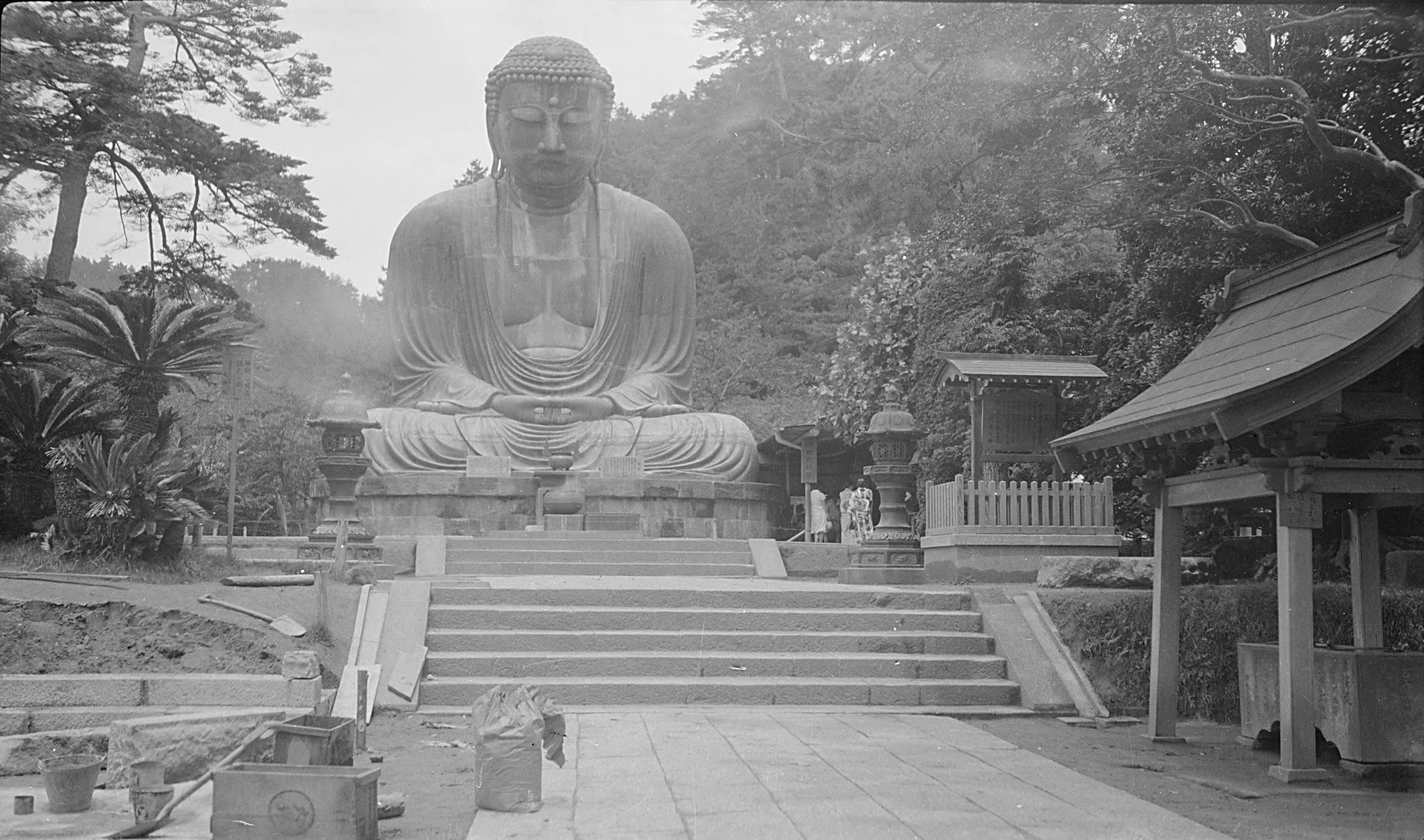
  • Description: The stone pedestal is braced by wood supports. The lanterns have also been reduced in size, but still remain on the third (top)  landing. The bow-legged table has also been reconstructed, bu the incense burner and flower vases are now missing. The reconstruction of the base in late 1924 is visible in the album of Vera Talbot [unfortunately, the International Center of Photography only shows recto pages]. Talbot landed in Yokahama on December 15, 1924 on the S.S. President Taft of the Pacific Mail Company. I presume the above photo shows the intermediate process before full reconstruction since the lanterns will be fully reconstituted and placed on the second landing by early 1925 (see next entry).

Sequential Chronology: 35

Visual Literacy of Buddhism P.Romaskiewicz

  • Date: April 18, 1925 [dated on reverse – I previously thought it was inscribed “1920”]
  • Information: Unknown tourist photograph in the Archive.
  • Description:
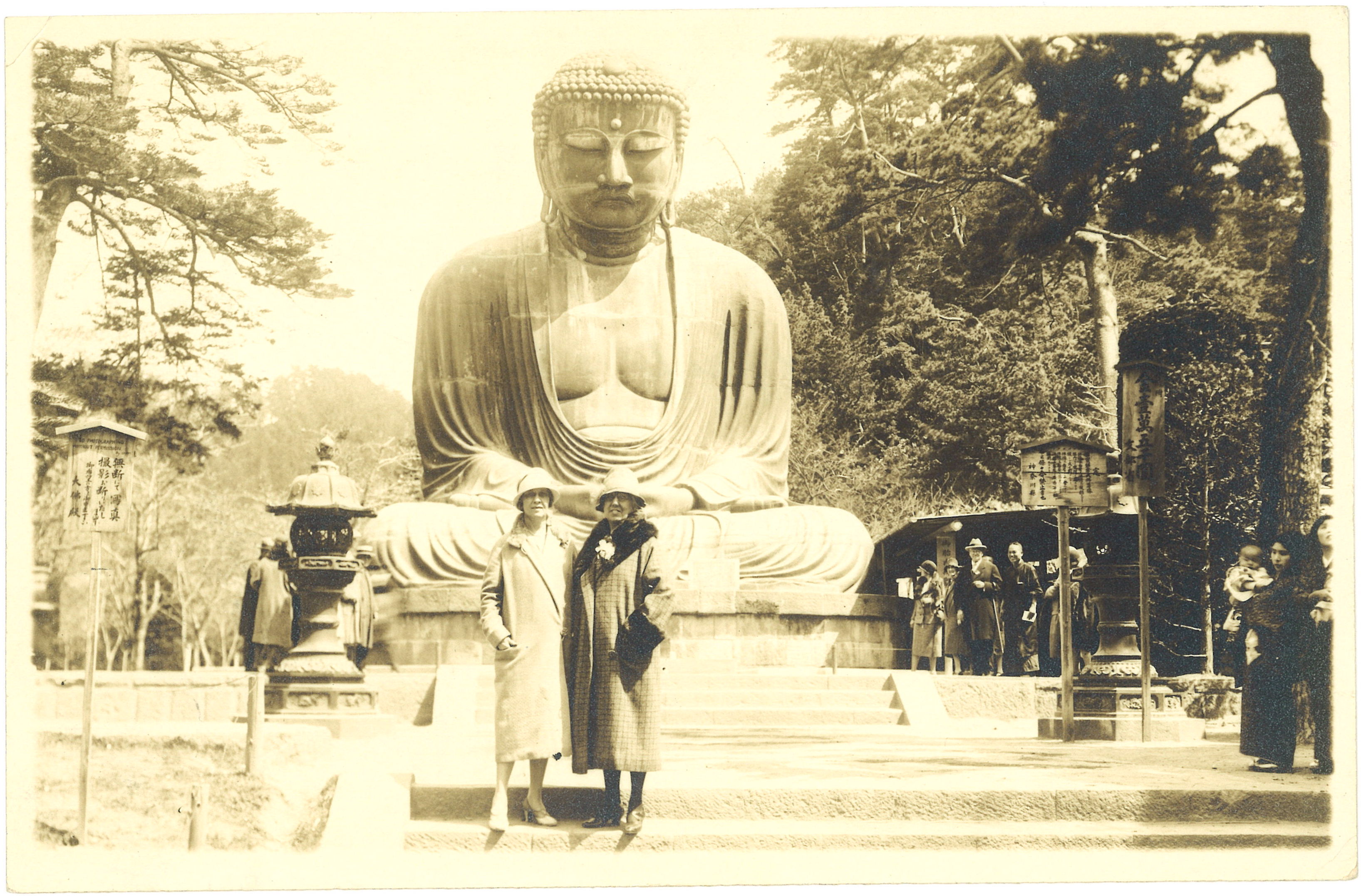
  • This shows the finished reconstruction after the Great Kantō earthquake. Most noticeably in this photograph, the two metal lanterns have been removed from the first landing and placed on the second landing. The large offering table has been removed. Roped-off stakes are also (barely) visible around the pedestal of the statue. Various signs and placards have also been erected, including one on the left in the foreground saying “No Photographing Without Permission, by Prior.” The tall sign on the right says: “下門。金壹萬五千圆。文部省.” The structure to the right of the statue has been reconstructed with a lower profile roof.

Sequential Chronology: 36

Visual Literacy of Buddhism P.Romaskiewicz

  • Date: 1925
  • Information: Amateur American photographer Sidney Gamble (1890–1968) visited Asia on four occasions between 1908 and 1932. This photograph is from his 1925 trip to Japan.
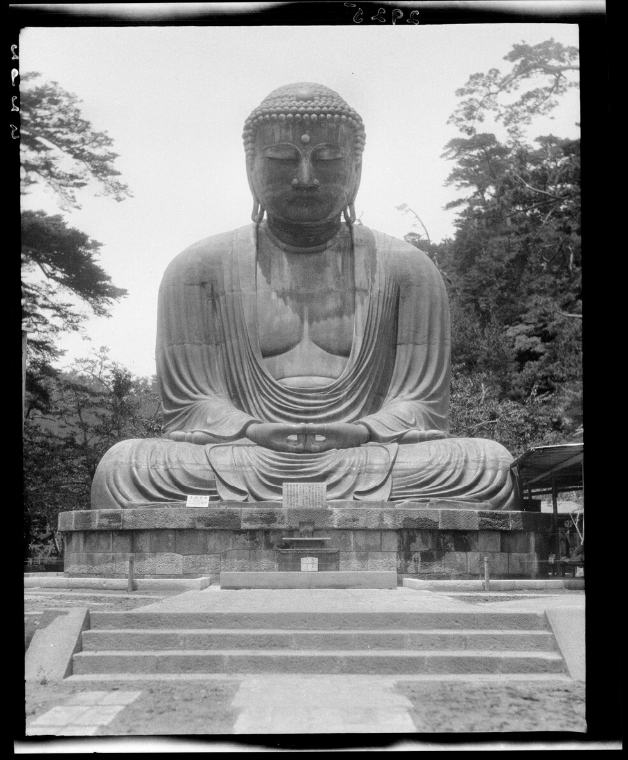
  • Description: Landscape curbing has been added to both sides of the statue foundation, with what appears to be paving stones going around the statue. Roped stakes are also driven into the ground by the curbing, prohibiting closer access to the statue. A low, shin-height slab has been placed in front of the coin box (possibly for kneeling?). A small, low table with a round incense burner is placed between the coin box and foundation. Three small wooden placards are also visible. The large placard in the center possibly describes the damage to the Daibutsu during the Great Kantō earthquake (as seen in another photograph in the Archive). Additionally, in later photographs, a small placard is placed on top of the table giving the height dimension of the Daibutsu: “forty-two feet, five inches” (approximately 12.9 meters)[大佛身像總高ニ四十二尺五寸周圓十六間一尺重量二萬五十].

Sequential Chronology: 37

Visual Literacy of Buddhism P.Romaskiewicz

  • Date: 1935
  • Information: Amateur American photographer Mary Jo Read took this photograph on a trip to East Asia in 1935.
  • Description: The erosion next to the stairs is in the process of being fixed. The altar area now displays a taller table, on top of which the original incense bowl has been placed. A larger round urn has also been placed in front of the altar table, replacing the coin offering box, which now appears positioned on the right side. (Judging by a dated postcard in the Archive, this arrangement was in place by at least January 1931). Based on another photograph in the Archive, the left-hand sign atop the pedestal is bilingual describing the dimensions of the Daibutsu; the placard on the right describes the damage during the 1923 earthquake.

Sequential Chronology: 38

Visual Literacy of Buddhism P.Romaskiewicz

  • Date: 1945
  • Information: Photograph from William Galen Harrach, who served during World War II; part of the Digital Collections of the National WWII Museum.
  • Description: The general altar arrangement has remained the same since the mid-1930s, but the censer on the altar has been traded out for one that is missing the “wings” seen on the original. The large round urn in front of the altar table has also changed. Both signs on the pedestal appear to have remained the same for the past decade.

Additional “Working Notes” Posts

Ueda’s Daibutsu and Dog Postcard

Collecting postcards became a national craze in Japan in the first decade of the twentieth century – and caused at least one riot. Yokohama, home to many of the oldest and most important Japanese tourist photography studios, became a major center of postcard production and the Ueda Photographic Prints Corporation 上田写真版合資会社, founded by Ueda Yoshizō上田義三 in the famed city port, was one of a handful of premier Japanese picture postcard publishers. Ueda’s early sets of cards included photographs of the Kamakura Daibutsu, but they and their business rivals continued to produce new views of this ancient colossus.

Professional and amateur photographs had long shot the Daibutsu frontally from long and medium distances. A few took photographs from the southwest corner, or even from behind, but images of the Daibutsu from the southeast were uncommon (although not unknown) likely because the temple landscaping did not easily allow for a person to position himself. The grounds of Kōtoku-in 高徳院, the temple where the Daibutsu resides, had continuously undergone  renovations since Western tourists discovered it in the 1860’s, slowly opening up the areas around the statue and providing better “picturesque” viewing. One unknown photographer from Ueda was able to take a position in the southeast corner and take a photograph [Figure 1] – one of the very few from this angle.

Figure 1

pckd007u(o)
pckd007u(r)

  • Title/Caption: Daibutsu, Kamakura. 佛大倉鎌
  • Year: c. 1912 [postally unused]
  • Publisher: Ueda Photographic Prints Corp. 上田写真版合資会社
  • Medium: collotype print on cardstock
  • Dimensions: 5.5 in X 3.5 in
  • Reverse Imprint: Carte postale – Postkarte – Post Card [Type 5], Made in Japan, 郵便はかき

This postcard image is also one of the few photographs that does not incorporate any people in its composition, a technique which typically assisted the viewer in gauging and appreciating the sheer size of the statue. Only the most astute observer would note that the photograph is not devoid of all beings – there is a dog resting at the stone base of the statue [Figure 2]. The dog’s distinctive head patterning and white body suggests this may be the same dog photographed in two older stereoview cards, who is seen mingling with temple visitors and tourists. Serene and relaxed, both the Daibutsu and dog appear to be enjoying the relative quiet of the scene.

Figure 2

PCKD007u(o) dog.jpg

The Ueda crest on the reverse along with the distinctive multilingual printing clearly reveals this card to be part of the Ueda Corp. stock published after 1907, possibly around 1912. It is difficult to determine when the photograph was taken, but the presence of the dog suggests it was taken sometime after the first few years of the turn of the century, when the stereoviews were taken. While this is one among a dozen or more Japanese picture postcards produced of the Daibutsu before 1923 (when the Kantō earthquake destabilized the Japanese postcard industry), it remains one of the most unique.


*This is part of a series of posts devoted to exploring the development of a visual literacy for Buddhist imagery in America. All items (except otherwise noted) are part of my personal collection of Buddhist-themed ephemera.


Additional Posts in Visual Literacy of Buddhism Series
 

Kimbei’s Undivided Back Postcard

The Japanese postal delivery service was initiated in 1871 and soon joined the Universal Postal Union (soon to be known formally as Union Postale Universelle) in 1877, thus permitting the sending and receiving of international mail. Until the start of the twentieth century, however, all postcards were issued by the Japanese government as private companies were prohibited from publishing their own cards. After legal permission was granted in 1900, private companies soon embarked on mass-scale printings of picture postcards (ehagaki 絵はがき). The postcard soon rivaled the traditional woodblock print as the favored medium to present contemporary Japanese images.[1] Furthermore, while many early postcards were illustrated with drawings, photographic images soon dominated the medium and are considered the earliest commodified forms of the photograph.[2] This was spurred by the development of a new printing process, known as the collotype, which allowed for photomechanical printing on a massive scale.  Several themes emerged as popular favorites, including ones that may sound odd to modern purchasers of postcards, such as “natural disasters” and “current events.” Not surprisingly, with the advent of the thriving tourism industry, “scenic views” (fukei 風景) emerged as a favorite visual genre for many domestic Japanese tourists and foreign travelers.

Since a driving force behind the early interest in postcards was the acquisition of inexpensive photographs, it seems only natural that several picture postcards would be reprints of old photographic stock. The premier Japanese photographer of his time, Tamamura Kōzaburō 玉村康三郎 (b. 1856), was commissioned in the 1890’s to produce a then-reported one-million hand-colored albumen prints (though more recent estimates place the number of prints at approximately 350,000) for the multi-volume work Japan: Described and Illustrated by the Japanese. He enlisted the help of his competitor, Kusakabe Kimbei 日下部金兵衛 (1841-1934), to finish the massive order.  Scholars have only recently begun to identify Kimbei’s photographs found within the publication. The postcard image of the Great Buddha of Kamakura [Figure 1] is now considered a Kimbei photograph. The original image was scaled down and slightly cropped to fit on a standard size postcard.

Figure 1

PCKD001kk(o).jpg
PCKD001kk(r).jpg

  • Title/Caption: NA
  • Year: 1900-1907
  • Photographer: Kusakabe Kimbei 日下部金兵衛 (1841-1934)
  • Medium: collotype print on cardstock, hand tinted
  • Dimensions: 5.5 in X 3.5 in
  • Inscription: Union Postale Universelle. CARTE POSTALE, 萬國郵便聯合端書

There is no caption identifying the statue or location on the postcard, but the Kamakura Daibutsu was certainly well known in the early twentieth century. In the coming years, however, it would become standard practice to include letterpress captions, often both in English and Japanese, to describe the scene. The fine reticulation pattern and matte cardstock identifies this image as a photomechanical reproduction, known as a collotype (korotaipu コロタイプ). As with standard albumen and silver gelatin photography, early postcards were hand-tinted with water-color washes.

The small margin at the bottom of the card was left for correspondence. Before 1907, the Union Postale Universelle required the entire reverse of the postcard be used for the address and name of the recipient, thus early publishers would leave blank space for a brief messages on the front of the card. Because of this limitation, the correspondence was typically very short, with foreign travelers often briefly commenting on their sightseeing excursions.

The reverse of this card is bordered by an ornamental filigree-like design in umber brown ink. This card is an example of an “undivided back,” since no line appears separating the spaces on the back where the correspondence and address would later come to be written. This functions now as an easy identifier for dating old postcards, with this exemplar dating between 1900 and 1907.  In addition, a small scalloped square appears in the top right corner, indicating the location to affix the necessary postage.


Notes:

*This is part of a series of posts devoted to exploring the development of a visual literacy for Buddhist imagery in America. All items (except otherwise noted) are part of my personal collection of Buddhist-themed ephemera.

[1] https://www.mfa.org/collections/asia/art-japanese-postcard

[2] Satō 2002: 41.

References:

  • Saitō Takio 斎藤多喜夫. 1985. “Yomigaeru shinsaizen no Yokohama fūkeiよみがえる震災前の横浜風景,” Kaikō no hiroba 開港のひろば, No. 12, pp. 1, 4.
  • Satō, Kenji. 2002. “Postcards in Japan: A Historical Sociology of a Forgotten Culture,” International Journal of Japanese Sociology, No. 11, pp. 35-55.
  • Yokohama Open Port Museum 横浜開港資料館, ed. 1999. Nen mae no Yokohama Kanagawa ― ehagaki de miru fūkei 年前の横浜・神奈川―絵葉書でみる風景. Tokyō: Yurindo 有隣堂.

Additional Posts in Visual Literacy of Buddhism Series

Ueda’s Hand-Colored Cerulean Letterpress Postcards

In early 1904, Japan formally declared war on Russia after nearly a decade of rising tensions. Military attachés and journalists from around the world traveled to the front with photographers to chronicle the gruesome affair. This use of wartime photography propelled a surge in popularity of Japanese picture postcards (ehagaki 絵はかき), resulting in a spike of mass-produced, inexpensive postcards depicting Japan’s military might. The swell in Japanese nationalism and interest in seeing images of a modernized state helped create a Japanese postcard boom in the middle of the first decade of the twentieth century.[1] New private postcard publishing houses, such as Ueda Photographic Prints Corporation 上田写真版合資会社, Hoshinoya 星野屋, and Tonboya トンボヤ, grew in number as did their inventory of photographic postcards. Consequently, during this period numerous new images of the Kamakura Daibutsu were taken and sold to a ready market of Japanese and foreign travelers [Figure 1].

 Figure 1

pckd004u(o)

PCKD004u(r).jpg

  • Title/Caption: Daibutsu, Kamakura. 佛大倉鎌
  • Year: c. 1907 [postally used 1910]
  • Publisher: Ueda Photographic Prints Corp. 上田写真版合資会社
  • Medium: collotype print on cardstock, hand tinted
  • Dimensions: 5.5 in X 3.5 in
  • Reverse Imprint: Postkarte [Type 1], 郵便はかき

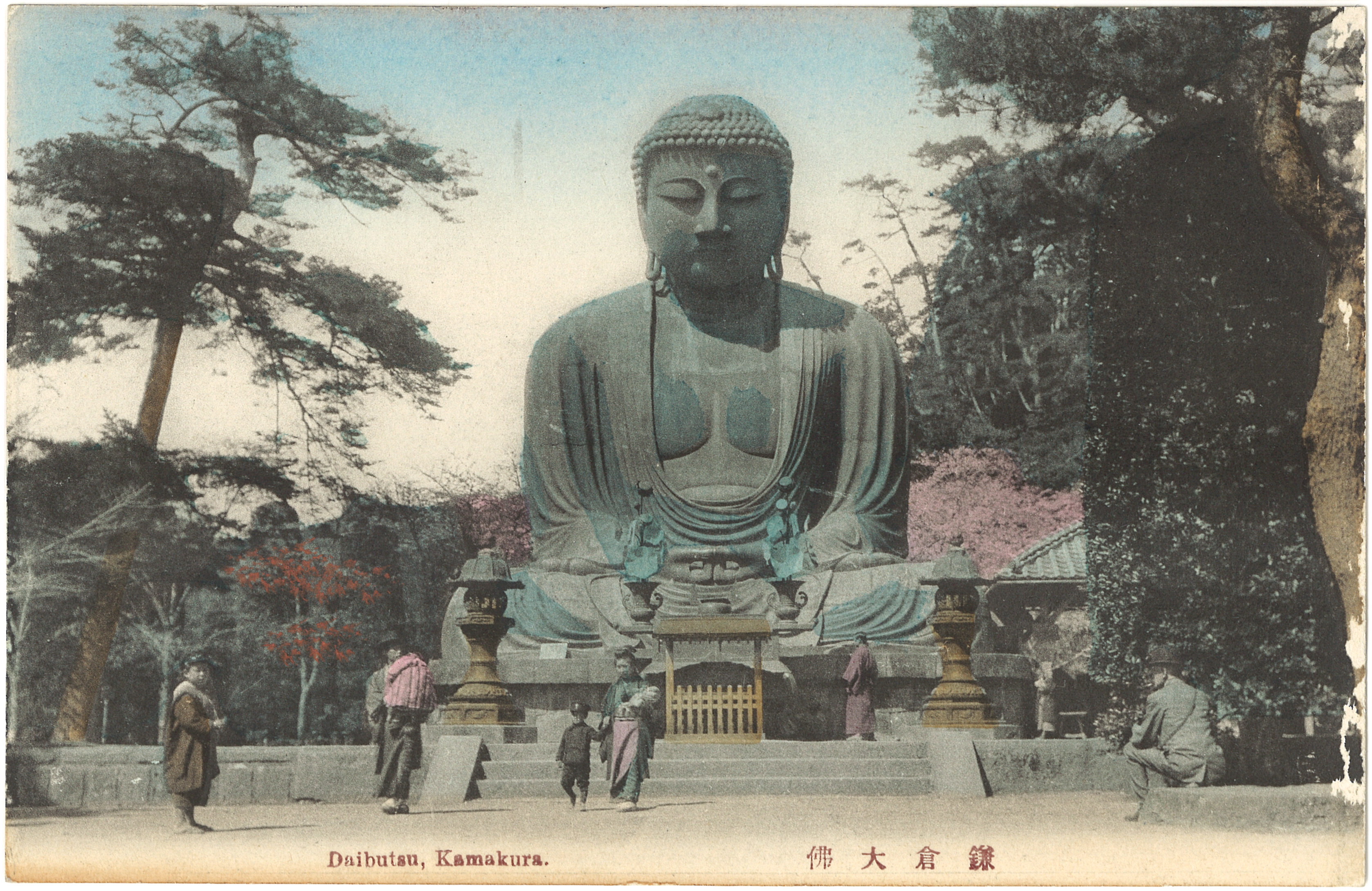
The unknown photographer of this postcard image set the camera on the second landing of the paved walkway and framed the Daibutsu frontally and symmetrically, similar to  numerous Yokohama port studios and foreign stereo-photographers of earlier years. The standard size ratio of the postcard allowed for a slightly larger panoramic sweep than that of older albumen prints, thus more of the foliage surrounding the site is visible. The mise-en-scène is natural and casual, unlike the highly choreographed images of piety taken by Herbert Ponting around the same period. The viewers eyes are eventually drawn to the group of people on the lower left, perhaps a family, that walks away from the Daibutsu. Except for the adolescent boy on the far left dressed in an oversized coat, no one makes eye contact with the photographer. This leaves the viewer with a sense of casual observation, as if seeing the normal daily activities of the temple grounds. The outfits of the family suggest a bricolage of cultures, as traditional flowing (and brightly colored) Japanese garments are mixed with Western attire, including a narrow brimmed hat worn by the older man and military school outfits (gakuran 学ラン) worn by the young boys (officially adopted in Japan in the 1880’s[2]). Another man sits on the far right, also wearing a brimmed hat, trousers, and vented jacket. To a Japanese viewer, these sartorial elements would be clear indications of a modern, militaristic, and “Westernized” Japan. Reading deeper, the lone kimono-wearing figure in the rear, closest to the Daibutsu, might symbolize the traditional and religious past being left behind by the more progressive present.

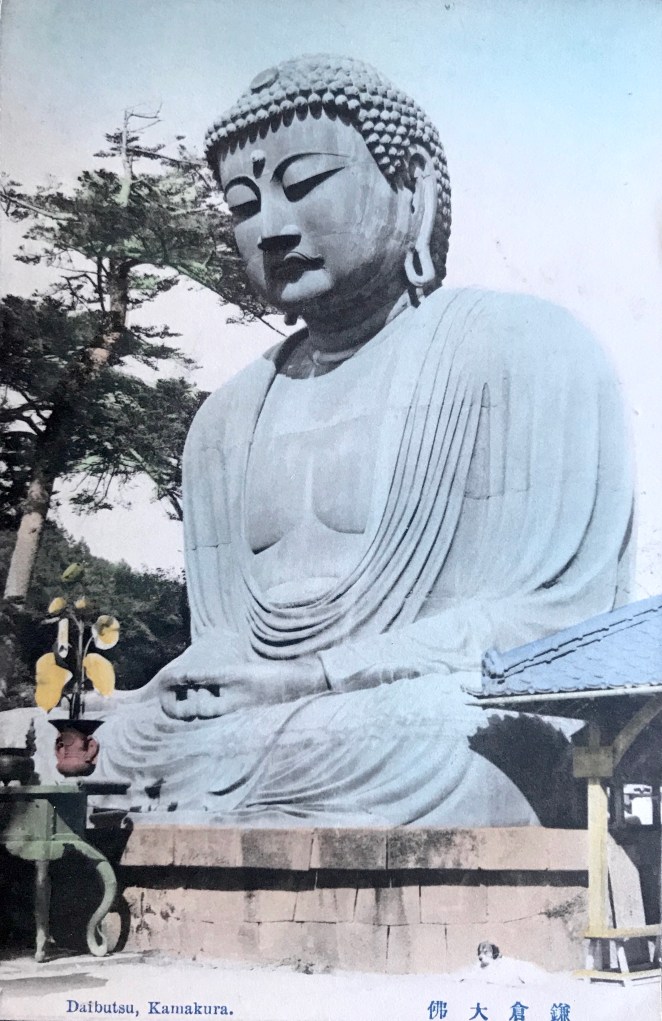
This collotype print on card stock was hand tinted with water color, but unlike the more conservative hues of older albumen prints sold at established port photography studios, postcards more frequently have a splash of bright color, especially the warm vibrant hues of orange, scarlet, and pink. The early colorists of Daibutsu postcards often included a patch of pink behind the statue, suggesting spring cherry blossoms, even though this was not the tradition of older Yokohama studios and – as far as I can discern – not botanically accurate [although this image may suggest otherwise].

In addition to this card, a vertical format of a similarly dated Daibutsu picture postcard [Figure 2] shows the same patch of tree foliage to the right of the Daibutsu also painted in cherry blossom pink.[3] Images such as these may function as the origins of the painting tradition for Daibutsu postcards which continued for several decades, effectively ending when color photography was introduced. More curiously, in the horizontal image above, the colorist also included a red-leaved maple tree (just above the man in the short-brimmed hat), inaccurately suggesting that spring cherry blossoms and red autumn foliage appear in the same season! Of course, these decisions were not motivated by a fidelity to reality, but by a consumer market with idealized visions of a bright and polychromatic Japanese landscape.

Figure 2

pckd005u1(o)
pckd005u1(r)

  • Title/Caption: Daibutsu, Kamakura. 佛大倉鎌
  • Year: c. 1907 [postally unused]
  • Publisher: Ueda Photographic Prints Corp. 上田写真版合資会社
  • Medium: collotype print on cardstock, hand tinted
  • Dimensions: 5.5 in X 3.5 in
  • Reverse Imprint: Postkarte [Type 1], 郵便はかき

These two postcards were not only sold by the same publisher (the printing on the reverse is identical on both), but clues in these photographs suggest they were taken at the same time. Most tellingly, the shadows are sharp, indicating a clear afternoon, and fall across the face and shoulders of the Daibutsu in precisely the same way, indicating they was taken on the same exact time of day.[4]

For both the horizontally and vertically formatted postcards, the photographic image bleeds to the edges, except on the bottom where an unprinted border leaves space for a caption, here both in English and Japanese. Identifying the location of the site, the cerulean colored letterpress is simple and succinct: “Daibutsu, Kamakura,” (or “Kamakura Daibutsu” 鎌倉大佛 in Japanese).[5] Unlike older postcards, no blank space needed to be reserved on the front of the card because new postal regulations allowed correspondence to be written on the back in addition to the recipient’s name and address. The evidence for this change is the narrow umber (or orange-cinnamon) colored dividing line separating the message from the address space on the reverse.[6] The new regulations for “divided back” postcards were passed in March 1907, but took effect in October of the same year, thus providing a terminus post quem of 1907 for both cards above.

The reverse of these cards also clearly indicates the intended international audience for this expanding postal medium. “Postkarte” (postcard) is written in German along the long edge, followed by French, Italian, and Russian translations, as well as Japanese (yūbin hakaki 郵便はかき [sic]) along the short edge. Unfortunately, as is common for older cards, the reverse sides do not provide information pertaining to the publisher. I feel there is solid evidence, however, to believe these were published by the Ueda Photographic Prints Corporation, founded by Ueda Yoshizō上田義三 in the bustling port of Yokohama. This company was known for its prolific production of early Japanese postcards.[7] If we examine other similar hand colored collotype postcards with cerulean captions and umber printing on the reverse – hereafter I refer to this scheme as the Ueda “cerulean-umber” design – we find a clear relationship between our cards and later cards imprinted with the Udea Corp. trademark. If we examine another horizontal postcard [Figure 3] with the same image (even with the same coloring, down to the red spot on the child’s pink jacket), we can observe the printing on the reverse is different, suggesting it comes from a different print run.

Figure 3

PCKD005u(o).jpg
pckd005u(r)

  • Title/Caption: Daibutsu, Kamakura. 佛大倉鎌
  • Year: c. 1910 [postally unused]
  • Publisher: Ueda Photographic Prints Corp. 上田写真版合資会社
  • Medium: collotype print on cardstock, hand tinted
  • Dimensions: 5.5 in X 3.5 in
  • Reverse Imprint: Carte postale – Postkarte – Post Card [Type 3], MADE IN JAPAN, 郵便はかき

Within a short period between 1907 and 1912, the design on the reverse of Ueda postcards changes several times [Figure 4], following a discernable progression, until the dividing line was capped by a heavily stylized Ueda crest in the last phase [Figure 5].[8] Please consult my working notes for an outline of these chronological changes.

Figure 4:

pckd004u5(o)
pckd004u5(r)

  • Title/Caption: Daibutsu, Kamakura. 佛大倉鎌
  • Year: c. 1912 [postally unused]
  • Publisher: Ueda Photographic Prints Corp. 上田写真版合資会社
  • Medium: collotype print on cardstock, hand tinted
  • Dimensions: 5.5 in X 3.5 in
  • Reverse Imprint: Carte postale – Postkarte – Post Card [Type 5], MADE IN JAPAN, 郵便はかき

Figure 5: The Ueda Photographic Prints Corp. trademark/crest.

PCKD004u5(r) crest.jpg

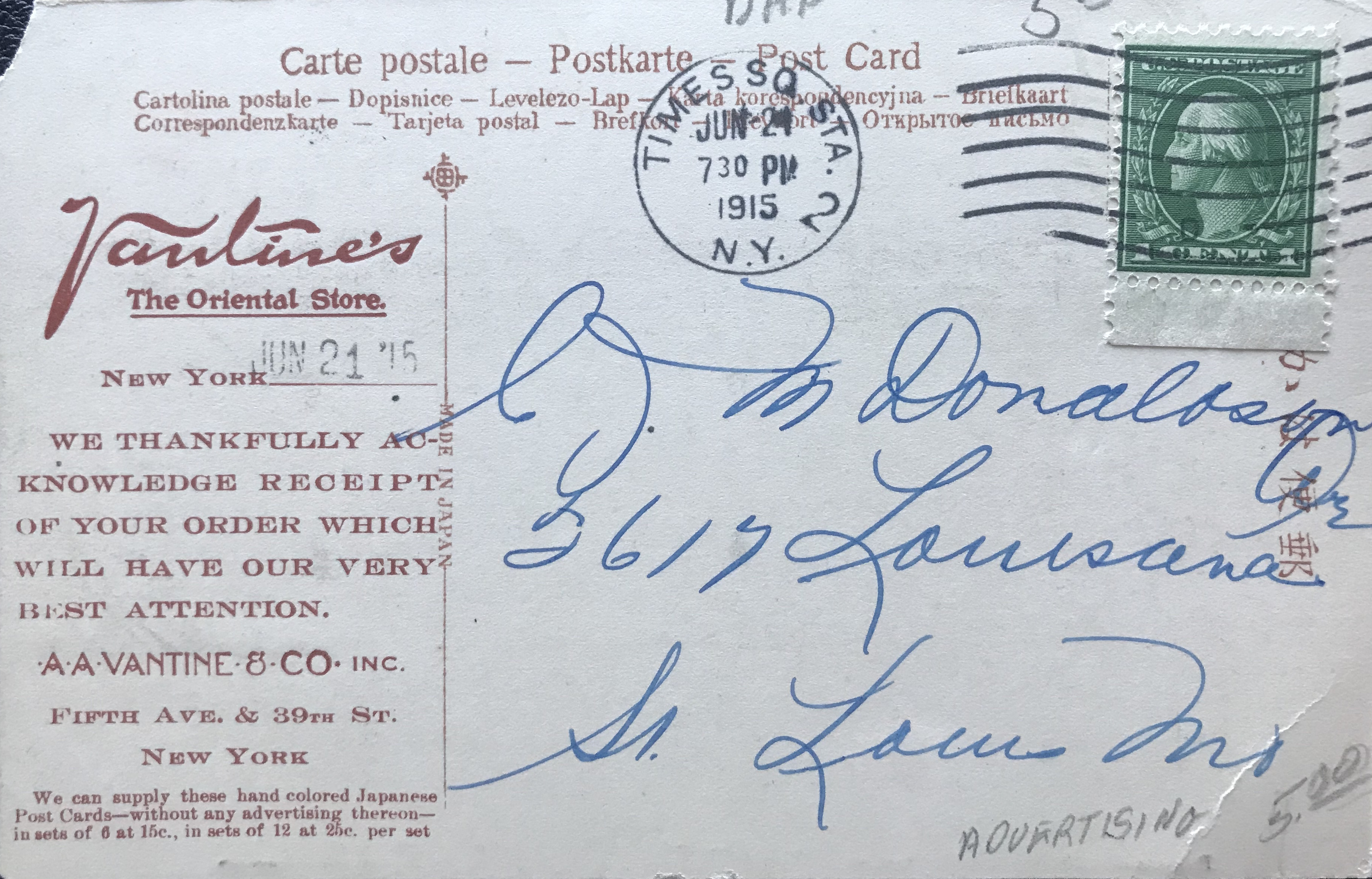
These Ueda Corp. postcards were domestically produced (later editions cearly say “Made in Japan”), but had a worldwide circulation. The cards were not only purchased as inexpensive souvenirs or mailed to lucky recipients around the world, the premier commercial importer of Asian goods into America, A.A. Vantine & Co., also sold Ueda postcards at its flagship store in New York City and through it’s widely distributed mail order catalogue. Coincidentally, Vantine’s heavily illustrated 1914 catalogue [Figure 5] highlights the horizontal Daibutsu postcard along with pictures of geisha and pagoda, all well-worn visual motifs of the exotic Orient. Affordably priced, Vantine’s sold a dozen of these Ueda published postcards for 25 cents.  The copy of Vantine’s catalogue three years later [Figure 6] informs its prospective buyers about the value of these inexpensive items: “To one interested in ‘things Japanese,” or as a gift to a friend making a collection, nothing is more appropriate than a set of Japanese souvenir postcards.” [10]

Figures 5 (left) & Figure 6 (right) [not part of Archive]


Figure 7

IMG_9312


In addition, Vantine’s used Ueda postcards to confirm orders placed by customers [Figure 7], thus diffusing the idealized imagery of Japan, and notably that of the Kamakura colossus, to people who never left the confines of their living rooms. From this vantage point, a postcard of the Daibutsu was no longer a momento of a trip, but one verification among many of the cultural difference and strange Otherness of the Orient.


Notes:

*This is part of a series of posts devoted to exploring the development of a visual literacy for Buddhist imagery in America. All items (except otherwise noted) are part of my personal collection of Buddhist-themed ephemera.**This post is in honor of Josh Harris, thanks for all the postcards!

[1] See for example:  https://visualizingcultures.mit.edu/asia_rising/ar_essay01.html and https://visualizingcultures.mit.edu/yellow_promise_yellow_peril/yp_essay01.html

[2] The development of Japanese school uniforms are detailed here: http://journal.media-culture.org.au/index.php/mcjournal/article/view/1041

[3] Uncolored versions of this vertical format postcard also exist [in Archive].

[4] This is in addition to the era clues supplied by the fenced and gable-roofed coin donation box and small placard by the right leg of the statue. These environmental elements can be confidently dated, minimally, to between 1896 and 1905, but may extend a few years beyond this range. While the printed postcard must postdate October 1907 (see below) the photograph may have been taken several years earlier, although I would assign it to a time between 1904 and 1907.

[5] It is difficult to tell if a caption is printed or letterpress, but on some samples there is slight embossing of the letters on the back – a telltale sign of letterpress printing. Visually, some postcards will have slight soiling where the caption pushes through on the reverse.

[6] It should be noted that an older undivided back version of this postcard exists which is not in the Archive, it is rather astutely analyzed here: http://celio-barreto.strikingly.com/blog/about-a-photo-postcard-version-2-0.

[7] Preliminary information of Yokohama postcard publishers can be found here: http://www.kaikou.city.yokohama.jp/journal/images/kaikouno-hiroba_12.pdf. And here: http://tamayochankankousya.seesaa.net/article/420534147.html. For more scattered informaiton on Japanese publishers, see here: http://www.ikjeld.com/japannews/00000551.php. Of the three most important publishers in Yokohama, Ueda started his business in 1897, Hoshinoya was started in 1904 (Meiji 37), and Tonboya in 1905/7 (Meiji 38, some sources claim Meiji 40).

[8] The Ueda Co. crest/trademark is comprised of the two characters of the Ueda family name: ue 上 repeated rotationally four times around da 田. Is should be remembered that earlier printed cards could remain unsold for several years before being purchased or mailed. It is worth noting that both the horizontal and vertical format card [in the Archive] depicted above were also produced in black and white.

[9] The U.S. Stamp Act of 1894 required the country of origin to be printed on all foreign imports to the US, but this stipulation was not fastidiously practiced. In addition, this act was amended in 1919 so the words, “Made in,” be included on all imports, but clearly this practices was already established before 1919.

[10] Scanned versions of several of the Vantine’s catalogues can be found here: https://archive.org/search.php?query=creator%3A%22A.A.+Vantine+and+Company+%28New+York%2C+N.Y.%29%22

Bibliography:

  • Morita Tadayoshi 森田忠吉, ed. 1910. Yokohama seikō meiyo kan: Kaikō go jū-nen kinen 横浜成功名誉鑑: 開港五十年紀念. Yokohama: Yokohama shō kyōshin byōsha 横浜商况新報社. [Digital version here: https://www.lib.city.yokohama.lg.jp/Archive/DTRP0320?SHIRYO_ID=2235%5D
  • Itō Izumi 伊藤泉美. 2001. “Tsuioku no Yokohama e hagaki ni miru 100-nen mae hitobito to fūkei 追憶の横浜繪葉書にみる100年前人びとと風景,” Kaikō no hiroba 開港のひろば, No. 71, p. 1.
  • Saitō Takio 斎藤多喜夫. 1985. “Yomigaeru shinsaizen no Yokohama fūkei よみがえる震災前の横浜風景,” Kaikō no hiroba 開港のひろば, No. 12, pp. 1, 4.
  • Yokohama Archives of History 横浜開港資料館, ed. 1999. Nen mae no Yokohama Kanagawa ehagaki de miru fūkei 年前の横浜・神奈川―絵葉書でみる風景. Tokyo: Yurindo 有隣堂.

Additional Posts in Visual Literacy of Buddhism Series
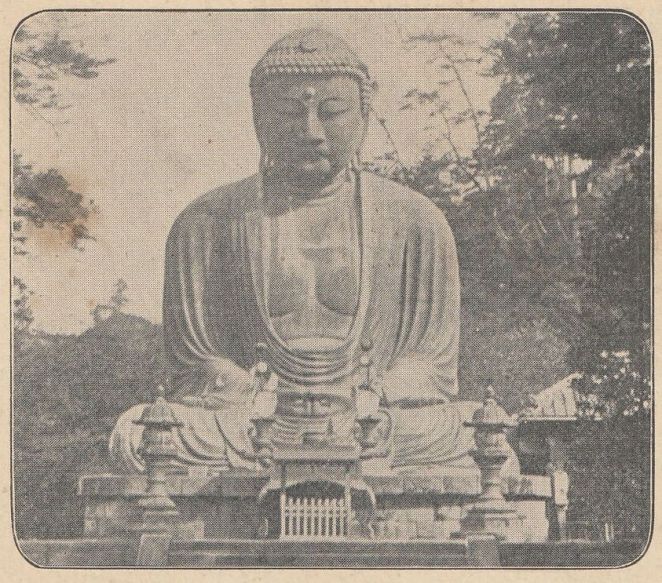
 

Group Activities Workshop
Introduction

Yesterday, I gave a short university-level workshop on organizing in-class group activities. This was partly a personal conversion story. As an undergrad, I absolutely despised group work. Sure, some of my apprehension was due to my angsty teenage disposition, but – as I’ve come to understand – some was also due to poorly executed planning by my old (but dearly valued) instructors.

My views on group work shifted when I was trained to teach freshman composition and rhetoric at UCSB. Peer-collaboration was highlighted as a student skill that needed to be taught, not just casually performed. Consequently, I returned to my old seminar yesterday to offer insights to this year’s new batch of writing instructors.

The Structuring Group Activities section below is the meat and potatoes of group activity.

Setting the Scene

The class was comprised of about twenty graduate students who all had previous teaching experience. To begin, I asked how many already included group work as an integral part of their classroom practices: Less than one-quarter raised their hands.

This was not surprising. I’ve found many other had similar negative experiences of group work as students like myself. I then turned to giving an outline of the potential benefits and drawbacks of group work [Slide 1].

Slide 1

Screen Shot 2018-09-14 at 13.26.26.png

Ultimately, I’ve come to feel that the negatives associated with group work can be significantly mitigated (except for the extra time it takes to do it) and the benefits can be amplified if the group activities are structured well.
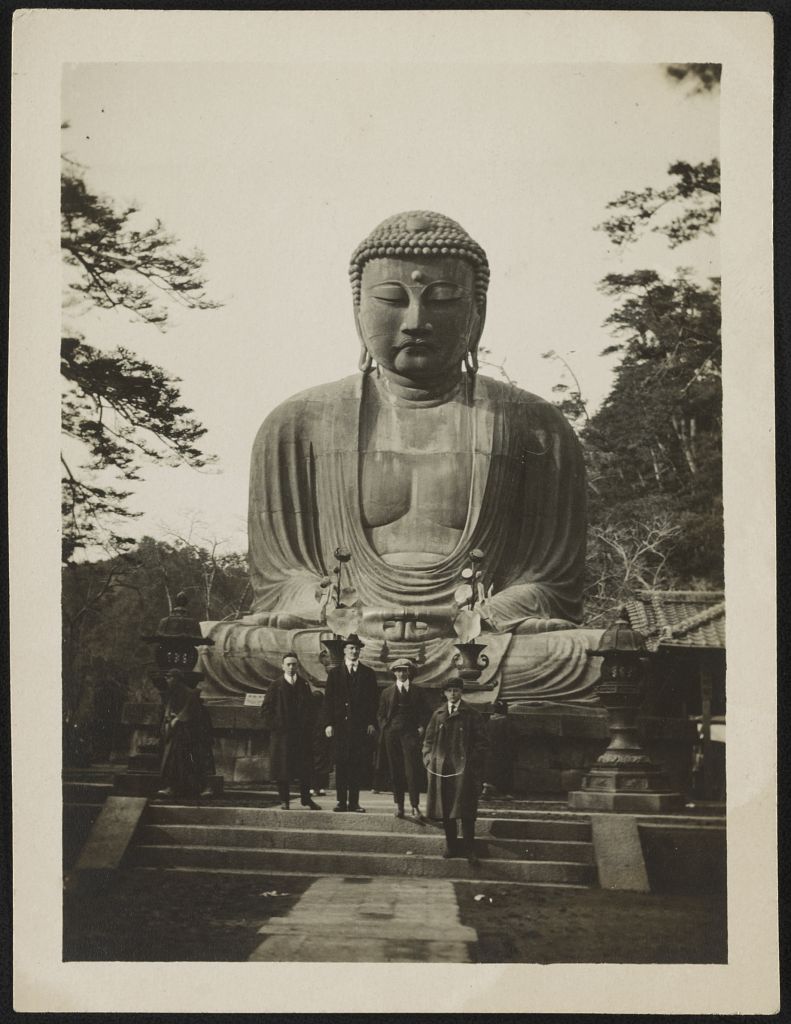

Structuring Group Activities

I spent a significant amount of time discussing the elements of an effective group activity [Slide 2]. Each element is described in further detail below.
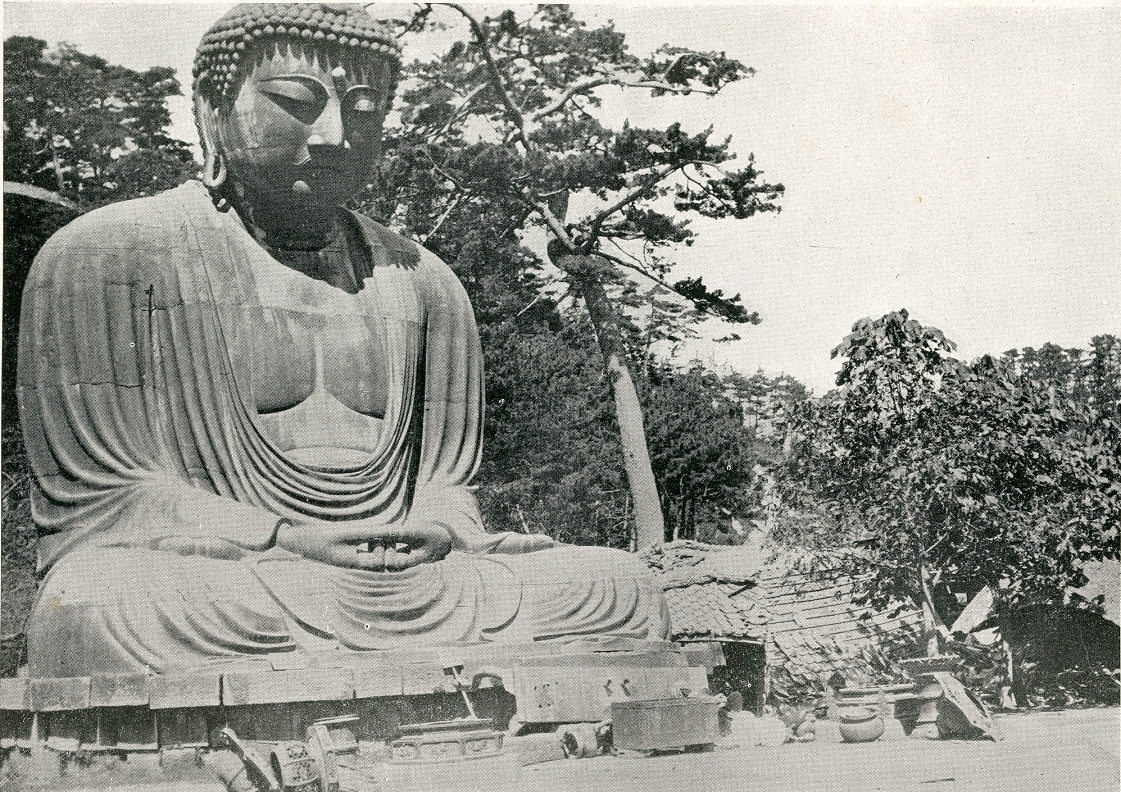
Slide 2

Screen Shot 2018-09-14 at 13.30.30.png

1. Classroom Culture: Group activities need to be started early and often in the term to establish them as a regular part of class meetings. Group activities should not be treated as a special event nor added to a course halfway through the term when a classroom culture has already been established.

For example, the very first thing I do on the first day of class is break students up into small groups so they get to know each other. I take attendance during this time, so its not wasted time for me. When I’m finished, I ask one student about another student in the group (what’s this person’s name, where are they from?). Often this is followed by a bunch of nervous laughter from everyone in the class as they realize they didn’t pay much attention to one another. I, of course, laugh with them and use this time to comment on the collaborative nature of our course and how important it will be to communicate and listen to one another. (To finish, I let the groups talk to one another again to take notes on names and share emails. I still ask students to introduce other group members, but the conversation remains lighthearted.)

2. Group Size: Groups should always be kept relatively small so no one can “hide” or easily shy away from conversation. I’ve found that three or four members per group is optimal (groups with too many people invite the dreaded “social loafing“). Of course this may not be possible in all classroom settings, but I’ve found that groups of more than five simply do not work.

3. Group Membership: Groups should change from class to class and should not only be comprised of friends or people who sit next to them. I typically have students count off to form random groupings. Because students will need to physically move to a new seat, I always try to do group work early in the class, if not for the first activity.

4. Task & Time: Ideally, group activities should be oriented around open-ended questions that require creativity or discussion/argumentation among the members. If you’re looking for a singular “correct” answer, that’s perhaps not best addressed by a group activity (pair-and-share is suitable). The question(s) the students address should be clear (written on a slide or board) and the time limits should be strict. I always prefer to keep the timing tight, giving students only 3-5 minutes to complete most tasks (the tasks are often not very complex). I use the timer on my phone and allow the alarm to ring to signal the time is up.

For example, I’ll write on a slide: “Create a list of 3 variant hook sentences for this introductory paragraph. You have 3 minutes.”
After 3 minutes, I’ll change the slide: “Determine which of your candidate hooks is the best. Have at least two good reasons why it is the best. You have three minutes.”

Overall, having a clear task and tight time creates an energy and motivation to work quickly and effectively.

5. Accountability: Importantly, groups should always need to produce a “deliverable” – either sharing their ideas verbally with the class, handing in an assignment, or posting on our course website.

6. Monitoring: Sometimes I stay at the front of the room watching or getting other materials ready. Other times I will walk around the class and passively observe/listen to discussion. Sometimes, especially if the group is quiet, I will ask them what they are thinking about or which ideas they are weighing.

7. Roles: To facilitate group interaction and the assumption of personal responsibility, I ask different members of the group to take different roles. One person always operates as a scribe to take “official” notes for the group. (This is important if they are asked to hand in something or post online). Equally, I ask another person to be the speaker. I typically take a friendly, yet partly adversarial role when I talk to the speaker of each group during class collaboration. The speaker will be asked to think on their feet as I ask them to clarify or justify their group’s “deliverable,” or to provide further examples and argue for significance. Sometimes, when the activity allows for it, I also assign the role of the “skeptic.” Their duty is to offer disagreements (ideally, counterarguments) whenever possible, to halt any chance of “group think.” At other times, I will assign the role of “source master” to look up primary quotes or pertinent passages to assist the scribe. In the past, partly for fun, I have also assigned the role of supporter. Their role is to be the hype-person for the group, complimenting the ideas of other members.

To be clear, each group member is tasked with working collaboratively to produce a product for class discussion. Except for the unique role of the speaker, everyone should be taking notes, looking up sources, acting as a skeptic and supporter. The use of “roles” is designed to be an analytical approach to effective group work, identifying smaller inter-group tasks that each student should work on and improve. At least, this reflects my analysis of effective group dynamics, others may certainly have a different analysis.

Lastly, I often let students decide which roles to take, but it reasonable to have roles randomly assigned. For me, I tell students to take roles that reasonably challenge them. If a student is often silent, I’ll recommend taking the role of the skeptic or supporter where they are expected to talk, but with minimal stakes. If the student wants more of a challenge, then try being the speaker of the group.

8. Off-Task Time: Finally, I sometime allow a minute or two of off-task time before or after an activity to let the students get to know each other and build classroom camaraderie. Consequently, even when the task is clearly finished by all groups, if everyone is getting along and chatting, I’d prefer to nourish nascent friendships than have dead silence.


Practice

Since this short lecture-workshop was for a class of new writing instructors, I provided them with instructions of how a group activity built for them might look [Slide 3].

Slide 3

Screen Shot 2018-09-14 at 13.44.27.png

Note the question was simple and direct and I provided some examples to stimulate ideas. In addition, there was a clear expectation that the response needed to be written down and there was a clear (short) time limit.

I spent the rest of my class time talking about processes – namely, writing, researching, and reading – which I will return to in a later post.


Workshop Posts

A Primer on Chinese Pagodas: The Vajra Throne Pagoda 金剛寶座塔

By Peter Romaskiewicz

[Click here for the previous post on pagoda history]

Architecturally, East Asian pagodas are far more diverse than one might assume. Because of this diversity, Chinese art historians have developed several typologies to sort the varied pagoda structures. One categorization, based on architectural style, includes the following six types [depicted left to right below]:

  • Overturned Bowl Style Pagoda 覆缽式塔
  • Multistory Pavilion Style Pagoda 樓閣式塔
  • Tiered Eave Style Pagoda 簷式塔
  • Single Story Style Pagoda 單層式塔 [=亭閣式塔?]
  • Tibetan Style Pagoda 藏式塔
  • Vajra Throne Style Pagoda 金剛寶座式塔[1]
p5-04.jpg
Illustrations of the Six-fold typology of Chinese pagodas (from FGS Encyclopedia of Buddhist Arts)

Of these, the first is the classical Indian stūpa, whose round body appears as if a begging bowl has been overturned. The next two have the iconic pagoda profile of a multistory tower accentuated by jutting eaves. The distinction is that the latter is not a true multistory structure because it cannot be ascended via an internal stairway. The fourth type consists of just a single story, while the fifth type is a later evolution of the Indic style, with a elevated and smaller circumference of the dome element. The last type, the Vajra Throne Style Pagoda, is a stylized version of the Mahābodhi Temple constructed on the site of Buddha’s enlightenment (i.e the Vajra seat or throne) in Bodh Gāya, India. This post will focus on this last type of pagoda which is arguably the most distinctive of the six types noted above, being comprised of five spires atop a square foundation.

HDRtist HDR - http://www.ohanaware.com/hdrtist/
Vajra Throne Pagoda 金剛寶座塔 at Zhenjue Temple 真覺寺 in Beijing

The Mahābodhi Temple in India was likely constructed in the late sixth or early seventh century. This dating is suggested based on the reports of two Chinese pilgrims who visited the site. Faxian 法顯 (337-c. 422), who visited Bodh Gāya in the early fifth century, made no mention of the large structure, while Xuanzang 玄奘 (602-664), who travelled in the middle of the seventh century, comments on the precise measurements of the temple he found which coincides with the temple that remains there today.[2] An early Chinese representation of the Mahābodhi Temple is found in the murals of the Buddhist caves of Dunhuang 敦煌 in western China.[3] Eventually, several Mahābodhi Temple-inspired buildings were constructed in China, mostly during the Ming Dynasty (1368-1644).[4] The most important, completed in 1473, was built at Zhenjue Temple 真覺寺 in Beijing.

HDRtist HDR - http://www.ohanaware.com/hdrtist/
Vajra Throne Pagoda 金剛寶座塔 at Zhenjue Temple 真覺寺 in Beijing

This last site is also called the Temple of the Five Pagodas 五塔寺 due to the appearance of the Mahābodhi Temple-inspired building which incorporates five pagodas into its architecture. The Chinese pagoda is named the Vajra Throne Pagoda 金剛寶座塔 after the traditional site where the Buddha was enlightened under the Bodhi Tree in Bodh Gāya, called the vajrāsana (Vajra Throne). Construction of the pagoda at Zhenjue Temple began during the reign of the Ming Emperor Yongle (r.1402-24) when a Buddhist monk named *Paṇḍita [?] 班迪達 from the “Western Regions” donated five Buddhist statues which the emperor instructed were to be housed in a special structure. He ordered that a pagoda be built that matched the architectural plans of the building found at the site of the vajrāsana. A horizontal plaque above the main entrance still reads “Imperially Constructed Vajra Throne Pagoda” 敕建金剛寶座塔. The pagoda was renovated during the Qing Dynasty, but is believed to retain some of the original structural elements. The square base of the Vajra Throne Pagoda is approximately 19 meters by 16 meters, and is about 8 meters high. This functions as a pedestal for five pagoda structures, each for one of the donated statues, of which the tallest central pagoda adds another 10 meters to the total height. These individual pagodas are each of the square, multi-eaved type. In addition a round terrace is placed in the center front, covering the top of a stairway that grants access to the top of the structure.

The sides of the main structure are ornately decorated with Buddhist images and symbols. Most of the space is covered by five horizontal registers which depict various  buddhas.

* This post was written as an addendum to the lecture I gave on Sacred Buddhist Architecture at the 2018 Woodenfish.

Notes

[1] This is based on the Encyclopedia of Buddhist Arts published by Foguang Shan, found here. Other typologies may include the Road Spanning Style Pagoda 過街式塔, Sutra Pillar Style Pagoda 經幢式塔, and Flower Pagoda 華塔, among others. Some consider the Tibetan Style Pagoda a subtype of the Overturned Bowl Style Pagoda. Moreover, it seems the Pavillion Style Pagoda 亭閣式塔 is another name for the Single Story Style Pagoda, though I need to revisit this.

[2] Faxian arrived in Bodh Gāya in 409 and noted that a stūpa was found there, presumably an early structure built on the site. Xuanzang arrived in 637 and his descriptions and measurements match the building that remains today. See the comments in Cunningham 1892: 17-8.

[3] Found on the western wall of Cave 428.

[4] These include the pagodas of Biyun Temple 碧雲寺 in Beijing (completed in 1747), Xihuang Temple 西黃寺 in Beijing, Miaozhan Temple 妙湛寺 in Yunnan (built in 1458), Cideng Temple 慈燈寺 in Inner Mongolia (completed in 1732), and Zhenjue Temple discussed here. To this list can be added the Miaogao Pagoda 妙高塔 on Mt. Yuquan 玉泉山 in Beijing. It is worth noting that the famed Chinese architect Liang Sicheng, considered the Flower Pagoda to be a architectural precusor to the Vajra Throne Pagoda.

References
  • Abe, Stanley K. 2002. Ordinary Images. Chicago and London: University of Chicago Pres. [see esp. pp. 103-06, 123-66]
  • Di Luo. 2017. “A Grain of Sand: Miniatures as Sacred Repositories, Part I: The Longxingsi Sutra Case,” [https://chinesearchitecture.wordpress.com/2017/05/29/a-grain-of-sand-miniatures-as-sacred-repositories-part-i-the-longxingsi-sutra-case/]
  • Di Luo. 2017. “A Grain of Sand: Miniatures as Sacred Repositories, Part II: The Huayansi Sutra Cabinets” [https://chinesearchitecture.wordpress.com/2017/05/30/a-grain-of-sand-miniatures-as-sacred-repositories-part-ii-the-huayansi-sutra-cabinets/]
  • Di Luo. 2017. “A Grain of Sand: Miniatures, Models, Simulacra” [https://chinesearchitecture.wordpress.com/2017/06/04/a-grain-of-sand-miniatures-models-simulacra/]
  • Fu, Xinian; Guo, Daiheng; Liu Xujie; Pan, Guxi; Qiao, Yun, Sun, Dazhang & Steinhardt, Nancy S. 2002. Chinese Architecture. New Haven: Yale University Press.
  • Kim, Youn-mi. 2017. “Virtual Pilgrimage and Virtual Geography: Power of Liao Miniature Pagodas (907–1125),” Religions, Vol. 8., pp. 1-29.
  • Le, Huu Phuoc. 2010. Buddhist Architecture. Lakeville, MN: Grafikol.
  • Ledderose, Lothar. 1980. “Chinese Prototypes of the Pagoda,” in The Stupa, Its Religious, Historical, and Architectural Significance, ed. Anna Libera Dallapiccola and Stephanie Zingel-ave Lallement. Wiesbaden: Franz Steiner Verlag, pp. 238-45
  • Liang Ssu-ch’eng [Sicheng]. 1984. Chinese Architecture: A Pictorial History, ed. Wilma Fairbank. Cambridge: MIT Press. [see esp. p. 124]
  • Lin, Wei-cheng. 2016. “Performing Center in a Vertical Rise: Multilevel Pagodas in China’s Medieval Period,” ARS Orientalis, Vol. 46, pp. 100-34.
  • Neelis, Jason. 2011. Early Buddhist Transmission and Trade Networks: Mobility and Exchange within and beyond the Northwestern Borderlands of South Asia. Leiden: Brill.
  • Seckel, Dietrich. 1980. “Stupa Elements Surviving in Eastern Asian Pagodas,” in The Stupa, Its Religious, Historical, and Architectural Significance, ed. Anna Libera Dallapiccola and Stephanie Zingel-ave Lallement. Wiesbaden: Franz Steiner Verlag.
  • Steinhardt, Nancy Shatzman. 1994. “Liao: An Architectural Tradition in the Making,” Artibus Asiae, Vol. 54, No. 1/2, pp. 5-39.
  • Steinhardt, Nancy S. 1997. Liao Architecture. Honolulu: University of Hawaii Pres.
  • Steinhardt, Nancy S. 2011. “The Sixth Century in East Asian Architecture,” Ars Orientalis, Vol. 41, pp.  27-71.
  • Steinhardt, Nancy S. 2014. Chinese Architecture in an Age of Turmoil, 200-600. Honolulu: University of Hawaii Press.